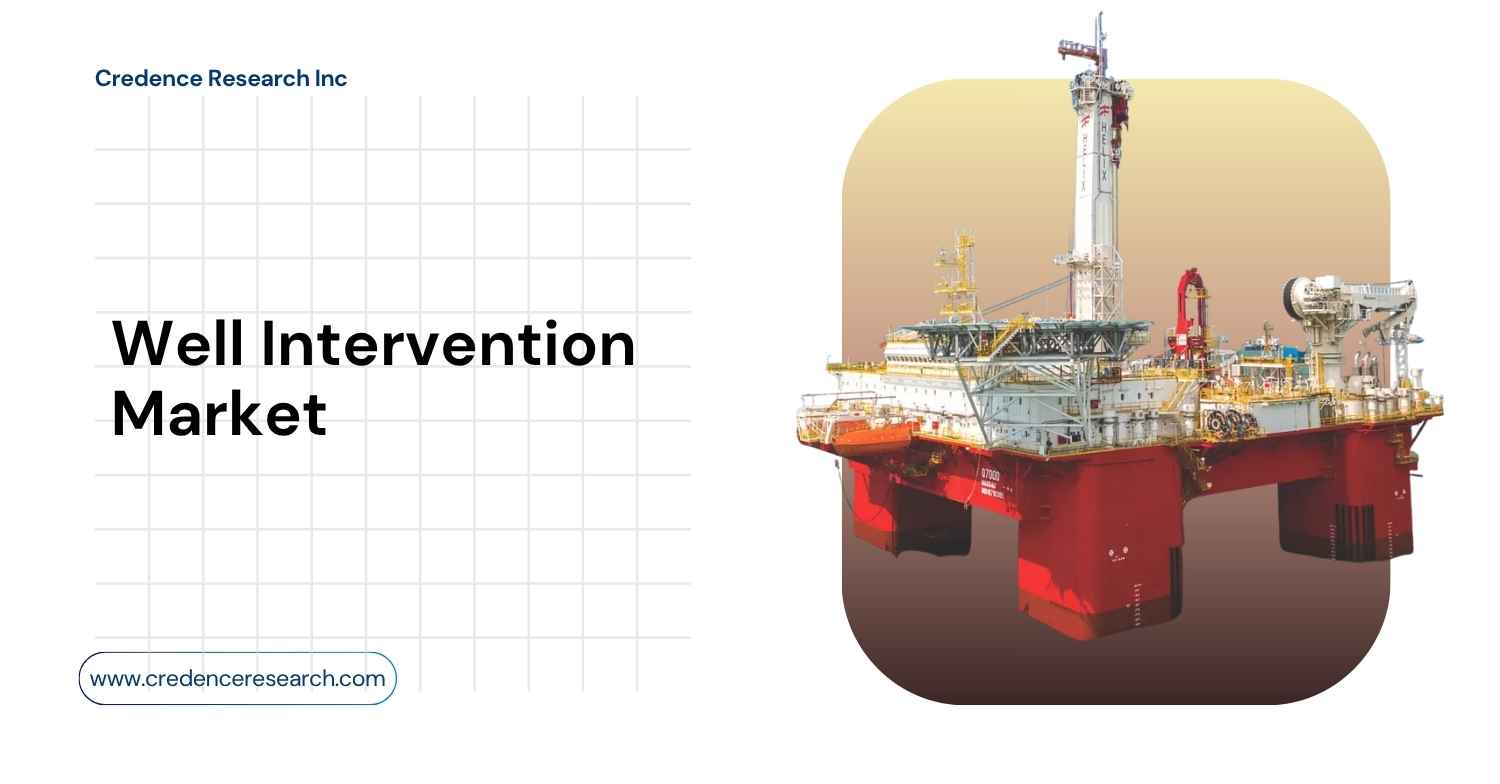
According to Credence Research, the global Well Intervention market was valued at USD 6,538.8 million in 2018. It reached USD 9,110.2 million in 2024 and is projected to grow to USD 12,893.4 million by 2032. This reflects a compound annual growth rate (CAGR) of 4.37% over the forecast period.
Market Overview
Well intervention includes all operations carried out on an oil or gas well to restore or improve production. These services are essential for optimizing well performance throughout the asset life cycle. Market demand is increasing due to maturing fields, higher well complexity, and a rising need for production enhancement.
Operators use intervention methods to maintain flow, extend well life, and reduce production downtime. Both onshore and offshore fields rely on these techniques to manage performance decline, equipment wear, and formation damage. The growing demand for cost-effective extraction methods is reinforcing service uptake across all regions.
Browse market data figures spread through 220+ pages and an in-depth TOC on “Well Intervention Market”
Market Driver:
Mature Oilfield Development Increases Intervention Demand
An expanding share of global oil production now comes from mature reservoirs, and without continued reinvestment global supply would decline by roughly 5.5 million barrels per day each year about the output of multiple major producing countries highlighting the growing dependence on sustaining measures in existing fields.
These fields require consistent servicing to address declining reservoir pressure, sand production, and equipment failure; extensive SPE and journal literature documents that uncontrolled sanding erodes tubing and surface equipment, plugs perforations, and triggers integrity failures that necessitate frequent cleanouts and remedial work.
Well intervention helps maintain economic output without major reinvestment, and large populations of aging wells in North America and Europe reinforce this need: the United States had 918,068 producing oil and gas wells in 2023, UK offshore operators plan to plug and abandon just over 2,000 wells over the next decade, and Norway reported 488 temporarily abandoned or inactive wells in its 2024 survey.
Intervention services such as stimulation, artificial lift, and remedial cementing help offset natural decline and extend well lifespans; artificial lift is broadly deployed to sustain economic flow where reservoir drive is insufficient, and industry references underscore its central role in late‑life production management across onshore and offshore assets. In practice, operators are prioritizing recovery from existing assets rather than new drilling, which increases the use of diagnostics, zonal isolation, and re‑perforation; national programs such as Indonesia’s idle‑well reactivation have returned more than 3,000 wells to operation since 2017 and delivered around 20,000 BOE/d in 2022, while Petrobras has outlined approximately 500 well interventions over the next ten years in Brazil to enhance recovery.
Light and medium interventions are preferred due to lower cost and minimal surface disturbance, with rigless methods offering rapid deployment, reduced logistics, and strong safety control; for example, a rigless ESP replacement in Ecuador was completed in 47 hours versus at least 7 days for a conventional workover, saving about USD 95,000 and reducing crew from around 40 to 12, and an integrated rigless P&A program in Norway executed 177 runs across 16 wells and 1,767,000 feet of coiled‑tubing operations at a fraction of traditional rig‑based costs.
This combination of asset‑sweating strategies and rigless execution has helped expand service uptake in cost‑sensitive regions including Latin America and Southeast Asia, supported by concrete national and operator activity plans such as PETRONAS’s published workover/intervention well counts and Indonesia’s multi‑year reactivation program.
Market Trend:
Offshore Field Expansion Fuels Subsea Well Servicing Growth
Offshore exploration is expanding due to stable oil prices and new license awards. Regions such as the North Sea, Gulf of Mexico, West Africa, and Brazil are seeing strong investment in offshore production. These deepwater and ultra-deepwater projects require high-specification intervention systems.
Technological developments in remotely operated vehicles (ROVs), riserless light well intervention (RLWI), and coiled tubing systems are driving offshore efficiency. These systems enable lower-risk, vessel-based intervention, minimizing the need for traditional rigs.
Advanced telemetry and fiber-optic logging tools are improving offshore data acquisition. Combined with real-time downhole monitoring, these tools allow better diagnostics and faster decision-making. The result is shorter intervention time and lower total well servicing costs.
Helix Energy, Oceaneering, and AKOFS Offshore are expanding their offshore fleets to support rising demand for vessel-based services. These firms invest in robotic technology and digital systems to improve subsea performance and reduce human intervention.
Offshore well servicing is also benefiting from new field developments that include pre-installed subsea access systems. These systems reduce setup time and allow quicker service deployment, especially in remote and high-risk environments.
As offshore infrastructure grows, the demand for specialized subsea well services is expected to rise. Integrated offshore service models, supported by digital workflows and autonomous tools, are positioned to lead this market segment over the forecast period.
Market Challenge:
High Risk and Cost Associated with Complex Interventions
Despite growing demand, the market faces challenges related to cost, technical risk, and regulatory compliance. Well intervention, particularly in offshore and HPHT environments, involves high operational complexity. Equipment failure, formation collapse, and blowouts pose major safety risks.
Costs are driven up by logistics, downtime, and crew mobilization. Offshore services require specialized vessels and control systems, which are capital-intensive and time-consuming to deploy. These constraints limit access for smaller operators or marginal fields.
In regions with weaker oil prices, operators may defer non-critical interventions. This delay increases long-term risk and may lead to higher remediation costs. Balancing service quality, safety, and cost-efficiency remains a key industry concern.
Environmental regulations and emission control mandates also increase operational requirements. Service providers must adhere to strict compliance frameworks, especially in Europe and North America. These requirements add to project cost and complexity, reducing profitability.
Adoption of automation, predictive maintenance, and real-time diagnostics is helping to reduce intervention risk. However, uptake remains uneven across markets. Companies in Asia and Africa continue to rely on manual systems due to lower capital availability and slower digital adoption.
Addressing this challenge requires greater collaboration across service providers, regulators, and operators. Industry training, digital system investment, and strong safety protocols are critical to ensuring reliable, cost-effective interventions.
Market Segmentation
By Services
- Logging and Bottomhole Survey
- Tubing / Packer Failure and Repair
- Stimulation
- Remedial Cementing
- Zonal Isolation
- Sand Control
- Artificial Lift
- Fishing
- Re-Perforation
- Others
Stimulation, artificial lift, and logging are the most in-demand services. Operators rely on these for both performance diagnostics and well productivity enhancement. Fishing and re-perforation are also growing due to aging infrastructure and increasing downhole equipment failures.
By Type
- Light Intervention
- Medium Intervention
- Heavy Intervention
Light intervention dominates in terms of volume due to its low footprint and rapid deployment. Medium intervention is gaining traction in offshore fields where moderate complexity exists. Heavy intervention is used in critical repairs, major cleanouts, and high-pressure environments.
By Application
- Onshore
- Offshore
Onshore continues to lead the market in total service volume. Onshore fields are easier to access, making regular servicing more viable. Offshore, while lower in volume, contributes significantly in terms of revenue due to higher service cost and operational complexity.
By Geography
- North America
- U.S.
- Canada
- Mexico
- Europe
- Germany
- France
- U.K.
- Italy
- Spain
- Rest of Europe
- Asia Pacific
- China
- Japan
- India
- South Korea
- South-east Asia
- Rest of Asia Pacific
- Latin America
- Brazil
- Argentina
- Rest of Latin America
- Middle East & Africa
- GCC Countries
- South Africa
- Rest of the Middle East and Africa
North America holds the largest share due to a high number of aging wells in the U.S. shale regions. Europe follows, driven by offshore servicing in the North Sea. Asia Pacific is expanding rapidly due to increasing investment in India, China, and Southeast Asia.
Middle East and Africa are also seeing rising demand, supported by redevelopment of mature fields and new licensing rounds in GCC countries and West Africa.
Key Player Analysis
The market is competitive, with global and regional players offering a broad range of services. Major companies are focused on expanding offshore capabilities, digitizing operations, and reducing intervention costs.
- Halliburton
- SLB
- Baker Hughes
- Weatherford
- Expro Group
- Key Energy Services
- AKOFS Offshore
- Helix Energy
- Oceaneering International, Inc.
- Hunting PLC
- Deepwell AS
- Other Key Players
These companies continue to invest in intervention tools, real-time monitoring systems, and offshore service vessels. Joint ventures and strategic acquisitions are used to expand geographical reach and technological depth. Players are also forming long-term service agreements with operators to ensure business continuity and cost sharing.
About Us:
Credence Research is a viable intelligence and market research platform that provides quantitative B2B research to more than 2000 clients worldwide and is built on the Give principle. The company is a market research and consulting firm serving governments, non-legislative associations, non-profit organizations, and various organizations worldwide. We help our clients improve their execution in a lasting way and understand their most imperative objectives.
Contact Us
Credence Research Inc.
North America – +1 304 308 1216
Australia – +61 4192 46279
Asia Pacific – +81 5050 50 9250
+64 22 017 0275
India – +91 6232 49 3207