
Adult Spinal Deformity Market Overview:
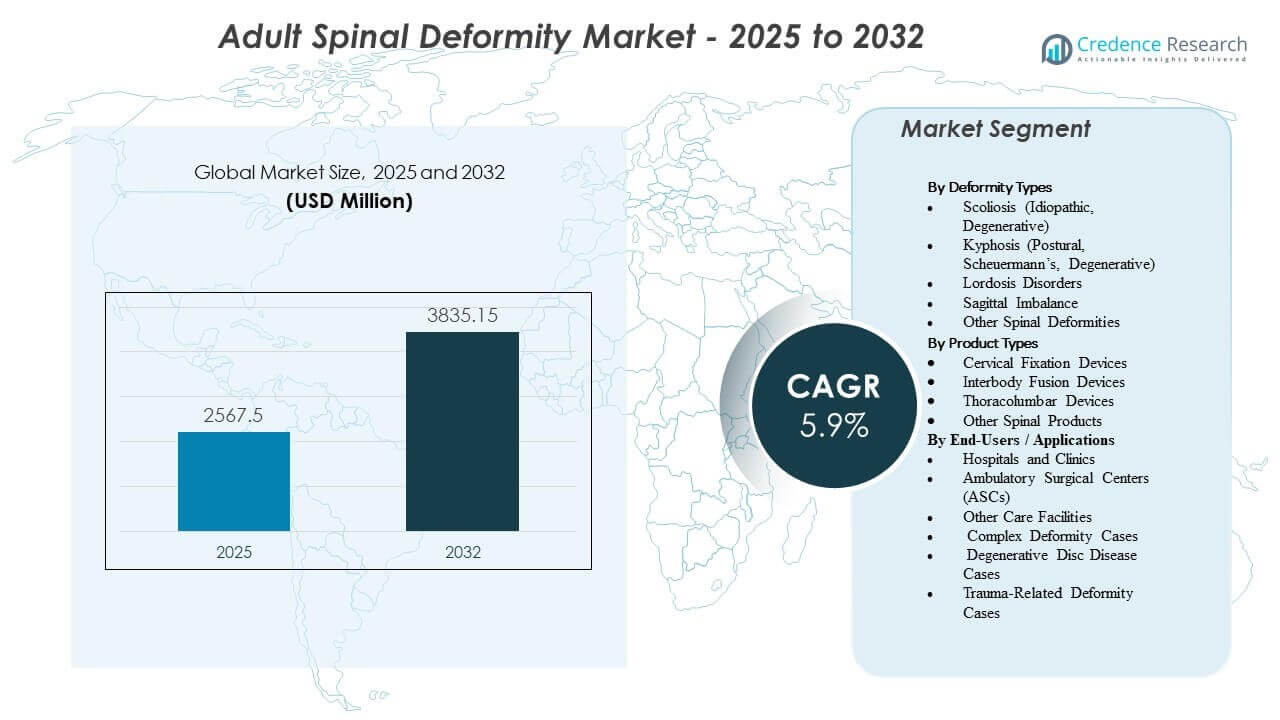
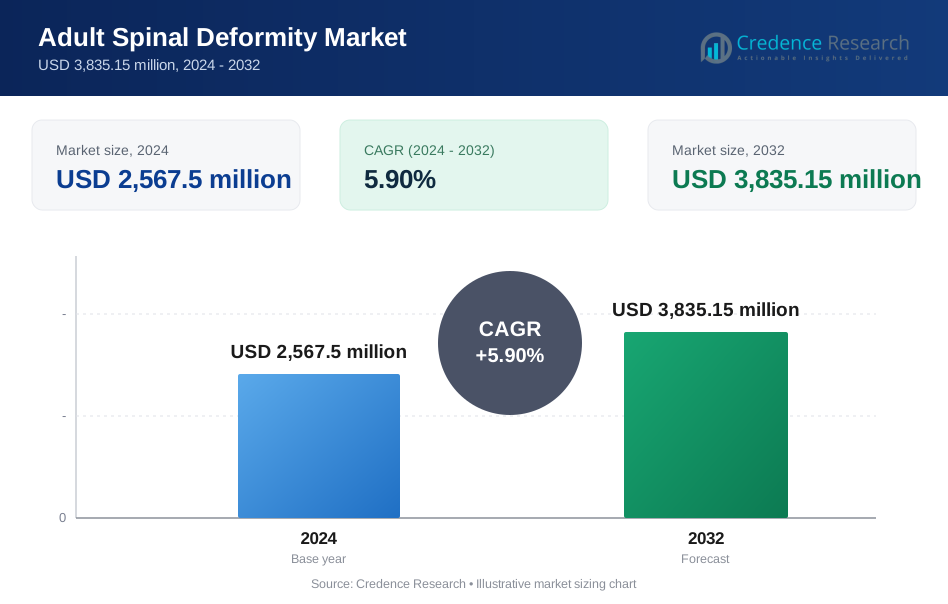
The Adult Spinal Deformity Market is projected to grow from USD 2,567.5 million in 2025 to an estimated USD 3,835.15 million by 2032, with a compound annual growth rate (CAGR) of 5.9% from 2025 to 2032.
| REPORT ATTRIBUTE | DETAILS |
|---|---|
| Historical Period | 2020-2024 |
| Base Year | 2025 |
| Forecast Period | 2026-2032 |
| Adult Spinal Deformity Market Size 2025 | USD 2,567.5 million |
| Adult Spinal Deformity Market, CAGR | 5.9% |
| Adult Spinal Deformity Market Size 2032 | USD 3,835.15 million |
Adult Spinal Deformity Market Insights:
- Market drivers include rising degenerative deformities, higher adoption of minimally invasive procedures, and stronger integration of robotics and navigation in surgical planning.
- Restraints emerge from high surgical costs, limited access to advanced correction systems in developing regions, and the complexity of multi-level deformity procedures.
- North America leads the market due to advanced clinical capabilities and strong adoption of precision-based correction technologies across major hospitals.
- Asia-Pacific shows the fastest growth driven by expanding diagnostic access, increased investment in spine centers, and rising awareness of posture-related deformities.
Adult Spinal Deformity Market Drivers
Growing Prevalence of Age-Related Spinal Disorders
Rising cases of degenerative spine conditions support steady growth across the Adult Spinal Deformity Market. Longer life expectancy exposes adults to progressive curvature disorders that demand structured treatment. Many patients present with chronic pain that pushes demand for early medical intervention. It drives wider screening programs in hospitals and spine centers. Strong awareness campaigns help adults understand deformity progression with greater clarity. Many programs promote early diagnosis to reduce severe complications. It strengthens the demand for structured treatment plans. It supports the need for advanced surgical and non-surgical therapies for complex deformity cases.
- For instance, Medtronicutilized its UNiD Adaptive Spine Intelligence (ASI) platform to analyze data from over 10,000 cases, enabling clinicians to predict compensatory mechanisms in aging patients and improve the accuracy of surgical planning for sagittal balance.
Advancements in Complex Spinal Surgical Techniques
Rapid improvement in surgical tools encourages faster adoption of advanced deformity correction methods. Surgeons use high-precision rods, screws, and cages to improve alignment stability. It improves clinical outcomes across adult patients with long-standing curvature disorders. Better surgical frameworks help reduce recovery timelines in high-risk age groups. Growing demand for minimally invasive techniques supports lower trauma during corrective procedures. Many hospitals invest in modern operating systems to align with quality care needs. These upgrades expand treatment reach across complex deformity categories. It strengthens patient confidence in surgical solutions for complex deformity patterns.
Increasing Adoption of Navigation and Robotic Systems
Navigation platforms help surgeons execute precision-based deformity correction with improved accuracy. Robotics supports controlled screw placement and reduces alignment errors in complex cases. It boosts clinical outcomes in adults with multi-level deformities. Rising investments from major hospitals help expand the availability of guided systems. These platforms reduce operating risks and improve confidence among surgeons. Many spine centers adopt digital planning tools to streamline workflow. Image-guided systems reduce intraoperative complications and support safer procedures. It improves access to advanced technologies within healthcare systems.
- For instance, Globus Medicaldemonstrated through its ExcelsiusGPS platform that robotic-assisted navigation achieved a 99% accuracy rate in pedicle screw placement across 1,200 procedures, significantly reducing the 10% to 12% malposition rate often associated with manual freehand techniques.
Rising Awareness and Early Diagnosis of Progressive Deformities
Awareness programs help adults understand the long-term effects of untreated deformities. Many patients now seek timely evaluation for posture changes and back discomfort. It promotes stronger engagement between patients and spine specialists. Advancing diagnostic tools help detect alignment deviations earlier. Hospitals use structured assessment models to classify deformity severity with greater accuracy. Digital imaging platforms support quick detection of sagittal imbalance. Early diagnosis reduces the need for complex reconstructive surgery. It reinforces structured intervention in adult spinal correction.
Adult Spinal Deformity Market Trends
Shift Toward Minimally Invasive Deformity Correction
Healthcare systems report rising demand for less invasive procedures that reduce surgical trauma. Many adults prefer approaches that lower blood loss and shorten hospital stay. It promotes stronger adoption of tubular retractors and percutaneous fixation tools. MISS techniques support faster recovery in aging patient groups. Improved cosmetic outcomes encourage wider patient acceptance. Hospitals expand MISS capabilities to enhance service portfolios. Many surgeons undergo training programs to improve MISS skills. The Adult Spinal Deformity Market gains steady momentum through these surgical improvements.
- For instance, Stryker’s Serrato pedicle screws are designed with a dual-thread pattern that increases pull-out strength by 33%, allowing for smaller incisions and more secure percutaneous fixation in osteoporotic bone typically found in older deformity patients.
Integration of Digital Planning and Predictive Analytics in Surgery
Preoperative planning software helps surgeons simulate correction outcomes with greater accuracy. Digital tools support real-time visualization of spinal curvature. It improves alignment prediction and reduces postoperative variability. Predictive analytics guide surgeons in selecting optimal treatment pathways. Many hospitals integrate AI-driven planning tools to enhance quality standards. These platforms reduce planning errors and support complex decision-making. Digital models improve safety in multi-level deformity cases. It strengthens the shift toward precision-driven deformity management.
Growing Use of Biologics for Fusion and Healing Support
Biologics play a growing role in complex deformity fusion procedures. Many surgeons prefer bone graft substitutes that support faster healing. It reduces donor-site complications linked with autografts. Synthetic materials improve structural support in long-segment fusions. BMPs gain wider use for consistent growth outcomes. Hospitals invest in biologics to expand their treatment capabilities. Patients seek biologic-supported corrections for quicker mobility restoration. It encourages greater adoption of regenerative treatment solutions.
- For instance, Orthofix’s Trinity ELITE allograft provides a viable cellular bone matrix that contains an average of 750,000 viable cells per cubic centimeter, providing the three essential elements for bone formation osteoconduction, osteoinduction, and osteogenesis to ensure successful fusion in complex multi-level reconstructions.
Expansion of Specialized Spine Centers Across Global Markets
Specialty centers help improve care delivery for complex deformities. These facilities offer advanced diagnostic and surgical tools under one framework. It promotes structured treatment pathways for multi-level deformities. Many regions experience rising investment in integrated spine centers. Hospitals collaborate with technology firms to equip centers with advanced robotics. Spine specialists gain access to dedicated training setups within these units. Patients prefer centers with consolidated expertise and advanced equipment. It supports global expansion of structured deformity care networks.
Market Challenges Analysis
High Surgical Costs and Limited Access to Advanced Technologies
Complex deformity procedures require expensive implants, navigation tools, and surgical equipment. Many patients struggle to access treatment due to financial constraints. It reduces adoption rates in developing healthcare systems. Hospitals face difficulty in investing in robotic and navigation platforms. Limited reimbursement coverage restricts treatment uptake among older adults. Training needs slow down the adoption of advanced systems. Regional infrastructure gaps limit the availability of specialized spine centers. It creates uneven access to high-quality deformity correction.
Postoperative Risks and Variability in Clinical Outcomes
Adult deformity surgery presents higher complication risks due to age-related comorbidities. Many cases require long-segment fusion, which increases recovery complexity. It creates challenges for both surgeons and healthcare providers. Complication management increases treatment cost and recovery burden. Variability in bone quality affects fixation stability and healing timelines. Hospitals must allocate more resources to postoperative care. Surgeons face difficulty in treating severe curves in high-risk groups. It drives the need for safer corrective solutions with predictable outcomes.
Adult Spinal Deformity Market Opportunities
Rising Demand for Next-Generation Robotics and Navigation Solutions
Growing investment in precision-based systems creates strong growth potential across the Adult Spinal Deformity Market. Many hospitals look to upgrade surgical capability with robotics and 3D navigation. It promotes safer corrections across challenging deformity categories. Image-guided systems help surgeons achieve higher alignment accuracy. These tools reduce intraoperative risk and support efficient workflow. Training programs expand surgeon expertise in advanced systems. Healthcare providers improve their service quality through these upgrades. It strengthens the adoption of premium technologies in spine surgery.
Expansion of Non-Surgical and Regenerative Treatment Approaches
Non-surgical therapies gain traction among adults seeking conservative care. Physical therapy, bracing, and biologic injectables support early-stage deformity management. It helps delay surgical intervention in moderate cases. Regenerative materials help improve bone healing in targeted deformity zones. Many providers explore hybrid care pathways that merge non-surgical and surgical strategies. Rising awareness supports adoption of low-risk treatment options. Healthcare systems promote preventive care programs for posture and spine health. It opens new avenues for diversified deformity management.
Adult Spinal Deformity Market Segmentation Analysis:
By Deformity Types
Scoliosis, including idiopathic and degenerative forms, represents a major share of the Adult Spinal Deformity Market due to its high prevalence among aging adults. Kyphosis cases grow steadily as postural decline and vertebral degeneration increase across older populations. Lordosis disorders gain medical attention because alignment deviation affects mobility and pain levels. Sagittal imbalance drives strong clinical demand for advanced corrective procedures. Other spinal deformities contribute steady volume from mixed etiologies that require structured evaluation. Hospitals focus on early diagnosis to classify deformity severity with improved accuracy. It strengthens the adoption of treatment pathways tailored to each deformity type.
- For instance, Alphatec Spine (ATEC)has optimized its EOS imaging technology to provide full-body, weight-bearing 3D reconstructions, which have been shown in clinical studies to detect sagittal vertical axis (SVA) deviations with a precision of within 1 millimeter, a critical metric for preventing proximal junctional kyphosis (PJK).
By Product Types
Cervical fixation devices generate strong demand due to rising correction needs in upper spine deformities. Interbody fusion devices maintain a central role, guided by wider adoption of cages and biologics to support stable fusion outcomes. Thoracolumbar devices dominate many surgical workflows because multi-level deformity correction requires durable hardware. Other spinal products, including orthobiologics and navigation tools, gain traction as hospitals upgrade procedural capabilities. Device manufacturers introduce advanced implants that support precise alignment control across complex curves. It reinforces product diversification within the Adult Spinal Deformity Market and supports better postoperative outcomes.
By End-Users / Applications
Hospitals and clinics lead adoption due to their access to advanced surgical systems and trained spine specialists. Ambulatory surgical centers expand their role as minimally invasive procedures become more common. Other care facilities support rehabilitation and conservative management for early-stage cases. Complex deformity cases drive demand for high-precision correction supported by robotics and navigation. Degenerative disc disease cases contribute steady patient volume due to rising age-related degeneration. Trauma-related deformity cases require rapid intervention, often involving fusion and fixation implants. It strengthens multi-setting demand across the Adult Spinal Deformity Market and enhances long-term care pathways.
- For instance, NuVasive(now part of Globus Medical) expanded its X360 system into the ASC setting, demonstrating that its lateral integrated approach reduces the average hospital length of stay from 4.1 days to 1.2 days, making complex deformity correction feasible in outpatient surgical environments.
Segmentation:
By Deformity Types- Scoliosis (Idiopathic, Degenerative)
- Kyphosis (Postural, Scheuermann’s, Degenerative)
- Lordosis Disorders
- Sagittal Imbalance
- Other Spinal Deformities
By Product Types
- Cervical Fixation Devices
- Interbody Fusion Devices
- Thoracolumbar Devices
- Other Spinal Products
By End-Users / Applications
- Hospitals and Clinics
- Ambulatory Surgical Centers (ASCs)
- Other Care Facilities
- Complex Deformity Cases
- Degenerative Disc Disease Cases
- Trauma-Related Deformity Cases
By Region
- North America
- U.S.
- Canada
- Mexico
- Europe
- Germany
- France
- U.K.
- Italy
- Spain
- Rest of Europe
- Asia Pacific
- China
- Japan
- India
- South Korea
- South-east Asia
- Rest of Asia Pacific
- Latin America
- Brazil
- Argentina
- Rest of Latin America
- Middle East & Africa
- GCC Countries
- South Africa
- Rest of the Middle East and Africa
Regional Analysis:
North America holds the largest share of the Adult Spinal Deformity Market, accounting for nearly 38% of global revenue. Strong clinical infrastructure supports high adoption of advanced spinal correction techniques. Hospitals in the region invest heavily in robotics and navigation systems to improve surgical precision. The market benefits from early diagnosis programs that guide patients toward structured care pathways. Insurance coverage for major deformity procedures improves treatment uptake across age groups. It strengthens the region’s leadership through consistent technology deployment and specialist availability.
Europe captures roughly 27% of the global market share driven by strong clinical adoption across major economies. Many countries maintain spine care programs that promote long-term management of age-related deformities. Hospitals use advanced imaging tools to improve planning accuracy for complex procedures. Regulatory frameworks support safe introduction of new implants and biologics into clinical practice. The region benefits from rising demand for minimally invasive procedures in aging populations. It maintains steady growth through organized healthcare systems and trained spine surgeons.
Asia-Pacific accounts for nearly 22% of the total share and emerges as the fastest-growing region. Expanding hospital capacity supports rising procedure volumes across developing economies. Patient awareness improves as diagnostic access becomes more affordable. Countries invest in advanced spine centers to manage growing rates of degenerative deformity. Market growth accelerates due to the higher prevalence of age-related spinal disorders. It shows strong potential as healthcare systems adopt surgical technologies from global manufacturers.
Key Player Analysis:
- Stryker
- Medtronic
- Zimmer Biomet
- Globus Medical
- Johnson & Johnson Services, Inc. (DePuy Synthes)
- B. Braun SE
- NuVasive
- Orthofix Medical
- RTI Surgical
- SeaSpine
- Abbott Laboratories
- Boston Scientific
Competitive Analysis:
Leading players shape the Adult Spinal Deformity Market through strong portfolios of implants, biologics, robotics, and navigation systems. Medtronic, Zimmer Biomet, Stryker, NuVasive, and Globus Medical dominate due to broad distribution networks and extensive R&D programs. Their systems support complex alignment correction with improved precision and reduced operating risks. Companies expand their product lines to include 3D navigation, expandable cages, and minimally invasive platforms. Smaller innovators enter the market with niche deformity correction tools that support surgeon-specific workflows. Hospitals evaluate vendors based on technology integration, implant durability, and postoperative outcomes. Competition intensifies as firms invest in robotics and predictive planning systems. It drives continuous upgrades that strengthen clinical outcomes and surgeon confidence across global markets.
Recent Developments:
- In December 2025, Companion Spine announced that the U.S. Food and Drug Administration (FDA) granted Premarket Approval (PMA) to its DIAM™ Spinal Stabilization System for the treatment of moderate to severe primary low back pain caused by degenerative disc disease, relevant to adult spinal deformity applications.
- In November 2025, Fortis Healthcare launched a dedicated Spine Deformity Center in Bangalore, featuring advanced thoracolumbar and cervical fixation systems, navigation-assisted surgery, and multidisciplinary teams for complex adult spinal deformity care.
- In July 2025, Spinal Resources Inc. announced the publication of pivotal findings on a novel patient-specific Bezier parametric curve rod platform designed for thoracolumbar fusion in adult spinal deformity cases.
Report Coverage:
The research report offers an in-depth analysis based on Deformity Types, Product Types, and End-Users / Applications. It details leading market players, providing an overview of their business, product offerings, investments, revenue streams, and key applications. Additionally, the report includes insights into the competitive environment, SWOT analysis, current market trends, as well as the primary drivers and constraints. Furthermore, it discusses various factors that have driven market expansion in recent years. The report also explores market dynamics, regulatory scenarios, and technological advancements that are shaping the industry. It assesses the impact of external factors and global economic changes on market growth. Lastly, it provides strategic recommendations for new entrants and established companies to navigate the complexities of the market.
Future Outlook:
- The Adult Spinal Deformity Market is set to expand as hospitals invest in advanced robotics and navigation platforms.
- Demand grows for minimally invasive correction methods that support faster recovery in older patients.
- Rising diagnoses of degenerative deformities strengthen the need for structured treatment pathways across large healthcare networks.
- Manufacturers accelerate innovation in fixation systems and biologics to support better fusion outcomes.
- Training programs improve surgeon adoption of precision systems that guide complex multi-level corrections.
- Specialty spine centers grow in number, enhancing access to advanced evaluation and treatment services.
- Digital planning tools gain wider use, supporting predictive alignment modeling for complex deformity cases.
- Non-surgical management options expand as early-stage deformity awareness increases among aging populations.
- Emerging regions strengthen their presence through improved hospital capacity and growing technology adoption.
- Strategic partnerships between device makers and hospitals support integrated care delivery and broaden therapy choices.
Request a Free Sample
Fill in your details and we'll send you a free sample report.
- Sample data tables & charts
- Research methodology
Need a Custom Version of This Report?
Tailor the scope, geography, or segments to your exact requirements.
- Custom geography or segment scope
- Direct access to our analyst team
Frequently Asked Questions
What is the current market size for the Adult Spinal Deformity Market, and what is its projected size in 2032?
At what Compound Annual Growth Rate is the Adult Spinal Deformity Market projected to grow between 2025 and 2032?
Which Adult Spinal Deformity Market segment held the largest share in 2025?
What are the primary factors fueling the growth of the Adult Spinal Deformity Market?
Who are the leading companies in the Adult Spinal Deformity Market?
Which region commanded the largest share of the Adult Spinal Deformity Market in 2025?
Table of Content
Chapter 1. Report Introduction
- 1.1 Report Description & Purpose
- 1.1.1 Report Title & Market Definition
- 1.1.2 Unique Selling Propositions (USP) & Key Differentiators
- 1.1.3 Value Proposition for Stakeholders
- 1.2 Research Objectives
- 1.2.1 Market Sizing Objectives (Volume & Revenue)
- 1.2.2 Segmentation Objectives
- 1.2.3 Competitive Intelligence Objectives
- 1.2.4 Forecast & Scenario Objectives
- 1.3 Report Scope
- 1.3.1 Adult Spinal Deformity Scope – Types & Subtypes Covered
- 1.3.2 Geographic Scope – Regions & Countries Covered
- 1.3.3 Historical Period, Base Year & Forecast Period (2024; forecast to 2032)
- 1.3.4 Inclusions & Exclusions
- 1.4 HS Code & Classification Framework
- 1.5 Currency, Units & Pricing Basis
- 1.6 Target Stakeholders
- 1.7 Limitations & Assumptions
Chapter 2. Executive Summary
- 2.1 Global Adult Spinal Deformity Market Snapshot
- 2.1.1 Market Size – Historical (2024) & Forecast (2024-2032) (2024: USD 2,567.5 million → 2032: USD 3,835.15 million)
- 2.1.2 Volume & Revenue – Global Totals
- 2.1.3 Key Market Highlights – Top Five Facts
- 2.2 Adult Spinal Deformity Market Segmentation Snapshot
- 2.2.1 Market Split by Region – 2024 vs. 2032
- 2.3 Competitive Snapshot
- 2.3.1 Top 10 Players by Revenue Share – 2024
- 2.3.2 Top 10 Players by Volume Share – 2024
- 2.3.3 Recent Strategic Developments (18-Month Summary)
- 2.4 Key Investment Highlights & Strategic Conclusions
Chapter 3. Adult Spinal Deformity Market Dynamics & Industry Analysis
- 3.1 Market Overview & Context
- 3.1.1 Adult Spinal Deformity Market Position in the Broader Automotive Value Chain
- 3.1.2 OEM vs. Replacement Market Dynamics
- 3.1.3 Market Maturity & Development Stage by Region
- 3.2 Adult Spinal Deformity Market Drivers
- 3.3 Adult Spinal Deformity Market Restraints & Challenges
- 3.4 Adult Spinal Deformity Market Opportunities
- 3.5 Porter's Five Forces Analysis
- 3.5.1 Threat of New Entrants
- 3.5.2 Bargaining Power of Suppliers
- 3.5.3 Bargaining Power of Buyers
- 3.5.4 Threat of Substitutes
- 3.5.5 Competitive Rivalry – Intensity Assessment
- 3.6 Adult Spinal Deformity Value Chain Analysis
- 3.6.1 Upstream – Raw Material/Input Suppliers
- 3.6.1.1 Raw Material/Input 1
- 3.6.1.2 Raw Material/Input 2
- 3.6.1.3 Raw Material/Input 3
- 3.6.2 Midstream – Production/Manufacturing/Service Delivery
- 3.6.2.1 Production/Process Overview
- 3.6.2.2 Key Facility Locations & Capacity by Manufacturer
- 3.6.3 Downstream – Distribution & End Consumer
- 3.6.3.1 Primary Channel – B2B/OEM
- 3.6.3.2 Secondary Channels – Dealer, Retail, Online, Direct
- 3.6.4 Value Chain Profitability Analysis
- 3.6.1 Upstream – Raw Material/Input Suppliers
- 3.7 PESTEL Analysis
- 3.7.1 Political Factors
- 3.7.2 Economic Factors
- 3.7.3 Social Factors
- 3.7.4 Technological Factors
- 3.7.5 Environmental Factors
- 3.7.6 Legal Factors
- 3.8 Adult Spinal Deformity Supply Chain Analysis
- 3.8.1 Raw Material/Input Supply Risk Assessment
- 3.8.2 Manufacturing Concentration Risk (Geographic Exposure)
- 3.8.3 Trade Disruption Impact Analysis
- 3.9 Regulatory & Policy Landscape
Note: The regulatory and policy landscape section covers regulations based on their applicability to the market, Adult Spinal Deformity category, geography, and scope of the study. Only regulatory frameworks with a material impact on operations, compliance, trade, sustainability, or market access are analyzed in detail.
Chapter 4. Key Investment Pockets & Opportunity Analysis
- 4.1 Adult Spinal Deformity Market Attractiveness Analysis
- 4.1.1 By Region – Investment Attractiveness Matrix (Volume × CAGR)
- 4.2 Absolute Revenue Growth Opportunity
- 4.2.1 By Region – Absolute USD Growth Through 2032
- 4.3 Incremental Volume Opportunity
- 4.3.1 By Region – Incremental Volume Through 2032
- 4.3.2 Segment – Incremental Volume
- 4.4 Emerging Submarket Opportunity Deep Dive (Subject to Applicability)
- 4.5 Emerging Market Opportunity Scorecards
- 4.5.1 United States
- 4.5.2 Europe
- 4.5.3 Asia
- 4.5.4 Middle East & Africa
Note: Emerging Market Opportunity Scorecards will be included based on relevance and strategic importance. Regions listed are indicative and may vary depending on data availability and market dynamics.
Chapter 5. Adult Spinal Deformity Import-Export Analysis & Trade Flows
- 5.1 Global Trade Overview
- 5.1.1 Global Export Value by Country (2024)
- 5.1.2 Global Export Volume by Country (2024)
- 5.1.3 Global Import Value by Country (2024)
- 5.1.4 Global Import Volume by Country (2024)
- 5.1.5 Net Trade Balance by Country (2024)
- 5.2 Export Analysis – Segment
- 5.2.1 Type 1 (HS Code)
- 5.2.2 Type 2 (HS Code)
- 5.2.3 Type 3 (HS Code)
- 5.2.4 Type 4 (HS Code)
- 5.2.5 Type 5 (HS Code)
- 5.3 Import Analysis – Segment
- 5.3.1 Type 1 (HS Code)
- 5.3.2 Type 2 (HS Code)
- 5.3.3 Type 3 (HS Code)
- 5.3.4 Type 4 (HS Code)
- 5.3.5 Type 5 (HS Code)
- 5.4 Average Unit Trade Prices
- 5.4.1 Average Export Price – Segment & Country
- 5.4.2 Average Import Price – Segment & Source Country
- 5.4.3 Price Trends (2024)
- 5.5 Key Trade Route Analysis
- 5.5.1 Trade Route 1
- 5.5.2 Trade Route 2
- 5.5.3 Trade Route 3
- 5.5.4 Trade Route 4
- 5.5.5 Trade Route 5
- 5.6 Trade Policy Impact Assessment
- 5.6.1 US Anti-Dumping & Section 301 Tariffs
- 5.6.2 EU Customs Union Impact
- 5.6.3 Major Free Trade Agreements
- 5.6.4 USMCA Rules of Origin
Note: Trade policy analysis will be included only where relevant to the Adult Spinal Deformity market.
Chapter 6. Competitive Landscape & Company Benchmarking
- 6.1 Adult Spinal Deformity Market Concentration & Structure
- 6.1.1 Herfindahl-Hirschman Index (HHI) – vs. 2024
- 6.1.2 Tier 1, Tier 2 & Tier 3 Market Structure
- 6.1.3 Global, Regional & Local Player Dynamics
- 6.2 Adult Spinal Deformity Market Share Analysis – 2024
- 6.2.1 Global Revenue Share by Company
- 6.2.2 Global Volume Share by Company
- 6.2.3 Regional Revenue Share
- 6.2.4 Market Share Evolution ( vs. 2024)
- 6.2.5 OEM Segment Share by Company
- 6.2.6 Replacement Segment Share by Company
- 6.3 Production/Delivery Capacity & Facility Analysis
- 6.3.1 Global Installed Capacity
- 6.3.2 Capacity Utilization Rates
- 6.3.3 Production/Output Volume
- 6.3.4 Facility Locations & Capacity Map
- 6.3.5 Planned Capacity Additions
- 6.4 Adult Spinal Deformity Competitive Benchmarking Matrix
- 6.4.1 Revenue, Volume, CAGR & Profitability Comparison
- 6.4.2 Channel Revenue Mix
- 6.4.3 Geographic Revenue Exposure
- 6.4.4 R&D Intensity
- 6.4.5 Sustainability Maturity
- 6.5 Strategic Developments in Adult Spinal Deformity (Last 24 Months)
- 6.5.1 Mergers, Acquisitions & Divestments
- 6.5.2 New Adult Spinal Deformity Launches
- 6.5.3 Facility Expansions
- 6.5.4 Strategic Alliances, Joint Ventures & Partnerships
- 6.5.5 Distribution Expansion & Market Entry
- 6.5.6 Sustainability & ESG Initiatives
- 6.6 Competitive Strategy Mapping
- 6.6.1 Leader, Challenger, Follower & Niche Classification
- 6.6.2 Pricing Strategy Comparison
- 6.6.3 Channel Strategy Matrix
Note: Strategic developments are included based on their materiality and the availability of reliable information.
Chapter 7. Global Adult Spinal Deformity Market – By Distribution Channel
- 7.1 Segment Overview
- 7.1.1 Volume & Revenue Split by Channel (2024 & 2032)
- 7.1.2 Channel Mix Evolution (2024-2032)
Chapter 8. Regional Market Analysis – Global Overview
- 8.1 Global Regional Overview
- 8.1.1 Regional Volume Share
- 8.1.2 Regional Revenue Share
- 8.1.3 Regional Volume by Region
- 8.1.4 Regional Revenue by Region
- 8.1.5 Regional Forecast Through 2032
- 8.2 Cross-Regional Segment Analysis
- 8.2.1 By Distribution Channel
- 8.2.2 By Brand/Price Tier
Chapter 9. North America Adult Spinal Deformity Market
- 9.1 United States
- 9.2 Canada
- 9.3 Mexico
Chapter 10. Europe Adult Spinal Deformity Market
- 10.1 Germany
- 10.2 France
- 10.3 Italy
- 10.4 United Kingdom
- 10.5 Spain
- 10.6 Poland
- 10.7 Russia
- 10.8 Netherlands
- 10.9 Belgium
- 10.10 Sweden
- 10.11 Denmark
- 10.12 Norway
- 10.13 Rest of Europe
Chapter 11. Asia Pacific Adult Spinal Deformity Market
- 11.1 China
- 11.2 India
- 11.3 Japan
- 11.4 South Korea
- 11.5 Thailand
- 11.6 Indonesia
- 11.7 Vietnam
- 11.8 Malaysia
- 11.9 Australia
- 11.10 Rest of Asia Pacific
Chapter 12. Latin America Adult Spinal Deformity Market
- 12.1 Brazil
- 12.2 Argentina
- 12.3 Colombia
- 12.4 Chile
- 12.5 Rest of Latin America
Chapter 13. Middle East Adult Spinal Deformity Market
- 13.1 Saudi Arabia
- 13.2 United Arab Emirates
- 13.3 Turkey
- 13.4 Israel
- 13.5 Iran
- 13.6 Rest of the Middle East
Chapter 14. Africa Adult Spinal Deformity Market
- 14.1 South Africa
- 14.2 Egypt
- 14.3 Nigeria
- 14.4 Morocco
- 14.5 Rest of Africa
Chapter 15. Adult Spinal Deformity Company Profiles
- 15.1 [Company 01]
- 15.1.1 Company Overview
- 15.1.2 Key Management Personnel
- 15.1.3 Products & Services Portfolio
- 15.1.4 Financial Performance
- 15.1.5 Key Market Focus & Geographic Presence
- 15.1.6 Recent Developments & Strategic Initiatives
Note: The company profile list is preliminary and may change based on research findings, market developments, data availability, and client requirements.
Chapter 16. Appendices
- Appendix A – List of Abbreviations & Acronyms
- Appendix B – Industry Classification Code Reference – Full Series
- Appendix C – Production & Capacity Data Tables
- Appendix D – End-Use & Demand Base Tables
- Appendix E – Consumption & Replacement Rate Assumptions
- Appendix F – ASP Reference Tables
- Appendix G – Manufacturing & Facility Database
- Appendix H – Import-Export Data Tables
- Appendix I – Regulatory Summary Tables
- Appendix J – Primary Research Participant List (Anonymized)
- Appendix K – Primary Research Questionnaire Framework
- Appendix L – Data Sources & Bibliography
- Appendix M – Market Size Divergence & Source Comparison
Chapter 17. Research Methodology
- 17.1 Research Framework & Philosophy
- 17.2 Secondary Research – Sources, Hierarchy & Data Extraction
- 17.3 Data Modeling – Bottom-Up & Top-Down Market Sizing
- 17.4 Primary Research – Stakeholder Framework, LOI & Sample Sizes
- 17.5 Forecast Methodology – Regression, Scenario & Sensitivity Analysis
- 17.6 Quality Control – Four-Layer Validation Framework
- 17.7 Limitations & Standard Assumptions
- 17.8 Disclaimer
