| REPORT ATTRIBUTE | DETAILS |
|---|---|
| Historical Period | 2020-2023 |
| Base Year | 2024 |
| Forecast Period | 2025-2032 |
| Africa Water Pump Market Size 2023 | USD 1,012.04 Million |
| Africa Water Pump Market, CAGR | 0.54% |
| Africa Water Pump Market Size 2032 | USD 1,068.06 Million |
Market Overview:
Africa Water Pump Market size was valued at USD 1,012.04 million in 2023 and is anticipated to reach USD 1,068.06 million by 2032, at a CAGR of 0.54% during the forecast period (2023-2032).
Multiple factors are driving growth in the Africa water pump market. Urbanization and industrial development have led to a surge in construction activities that require dewatering and water supply solutions. The mining industry, especially in resource-rich nations, depends on high-capacity pumping systems for operations. Agriculture also plays a pivotal role, as many African countries are focusing on improving irrigation infrastructure to boost food security. Increasing investments in wastewater treatment and rural water supply programs are further fueling demand. Climate-related challenges such as drought and water scarcity have pushed governments to invest in sustainable water management systems. Technological advancements, including smart pumps and solar-powered units, are enhancing efficiency and reducing
Across Africa, the water pump market demonstrates regional diversity shaped by infrastructure priorities and resource availability. Southern Africa, particularly South Africa, shows strong demand driven by the agricultural and construction sectors. In East Africa, countries like Kenya and Ethiopia are adopting water pump systems to improve rural water access and enhance irrigation. Central African nations such as the Democratic Republic of Congo are witnessing increased pump installations to support industrial and mining activities. West Africa is seeing gradual growth in urban and peri-urban areas where water infrastructure is expanding to meet rising population needs. In North Africa, efforts to combat water scarcity have led to modernization of pumping systems and integration of sustainable technologies in public water projects. Regional development programs and international aid are further accelerating market expansion in underserved areas.
Market Insights:
- The Africa Water Pump Market is projected to grow modestly, reaching USD 1,068.06 million by 2032 from USD 1,012.04 million in 2023, reflecting a slow but steady CAGR of 0.54%.
- The global water pump market was valued at USD 55,454.00 million in 2023 and is projected to reach USD 80,304.96 million by 2032, growing at a CAGR of 4.2% during the forecast period.
- Rapid urbanization and infrastructure development are driving demand for dewatering and municipal water supply systems across expanding cities.
- Agricultural modernization, especially through irrigation system upgrades, is increasing the adoption of centrifugal and solar-powered pumps in rural areas.
- Industrial growth, particularly in mining and oil & gas sectors in Zambia, South Africa, and the DRC, continues to boost demand for high-capacity and durable pumps.
- Water scarcity and climate change are prompting governments and NGOs to invest in off-grid, sustainable water pumping solutions, including boreholes and solar-powered systems.
- Market growth is challenged by high upfront costs, limited financing options, and logistical hurdles in remote regions, which hinder widespread adoption.
- Regional diversity shapes market performance, with South Africa, Kenya, Ethiopia, and North African nations leading in adoption due to targeted investments and modernization efforts.
Market Drivers:
Infrastructure Development and Urbanization
The growing pace of infrastructure development and urbanization across Africa significantly drives the demand for water pumps. As cities expand and new residential, commercial, and industrial projects emerge, the need for consistent and efficient water supply systems becomes critical. Water pumps are essential in construction projects for dewatering and site drainage, particularly in areas with high groundwater levels or during rainy seasons. Urban expansion has also placed increased pressure on municipal water utilities, prompting investments in modern pumping infrastructure to ensure reliable water distribution and wastewater management. These developments contribute to the rising adoption of technologically advanced pumps capable of supporting large-scale water systems in urban settings.
Agricultural Advancements and Irrigation Needs
Agriculture remains a cornerstone of many African economies, and the sector’s modernization is a major driver of the water pump market. Many governments and development agencies are actively promoting mechanized and efficient irrigation techniques to enhance crop yields and ensure food security. In regions prone to erratic rainfall or seasonal droughts, farmers increasingly rely on water pumps to access groundwater or transport surface water to fields. As a result, the demand for centrifugal and submersible pumps continues to grow. Additionally, smallholder farmers are adopting solar-powered water pumps due to their affordability and sustainability, particularly in off-grid rural areas. For example, solar pumps have been successfully deployed in countries like Ghana and Ethiopia through government partnerships with private companies, making irrigation more accessible. This trend not only supports agricultural productivity but also drives the growth of decentralized, renewable-energy-based water pumping systems.
Industrial Expansion and Mining Activities
Africa’s expanding industrial base, particularly in mining and energy sectors, is a key factor contributing to the increased use of water pumps. The mining industry, prominent in countries such as Zambia, South Africa, and the Democratic Republic of Congo, requires high-capacity dewatering and slurry handling pumps to manage water during extraction and processing. Similarly, oil and gas operations utilize specialized pumping solutions for fluid transfer and site drainage. The growth of manufacturing and processing industries across the continent also adds to the demand for reliable water movement systems. These industries often operate in remote or semi-urban locations, where dedicated pumping infrastructure ensures operational continuity and environmental compliance, thereby reinforcing market growth.
Water Scarcity and Sustainability Initiatives
Africa faces considerable challenges related to water scarcity, which are exacerbated by climate change, population growth, and inadequate infrastructure. As a result, governments and international organizations are investing in projects aimed at improving water accessibility and efficiency. For instance, in Nigeria, community borehole projects supported by solar-powered pumps have significantly enhanced rural water supply systems. Water pumps play a critical role in enabling such initiatives by supporting the development of boreholes, community water supply systems, and wastewater recycling facilities. Furthermore, sustainability goals are pushing the market toward energy-efficient and solar-powered water pumps, particularly in regions with limited access to electricity. The push for climate-resilient infrastructure and off-grid water solutions continues to influence purchasing decisions across public and private sectors, reinforcing the role of water pumps in Africa’s broader development agenda.
Market Trends:
Rising Adoption of Solar-Powered Water Pumps
One of the most notable trends in the Africa water pump market is the growing adoption of solar-powered pumping systems. With many regions lacking access to a stable power grid, solar pumps provide a viable alternative for both agricultural and community water supply applications. For instance, in Ghana, the government has collaborated with Pumptech to introduce pay-as-you-own financing models, making solar pumps more accessible to smallholder farmers. Governments and NGOs are increasingly supporting solar pump installations through subsidy programs and development grants, particularly in off-grid rural areas. The reduction in solar panel costs and advancements in energy-efficient pump technologies have further accelerated this shift. As sustainability becomes a key concern, solar water pumps are emerging as a long-term solution to address water accessibility challenges while reducing environmental impact.
Growth in Smart and Automated Pumping Systems
The integration of smart technologies in water pumping systems is gradually gaining traction across urban and industrial zones in Africa. Advanced systems equipped with sensors, remote monitoring, and automation capabilities allow users to optimize performance and reduce energy consumption. For example, IoT-enabled smart pumps are enhancing reliability and reducing energy consumption in municipal water networks. These smart pumps are particularly useful in municipal water supply networks and industrial plants, where operational efficiency and real-time diagnostics are critical. Although the adoption rate is currently higher in more developed urban centers, the trend is expected to expand as digital infrastructure and internet penetration improve. This technological shift is paving the way for predictive maintenance and improved lifecycle management of pumping systems.
Private Sector Investments in Water Infrastructure
Another key trend shaping the Africa water pump market is the increased involvement of private sector players in water infrastructure development. With public systems facing capacity and funding constraints, private companies are stepping in to invest in water treatment plants, pumping stations, and irrigation projects. These investments often come through public-private partnerships (PPPs), particularly in fast-growing economies like Kenya, Nigeria, and Egypt. As a result, the demand for high-quality, durable water pumps is rising across multiple project types. The presence of multinational pump manufacturers and local assembly units is further boosting product availability and customization for specific regional needs.
Focus on Climate Resilience and Disaster Preparedness
Climate change is influencing water infrastructure planning across Africa, and there is an increasing emphasis on building climate-resilient pumping solutions. Seasonal flooding, droughts, and unpredictable rainfall patterns are pushing both public and private stakeholders to invest in adaptable and durable water pumps. Pumps used in emergency water supply, flood control, and storm water drainage are in higher demand, particularly in flood-prone regions. Manufacturers are responding with designs that offer corrosion resistance, mobile deployment, and multi-purpose functionality. This trend aligns with broader efforts to strengthen disaster preparedness and ensure consistent water access during environmental disruptions.
Market Challenges Analysis:
Limited Access to Financing and High Initial Costs
One of the primary restraints affecting the Africa water pump market is the limited access to financing for both consumers and project developers. The upfront cost of water pump systems, particularly solar-powered and high-capacity models, can be prohibitively high for smallholder farmers, local municipalities, and low-income households. For example, Uganda's solar pump subsidy program requires farmers to contribute 25% of the system cost, which can range from $1,100 to $3,800 amounts that are often unaffordable for poorer farmers without access to credit or savings. In many cases, the lack of structured financing models and limited availability of subsidies or credit facilities hinder adoption. While donor-funded initiatives and government programs have attempted to bridge this gap, the pace of deployment remains slow in underserved areas, limiting the broader market potential.
Inadequate Infrastructure and Distribution Networks
The lack of reliable infrastructure and logistics networks poses a significant challenge for market expansion, especially in remote and rural regions. Inadequate road access, inconsistent electricity supply, and weak water infrastructure constrain both the installation and maintenance of pumping systems. Moreover, many regions suffer from a shortage of skilled technicians and after-sales service providers, resulting in delayed repairs and operational inefficiencies. These limitations affect end-user confidence and can lead to premature equipment failure or underutilization of installed systems.
Regulatory Gaps and Market Fragmentation
Regulatory inconsistencies and a fragmented supplier base also hinder the growth of the water pump market in Africa. In several countries, the absence of standardized product certification and quality control allows for the influx of substandard or counterfeit equipment, which compromises performance and safety. Additionally, unclear procurement policies in public sector projects often create barriers for reputable manufacturers and limit the transparency of large-scale pump deployments. These regulatory and market structure issues reduce the efficiency of investments and slow down technology adoption across the region.
Market Opportunities:
The Africa water pump market presents significant opportunities for growth, driven by the continent’s ongoing focus on water security, agricultural development, and infrastructure modernization. With many regions experiencing water scarcity and irregular rainfall patterns, there is increasing demand for efficient water management solutions. This creates a substantial opportunity for water pump manufacturers and service providers to introduce reliable technologies tailored to both large-scale applications and community-based water systems. Moreover, the rising interest in renewable energy solutions opens new avenues for solar-powered water pumps, especially in off-grid areas. International development agencies and governments are continuing to invest in sustainable water access projects, creating a favorable environment for market expansion across multiple African countries.
In addition to water supply and irrigation, the growing need for wastewater treatment and flood control infrastructure presents another area of opportunity. Urban centers are rapidly expanding, and municipal authorities are under pressure to upgrade water infrastructure to meet rising demand. This includes the deployment of automated and energy-efficient pumping systems that support large-scale distribution and drainage networks. The market also holds potential for private sector participation through public-private partnerships and infrastructure investment funds, particularly in emerging economies such as Kenya, Nigeria, and Ghana. Furthermore, local manufacturing, distribution partnerships, and after-sales service models offer businesses the chance to build sustainable operations while addressing critical regional water management challenges. These developments position the Africa water pump market as a promising sector with long-term growth prospects.
Market Segmentation Analysis:
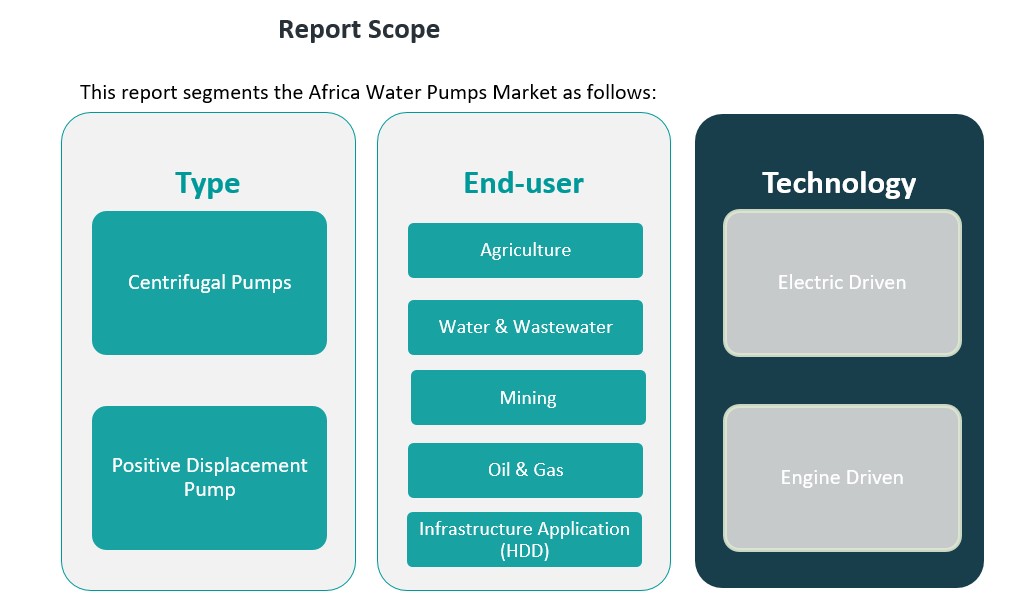
The Africa water pump market is segmented by type, end-user, and technology, each reflecting distinct application needs and growth patterns across the region.
By types, centrifugal pumps hold a dominant position due to their widespread use in water transfer, irrigation, and industrial operations. Their ability to handle large volumes with relatively simple design makes them suitable for both rural and urban applications. Positive displacement pumps, though less prevalent, are gaining attention in sectors requiring consistent pressure and flow, such as oil & gas and chemical processing.
By end-user segments, agriculture remains the leading contributor to water pump demand, driven by efforts to enhance irrigation infrastructure and support food security across the continent. Water and wastewater management is another critical segment, supported by urbanization and infrastructure development projects that require robust pumping solutions for treatment and distribution. The mining sector continues to invest in dewatering systems, particularly in countries with expanding mineral extraction activities. Oil and gas applications also contribute to demand, particularly in regions where upstream operations require fluid transfer systems. Infrastructure applications such as horizontal directional drilling (HDD) are emerging as niche areas, especially in urban development and underground utility installations.
By technology perspective, electric-driven pumps dominate due to their efficiency and integration with urban grid systems. However, engine-driven pumps serve as a vital alternative in off-grid and remote areas, where electricity access is limited. This technological segmentation highlights the diverse energy
Segmentation:
By Type Segment:
- Centrifugal Pumps
- Positive Displacement Pumps
By End-User Segment:
- Agriculture
- Water & Wastewater
- Mining
- Oil & Gas
- Infrastructure Application (HDD)
By Technology Segment:
- Electric Driven
- Engine Driven
Regional Analysis:
The Africa water pump market exhibits diverse regional dynamics, shaped by varying levels of industrialization, infrastructure development, and natural resource distribution. South Africa leads the market, accounting for approximately 20% of the regional share. This dominance is attributed to its well-established mining and industrial sectors, which demand robust pumping solutions for operations such as dewatering and fluid transfer. The country's advanced infrastructure and focus on wastewater management further bolster the adoption of water pumps.
Nigeria holds a significant position in the market, contributing around 15% to the regional share. The nation's expanding oil and gas industry, coupled with urbanization and agricultural activities, drives the demand for various types of water pumps. However, challenges such as inconsistent power supply and infrastructural deficits can impede optimal market growth.
Zambia and the Democratic Republic of Congo (DRC) are emerging as notable markets, each contributing approximately 10% to the regional share. In Zambia, the mining sector's growth, particularly in copper extraction, necessitates efficient dewatering solutions. Similarly, the DRC's rich mineral resources and ongoing industrial projects increase the demand for reliable water pumping systems.
Kenya and Ethiopia, representing East Africa, collectively account for about 12% of the market. These countries are investing in agricultural development and rural water supply initiatives, leading to increased adoption of water pumps, especially solar-powered variants suitable for off-grid areas. Government programs aimed at improving water accessibility further stimulate market growth in these regions.
North African countries, including Egypt and Morocco, contribute approximately 18% to the regional market. Their focus on modernizing irrigation systems and expanding wastewater treatment facilities drives the demand for advanced water pumping technologies. The implementation of large-scale agricultural projects and urban infrastructure development also plays a crucial role in market expansion.
The remaining 25% of the market is distributed among other African nations, where water pump adoption is gradually increasing due to developmental initiatives and international aid programs. Overall, the Africa water pump market's regional landscape is characterized by a blend of established markets and emerging opportunities, each influenced by specific economic activities and infrastructural needs.
Key Player Analysis:
- SLB
- Ingersoll Rand
- The Weir Group PLC
- Vaughan Company
- KSB SE & Co. KGaA
- Pentair
- Grundfos Holding A/S
- Xylem
- Flowserve Corporation
- ITT Inc.
- EBARA Corporation
Competitive Analysis:
The Africa water pump market features a competitive landscape comprising global manufacturers, regional players, and specialized local firms. Key international companies such as Grundfos, Xylem Inc., KSB SE & Co. KGaA, and Sulzer Ltd. maintain a strong presence through advanced technologies and extensive distribution networks. These players focus on energy-efficient and solar-integrated pump systems to cater to Africa’s diverse infrastructural and agricultural needs. Regional companies and local assemblers contribute to market competitiveness by offering cost-effective and customized solutions suited to specific climatic and operational conditions. Strategic partnerships, localization of manufacturing, and after-sales service capabilities remain critical differentiators in this market. Additionally, rising public and private sector investments in water infrastructure continue to attract new entrants. As technological innovation and demand for sustainability grow, competition is expected to intensify, particularly in high-growth segments such as solar-powered pumps and smart water management systems.
Recent Developments:
- In February 2025, Ingersoll Randacquired SSI Aeration, Inc., a global leader in wastewater treatment equipment manufacturing. This acquisition expands Ingersoll Rand's capabilities in the high-growth wastewater treatment market by integrating SSI’s energy-efficient aeration systems with its existing technologies, such as low-pressure compressors.
- In December 2024, Pentairacquired G&F Manufacturing, LLC for $108 million. This acquisition strengthens Pentair’s pool equipment portfolio by adding Gulfstream-brand heat pumps tailored to sustainability trends in Florida and surrounding regions.
- Grundfos' commitment to the Water Resilience Coalition in March 2025 aligns with the water pump market's focus on sustainability and efficient water management. The coalition’s goals include measurable improvements in global water sustainability by 2030.
- On February 28, 2025, KSB launched the MultiTec Plus pump series, specifically optimized for drinking water transport. This product integrates energy-saving technologies and real-time monitoring capabilities, emphasizing advancements in smart and sustainable water pumping solutions.
Market Concentration & Characteristics:
The Africa water pump market exhibits a moderately fragmented structure, characterized by the coexistence of multinational corporations, regional manufacturers, and local distributors. While global players such as Grundfos, Xylem, and KSB hold a significant share in urban and industrial segments due to their technological edge and established brand reputation, local and regional firms remain dominant in rural and cost-sensitive markets. The market is highly price-sensitive, with purchasing decisions often influenced by affordability, energy efficiency, and ease of maintenance. Diverse climatic and infrastructural conditions across regions necessitate customized product offerings, contributing to a wide variety of pump types and technologies. The presence of informal markets and the influx of low-cost imports also affect market uniformity and quality standards. Despite these challenges, increasing demand for reliable water supply solutions, particularly solar-powered and diesel-driven pumps, continues to shape the market’s evolution, offering room for differentiation through innovation and localized strategies.
Report Coverage:
The research report offers an in-depth analysis based on Type Segment, End-User Segment and Technology Segment. It details leading market players, providing an overview of their business, product offerings, investments, revenue streams, and key applications. Additionally, the report includes insights into the competitive environment, SWOT analysis, current market trends, as well as the primary drivers and constraints. Furthermore, it discusses various factors that have driven market expansion in recent years. The report also explores market dynamics, regulatory scenarios, and technological advancements that are shaping the industry. It assesses the impact of external factors and global economic changes on market growth. Lastly, it provides strategic recommendations for new entrants and established companies to navigate the complexities of the market.
Future Outlook:
- Increasing investments in rural water infrastructure will expand pump deployment across underserved regions.
- Adoption of solar-powered water pumps is expected to accelerate in off-grid and drought-prone areas.
- Demand for smart and automated pump systems will rise with the growth of urban water networks.
- Expansion of commercial agriculture will drive the need for high-capacity irrigation pumps.
- Public-private partnerships will play a greater role in financing large-scale water projects.
- Local manufacturing and assembly operations will strengthen to reduce reliance on imports.
- Rising focus on wastewater management will create opportunities in treatment and drainage applications.
- Technological innovation will enhance energy efficiency and reduce operational costs of pump systems.
- Support from international aid organizations will facilitate market entry and capacity building.
- Regulatory improvements and quality standardization will help curb the spread of low-grade products.

Request a Free Sample
Fill in your details and we'll send you a free sample report.
- Sample data tables & charts
- Research methodology
Market Dynamics
Infrastructure Development and Urbanization
Rapid urbanization and the expansion of cities across Africa are increasing the need for reliable water supply and wastewater management, driving demand for advanced water pump systems in construction and municipal projects.
Agricultural Advancements and Irrigation Needs
Modernization of agriculture, particularly through improved irrigation infrastructure, is boosting the adoption of centrifugal and solar-powered pumps to enhance crop yields and ensure food security in regions with erratic rainfall.
Industrial Expansion and Mining Activities
Growth in mining and industrial sectors, especially in resource-rich countries like South Africa, Zambia, and the DRC, is fueling demand for high-capacity and durable water pumps for dewatering and fluid transfer operations.
Water Scarcity and Sustainability Initiatives
Climate change and water scarcity are prompting governments and NGOs to invest in sustainable water management systems, including solar-powered and energy-efficient pumps, to improve rural water access and resilience.
Technological Advancements and Solar Adoption
The increasing availability and affordability of solar-powered and smart pump technologies are enabling off-grid and remote communities to access water more efficiently, supporting market growth in underserved areas.
Need a Custom Version of This Report?
Tailor the scope, geography, or segments to your exact requirements.
- Custom geography or segment scope
- Direct access to our analyst team
Frequently Asked Questions
Q: What is the current size of the Africa Water Pump Market?
Q: What factors are driving the growth of the Africa Water Pump Market?
What are the key segments within the Africa Water Pump Market?
What are some challenges faced by the Africa Water Pump Market?
Who are the major players in the Africa Water Pump Market?
Table of Content
Chapter 1 Market Segmentation
- 1.1 Segmentation Framework
- 1.1.1 Product and Service Classification
- 1.1.2 Application and End-Use Classification
- 1.1.3 Technology and Solution Classification
- 1.1.4 Customer and Distribution Channel Classification
- 1.1.5 Geographic Segmentation
- 1.1.6 Market Segment Definitions and Boundaries
- 1.2 By Type
- 1.2.1 Centrifugal Pumps
- 1.2.2 Positive Displacement Pumps
- 1.3 By End-User
- 1.3.1 Agriculture
- 1.3.2 Water & Wastewater
- 1.3.3 Mining
- 1.3.4 Oil & Gas
- 1.3.5 Infrastructure Application (HDD)
- 1.4 By Technology
- 1.4.1 Electric Driven
- 1.4.2 Engine Driven
Chapter 2 Introduction
- 2.1 Report Objectives and Scope
- 2.2 Product Definition and Industry Terminology
- 2.3 Market Inclusions and Exclusions
- 2.4 Research Process
- 2.4.1 Primary Research and Expert Interviews
- 2.4.2 Secondary Research and Source Review
- 2.4.3 Top-Down and Bottom-Up Estimation
- 2.4.4 Data Triangulation and Verification
- 2.5 Market Size Measurement Basis
- 2.5.1 2023: USD 1,012.04 million → 2032: USD 1,068.06 million
- 2.6 Historical and Forecast Reference Periods
- 2.6.1 Base Year: 2023
- 2.6.2 Forecast Period: 2023-2032
- 2.7 Research Assumptions and Limitations
Chapter 3 Executive Summary
- 3.1 Market Snapshot and Key Findings
- 3.2 Base-Year Market Size, 2023
- 3.3 Forecast Market Size, 2032
- 3.4 Revenue and Volume Growth Outlook
- 3.5 Key Demand and Supply Indicators
- 3.6 Leading Market Segments
- 3.7 Fastest-Growing Market Opportunities
- 3.8 Regional Performance Highlights
- 3.9 Technology and Industry Transformation
- 3.10 Competitive Landscape Summary
- 3.11 Analyst View and Strategic Implications
Chapter 4 Africa Water Pump Market Trends and Developments
- 4.1 Historical Industry Development
- 4.2 Recent Market Trends and Developments
- 4.3 Demand and Customer Behavior Trends
- 4.4 Technology and Product Innovation
- 4.5 Artificial Intelligence, Automation and Digitalization
- 4.6 Local Manufacturing and Supply Chain Realignment
- 4.7 Industry Partnerships, Mergers and Acquisitions
- 4.8 Sustainability and Circular Economy Developments
- 4.9 Government and Private Sector Investment Trends
- 4.10 Emerging Business Models and Commercialization
- 4.11 Industry Developments and Announcements
Chapter 5 Africa Water Pump Market Production, Supply and Demand Analysis
- 5.1 Demand Trend and Consumption Analysis
- 5.2 Demand Forecast, 2023-2032
- 5.3 Production and Output Trend
- 5.4 Production and Output Forecast, 2023-2032
- 5.5 Installed Capacity and Capacity Utilization
- 5.6 Company-Wise Production Plants and Statistics
- 5.6.1 Installed Production Capacity
- 5.6.2 Actual Production
- 5.6.3 Planned Capacity and Expansion Targets
- 5.7 Supply Chain Structure and Procurement Trends
- 5.8 Supply-Demand Gap and Bottlenecks
- 5.9 Import Dependence and Sourcing Structure
- 5.10 Contract Manufacturing and Outsourcing
- 5.11 Regional Supply and Demand Concentration
Chapter 6 Africa Water Pump Market Pricing Analysis
- 6.1 Pricing Structure and Measurement
- 6.2 Historical Pricing Trends
- 6.3 Pricing Outlook, 2023-2032
- 6.4 Average Selling Price and Unit Economics
- 6.5 Pricing by Product and Market Segment
- 6.6 Geographic Pricing Differences
- 6.7 Key Input, Energy, Labor and Logistics Costs
- 6.8 Contract Pricing and Purchasing Models
- 6.9 Pricing Sensitivity and Competitive Positioning
- 6.10 Price, Margin and Profitability Implications
Chapter 7 Africa Water Pump Market Dynamics
- 7.1 Market Growth Drivers
- 7.1.1 Demand-Side Drivers
- 7.1.2 Technology and Innovation Drivers
- 7.1.3 Infrastructure and Investment Drivers
- 7.1.4 Regulatory and Policy Drivers
- 7.2 Market Restraints
- 7.2.1 Cost and Affordability Constraints
- 7.2.2 Technology and Adoption Barriers
- 7.2.3 Supply Chain and Operational Constraints
- 7.3 Market Challenges
- 7.3.1 Competitive Pressure and Margin Erosion
- 7.3.2 Skills, Infrastructure and Implementation Gaps
- 7.4 Emerging Market Opportunities
- 7.5 Market Dynamics Impact and Time-Horizon Assessment
Chapter 8 Africa Water Pump Value Chain Analysis
- 8.1 Industry Value Chain Overview
- 8.2 Upstream Suppliers and Critical Inputs
- 8.3 Technology and Component Providers
- 8.4 Manufacturing or Service Delivery
- 8.5 Distribution, Channel Partners and Integrators
- 8.6 Downstream Applications and End Users
- 8.7 Value Addition and Profit Pools
- 8.8 Vertical Integration and Outsourcing
- 8.9 Supplier Concentration and Risk
- 8.10 Supply Chain Localization and Resilience
Chapter 9 Africa Water Pump Market Regulations and Policies
- 9.1 Relevant Laws, Standards and Compliance Frameworks
- 9.2 Product, Service, Safety and Quality Requirements
- 9.3 Government Policies, Incentives and Subsidies
- 9.4 Imports, Exports and Trade Barriers
- 9.5 Public Procurement and Local Content Requirements
- 9.6 Environmental and Sustainability Compliance
- 9.7 Upcoming Policy Changes and Market Implications
Chapter 10 Africa Water Pump Market Hotspots and Opportunities
- 10.1 Market Opportunity Mapping and Growth Hotspots
- 10.2 High-Growth Applications and Customer Groups
- 10.3 Underserved Markets and White-Space Opportunities
- 10.4 Emerging Technology and Product Opportunities
- 10.5 New Capacity and Investment Hotspots
- 10.6 Market Entry and Expansion Opportunities
- 10.7 Distribution and Partnership Opportunities
- 10.8 Near-Term and Long-Term Commercial Potential
- 10.9 Opportunity Attractiveness and Execution Risks
Chapter 11 Africa Water Pump Market Outlook, 2023-2032
- 11.1 Market Size and Analysis
- 11.1.1 Revenue (Market Measurement: 2023: USD 1,012.04 million → 2032: USD 1,068.06 million)
- 11.1.2 Market Volume and Quantity Sold
- 11.1.3 Historical Market Size
- 11.1.4 Base-Year Market Size, 2023
- 11.2 Market Forecast, 2023-2032
- 11.2.1 Revenue Forecast to 2032
- 11.2.2 Volume Forecast to 2032
- 11.2.3 CAGR and Year-on-Year Growth
- 11.2.4 Incremental Revenue Opportunity
- 11.3 Forecast Assumptions and Scenario Analysis
- 11.3.1 Base-Case Forecast
- 11.3.2 Optimistic and Conservative Scenarios
- 11.3.3 Technology, Pricing and Policy Sensitivities
- 11.4 Market Attractiveness and Growth Outlook
Chapter 12 Africa Water Pump Market Segmentation and Outlook
- 12.1 Segmentation Summary and Market Shares, 2023
- 12.2 Largest and Fastest-Growing Segments
- 12.3 By Type - Market Size and Forecast, 2023-2032
- 12.3.1 Segment Definition and Scope
- 12.3.2 Historical Market Size
- 12.3.3 Revenue Forecast, 2023-2032
- 12.3.4 Volume Forecast, 2023-2032
- 12.3.5 Base-Year Market Share, 2023
- 12.3.6 Segment CAGR and Growth Drivers
- 12.3.7 Subsegment Market Size and Forecast
- 12.3.7.1 Centrifugal Pumps
- 12.3.7.2 Positive Displacement Pumps
- 12.3.8 Subsegment Pricing and Adoption Trends
- 12.3.9 Leading Suppliers and Competition
- 12.3.10 Regional Demand and Opportunities
- 12.4 By End-User - Market Size and Forecast, 2023-2032
- 12.4.1 Segment Definition and Scope
- 12.4.2 Historical Market Size
- 12.4.3 Revenue Forecast, 2023-2032
- 12.4.4 Volume Forecast, 2023-2032
- 12.4.5 Base-Year Market Share, 2023
- 12.4.6 Segment CAGR and Growth Drivers
- 12.4.7 Subsegment Market Size and Forecast
- 12.4.7.1 Agriculture
- 12.4.7.2 Water & Wastewater
- 12.4.7.3 Mining
- 12.4.7.4 Oil & Gas
- 12.4.7.5 Infrastructure Application (HDD)
- 12.4.8 Subsegment Pricing and Adoption Trends
- 12.4.9 Leading Suppliers and Competition
- 12.4.10 Regional Demand and Opportunities
- 12.5 By Technology - Market Size and Forecast, 2023-2032
- 12.5.1 Segment Definition and Scope
- 12.5.2 Historical Market Size
- 12.5.3 Revenue Forecast, 2023-2032
- 12.5.4 Volume Forecast, 2023-2032
- 12.5.5 Base-Year Market Share, 2023
- 12.5.6 Segment CAGR and Growth Drivers
- 12.5.7 Subsegment Market Size and Forecast
- 12.5.7.1 Electric Driven
- 12.5.7.2 Engine Driven
- 12.5.8 Subsegment Pricing and Adoption Trends
- 12.5.9 Leading Suppliers and Competition
- 12.5.10 Regional Demand and Opportunities
- 12.6 Segment Growth Comparison
- 12.7 Segment Attractiveness and Priority Matrix
Chapter 13 Africa Water Pump End-Use and Application Market Outlook
- 13.1 End-Use Industry and Customer Demand Structure
- 13.2 Leading Applications and Customer Groups
- 13.3 End-Use Market Size, Share and Forecast
- 13.4 Major End-Use Industry Deep Dives
- 13.4.1 Customer Requirements and Use Cases
- 13.4.2 Demand and Replacement Cycles
- 13.4.3 Technical and Regulatory Considerations
- 13.4.4 Purchasing and Procurement Models
- 13.4.5 Leading Vendors and Distribution Channels
- 13.4.6 Forecast and Commercial Opportunities
- 13.5 Emerging Applications and Cross-Segment Demand
- 13.6 End-Use Industry Investment Priorities
Chapter 14 Africa Water Pump Geographic Market Outlook, 2023-2032
- 14.1 Regional Market Size and Country-Level Shares, 2023
- 14.2 Country Market Size Comparison, 2023
- 14.3 Country Market Forecasts, 2023-2032
- 14.4 Subregional Industrial and Demand Clusters
- 14.5 Intra-Regional Pricing and Cost Differences
- 14.6 Cross-Border Trade and Supply Networks
- 14.7 Regional Supply and Demand Balances
- 14.8 Country Opportunity Comparison and Prioritization
Note: Every listed country is covered on the structure shown under the first country.
Chapter 15 Africa Water Pump Technology, Innovation and Sustainability Outlook
- 15.1 Technology Landscape and Maturity
- 15.2 Product, Process and Service Innovation
- 15.3 AI, Automation and Digital Tools in the Industry
- 15.4 Technology Adoption and Performance Benchmarking
- 15.5 Innovation Pipeline and R&D Investment
- 15.6 Patent and Intellectual Property Trends
- 15.7 Energy Efficiency and Resource Management
- 15.8 Sustainability, Recycling and Circularity
- 15.9 Technology Roadmap, 2023-2032
- 15.10 Risks of Obsolescence and Technology Substitution
Chapter 16 Africa Water Pump Market Key Strategic Imperatives
- 16.1 Growth and Market Entry Priorities
- 16.2 High-Return Products and Segments
- 16.3 Pricing, Profitability and Cost Optimization
- 16.4 Technology Investment and Product Differentiation
- 16.5 Supply Chain Localization and Resilience
- 16.6 Distribution and Customer Acquisition
- 16.7 Partnership, Acquisition and Capacity Strategy
- 16.8 Regional Expansion Priorities
- 16.9 Short-, Medium- and Long-Term Actions
Chapter 17 Competition Outlook
- 17.1 Industry Competition Characteristics
- 17.2 Market Structure and Concentration
- 17.3 Market Share and Competitive Positioning, 2023
- 17.4 Company-Wise Revenue and Product Benchmarking
- 17.5 Production and Service Capacity Benchmarking
- 17.6 Technology, Pricing and Differentiation
- 17.7 Regional Footprint and Distribution Strength
- 17.8 Mergers, Acquisitions and Strategic Alliances
- 17.9 New Entrants and Competitive Threats
- 17.10 Porter's Five Forces and Industry Attractiveness
- 17.11 Competitive Outlook, 2023-2032
Chapter 18 Company Profiles
- 18.1 Company Coverage and Selection Criteria
- 18.2 Grundfos Holding A/S
- 18.2.1 Business Description
- 18.2.2 Company Ownership and Geographic Presence
- 18.2.3 Product and Service Portfolio
- 18.2.4 Manufacturing and Operating Footprint
- 18.2.5 Production Capacity and Expansion Plans
- 18.2.6 Financial Performance and Investment
- 18.2.7 Market Share and Competitive Position
- 18.2.8 Technology and Innovation Capabilities
- 18.2.9 Strategic Alliances or Partnerships
- 18.2.10 Recent Developments
- 18.2.11 Growth Strategy and Outlook
- 18.3 Xylem
- 18.4 KSB SE & Co. KGaA
- 18.5 Pentair
- 18.6 Flowserve Corporation
- 18.7 ITT Inc.
- 18.8 EBARA Corporation
- 18.9 The Weir Group PLC
- 18.10 Ingersoll Rand
- 18.11 SLB
- 18.12 Other Relevant Market Participants
Note: Every listed company is profiled on the structure shown under the first company. The company list is preliminary and may change based on research findings, market developments, data availability and client requirements.
Chapter 19 Disclaimer
- 19.1 Research and Forecast Disclaimer
- 19.2 Data Source and Estimation Limitations
Note: The depth of individual sections depends on data availability for this market. Volume, capacity, trade and other unit-based metrics are included where applicable.