Home » Chemicals » Algae Biofuel Market

Algae Biofuel Market By Type (Jet Fuel, Bioethanol, Methane, Biodiesel, Bio-Butanol); By Application (Transportation, Aerospace, Other Application); By Biofuel Type (Biodiesel, Bioethanol, Biobutanol) – Growth, Share, Opportunities & Competitive Analysis, 2024 – 2032

Report ID: 1324 | Report Format : Excel, PDF

Market Overview

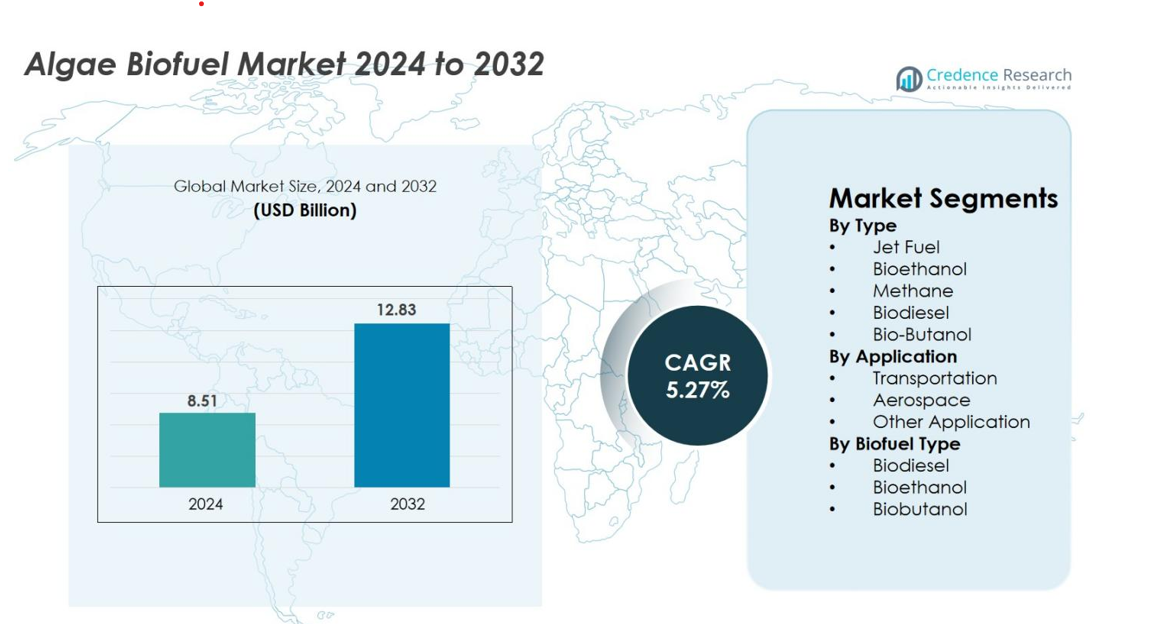
Algae Biofuel Market size was valued at USD 8.51 Billion in 2024 and is anticipated to reach USD 12.83 Billion by 2032, at a CAGR of 5.27% during the forecast period.

REPORT ATTRIBUTE DETAILS
Historical Period 2020-2023
Base Year 2024
Forecast Period 2025-2032
Algae Biofuel Market Size 2024 USD 8.51 Billion
Algae Biofuel Market, CAGR 5.27%
Algae Biofuel Market Size 2032 USD 12.83 Billion


Algae Biofuel Market showcases strong participation from key players such as Algenol Biotech, Sapphire Energy, Blue Marble Productions, Inc., Culture BioSystems, Genifuel Corporation, Solix, Algae Systems LLC, Reliance Life Sciences, Origin Oils, and AlgaEnergy, all of which continue advancing high-yield strains, integrated CO₂ utilization systems, and cost-efficient extraction technologies. These companies actively expand pilot and commercial-scale operations to meet rising demand for renewable fuels in transportation and aviation sectors. North America leads the market with an exact 38.4% share, supported by robust R&D infrastructure, government incentives, and strong adoption of sustainable aviation fuel pathways, positioning the region at the forefront of commercialization.

Algae Biofuel Market size

Market Insights

  • The Algae Biofuel Market was valued at USD 8.51 Billion in 2024 and is projected to reach USD 12.83 Billion by 2032, advancing at a 5.27% CAGR during the forecast period.
  • Market growth is driven by expanding demand for low-carbon fuels, strong interest in algae-derived biodiesel with a 41.6% segment share, and rising adoption of sustainable aviation fuel across global airlines.
  • Key trends include rapid innovation in strain engineering, integration of algae farms with CO₂-emitting industries, and scaling of photobioreactor technologies to improve output efficiency and reduce production costs.
  • The competitive landscape features active participation from Algenol Biotech, Sapphire Energy, Solix, Genifuel Corporation, AlgaEnergy, and other players focusing on advanced biofuel pathways, co-product optimization, and strategic research collaborations.
  • Regionally, North America leads with a 38.4% share, followed by Europe at 27.1%, Asia-Pacific at 24.6%, while Transportation remains the leading application segment with 62.4% market share, supported by renewable fuel mandates.

Access crucial information at unmatched prices!

Request your sample report today & start making informed decisions powered by Credence Research Inc.!

Download Sample

Market Segmentation Analysis

By Type

The by Type segment of the Algae Biofuel Market is led by Biodiesel, holding an 41.6% share in 2024, driven by its high lipid yield, engine compatibility, and strong regulatory support for cleaner diesel blends. Bioethanol follows with increasing adoption due to blend mandates, while Jet Fuel gains momentum as airlines expand testing of algae-derived SAF. Bio-Butanol advances due to its higher energy density, and Methane grows gradually through biogas and waste-to-energy initiatives. Overall, policy incentives and industry decarbonization efforts strengthen demand across all fuel categories.

  • For instance, Algenol’s demonstration facility in Florida achieved an annual output of 100,000 gallons of ethanol using CO₂-fed algae photobioreactors, and its technology platform documented ethanol productivity rates exceeding 8,000 gallons per acre per year under continuous operation, showcasing commercially relevant yields for fuel-grade ethanol.

By Application

The Transportation segment dominates the Algae Biofuel Market with a precise 62.4% share in 2024, supported by rising biodiesel and bioethanol utilization in road transport, commercial fleets, and public mobility programs. Aerospace holds a growing share as algae-based SAF development accelerates to meet net-zero aviation targets and reduce lifecycle emissions. Other Applications, contributing the remaining share, include industrial heating and small-scale power generation, driven by the demand for renewable and cleaner energy alternatives in manufacturing and utility sectors.

  • For instance, Solazyme (later TerraVia) fulfilled a U.S. Department of Defense contract supplying 450,000 gallons of algae-based marine diesel and naval distillate fuel, which were subsequently used in operational fleet evaluations—marking one of the largest recorded volumes of algal fuel supplied for transportation testing.

By Biofuel Type

The by Biofuel Type segment is led by Biodiesel, capturing an 46.8% market share in 2024, driven by its high conversion efficiency from algal lipids and compatibility with existing storage, transport, and engine systems. Bioethanol retains strong demand due to global fuel-blend regulations, while Biobutanol expands its presence because of its superior energy density and reduced corrosiveness compared to ethanol. Advancements in photobioreactor systems, strain optimization, and cost-efficient lipid extraction continue to boost biodiesel output and accelerate adoption across diverse end-use sectors.

Key Growth Drivers

Rising Demand for Low-Carbon and Sustainable Energy Alternatives

The global shift toward decarbonization continues to strengthen demand for algae biofuels as industries and governments aim to reduce reliance on fossil fuels. Algae-based fuels offer significantly lower lifecycle emissions, aligning with global carbon-neutrality commitments and renewable energy transition plans. Transportation, marine, and aviation sectors increasingly favor algae-derived fuels to meet emission reduction standards without major engine modifications. Algae’s rapid growth rate, high oil yield, non-dependence on arable land, and ability to utilize CO₂-rich industrial exhaust make it a highly sustainable feedstock. As nations enforce stricter renewable fuel mandates, algae biofuels gain strong commercial relevance, contributing to long-term climate strategies and energy diversification.

  • For instance, the U.S. Navy completed its largest advanced biofuel procurement by ordering 450,000 gallons of algal-based marine and jet fuel produced through Solazyme and Dynamic Fuels, which was subsequently incorporated into ship and aircraft operational exercises, marking the largest recorded governmental deployment volume of algae-derived fuel.

Advancements in Algal Strain Engineering and Bioprocessing Technologies

Continuous innovations in strain engineering, bioreactor design, nutrient optimization, and downstream processing significantly enhance the commercial viability of algae biofuels. Genetic engineering and synthetic biology enable the development of high-lipid strains with faster growth cycles and superior yields. Improved photobioreactor systems increase light capture efficiency, stabilize cultivation conditions, and reduce contamination risks, ensuring consistent biomass output. Advances in cost-efficient harvesting and extraction methods including hydrothermal liquefaction and membrane-based separation streamline bio-oil production and reduce operating expenses. These technological gains narrow the cost gap with petroleum-based fuels and support wider adoption of algae biofuels across different end-use sectors.

  • For instance, researchers at ExxonMobil and Synthetic Genomics engineered an algal strain capable of producing lipid content up to 40% of dry biomass double the baseline 20% level reported at project initiation and field cultivation trials achieved a documented biomass productivity of 18 grams per square meter per day, demonstrating measurable gains from genetic optimization.

Government Incentives, Investments, and Energy Diversification Policies

Supportive policies and government initiatives play a critical role in accelerating algae biofuel development. Many countries prioritize algae within renewable energy portfolios due to its environmental benefits and potential contribution to national energy security. Incentives such as tax credits, grants, low-interest financing, and R&D funding strengthen commercial project pipelines and attract private investment. Renewable fuel mandates create stable demand for algae-based biodiesel, bioethanol, and aviation fuels. Governments also promote carbon capture initiatives where industrial CO₂ emissions are used as nutrient sources for algae cultivation, enhancing circular economy models. With stronger policy alignment toward green fuels, algae biofuels continue to gain momentum as a key element of future energy strategies.

Key Trends & Opportunities

Expansion of Algae-Based Sustainable Aviation Fuel (SAF)

Growing emphasis on aviation decarbonization creates a major opportunity for algae-derived sustainable aviation fuels. Airlines and aerospace manufacturers increasingly partner with biofuel companies to explore scalable production pathways that meet tightening global emission standards. Algae-based SAF offers excellent performance, high energy density, and compatibility with existing jet engines, making it an attractive alternative for long-haul aviation. Regulatory frameworks encouraging SAF blending further stimulate investment in large-scale production facilities. As airports and carriers adopt carbon-neutral goals, algae emerges as a promising feedstock capable of reducing aviation emissions while supporting long-term sustainability commitments and operational efficiency.

  • For instance, Continental Airlines conducted a 90-minute demonstration flight on a Boeing 737-800 using a 50/50 blend of jet fuel and algae-derived HEFA supplied by Solazyme and Honeywell UOP, and post-flight engine diagnostics confirmed full performance compatibility with CFM56 turbofan engines without hardware modifications, establishing the first U.S. commercial airline test flight powered by an algal fuel blend.

Integration of Algae Cultivation into Industrial Carbon Capture Systems

A key emerging trend is the integration of algae production systems with industrial CO₂ emitters as part of broader circular economy strategies. Manufacturing plants, power stations, and processing facilities increasingly explore algae cultivation to capture and utilize carbon dioxide that would otherwise be released into the atmosphere. The captured CO₂ becomes a nutrient source for algal biomass, creating a dual benefit of emission reduction and biofuel production. Wastewater streams are also being utilized to support nutrient-rich cultivation, further reducing operational costs. This model generates additional value through co-products such as biofertilizers and biochemicals, enhancing the economic feasibility of integrated algae-based energy solutions.

  • For instance, the U.S. Department of Energy’s Arizona State University–run Power System Integration project demonstrated that flue gas from a natural gas power plant supplying CO₂ at concentrations between 5% and 8% enabled algal cultivation yields of 24 grams per square meter per day, directly converting stack emissions into biomass without supplemental industrial-grade CO₂.

Key Challenges

High Production Costs and Scalability Limitations

Despite strong potential, algae biofuels face significant cost and scalability challenges that hinder mass commercialization. Cultivation, harvesting, and extraction processes remain expensive due to energy-intensive operations and the need for advanced equipment. Open-pond systems struggle with inconsistent yields, temperature fluctuations, and contamination risks, while photobioreactors require substantial capital investment and controlled environments. These factors limit the ability to produce algae biofuel at competitive prices compared to fossil fuels or more established biofuel types. Achieving consistent large-scale output remains difficult, and economic viability depends heavily on technological breakthroughs and reduced production costs across the value chain.

Regulatory Uncertainty and Market Commercialization Barriers

The algae biofuel industry faces regulatory complexity, certification challenges, and uncertainties that slow commercial expansion. Many regions lack standardized guidelines for large-scale algae cultivation, land use, wastewater integration, and fuel quality benchmarks. Approval processes for aviation biofuels are particularly stringent, increasing compliance costs and lengthening time-to-market. Infrastructure constraints for storage, blending, and distribution further limit adoption. Inconsistent policies across countries reduce investor confidence and complicate long-term planning for commercial facilities. Without clearer regulatory frameworks and stable policy support, transitioning from pilot projects to full-scale production remains a major obstacle for industry growth.

Regional Analysis

North America

North America leads the Algae Biofuel Market with an 38.4% share in 2024, driven by strong federal incentives, large-scale R&D investments, and a well-established biofuel commercialization ecosystem. The U.S. benefits from extensive pilot facilities, advanced photobioreactor technologies, and strong participation from energy companies expanding renewable fuel portfolios. Supportive frameworks such as the U.S. Renewable Fuel Standard and state-level low-carbon fuel regulations further accelerate adoption. Growing interest in algae-based SAF from major airlines and defense programs also boosts demand, positioning North America as the most technologically advanced and commercially active region in the sector.

Europe

Europe holds 27.1% market share in 2024, supported by aggressive decarbonization policies and the EU’s long-term renewable energy directives prioritizing advanced biofuels. Countries such as Germany, the Netherlands, and France invest heavily in algae research clusters and industrial-scale demonstration plants. The region’s aviation sector accelerates algae-based SAF demand to meet increasingly strict emissions rules under the Fit-for-55 framework. Strong circular economy initiatives integrating CO₂ utilization, wastewater recycling, and green industrial systems further promote algae cultivation. Europe’s regulatory clarity and sustainability focus make it a key hub for advanced biofuel innovation and commercialization.

Asia-Pacific

Asia-Pacific accounts for an 24.6% share of the Algae Biofuel Market in 2024, driven by rising energy demand, large-scale cultivation potential, and expanding government support for renewable energy systems. China, India, Japan, and South Korea lead regional activity with investments in open-pond algae farms, CO₂-to-biofuel pilot projects, and hybrid cultivation technologies. The region’s fast-growing transportation and aviation sectors create strong long-term demand for biodiesel and SAF. Availability of sunlight, low-cost labor, and favorable climatic conditions further strengthen cost competitiveness, positioning Asia-Pacific as a high-growth market with strong commercialization prospects.

Latin America

Latin America captures 6.3% market share in 2024, supported by expanding biofuel mandates and large-scale biomass production capabilities. Countries such as Brazil, Chile, and Mexico actively explore algae cultivation to diversify renewable fuel sources and enhance energy independence. Coastal regions with abundant sunlight and favorable water conditions offer strong cultivation potential, enabling cost-effective algae biomass generation. Government-backed research programs and pilot-scale initiatives focusing on biodiesel and biogas production contribute to early-stage commercial activity. Growing interest in low-carbon transportation fuels and sustainable industrial energy solutions further supports algae biofuel adoption across the region.

Middle East & Africa

The Middle East & Africa region holds 3.6% share in 2024, driven by emerging interest in diversifying beyond fossil fuels and leveraging abundant sunlight for high-yield algae cultivation. Gulf countries invest in algae pilot projects focused on renewable jet fuels and carbon-capture applications to support long-term sustainability goals. African nations demonstrate potential through low-cost land availability and favorable climatic conditions, attracting early-stage research activity. Although commercialization remains limited, increasing adoption of circular water systems and renewable energy initiatives positions the region as a developing market with long-term algae biofuel opportunities.

Market Segmentations

By Type

  • Jet Fuel
  • Bioethanol
  • Methane
  • Biodiesel
  • Bio-Butanol

By Application

  • Transportation
  • Aerospace
  • Other Application

By Biofuel Type

  • Biodiesel
  • Bioethanol
  • Biobutanol

By Geography

  • North America
    • U.S.
    • Canada
    • Mexico
  • Europe
    • Germany
    • France
    • U.K.
    • Italy
    • Spain
    • Rest of Europe
  • Asia Pacific
    • China
    • Japan
    • India
    • South Korea
    • South-east Asia
    • Rest of Asia Pacific
  • Latin America
    • Brazil
    • Argentina
    • Rest of Latin America
  • Middle East & Africa
    • GCC Countries
    • South Africa
    • Rest of the Middle East and Africa

Competitive Landscape

The Algae Biofuel Market features a dynamic competitive landscape driven by continuous innovation, strategic collaborations, and increasing investment in large-scale production technologies. Key players such as Algenol Biotech, Blue Marble Productions, Inc., Sapphire Energy, Culture BioSystems, Origin Oils, Genifuel Corporation, Algae Systems LLC, Solix, Reliance Life Sciences, and AlgaEnergy actively expand their capabilities through advanced strain engineering, high-yield bioreactor systems, and cost-efficient lipid extraction processes. Companies are accelerating pilot-to-commercial transitions by integrating CO₂ capture partnerships with industrial emitters and engaging in long-term supply agreements with transportation and aviation fuel distributors. Many players focus on developing algae-based sustainable aviation fuels (SAF), supported by rising demand from airlines and net-zero commitments. Mergers, research alliances, and government-funded demonstration projects further intensify competition, while firms increasingly diversify into co-products such as biochemicals, animal feed, and biofertilizers to strengthen revenue streams and enhance overall commercial viability.

Shape Your Report to Specific Countries or Regions & Enjoy 30% Off!

Key Player Analysis

Recent Developments

  • In October 2025, Algae‑C Inc. announced its acquisition by Rockcliffe Labs Inc..
  • In July 2025, Leave a Nest Co., Ltd. announced that Atoz (bio-fuels & carbon solutions) and ALBIC (microalgae-biology research) are its partners for the ‘Global Algae Summit 2025’.
  • In 2025, BRK Technology Co. Ltd. announced the launch of its 2025 pilot programme to evaluate algae-based drop-in renewable fuels (aviation, marine, heavy transportation)

Report Coverage

The research report offers an in-depth analysis based on Type, Application, Biofuel Type and Geography. It details leading market players, providing an overview of their business, product offerings, investments, revenue streams, and key applications. Additionally, the report includes insights into the competitive environment, SWOT analysis, current market trends, as well as the primary drivers and constraints. Furthermore, it discusses various factors that have driven market expansion in recent years. The report also explores market dynamics, regulatory scenarios, and technological advancements that are shaping the industry. It assesses the impact of external factors and global economic changes on market growth. Lastly, it provides strategic recommendations for new entrants and established companies to navigate the complexities of the market.

Future Outlook

  1. The market will experience steady growth as global energy systems shift toward low-carbon and renewable fuel alternatives.
  2. Advancements in algal strain engineering will improve lipid productivity and significantly reduce overall production costs.
  3. Sustainable aviation fuel derived from algae will gain stronger adoption as airlines accelerate net-zero emission commitments.
  4. Integration of algae cultivation with industrial CO₂ capture systems will expand, enhancing circular carbon utilization models.
  5. Large-scale photobioreactor and hybrid open-pond systems will become more efficient, supporting commercial-scale output.
  6. Increasing government incentives and renewable fuel mandates will strengthen investment flows into algae-based biofuel projects.
  7. Co-products such as biofertilizers, biochemicals, and protein-rich biomass will enhance profitability and diversify revenue streams.
  8. Strategic collaborations between energy companies, biotechnology firms, and research institutions will accelerate technology breakthroughs.
  9. Emerging markets in Asia-Pacific and the Middle East will develop new cultivation hubs due to favorable climatic and cost conditions.
  10. Continued focus on decarbonizing transportation and aviation will position algae biofuels as a critical long-term clean energy solution.

1. Preface
1.1. Report Description
1.1.1. Purpose of the Report
1.1.2. Target Audience
1.1.3. USP and Key Offerings
1.2. Research Scope
1.3. Research Methodology
1.3.1. Phase I – Secondary Research
1.3.2. Phase II – Primary Research
1.3.3. Phase III – Expert Panel Review
1.3.4. Approach Adopted
1.3.4.1. Top-Down Approach
1.3.4.2. Bottom-Up Approach
1.3.5. Assumptions
1.4. Market Segmentation

2. Executive Summary
2.1. Market Snapshot: Global Algae Biofuel Market
2.2. Global Algae Biofuel Market, By Type
2.3. Global Algae Biofuel Market, By Application
2.4. Global Algae Biofuel Market, By Region

3. Market Dynamics & Factors Analysis
3.1. Introduction
3.1.1. Global Algae Biofuel Market Value, 2016-2028, (US$ Bn)
3.2. Market Dynamics
3.2.1. Key Growth Trends
3.2.2. Market Drivers
3.2.3. Market Restraints
3.2.4. Market Opportunities
3.2.5. Major Industry Challenges
3.3. Attractive Investment Proposition,2021
3.3.1. Type
3.3.2. Application
3.3.3. Geography

4. Premium Insights
4.1. STAR (Situation, Task, Action, Results) Analysis
4.2. Porter’s Five Forces Analysis
4.2.1. Threat of New Entrants
4.2.2. Bargaining Power of Buyers/Consumers
4.2.3. Bargaining Power of Suppliers
4.2.4. Threat of Substitute Types
4.2.5. Intensity of Competitive Rivalry
4.3. Value Chain Analysis
4.4. Technology Analysis
4.5. Marketing Strategy Analysis
4.5.1. Direct Marketing
4.5.2. Indirect Marketing
4.5.3. Marketing Channel Development Trend

5. Market Positioning of Key Players, 2021
5.1. Company market share of key players, 2021
5.2. Competitive Benchmarking
5.3. Market Positioning of Key Vendors
5.4. Geographical Presence Analysis
5.5. Major Strategies Adopted by Key Players
5.5.1. Key Strategies Analysis
5.5.2. Mergers and Acquisitions
5.5.3. Partnerships
5.5.4. Product Launch
5.5.5. Geographical Expansion
5.5.6. Others

6. COVID 19 Impact Analysis
6.1. Global Algae Biofuel Market Pre Vs Post COVID 19, 2019 – 2028
6.2. Impact on Import & Export
6.3. Impact on Demand & Supply

7. Global Algae Biofuel Market
7.1. Global Algae Biofuel Market, by Type, 2016-2028(US$ Bn)
7.1.1. Overview
7.1.2. Global Algae Biofuel Market, By Type, 2021 vs 2028 (in%)
7.1.3. Global Algae Biofuel Market, By Bioethanol, 2016-2028 (US$ Bn)
7.1.4. Global Algae Biofuel Market, By Biodiesel, 2016-2028 (US$ Bn)
7.1.5. Global Algae Biofuel Market, By Methane, 2016-2028 (US$ Bn)
7.1.6. Global Algae Biofuel Market, By Jet Fuel, 2016-2028 (US$ Bn)
7.1.7. Global Algae Biofuel Market, By Biobutanol, 2016-2028 (US$ Bn)
7.1.8. Global Algae Biofuel Market, By Biogasoline, 2016-2028 (US$ Bn)
7.1.9. Global Algae Biofuel Market, By Green Diesel, 2016-2028 (US$ Bn)
7.1.10. Global Algae Biofuel Market, By Others, 2016-2028 (US$ Bn)
7.2. Global Algae Biofuel Market, by Organization Size, 2016-2028(US$ Bn)
7.2.1. Overview
7.2.2. Global Algae Biofuel Market, By Application, 2021 vs 2028 (in%)
7.2.3. Global Algae Biofuel Market, By Transportation, 2016-2028 (US$ Bn)
7.2.4. Global Algae Biofuel Market, By Aerospace, 2016-2028 (US$ Bn)
7.2.5. Global Algae Biofuel Market, By Other Applications, 2016-2028 (US$ Bn)

8. North America Algae Biofuel Market Analysis
8.1. North America Algae Biofuel Market, by Type, 2016-2028(US$ Bn)
8.1.1. Overview
8.1.2. SRC Analysis
8.2. North America Algae Biofuel Market, by Application, 2016-2028(US$ Bn)
8.2.1. Overview
8.2.2. SRC Analysis
8.3. North America Algae Biofuel Market, by Country, 2016-2028 (US$ Bn)
8.3.1. U.S.
8.3.1.1. U.S. Algae Biofuel Market Estimates and Forecast, 2016-2028 (US$ Bn)
8.3.1.2. U.S. Algae Biofuel, By Type, 2016-2028 (US$ Bn)
8.3.1.3. U.S. Algae Biofuel, By Application, 2016-2028 (US$ Bn)
8.3.2. Canada
8.3.2.1. Canada Algae Biofuel Market Estimates and Forecast, 2016-2028 (US$ Bn)
8.3.2.2. Canada Algae Biofuel, By Type, 2016-2028 (US$ Bn)
8.3.2.3. Canada Algae Biofuel, By Application, 2016-2028 (US$ Bn)

9. Europe Algae Biofuel Market Analysis
9.1. Europe Algae Biofuel Market, by Type, 2016-2028(US$ Bn)
9.1.1. Overview
9.1.2. SRC Analysis
9.2. Europe Algae Biofuel Market, by Application, 2016-2028(US$ Bn)
9.2.1. Overview
9.2.2. SRC Analysis
9.3. Europe Algae Biofuel Market, by Country, 2016-2028 (US$ Bn)
9.3.1. Germany
9.3.1.1. Germany Algae Biofuel Market Estimates and Forecast, 2016-2028 (US$ Bn)
9.3.1.2. Germany Algae Biofuel, By Type, 2016-2028 (US$ Bn)
9.3.1.3. Germany Algae Biofuel, By Application, 2016-2028 (US$ Bn)
9.3.2. France
9.3.2.1. France Algae Biofuel Market Estimates and Forecast, 2016-2028 (US$ Bn)
9.3.2.2. France Algae Biofuel, By Type, 2016-2028 (US$ Bn)
9.3.2.3. France Algae Biofuel, By Application, 2016-2028 (US$ Bn)
9.3.3. UK
9.3.3.1. UK Algae Biofuel Market Estimates and Forecast, 2016-2028 (US$ Bn)
9.3.3.2. UK Algae Biofuel, By Type, 2016-2028 (US$ Bn)
9.3.3.3. UK Algae Biofuel, By Application, 2016-2028 (US$ Bn)
9.3.4. Italy
9.3.4.1. Italy Algae Biofuel Market Estimates and Forecast, 2016-2028 (US$ Bn)
9.3.4.2. Italy Algae Biofuel, By Type, 2016-2028 (US$ Bn)
9.3.4.3. Italy Algae Biofuel, By Application, 2016-2028 (US$ Bn)
9.3.5. Spain
9.3.5.1. Spain Algae Biofuel Market Estimates and Forecast, 2016-2028 (US$ Bn)
9.3.5.2. Spain Algae Biofuel, By Type, 2016-2028 (US$ Bn)
9.3.5.3. Spain Algae Biofuel, By Application, 2016-2028 (US$ Bn)
9.3.6. Rest of Europe
9.3.6.1. Rest of Europe Algae Biofuel Market Estimates and Forecast, 2016-2028 (US$ Bn)
9.3.6.2. Rest of Europe Algae Biofuel, By Type, 2016-2028 (US$ Bn)
9.3.6.3. Rest of Europe Algae Biofuel, By Application, 2016-2028 (US$ Bn)

10. Asia Pacific Algae Biofuel Market Analysis
10.1. Asia Pacific Algae Biofuel Market, by Type, 2016-2028(US$ Bn)
10.1.1. Overview
10.1.2. SRC Analysis
10.2. Asia Pacific Algae Biofuel Market, by Application, 2016-2028(US$ Bn)
10.2.1. Overview
10.2.2. SRC Analysis
10.3. Asia Pacific Algae Biofuel Market, by Country, 2016-2028 (US$ Bn)
10.3.1. China
10.3.1.1. China Algae Biofuel Market Estimates and Forecast, 2016-2028 (US$ Bn)
10.3.1.2. China Algae Biofuel, By Type, 2016-2028 (US$ Bn)
10.3.1.3. China Algae Biofuel, By Application, 2016-2028 (US$ Bn)
10.3.2. Japan
10.3.2.1. Japan Algae Biofuel Market Estimates and Forecast, 2016-2028 (US$ Bn)
10.3.2.2. Japan Algae Biofuel, By Type, 2016-2028 (US$ Bn)
10.3.2.3. Japan Algae Biofuel, By Application, 2016-2028 (US$ Bn)
10.3.3. India
10.3.3.1. India Algae Biofuel Market Estimates and Forecast, 2016-2028 (US$ Bn)
10.3.3.2. India Algae Biofuel, By Type, 2016-2028 (US$ Bn)
10.3.3.3. India Algae Biofuel, By Application, 2016-2028 (US$ Bn)
10.3.4. South Korea
10.3.4.1. South Korea Algae Biofuel Market Estimates and Forecast, 2016-2028 (US$ Bn)
10.3.4.2. South Korea Algae Biofuel, By Type, 2016-2028 (US$ Bn)
10.3.4.3. South Korea Algae Biofuel, By Application, 2016-2028 (US$ Bn)
10.3.5. South-East Asia
10.3.5.1. South-East Asia Algae Biofuel Market Estimates and Forecast, 2016-2028 (US$ Bn)
10.3.5.2. South-East Asia Algae Biofuel, By Type, 2016-2028 (US$ Bn)
10.3.5.3. South-East Asia Algae Biofuel, By Application, 2016-2028 (US$ Bn)
10.3.6. Rest of Asia Pacific
10.3.6.1. Rest of Asia Pacific Algae Biofuel Market Estimates and Forecast, 2016-2028 (US$ Bn)
10.3.6.2. Rest of Asia Pacific Algae Biofuel, By Type, 2016-2028 (US$ Bn)
10.3.6.3. Rest of Asia Pacific Algae Biofuel, By Application, 2016-2028 (US$ Bn)

11. Latin America Algae Biofuel Market Analysis
11.1. Latin America Algae Biofuel Market, by Type, 2016-2028(US$ Bn)
11.1.1. Overview
11.1.2. SRC Analysis
11.2. Latin America Algae Biofuel Market, by Application, 2016-2028(US$ Bn)
11.2.1. Overview
11.2.2. SRC Analysis
11.3. Latin America Algae Biofuel Market, by Country, 2016-2028 (US$ Bn)
11.3.1. Brazil
11.3.1.1. Brazil Algae Biofuel Market Estimates and Forecast, 2016-2028 (US$ Bn)
11.3.1.2. Brazil Algae Biofuel, By Type, 2016-2028 (US$ Bn)
11.3.1.3. Brazil Algae Biofuel, By Application, 2016-2028 (US$ Bn)
11.3.2. Mexico
11.3.2.1. Mexico Algae Biofuel Market Estimates and Forecast, 2016-2028 (US$ Bn)
11.3.2.2. Mexico Algae Biofuel, By Type, 2016-2028 (US$ Bn)
11.3.2.3. Mexico Algae Biofuel, By Application, 2016-2028 (US$ Bn)
11.3.3. Rest of Latin America
11.3.3.1. Rest of Latin America Algae Biofuel Market Estimates and Forecast, 2016-2028 (US$ Bn)
11.3.3.2. Rest of Latin America Algae Biofuel, By Type, 2016-2028 (US$ Bn)
11.3.3.3. Rest of Latin America Algae Biofuel, By Application, 2016-2028 (US$ Bn)

12. Middle East and Africa Algae Biofuel Market Analysis
12.1. Middle East and Africa Algae Biofuel Market, by Type, 2016-2028(US$ Bn)
12.1.1. Overview
12.1.2. SRC Analysis
12.2. Middle East and Africa Algae Biofuel Market, by Application, 2016-2028(US$ Bn)
12.2.1. Overview
12.2.2. SRC Analysis
12.3. Middle East and Africa Algae Biofuel Market, by Country, 2016-2028 (US$ Bn)
12.3.1. GCC Countries
12.3.1.1. GCC Countries il Algae Biofuel Market Estimates and Forecast, 2016-2028 (US$ Bn)
12.3.1.2. GCC Countries Algae Biofuel, By Type, 2016-2028 (US$ Bn)
12.3.1.3. GCC Countries Algae Biofuel, By Application, 2016-2028 (US$ Bn)
12.3.2. South Africa
12.3.2.1. South Africa Algae Biofuel Market Estimates and Forecast, 2016-2028 (US$ Bn)
12.3.2.2. South Africa Algae Biofuel, By Type, 2016-2028 (US$ Bn)
12.3.2.3. South Africa Algae Biofuel, By Application, 2016-2028 (US$ Bn)
12.3.3. Rest of Middle East and Africa
12.3.3.1. Rest of Middle East and Africa Algae Biofuel Market Estimates and Forecast, 2016-2028 (US$ Bn)
12.3.3.2. Rest of Middle East and Africa Algae Biofuel, By Type, 2016-2028 (US$ Bn)
12.3.3.3. Rest of Middle East and Africa Algae Biofuel, By Application, 2016-2028 (US$ Bn)

13. Company Profiles
13.1. Algenol
13.1.1. Company Overview
13.1.2. Products/Methane Portfolio
13.1.3. Geographical Presence
13.1.4. Financial Summary
13.1.4.1. Market Revenue and Net Profit (2019-2021)
13.1.4.2. Business Segment Revenue Analysis
13.1.4.3. Geographical Revenue Analysis
13.2. Blue Marble Production
13.3. Solazyme Inc.
13.4. Sapphire Energy
13.5. Culture Biosystems
13.6. Origin Oils Inc.
13.7. Proviron
13.8. Genifuels
13.9. Algae Systems
13.10. Solix Biofuels
13.11. Reliance Life Sciences
13.12. Others


List of Figures

FIG. 1 Global Algae Biofuel Market: Research Methodology
FIG. 2 Market Size Estimation – Top Down & Bottom up Approach
FIG. 3 Global Algae Biofuel Market Segmentation
FIG. 4 Global Algae Biofuel Market, by Type, 2021 (US$ Bn)
FIG. 5 Global Algae Biofuel Market, by Application, 2021 (US$ Bn)
FIG. 6 Global Algae Biofuel Market, by Geography, 2021 (US$ Bn)
FIG. 7 Attractive Investment Proposition, by Type, 2021
FIG. 8 Attractive Investment Proposition, by Application, 2021
FIG. 9 Attractive Investment Proposition, by Geography, 2021
FIG. 10 Global Market Share Analysis of Key Algae Biofuel Market Manufacturers, 2021
FIG. 11 Global Market Positioning of Key Algae Biofuel Market Manufacturers, 2021
FIG. 12 Global Algae Biofuel Market Value Contribution, By Type, 2021 & 2028 (Value %)
FIG. 13 Global Algae Biofuel Market, by Bioethanol, Value, 2016-2028 (US$ Bn)
FIG. 14 Global Algae Biofuel Market, by Biodiesel, Value, 2016-2028 (US$ Bn)
FIG. 15 Global Algae Biofuel Market, by Methane, Value, 2016-2028 (US$ Bn)
FIG. 16 Global Algae Biofuel Market, by Jet Fuel, Value, 2016-2028 (US$ Bn)
FIG. 17 Global Algae Biofuel Market, by Biobutanol, Value, 2016-2028 (US$ Bn)
FIG. 18 Global Algae Biofuel Market, by Biogasoline, Value, 2016-2028 (US$ Bn)
FIG. 19 Global Algae Biofuel Market, by Green Diesel, Value, 2016-2028 (US$ Bn)
FIG. 20 Global Algae Biofuel Market, by Others, Value, 2016-2028 (US$ Bn)
FIG. 21 Global Algae Biofuel Market Value Contribution, By Application, 2021 & 2028 (Value %)
FIG. 22 Global Algae Biofuel Market, by Transportation, Value, 2016-2028 (US$ Bn)
FIG. 23 Global Algae Biofuel Market, by Aerospace, Value, 2016-2028 (US$ Bn)
FIG. 24 Global Algae Biofuel Market, by Other Applications, Value, 2016-2028 (US$ Bn)
FIG. 25 U.S. Algae Biofuel Market, 2016-2028 (US$ Bn)
FIG. 26 Canada Algae Biofuel Market, 2016-2028 (US$ Bn)
FIG. 27 Germany Algae Biofuel Market, 2016-2028 (US$ Bn)
FIG. 28 France Algae Biofuel Market, 2016-2028 (US$ Bn)
FIG. 29 U.K. Algae Biofuel Market, 2016-2028 (US$ Bn)
FIG. 30 Italy Algae Biofuel Market, 2016-2028 (US$ Bn)
FIG. 31 Spain Algae Biofuel Market, 2016-2028 (US$ Bn)
FIG. 32 Rest of Europe Algae Biofuel Market, 2016-2028 (US$ Bn)
FIG. 33 China Algae Biofuel Market, 2016-2028 (US$ Bn)
FIG. 34 Japan Algae Biofuel Market, 2016-2028 (US$ Bn)
FIG. 35 India Algae Biofuel Market, 2016-2028 (US$ Bn)
FIG. 36 South Korea Algae Biofuel Market, 2016-2028 (US$ Bn)
FIG. 37 Southeast Asia Algae Biofuel Market, 2016-2028 (US$ Bn)
FIG. 38 Rest of Asia Pacific Algae Biofuel Market, 2016-2028 (US$ Bn)
FIG. 39 Latin America Algae Biofuel Market, 2016-2028 (US$ Bn)
FIG. 40 Brazil Algae Biofuel Market, 2016-2028 (US$ Bn)
FIG. 41 Mexico Algae Biofuel Market, 2016-2028 (US$ Bn)
FIG. 42 Rest of Latin America Algae Biofuel Market, 2016-2028 (US$ Bn)
FIG. 43 Middle East & Africa Algae Biofuel Market, 2016-2028 (US$ Bn)
FIG. 44 GCC Countries Algae Biofuel Market, 2016-2028 (US$ Bn)
FIG. 45 South Africa Algae Biofuel Market, 2016-2028 (US$ Bn)
FIG. 46 Rest of Middle East and Africa Algae Biofuel Market, 2016-2028 (US$ Bn)

List of Tables

TABLE 1 Market Snapshot: Global Algae Biofuel Market
TABLE 2 Global Algae Biofuel Market, by Competitive Benchmarking, 2021
TABLE 3 Global Algae Biofuel Market, by Geographical Presence Analysis, 2021
TABLE 4 Global Algae Biofuel Market, by Key Strategies Analysis, 2021
TABLE 5 Global Algae Biofuel Market, by Type, 2016-2028 (US$ Bn)
TABLE 6 Global Algae Biofuel Market, by Application, 2016-2028 (US$ Bn)
TABLE 7 Global Algae Biofuel Market, by Geography, 2016-2028 (US$ Bn)
TABLE 8 North America Algae Biofuel Market, by Type, 2016-2028 (US$ Bn)
TABLE 9 North America Algae Biofuel Market, by Application, 2016-2028 (US$ Bn)
TABLE 10 North America Algae Biofuel Market, by Country, 2016-2028 (US$ Bn)
TABLE 11 US Algae Biofuel Market, by Type, 2016-2028 (US$ Bn)
TABLE 12 US Algae Biofuel Market, by Application, 2016-2028 (US$ Bn)
TABLE 13 Canada Algae Biofuel Market, by Type, 2016-2028 (US$ Bn)
TABLE 14 Canada Algae Biofuel Market, by Application, 2016-2028 (US$ Bn)
TABLE 15 Europe Algae Biofuel Market, by Type, 2016-2028 (US$ Bn)
TABLE 16 Europe Algae Biofuel Market, by Application, 2016-2028 (US$ Bn)
TABLE 17 Europe Algae Biofuel Market, by Country, 2016-2028 (US$ Bn)
TABLE 18 Germany Algae Biofuel Market, by Type, 2016-2028 (US$ Bn)
TABLE 19 Germany Algae Biofuel Market, by Application, 2016-2028 (US$ Bn)
TABLE 20 France Algae Biofuel Market, by Type, 2016-2028 (US$ Bn)
TABLE 21 France Algae Biofuel Market, by Application, 2016-2028 (US$ Bn)
TABLE 22 UK Algae Biofuel Market, by Type, 2016-2028 (US$ Bn)
TABLE 23 UK Algae Biofuel Market, by Application, 2016-2028 (US$ Bn)
TABLE 24 Italy Algae Biofuel Market, by Type, 2016-2028 (US$ Bn)
TABLE 25 Italy Algae Biofuel Market, by Application, 2016-2028 (US$ Bn)
TABLE 26 Spain Algae Biofuel Market, by Type, 2016-2028 (US$ Bn)
TABLE 27 Spain Algae Biofuel Market, by Application, 2016-2028 (US$ Bn)
TABLE 28 Rest of Europe Algae Biofuel Market, by Type, 2016-2028 (US$ Bn)
TABLE 29 Rest of Europe Algae Biofuel Market, by Application, 2016-2028 (US$ Bn)
TABLE 30 Asia Pacific Algae Biofuel Market, by Type, 2016-2028 (US$ Bn)
TABLE 31 Asia Pacific Algae Biofuel Market, by Application, 2016-2028 (US$ Bn)
TABLE 32 Asia Pacific Algae Biofuel Market, by Country, 2016-2028 (US$ Bn)
TABLE 33 China Algae Biofuel Market, by Type, 2016-2028 (US$ Bn)
TABLE 34 China Algae Biofuel Market, by Application, 2016-2028 (US$ Bn)
TABLE 35 Japan Algae Biofuel Market, by Type, 2016-2028 (US$ Bn)
TABLE 36 Japan Algae Biofuel Market, by Application, 2016-2028 (US$ Bn)
TABLE 37 India Algae Biofuel Market, by Type, 2016-2028 (US$ Bn)
TABLE 38 India Algae Biofuel Market, by Application, 2016-2028 (US$ Bn)
TABLE 39 South Korea Algae Biofuel Market, by Type, 2016-2028 (US$ Bn)
TABLE 40 South Korea Algae Biofuel Market, by Application, 2016-2028 (US$ Bn)
TABLE 41 South East Asia Algae Biofuel Market, by Type, 2016-2028 (US$ Bn)
TABLE 42 South East Asia Algae Biofuel Market, by Application, 2016-2028 (US$ Bn)
TABLE 43 Rest of Asia Pacific Algae Biofuel Market, by Type, 2016-2028 (US$ Bn)
TABLE 44 Rest of Asia Pacific Algae Biofuel Market, by Application, 2016-2028 (US$ Bn)
TABLE 45 Latin America Algae Biofuel Market, by Type, 2016-2028 (US$ Bn)
TABLE 46 Latin America Algae Biofuel Market, by Application, 2016-2028 (US$ Bn)
TABLE 47 Latin America Algae Biofuel Market, by Country, 2016-2028 (US$ Bn)
TABLE 48 Brazil Algae Biofuel Market, by Type, 2016-2028 (US$ Bn)
TABLE 49 Brazil Algae Biofuel Market, by Application, 2016-2028 (US$ Bn)
TABLE 50 Mexico Algae Biofuel Market, by Type, 2016-2028 (US$ Bn)
TABLE 51 Mexico Algae Biofuel Market, by Application, 2016-2028 (US$ Bn)
TABLE 52 Rest of Latin America Algae Biofuel Market, by Type, 2016-2028 (US$ Bn)
TABLE 53 Rest of Latin America Algae Biofuel Market, by Application, 2016-2028 (US$ Bn)
TABLE 54 Middle East and Africa Algae Biofuel Market, by Type, 2016-2028 (US$ Bn)
TABLE 55 Middle East and Africa Algae Biofuel Market, by Application, 2016-2028 (US$ Bn)
TABLE 56 Middle East and Africa Algae Biofuel Market, by Country, 2016-2028 (US$ Bn)
TABLE 57 GCC Countries Algae Biofuel Market, by Type, 2016-2028 (US$ Bn)
TABLE 58 GCC Countries Algae Biofuel Market, by Application, 2016-2028 (US$ Bn)
TABLE 59 South Africa Algae Biofuel Market, by Type, 2016-2028 (US$ Bn)
TABLE 60 South Africa Algae Biofuel Market, by Application, 2016-2028 (US$ Bn)
TABLE 61 Rest of Middle East and Africa Algae Biofuel Market, by Type, 2016-2028 (US$ Bn)
TABLE 62 Rest of Middle East and Africa Algae Biofuel Market, by Application, 2016-2028 (US$ Bn)

Request Free Sample

We prioritize the confidentiality and security of your data. Our promise: your information remains private.

Ready to Transform Data into Decisions?

Request Your Sample Report and Start Your Journey of Informed Choices


Providing the strategic compass for industry titans.

cr-clients-logos

Frequently Asked Questions:

What is the current market size for Algae Biofuel Market, and what is its projected size in 2032?

The Algae Biofuel Market is valued at USD 8.51 Billion in 2024 and is projected to reach USD 12.83 Billion by 2032.

At what Compound Annual Growth Rate is the Algae Biofuel Market projected to grow between 2025 and 2032?

The Algae Biofuel Market is projected to grow at a CAGR of 5.27% during 2025–2032.

Which is the leading region of the market for algae biofuel?

North America accounted for the most heightened share in the global algae biofuel market.

What are the key drivers for the growth of the algae biofuel market?

Increasing demand for renewable fuels, rising petrol and diesel prices, and increasing inclination towards eco-friendly lifestyles characterized by fewer or no adverse environmental and health effects.

Which is the major segment in the algae biofuel market by application?

The transport segment had a major share in the global market.

Who are the leading companies in the Algae Biofuel Market?

Leading companies in the Algae Biofuel Market include Algenol Biotech, Sapphire Energy, Blue Marble Productions, Inc., Culture BioSystems, Genifuel Corporation, Solix, Algae Systems LLC, Reliance Life Sciences, Origin Oils, and AlgaEnergy.

About Author

Shweta Bisht

Shweta Bisht

Healthcare & Biotech Analyst

Shweta is a healthcare and biotech researcher with strong analytical skills in chemical and agri domains.

View Profile


Related Reports

Organotin Stabilizers Market

The Organotin Stabilizers Market size was valued at USD 1,100.00 million in 2018 to USD 1,295.92 million in 2024 and is anticipated to reach USD 2,064.02 million by 2032, at a CAGR of 6.11% during the forecast period.

Citric Acid Market

The Citric Acid Market size was valued at USD 3,500.00 million in 2018 to USD 3,880.69 million in 2024 and is anticipated to reach USD 5,299.62 million by 2032, at a CAGR of 4.01% during the forecast period.

Pneumatic Bolting Tool Market

The Pneumatic bolting tool market is projected to grow from USD 1,923 million in 2024 to USD 3,025.6 million by 2032, at a CAGR of 5.83% from 2024 to 2032.

Plastics Market

The Plastics market is projected to grow steadily during the forecast period. The market stood at USD 524,473 million in 2024 and is expected to reach USD 769,000.9 million by 2032. The Plastics market is projected to grow at a CAGR of 4.9% from 2024 to 2032.

Plasticizers Market

The Plasticizers market was valued at USD 17,743 million in 2024. The market is projected to reach USD 25,621 million by 2032. This growth reflects a 4.7% CAGR from 2024 to 2032.

Pigment Dispersion Market

The Pigment dispersion market is projected to grow from USD 27,012 million in 2024 to USD 37,396.2 million by 2032. The market is expected to record a CAGR of 4.15% during the 2024–2032 period.

Piping And Fittings Market

The Piping and fittings market is projected to grow from USD 83,185 million in 2024 to USD 131,586.7 million by 2032. This expansion reflects a compound annual growth rate of 5.9% from 2024 to 2032.

PFAS Filtration Market

The PFAS filtration market is projected to grow from USD 2,033 million in 2024 to an estimated USD 3,469.3 million by 2032, with a CAGR of 6.91% from 2024 to 2032.

Petroleum Refining Hydrogen Market

The Petroleum refining hydrogen market is projected to grow from USD 139,882 million in 2024 to USD 357,377.4 million by 2032. The market is expected to expand at a CAGR of 12.44% from 2024 to 2032.

Photochromic Materials Market

The Photochromic materials market is projected to grow from USD 1,313 million in 2024 to USD 2,247.2 million by 2032, with a compound annual growth rate of 6.95% from 2024 to 2032.

Paraffin Inhibitors Market

The Paraffin inhibitors market is projected to grow from USD 696.5 million in 2024 to USD 1001.9 million by 2032. The market is expected to expand at a CAGR of 4.65% during the forecast period.

Packed Bed Reactor Market

The Packed bed reactor market is projected to grow from USD 2,533 million in 2024 to USD 4,021.7 million by 2032, at a CAGR of 5.95% during the forecast period.

Licence Option

The report comes as a view-only PDF document, optimized for individual clients. This version is recommended for personal digital use and does not allow printing. Use restricted to one purchaser only.
$4999

To meet the needs of modern corporate teams, our report comes in two formats: a printable PDF and a data-rich Excel sheet. This package is optimized for internal analysis. Unlimited users allowed within one corporate location (e.g., regional office).
$6999

The report will be delivered in printable PDF format along with the report’s data Excel sheet. This license offers 100 Free Analyst hours where the client can utilize Credence Research Inc. research team. Permitted for unlimited global use by all users within the purchasing corporation, such as all employees of a single company.
$12999

Report delivery within 24 to 48 hours

Europe

North America

Email

Smallform of Sample request
User Review

Thank you for the data! The numbers are exactly what we asked for and what we need to build our business case.

Materials Scientist
(privacy requested)

User Review

The report was an excellent overview of the Industrial Burners market. This report does a great job of breaking everything down into manageable chunks.

Imre Hof
Management Assistant, Bekaert

cr-clients-logos

Request Sample


