
Aminoglycosides Market Overview:
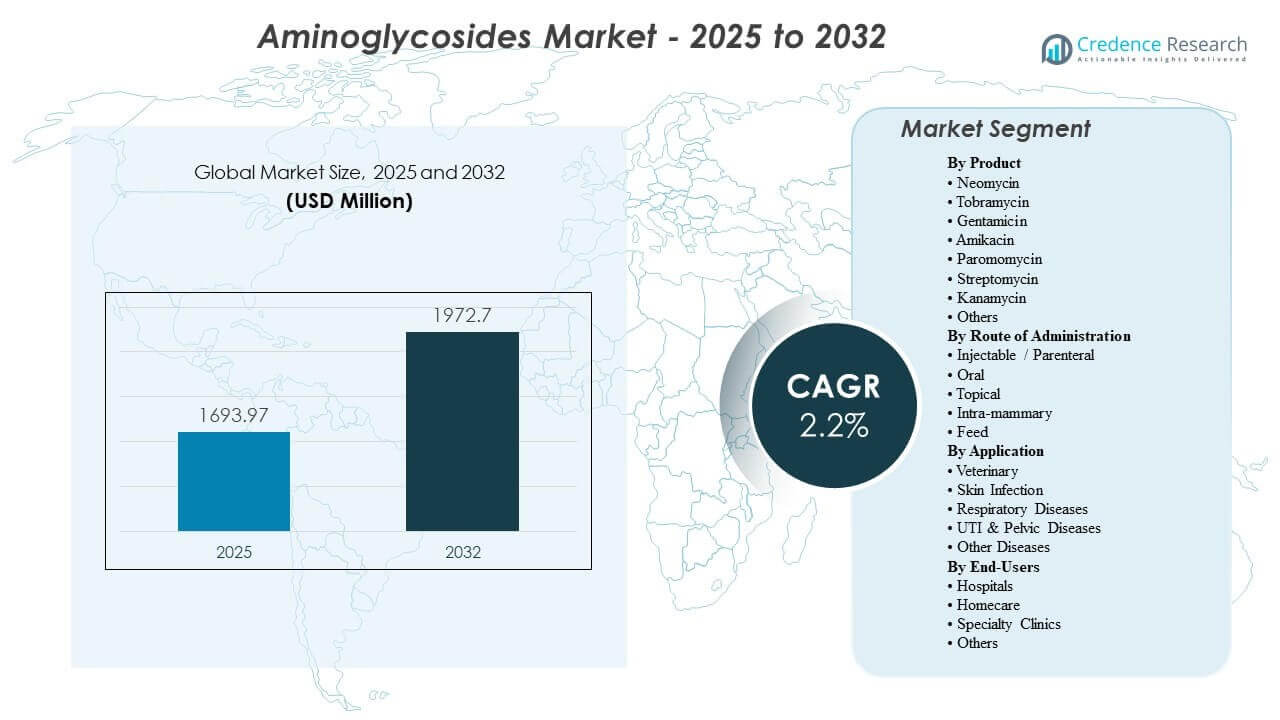
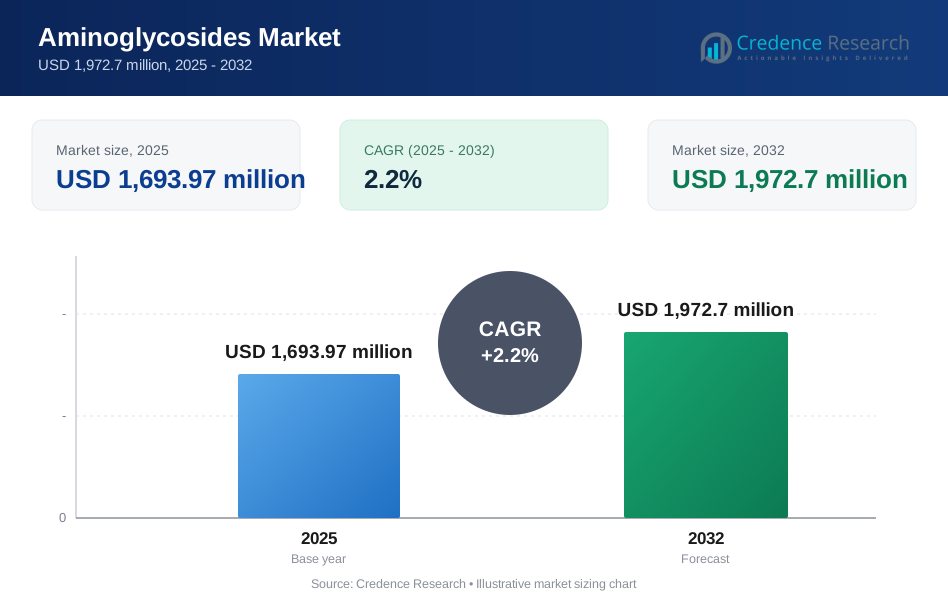
The Aminoglycosides Market is projected to grow from USD 1,693.97 million in 2025 to an estimated USD 1,972.7 million by 2032, with a compound annual growth rate (CAGR) of 2.2% from 2025 to 2032.
| REPORT ATTRIBUTE | DETAILS |
|---|---|
| Historical Period | 2020-2023 |
| Base Year | 2024 |
| Forecast Period | 2025-2032 |
| Aminoglycosides Market Size 2025 | USD 1,693.97 million |
| Aminoglycosides Market, CAGR | 2.2% |
| Aminoglycosides Market Size 2032 | USD 1,972.7 million |
Market growth is driven by rising multidrug-resistant infections and the need for reliable antibiotics that deliver fast and predictable outcomes. Healthcare providers depend on aminoglycosides for targeted activity against gram-negative pathogens, especially in intensive care units. New safety-focused formulations support wider acceptance by improving dosing precision and reducing toxicity concerns. Advances in therapeutic drug monitoring help clinicians optimize dosing decisions. Strong reliance on combination therapies further strengthens adoption across complex infection cases. Increased research on resistant bacterial strains also supports sustained market interest.
North America leads the Aminoglycosides Market due to strong hospital infrastructure and widespread use in critical care environments. Europe follows with established clinical guidelines that reinforce appropriate antibiotic use across major healthcare systems. Asia-Pacific is emerging rapidly because infection prevalence remains high and healthcare capacity is expanding in countries such as India and China. Latin America shows steady progression supported by improvements in diagnostic access and antimicrobial stewardship efforts. The Middle East and Africa continue to develop as healthcare systems modernize and demand rises for reliable broad-spectrum antibiotics.
Aminoglycosides Market Insights:
- The Aminoglycosides Market is projected to rise from USD 1,693.97 million in 2025 to USD 1,972.7 million by 2032, supported by steady demand across hospital and critical care settings.
- Rising multidrug-resistant infections strengthen the need for aminoglycosides, which offer fast bactericidal action and remain essential in severe gram-negative cases.
- Toxicity concerns and reliance on precise dosing continue to limit broader adoption, pushing healthcare providers to use strict therapeutic monitoring.
- North America leads due to strong hospital capacity and structured antibiotic protocols, while Europe maintains high usage through established clinical guidelines.
- Asia-Pacific emerges rapidly with rising infection prevalence and expanding healthcare infrastructure, widening opportunities for aminoglycoside adoption across clinical and veterinary settings.
Aminoglycosides Market Drivers
Rising Need For Effective Treatment Against Severe Bacterial Infections
The Aminoglycosides Market grows due to stronger demand for therapies that control severe gram-negative infections. Hospitals depend on fast bactericidal action to manage intensive care cases. It supports treatment pathways when resistance limits other antibiotics. Clinicians prefer reliable drugs with predictable outcomes in life-threatening conditions. New dosing approaches aim to reduce toxicity while maintaining clinical strength. Research teams track resistance trends to guide precise use. Regulatory bodies promote stewardship programs that support evidence-based prescribing. Broader awareness boosts confidence across healthcare professionals.
- For instance, Achaogen developed Plazomicin (Zemdri), which achieved an 82.4% microbiological eradication rate in patients with ESBL-producing Enterobacteriaceae during the EPIC Phase III trial, outperforming meropenem at 75%. The study also showed a higher composite cure rate for Plazomicin, demonstrating statistically significant superiority at the test-of-cure visit in complicated urinary tract infections.
Growing Use In Combination Therapy For High-Risk Patient Groups
Critical care units rely on aminoglycosides for combination regimens that target complex infections. The Aminoglycosides Market benefits from rising use in ventilator-associated pneumonia and bloodstream infections. It helps reduce treatment gaps when broad coverage is required. Hospitals follow established protocols that include dual-therapy strategies. Clinicians see improved outcomes when therapy aligns with pathogen profiles. Adoption rises in surgical and trauma cases where bacterial spread poses risks. New clinical data supports optimized dosing schedules. Wider protocol standardization strengthens acceptance.
Increasing Hospitalization Due To Complicated Infectious Diseases
Higher admission rates for severe infections support steady growth in aminoglycoside demand. Intensive care teams manage rising cases linked to chronic illness and compromised immunity. The drug class fits urgent treatment pathways that require speed and reliability. It remains vital when rapid escalation of therapy is needed. Hospitals maintain stock due to frequent emergency use. Clinical teams apply structured guidelines that preserve efficacy. Wider diagnostic use improves pathogen identification and supports targeted therapy decisions. Upgrades in emergency care boost adoption further.
- For instance, Pfizer Inc. supports global access to gentamicin through its long-established injectable antibiotic portfolio, which remains a core component of WHO-recommended regimens for neonatal sepsis. Early administration of gentamicin is clinically associated with improved survival outcomes in newborns with severe bacterial infections, reinforcing its continued importance in hospital protocols.
Advancements In Formulation And Delivery Safety Improvements
Reformulated products focus on improving safety while maintaining therapeutic strength. The Aminoglycosides Market gains momentum from once-daily dosing options that help reduce toxicity. It supports better monitoring due to simpler schedules. Digital tools help optimize levels during treatment. Hospitals deploy pharmacokinetic models that improve precision. Manufacturers improve purity and stability through advanced processes. Clinical teams gain clearer control over dosing adjustments. Enhanced delivery approaches reinforce confidence in high-risk settings.
Aminoglycosides Market Trends
Shift Toward Precision Dosing Supported By Digital Monitoring Tools
Healthcare providers adopt advanced digital tools that guide individualized dosing strategies. The Aminoglycosides Market gains traction from software that tracks serum levels and predicts adjustments. It improves safety by reducing exposure variance. Hospitals use automated alerts that support clinical teams. Remote monitoring expands visibility across care units. Pharmacists integrate digital dashboards into decision pathways. Better control supports compliance with stewardship goals. Rising tech adoption strengthens long-term clinical value.
Growing Interest In Novel Derivatives With Lower Toxicity Profiles
Researchers focus on next-generation aminoglycoside derivatives that target pathogens with fewer side effects. The trend supports long-term clinical acceptance. The Aminoglycosides Market benefits from trials that explore improved selectivity. It drives attention toward molecules engineered for safer kidney and ear outcomes. Drug developers use targeted design to refine binding patterns. Better tolerability improves suitability for broader patient groups. Hospitals track clinical datasets that support informed use. Advances encourage deeper investment across research portfolios.
- For instance, Juvabis, in collaboration with Roche, is advancing Apramycin, a novel aminoglycoside that has demonstrated significantly reduced ototoxicity in pre-clinical studies compared to gentamicin while maintaining strong activity against highly resistant Enterobacteriaceae, with published MIC values typically ranging from 2–8 µg/mL.
Expanding Diagnostic Capabilities Supporting Targeted Antibiotic Selection
Modern diagnostic tools shorten the time needed to identify resistant pathogens. Labs adopt rapid systems that guide therapy alignment. The Aminoglycosides Market gains relevance when decisions rely on faster pathogen visibility. It reinforces responsible antibiotic selection in high-risk units. Clinicians adopt culture-free tests that improve accuracy. Point-of-care diagnostics help reduce treatment delays. Hospitals integrate decision-support platforms for consistency. Better diagnostic clarity strengthens targeted treatment precision.
- For instance, the bioMérieux VITEK® REVEAL™ system delivers phenotypic AST results directly from positive blood cultures in an average of 5.5–6 hours, eliminating the 18–24-hour subculture step required by traditional methods. This faster turnaround allows clinicians to optimize or de-escalate aminoglycoside therapy much earlier, improving precision in managing severe infections.
Rising Focus On Antimicrobial Stewardship Programs In Clinical Settings
Health systems strengthen stewardship programs to manage antibiotic resistance. Hospitals track antibiotic utilization through structured protocols. The Aminoglycosides Market aligns with safe-use frameworks that reduce misuse. It benefits from policies that promote evidence-based prescribing. Education programs help clinicians refine patient selection. Data dashboards monitor compliance over time. Multidisciplinary teams support corrective actions. Strong stewardship pushes the market toward controlled and appropriate use.
Aminoglycosides Market Challenges Analysis
Concerns Over Toxicity And Narrow Therapeutic Window
Clinicians remain cautious due to risks linked to kidney and ear toxicity. The Aminoglycosides Market sees constraints when dosing precision becomes difficult. It demands careful monitoring to avoid adverse effects. Hospitals require trained teams to track serum levels accurately. Limited flexibility reduces suitability for vulnerable groups. Clinicians adjust therapy frequently to maintain safe ranges. High monitoring needs increase resource use. Caution limits broader application despite clinical strength.
Rising Antimicrobial Resistance And Limited Novel Drug Development
Resistance growth limits effectiveness and forces clinicians to preserve aminoglycoside use for severe cases. The Aminoglycosides Market faces pressure when resistant strains reduce treatment value. It raises concern for long-term reliability. Few new drugs enter pipelines, slowing innovation. Researchers struggle with complex design challenges. Hospitals seek guidance to manage resistance trends. Policy makers push stewardship to reduce misuse. Slow drug development restricts rapid market expansion.
Aminoglycosides Market Opportunities
Stronger Demand In Emerging Regions With High Infection Burden
Emerging countries experience higher rates of severe bacterial infections that require potent antibiotics. The Aminoglycosides Market benefits from rising healthcare access in these regions. It gains momentum when hospitals upgrade critical care units. Governments invest in infection control programs. Clinicians integrate structured treatment protocols to handle complex cases. Better diagnostic capacity supports targeted prescribing. Expanding medical infrastructure widens adoption. Higher awareness strengthens long-term growth prospects.
Potential For Innovation In Safer Derivatives And Advanced Delivery Systems
Drug developers explore safer molecules that maintain strong bactericidal action. The Aminoglycosides Market sees opportunity in systems that reduce toxicity risk. It aligns with research targeting precision mechanisms. Improved delivery technologies help refine dosing accuracy. Hospitals welcome innovations that reduce monitoring pressure. Partnerships support faster clinical evaluation. New data encourages broader regulatory acceptance. Better safety profiles improve suitability for larger patient groups.
Aminoglycosides Market Segmentation Analysis:
By Product
The Aminoglycosides Market shows steady adoption across key molecules such as neomycin, tobramycin, gentamicin, and amikacin. Each drug supports treatment pathways for severe bacterial infections requiring fast bactericidal action. Gentamicin and amikacin hold strong use in critical care due to broad pathogen coverage. Tobramycin sees higher demand in respiratory infection management. Paromomycin remains relevant for parasitic diseases. Streptomycin and kanamycin maintain use in specific infectious disease programs. The “others” category includes emerging formulations targeting resistant strains and improved safety profiles.
By Route of Administration
Injectable and parenteral forms dominate the Aminoglycosides Market because clinicians rely on rapid systemic delivery for life-threatening infections. It supports intensive care protocols that require high serum concentration. Oral formulations serve targeted therapeutic needs where absorption aligns with clinical goals. Topical products deliver localized treatment for skin and eye infections. Intra-mammary routes see consistent veterinary adoption for mastitis control. Feed-based routes support livestock health management programs across major agriculture markets.
By Application
Veterinary use forms a strong part of the Aminoglycosides Market due to high infection prevalence in livestock. Skin infection treatment benefits from broad-spectrum activity and predictable outcomes. Respiratory disease management relies on tobramycin and gentamicin due to strong pathogen coverage. UTI and pelvic disease therapies follow structured protocols using amikacin and gentamicin. Other diseases include rare or resistant infections that require potent antibiotic regimens. It supports consistent clinical demand across primary and specialty settings.
- For instance, Cipla’s launch of ZEMDRI (plazomicin) demonstrated strong activity against ESBL-producing Enterobacteriaceae with documented MIC values significantly lower than conventional aminoglycosides.
By End-Users
Hospitals lead the Aminoglycosides Market because intensive care and emergency units require fast-acting antibiotics. Specialty clinics support use in pulmonology, infectious disease, and surgical care. Homecare adoption grows for chronic respiratory therapies using inhaled formulations. The “others” segment covers long-term care centers and outpatient facilities that follow structured treatment protocols. It benefits from improved monitoring tools that help manage toxicity risks and maintain dosing precision.
- For instance, Thermo Fisher Scientific has advanced hospital-based monitoring through its QMS Gentamicin Immunoassay, which allows clinical labs to maintain therapeutic drug windows between 0.5 µg/mL and 10.0 µg/mL with a precision coefficient of variation (CV) of less than 5%.
Aminoglycosides Market Segmentation:
By Product
- Neomycin
- Tobramycin
- Gentamicin
- Amikacin
- Paromomycin
- Streptomycin
- Kanamycin
- Others
By Route of Administration
- Injectable / Parenteral
- Oral
- Topical
- Intra-mammary
- Feed
By Application
- Veterinary
- Skin Infection
- Respiratory Diseases
- UTI & Pelvic Diseases
- Other Diseases
By End-Users
- Hospitals
- Homecare
- Specialty Clinics
- Others
By Regional
- North America
- U.S.
- Canada
- Mexico
- Europe
- Germany
- France
- U.K.
- Italy
- Spain
- Rest of Europe
- Asia Pacific
- China
- Japan
- India
- South Korea
- South-east Asia
- Rest of Asia Pacific
- Latin America
- Brazil
- Argentina
- Rest of Latin America
- Middle East & Africa
- GCC Countries
- South Africa
- Rest of the Middle East and Africa
Regional Analysis:
North America holds the largest share of the Aminoglycosides Market, supported by strong hospital networks and advanced critical care infrastructure. The region accounts for nearly 35% of global use due to high adoption in ICU and emergency settings. It benefits from strict antimicrobial stewardship programs that guide structured prescribing. Demand rises in respiratory and surgical infection management. Pharmaceutical manufacturers maintain steady supply capacity across major markets. The region continues to invest in infection surveillance systems that support informed antibiotic selection.
Europe holds the second-largest share of the global market, capturing close to 28% due to strong clinical guidelines and consistent demand across hospital systems. The Aminoglycosides Market gains stable traction in countries that maintain high diagnostic accuracy. It supports structured care pathways for severe gram-negative infections. Clinicians rely on established treatment protocols for UTI, respiratory disease, and surgical complications. Research institutions contribute through trials focused on safer formulations. Regulatory bodies reinforce controlled use to maintain long-term effectiveness.
Asia-Pacific is the fastest-growing region, accounting for nearly 30% of global market share driven by high infection burden and expanding healthcare access. The Aminoglycosides Market grows as hospitals strengthen their critical care capacity in China, India, and Southeast Asia. It sees rising adoption in veterinary care due to large livestock populations. Clinical teams in emerging markets depend on aminoglycosides for cost-effective broad-spectrum coverage. Investments in diagnostic tools support better antibiotic alignment. Improving hospital infrastructure fuels continued market progression.
Key Player Analysis:
- Pfizer Inc.
- Cipla Limited
- AbbVie Inc. (Allergan PLC)
- Teva Pharmaceutical Industries Ltd.
- Hikma Pharmaceuticals PLC
- Sun Pharmaceutical Industries Ltd.
- Lupin Limited
- Zoetis Inc.
- Merck & Co., Inc.
- Fresenius Kabi
- Viatris Inc.
- Amneal Pharmaceuticals, Inc.
- Insmed Incorporated
- Novartis AG
- Johnson & Johnson
- Bristol Myers Squibb Company
- Aurobindo Pharma
Competitive Analysis:
The Aminoglycosides Market features a competitive landscape shaped by established pharmaceutical companies with strong manufacturing and distribution capabilities. It includes players that supply generic formulations and maintain large-scale production networks. Companies focus on improving purity levels, reducing toxicity risks, and refining delivery formats. Product differentiation remains modest, which intensifies price competition across global markets. Firms strengthen market presence through supply-chain expansion into fast-growing regions. Strategic partnerships help increase access to veterinary and human health sectors. R&D efforts target next-generation derivatives with safer profiles. Competitive pressure encourages companies to maintain regulatory compliance and consistent product quality across key markets.
Recent Developments:
- In May 2025, Cipla Limited launched ZEMDRI (Plazomicin), a novel intravenous aminoglycoside designed to treat complicated urinary tract infections, enhancing options against antimicrobial resistance.
Report Coverage:
The research report offers an in-depth analysis based on Product, Route of Administration, Application, End-Users and Regional. It details leading market players, providing an overview of their business, product offerings, investments, revenue streams, and key applications. Additionally, the report includes insights into the competitive environment, SWOT analysis, current market trends, as well as the primary drivers and constraints. Furthermore, it discusses various factors that have driven market expansion in recent years. The report also explores market dynamics, regulatory scenarios, and technological advancements that are shaping the industry. It assesses the impact of external factors and global economic changes on market growth. Lastly, it provides strategic recommendations for new entrants and established companies to navigate the complexities of the market.
Future Outlook:
- Demand for broad-spectrum therapies is expected to strengthen as healthcare systems manage rising cases of severe bacterial infections.
- Safer formulations will gain attention as research teams refine molecules that lower toxicity risks without reducing therapeutic strength.
- Digital dosing tools will support precise monitoring and improve clinician confidence across intensive care units.
- Growth in emerging markets will rise as hospital infrastructure expands and diagnostic capabilities improve.
- Veterinary use is likely to remain stable due to ongoing infection management needs in livestock sectors.
- Combination therapy strategies are expected to grow as clinicians manage complex infections requiring rapid bactericidal action.
- Rising antimicrobial stewardship efforts will guide controlled, evidence-based use across hospital systems.
- Pharmaceutical firms may expand production capacity to strengthen supply continuity across global regions.
- Innovation in inhaled and topical formats could widen adoption across respiratory and skin infection segments.
- Stronger regulatory focus on quality and purity will push manufacturers to adopt advanced manufacturing standards
Request a Free Sample
Fill in your details and we'll send you a free sample report.
- Sample data tables & charts
- Research methodology
Need a Custom Version of This Report?
Tailor the scope, geography, or segments to your exact requirements.
- Custom geography or segment scope
- Direct access to our analyst team
Frequently Asked Questions
What is the current market size for Aminoglycosides Market, and what is its projected size in 2032?
At what Compound Annual Growth Rate is the Aminoglycosides Market projected to grow between 2025 and 2032?
Which Aminoglycosides Market segment held the largest share in 2025?
What are the primary factors fueling the growth of the Aminoglycosides Market?
Who are the leading companies in the Aminoglycosides Market?
Which region commanded the largest share of the Aminoglycosides Market in 2025?
Table of Content
Chapter 1. Report Introduction
- 1.1 Report Description & Purpose
- 1.1.1 Report Title & Market Definition
- 1.1.2 Unique Selling Propositions (USP) & Key Differentiators
- 1.1.3 Value Proposition for Stakeholders
- 1.2 Research Objectives
- 1.2.1 Market Sizing Objectives (Volume & Revenue)
- 1.2.2 Segmentation Objectives
- 1.2.3 Competitive Intelligence Objectives
- 1.2.4 Forecast & Scenario Objectives
- 1.3 Report Scope
- 1.3.1 Aminoglycosides Scope – Types & Subtypes Covered
- 1.3.2 Geographic Scope – Regions & Countries Covered
- 1.3.3 Historical Period, Base Year & Forecast Period (2025; forecast to 2032)
- 1.3.4 Inclusions & Exclusions
- 1.4 HS Code & Classification Framework
- 1.5 Currency, Units & Pricing Basis
- 1.6 Target Stakeholders
- 1.7 Limitations & Assumptions
Chapter 2. Executive Summary
- 2.1 Global Aminoglycosides Market Snapshot
- 2.1.1 Market Size – Historical (2025) & Forecast (2025-2032) (2025: USD 1,693.97 million → 2032: USD 1,972.7 million)
- 2.1.2 Volume & Revenue – Global Totals
- 2.1.3 Key Market Highlights – Top Five Facts
- 2.2 Aminoglycosides Market Segmentation Snapshot
- 2.2.1 Market Split by Region – 2025 vs. 2032
- 2.3 Competitive Snapshot
- 2.3.1 Top 10 Players by Revenue Share – 2025
- 2.3.2 Top 10 Players by Volume Share – 2025
- 2.3.3 Recent Strategic Developments (18-Month Summary)
- 2.4 Key Investment Highlights & Strategic Conclusions
Chapter 3. Aminoglycosides Market Dynamics & Industry Analysis
- 3.1 Market Overview & Context
- 3.1.1 Aminoglycosides Market Position in the Broader Automotive Value Chain
- 3.1.2 OEM vs. Replacement Market Dynamics
- 3.1.3 Market Maturity & Development Stage by Region
- 3.2 Aminoglycosides Market Drivers
- 3.3 Aminoglycosides Market Restraints & Challenges
- 3.4 Aminoglycosides Market Opportunities
- 3.5 Porter's Five Forces Analysis
- 3.5.1 Threat of New Entrants
- 3.5.2 Bargaining Power of Suppliers
- 3.5.3 Bargaining Power of Buyers
- 3.5.4 Threat of Substitutes
- 3.5.5 Competitive Rivalry – Intensity Assessment
- 3.6 Aminoglycosides Value Chain Analysis
- 3.6.1 Upstream – Raw Material/Input Suppliers
- 3.6.1.1 Raw Material/Input 1
- 3.6.1.2 Raw Material/Input 2
- 3.6.1.3 Raw Material/Input 3
- 3.6.2 Midstream – Production/Manufacturing/Service Delivery
- 3.6.2.1 Production/Process Overview
- 3.6.2.2 Key Facility Locations & Capacity by Manufacturer
- 3.6.3 Downstream – Distribution & End Consumer
- 3.6.3.1 Primary Channel – B2B/OEM
- 3.6.3.2 Secondary Channels – Dealer, Retail, Online, Direct
- 3.6.4 Value Chain Profitability Analysis
- 3.6.1 Upstream – Raw Material/Input Suppliers
- 3.7 PESTEL Analysis
- 3.7.1 Political Factors
- 3.7.2 Economic Factors
- 3.7.3 Social Factors
- 3.7.4 Technological Factors
- 3.7.5 Environmental Factors
- 3.7.6 Legal Factors
- 3.8 Aminoglycosides Supply Chain Analysis
- 3.8.1 Raw Material/Input Supply Risk Assessment
- 3.8.2 Manufacturing Concentration Risk (Geographic Exposure)
- 3.8.3 Trade Disruption Impact Analysis
- 3.9 Regulatory & Policy Landscape
Note: The regulatory and policy landscape section covers regulations based on their applicability to the market, Aminoglycosides category, geography, and scope of the study. Only regulatory frameworks with a material impact on operations, compliance, trade, sustainability, or market access are analyzed in detail.
Chapter 4. Key Investment Pockets & Opportunity Analysis
- 4.1 Aminoglycosides Market Attractiveness Analysis
- 4.1.1 By Region – Investment Attractiveness Matrix (Volume × CAGR)
- 4.2 Absolute Revenue Growth Opportunity
- 4.2.1 By Region – Absolute USD Growth Through 2032
- 4.3 Incremental Volume Opportunity
- 4.3.1 By Region – Incremental Volume Through 2032
- 4.3.2 Segment – Incremental Volume
- 4.4 Emerging Submarket Opportunity Deep Dive (Subject to Applicability)
- 4.5 Emerging Market Opportunity Scorecards
- 4.5.1 United States
- 4.5.2 Europe
- 4.5.3 Asia
- 4.5.4 Middle East & Africa
Note: Emerging Market Opportunity Scorecards will be included based on relevance and strategic importance. Regions listed are indicative and may vary depending on data availability and market dynamics.
Chapter 5. Aminoglycosides Import-Export Analysis & Trade Flows
- 5.1 Global Trade Overview
- 5.1.1 Global Export Value by Country (2025)
- 5.1.2 Global Export Volume by Country (2025)
- 5.1.3 Global Import Value by Country (2025)
- 5.1.4 Global Import Volume by Country (2025)
- 5.1.5 Net Trade Balance by Country (2025)
- 5.2 Export Analysis – Segment
- 5.2.1 Type 1 (HS Code)
- 5.2.2 Type 2 (HS Code)
- 5.2.3 Type 3 (HS Code)
- 5.2.4 Type 4 (HS Code)
- 5.2.5 Type 5 (HS Code)
- 5.3 Import Analysis – Segment
- 5.3.1 Type 1 (HS Code)
- 5.3.2 Type 2 (HS Code)
- 5.3.3 Type 3 (HS Code)
- 5.3.4 Type 4 (HS Code)
- 5.3.5 Type 5 (HS Code)
- 5.4 Average Unit Trade Prices
- 5.4.1 Average Export Price – Segment & Country
- 5.4.2 Average Import Price – Segment & Source Country
- 5.4.3 Price Trends (2025)
- 5.5 Key Trade Route Analysis
- 5.5.1 Trade Route 1
- 5.5.2 Trade Route 2
- 5.5.3 Trade Route 3
- 5.5.4 Trade Route 4
- 5.5.5 Trade Route 5
- 5.6 Trade Policy Impact Assessment
- 5.6.1 US Anti-Dumping & Section 301 Tariffs
- 5.6.2 EU Customs Union Impact
- 5.6.3 Major Free Trade Agreements
- 5.6.4 USMCA Rules of Origin
Note: Trade policy analysis will be included only where relevant to the Aminoglycosides market.
Chapter 6. Competitive Landscape & Company Benchmarking
- 6.1 Aminoglycosides Market Concentration & Structure
- 6.1.1 Herfindahl-Hirschman Index (HHI) – vs. 2025
- 6.1.2 Tier 1, Tier 2 & Tier 3 Market Structure
- 6.1.3 Global, Regional & Local Player Dynamics
- 6.2 Aminoglycosides Market Share Analysis – 2025
- 6.2.1 Global Revenue Share by Company
- 6.2.2 Global Volume Share by Company
- 6.2.3 Regional Revenue Share
- 6.2.4 Market Share Evolution ( vs. 2025)
- 6.2.5 OEM Segment Share by Company
- 6.2.6 Replacement Segment Share by Company
- 6.3 Production/Delivery Capacity & Facility Analysis
- 6.3.1 Global Installed Capacity
- 6.3.2 Capacity Utilization Rates
- 6.3.3 Production/Output Volume
- 6.3.4 Facility Locations & Capacity Map
- 6.3.5 Planned Capacity Additions
- 6.4 Aminoglycosides Competitive Benchmarking Matrix
- 6.4.1 Revenue, Volume, CAGR & Profitability Comparison
- 6.4.2 Channel Revenue Mix
- 6.4.3 Geographic Revenue Exposure
- 6.4.4 R&D Intensity
- 6.4.5 Sustainability Maturity
- 6.5 Strategic Developments in Aminoglycosides (Last 24 Months)
- 6.5.1 Mergers, Acquisitions & Divestments
- 6.5.2 New Aminoglycosides Launches
- 6.5.3 Facility Expansions
- 6.5.4 Strategic Alliances, Joint Ventures & Partnerships
- 6.5.5 Distribution Expansion & Market Entry
- 6.5.6 Sustainability & ESG Initiatives
- 6.6 Competitive Strategy Mapping
- 6.6.1 Leader, Challenger, Follower & Niche Classification
- 6.6.2 Pricing Strategy Comparison
- 6.6.3 Channel Strategy Matrix
Note: Strategic developments are included based on their materiality and the availability of reliable information.
Chapter 7. Global Aminoglycosides Market – By Distribution Channel
- 7.1 Segment Overview
- 7.1.1 Volume & Revenue Split by Channel (2025 & 2032)
- 7.1.2 Channel Mix Evolution (2025-2032)
Chapter 8. Regional Market Analysis – Global Overview
- 8.1 Global Regional Overview
- 8.1.1 Regional Volume Share
- 8.1.2 Regional Revenue Share
- 8.1.3 Regional Volume by Region
- 8.1.4 Regional Revenue by Region
- 8.1.5 Regional Forecast Through 2032
- 8.2 Cross-Regional Segment Analysis
- 8.2.1 By Distribution Channel
- 8.2.2 By Brand/Price Tier
Chapter 9. North America Aminoglycosides Market
- 9.1 United States
- 9.2 Canada
- 9.3 Mexico
Chapter 10. Europe Aminoglycosides Market
- 10.1 Germany
- 10.2 France
- 10.3 Italy
- 10.4 United Kingdom
- 10.5 Spain
- 10.6 Poland
- 10.7 Russia
- 10.8 Netherlands
- 10.9 Belgium
- 10.10 Sweden
- 10.11 Denmark
- 10.12 Norway
- 10.13 Rest of Europe
Chapter 11. Asia Pacific Aminoglycosides Market
- 11.1 China
- 11.2 India
- 11.3 Japan
- 11.4 South Korea
- 11.5 Thailand
- 11.6 Indonesia
- 11.7 Vietnam
- 11.8 Malaysia
- 11.9 Australia
- 11.10 Rest of Asia Pacific
Chapter 12. Latin America Aminoglycosides Market
- 12.1 Brazil
- 12.2 Argentina
- 12.3 Colombia
- 12.4 Chile
- 12.5 Rest of Latin America
Chapter 13. Middle East Aminoglycosides Market
- 13.1 Saudi Arabia
- 13.2 United Arab Emirates
- 13.3 Turkey
- 13.4 Israel
- 13.5 Iran
- 13.6 Rest of the Middle East
Chapter 14. Africa Aminoglycosides Market
- 14.1 South Africa
- 14.2 Egypt
- 14.3 Nigeria
- 14.4 Morocco
- 14.5 Rest of Africa
Chapter 15. Aminoglycosides Company Profiles
- 15.1 [Company 01]
- 15.1.1 Company Overview
- 15.1.2 Key Management Personnel
- 15.1.3 Products & Services Portfolio
- 15.1.4 Financial Performance
- 15.1.5 Key Market Focus & Geographic Presence
- 15.1.6 Recent Developments & Strategic Initiatives
Note: The company profile list is preliminary and may change based on research findings, market developments, data availability, and client requirements.
Chapter 16. Appendices
- Appendix A – List of Abbreviations & Acronyms
- Appendix B – Industry Classification Code Reference – Full Series
- Appendix C – Production & Capacity Data Tables
- Appendix D – End-Use & Demand Base Tables
- Appendix E – Consumption & Replacement Rate Assumptions
- Appendix F – ASP Reference Tables
- Appendix G – Manufacturing & Facility Database
- Appendix H – Import-Export Data Tables
- Appendix I – Regulatory Summary Tables
- Appendix J – Primary Research Participant List (Anonymized)
- Appendix K – Primary Research Questionnaire Framework
- Appendix L – Data Sources & Bibliography
- Appendix M – Market Size Divergence & Source Comparison
Chapter 17. Research Methodology
- 17.1 Research Framework & Philosophy
- 17.2 Secondary Research – Sources, Hierarchy & Data Extraction
- 17.3 Data Modeling – Bottom-Up & Top-Down Market Sizing
- 17.4 Primary Research – Stakeholder Framework, LOI & Sample Sizes
- 17.5 Forecast Methodology – Regression, Scenario & Sensitivity Analysis
- 17.6 Quality Control – Four-Layer Validation Framework
- 17.7 Limitations & Standard Assumptions
- 17.8 Disclaimer
