
Angio Suites Market Overview:
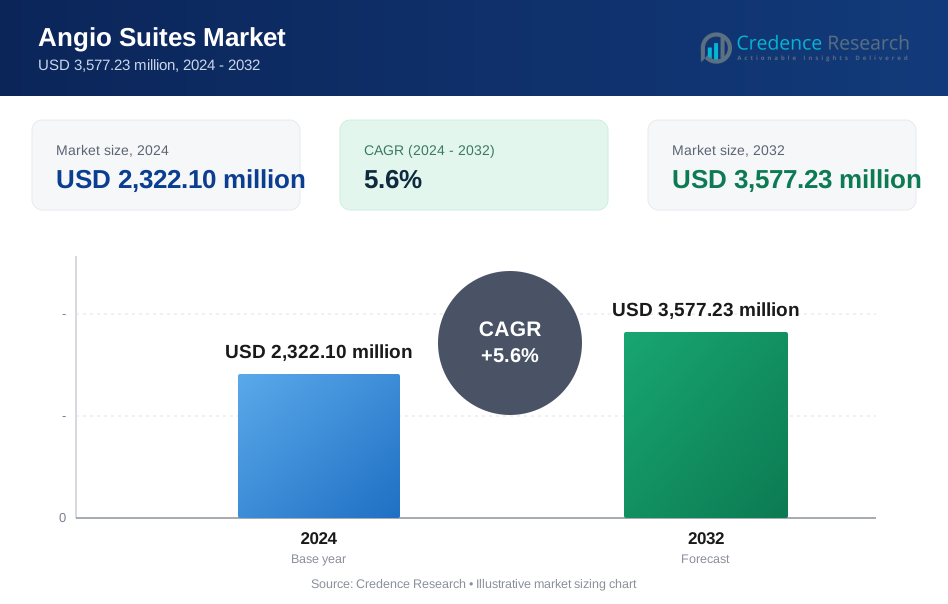
The Angio Suites Market is projected to grow from USD 2,322.1 million in 2024 to an estimated USD 3,577.23 million by 2032, with a compound annual growth rate (CAGR) of 5.6% from 2024 to 2032.
| REPORT ATTRIBUTE | DETAILS |
|---|---|
| Historical Period | 2020-2023 |
| Base Year | 2024 |
| Forecast Period | 2025-2032 |
| Angio Suites Market Size 2024 | USD 2,322.1 million |
| Angio Suites Market, CAGR | 5.6% |
| Angio Suites Market Size 2032 | USD 3,577.23 million |
The market expands as minimally invasive treatments gain preference across global health systems. Hospitals invest in advanced imaging that improves precision, lowers radiation exposure, and supports better treatment outcomes. Demand strengthens as clinicians rely on high-resolution visualization for stenting, angioplasty, and complex vascular repairs. Hybrid operating rooms attract investment due to their ability to facilitate multiple procedures without patient repositioning. Faster imaging, improved software guidance, and integrated device compatibility help streamline workflows. This shift supports long-term growth as providers prioritize safety, accuracy, and efficient case management.
North America leads the market due to strong technological adoption and widespread availability of advanced interventional facilities. Europe follows, supported by modernization of clinical infrastructure and rising demand for minimally invasive vascular and neurovascular interventions. Asia Pacific emerges as the fastest growing region as healthcare systems expand specialized cardiac and neurointerventional centers. Latin America and the Middle East show steady progress with investments in tertiary care and diagnostic imaging upgrades. Each region advances based on procedural demand, hospital capability, and clinical readiness.
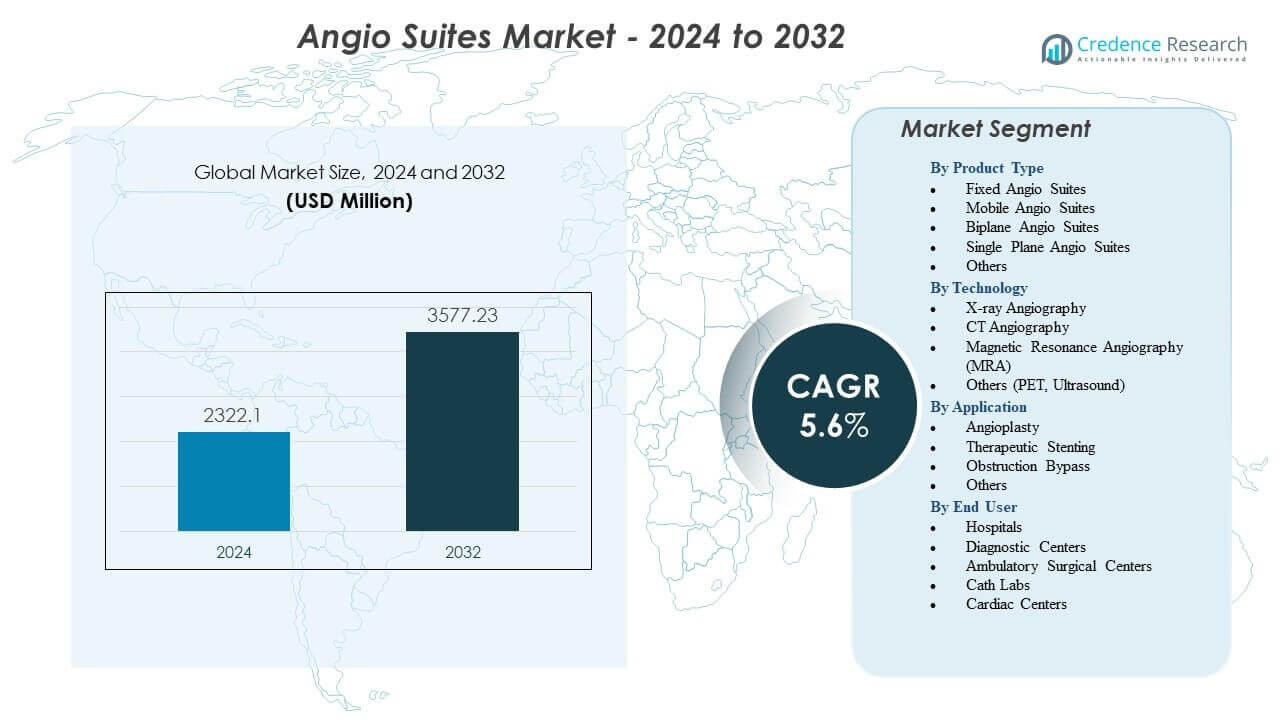
Angio Suites Market Insights:
- The Angio Suites Market is projected to grow from USD 2,322.1 million in 2024 to USD 3,577.23 million by 2032, reflecting a 5.6% CAGR driven by rising adoption of hybrid and image-guided interventional systems.
- Demand increases as hospitals prioritize minimally invasive procedures supported by high-precision imaging that improves workflow efficiency and clinical accuracy.
- Market restraints emerge from high installation costs, complex infrastructure requirements, and the need for specialized interventional staff across many facilities.
- Regional trends show North America leading due to advanced clinical capabilities, Europe expanding through modernization efforts, and Asia Pacific growing rapidly with rising investment in cardiovascular and neurovascular centers.
- Long-term growth remains supported by continuous technology upgrades, broader clinical applications, and increasing preference for integrated, multi-modality angio environments.
Angio Suites Market Drivers
Growing Preference for Image-Guided Interventions and Hybrid Operating Room Expansion
The Angio Suites Market grows with a steady rise in image-guided procedures across cardiology, oncology, and neurovascular care. Hospitals rely on advanced systems to support precision-driven workflows. Clinicians use integrated platforms to reduce procedural risks and enhance treatment accuracy. Hybrid operating rooms support a wider range of interventions without patient transfers. Many facilities upgrade legacy rooms to boost efficiency and safety. Vendors design systems that offer flexible configurations for multiple specialties. Demand increases in high-acuity centers that handle complex cases. It strengthens the need for continuous equipment improvement.
Increasing Burden of Cardiovascular and Neurovascular Diseases Worldwide
Rising cases of stroke and coronary artery disease push healthcare providers to adopt advanced interventional solutions. The Angio Suites Market benefits from a higher volume of minimally invasive treatments. Hospitals focus on early diagnosis and targeted therapies to reduce mortality. Many health systems invest in faster imaging platforms that support timely decision-making. Clinicians rely on real-time visualization to manage complex lesions. Governments support advanced care models to reduce clinical backlogs. Patients prefer procedures with reduced trauma and quicker recovery. It supports the long-term demand for modern suites.
- For instance, GE Healthcare’s IGS 7 platform uses a CMOS detector with 2.3× higher DQE, improving lesion visualization in low-dose settings.
Rapid Technology Innovation Enhancing Workflow Speed and Clinical Outcomes
Technology upgrades transform operational efficiency across high-volume centers. Intelligent software tools support faster image processing and smoother workflow management. The Angio Suites Market gains traction when providers adopt AI-supported navigation and automation features. Vendors introduce detector improvements that enhance resolution. Many systems support multi-modality integration for smoother transitions during procedures. Efficiency improves when teams use guided protocols and standardized workflows. Hospitals observe fewer delays during complex interventions. It encourages active replacement of slower and outdated units.
- For instance, Philips SmartCT enables 3D acquisition with a single touch and reconstructs volumes in under 3 seconds.
Growing Shift Toward Minimally Invasive Care Across Global Health Systems
Minimally invasive care continues to influence investment decisions across hospitals. Physicians rely on advanced imaging to perform targeted interventions with greater accuracy. Increased demand for shorter hospital stays drives adoption of modern suites. Many patients prefer procedures with lower risks and reduced pain. The Angio Suites Market supports this shift with improved image clarity and device compatibility. Clinics gain confidence from predictable outcomes and smoother recoveries. Global health systems promote technologies that limit surgical trauma. It builds sustained demand for next-generation angio platforms.
Angio Suites Market Trends
Rising Integration of Robotics and Intelligent Navigation Tools in Modern Suites
Robotics gains traction in many centers that aim to improve precision. Robotic controls support physicians during delicate vascular interventions. The Angio Suites Market witnesses deeper integration of intelligent navigation tools. Guided movements reduce variations in operator technique. Many systems support remote positioning to lower radiation exposure. Robotics increases consistency across repeated procedures. Hospitals explore semi-automated workflows to reduce fatigue. It pushes vendors to design advanced user interfaces.
- For instance, Siemens Healthineers' Nexaris Hybrid OR integrates the ARTIS icono angiography system with robotic C-arm movement capable of 250° orbital rotation and sub-millimeter positioning accuracy.
Growing Adoption of Multi-Modality Imaging for Comprehensive Care Delivery
Multi-modality configurations allow teams to access CT, ultrasound, and fluoroscopy within one environment. Many hospitals prefer integrated layouts for smoother transitions. The Angio Suites Market benefits when teams require broader diagnostic support during interventions. Combined imaging reduces delays and movement-related risks. Physicians depend on enhanced clarity when treating complex vascular structures. System upgrades support advanced visualization protocols. Many vendors offer modular designs that adapt to different specialties. It expands the scope of applications in one suite.
- For instance, Canon Medical’s Alphenix 4D CT launched in Europe in 2025 combines Alphenix Sky+ angio imaging with Aquilion ONE / INSIGHT Edition CT featuring a 0.24-second rotation speed and 16 cm volumetric coverage.
Increasing Focus on Radiation Dose Optimization and Staff Safety
Healthcare providers invest in platforms that reduce radiation exposure for patients and staff. Many systems include dose-tracking software and smart shielding. The Angio Suites Market supports this shift by offering features that limit unnecessary exposure. Hospitals enforce strict safety guidelines to protect interventional teams. Vendors develop detectors that produce clearer images at lower doses. Safety-driven procurement policies guide purchasing patterns. Staff training programs strengthen compliance. It encourages steady innovation in radiation-efficient technologies.
Expansion of Digital Connectivity and Data-Driven Workflow Management
Digital tools support better coordination between imaging devices, patient records, and clinical systems. Many hospitals use integrated dashboards to monitor procedural metrics. The Angio Suites Market grows when facilities adopt real-time data flow to enhance decision-making. Analytics tools help teams predict workflow bottlenecks. Remote system monitoring improves uptime and reduces disruptions. Digital platforms support automated documentation and quality tracking. Facilities aim to improve operational visibility across departments. It increases interest in connected suite infrastructure.
Angio Suites Market Challenges Analysis
High Capital Costs, Complex Installation Requirements, and Slow Replacement Cycles
High investment costs limit adoption across smaller facilities. Many hospitals face budget constraints that delay upgrades. Complex installation work requires structural changes that extend project timelines. The Angio Suites Market faces hurdles when facilities struggle with long procurement cycles. Operating rooms often require significant downtime during setup. Replacement decisions slow down when older systems remain functional. High maintenance costs challenge long-term planning. It places pressure on vendors to offer flexible financing models.
Shortage of Skilled Interventional Staff and Rising Technical Complexity of New Systems
Many regions face shortages of trained interventional radiologists and technicians. New systems require advanced training that extends onboarding periods. The Angio Suites Market encounters barriers when staff struggle to adapt to complex controls. Hospitals experience workflow delays during skill transitions. Rapid technology evolution increases the learning curve. Staff fatigue rises in high-acuity environments. Providers seek simplified interfaces to reduce errors. It pushes manufacturers to improve usability and training support.
Angio Suites Market Segmentation Analysis:
By Product Type
The Angio Suites Market shows steady demand across fixed, mobile, biplane, single-plane, and other configurations. Fixed suites support high-volume hospitals that rely on stable infrastructure and broad procedural capability. Mobile suites help facilities manage space limits and budget priorities while keeping imaging access flexible. Biplane suites remain important for neurovascular and cardiac teams that require dual-angle visualization for complex procedures. Single-plane systems support routine vascular and diagnostic interventions. Other configurations, including ceiling- or floor-mounted units, help providers adapt to layout needs. It supports diverse clinical environments that prioritize precision and workflow efficiency.
- For instance, Siemens Healthineers’ ARTIS pheno delivers a 16 GB/s data pipeline and achieves 0.36 µGy/frame ultra-low-dose imaging
By Technology
Technology adoption within the Angio Suites Market centers on X-ray angiography, CT angiography, MRA, and other modalities such as PET or ultrasound. X-ray systems lead due to widespread use in vascular and cardiac procedures. CT angiography supports fast diagnostic decisions and clearer anatomical mapping. MRA helps clinicians manage patients who require non-ionizing techniques. PET and ultrasound expand functional insights for targeted care. Hospitals select mixed technologies that support procedural accuracy. It strengthens the role of suites in advanced interventional pathways.
By Application
Application trends in the Angio Suites Market cover angioplasty, therapeutic stenting, obstruction bypass, and other procedures across neurology, oncology, cardiology, and peripheral vascular care. Angioplasty remains a core use case in many centers. Therapeutic stenting supports treatment pathways that depend on precise device placement. Obstruction bypass procedures require advanced visualization for improved safety. Other applications help clinicians manage diverse acute and elective cases. It reinforces the need for imaging that improves decision-making and reduces procedural risks.
- For instance, Philips HyperVue DeepOCT delivers 10-micron plaque-level resolution. Stenting workflows improve for instance, Siemens syngo Application Protocols reduce procedural steps by up to 20%.
By End User
End-user adoption in the Angio Suites Market spans hospitals, diagnostic centers, ambulatory surgical centers, cath labs, and cardiac centers. Hospitals lead due to wide procedural scope and higher investment capacity. Diagnostic centers increasingly adopt suites to expand service offerings. Ambulatory surgical centers use compact systems for targeted interventional workflows. Cath labs rely on advanced imaging to manage coronary and vascular procedures. Cardiac centers use suites to support complex structural interventions. It ensures strong demand for platforms that improve accuracy and clinical efficiency.
Angio Suites Market Segmentation:
By Product Type
- Fixed Angio Suites
- Mobile Angio Suites
- Biplane Angio Suites
- Single Plane Angio Suites
- Others
By Technology
- X-ray Angiography
- CT Angiography
- Magnetic Resonance Angiography (MRA)
- Others (PET, Ultrasound)
By Application
- Angioplasty
- Therapeutic Stenting
- Obstruction Bypass
- Others
By End User
- Hospitals
- Diagnostic Centers
- Ambulatory Surgical Centers
- Cath Labs
- Cardiac Centers
By Region
- North America (U.S., Canada)
- Europe (Germany, UK, France, Italy, Spain, Rest of Europe)
- Asia Pacific (China, India, Japan, South Korea, Australia, Southeast Asia)
- Latin America (Brazil, Mexico, Argentina, Rest of Latin America)
- Middle East & Africa (GCC, South Africa, Egypt, Rest of MEA)
Regional Analysis:
North America holds the largest share of the Angio Suites Market with an estimated 38%, driven by strong hospital investments and high adoption of hybrid operating rooms. Large health systems upgrade imaging platforms to support complex cardiovascular and neurovascular procedures. Demand grows as providers focus on workflow efficiency and advanced visualization. The region benefits from strong regulatory clarity and robust vendor presence. Many hospitals deploy multi-modality imaging to improve accuracy across interventional pathways. It reflects a mature landscape that continues to expand through technology replacement cycles.
Europe accounts for roughly 29% of the Angio Suites Market, supported by steady modernization of clinical infrastructure. Hospitals expand hybrid OR capacity to manage rising caseloads in vascular and cardiac care. Demand increases in nations that prioritize minimally invasive services and faster diagnostic support. Vendors introduce systems tailored to space-limited facilities across Western and Eastern Europe. Health systems invest in radiation reduction tools and improved patient safety features. It strengthens the region’s shift toward more integrated interventional platforms.
Asia Pacific captures close to 24% of the Angio Suites Market and shows the fastest growth trajectory. China, India, and Japan increase spending on cardiovascular and neurovascular treatment centers due to high disease prevalence. Hospitals seek mobile and fixed suites that improve procedural throughput. Governments expand tertiary care facilities to meet rising demand for advanced intervention. Vendors collaborate with regional distributors to widen access to high-end imaging systems. It positions Asia Pacific as a rapidly scaling contributor to global market expansion.
Key Player Analysis:
- Siemens Healthineers
- Koninklijke Philips N.V.
- GE Healthcare
- Canon Medical Systems Corporation
- Shimadzu Corporation
- Hitachi, Ltd.
- Carestream Health
- Mindray Medical International Limited
- FUJIFILM Holdings Corporation
- Hologic, Inc.
- Ziehm Imaging GmbH
- ESAOTE S.p.A.
- IMRIS
- 3D Systems Inc.
- ZEISS International
- Guerbet
- Braun
- Planmeca
- Medtronic plc
- Boston Scientific Corporation
Competitive Analysis:
The Angio Suites Market features strong competition among global imaging leaders that supply advanced angiography systems and hybrid operating room platforms. Siemens Healthineers, Philips, GE Healthcare, Canon Medical, and Shimadzu dominate with broad portfolios and consistent technology upgrades. Each company focuses on image clarity, radiation dose reduction, and integrated workflow tools that support high-acuity procedures. Vendors expand modular system options to meet diverse facility layouts. Competitors invest in AI-supported navigation, automation features, and connectivity enhancements to raise clinical efficiency. Many firms strengthen service networks to secure long-term customer relationships. Biplane and mobile systems remain core differentiators across high-volume markets. It remains a competitive environment shaped by innovation cycles and strategic partnerships.
Recent Developments:
- In December 2025, Koninklijke Philips N.V. agreed to acquire SpectraWAVE, Inc., to advance AI-powered coronary intravascular imaging and physiological assessment integrated with its Azurion image-guided therapy platform.
- In September 2025, Siemens Healthineers announced a comarketing partnership with Interventional Systems to promote robot-assisted percutaneous procedures in its angiography suites, enhancing precision and efficiency in image-guided therapies.
- In September 2025, Canon Medical Systems Corporation launched its next-generation Alphenix 4D CT interventional imaging solution combined with Aquilion ONE / INSIGHT Edition in Europe, with U.S. clearance following in November 2025, enabling advanced Angio-CT hybrid workflows.
Report Coverage:
The research report offers an in-depth analysis based on Product Type, Technology, Application and End User. It details leading market players, providing an overview of their business, product offerings, investments, revenue streams, and key applications. Additionally, the report includes insights into the competitive environment, SWOT analysis, current market trends, as well as the primary drivers and constraints. Furthermore, it discusses various factors that have driven market expansion in recent years. The report also explores market dynamics, regulatory scenarios, and technological advancements that are shaping the industry. It assesses the impact of external factors and global economic changes on market growth. Lastly, it provides strategic recommendations for new entrants and established companies to navigate the complexities of the market.
Future Outlook:
- Growing demand for minimally invasive procedures will strengthen the Angio Suites Market by encouraging hospitals to expand interventional capacity.
- Advancements in imaging clarity and workflow automation will support higher adoption across high-acuity centers.
- Expansion of hybrid operating rooms will drive broader use of integrated angiography platforms.
- Rising neurovascular and cardiac caseloads will push facilities to upgrade to more advanced biplane systems.
- Increased focus on radiation-efficient technologies will shape future product development.
- Mobile suites will gain traction in space-limited and budget-constrained facilities seeking flexible deployment.
- AI-enabled navigation and real-time analytics will improve procedural accuracy and decision support.
- Regional hospitals will adopt mid-range systems to meet rising demand for vascular and diagnostic services.
- Strong vendor investment in modular configurations will help users customize equipment for diverse interventions.
- Digital connectivity and ecosystem integration will position the Angio Suites Market for sustained long-term growth.
Request a Free Sample
Fill in your details and we'll send you a free sample report.
- Sample data tables & charts
- Research methodology
Need a Custom Version of This Report?
Tailor the scope, geography, or segments to your exact requirements.
- Custom geography or segment scope
- Direct access to our analyst team
Frequently Asked Questions
What is the current market size for the Angio Suites Market, and what is its projected size in 2032?
At what Compound Annual Growth Rate is the Angio Suites Market projected to grow between 2024 and 2032?
Which Angio Suites Market segment held the largest share in 2024?
What are the primary factors fueling the growth of the Angio Suites Market?
Who are the leading companies in the Angio Suites Market?
Which region commanded the largest share of the Angio Suites Market in 2024?
Table of Content
Chapter 1. Report Introduction
- 1.1 Report Description & Purpose
- 1.1.1 Report Title & Market Definition
- 1.1.2 Unique Selling Propositions (USP) & Key Differentiators
- 1.1.3 Value Proposition for Stakeholders
- 1.2 Research Objectives
- 1.2.1 Market Sizing Objectives (Volume & Revenue)
- 1.2.2 Segmentation Objectives
- 1.2.3 Competitive Intelligence Objectives
- 1.2.4 Forecast & Scenario Objectives
- 1.3 Report Scope
- 1.3.1 Angio Suites Scope – Types & Subtypes Covered
- 1.3.2 Geographic Scope – Regions & Countries Covered
- 1.3.3 Historical Period, Base Year & Forecast Period (2024; forecast to 2032)
- 1.3.4 Inclusions & Exclusions
- 1.4 HS Code & Classification Framework
- 1.5 Currency, Units & Pricing Basis
- 1.6 Target Stakeholders
- 1.7 Limitations & Assumptions
Chapter 2. Executive Summary
- 2.1 Global Angio Suites Market Snapshot
- 2.1.1 Market Size – Historical (2024) & Forecast (2024-2032) (2024: USD 2,322.10 million → 2032: USD 3,577.23 million)
- 2.1.2 Volume & Revenue – Global Totals
- 2.1.3 Key Market Highlights – Top Five Facts
- 2.2 Angio Suites Market Segmentation Snapshot
- 2.2.1 Market Split by Region – 2024 vs. 2032
- 2.3 Competitive Snapshot
- 2.3.1 Top 10 Players by Revenue Share – 2024
- 2.3.2 Top 10 Players by Volume Share – 2024
- 2.3.3 Recent Strategic Developments (18-Month Summary)
- 2.4 Key Investment Highlights & Strategic Conclusions
Chapter 3. Angio Suites Market Dynamics & Industry Analysis
- 3.1 Market Overview & Context
- 3.1.1 Angio Suites Market Position in the Broader Automotive Value Chain
- 3.1.2 OEM vs. Replacement Market Dynamics
- 3.1.3 Market Maturity & Development Stage by Region
- 3.2 Angio Suites Market Drivers
- 3.3 Angio Suites Market Restraints & Challenges
- 3.4 Angio Suites Market Opportunities
- 3.5 Porter's Five Forces Analysis
- 3.5.1 Threat of New Entrants
- 3.5.2 Bargaining Power of Suppliers
- 3.5.3 Bargaining Power of Buyers
- 3.5.4 Threat of Substitutes
- 3.5.5 Competitive Rivalry – Intensity Assessment
- 3.6 Angio Suites Value Chain Analysis
- 3.6.1 Upstream – Raw Material/Input Suppliers
- 3.6.1.1 Raw Material/Input 1
- 3.6.1.2 Raw Material/Input 2
- 3.6.1.3 Raw Material/Input 3
- 3.6.2 Midstream – Production/Manufacturing/Service Delivery
- 3.6.2.1 Production/Process Overview
- 3.6.2.2 Key Facility Locations & Capacity by Manufacturer
- 3.6.3 Downstream – Distribution & End Consumer
- 3.6.3.1 Primary Channel – B2B/OEM
- 3.6.3.2 Secondary Channels – Dealer, Retail, Online, Direct
- 3.6.4 Value Chain Profitability Analysis
- 3.6.1 Upstream – Raw Material/Input Suppliers
- 3.7 PESTEL Analysis
- 3.7.1 Political Factors
- 3.7.2 Economic Factors
- 3.7.3 Social Factors
- 3.7.4 Technological Factors
- 3.7.5 Environmental Factors
- 3.7.6 Legal Factors
- 3.8 Angio Suites Supply Chain Analysis
- 3.8.1 Raw Material/Input Supply Risk Assessment
- 3.8.2 Manufacturing Concentration Risk (Geographic Exposure)
- 3.8.3 Trade Disruption Impact Analysis
- 3.9 Regulatory & Policy Landscape
Note: The regulatory and policy landscape section covers regulations based on their applicability to the market, Angio Suites category, geography, and scope of the study. Only regulatory frameworks with a material impact on operations, compliance, trade, sustainability, or market access are analyzed in detail.
Chapter 4. Key Investment Pockets & Opportunity Analysis
- 4.1 Angio Suites Market Attractiveness Analysis
- 4.1.1 By Region – Investment Attractiveness Matrix (Volume × CAGR)
- 4.2 Absolute Revenue Growth Opportunity
- 4.2.1 By Region – Absolute USD Growth Through 2032
- 4.3 Incremental Volume Opportunity
- 4.3.1 By Region – Incremental Volume Through 2032
- 4.3.2 Segment – Incremental Volume
- 4.4 Emerging Submarket Opportunity Deep Dive (Subject to Applicability)
- 4.5 Emerging Market Opportunity Scorecards
- 4.5.1 United States
- 4.5.2 Europe
- 4.5.3 Asia
- 4.5.4 Middle East & Africa
Note: Emerging Market Opportunity Scorecards will be included based on relevance and strategic importance. Regions listed are indicative and may vary depending on data availability and market dynamics.
Chapter 5. Angio Suites Import-Export Analysis & Trade Flows
- 5.1 Global Trade Overview
- 5.1.1 Global Export Value by Country (2024)
- 5.1.2 Global Export Volume by Country (2024)
- 5.1.3 Global Import Value by Country (2024)
- 5.1.4 Global Import Volume by Country (2024)
- 5.1.5 Net Trade Balance by Country (2024)
- 5.2 Export Analysis – Segment
- 5.2.1 Type 1 (HS Code)
- 5.2.2 Type 2 (HS Code)
- 5.2.3 Type 3 (HS Code)
- 5.2.4 Type 4 (HS Code)
- 5.2.5 Type 5 (HS Code)
- 5.3 Import Analysis – Segment
- 5.3.1 Type 1 (HS Code)
- 5.3.2 Type 2 (HS Code)
- 5.3.3 Type 3 (HS Code)
- 5.3.4 Type 4 (HS Code)
- 5.3.5 Type 5 (HS Code)
- 5.4 Average Unit Trade Prices
- 5.4.1 Average Export Price – Segment & Country
- 5.4.2 Average Import Price – Segment & Source Country
- 5.4.3 Price Trends (2024)
- 5.5 Key Trade Route Analysis
- 5.5.1 Trade Route 1
- 5.5.2 Trade Route 2
- 5.5.3 Trade Route 3
- 5.5.4 Trade Route 4
- 5.5.5 Trade Route 5
- 5.6 Trade Policy Impact Assessment
- 5.6.1 US Anti-Dumping & Section 301 Tariffs
- 5.6.2 EU Customs Union Impact
- 5.6.3 Major Free Trade Agreements
- 5.6.4 USMCA Rules of Origin
Note: Trade policy analysis will be included only where relevant to the Angio Suites market.
Chapter 6. Competitive Landscape & Company Benchmarking
- 6.1 Angio Suites Market Concentration & Structure
- 6.1.1 Herfindahl-Hirschman Index (HHI) – vs. 2024
- 6.1.2 Tier 1, Tier 2 & Tier 3 Market Structure
- 6.1.3 Global, Regional & Local Player Dynamics
- 6.2 Angio Suites Market Share Analysis – 2024
- 6.2.1 Global Revenue Share by Company
- 6.2.2 Global Volume Share by Company
- 6.2.3 Regional Revenue Share
- 6.2.4 Market Share Evolution ( vs. 2024)
- 6.2.5 OEM Segment Share by Company
- 6.2.6 Replacement Segment Share by Company
- 6.3 Production/Delivery Capacity & Facility Analysis
- 6.3.1 Global Installed Capacity
- 6.3.2 Capacity Utilization Rates
- 6.3.3 Production/Output Volume
- 6.3.4 Facility Locations & Capacity Map
- 6.3.5 Planned Capacity Additions
- 6.4 Angio Suites Competitive Benchmarking Matrix
- 6.4.1 Revenue, Volume, CAGR & Profitability Comparison
- 6.4.2 Channel Revenue Mix
- 6.4.3 Geographic Revenue Exposure
- 6.4.4 R&D Intensity
- 6.4.5 Sustainability Maturity
- 6.5 Strategic Developments in Angio Suites (Last 24 Months)
- 6.5.1 Mergers, Acquisitions & Divestments
- 6.5.2 New Angio Suites Launches
- 6.5.3 Facility Expansions
- 6.5.4 Strategic Alliances, Joint Ventures & Partnerships
- 6.5.5 Distribution Expansion & Market Entry
- 6.5.6 Sustainability & ESG Initiatives
- 6.6 Competitive Strategy Mapping
- 6.6.1 Leader, Challenger, Follower & Niche Classification
- 6.6.2 Pricing Strategy Comparison
- 6.6.3 Channel Strategy Matrix
Note: Strategic developments are included based on their materiality and the availability of reliable information.
Chapter 7. Global Angio Suites Market – By Distribution Channel
- 7.1 Segment Overview
- 7.1.1 Volume & Revenue Split by Channel (2024 & 2032)
- 7.1.2 Channel Mix Evolution (2024-2032)
Chapter 8. Regional Market Analysis – Global Overview
- 8.1 Global Regional Overview
- 8.1.1 Regional Volume Share
- 8.1.2 Regional Revenue Share
- 8.1.3 Regional Volume by Region
- 8.1.4 Regional Revenue by Region
- 8.1.5 Regional Forecast Through 2032
- 8.2 Cross-Regional Segment Analysis
- 8.2.1 By Distribution Channel
- 8.2.2 By Brand/Price Tier
Chapter 9. North America Angio Suites Market
- 9.1 United States
- 9.2 Canada
- 9.3 Mexico
Chapter 10. Europe Angio Suites Market
- 10.1 Germany
- 10.2 France
- 10.3 Italy
- 10.4 United Kingdom
- 10.5 Spain
- 10.6 Poland
- 10.7 Russia
- 10.8 Netherlands
- 10.9 Belgium
- 10.10 Sweden
- 10.11 Denmark
- 10.12 Norway
- 10.13 Rest of Europe
Chapter 11. Asia Pacific Angio Suites Market
- 11.1 China
- 11.2 India
- 11.3 Japan
- 11.4 South Korea
- 11.5 Thailand
- 11.6 Indonesia
- 11.7 Vietnam
- 11.8 Malaysia
- 11.9 Australia
- 11.10 Rest of Asia Pacific
Chapter 12. Latin America Angio Suites Market
- 12.1 Brazil
- 12.2 Argentina
- 12.3 Colombia
- 12.4 Chile
- 12.5 Rest of Latin America
Chapter 13. Middle East Angio Suites Market
- 13.1 Saudi Arabia
- 13.2 United Arab Emirates
- 13.3 Turkey
- 13.4 Israel
- 13.5 Iran
- 13.6 Rest of the Middle East
Chapter 14. Africa Angio Suites Market
- 14.1 South Africa
- 14.2 Egypt
- 14.3 Nigeria
- 14.4 Morocco
- 14.5 Rest of Africa
Chapter 15. Angio Suites Company Profiles
- 15.1 [Company 01]
- 15.1.1 Company Overview
- 15.1.2 Key Management Personnel
- 15.1.3 Products & Services Portfolio
- 15.1.4 Financial Performance
- 15.1.5 Key Market Focus & Geographic Presence
- 15.1.6 Recent Developments & Strategic Initiatives
Note: The company profile list is preliminary and may change based on research findings, market developments, data availability, and client requirements.
Chapter 16. Appendices
- Appendix A – List of Abbreviations & Acronyms
- Appendix B – Industry Classification Code Reference – Full Series
- Appendix C – Production & Capacity Data Tables
- Appendix D – End-Use & Demand Base Tables
- Appendix E – Consumption & Replacement Rate Assumptions
- Appendix F – ASP Reference Tables
- Appendix G – Manufacturing & Facility Database
- Appendix H – Import-Export Data Tables
- Appendix I – Regulatory Summary Tables
- Appendix J – Primary Research Participant List (Anonymized)
- Appendix K – Primary Research Questionnaire Framework
- Appendix L – Data Sources & Bibliography
- Appendix M – Market Size Divergence & Source Comparison
Chapter 17. Research Methodology
- 17.1 Research Framework & Philosophy
- 17.2 Secondary Research – Sources, Hierarchy & Data Extraction
- 17.3 Data Modeling – Bottom-Up & Top-Down Market Sizing
- 17.4 Primary Research – Stakeholder Framework, LOI & Sample Sizes
- 17.5 Forecast Methodology – Regression, Scenario & Sensitivity Analysis
- 17.6 Quality Control – Four-Layer Validation Framework
- 17.7 Limitations & Standard Assumptions
- 17.8 Disclaimer
