
Market Overview
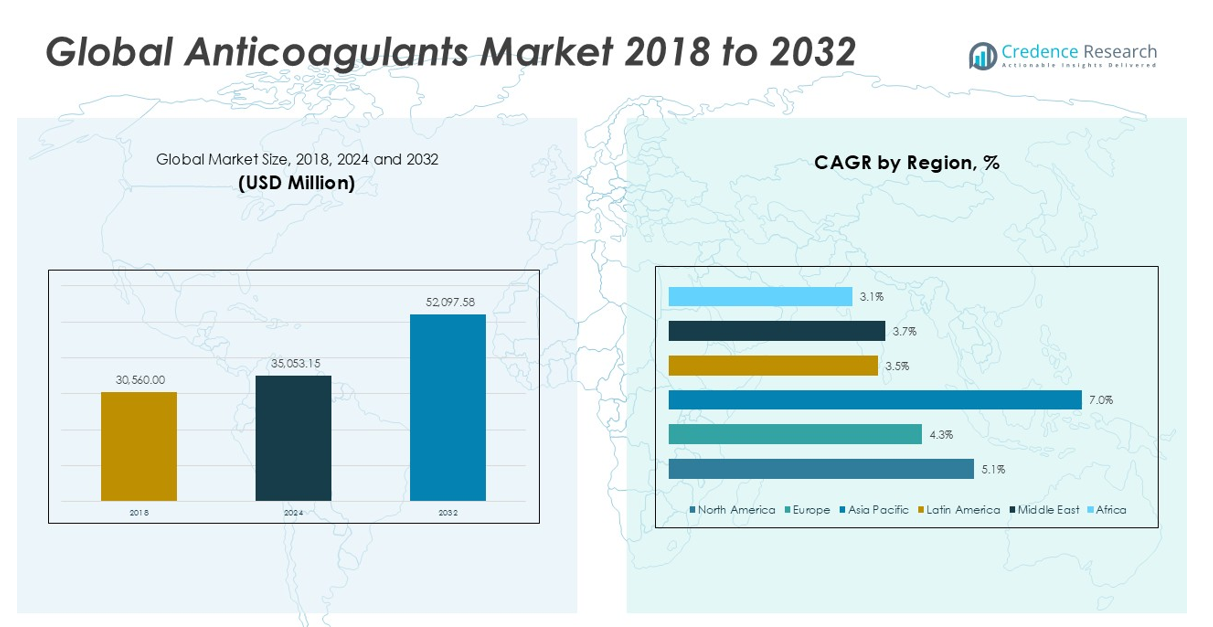
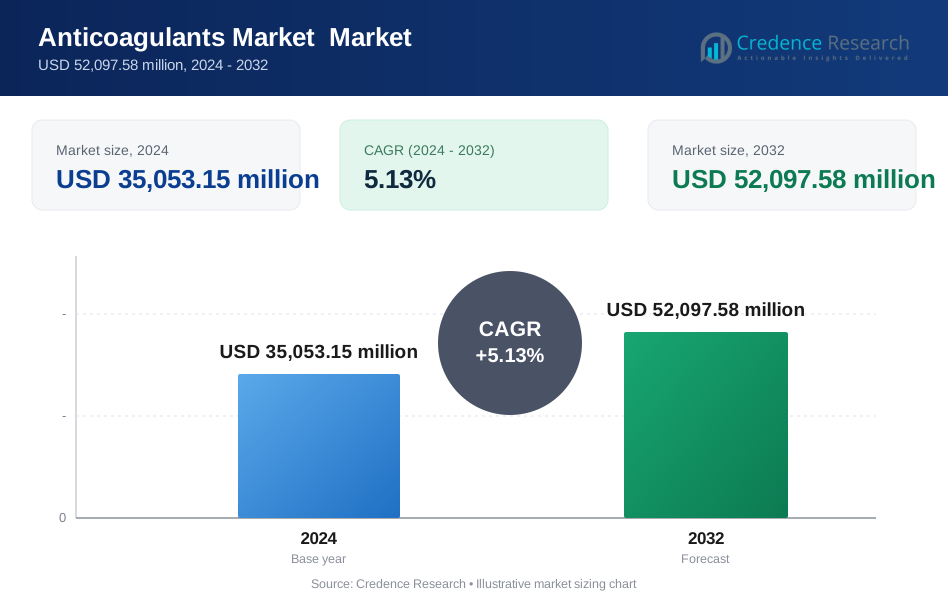
The anticoagulants market size was valued at USD 30,560.00 million in 2018, reached USD 35,053.15 million in 2024, and is anticipated to reach USD 52,097.58 million by 2032, at a CAGR of 5.13% during the forecast period.
| REPORT ATTRIBUTE | DETAILS |
|---|---|
| Historical Period | 2020-2023 |
| Base Year | 2024 |
| Forecast Period | 2025-2032 |
| Anticoagulants Market Size 2024 | USD 35,053.15 million |
| Anticoagulants Market, CAGR | 5.13% |
| Anticoagulants Market Size 2032 | USD 52,097.58 million |
The anticoagulants market is led by major players including Pfizer Inc., Bristol-Myers Squibb Company, Bayer AG, Boehringer Ingelheim International GmbH, Johnson & Johnson Services, Inc., Sanofi, DAIICHI SANKYO COMPANY, LIMITED, GSK plc, Eisai Co., Ltd., and Aspen Holdings. These companies dominate the market through strong portfolios, especially in the novel oral anticoagulants (NOACs) segment, with Eliquis and Xarelto driving substantial global sales. North America is the leading region, holding approximately 50.8% of the market share in 2024, supported by advanced healthcare systems, high disease prevalence, and rapid adoption of innovative therapies. Europe follows, benefiting from growing awareness and supportive healthcare policies. The Asia Pacific region is emerging as the fastest-growing market, driven by improving healthcare access and rising cardiovascular disease incidence. These top players continue to strengthen their global footprint through strategic alliances, product development, and market expansion efforts in both developed and emerging economies.
Market Insights
- The global anticoagulants market was valued at USD 30,560.00 million in 2018, reached USD 35,053.15 million in 2024, and is projected to grow to USD 52,097.58 million by 2032 at a CAGR of 5.13% during the forecast period.
- The market is driven by the increasing prevalence of cardiovascular diseases, especially atrial fibrillation and deep vein thrombosis, along with the rising geriatric population requiring long-term anticoagulant therapy.
- A key trend shaping the market is the rapid adoption of novel oral anticoagulants (NOACs) like Eliquis and Xarelto, which offer convenience and lower bleeding risks compared to traditional therapies.
- North America holds the largest regional share at 50.8% in 2024, with oral anticoagulants dominating by route of administration, while Asia Pacific is the fastest-growing region due to improved healthcare access and growing patient awareness.
- Market growth faces restraints such as high bleeding risks, strict regulatory approval processes, and pricing pressure from generic competition.
Market Segmentation Analysis:
By Drug Category: In the anticoagulants market, Novel Oral Anticoagulants (NOACs) dominate the drug category segment, holding a significant market share due to their ease of administration and lower monitoring requirements compared to traditional therapies. Among NOACs, Eliquis and Xarelto are the leading products, driven by their proven safety profiles and reduced risk of bleeding. These drugs are widely prescribed for stroke prevention in atrial fibrillation and the treatment of venous thromboembolism. The growing preference for NOACs over Vitamin K Antagonists and Heparins is supported by their superior patient compliance and favorable clinical outcomes.- For instance, Bristol-Myers Squibb reported that Eliquis achieved more than 10 million prescriptions in the United States in 2022, reflecting its widespread clinical acceptance and physician preference.
- For instance, Bayer AG recorded that Xarelto surpassed 1 billion treatment days globally by the end of 2021, underscoring its extensive use in outpatient and oral anticoagulant therapies.
Market Overview
Rising Prevalence of Cardiovascular Diseases
The increasing global burden of cardiovascular diseases, particularly atrial fibrillation, deep vein thrombosis, and myocardial infarction, significantly drives the growth of the anticoagulants market. As the aging population expands, the incidence of these conditions continues to rise, fueling the demand for effective anticoagulation therapies. Anticoagulants play a crucial role in stroke prevention and clot management, making them essential in long-term treatment regimens. This consistent rise in cardiovascular cases directly supports market expansion, especially in developed regions with high diagnostic rates and healthcare accessibility.- For instance, Pfizer Inc. reported that in 2022, over 5.9 million patients worldwide were treated with its anticoagulant therapies, supporting its substantial role in cardiovascular disease management.
Shift Toward Novel Oral Anticoagulants (NOACs)
The market is witnessing a rapid shift from traditional anticoagulants such as heparin and vitamin K antagonists to novel oral anticoagulants (NOACs) due to their superior safety profile, minimal dietary restrictions, and reduced need for regular monitoring. NOACs like Eliquis and Xarelto offer improved patient convenience and better clinical outcomes, which are key factors driving their adoption. The growing physician preference for these drugs, combined with increasing patient compliance, is accelerating the overall growth of the anticoagulants market across various treatment applications.- For instance, Daiichi Sankyo’s Edoxaban (Savaysa/Lixiana) achieved more than 2 million patient-years of exposure globally by 2022, reflecting its expanding acceptance in both stroke prevention and venous thromboembolism treatment.
Expanding Geriatric Population
The global increase in the elderly population is a critical growth driver for the anticoagulants market. Older adults are at a higher risk of developing blood clots and cardiovascular complications, necessitating long-term anticoagulant therapy. As life expectancy improves worldwide, the demand for effective and safe anticoagulants for managing age-related disorders such as atrial fibrillation is expected to rise steadily. This demographic trend is particularly evident in North America, Europe, and parts of Asia, where the aging population is growing at a significant rate, contributing to sustained market demand.Key Trends & Opportunities
Growing Adoption of Self-Administration Therapies
There is a noticeable trend toward self-administration of anticoagulants, particularly oral therapies, which offer greater flexibility and independence to patients. This shift reduces the reliance on hospital-based care and aligns with the broader move towards home healthcare solutions. The convenience of self-management, supported by telemedicine and digital health tools, creates significant growth opportunities for pharmaceutical companies focusing on patient-centric products. As healthcare systems aim to reduce costs and hospital visits, the demand for easy-to-use, self-administered anticoagulants continues to grow.- For instance, Johnson & Johnson reported that over 70% of its Xarelto prescriptions in the U.S. in 2022 were filled for outpatient, self-administered use, demonstrating the clear shift toward home-based anticoagulant management.
Technological Advancements in Drug Development
Continuous advancements in anticoagulant formulations and drug delivery technologies present strong growth opportunities. Pharmaceutical companies are investing in the development of safer, faster-acting, and longer-lasting anticoagulants with fewer side effects. Innovations such as targeted delivery systems and extended-release formulations are enhancing therapeutic outcomes and patient adherence. These technological improvements not only differentiate new products but also attract healthcare providers seeking more reliable treatment options, thereby fostering competitive advantage and supporting market expansion in both developed and emerging regions.- For instance, Sanofi successfully developed and introduced Clexane’s prefilled syringes with an automatic needle protection system, distributing over 20 million units globally by 2021 to improve safety in self-injection anticoagulant therapies.
Key Challenges
High Risk of Bleeding Complications
Despite their therapeutic benefits, anticoagulants pose a significant risk of bleeding, which remains a major clinical challenge. Both healthcare providers and patients must carefully balance the benefits of anticoagulation with the potential for serious bleeding events, including gastrointestinal and intracranial hemorrhages. This risk often limits the long-term use of anticoagulants, particularly in elderly patients or those with multiple comorbidities. The fear of bleeding complications can lead to under-prescription or discontinuation of therapy, ultimately impacting patient outcomes and market growth.Stringent Regulatory Approvals
The anticoagulants market faces strict regulatory scrutiny due to the potential risks associated with these therapies. Obtaining approval for new anticoagulant drugs requires comprehensive clinical trials that demonstrate both safety and efficacy over extended periods. This regulatory process is time-consuming and costly, creating high entry barriers for new players. Moreover, any adverse post-market safety findings can lead to product withdrawals or restricted usage, which can negatively affect the reputation and financial performance of pharmaceutical companies operating in this space.Patent Expiries and Market Competition
Patent expiries of leading anticoagulants such as Xarelto and Eliquis are intensifying generic competition, posing a significant challenge for branded drug manufacturers. The entry of cost-effective generics is expected to reduce market share and profit margins for originator companies. Additionally, increasing competition among existing players to capture price-sensitive markets may lead to pricing pressures, further impacting revenue growth. To sustain their competitive position, major companies must invest in lifecycle management strategies, including developing next-generation products and exploring new therapeutic indications.Regional Analysis
North America North America holds the largest share in the global anticoagulants market, accounting for approximately 50.8% in 2024 with a market size of USD 17,792.77 million, up from USD 15,646.72 million in 2018. The market is projected to reach USD 26,418.78 million by 2032, growing at a CAGR of 5.1%. This growth is driven by the high prevalence of cardiovascular diseases, a strong adoption of novel oral anticoagulants (NOACs), and advanced healthcare infrastructure. Increasing awareness, a growing elderly population, and favorable reimbursement policies further support North America's dominant position in the global market. Europe Europe represents a significant market, holding around 20.9% share in 2024, with its market size reaching USD 7,458.35 million, up from USD 6,814.88 million in 2018. The market is expected to grow to USD 10,354.53 million by 2032 at a CAGR of 4.3%. Growth is supported by rising cases of atrial fibrillation and deep vein thrombosis, along with increasing healthcare investments. The expanding use of NOACs and the presence of leading pharmaceutical players contribute to the market's steady development, although price pressures from generic competition slightly temper overall growth. Asia Pacific Asia Pacific is emerging as the fastest-growing region in the anticoagulants market, with a market share of approximately 17.6% in 2024 and a strong CAGR of 7.0%. The market value is projected to rise from USD 5,060.74 million in 2018 to USD 6,184.98 million in 2024, reaching USD 10,570.64 million by 2032. Rapid urbanization, improving healthcare infrastructure, and increasing awareness of cardiovascular diseases are key growth drivers. Additionally, the growing elderly population and rising healthcare expenditure in countries like China, Japan, and India are accelerating regional demand for anticoagulant therapies. Latin America The anticoagulants market in Latin America is steadily expanding, with a market share of around 3.8% in 2024. The market is expected to grow from USD 1,188.78 million in 2018 to USD 1,342.18 million in 2024, and further reach USD 1,759.33 million by 2032, at a CAGR of 3.5%. Growth is driven by increasing incidences of venous thromboembolism and improving access to healthcare services. However, limited healthcare coverage and pricing sensitivity in several countries present challenges to faster market penetration, though urban centers are witnessing a gradual rise in anticoagulant usage. Middle East The Middle East anticoagulants market holds a market share of about 3.8% in 2024, growing from USD 1,054.32 million in 2018 to USD 1,124.98 million in 2024, with a projected value of USD 1,490.28 million by 2032 at a CAGR of 3.7%. Market expansion is supported by the rising prevalence of cardiovascular diseases and increasing investments in healthcare infrastructure. Efforts to modernize healthcare systems and improve disease awareness across key Gulf countries are contributing to steady growth, although slower adoption in rural areas continues to limit broader regional development. Africa Africa represents a smaller but gradually expanding share in the anticoagulants market, holding around 3.3% market share in 2024. The market size is expected to grow from USD 794.56 million in 2018 to USD 1,149.89 million in 2024, reaching USD 1,504.02 million by 2032 at a CAGR of 3.1%. The growing burden of non-communicable diseases, including cardiovascular disorders, is driving demand. However, limited healthcare access, affordability issues, and a lack of widespread awareness continue to challenge market growth, though targeted efforts in urban areas are gradually improving anticoagulant accessibility and usage.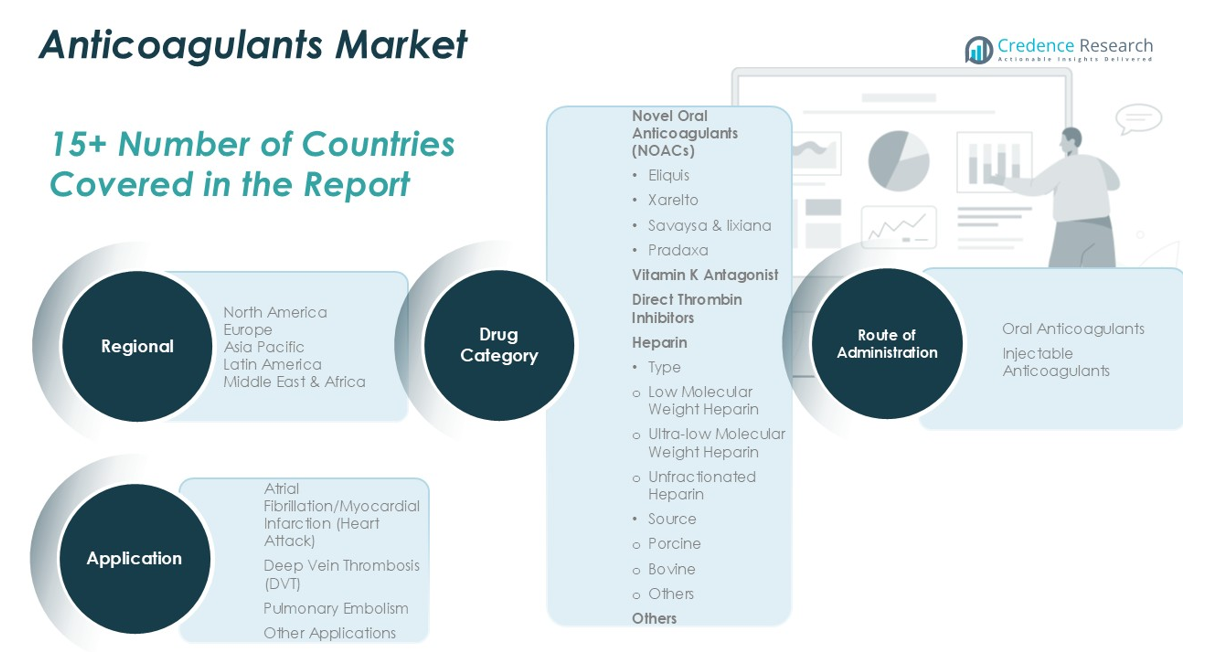
Market Segmentations:
By Drug Category- Novel Oral Anticoagulants (NOACs)
- Eliquis
- Xarelto
- Savaysa & Lixiana
- Pradaxa
- Vitamin K Antagonist
- Direct Thrombin Inhibitors
- Heparin
- Route of Administration
- Low Molecular Weight Heparin
- Ultra-low Molecular Weight Heparin
- Unfractionated Heparin
- Source
- Route of Administration
- Others
- Oral Anticoagulants
- Injectable Anticoagulants
- Atrial Fibrillation / Myocardial Infarction (Heart Attack)
- Deep Vein Thrombosis (DVT)
- Pulmonary Embolism
- Other Applications
- North America
- U.S.
- Canada
- Mexico
- Europe
- Germany
- France
- U.K.
- Italy
- Spain
- Rest of Europe
- Asia Pacific
- China
- Japan
- India
- South Korea
- South-east Asia
- Rest of Asia Pacific
- Latin America
- Brazil
- Argentina
- Rest of Latin America
- Middle East & Africa
- GCC Countries
- South Africa
- Rest of the Middle East and Africa
Competitive Landscape
The anticoagulants market is highly competitive, driven by the presence of established pharmaceutical giants and continuous product innovation. Key players such as Pfizer Inc., Bristol-Myers Squibb Company, Bayer AG, Boehringer Ingelheim International GmbH, Johnson & Johnson Services, Inc., and DAIICHI SANKYO COMPANY, LIMITED dominate the market, particularly in the novel oral anticoagulants (NOACs) segment. These companies focus on expanding their product portfolios, securing regulatory approvals, and enhancing market reach through strategic collaborations and partnerships. Intense competition is evident in the race to develop safer anticoagulants with fewer bleeding risks and more convenient dosing regimens. Patent expirations of leading products like Xarelto and Eliquis are paving the way for generic entries, which is expected to intensify price competition. Additionally, emerging players are leveraging opportunities in developing regions by offering cost-effective alternatives. The competitive dynamics are further shaped by ongoing clinical trials, regulatory challenges, and the shift towards patient-centric treatment options.Key Player Analysis
- Aspen Holdings
- Pfizer Inc.
- Bristol-Myers Squibb Company
- GSK plc
- Sanofi
- Bayer AG
- Boehringer Ingelheim International GmbH
- DAIICHI SANKYO COMPANY, LIMITED
- Johnson & Johnson Services, Inc.
- Eisai Co., Ltd.
Recent Developments
- In March 2025, The FDA has approved the first generic versions of Johnson & Johnson's big-selling anticoagulant Xarelto from Sun Pharma subsidiary Taro Pharmaceuticals and Lupin. This is to reduce the risk of major cardiovascular events in adult patients with coronary artery disease (CAD) and to reduce the risk of major thrombotic vascular events in adult patients with peripheral artery disease (PAD), including patients who have recently undergone a lower extremity revascularisation procedure due to symptomatic PAD.
- In March 2025, Cadrenal Therapeutics, Inc., announced the signing of a Collaboration Agreement with Abbott to support Cadrenal’s pivotal TECarfarin Anticoagulation and Hemocompatibility with Left Ventricular Assist Devices (TECH-LVAD) trial. Quang X. Pham, Chief Executive Officer, Cadrenal Therapeutics, Inc. stated “Together, we have a unique opportunity to evaluate tecarfarin in combination with the HeartMate 3™ LVAD, advancing our commitment to bringing forward the first innovation in vitamin K-targeted anticoagulation in over 70 years.”
- In January 2025, TAH3311, a first-of-its-type anticoagulant agent administered orally as a water-free dissolving film, has successfully completed its major clinical trial. The completion was announced in a press release from TAHO Pharmaceuticals Ltd., the manufacturer of the agent. The company is currently planning regulatory submissions in both the US and Europe and working to accelerate a global commercial launch of the agent.
- In December 2024, Novo Nordisk announced its Alhemo (concizumab-mtci) injection announced approval from the U.S. Food and Drug Administration (FDA). The approval is expected to strengthen its portfolio and further its commitment to offering solutions for rare bleeding disorders.
- In October 2024, Pfizer Inc. announced that it had received U.S. FDA approval for its HYMPAVZI (marstacimab-hncq), developed for treating Hemophilia A or B without inhibitors. It is a once-weekly subcutaneous prophylactic treatment.
- In November 2023, Pharmascience Canada announced the launch of the generic drug (Pr) pms-RIVAROXABAN. This medicine belongs to the anticoagulant (blood thinner) group and helps prevent blood clots by directly blocking the activity of Factor Xa.
- In July 2023, Endo International plc. launched bivalirudin injection in ready-to-use (RTU) vials in the U.S. with the collaboration of Gland Pharma Limited, India, and MAIA Pharmaceuticals, Inc. The new RTU vials of bivalirudin are expected to be more convenient and efficient for healthcare professionals
Market Concentration & Characteristics
The anticoagulants market is moderately concentrated, with a few major players holding significant market shares due to their strong product portfolios and established global presence. It is characterized by high entry barriers, driven by stringent regulatory requirements, complex clinical trial processes, and the need for proven long-term safety and efficacy. The market shows a strong preference for novel oral anticoagulants (NOACs) over traditional therapies, influenced by patient demand for safer and more convenient options. It remains highly competitive, with leading companies continuously focusing on product innovation, strategic partnerships, and geographic expansion to maintain their positions. Patent expiries of key drugs have introduced price pressures and opened opportunities for generics, intensifying competition. The anticoagulants market benefits from growing healthcare awareness, improved diagnostic capabilities, and increasing incidences of cardiovascular diseases worldwide. It continues to evolve with advancements in drug delivery and a growing shift towards patient-centric treatment approaches that improve compliance and therapeutic outcomes.Report Coverage
The research report offers an in-depth analysis based on Drug Category, Route of Administration, Application and Geography. It details leading market players, providing an overview of their business, product offerings, investments, revenue streams, and key applications. Additionally, the report includes insights into the competitive environment, SWOT analysis, current market trends, as well as the primary drivers and constraints. Furthermore, it discusses various factors that have driven market expansion in recent years. The report also explores market dynamics, regulatory scenarios, and technological advancements that are shaping the industry. It assesses the impact of external factors and global economic changes on market growth. Lastly, it provides strategic recommendations for new entrants and established companies to navigate the complexities of the market.Future Outlook
- The anticoagulants market is expected to continue growing steadily due to the rising global burden of cardiovascular diseases.
- The demand for novel oral anticoagulants (NOACs) will increase, driven by their ease of use and lower risk of bleeding.
- North America will likely maintain its market leadership, supported by advanced healthcare systems and high patient awareness.
- The Asia Pacific region is anticipated to witness the fastest growth due to improving healthcare infrastructure and rising disease prevalence.
- Patent expirations of leading anticoagulant drugs will increase competition from cost-effective generic alternatives.
- The focus on developing safer anticoagulants with minimal bleeding risks will drive research and innovation.
- The trend towards self-administration and home-based therapies will continue to support the adoption of oral anticoagulants.
- Regulatory challenges will remain high, with strict approval processes influencing new product launches.
- Strategic collaborations and partnerships among key players will shape competitive dynamics and market expansion.
- Increasing healthcare investments and growing awareness in emerging markets will create new growth opportunities.
Request a Free Sample
Fill in your details and we'll send you a free sample report.
- Sample data tables & charts
- Research methodology
Need a Custom Version of This Report?
Tailor the scope, geography, or segments to your exact requirements.
- Custom geography or segment scope
- Direct access to our analyst team
Frequently Asked Questions
What is the current size of the Anticoagulants Market?
What are the key segments within the Anticoagulants Market?
What are some challenges faced by the Anticoagulants Market?
Who are the major players in the Anticoagulants Market?
Table of Content
Chapter 1. Report Introduction
- 1.1 Report Description & Purpose
- 1.1.1 Report Title & Market Definition
- 1.1.2 Unique Selling Propositions (USP) & Key Differentiators
- 1.1.3 Value Proposition for Stakeholders
- 1.2 Research Objectives
- 1.2.1 Market Sizing Objectives (Volume & Revenue)
- 1.2.2 Segmentation Objectives
- 1.2.3 Competitive Intelligence Objectives
- 1.2.4 Forecast & Scenario Objectives
- 1.3 Report Scope
- 1.3.1 Anticoagulants Market Scope – Types & Subtypes Covered
- 1.3.2 Geographic Scope – Regions & Countries Covered
- 1.3.3 Historical Period, Base Year & Forecast Period (2024; forecast to 2032)
- 1.3.4 Inclusions & Exclusions
- 1.4 HS Code & Classification Framework
- 1.5 Currency, Units & Pricing Basis
- 1.6 Target Stakeholders
- 1.7 Limitations & Assumptions
Chapter 2. Executive Summary
- 2.1 Global Anticoagulants Market Market Snapshot
- 2.1.1 Market Size – Historical (2024) & Forecast (2024-2032) (2024: USD 35,053.15 million → 2032: USD 52,097.58 million)
- 2.1.2 Volume & Revenue – Global Totals
- 2.1.3 Key Market Highlights – Top Five Facts
- 2.2 Anticoagulants Market Market Segmentation Snapshot
- 2.2.1 Market Split by Region – 2024 vs. 2032
- 2.3 Competitive Snapshot
- 2.3.1 Top 10 Players by Revenue Share – 2024
- 2.3.2 Top 10 Players by Volume Share – 2024
- 2.3.3 Recent Strategic Developments (18-Month Summary)
- 2.4 Key Investment Highlights & Strategic Conclusions
Chapter 3. Anticoagulants Market Market Dynamics & Industry Analysis
- 3.1 Market Overview & Context
- 3.1.1 Anticoagulants Market Market Position in the Broader Automotive Value Chain
- 3.1.2 OEM vs. Replacement Market Dynamics
- 3.1.3 Market Maturity & Development Stage by Region
- 3.2 Anticoagulants Market Market Drivers
- 3.3 Anticoagulants Market Market Restraints & Challenges
- 3.4 Anticoagulants Market Market Opportunities
- 3.5 Porter's Five Forces Analysis
- 3.5.1 Threat of New Entrants
- 3.5.2 Bargaining Power of Suppliers
- 3.5.3 Bargaining Power of Buyers
- 3.5.4 Threat of Substitutes
- 3.5.5 Competitive Rivalry – Intensity Assessment
- 3.6 Anticoagulants Market Value Chain Analysis
- 3.6.1 Upstream – Raw Material/Input Suppliers
- 3.6.1.1 Raw Material/Input 1
- 3.6.1.2 Raw Material/Input 2
- 3.6.1.3 Raw Material/Input 3
- 3.6.2 Midstream – Production/Manufacturing/Service Delivery
- 3.6.2.1 Production/Process Overview
- 3.6.2.2 Key Facility Locations & Capacity by Manufacturer
- 3.6.3 Downstream – Distribution & End Consumer
- 3.6.3.1 Primary Channel – B2B/OEM
- 3.6.3.2 Secondary Channels – Dealer, Retail, Online, Direct
- 3.6.4 Value Chain Profitability Analysis
- 3.6.1 Upstream – Raw Material/Input Suppliers
- 3.7 PESTEL Analysis
- 3.7.1 Political Factors
- 3.7.2 Economic Factors
- 3.7.3 Social Factors
- 3.7.4 Technological Factors
- 3.7.5 Environmental Factors
- 3.7.6 Legal Factors
- 3.8 Anticoagulants Market Supply Chain Analysis
- 3.8.1 Raw Material/Input Supply Risk Assessment
- 3.8.2 Manufacturing Concentration Risk (Geographic Exposure)
- 3.8.3 Trade Disruption Impact Analysis
- 3.9 Regulatory & Policy Landscape
Note: The regulatory and policy landscape section covers regulations based on their applicability to the market, Anticoagulants Market category, geography, and scope of the study. Only regulatory frameworks with a material impact on operations, compliance, trade, sustainability, or market access are analyzed in detail.
Chapter 4. Key Investment Pockets & Opportunity Analysis
- 4.1 Anticoagulants Market Market Attractiveness Analysis
- 4.1.1 By Region – Investment Attractiveness Matrix (Volume × CAGR)
- 4.2 Absolute Revenue Growth Opportunity
- 4.2.1 By Region – Absolute USD Growth Through 2032
- 4.3 Incremental Volume Opportunity
- 4.3.1 By Region – Incremental Volume Through 2032
- 4.3.2 Segment – Incremental Volume
- 4.4 Emerging Submarket Opportunity Deep Dive (Subject to Applicability)
- 4.5 Emerging Market Opportunity Scorecards
- 4.5.1 United States
- 4.5.2 Europe
- 4.5.3 Asia
- 4.5.4 Middle East & Africa
Note: Emerging Market Opportunity Scorecards will be included based on relevance and strategic importance. Regions listed are indicative and may vary depending on data availability and market dynamics.
Chapter 5. Anticoagulants Market Import-Export Analysis & Trade Flows
- 5.1 Global Trade Overview
- 5.1.1 Global Export Value by Country (2024)
- 5.1.2 Global Export Volume by Country (2024)
- 5.1.3 Global Import Value by Country (2024)
- 5.1.4 Global Import Volume by Country (2024)
- 5.1.5 Net Trade Balance by Country (2024)
- 5.2 Export Analysis – Segment
- 5.2.1 Type 1 (HS Code)
- 5.2.2 Type 2 (HS Code)
- 5.2.3 Type 3 (HS Code)
- 5.2.4 Type 4 (HS Code)
- 5.2.5 Type 5 (HS Code)
- 5.3 Import Analysis – Segment
- 5.3.1 Type 1 (HS Code)
- 5.3.2 Type 2 (HS Code)
- 5.3.3 Type 3 (HS Code)
- 5.3.4 Type 4 (HS Code)
- 5.3.5 Type 5 (HS Code)
- 5.4 Average Unit Trade Prices
- 5.4.1 Average Export Price – Segment & Country
- 5.4.2 Average Import Price – Segment & Source Country
- 5.4.3 Price Trends (2024)
- 5.5 Key Trade Route Analysis
- 5.5.1 Trade Route 1
- 5.5.2 Trade Route 2
- 5.5.3 Trade Route 3
- 5.5.4 Trade Route 4
- 5.5.5 Trade Route 5
- 5.6 Trade Policy Impact Assessment
- 5.6.1 US Anti-Dumping & Section 301 Tariffs
- 5.6.2 EU Customs Union Impact
- 5.6.3 Major Free Trade Agreements
- 5.6.4 USMCA Rules of Origin
Note: Trade policy analysis will be included only where relevant to the Anticoagulants Market market.
Chapter 6. Competitive Landscape & Company Benchmarking
- 6.1 Anticoagulants Market Market Concentration & Structure
- 6.1.1 Herfindahl-Hirschman Index (HHI) – vs. 2024
- 6.1.2 Tier 1, Tier 2 & Tier 3 Market Structure
- 6.1.3 Global, Regional & Local Player Dynamics
- 6.2 Anticoagulants Market Market Share Analysis – 2024
- 6.2.1 Global Revenue Share by Company
- 6.2.2 Global Volume Share by Company
- 6.2.3 Regional Revenue Share
- 6.2.4 Market Share Evolution ( vs. 2024)
- 6.2.5 OEM Segment Share by Company
- 6.2.6 Replacement Segment Share by Company
- 6.3 Production/Delivery Capacity & Facility Analysis
- 6.3.1 Global Installed Capacity
- 6.3.2 Capacity Utilization Rates
- 6.3.3 Production/Output Volume
- 6.3.4 Facility Locations & Capacity Map
- 6.3.5 Planned Capacity Additions
- 6.4 Anticoagulants Market Competitive Benchmarking Matrix
- 6.4.1 Revenue, Volume, CAGR & Profitability Comparison
- 6.4.2 Channel Revenue Mix
- 6.4.3 Geographic Revenue Exposure
- 6.4.4 R&D Intensity
- 6.4.5 Sustainability Maturity
- 6.5 Strategic Developments in Anticoagulants Market (Last 24 Months)
- 6.5.1 Mergers, Acquisitions & Divestments
- 6.5.2 New Anticoagulants Market Launches
- 6.5.3 Facility Expansions
- 6.5.4 Strategic Alliances, Joint Ventures & Partnerships
- 6.5.5 Distribution Expansion & Market Entry
- 6.5.6 Sustainability & ESG Initiatives
- 6.6 Competitive Strategy Mapping
- 6.6.1 Leader, Challenger, Follower & Niche Classification
- 6.6.2 Pricing Strategy Comparison
- 6.6.3 Channel Strategy Matrix
Note: Strategic developments are included based on their materiality and the availability of reliable information.
Chapter 7. Global Anticoagulants Market Market – By Distribution Channel
- 7.1 Segment Overview
- 7.1.1 Volume & Revenue Split by Channel (2024 & 2032)
- 7.1.2 Channel Mix Evolution (2024-2032)
Chapter 8. Regional Market Analysis – Global Overview
- 8.1 Global Regional Overview
- 8.1.1 Regional Volume Share
- 8.1.2 Regional Revenue Share
- 8.1.3 Regional Volume by Region
- 8.1.4 Regional Revenue by Region
- 8.1.5 Regional Forecast Through 2032
- 8.2 Cross-Regional Segment Analysis
- 8.2.1 By Distribution Channel
- 8.2.2 By Brand/Price Tier
Chapter 9. North America Anticoagulants Market Market
- 9.1 United States
- 9.2 Canada
- 9.3 Mexico
Chapter 10. Europe Anticoagulants Market Market
- 10.1 Germany
- 10.2 France
- 10.3 Italy
- 10.4 United Kingdom
- 10.5 Spain
- 10.6 Poland
- 10.7 Russia
- 10.8 Netherlands
- 10.9 Belgium
- 10.10 Sweden
- 10.11 Denmark
- 10.12 Norway
- 10.13 Rest of Europe
Chapter 11. Asia Pacific Anticoagulants Market Market
- 11.1 China
- 11.2 India
- 11.3 Japan
- 11.4 South Korea
- 11.5 Thailand
- 11.6 Indonesia
- 11.7 Vietnam
- 11.8 Malaysia
- 11.9 Australia
- 11.10 Rest of Asia Pacific
Chapter 12. Latin America Anticoagulants Market Market
- 12.1 Brazil
- 12.2 Argentina
- 12.3 Colombia
- 12.4 Chile
- 12.5 Rest of Latin America
Chapter 13. Middle East Anticoagulants Market Market
- 13.1 Saudi Arabia
- 13.2 United Arab Emirates
- 13.3 Turkey
- 13.4 Israel
- 13.5 Iran
- 13.6 Rest of the Middle East
Chapter 14. Africa Anticoagulants Market Market
- 14.1 South Africa
- 14.2 Egypt
- 14.3 Nigeria
- 14.4 Morocco
- 14.5 Rest of Africa
Chapter 15. Anticoagulants Market Company Profiles
- 15.1 [Company 01]
- 15.1.1 Company Overview
- 15.1.2 Key Management Personnel
- 15.1.3 Products & Services Portfolio
- 15.1.4 Financial Performance
- 15.1.5 Key Market Focus & Geographic Presence
- 15.1.6 Recent Developments & Strategic Initiatives
Note: The company profile list is preliminary and may change based on research findings, market developments, data availability, and client requirements.
Chapter 16. Appendices
- Appendix A – List of Abbreviations & Acronyms
- Appendix B – Industry Classification Code Reference – Full Series
- Appendix C – Production & Capacity Data Tables
- Appendix D – End-Use & Demand Base Tables
- Appendix E – Consumption & Replacement Rate Assumptions
- Appendix F – ASP Reference Tables
- Appendix G – Manufacturing & Facility Database
- Appendix H – Import-Export Data Tables
- Appendix I – Regulatory Summary Tables
- Appendix J – Primary Research Participant List (Anonymized)
- Appendix K – Primary Research Questionnaire Framework
- Appendix L – Data Sources & Bibliography
- Appendix M – Market Size Divergence & Source Comparison
Chapter 17. Research Methodology
- 17.1 Research Framework & Philosophy
- 17.2 Secondary Research – Sources, Hierarchy & Data Extraction
- 17.3 Data Modeling – Bottom-Up & Top-Down Market Sizing
- 17.4 Primary Research – Stakeholder Framework, LOI & Sample Sizes
- 17.5 Forecast Methodology – Regression, Scenario & Sensitivity Analysis
- 17.6 Quality Control – Four-Layer Validation Framework
- 17.7 Limitations & Standard Assumptions
- 17.8 Disclaimer
