
Aspiration and Biopsy Needle Market Overview:
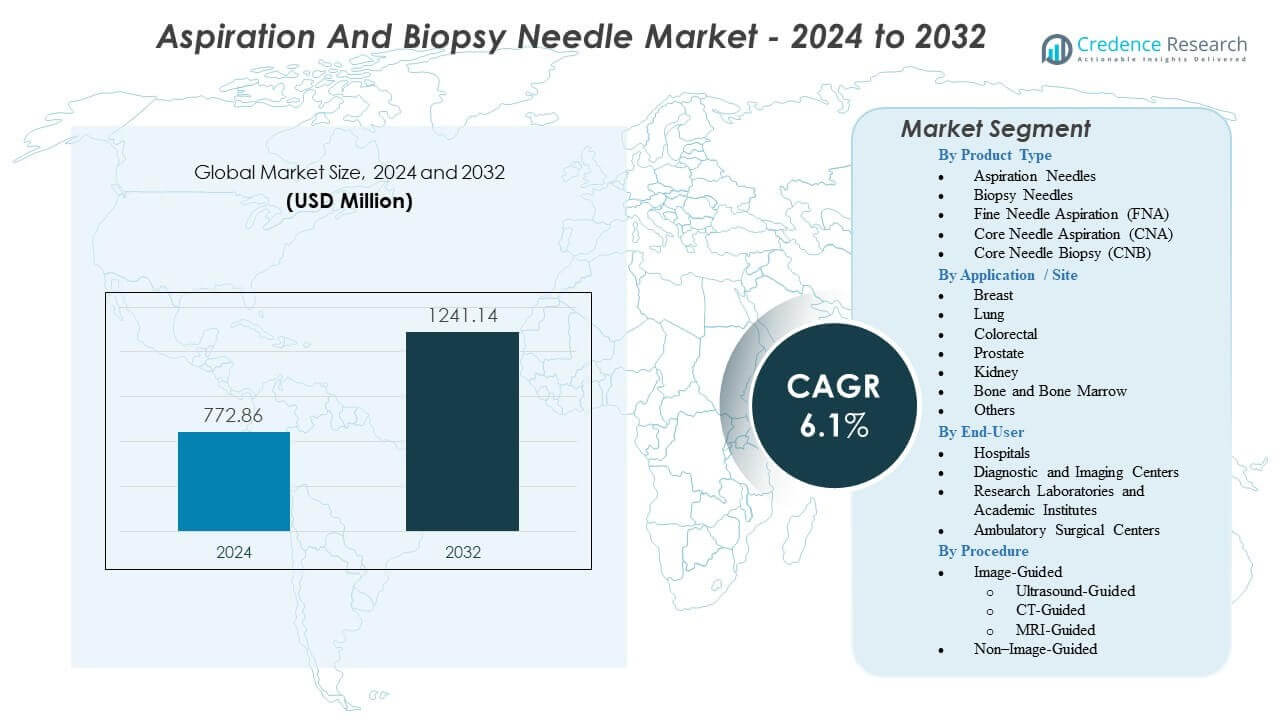
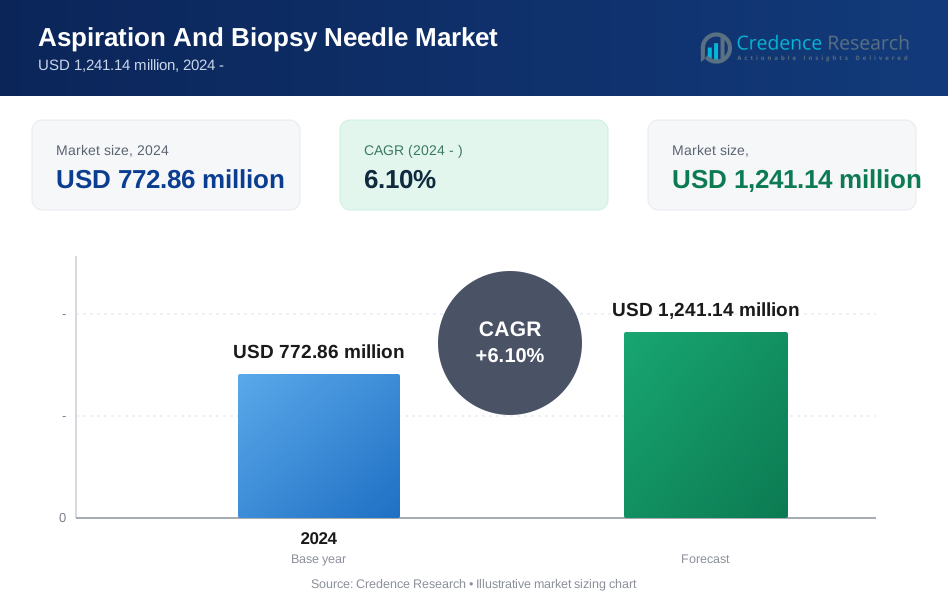
The Aspiration and Biopsy Needle Market is projected to grow from USD 772.86 million in 2024 to an estimated USD 1241.14 million by 2032, with a compound annual growth rate (CAGR) of 6.1% from 2024 to 2032.
| REPORT ATTRIBUTE | DETAILS |
|---|---|
| Historical Period | 2020-2023 |
| Base Year | 2024 |
| Forecast Period | 2025-2032 |
| Aspiration and Biopsy Needle Market Size 2024 | USD 772.86 million |
| Aspiration and Biopsy Needle Market, CAGR | 6.1% |
| Aspiration and Biopsy Needle Market Size 2032 | USD 1241.14 million |
Growing diagnostic complexity drives wider use of aspiration and biopsy needles across oncology, gastroenterology, pulmonology, and nephrology workflows. Healthcare teams prefer technologies that support consistent tissue extraction during image-guided procedures. Rising awareness of early detection encourages providers to rely on tools that deliver precise samples for histology and molecular testing. Innovations in needle geometry and coatings improve control during insertion and enhance sample quality. Greater clinical emphasis on minimally invasive techniques accelerates the transition toward standardized biopsy protocols. Expanding cancer programs increase procedural volumes across specialized care centers.
North America leads the market due to advanced diagnostic infrastructure and strong clinical adoption of image-guided biopsy techniques. Europe shows steady growth supported by screening programs and established oncology networks that rely on routine tissue sampling. Asia Pacific emerges quickly as investments in imaging systems, pathology laboratories, and cancer diagnostics expand across China and India. Latin America progresses with improving access to interventional radiology services. Middle Eastern healthcare systems upgrade diagnostic capabilities to support early detection strategies. African regions show gradual adoption driven by growing awareness and incremental infrastructure improvements.
Aspiration and Biopsy Needle Market Insights:
- The market grows from USD 772.86 million in 2024 to USD 1241.14 million by 2032 at a 6.1% CAGR, driven by rising demand for accurate tissue sampling.
- Growing use of minimally invasive techniques and image-guided procedures strengthens adoption across hospitals and diagnostic centers.
- Limited skilled operators, procedural variation, and dependence on advanced imaging infrastructure create restraints in several regions.
- North America leads due to strong diagnostic capacity, while Europe benefits from structured screening programs and established oncology networks.
- Asia Pacific emerges rapidly with expanding imaging access and rising cancer diagnostics demand, while Latin America and the Middle East grow steadily with improving healthcare systems.
Aspiration and Biopsy Needle Market Drivers
Growing Use of Minimally Invasive Diagnostic Procedures Across Clinical Workflows
Healthcare providers expand their use of minimally invasive procedures to improve diagnostic accuracy. Imaging support allows clinicians to target tissue with stronger precision. Demand for earlier disease detection encourages teams to select advanced extraction tools. Cancer programs increase biopsy volumes across hospitals and specialty centers. Physicians prefer techniques that shorten patient recovery times. Manufacturers respond with improved needle designs for stable sample capture. Training programs support safer use of interventional methods. The Aspiration And Biopsy Needle Market moves forward with greater adoption of reliable diagnostic tools.
Expansion of Cancer Screening Programs Across Global Healthcare Systems
Cancer screening programs create sustained demand for high-performance biopsy tools. Hospitals depend on tissue confirmation to guide treatment paths. National initiatives focus on early detection for breast, lung, and gastrointestinal cancers. Higher participation rates raise the number of image-guided procedures. Providers reinforce diagnostic pathways with standardized sampling protocols. Clinical guidelines encourage use of needles that deliver accurate tissue cores. Public awareness campaigns drive more individuals to pursue routine checks. The Aspiration And Biopsy Needle Market responds to screening growth with higher procedural volumes.
Rising Adoption of Advanced Imaging Techniques Supporting Needle Accuracy
Imaging platforms support safer and more targeted needle placement for biopsies. Ultrasound and CT systems give operators real-time visibility during tissue access. Hospitals integrate upgraded radiology units to enhance diagnostic certainty. Stronger imaging increases clinician confidence in performing complex procedures. Research centers test new visualization methods to reduce sampling errors. Manufacturers align needle designs with these technology upgrades. Interventional radiology teams report higher sample adequacy with guided access. The Aspiration And Biopsy Needle Market benefits from the steady shift toward imaging-dependent diagnostics.
- For instance, Siemens Healthineers’ Acuson Sequoia ultrasound platform improves lesion detectability by up to 30% through its Deep Abdominal Transducer, which strengthens accuracy during soft-tissue biopsy procedures.
Innovation in Needle Engineering and Safety Features Boosting Clinical Performance
Product developers enhance needle geometry to deliver consistent core quality. Safety features reduce risks to both operators and patients. Coatings improve tissue penetration and lower friction. Multiple gauge options support a wider range of clinical needs. Engineers refine tip configurations to achieve clearer histologic samples. Hospitals value devices that streamline workflows without disrupting procedures. Procurement teams prioritize reliable tools for diverse biopsy types. The Aspiration And Biopsy Needle Market grows with continued upgrades across design and usability standards.
- For instance, Argon Medical’s BioPince™ full-core biopsy needle achieves a three-times larger tissue sample volume compared with conventional side-notch needles, supporting higher diagnostic accuracy in pathology labs.
Aspiration and Biopsy Needle Market Trends
Rising Integration of Robotics and Image-Guided Systems in Biopsy Procedures
Robotics systems enter biopsy suites to support tighter needle control. Automated positioning improves stability during tissue access. Sensors help operators align with targets that demand precision. Hospitals test platforms that assist with complex or deep-seated lesions. Developers integrate robotics with imaging units for coherent operation. These systems reduce dependence on manual techniques during difficult cases. Clinical teams explore hybrid workflows that pair automation with traditional tools. The Aspiration And Biopsy Needle Market aligns with stronger adoption of robotic guidance.
- For instance, the iSR’obot™ Mona Lisa system by Biobot Surgical achieved a targeting accuracy within 1.3 mm during MRI–ultrasound fusion prostate biopsies, confirming measurable precision gains in clinical use.
Shift Toward Single-Use and Sterile Needle Solutions to Reduce Cross-Contamination
Healthcare facilities shift to sterile single-use biopsy needles to strengthen infection control. Regulatory agencies promote strict compliance for patient safety. Procurement teams evaluate devices that limit contamination risks. Single-use products reduce the need for reprocessing cycles. Hospitals remove uncertainty linked to sterilization variation. New materials support durable designs that maintain sharpness. Waste management programs expand to handle higher disposal volumes. The Aspiration And Biopsy Needle Market reflects this preference for cleaner, safer procedural tools.
Growing Role of AI-Supported Diagnostic Pathways Enhancing Tissue Evaluation
AI platforms support interpretation of biopsy samples with stronger accuracy. Algorithms detect subtle features that guide pathologist decisions. Hospitals adopt AI modules to speed reporting timelines. Automation reduces variation in diagnostic interpretation. Digital pathology tools create streamlined review systems. Laboratories build integrated workflows that link tissue imaging with AI engines. Research centers test advanced models for rare disease classification. The Aspiration And Biopsy Needle Market benefits from smoother diagnostic chains supported by AI.
- For instance, Paige AI demonstrated that its FDA-authorized prostate cancer detection model improves sensitivity by 7.3 percentage points compared to manual review alone, confirming its value in biopsy-based diagnostics.
Development of Specialized Needles for Organ-Specific and Complex Tissue Sampling
Developers design organ-specific needles for targeted procedures. Specialized tools support liver, lung, thyroid, and breast biopsies. Clinical teams value customization that fits unique anatomical structures. New materials improve rigidity and reduce vibration. Needles with enhanced echo visibility strengthen ultrasound diagnoses. Trials explore configurations tailored to precision oncology. Providers adopt models that support delicate tissue extraction with fewer attempts. The Aspiration And Biopsy Needle Market evolves with a broader range of specialized products.
Aspiration and Biopsy Needle Market Challenges Analysis
Limited Skilled Workforce and Variation in Procedural Expertise Across Regions
Variation in operator skill creates inconsistent biopsy outcomes. Training access differs across developed and emerging regions. Hospitals face shortages of interventional radiologists in many markets. Inexperienced users risk inadequate tissue capture or complications. Clinics struggle to maintain uniform standards for diagnostic sampling. Equipment upgrades do not solve gaps in human expertise. Rural regions confront higher hurdles due to weaker training networks. The Aspiration And Biopsy Needle Market encounters performance limitations linked to these workforce disparities.
Regulatory Constraints, Cost Pressures, and Operational Barriers Slowing Adoption
Regulatory reviews extend product development timelines. Compliance requirements increase financial burdens on manufacturers. Hospitals face budget limits that restrict replacement of outdated tools. Reimbursement gaps delay adoption of advanced biopsy systems. Procurement teams evaluate cost before approving new devices. Supply chain disruption impacts timely product availability. Smaller clinics struggle to maintain stable inventory for varied biopsy needs. The Aspiration And Biopsy Needle Market must navigate these financial and regulatory pressures.
Aspiration and Biopsy Needle Market Opportunities
Expansion of Precision Diagnostics and Personalized Treatment Pathways Across Oncology
Precision medicine pushes demand for higher-quality biopsy samples. Targeted therapies require accurate molecular data. Hospitals invest in tissue extraction tools that deliver intact samples. New biomarker research increases reliance on core biopsies. Providers need devices compatible with next-generation testing platforms. Advanced needles improve suitability for genomic evaluation. Research partnerships support development of innovative sampling tools. The Aspiration And Biopsy Needle Market gains momentum from growth in personalized cancer care.
Growth Potential in Emerging Healthcare Markets Through Infrastructure Strengthening
Emerging regions expand diagnostic infrastructure at a steady pace. Investment in imaging and pathology strengthens biopsy capacity. Governments support screening programs that increase tissue sampling. Hospitals adopt updated devices to meet rising procedural demand. International suppliers enter new markets through local partnerships. Training initiatives improve operator competency for complex biopsies. Expanding private healthcare systems unlock new procurement channels. The Aspiration And Biopsy Needle Market benefits from broader access in developing regions.
Aspiration and Biopsy Needle Market Segmentation Analysis:
By Product Type
The Aspiration And Biopsy Needle Market expands with steady demand across aspiration needles, biopsy needles, FNA devices, CNA tools, and CNB systems. Each option supports different diagnostic needs across oncology and chronic disease management. Providers select aspiration needles for cytology samples that require minimal tissue disruption. FNA tools help clinicians collect cells for rapid evaluation. CNA and CNB devices support deeper access and produce larger cores required for molecular testing. Procurement teams prioritize reliable products that maintain sample integrity. Product variety supports broader adoption across routine and complex procedures.
- For instance, Cook Medical’s Quick-Core® biopsy needle demonstrated a diagnostic accuracy above 90% in soft-tissue biopsies across multiple clinical evaluations, confirming its reliability in routine sampling workflows.
By Application / Site
Diagnostic activity in the Aspiration And Biopsy Needle Market increases across breast, lung, colorectal, prostate, kidney, bone, and bone marrow procedures. Breast and lung lead due to high imaging use and strong cancer screening volumes. Colorectal and prostate procedures grow with rising awareness of early disease detection. Kidney sampling supports renal disease evaluation and transplant follow-up. Bone and bone marrow biopsies support hematologic assessment. Other applications expand with stronger clinical demand for targeted tissue sampling. Each site benefits from tools designed for precision and low patient discomfort.
By End-User
Hospitals lead the Aspiration And Biopsy Needle Market because they manage high biopsy volumes across oncology and radiology units. Diagnostic and imaging centers expand usage due to growth in outpatient image-guided procedures. Research laboratories and academic institutes increase sampling demand for molecular studies. Ambulatory surgical centers support fast-turnaround diagnostic procedures for select patient groups. Each end-user segment values reliable devices that support consistent sample retrieval. Adoption remains linked to imaging capability and workflow standardization.
- For instance, Mayo Clinic reported that structured image-guided biopsy programs improved sample adequacy for lung lesions to 88%, supporting wider adoption of advanced biopsy tools in high-volume hospital settings.
By Procedure
Image-guided procedures strengthen the Aspiration And Biopsy Needle Market due to higher accuracy in ultrasound, CT, and MRI-guided access. Ultrasound remains widely used for real-time direction during soft tissue sampling. CT guidance supports lung, bone, and deep organ biopsies. MRI guidance helps clinicians target complex lesions. Non–image-guided procedures continue in limited settings where access is straightforward. Broader reliance on imaging improves sample adequacy and lowers complication risk.
Segmentation:
By Product Type
- Aspiration Needles
- Biopsy Needles
- Fine Needle Aspiration (FNA)
- Core Needle Aspiration (CNA)
- Core Needle Biopsy (CNB)
By Application / Site
- Breast
- Lung
- Colorectal
- Prostate
- Kidney
- Bone and Bone Marrow
- Others
By End-User
- Hospitals
- Diagnostic and Imaging Centers
- Research Laboratories and Academic Institutes
- Ambulatory Surgical Centers
By Procedure
- Image-Guided
- Ultrasound-Guided
- CT-Guided
- MRI-Guided
- Non–Image-Guided
By Region
- North America
- U.S.
- Canada
- Mexico
- Europe
- Germany
- France
- U.K.
- Italy
- Spain
- Rest of Europe
- Asia Pacific
- China
- Japan
- India
- South Korea
- South-east Asia
- Rest of Asia Pacific
- Latin America
- Brazil
- Argentina
- Rest of Latin America
- Middle East & Africa
- GCC Countries
- South Africa
- Rest of the Middle East and Africa
Regional Analysis:
North America holds the largest share of the Aspiration And Biopsy Needle Market with close to 38%, supported by strong diagnostic networks and widespread adoption of image-guided procedures. Healthcare systems in the region invest in advanced imaging and biopsy platforms that improve sampling accuracy. Cancer screening programs fuel consistent procedural demand. Hospitals rely on standardized pathways that reinforce the use of high-performance biopsy tools. Research institutions drive innovation through clinical studies and technology validation. The Aspiration And Biopsy Needle Market strengthens its foothold in North America through mature infrastructure and high clinical adoption.
Europe captures nearly 27% of the market and benefits from robust screening programs for breast, lung, and colorectal cancers. Diagnostic centers across the region integrate upgraded imaging platforms to support growing biopsy volumes. Clinical guidelines encourage early detection protocols that increase demand for reliable sampling tools. Providers prefer devices that support precision during ultrasound-guided and CT-guided access. Several countries report higher biopsy utilization due to expanding oncology services. The Aspiration And Biopsy Needle Market maintains stable growth in Europe through structured care systems and rising procedural awareness.
Asia Pacific holds about 23% of the market and accelerates due to expanding healthcare capacity in China, India, and Southeast Asia. The region invests in imaging infrastructure that supports advanced biopsy workflows. Growing cancer incidence drives hospitals to adopt improved diagnostic tools. Private healthcare networks expand access to minimally invasive sampling methods. Training programs help clinicians use modern biopsy devices with greater confidence. The Aspiration And Biopsy Needle Market grows in Asia Pacific with strong investment momentum and wider accessibility. Latin America holds nearly 7%, while the Middle East & Africa account for 5%, supported by rising diagnostic demand and gradual infrastructure development.
Key Player Analysis:
- Becton, Dickinson and Company (BD)
- Medtronic Plc
- Olympus Corporation
- Boston Scientific Corporation
- Cook Group Incorporated
- Argon Medical Devices, Inc.
- CONMED Corporation
- Hologic, Inc.
- Mammotome
- INRAD Inc.
- Stryker Corporation
- Cardinal Health
- Merit Medical Systems, Inc.
Competitive Analysis:
The Aspiration And Biopsy Needle Market features strong competition among global and regional manufacturers that focus on performance, safety, and precision. Leading companies strengthen portfolios with advanced biopsy devices that improve sample adequacy and operator control. Firms compete by launching needles with enhanced tip geometry, improved coatings, and broader gauge options. Several players expand partnerships with imaging system manufacturers to support integrated biopsy workflows. Hospitals evaluate vendors based on product reliability, training support, and clinical outcomes. Pricing pressure increases in developing markets where procurement teams seek high-value solutions. Companies invest in R&D to differentiate products with better ergonomics and diagnostic accuracy. The Aspiration And Biopsy Needle Market continues to evolve as innovation and competitive positioning shape technology adoption across care settings.
Recent Developments:
- In January 2026, Olympus Corporation launched the SecureFlex™ single-use fine needle biopsy device in the U.S. for endoscopic ultrasound-guided tissue sampling, designed for precision access to hard-to-reach lesions like those in pancreatic cancer diagnostics.
- In October 2025, Olympus launched the SecureFlex, a single-use fine needle biopsy device designed for precision sampling in endoscopic ultrasound-guided procedures. Olympus Corporation announced this new product with commercial availability starting in Europe and Japan in Autumn 2025, followed by a global rollout pending regulatory approvals.
Report Coverage:
The research report offers an in-depth analysis based on Product Type, Application / Site, End-User and Procedure. It details leading market players, providing an overview of their business, product offerings, investments, revenue streams, and key applications. Additionally, the report includes insights into the competitive environment, SWOT analysis, current market trends, as well as the primary drivers and constraints. Furthermore, it discusses various factors that have driven market expansion in recent years. The report also explores market dynamics, regulatory scenarios, and technological advancements that are shaping the industry. It assesses the impact of external factors and global economic changes on market growth. Lastly, it provides strategic recommendations for new entrants and established companies to navigate the complexities of the market.
Future Outlook:
- Demand strengthens as healthcare providers expand adoption of image-guided sampling tools that improve diagnostic precision across oncology and chronic disease care.
- Innovation in needle geometry and coatings supports higher sample adequacy and greater operator control in complex procedures.
- Growth in minimally invasive diagnostics encourages hospitals to standardize workflows using reliable aspiration and biopsy tools.
- Integration of advanced ultrasound, CT, and MRI platforms enhances clinician confidence in tissue targeting across diverse anatomical sites.
- Rising cancer screening participation fuels consistent procedural demand across outpatient centers and specialty clinics.
- Manufacturers increase investment in single-use sterile devices that reduce contamination risk and streamline procedural safety.
- Training programs expand in emerging regions to support skilled use of guided biopsy techniques.
- Global health systems accelerate investments in diagnostic infrastructure that supports higher biopsy volumes.
- R&D efforts focus on organ-specific needle systems and precision oncology applications.
- Collaborative developments between imaging and device companies strengthen interoperability, boosting clinical adoption worldwide.
Request a Free Sample
Fill in your details and we'll send you a free sample report.
- Sample data tables & charts
- Research methodology
Need a Custom Version of This Report?
Tailor the scope, geography, or segments to your exact requirements.
- Custom geography or segment scope
- Direct access to our analyst team
Frequently Asked Questions
What is the current market size for the Aspiration And Biopsy Needle Market, and what is its projected size in 2032?
At what Compound Annual Growth Rate is the Aspiration And Biopsy Needle Market projected to grow between 2024 and 2032?
Which Aspiration And Biopsy Needle Market segment held the largest share in 2024?
What are the primary factors fueling the growth of the Aspiration And Biopsy Needle Market?
Who are the leading companies in the Aspiration And Biopsy Needle Market?
Which region commanded the largest share of the Aspiration And Biopsy Needle Market in 2024?
Table of Content
Chapter 1. Report Introduction
- 1.1 Report Description & Purpose
- 1.1.1 Report Title & Market Definition
- 1.1.2 Unique Selling Propositions (USP) & Key Differentiators
- 1.1.3 Value Proposition for Stakeholders
- 1.2 Research Objectives
- 1.2.1 Market Sizing Objectives (Volume & Revenue)
- 1.2.2 Segmentation Objectives
- 1.2.3 Competitive Intelligence Objectives
- 1.2.4 Forecast & Scenario Objectives
- 1.3 Report Scope
- 1.3.1 Aspiration And Biopsy Needle Scope – Types & Subtypes Covered
- 1.3.2 Geographic Scope – Regions & Countries Covered
- 1.3.3 Historical Period, Base Year & Forecast Period (2024; forecast to the forecast period)
- 1.3.4 Inclusions & Exclusions
- 1.4 HS Code & Classification Framework
- 1.5 Currency, Units & Pricing Basis
- 1.6 Target Stakeholders
- 1.7 Limitations & Assumptions
Chapter 2. Executive Summary
- 2.1 Global Aspiration And Biopsy Needle Market Snapshot
- 2.1.1 Market Size – Historical (2024) & Forecast (the forecast period) (2024: USD 772.86 million → forecast year: USD 1,241.14 million)
- 2.1.2 Volume & Revenue – Global Totals
- 2.1.3 Key Market Highlights – Top Five Facts
- 2.2 Aspiration And Biopsy Needle Market Segmentation Snapshot
- 2.2.1 Market Split by Region – 2024 vs.
- 2.3 Competitive Snapshot
- 2.3.1 Top 10 Players by Revenue Share – 2024
- 2.3.2 Top 10 Players by Volume Share – 2024
- 2.3.3 Recent Strategic Developments (18-Month Summary)
- 2.4 Key Investment Highlights & Strategic Conclusions
Chapter 3. Aspiration And Biopsy Needle Market Dynamics & Industry Analysis
- 3.1 Market Overview & Context
- 3.1.1 Aspiration And Biopsy Needle Market Position in the Broader Automotive Value Chain
- 3.1.2 OEM vs. Replacement Market Dynamics
- 3.1.3 Market Maturity & Development Stage by Region
- 3.2 Aspiration And Biopsy Needle Market Drivers
- 3.3 Aspiration And Biopsy Needle Market Restraints & Challenges
- 3.4 Aspiration And Biopsy Needle Market Opportunities
- 3.5 Porter's Five Forces Analysis
- 3.5.1 Threat of New Entrants
- 3.5.2 Bargaining Power of Suppliers
- 3.5.3 Bargaining Power of Buyers
- 3.5.4 Threat of Substitutes
- 3.5.5 Competitive Rivalry – Intensity Assessment
- 3.6 Aspiration And Biopsy Needle Value Chain Analysis
- 3.6.1 Upstream – Raw Material/Input Suppliers
- 3.6.1.1 Raw Material/Input 1
- 3.6.1.2 Raw Material/Input 2
- 3.6.1.3 Raw Material/Input 3
- 3.6.2 Midstream – Production/Manufacturing/Service Delivery
- 3.6.2.1 Production/Process Overview
- 3.6.2.2 Key Facility Locations & Capacity by Manufacturer
- 3.6.3 Downstream – Distribution & End Consumer
- 3.6.3.1 Primary Channel – B2B/OEM
- 3.6.3.2 Secondary Channels – Dealer, Retail, Online, Direct
- 3.6.4 Value Chain Profitability Analysis
- 3.6.1 Upstream – Raw Material/Input Suppliers
- 3.7 PESTEL Analysis
- 3.7.1 Political Factors
- 3.7.2 Economic Factors
- 3.7.3 Social Factors
- 3.7.4 Technological Factors
- 3.7.5 Environmental Factors
- 3.7.6 Legal Factors
- 3.8 Aspiration And Biopsy Needle Supply Chain Analysis
- 3.8.1 Raw Material/Input Supply Risk Assessment
- 3.8.2 Manufacturing Concentration Risk (Geographic Exposure)
- 3.8.3 Trade Disruption Impact Analysis
- 3.9 Regulatory & Policy Landscape
Note: The regulatory and policy landscape section covers regulations based on their applicability to the market, Aspiration And Biopsy Needle category, geography, and scope of the study. Only regulatory frameworks with a material impact on operations, compliance, trade, sustainability, or market access are analyzed in detail.
Chapter 4. Key Investment Pockets & Opportunity Analysis
- 4.1 Aspiration And Biopsy Needle Market Attractiveness Analysis
- 4.1.1 By Region – Investment Attractiveness Matrix (Volume × CAGR)
- 4.2 Absolute Revenue Growth Opportunity
- 4.2.1 By Region – Absolute USD Growth Through the forecast period
- 4.3 Incremental Volume Opportunity
- 4.3.1 By Region – Incremental Volume Through the forecast period
- 4.3.2 Segment – Incremental Volume
- 4.4 Emerging Submarket Opportunity Deep Dive (Subject to Applicability)
- 4.5 Emerging Market Opportunity Scorecards
- 4.5.1 United States
- 4.5.2 Europe
- 4.5.3 Asia
- 4.5.4 Middle East & Africa
Note: Emerging Market Opportunity Scorecards will be included based on relevance and strategic importance. Regions listed are indicative and may vary depending on data availability and market dynamics.
Chapter 5. Aspiration And Biopsy Needle Import-Export Analysis & Trade Flows
- 5.1 Global Trade Overview
- 5.1.1 Global Export Value by Country (2024)
- 5.1.2 Global Export Volume by Country (2024)
- 5.1.3 Global Import Value by Country (2024)
- 5.1.4 Global Import Volume by Country (2024)
- 5.1.5 Net Trade Balance by Country (2024)
- 5.2 Export Analysis – Segment
- 5.2.1 Type 1 (HS Code)
- 5.2.2 Type 2 (HS Code)
- 5.2.3 Type 3 (HS Code)
- 5.2.4 Type 4 (HS Code)
- 5.2.5 Type 5 (HS Code)
- 5.3 Import Analysis – Segment
- 5.3.1 Type 1 (HS Code)
- 5.3.2 Type 2 (HS Code)
- 5.3.3 Type 3 (HS Code)
- 5.3.4 Type 4 (HS Code)
- 5.3.5 Type 5 (HS Code)
- 5.4 Average Unit Trade Prices
- 5.4.1 Average Export Price – Segment & Country
- 5.4.2 Average Import Price – Segment & Source Country
- 5.4.3 Price Trends (2024)
- 5.5 Key Trade Route Analysis
- 5.5.1 Trade Route 1
- 5.5.2 Trade Route 2
- 5.5.3 Trade Route 3
- 5.5.4 Trade Route 4
- 5.5.5 Trade Route 5
- 5.6 Trade Policy Impact Assessment
- 5.6.1 US Anti-Dumping & Section 301 Tariffs
- 5.6.2 EU Customs Union Impact
- 5.6.3 Major Free Trade Agreements
- 5.6.4 USMCA Rules of Origin
Note: Trade policy analysis will be included only where relevant to the Aspiration And Biopsy Needle market.
Chapter 6. Competitive Landscape & Company Benchmarking
- 6.1 Aspiration And Biopsy Needle Market Concentration & Structure
- 6.1.1 Herfindahl-Hirschman Index (HHI) – vs. 2024
- 6.1.2 Tier 1, Tier 2 & Tier 3 Market Structure
- 6.1.3 Global, Regional & Local Player Dynamics
- 6.2 Aspiration And Biopsy Needle Market Share Analysis – 2024
- 6.2.1 Global Revenue Share by Company
- 6.2.2 Global Volume Share by Company
- 6.2.3 Regional Revenue Share
- 6.2.4 Market Share Evolution ( vs. 2024)
- 6.2.5 OEM Segment Share by Company
- 6.2.6 Replacement Segment Share by Company
- 6.3 Production/Delivery Capacity & Facility Analysis
- 6.3.1 Global Installed Capacity
- 6.3.2 Capacity Utilization Rates
- 6.3.3 Production/Output Volume
- 6.3.4 Facility Locations & Capacity Map
- 6.3.5 Planned Capacity Additions
- 6.4 Aspiration And Biopsy Needle Competitive Benchmarking Matrix
- 6.4.1 Revenue, Volume, CAGR & Profitability Comparison
- 6.4.2 Channel Revenue Mix
- 6.4.3 Geographic Revenue Exposure
- 6.4.4 R&D Intensity
- 6.4.5 Sustainability Maturity
- 6.5 Strategic Developments in Aspiration And Biopsy Needle (Last 24 Months)
- 6.5.1 Mergers, Acquisitions & Divestments
- 6.5.2 New Aspiration And Biopsy Needle Launches
- 6.5.3 Facility Expansions
- 6.5.4 Strategic Alliances, Joint Ventures & Partnerships
- 6.5.5 Distribution Expansion & Market Entry
- 6.5.6 Sustainability & ESG Initiatives
- 6.6 Competitive Strategy Mapping
- 6.6.1 Leader, Challenger, Follower & Niche Classification
- 6.6.2 Pricing Strategy Comparison
- 6.6.3 Channel Strategy Matrix
Note: Strategic developments are included based on their materiality and the availability of reliable information.
Chapter 7. Global Aspiration And Biopsy Needle Market – By Distribution Channel
- 7.1 Segment Overview
- 7.1.1 Volume & Revenue Split by Channel (2024 & )
- 7.1.2 Channel Mix Evolution (the forecast period)
Chapter 8. Regional Market Analysis – Global Overview
- 8.1 Global Regional Overview
- 8.1.1 Regional Volume Share
- 8.1.2 Regional Revenue Share
- 8.1.3 Regional Volume by Region
- 8.1.4 Regional Revenue by Region
- 8.1.5 Regional Forecast Through the forecast period
- 8.2 Cross-Regional Segment Analysis
- 8.2.1 By Distribution Channel
- 8.2.2 By Brand/Price Tier
Chapter 9. North America Aspiration And Biopsy Needle Market
- 9.1 United States
- 9.2 Canada
- 9.3 Mexico
Chapter 10. Europe Aspiration And Biopsy Needle Market
- 10.1 Germany
- 10.2 France
- 10.3 Italy
- 10.4 United Kingdom
- 10.5 Spain
- 10.6 Poland
- 10.7 Russia
- 10.8 Netherlands
- 10.9 Belgium
- 10.10 Sweden
- 10.11 Denmark
- 10.12 Norway
- 10.13 Rest of Europe
Chapter 11. Asia Pacific Aspiration And Biopsy Needle Market
- 11.1 China
- 11.2 India
- 11.3 Japan
- 11.4 South Korea
- 11.5 Thailand
- 11.6 Indonesia
- 11.7 Vietnam
- 11.8 Malaysia
- 11.9 Australia
- 11.10 Rest of Asia Pacific
Chapter 12. Latin America Aspiration And Biopsy Needle Market
- 12.1 Brazil
- 12.2 Argentina
- 12.3 Colombia
- 12.4 Chile
- 12.5 Rest of Latin America
Chapter 13. Middle East Aspiration And Biopsy Needle Market
- 13.1 Saudi Arabia
- 13.2 United Arab Emirates
- 13.3 Turkey
- 13.4 Israel
- 13.5 Iran
- 13.6 Rest of the Middle East
Chapter 14. Africa Aspiration And Biopsy Needle Market
- 14.1 South Africa
- 14.2 Egypt
- 14.3 Nigeria
- 14.4 Morocco
- 14.5 Rest of Africa
Chapter 15. Aspiration And Biopsy Needle Company Profiles
- 15.1 [Company 01]
- 15.1.1 Company Overview
- 15.1.2 Key Management Personnel
- 15.1.3 Products & Services Portfolio
- 15.1.4 Financial Performance
- 15.1.5 Key Market Focus & Geographic Presence
- 15.1.6 Recent Developments & Strategic Initiatives
Note: The company profile list is preliminary and may change based on research findings, market developments, data availability, and client requirements.
Chapter 16. Appendices
- Appendix A – List of Abbreviations & Acronyms
- Appendix B – Industry Classification Code Reference – Full Series
- Appendix C – Production & Capacity Data Tables
- Appendix D – End-Use & Demand Base Tables
- Appendix E – Consumption & Replacement Rate Assumptions
- Appendix F – ASP Reference Tables
- Appendix G – Manufacturing & Facility Database
- Appendix H – Import-Export Data Tables
- Appendix I – Regulatory Summary Tables
- Appendix J – Primary Research Participant List (Anonymized)
- Appendix K – Primary Research Questionnaire Framework
- Appendix L – Data Sources & Bibliography
- Appendix M – Market Size Divergence & Source Comparison
Chapter 17. Research Methodology
- 17.1 Research Framework & Philosophy
- 17.2 Secondary Research – Sources, Hierarchy & Data Extraction
- 17.3 Data Modeling – Bottom-Up & Top-Down Market Sizing
- 17.4 Primary Research – Stakeholder Framework, LOI & Sample Sizes
- 17.5 Forecast Methodology – Regression, Scenario & Sensitivity Analysis
- 17.6 Quality Control – Four-Layer Validation Framework
- 17.7 Limitations & Standard Assumptions
- 17.8 Disclaimer
