
Automotive Fuel Injector Market Overview:
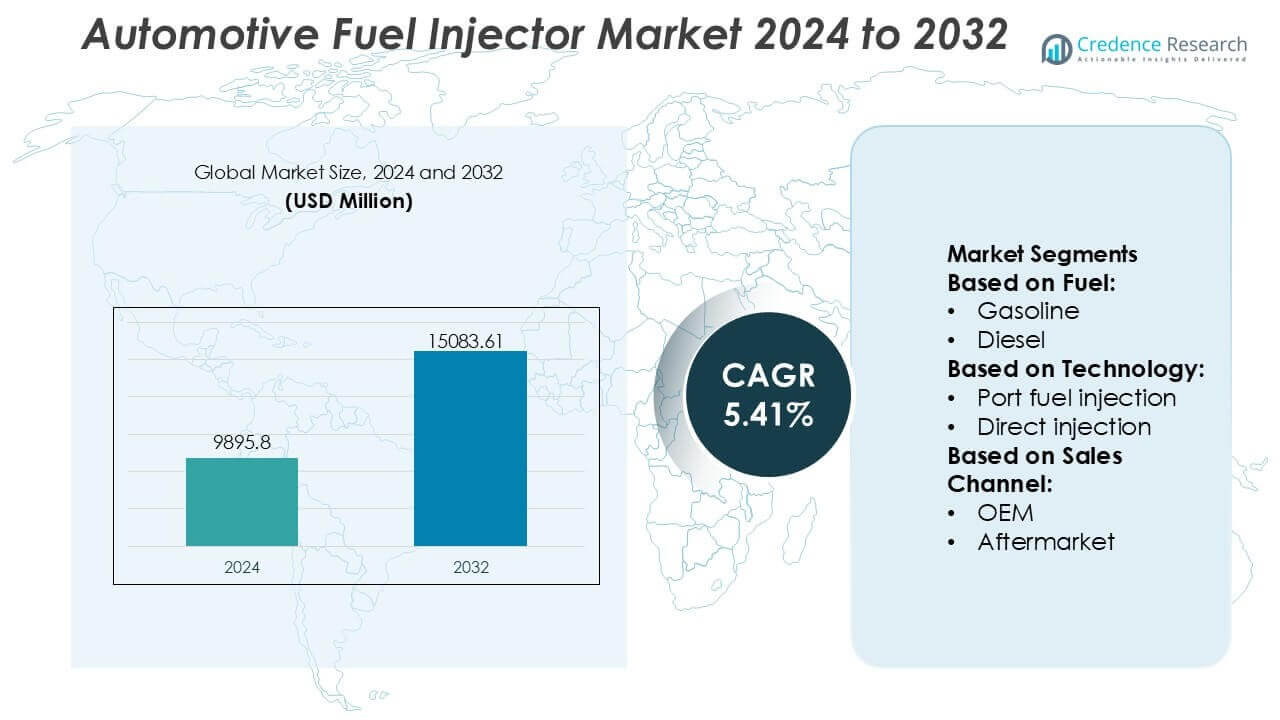
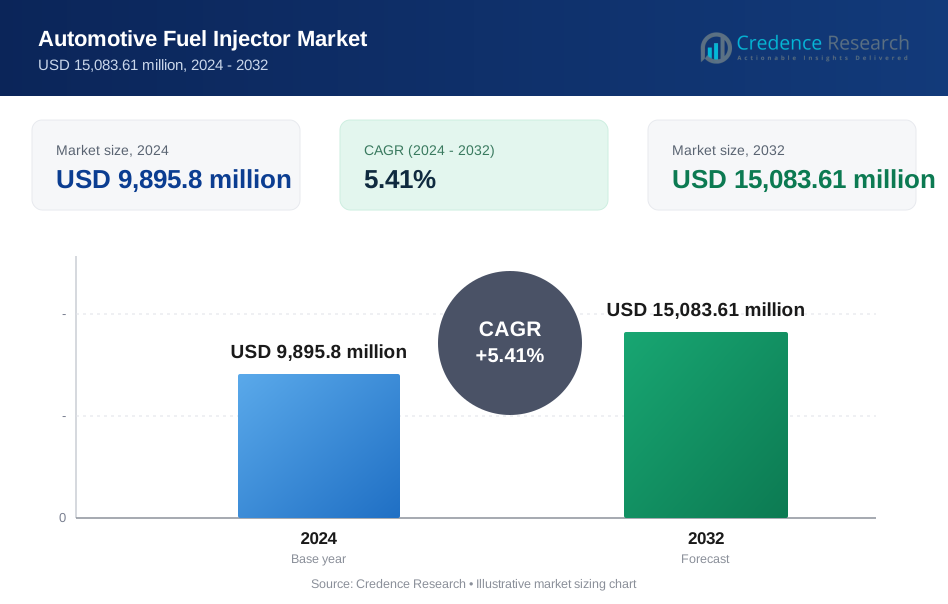
Automotive Fuel Injector Market size was valued USD 9895.8 million in 2024 and is anticipated to reach USD 15083.61 million by 2032, at a CAGR of 5.41% during the forecast period.
| REPORT ATTRIBUTE | DETAILS |
|---|---|
| Historical Period | 2020-2023 |
| Base Year | 2024 |
| Forecast Period | 2025-2032 |
| Automotive Fuel Injector Market Size 2024 | USD 9895.8 million |
| Automotive Fuel Injector Market, CAGR | 5.41% |
| Automotive Fuel Injector Market Size 2032 | USD 15083.61 million |
Automotive Fuel Injector Market Insights
- A key market driver is the growing adoption of high-pressure direct injection systems, as automakers prioritize improved fuel efficiency, precise fuel delivery, and lower exhaust emissions across passenger and commercial vehicles.
- Major market trends include increasing integration of electronic control units, demand for advanced spray atomization technologies, and rising use of durable materials to ensure injector compatibility with alternative and blended fuels.
- Competitive intensity remains high, with established global players and regional manufacturers focusing on OEM partnerships, automation, and continuous R&D investments, while aftermarket competition strengthens through cost-effective replacement solutions.
- Asia-Pacific dominates with an exact 42% market share, driven by China, Japan, and India, while the gasoline injector segment leads with an estimated ~58% share due to its widespread use in passenger vehicles.
Automotive Fuel Injector Market Segmentation Analysis:
By Fuel
The Automotive Fuel Injector Market, by fuel type, is led by gasoline injectors, which hold an estimated 62% market share. This dominance is driven by the large global passenger car parc, continued production of gasoline engines in emerging markets, and the compatibility of gasoline injectors with downsized, turbocharged powertrains. Gasoline direct injection systems enable precise fuel metering, improved combustion efficiency, and reduced particulate emissions, supporting regulatory compliance. Diesel injectors maintain steady demand in commercial vehicles due to high-pressure common-rail systems, while “others,” including alternative fuels, remain niche owing to limited infrastructure.
- For instance, Biogen Idec operates large-scale precision manufacturing and quality-controlled filling operations supporting more than 20 commercial and late-stage products, with individual biologics batches exceeding 10,000 filled units per run and analytical testing regimes that process over 1,500 quality parameters per batch, demonstrating the same high-precision control philosophy that underpins advanced fuel injection technologies.
By Technology
By technology, direct injection represents the dominant sub-segment with approximately 54% market share, supported by its ability to deliver higher fuel efficiency, improved power output, and lower emissions compared with legacy systems. Automakers increasingly adopt direct injection to meet tightening emission norms while maintaining engine performance. Port fuel injection continues to serve cost-sensitive vehicle segments and emerging markets due to its simpler design and lower maintenance costs. Throttle body injection remains minimal, largely confined to older platforms, as modern engine architectures favor multi-point and direct injection technologies.
- For instance, Ypsomed has demonstrated high-precision fluid-delivery expertise through its automated injection systems capable of delivering volumes as low as 0.01 milliliters with dosing accuracy within ±0.002 milliliters, supported by production lines exceeding 1,200 assembled injection devices per hour, reflecting the same precision engineering principles critical to advanced automotive fuel injection technologies.
By Sales Channel
By sales channel, the market is dominated by OEM supply, accounting for roughly 68% market share, driven by long-term contracts with automakers and integration of injectors during vehicle assembly. OEM demand benefits from rising vehicle production volumes, platform standardization, and the adoption of advanced injection systems in new models. The aftermarket segment grows steadily, supported by injector wear, contamination issues, and increasing average vehicle age. Replacement demand is particularly strong in high-mileage vehicles, where performance degradation and emission failures necessitate timely injector replacement.
Key Growth Drivers
Rising Stringency of Emission and Fuel-Efficiency Regulations
Tightening global emission norms and fuel-efficiency mandates remain a primary growth driver for the automotive fuel injector market. Governments across major automotive regions continue to enforce lower tailpipe emissions, pushing OEMs to adopt precise fuel metering technologies. Advanced injectors enable finer atomization, optimized spray patterns, and accurate fuel delivery, directly supporting compliance with Euro, BS, and EPA standards. This regulatory pressure accelerates replacement of legacy injection systems with electronically controlled, high-pressure injectors across both gasoline and diesel vehicles, sustaining steady demand from OEM and aftermarket channels.
- For instance, Owen Mumford has demonstrated validated precision-engineering capabilities through its injection device platforms, where controlled-force drive mechanisms deliver dose volumes as low as 0.05 milliliters with actuation force repeatability within 1 newton, supported by automated assembly lines producing more than 10 million devices annually and in-house verification systems performing over 1,000 functional checks per device batch capabilities that closely mirror the accuracy, repeatability, and regulatory robustness required in modern automotive fuel-injection systems.
Growth in Global Vehicle Production and Powertrain Diversification
Expanding vehicle production volumes, particularly in emerging economies, significantly support fuel injector demand. While passenger vehicles remain the largest contributor, light commercial and heavy-duty segments also drive growth through rising logistics, construction, and e-commerce activity. Simultaneously, diversification of powertrains ranging from downsized turbocharged engines to hybrid configurations require injectors capable of operating under higher pressures and variable duty cycles. This combination of higher production volumes and evolving engine architectures reinforces sustained demand for technologically advanced injector solutions.
- For instance, Amgen demonstrates comparable large-scale precision and reliability in advanced manufacturing, operating single-use bioreactor systems with working volumes up to 2,000 liters, supported by automated process controls that monitor more than 500 critical process parameters in real time and downstream fill-finish lines capable of processing over 1 million injectable units per day, underscoring the level of scalable precision and robustness demanded by complex, high-throughput engineering systems.
Increasing Adoption of Direct Injection Technologies
The shift from conventional port fuel injection toward direct injection systems acts as a strong market catalyst. Direct injection improves combustion efficiency, engine responsiveness, and fuel economy, making it a preferred choice for modern gasoline and diesel engines. Automakers increasingly integrate high-pressure injectors to support downsizing and turbocharging strategies without compromising performance. As direct injection penetrates mid-range and mass-market vehicles, demand rises for durable, precision-engineered injectors, supporting both new vehicle installations and long-term replacement cycles.
Key Trends & Opportunities
Advancements in Injector Design and Materials
Technological innovation in injector design is a prominent trend shaping market opportunities. Manufacturers increasingly focus on multi-hole nozzles, improved needle control, and advanced coatings to enhance durability under extreme pressure and temperature conditions. Lightweight materials and precision manufacturing improve response times and reduce wear, extending service life. These advancements create opportunities for suppliers offering next-generation injectors compatible with modern engine management systems, while also supporting automakers’ goals for efficiency, reliability, and reduced total cost of ownership.
- For instance, SHL Medical AG has demonstrated robust, scalable precision manufacturing and design performance in its advanced drug-delivery platforms, having shipped more than 1.5 billion autoinjectors globally with modular device platforms that support a range of primary container volumes up to 5 mL, and its Reunite™ dual-chamber autoinjector design has been shortlisted for two global innovation awards in 2025 for its automated reconstitution and delivery technology.
Expansion of the Automotive Aftermarket
The growing global vehicle parc and longer vehicle ownership cycles are expanding opportunities within the automotive aftermarket. Fuel injectors experience gradual performance degradation due to contamination and wear, driving replacement demand over a vehicle’s lifespan. Independent service centers and authorized workshops increasingly adopt remanufactured and high-quality replacement injectors to restore engine efficiency. This trend creates steady revenue streams for suppliers offering cost-effective, reliable aftermarket solutions, particularly in regions with aging vehicle fleets and strong repair and maintenance cultures.
- For instance, Teva Pharmaceutical has bolstered its production technology using its Teva Rise global open innovation platform to accelerate AI and Industry 4.0 smart manufacturing solutions, engaging seven real-world tech challenges across R&D, manufacturing, and supply chain operations to validate and scale automation, digital process controls, and predictive analytics in real-world environments.
Key Challenges
High Cost and Complexity of Advanced Fuel Injectors
One of the key challenges in the automotive fuel injector market is the rising cost and technical complexity of advanced injector systems. High-pressure direct injection units require precision manufacturing, sophisticated materials, and stringent quality control, increasing production costs. These factors can limit adoption in cost-sensitive vehicle segments and emerging markets. Additionally, complex injector designs demand specialized diagnostic and repair capabilities, raising maintenance costs and creating barriers for smaller service providers.
Gradual Shift Toward Electrified Powertrains
The long-term transition toward electrified powertrains presents a structural challenge for the fuel injector market. Battery electric vehicles do not require fuel injection systems, gradually reducing addressable demand in regions with strong electrification policies. While hybrids continue to support injector usage, increasing electrification intensity may limit volume growth over time. Market participants must balance near-term demand from internal combustion engines with strategic investments in adjacent technologies to mitigate future risks.
Regional Analysis
North America
North America represents a mature yet technologically advanced Automotive Fuel Injector Market, accounting for approximately 26% market share. Demand is driven by stringent emission regulations, widespread adoption of gasoline direct injection (GDI) systems, and a strong preference for high-performance vehicles. OEMs in the region emphasize precision-engineered injectors that improve fuel atomization and combustion efficiency to meet tightening fuel economy standards. The presence of established automotive manufacturers, advanced R&D infrastructure, and a large replacement aftermarket further supports market stability. Growth is increasingly supported by hybrid vehicle penetration and continuous upgrades in injector durability and electronic control integration.
Europe
Europe holds an estimated 24% share of the Automotive Fuel Injector Market, supported by strict Euro emission norms and a strong diesel vehicle legacy. Although diesel penetration is gradually declining, advanced diesel fuel injectors remain critical in commercial vehicles and select passenger segments. The region shows high adoption of high-pressure common rail systems and multi-hole injectors to optimize combustion efficiency and reduce particulate emissions. OEM focus on downsized turbocharged engines and hybrid platforms sustains injector demand. Strong regulatory oversight, technological innovation, and premium vehicle production continue to shape a stable yet innovation-driven regional market landscape.
Asia-Pacific
Asia-Pacific dominates the Automotive Fuel Injector Market with an estimated 38% market share, driven by high vehicle production volumes across China, India, Japan, and Southeast Asia. Rapid urbanization, expanding middle-class populations, and rising passenger vehicle ownership significantly boost injector demand. Gasoline injectors lead volume consumption, while diesel injectors maintain relevance in commercial and utility vehicles. Cost-optimized manufacturing, localized supply chains, and increasing adoption of direct injection technologies support market expansion. Additionally, tightening emission standards across emerging economies are accelerating the transition toward electronically controlled and high-efficiency fuel injector systems.
Latin America
Latin America accounts for approximately 7% of the global market, supported by steady automotive production in Brazil, Mexico, and Argentina. The region’s market is characterized by demand for durable, cost-effective fuel injectors suited to varied fuel quality and operating conditions. OEM and aftermarket demand remains balanced, with a strong focus on replacement injectors due to an aging vehicle parc. Gradual enforcement of emission regulations and recovery in automotive manufacturing are encouraging adoption of improved fuel injection technologies. However, economic volatility and limited electrification penetration moderate the overall growth pace.
Middle East & Africa
The Middle East & Africa region holds an estimated 5% market share, driven primarily by demand for fuel injectors in passenger cars and light commercial vehicles. The market benefits from high vehicle usage rates, especially in Gulf countries, supporting strong aftermarket demand. Fuel injectors designed for high-temperature and harsh operating environments are particularly important in this region. While emission regulations remain comparatively less stringent, gradual policy alignment with global standards is driving demand for more efficient injection systems. Growth remains steady, supported by vehicle imports, infrastructure development, and expanding urban mobility.
Automotive Fuel Injector Market Segmentations:
By Fuel:
- Gasoline
- Diesel
By Technology:
- Port fuel injection
- Direct injection
By Sales Channel:
- OEM
- Aftermarket
By Geography
- North America
- U.S.
- Canada
- Mexico
- Europe
- Germany
- France
- U.K.
- Italy
- Spain
- Rest of Europe
- Asia Pacific
- China
- Japan
- India
- South Korea
- South-east Asia
- Rest of Asia Pacific
- Latin America
- Brazil
- Argentina
- Rest of Latin America
- Middle East & Africa
- GCC Countries
- South Africa
- Rest of the Middle East and Africa
Competitive Landscape
The competitive landscape of the Automotive Fuel Injector Market players such as Biogen Idec, Ypsomed, Pfizer, Inc., Owen Mumford, Amgen, Mylan N.V., SHL Medical AG, Teva Pharmaceutical, Eli Lilly, AbbVie, Inc. the Automotive Fuel Injector Market is shaped by intense competition focused on technological differentiation, manufacturing efficiency, and long-term OEM relationships. Market participants prioritize the development of high-precision injectors that deliver consistent fuel atomization, optimized flow rates, and durability under extreme pressure and temperature conditions. Continuous investments in advanced materials, micron-level machining, and automated quality inspection systems support higher performance and lower defect rates. Companies also strengthen their positions through close collaboration with vehicle manufacturers and Tier-1 suppliers, enabling early adoption of injector designs aligned with evolving engine architectures and emission regulations. In parallel, scale advantages, global production networks, and localized manufacturing help reduce costs and improve supply reliability. Aftermarket coverage, compliance with stringent quality standards, and the ability to support both gasoline and diesel platforms further intensify competition, making operational excellence and innovation critical to sustaining market leadership.
Key Player Analysis
- Biogen Idec
- Ypsomed
- Pfizer, Inc.
- Owen Mumford
- Amgen
- Mylan N.V.
- SHL Medical AG
- Teva Pharmaceutical
- Eli Lilly
- AbbVie, Inc.
Recent Developments
- In August 2024, Eli Lilly introduced single-dose vials of its weight-loss drug Zepbound at a discounted price for cash-paying patients to address supply shortages and compete with rivals and compounded versions.
- In May 2024, Eisai Co. and Nippon medac Co. announced the launch of a Metoject Subcutaneous Injection Pen will be the first self-administrable MTX subcutaneous injection pen-type autoinjector for rheumatoid arthritis in Japan.
- In January 2024, Standard Motor Products, Inc. (SMP) announced a significant expansion of its gasoline fuel injection program, which comprises over 2,100 part numbers for a complete repair solution.
Report Coverage
The research report offers an in-depth analysis based on Fuel, Technology, Sales Channel and Geography. It details leading market players, providing an overview of their business, product offerings, investments, revenue streams, and key applications. Additionally, the report includes insights into the competitive environment, SWOT analysis, current market trends, as well as the primary drivers and constraints. Furthermore, it discusses various factors that have driven market expansion in recent years. The report also explores market dynamics, regulatory scenarios, and technological advancements that are shaping the industry. It assesses the impact of external factors and global economic changes on market growth. Lastly, it provides strategic recommendations for new entrants and established companies to navigate the complexities of the market.
Future Outlook
- Increasing adoption of direct injection systems will continue to enhance fuel efficiency and combustion control across passenger and commercial vehicles.
- Stricter global emission regulations will drive demand for high-precision fuel injectors with improved atomization and reduced particulate output.
- Technological advancements in materials and surface coatings will improve injector durability and performance under high-pressure operating conditions.
- Growth in hybrid powertrains will support demand for injectors optimized for frequent start-stop cycles and variable load conditions.
- Expansion of automated and digitally controlled manufacturing will improve production consistency and reduce defect rates.
- Rising vehicle production in emerging economies will create sustained demand for cost-efficient and reliable injector solutions.
- OEM preference for integrated fuel system solutions will strengthen long-term supplier partnerships and platform-based contracts.
- Increasing focus on lightweight engine components will encourage compact injector designs without compromising flow accuracy.
- Aftermarket demand will remain steady due to aging vehicle fleets and routine injector replacement requirements.
- Ongoing research in alternative and low-carbon fuels will require injectors capable of handling diverse fuel compositions.
Request a Free Sample
Fill in your details and we'll send you a free sample report.
- Sample data tables & charts
- Research methodology
Need a Custom Version of This Report?
Tailor the scope, geography, or segments to your exact requirements.
- Custom geography or segment scope
- Direct access to our analyst team
Frequently Asked Questions
What is the current market size for the Automotive Fuel Injector Market, and what is its projected size in 2032?
At what Compound Annual Growth Rate is the Automotive Fuel Injector Market projected to grow between 2024 and 2032?
Which Automotive Fuel Injector Market segment held the largest share in 2024?
What are the primary factors fueling the growth of the Automotive Fuel Injector Market?
Who are the leading companies in the Automotive Fuel Injector Market?
Which region commanded the largest share of the Automotive Fuel Injector Market in 2024?
Table of Content
Chapter 1. Report Introduction
- 1.1 Report Description & Purpose
- 1.1.1 Report Title & Market Definition
- 1.1.2 Unique Selling Propositions (USP) & Key Differentiators
- 1.1.3 Value Proposition for Stakeholders
- 1.2 Research Objectives
- 1.2.1 Market Sizing Objectives (Volume & Revenue) (Volume Where Applicable)
- 1.2.2 Segmentation Objectives
- 1.2.3 Competitive Intelligence Objectives
- 1.2.4 Forecast & Scenario Objectives
- 1.3 Report Scope
- 1.3.1 Automotive Fuel Injector Scope – Segments & Subsegments Covered
- 1.3.2 Geographic Scope – Regions & Countries Covered
- 1.3.3 Historical Period, Base Year & Forecast Period (2024; forecast to 2032)
- 1.3.4 Inclusions & Exclusions
- 1.4 Industry Classification & Applicable Codes
- 1.5 Currency, Measurement Units & Valuation Basis
- 1.6 Target Stakeholders
- 1.7 Limitations & Assumptions
Chapter 2. Executive Summary
- 2.1 Global Automotive Fuel Injector Market Snapshot
- 2.1.1 Market Size – Historical (2024) & Forecast (2024-2032) (2024: USD 9,895.8 million → 2032: USD 15,083.61 million)
- 2.1.2 Volume & Revenue – Global Totals (Volume Where Applicable)
- 2.1.3 Key Market Highlights – Top Five Facts
- 2.2 Automotive Fuel Injector Market Segmentation Snapshot
- 2.2.1 Market Split by Region – 2024 vs. 2032
- 2.3 Competitive Snapshot
- 2.3.1 Top 10 Players by Revenue Share – 2024
- 2.3.2 Top 10 Players by Volume Share – 2024 (Volume Where Applicable)
- 2.3.3 Recent Strategic Developments (18-Month Summary)
- 2.4 Key Investment Highlights & Strategic Conclusions
Chapter 3. Automotive Fuel Injector Market Dynamics & Industry Analysis
- 3.1 Market Overview & Context
- 3.1.1 Automotive Fuel Injector Market Position in the Broader Industry Value Chain
- 3.1.2 Demand Structure & Purchasing Dynamics
- 3.1.3 Market Maturity & Development Stage by Region
- 3.2 Automotive Fuel Injector Market Drivers
- 3.3 Automotive Fuel Injector Market Restraints & Challenges
- 3.4 Automotive Fuel Injector Market Opportunities
- 3.5 Porter's Five Forces Analysis
- 3.5.1 Threat of New Entrants
- 3.5.2 Bargaining Power of Suppliers
- 3.5.3 Bargaining Power of Buyers
- 3.5.4 Threat of Substitutes
- 3.5.5 Competitive Rivalry – Intensity Assessment
- 3.6 Automotive Fuel Injector Value Chain Analysis
- 3.6.1 Upstream – Key Inputs, Resources & Suppliers
- 3.6.1.1 Key Input/Resource 1
- 3.6.1.2 Key Input/Resource 2
- 3.6.1.3 Key Input/Resource 3
- 3.6.2 Midstream – Core Operations & Value Creation
- 3.6.2.1 Operating Model & Process Overview
- 3.6.2.2 Key Operating Locations & Capabilities by Company
- 3.6.3 Downstream – Market Channels & End Users
- 3.6.3.1 Direct Sales & Customer Engagement Channels
- 3.6.3.2 Indirect Sales, Intermediaries & Partner Channels
- 3.6.4 Value Chain Profitability Analysis
- 3.6.1 Upstream – Key Inputs, Resources & Suppliers
- 3.7 PESTEL Analysis
- 3.7.1 Political Factors
- 3.7.2 Economic Factors
- 3.7.3 Social Factors
- 3.7.4 Technological Factors
- 3.7.5 Environmental Factors
- 3.7.6 Legal Factors
- 3.8 Automotive Fuel Injector Supply Chain Analysis
- 3.8.1 Critical Input & Resource Availability Risk Assessment
- 3.8.2 Supplier & Operational Concentration Risk (Geographic Exposure)
- 3.8.3 Supply & Service Disruption Impact Analysis
- 3.9 Regulatory & Policy Landscape
Note: The regulatory and policy landscape section covers regulations based on their applicability to the market, Automotive Fuel Injector category, geography, and scope of the study. Only regulatory frameworks with a material impact on operations, compliance, trade, sustainability, or market access are analyzed in detail.
Chapter 4. Key Investment Pockets & Opportunity Analysis
- 4.1 Automotive Fuel Injector Market Attractiveness Analysis
- 4.1.1 By Region – Investment Attractiveness Matrix (Market Size × CAGR)
- 4.2 Absolute Revenue Growth Opportunity
- 4.2.1 By Region – Absolute Revenue Growth Through 2032
- 4.3 Incremental Demand Opportunity
- 4.3.1 By Region – Incremental Demand Through 2032
- 4.3.2 Segment – Incremental Demand
- 4.4 Emerging Submarket Opportunity Deep Dive (Subject to Applicability)
- 4.5 Priority Market Opportunity Scorecards
- 4.5.1 United States
- 4.5.2 Europe
- 4.5.3 Asia
- 4.5.4 Middle East & Africa
Note: Priority market opportunity scorecards reflect the geographic scope and strategic relevance of the study. Listed markets are indicative and may be adapted to the industry.
Chapter 5. Automotive Fuel Injector Cross-Border Trade & Market Access Analysis
- 5.1 International Trade & Cross-Border Activity Overview
- 5.1.1 Global Export Value by Country (2024)
- 5.1.2 Global Export Volume by Country (2024) (Volume Where Applicable)
- 5.1.3 Global Import Value by Country (2024)
- 5.1.4 Global Import Volume by Country (2024) (Volume Where Applicable)
- 5.1.5 Net Trade Balance by Country (2024)
- 5.2 Export Analysis – Segment
- 5.2.1 Category 1 (Applicable Classification Code)
- 5.2.2 Category 2 (Applicable Classification Code)
- 5.2.3 Category 3 (Applicable Classification Code)
- 5.2.4 Category 4 (Applicable Classification Code)
- 5.2.5 Category 5 (Applicable Classification Code)
- 5.3 Import Analysis – Segment
- 5.3.1 Category 1 (Applicable Classification Code)
- 5.3.2 Category 2 (Applicable Classification Code)
- 5.3.3 Category 3 (Applicable Classification Code)
- 5.3.4 Category 4 (Applicable Classification Code)
- 5.3.5 Category 5 (Applicable Classification Code)
- 5.4 Cross-Border Pricing & Transaction Benchmarks
- 5.4.1 Export Pricing – Segment & Country
- 5.4.2 Import Pricing – Segment & Source Country
- 5.4.3 Price Trends (2024)
- 5.5 Key Cross-Border Trade & Delivery Routes
- 5.5.1 Cross-Border Trade/Delivery Route 1
- 5.5.2 Cross-Border Trade/Delivery Route 2
- 5.5.3 Cross-Border Trade/Delivery Route 3
- 5.5.4 Cross-Border Trade/Delivery Route 4
- 5.5.5 Cross-Border Trade/Delivery Route 5
- 5.6 Trade Policy & Market Access Impact Assessment
- 5.6.1 Tariff & Non-Tariff Barriers
- 5.6.2 Regional Trade & Economic Integration Frameworks
- 5.6.3 Bilateral & Multilateral Trade Agreements
- 5.6.4 Cross-Border Operating, Licensing & Localization Requirements
Note: This chapter applies where cross-border trade or delivery is relevant to Automotive Fuel Injector. Goods, services, and digital offerings are assessed using applicable classifications and transaction measures. Import-export volumes, trade balances, and route analyses are included only where meaningful to the market.
Chapter 6. Competitive Landscape & Company Benchmarking
- 6.1 Automotive Fuel Injector Market Concentration & Structure
- 6.1.1 Herfindahl-Hirschman Index (HHI) – vs. 2024
- 6.1.2 Leading, Mid-Sized & Emerging Player Structure
- 6.1.3 Global, Regional & Local Player Dynamics
- 6.2 Automotive Fuel Injector Market Share Analysis – 2024
- 6.2.1 Global Revenue Share by Company
- 6.2.2 Global Volume Share by Company (Volume Where Applicable)
- 6.2.3 Regional Revenue Share
- 6.2.4 Market Share Evolution ( vs. 2024)
- 6.2.5 Company Market Share by Key Segment
- 6.2.6 Company Market Share by Customer Group
- 6.3 Operating Scale, Capacity & Infrastructure Analysis
- 6.3.1 Global Operating Scale & Supply Capacity
- 6.3.2 Resource Utilization & Operating Efficiency
- 6.3.3 Output, Service Delivery & Activity Metrics
- 6.3.4 Operating Footprint & Infrastructure Map
- 6.3.5 Planned Operational & Capacity Expansion
- 6.4 Automotive Fuel Injector Competitive Benchmarking Matrix
- 6.4.1 Revenue, Growth, Profitability & Operating Metric Comparison
- 6.4.2 Channel Revenue Mix
- 6.4.3 Geographic Revenue Exposure
- 6.4.4 R&D Intensity
- 6.4.5 Sustainability Maturity
- 6.5 Strategic Developments in Automotive Fuel Injector (Last 24 Months)
- 6.5.1 Mergers, Acquisitions & Divestments
- 6.5.2 New Products, Services & Solutions in Automotive Fuel Injector
- 6.5.3 Operational & Infrastructure Expansions
- 6.5.4 Strategic Alliances, Joint Ventures & Partnerships
- 6.5.5 Distribution Expansion & Market Entry
- 6.5.6 Sustainability & ESG Initiatives
- 6.6 Competitive Strategy Mapping
- 6.6.1 Leader, Challenger, Follower & Niche Classification
- 6.6.2 Pricing Strategy Comparison
- 6.6.3 Channel Strategy Matrix
Note: Strategic developments are included based on their materiality and the availability of reliable information.
Chapter 7. Global Automotive Fuel Injector Market – By Sales & Delivery Channel
- 7.1 Segment Overview
- 7.1.1 Volume & Revenue Split by Channel (2024 & 2032) (Volume Where Applicable)
- 7.1.2 Channel Mix Evolution (2024-2032)
Chapter 8. Regional Market Analysis – Global Overview
- 8.1 Global Regional Overview
- 8.1.1 Regional Volume Share (Volume Where Applicable)
- 8.1.2 Regional Revenue Share
- 8.1.3 Regional Volume by Region (Volume Where Applicable)
- 8.1.4 Regional Revenue by Region
- 8.1.5 Regional Forecast Through 2032
- 8.2 Cross-Regional Segment Analysis
- 8.2.1 By Sales & Delivery Channel
- 8.2.2 By Competitive Positioning & Price Tier
Chapter 9. North America Automotive Fuel Injector Market
- 9.1 United States
- 9.2 Canada
- 9.3 Mexico
Chapter 10. Europe Automotive Fuel Injector Market
- 10.1 Germany
- 10.2 France
- 10.3 Italy
- 10.4 United Kingdom
- 10.5 Spain
- 10.6 Poland
- 10.7 Russia
- 10.8 Netherlands
- 10.9 Belgium
- 10.10 Sweden
- 10.11 Denmark
- 10.12 Norway
- 10.13 Rest of Europe
Chapter 11. Asia Pacific Automotive Fuel Injector Market
- 11.1 China
- 11.2 India
- 11.3 Japan
- 11.4 South Korea
- 11.5 Thailand
- 11.6 Indonesia
- 11.7 Vietnam
- 11.8 Malaysia
- 11.9 Australia
- 11.10 Rest of Asia Pacific
Chapter 12. Latin America Automotive Fuel Injector Market
- 12.1 Brazil
- 12.2 Argentina
- 12.3 Colombia
- 12.4 Chile
- 12.5 Rest of Latin America
Chapter 13. Middle East Automotive Fuel Injector Market
- 13.1 Saudi Arabia
- 13.2 United Arab Emirates
- 13.3 Turkey
- 13.4 Israel
- 13.5 Iran
- 13.6 Rest of the Middle East
Chapter 14. Africa Automotive Fuel Injector Market
- 14.1 South Africa
- 14.2 Egypt
- 14.3 Nigeria
- 14.4 Morocco
- 14.5 Rest of Africa
Chapter 15. Automotive Fuel Injector Company Profiles
- 15.1 [Company 01]
- 15.1.1 Company Overview
- 15.1.2 Key Management Personnel
- 15.1.3 Products & Services Portfolio
- 15.1.4 Financial Performance
- 15.1.5 Key Market Focus & Geographic Presence
- 15.1.6 Recent Developments & Strategic Initiatives
Note: The company profile list is preliminary and may change based on research findings, market developments, data availability, and client requirements.
Chapter 16. Appendices
- Appendix A – List of Abbreviations & Acronyms
- Appendix B – Industry Classification Code Reference – Full Series
- Appendix C – Supply, Output & Operating Capacity Data Tables
- Appendix D – End-Use & Demand Base Tables
- Appendix E – Demand, Adoption & Usage Assumptions
- Appendix F – Pricing & Revenue Metric Reference Tables
- Appendix G – Company Operations & Infrastructure Database
- Appendix H – Cross-Border Trade & Activity Data Tables (Where Applicable)
- Appendix I – Regulatory Summary Tables
- Appendix J – Primary Research Participant List (Anonymized)
- Appendix K – Primary Research Questionnaire Framework
- Appendix L – Data Sources & Bibliography
- Appendix M – Market Size Divergence & Source Comparison
Chapter 17. Research Methodology
- 17.1 Research Framework & Philosophy
- 17.2 Secondary Research – Sources, Hierarchy & Data Extraction
- 17.3 Data Modeling – Bottom-Up & Top-Down Market Sizing
- 17.4 Primary Research – Stakeholder Framework, LOI & Sample Sizes
- 17.5 Forecast Methodology – Regression, Scenario & Sensitivity Analysis
- 17.6 Quality Control – Four-Layer Validation Framework
- 17.7 Limitations & Standard Assumptions
- 17.8 Disclaimer
