
Automotive Head-Up Display (HUD) Market Overview:
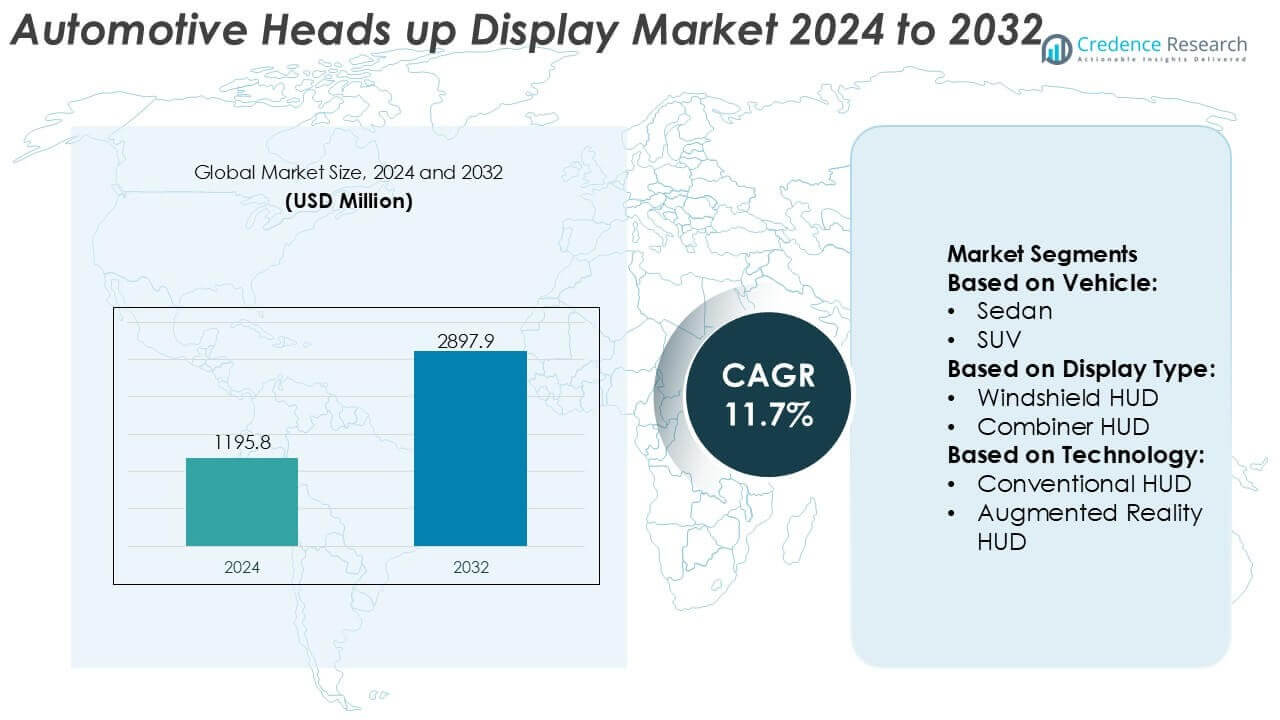
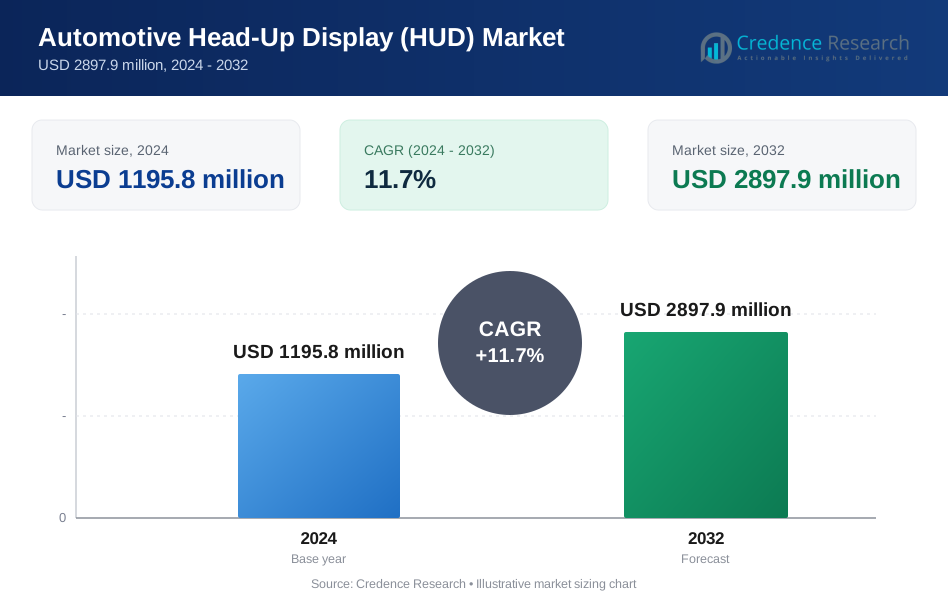
Automotive Heads up Display Market size was valued USD 1195.8 million in 2024 and is anticipated to reach USD 2897.9 million by 2032, at a CAGR of 11.7% during the forecast period.
| REPORT ATTRIBUTE | DETAILS |
|---|---|
| Historical Period | 2020-2023 |
| Base Year | 2024 |
| Forecast Period | 2025-2032 |
| Automotive Heads-Up Display Market Size 2024 | USD 1195.8 million |
| Automotive Heads-Up Display Market , CAGR | 11.7% |
| Automotive Heads-Up Display Market Size 2032 | USD 2897.9 million |
Automotive Head-Up Display (HUD) Market Insights
- Market growth is primarily driven by increasing integration of ADAS, navigation, and safety alerts into HUDs, improving driver awareness and reducing distraction across passenger and premium vehicle segments.
- Key market trends include rapid adoption of augmented reality HUDs, expansion of windshield-based systems, and growing penetration of HUDs into mid-range vehicles, with windshield HUDs accounting for over half of total installations.
- The competitive landscape is shaped by strong R&D focus on optical efficiency, compact projection engines, and software-defined interfaces, while high system costs and complex integration act as key market restraints.
- Regionally, Asia-Pacific leads with an exact 38% market share, supported by high vehicle production and advanced cockpit adoption, followed by Europe and North America with strong regulatory and technology pull.
Automotive Head-Up Display (HUD) Market Segmentation Analysis:
By Vehicle
The Automotive Head-Up Display market by vehicle type is led by passenger cars, which account for around 68% market share, driven by higher production volumes and faster adoption of driver-assistance and comfort technologies. Within passenger cars, SUVs form the dominant sub-segment due to premium positioning, larger windshield areas suitable for HUD integration, and higher penetration of ADAS features. Automakers increasingly install HUDs in mid-range sedans and hatchbacks as safety regulations tighten and consumer awareness improves. Commercial vehicles and off-highway vehicles show gradual uptake, mainly supported by fleet safety requirements and navigation efficiency needs.
- For instance, Sharp Electronics Corporation has developed automotive-grade TFT-LCD HUD panels with luminance levels exceeding 12,000 cd/m² and optical engines supporting projection distances above 7 meters, enabling clear visibility in SUVs and passenger cars under direct sunlight while maintaining operating reliability across a temperature range from –40°C to 85°C.
By Display Type
By display type, windshield HUDs dominate the market with approximately 72% share, owing to their superior image size, better depth perception, and seamless driver visibility. Windshield-based systems project information directly onto the glass, minimizing eye movement and improving reaction time, which strongly supports safety-driven adoption. OEM preference for integrated, premium cockpit designs further accelerates this segment. Combiner HUDs hold a smaller share, mainly used in cost-sensitive models and entry-level vehicles, where compact design, lower system complexity, and reduced integration costs remain key adoption drivers.
- For instance, Panasonic Holdings Corporation has developed windshield HUD optical modules capable of projecting virtual images at distances exceeding 10 meters, with brightness levels above 15,000 cd/m² and a horizontal field of view greater than 10 degrees, while achieving response times below 10 milliseconds specifications validated in Panasonic’s automotive HUD systems supplied to global OEM platforms for high-contrast visibility under direct sunlight.
By Technology
By technology, conventional HUDs currently hold the largest share at about 58%, supported by mature projection systems, lower costs, and wide availability across mass-market vehicles. However, Augmented Reality HUDs represent the fastest-growing and strategically dominant future sub-segment, driven by real-time navigation overlays, ADAS alerts, and enhanced situational awareness. AR HUDs improve driving precision by aligning digital content with real-world objects, accelerating adoption in premium and electric vehicles. Holographic HUDs remain in an early adoption phase, limited by higher costs and complex optical requirements.
Key Growth Drivers
Rising Focus on Driver Safety and ADAS Integration
The growing emphasis on vehicle safety and advanced driver assistance systems (ADAS) is a primary growth driver for the automotive head-up display (HUD) market. Automakers increasingly integrate HUDs with ADAS features such as lane-keeping assist, adaptive cruise control, collision warnings, and navigation alerts. By projecting critical information directly into the driver’s line of sight, HUDs reduce distraction and improve reaction time. Stricter safety regulations and consumer preference for vehicles with enhanced safety technologies continue to accelerate OEM adoption across passenger and premium vehicle segments.
- For instance, Sony Corporation has advanced automotive HUD performance through its high-resolution CMOS image sensors and microdisplay technologies, including sensors with 8.3-megapixel resolution, pixel sizes of 2.1 µm, and dynamic range exceeding 120 dB, enabling precise rendering of ADAS symbols with high contrast under challenging lighting conditions, while achieving sensor readout speeds above 60 frames per second to support real-time safety alerts without perceptible latency.
Increasing Demand for Premium In-Vehicle User Experience
Consumer expectations for advanced digital and connected in-car experiences strongly support HUD market growth. HUDs enhance vehicle interiors by delivering a premium, futuristic interface that complements digital instrument clusters and infotainment systems. Automakers use HUDs to differentiate models through improved visual clarity, customizable displays, and seamless integration with smartphone connectivity and navigation systems. As premium features migrate from luxury to mid-range vehicles, HUD adoption expands beyond high-end models, driving higher installation rates and broader market penetration.
- For instance, Tandem OLED drivers reducing power consumption by 40 % compared to single-stack equivalents while increasing panel lifespan as validated by in-house reliability testing. LG’s automotive LTPS LCD solutions used in HUD applications achieve up to 5,000 cd/m² brightness, supporting clear visibility under direct daylight conditions for driver-facing projections.
Advancements in Display and Projection Technologies Continuous improvements in optical systems, display resolution, and projection technologies significantly drive HUD adoption. Innovations such as augmented reality (AR) HUDs, high-brightness projectors, and wide field-of-view windscreen displays enhance readability under varying lighting conditions. These technological advancements allow real-time overlay of navigation paths, hazard warnings, and driving cues onto the road view. Improved system reliability, compact designs, and declining component costs further encourage automakers to integrate HUDs across a wider range of vehicle platforms.
Key Trends & Opportunities
Shift Toward Augmented Reality Head-Up Displays
Augmented reality HUDs represent a major trend and opportunity in the automotive HUD market. Unlike conventional HUDs, AR HUDs project contextual information aligned with real-world objects, such as lane markings, pedestrians, or navigation turns. This improves driver comprehension and situational awareness. Automakers increasingly view AR HUDs as a core component of next-generation human–machine interfaces, especially for semi-autonomous vehicles. Growing investments in AR software, sensors, and vehicle perception systems create strong long-term opportunities for technology suppliers.
- For instance, Dell’s Automotive Reference Architecture defines the use of clustered compute and storage systems optimized for AI model training and ADAS/AR visualization workflows, incorporating Dell Precision workstations such as the Precision 5690, which sports a 16-core Intel® Core™ Ultra 7 165H processor running up to 5.0 GHz and an NVIDIA® RTX™ 4000 Ada Generation GPU with 12 GB GDDR6 memory to handle complex 3D rendering and machine learning workloads critical for AR HUD content generation and simulation during development.
Expansion into Mid-Segment and Electric Vehicles
HUD adoption is expanding rapidly beyond luxury vehicles into mid-segment passenger cars and electric vehicles. Electric vehicle manufacturers prioritize digital interfaces to enhance driving efficiency, navigation, and energy management displays. HUDs support this shift by presenting speed, range, and navigation data without diverting driver attention. As EV volumes rise globally and automakers standardize digital cockpits, HUDs gain wider acceptance, creating opportunities for cost-optimized systems tailored to high-volume vehicle platforms.
- For instance, DVX-3220, is offered with 6.6 mm, 8 mm, and 10 mm pixel spacings, enabling tighter imaging and crisp picture quality suitable for long-range visibility in transportation hubs and public environments.
Integration with Connected and Software-Defined Vehicles
The transition toward connected and software-defined vehicles creates new opportunities for HUD systems. HUDs increasingly integrate with vehicle operating systems, cloud connectivity, and over-the-air updates, enabling dynamic content, personalization, and feature upgrades. Real-time traffic, navigation, and vehicle-to-everything (V2X) alerts enhance HUD functionality. This trend supports recurring software-driven revenue models and strengthens the strategic importance of HUDs within the evolving digital vehicle architecture.
Key Challenges
High System Cost and Integration Complexity
The relatively high cost of HUD systems remains a key challenge, particularly for mass-market vehicle adoption. Advanced optical components, precision windscreen requirements, and complex calibration processes increase system costs and integration time. Automakers must redesign dashboards and windshields to accommodate HUD hardware, adding manufacturing complexity. Cost sensitivity in entry-level vehicles limits penetration, requiring suppliers to balance performance, reliability, and affordability to support wider market expansion.
Technical Limitations and Environmental Constraints
HUD performance can be affected by environmental factors such as bright sunlight, extreme temperatures, and windshield quality. Issues related to image distortion, ghosting, or reduced visibility under certain conditions can impact user experience. Additionally, differences in driver height and seating position require precise alignment and customization. Addressing these technical limitations demands continuous R&D investment, robust testing, and close collaboration with automakers, posing ongoing challenges for consistent, large-scale deployment.
Regional Analysis
North America
North America holds an estimated 32% market share in the automotive head-up display (HUD) market, driven by early adoption of advanced driver assistance systems and strong consumer preference for premium vehicle features. The region benefits from high penetration of luxury and mid-to-high segment passenger vehicles, where HUDs are increasingly offered as standard or optional features. Strict vehicle safety regulations, combined with growing demand for connected and semi-autonomous vehicles, accelerate HUD integration. Strong presence of technology-focused OEMs and Tier-1 suppliers further supports continuous innovation and rapid commercialization of advanced HUD solutions.
Europe
Europe accounts for approximately 28% of the global automotive HUD market, supported by stringent road safety regulations and strong demand for advanced in-vehicle technologies. Premium automotive brands play a key role in driving HUD adoption, particularly in luxury and performance vehicles. The region’s focus on reducing driver distraction and improving human–machine interfaces aligns well with HUD functionality. Additionally, rising electrification, increasing penetration of advanced driver assistance features, and strong R&D investments in optical and augmented reality technologies contribute to steady market expansion across both Western and Central European countries.
Asia-Pacific
Asia-Pacific dominates the automotive HUD market with an estimated 34% market share, driven by high vehicle production volumes and rapid adoption of advanced cockpit technologies. Countries such as China, Japan, and South Korea lead regional growth due to strong automotive manufacturing ecosystems and increasing demand for feature-rich passenger vehicles. Rising disposable incomes and growing consumer preference for digital displays support HUD adoption beyond luxury models. Additionally, aggressive expansion of electric vehicles and smart mobility initiatives in the region further strengthen demand for HUD systems integrated with navigation, safety, and vehicle connectivity features.
Latin America
Latin America represents around 4% of the automotive HUD market, reflecting gradual adoption of advanced vehicle technologies. Market growth is supported by increasing vehicle production, particularly in Brazil and Mexico, and rising demand for enhanced safety and comfort features in mid-range passenger cars. While HUD penetration remains limited compared to developed regions, improving economic conditions and expanding presence of global OEMs are encouraging the introduction of advanced display technologies. Over time, increasing awareness of driver safety and growing availability of cost-optimized HUD systems are expected to support moderate regional growth.
Middle East & Africa
The Middle East & Africa region accounts for approximately 2% market share in the automotive HUD market. Demand is primarily driven by luxury and premium vehicle sales, especially in Middle Eastern countries with high purchasing power. HUD adoption remains concentrated in high-end passenger vehicles, where advanced digital interfaces are valued for both safety and comfort. Limited automotive manufacturing infrastructure and lower penetration of advanced safety systems in parts of Africa constrain broader adoption. However, gradual improvements in vehicle safety standards and rising premium vehicle imports support steady long-term growth potential.
Automotive Head-Up Display (HUD) Market Segmentations:
By Vehicle:
- Sedan
- SUV
By Display Type:
- Windshield HUD
- Combiner HUD
By Technology:
- Conventional HUD
- Augmented Reality HUD
By Geography
- North America
- U.S.
- Canada
- Mexico
- Europe
- Germany
- France
- U.K.
- Italy
- Spain
- Rest of Europe
- Asia Pacific
- China
- Japan
- India
- South Korea
- South-east Asia
- Rest of Asia Pacific
- Latin America
- Brazil
- Argentina
- Rest of Latin America
- Middle East & Africa
- GCC Countries
- South Africa
- Rest of the Middle East and Africa
Competitive Landscape
The competitive landscape of the Automotive Heads-Up Display (HUD) market players such as Sharp Electronics Corporation; CDW; Panasonic Holdings Corporation; Sony Corporation; LG DISPLAY CO., LTD.; Dell Inc.; Daktronics; Cisco Systems, Inc.; SAMSUNG; Koninklijke Philips N.V.; NEC Corporation. The automotive heads-up display market is characterized by intense competition driven by rapid advancements in display optics, human–machine interface design, and software integration. Market participants compete by enhancing image brightness, expanding field of view, and improving contrast ratios to ensure clear visibility under varying driving and lighting conditions. Strong emphasis is placed on augmented-reality overlays, real-time navigation cues, and ADAS data visualization to improve driver awareness and safety. Companies also differentiate through compact system architectures, windshield-compatible projection technologies, and automotive-grade reliability that meets stringent regulatory and durability standards. Strategic collaborations with OEMs and Tier-1 suppliers enable early integration of HUD systems into new vehicle platforms, while continuous investments in R&D, digital processing, and manufacturing scalability support cost optimization and performance consistency. As vehicles become more connected and software-defined, competition increasingly centers on seamless system integration, upgradeability, and long-term platform compatibility.
Key Player Analysis
- Sharp Electronics Corporation
- CDW
- Panasonic Holdings Corporation
- Sony Corporation
- LG DISPLAY CO., LTD.
- Dell Inc.
- Daktronics
- Cisco Systems, Inc.
- SAMSUNG
- Koninklijke Philips N.V.
- NEC Corporation
Recent Developments
- In January 2025, Hyundai Mobis did unveil the world's first full-windshield holographic display (HWD) at CES 2025, co-developed with ZEISS, turning the entire windshield into a transparent screen for driving data, navigation, and infotainment, with plans for a 2027 market launch.
- In April 2024, Daktronics partnered with the University of Colorado to install a significant new LED display system at Folsom Field, featuring six displays totaling 8,800 square feet, aimed at boosting fan experience and creating sponsorship opportunities before the 2024 football season.
- In February 2024, SHARP Electronics of Canada Ltd. announced the launch of the MultiSync PNME Series commercial displays, a new product line designed to meet the evolving demands of the digital signage market. These displays, developed in collaboration with NEC Corporation, emphasize commercial-grade reliability while integrating modernized features.
- In February 2024, Samsung showcased cutting-edge commercial display innovations centered on hyper-connectivity through SmartThings for Business and new display technologies like the Transparent MICRO LED.
Report Coverage
The research report offers an in-depth analysis based on Vehicle, Display Type, Technology and Geography. It details leading market players, providing an overview of their business, product offerings, investments, revenue streams, and key applications. Additionally, the report includes insights into the competitive environment, SWOT analysis, current market trends, as well as the primary drivers and constraints. Furthermore, it discusses various factors that have driven market expansion in recent years. The report also explores market dynamics, regulatory scenarios, and technological advancements that are shaping the industry. It assesses the impact of external factors and global economic changes on market growth. Lastly, it provides strategic recommendations for new entrants and established companies to navigate the complexities of the market.
Future Outlook
- Adoption of augmented reality–based HUDs will increase as automakers prioritize enhanced driver awareness and contextual information delivery.
- Integration of HUDs with advanced driver-assistance systems will deepen, enabling real-time visualization of safety and navigation data.
- Demand for larger field-of-view and higher-resolution projections will grow to support complex driving environments.
- Windshield-based HUDs will gain wider acceptance due to improved optical efficiency and seamless cockpit integration.
- Software-defined vehicle architectures will support over-the-air updates for HUD features and user interfaces.
- Growing electrification and autonomous driving development will accelerate the need for intuitive human–machine interfaces.
- Miniaturization of optical components will reduce system weight and improve design flexibility for vehicle interiors.
- Increasing focus on driver comfort and reduced cognitive load will shape future HUD content design.
- Expansion of HUD adoption into mid-range and mass-market vehicles will broaden overall market penetration.
- Collaboration between display technology providers and automotive OEMs will intensify to accelerate innovation cycles.
Request a Free Sample
Fill in your details and we'll send you a free sample report.
- Sample data tables & charts
- Research methodology
Need a Custom Version of This Report?
Tailor the scope, geography, or segments to your exact requirements.
- Custom geography or segment scope
- Direct access to our analyst team
Frequently Asked Questions
What is the current market size of the Automotive Heads-Up Display Market and its projected size by 2032?
At what Compound Annual Growth Rate is the Automotive Heads-Up Display Market expected to grow during the forecast period?
Which segment held the largest share of the Automotive Heads-Up Display Market in 2024?
What are the primary factors driving the growth of the Automotive Heads-Up Display Market?
Who are the leading companies operating in the Automotive Heads-Up Display Market?
Which region accounted for the largest share of the Automotive Heads-Up Display Market in 2024?
Table of Content
Chapter 1. Report Introduction
- 1.1 Report Description & Purpose
- 1.1.1 Report Title & Market Definition
- 1.1.2 Unique Selling Propositions (USP) & Key Differentiators
- 1.1.3 Value Proposition for Stakeholders
- 1.2 Research Objectives
- 1.2.1 Market Sizing Objectives (Volume & Revenue)
- 1.2.2 Segmentation Objectives
- 1.2.3 Competitive Intelligence Objectives
- 1.2.4 Forecast & Scenario Objectives
- 1.3 Report Scope
- 1.3.1 Automotive Head-Up Display (HUD) Scope – Types & Subtypes Covered
- 1.3.2 Geographic Scope – Regions & Countries Covered
- 1.3.3 Historical Period, Base Year & Forecast Period (2024; forecast to 2032)
- 1.3.4 Inclusions & Exclusions
- 1.4 HS Code & Classification Framework
- 1.5 Currency, Units & Pricing Basis
- 1.6 Target Stakeholders
- 1.7 Limitations & Assumptions
Chapter 2. Executive Summary
- 2.1 Global Automotive Head-Up Display (HUD) Market Snapshot
- 2.1.1 Market Size – Historical (2024) & Forecast (2024-2032) (2024: USD 1195.8 million → 2032: USD 2897.9 million)
- 2.1.2 Volume & Revenue – Global Totals
- 2.1.3 Key Market Highlights – Top Five Facts
- 2.2 Automotive Head-Up Display (HUD) Market Segmentation Snapshot
- 2.2.1 Market Split by Region – 2024 vs. 2032
- 2.3 Competitive Snapshot
- 2.3.1 Top 10 Players by Revenue Share – 2024
- 2.3.2 Top 10 Players by Volume Share – 2024
- 2.3.3 Recent Strategic Developments (18-Month Summary)
- 2.4 Key Investment Highlights & Strategic Conclusions
Chapter 3. Automotive Head-Up Display (HUD) Market Dynamics & Industry Analysis
- 3.1 Market Overview & Context
- 3.1.1 Automotive Head-Up Display (HUD) Market Position in the Broader Automotive Value Chain
- 3.1.2 OEM vs. Replacement Market Dynamics
- 3.1.3 Market Maturity & Development Stage by Region
- 3.2 Automotive Head-Up Display (HUD) Market Drivers
- 3.3 Automotive Head-Up Display (HUD) Market Restraints & Challenges
- 3.4 Automotive Head-Up Display (HUD) Market Opportunities
- 3.5 Porter's Five Forces Analysis
- 3.5.1 Threat of New Entrants
- 3.5.2 Bargaining Power of Suppliers
- 3.5.3 Bargaining Power of Buyers
- 3.5.4 Threat of Substitutes
- 3.5.5 Competitive Rivalry – Intensity Assessment
- 3.6 Automotive Head-Up Display (HUD) Value Chain Analysis
- 3.6.1 Upstream – Raw Material/Input Suppliers
- 3.6.1.1 Raw Material/Input 1
- 3.6.1.2 Raw Material/Input 2
- 3.6.1.3 Raw Material/Input 3
- 3.6.2 Midstream – Production/Manufacturing/Service Delivery
- 3.6.2.1 Production/Process Overview
- 3.6.2.2 Key Facility Locations & Capacity by Manufacturer
- 3.6.3 Downstream – Distribution & End Consumer
- 3.6.3.1 Primary Channel – B2B/OEM
- 3.6.3.2 Secondary Channels – Dealer, Retail, Online, Direct
- 3.6.4 Value Chain Profitability Analysis
- 3.6.1 Upstream – Raw Material/Input Suppliers
- 3.7 PESTEL Analysis
- 3.7.1 Political Factors
- 3.7.2 Economic Factors
- 3.7.3 Social Factors
- 3.7.4 Technological Factors
- 3.7.5 Environmental Factors
- 3.7.6 Legal Factors
- 3.8 Automotive Head-Up Display (HUD) Supply Chain Analysis
- 3.8.1 Raw Material/Input Supply Risk Assessment
- 3.8.2 Manufacturing Concentration Risk (Geographic Exposure)
- 3.8.3 Trade Disruption Impact Analysis
- 3.9 Regulatory & Policy Landscape
Note: The regulatory and policy landscape section covers regulations based on their applicability to the market, Automotive Head-Up Display (HUD) category, geography, and scope of the study. Only regulatory frameworks with a material impact on operations, compliance, trade, sustainability, or market access are analyzed in detail.
Chapter 4. Key Investment Pockets & Opportunity Analysis
- 4.1 Automotive Head-Up Display (HUD) Market Attractiveness Analysis
- 4.1.1 By Region – Investment Attractiveness Matrix (Volume × CAGR)
- 4.2 Absolute Revenue Growth Opportunity
- 4.2.1 By Region – Absolute USD Growth Through 2032
- 4.3 Incremental Volume Opportunity
- 4.3.1 By Region – Incremental Volume Through 2032
- 4.3.2 Segment – Incremental Volume
- 4.4 Emerging Submarket Opportunity Deep Dive (Subject to Applicability)
- 4.5 Emerging Market Opportunity Scorecards
- 4.5.1 United States
- 4.5.2 Europe
- 4.5.3 Asia
- 4.5.4 Middle East & Africa
Note: Emerging Market Opportunity Scorecards will be included based on relevance and strategic importance. Regions listed are indicative and may vary depending on data availability and market dynamics.
Chapter 5. Automotive Head-Up Display (HUD) Import-Export Analysis & Trade Flows
- 5.1 Global Trade Overview
- 5.1.1 Global Export Value by Country (2024)
- 5.1.2 Global Export Volume by Country (2024)
- 5.1.3 Global Import Value by Country (2024)
- 5.1.4 Global Import Volume by Country (2024)
- 5.1.5 Net Trade Balance by Country (2024)
- 5.2 Export Analysis – Segment
- 5.2.1 Type 1 (HS Code)
- 5.2.2 Type 2 (HS Code)
- 5.2.3 Type 3 (HS Code)
- 5.2.4 Type 4 (HS Code)
- 5.2.5 Type 5 (HS Code)
- 5.3 Import Analysis – Segment
- 5.3.1 Type 1 (HS Code)
- 5.3.2 Type 2 (HS Code)
- 5.3.3 Type 3 (HS Code)
- 5.3.4 Type 4 (HS Code)
- 5.3.5 Type 5 (HS Code)
- 5.4 Average Unit Trade Prices
- 5.4.1 Average Export Price – Segment & Country
- 5.4.2 Average Import Price – Segment & Source Country
- 5.4.3 Price Trends (2024)
- 5.5 Key Trade Route Analysis
- 5.5.1 Trade Route 1
- 5.5.2 Trade Route 2
- 5.5.3 Trade Route 3
- 5.5.4 Trade Route 4
- 5.5.5 Trade Route 5
- 5.6 Trade Policy Impact Assessment
- 5.6.1 US Anti-Dumping & Section 301 Tariffs
- 5.6.2 EU Customs Union Impact
- 5.6.3 Major Free Trade Agreements
- 5.6.4 USMCA Rules of Origin
Note: Trade policy analysis will be included only where relevant to the Automotive Head-Up Display (HUD) market.
Chapter 6. Competitive Landscape & Company Benchmarking
- 6.1 Automotive Head-Up Display (HUD) Market Concentration & Structure
- 6.1.1 Herfindahl-Hirschman Index (HHI) – vs. 2024
- 6.1.2 Tier 1, Tier 2 & Tier 3 Market Structure
- 6.1.3 Global, Regional & Local Player Dynamics
- 6.2 Automotive Head-Up Display (HUD) Market Share Analysis – 2024
- 6.2.1 Global Revenue Share by Company
- 6.2.2 Global Volume Share by Company
- 6.2.3 Regional Revenue Share
- 6.2.4 Market Share Evolution ( vs. 2024)
- 6.2.5 OEM Segment Share by Company
- 6.2.6 Replacement Segment Share by Company
- 6.3 Production/Delivery Capacity & Facility Analysis
- 6.3.1 Global Installed Capacity
- 6.3.2 Capacity Utilization Rates
- 6.3.3 Production/Output Volume
- 6.3.4 Facility Locations & Capacity Map
- 6.3.5 Planned Capacity Additions
- 6.4 Automotive Head-Up Display (HUD) Competitive Benchmarking Matrix
- 6.4.1 Revenue, Volume, CAGR & Profitability Comparison
- 6.4.2 Channel Revenue Mix
- 6.4.3 Geographic Revenue Exposure
- 6.4.4 R&D Intensity
- 6.4.5 Sustainability Maturity
- 6.5 Strategic Developments in Automotive Head-Up Display (HUD) (Last 24 Months)
- 6.5.1 Mergers, Acquisitions & Divestments
- 6.5.2 New Automotive Head-Up Display (HUD) Launches
- 6.5.3 Facility Expansions
- 6.5.4 Strategic Alliances, Joint Ventures & Partnerships
- 6.5.5 Distribution Expansion & Market Entry
- 6.5.6 Sustainability & ESG Initiatives
- 6.6 Competitive Strategy Mapping
- 6.6.1 Leader, Challenger, Follower & Niche Classification
- 6.6.2 Pricing Strategy Comparison
- 6.6.3 Channel Strategy Matrix
Note: Strategic developments are included based on their materiality and the availability of reliable information.
Chapter 7. Global Automotive Head-Up Display (HUD) Market – By Distribution Channel
- 7.1 Segment Overview
- 7.1.1 Volume & Revenue Split by Channel (2024 & 2032)
- 7.1.2 Channel Mix Evolution (2024-2032)
Chapter 8. Regional Market Analysis – Global Overview
- 8.1 Global Regional Overview
- 8.1.1 Regional Volume Share
- 8.1.2 Regional Revenue Share
- 8.1.3 Regional Volume by Region
- 8.1.4 Regional Revenue by Region
- 8.1.5 Regional Forecast Through 2032
- 8.2 Cross-Regional Segment Analysis
- 8.2.1 By Distribution Channel
- 8.2.2 By Brand/Price Tier
Chapter 9. North America Automotive Head-Up Display (HUD) Market
- 9.1 United States
- 9.2 Canada
- 9.3 Mexico
Chapter 10. Europe Automotive Head-Up Display (HUD) Market
- 10.1 Germany
- 10.2 France
- 10.3 Italy
- 10.4 United Kingdom
- 10.5 Spain
- 10.6 Poland
- 10.7 Russia
- 10.8 Netherlands
- 10.9 Belgium
- 10.10 Sweden
- 10.11 Denmark
- 10.12 Norway
- 10.13 Rest of Europe
Chapter 11. Asia Pacific Automotive Head-Up Display (HUD) Market
- 11.1 China
- 11.2 India
- 11.3 Japan
- 11.4 South Korea
- 11.5 Thailand
- 11.6 Indonesia
- 11.7 Vietnam
- 11.8 Malaysia
- 11.9 Australia
- 11.10 Rest of Asia Pacific
Chapter 12. Latin America Automotive Head-Up Display (HUD) Market
- 12.1 Brazil
- 12.2 Argentina
- 12.3 Colombia
- 12.4 Chile
- 12.5 Rest of Latin America
Chapter 13. Middle East Automotive Head-Up Display (HUD) Market
- 13.1 Saudi Arabia
- 13.2 United Arab Emirates
- 13.3 Turkey
- 13.4 Israel
- 13.5 Iran
- 13.6 Rest of the Middle East
Chapter 14. Africa Automotive Head-Up Display (HUD) Market
- 14.1 South Africa
- 14.2 Egypt
- 14.3 Nigeria
- 14.4 Morocco
- 14.5 Rest of Africa
Chapter 15. Automotive Head-Up Display (HUD) Company Profiles
- 15.1 [Company 01]
- 15.1.1 Company Overview
- 15.1.2 Key Management Personnel
- 15.1.3 Products & Services Portfolio
- 15.1.4 Financial Performance
- 15.1.5 Key Market Focus & Geographic Presence
- 15.1.6 Recent Developments & Strategic Initiatives
Note: The company profile list is preliminary and may change based on research findings, market developments, data availability, and client requirements.
Chapter 16. Appendices
- Appendix A – List of Abbreviations & Acronyms
- Appendix B – Industry Classification Code Reference – Full Series
- Appendix C – Production & Capacity Data Tables
- Appendix D – End-Use & Demand Base Tables
- Appendix E – Consumption & Replacement Rate Assumptions
- Appendix F – ASP Reference Tables
- Appendix G – Manufacturing & Facility Database
- Appendix H – Import-Export Data Tables
- Appendix I – Regulatory Summary Tables
- Appendix J – Primary Research Participant List (Anonymized)
- Appendix K – Primary Research Questionnaire Framework
- Appendix L – Data Sources & Bibliography
- Appendix M – Market Size Divergence & Source Comparison
Chapter 17. Research Methodology
- 17.1 Research Framework & Philosophy
- 17.2 Secondary Research – Sources, Hierarchy & Data Extraction
- 17.3 Data Modeling – Bottom-Up & Top-Down Market Sizing
- 17.4 Primary Research – Stakeholder Framework, LOI & Sample Sizes
- 17.5 Forecast Methodology – Regression, Scenario & Sensitivity Analysis
- 17.6 Quality Control – Four-Layer Validation Framework
- 17.7 Limitations & Standard Assumptions
- 17.8 Disclaimer
