UAE Used Cars Market Overview:
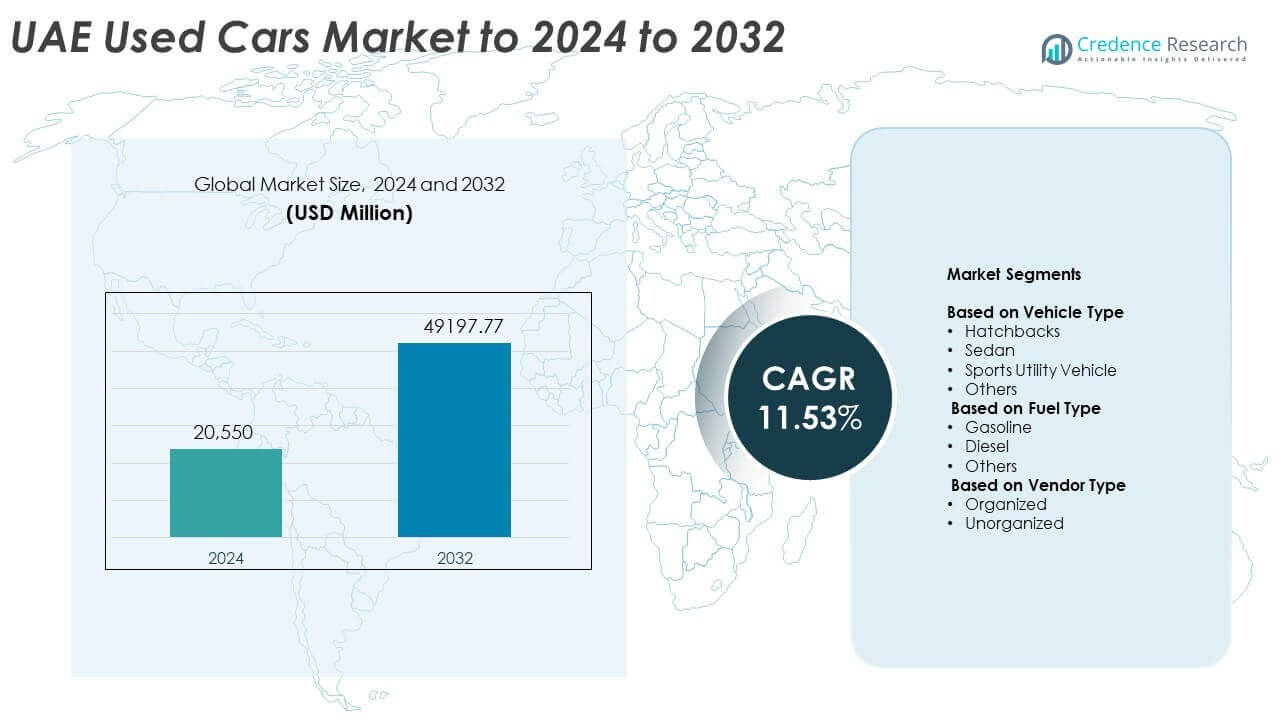
UAE Used Cars Market size was valued USD 20,550 million in 2024 and is anticipated to reach USD 49,197.77 million by 2032, at a CAGR of 11.53% during the forecast period.
| REPORT ATTRIBUTE | DETAILS |
|---|---|
| Historical Period | 2020-2024 |
| Base Year | 2025 |
| Forecast Period | 2026-2032 |
| UAE Used Cars Market Size 2024 | USD 20,550 million |
| UAE Used Cars Market, CAGR | 11.53% |
| UAE Used Cars Market Size 2032 | USD 49,197.77 million |
UAE Used Cars Market Insights
- Strong demand for affordable mobility, high vehicle replacement rates, and wider certified options drove market expansion across major cities.
- Digital platforms, online inspections, and rising trust in certified pre-owned cars shaped key market trends and encouraged more structured buying behavior.
- Intense competition came from organized dealers and online marketplaces offering transparent pricing, verified reports, and flexible financing.
- Dubai led the market with about 49% share in 2024, followed by Abu Dhabi at nearly 29%, while SUVs dominated the vehicle type segment with about 46% share across the UAE.
UAE Used Cars Market Segmentation Analysis:
By Vehicle Type
Sports Utility Vehicle led the vehicle type segment in 2024 with about 46% share. Buyers in the UAE favored SUVs due to strong road presence, higher ground clearance, and better performance on mixed terrains. Demand also grew because families preferred spacious cabins and stronger safety features. Many expats shifted to pre-owned SUVs as they delivered good value, lower depreciation, and wide availability across organized dealers. Hatchbacks and sedans saw steady activity, but their share trailed due to changing lifestyle needs and rising preference for larger vehicles.
- For instance, Toyota sold 11,233,039 vehicles worldwide in 2023, many being SUVs and crossovers.
By Fuel Type
Gasoline held the dominant position in 2024 with nearly 71% share. UAE drivers preferred gasoline cars due to smoother engines, wider model availability, and lower maintenance costs. The fuel also remained popular because many used car buyers sought quiet performance and easy servicing. Diesel vehicles stayed limited as users avoided higher repair risks and noise levels in older units. The shift toward cleaner energy options further reduced diesel interest, keeping gasoline as the top choice across both individual buyers and fleet replacements.
- For instance, the Chinese auto industry is estimated to have total factory capacity to build up to 30 million gasoline vehicles annually, but demand has cratered, leaving capacity for as many as 20 million gasoline-powered cars underutilized across various manufacturers, including state-owned giants such as SAIC, BAIC, Changan, and Dongfeng.
By Vendor Type
Organized vendors led the vendor type segment in 2024 with about 59% share. Buyers trusted certified dealers because they offered inspected vehicles, verified history reports, and structured warranties. Growing digital platforms and branded multi-brand showrooms also pushed more consumers toward organized channels. Transparent pricing and assured after-sales support helped organized vendors gain stronger traction compared to unorganized sellers. The unorganized segment remained active, but many buyers shifted away from informal deals due to higher perceived risk and lack of documentation.
Key Growth Drivers
Rising Demand for Affordable Mobility
Growing interest in cost-effective mobility encouraged many UAE residents to choose pre-owned vehicles over new models. The used car market expanded as buyers sought lower upfront costs, reduced depreciation, and flexible financing. High expat turnover also supported repeat demand across shorter ownership cycles. Wider model availability in SUVs and sedans further strengthened preference for budget-friendly choices. This shift positioned affordable mobility as a major driver of market expansion.
- For instance, Suzuki recorded 3,072,824 global vehicle sales in 2023 across many compact segments.
Expansion of Organized Dealership Networks
Organized dealers grew rapidly due to better transparency, structured warranties, and certified inspections. Buyers trusted these vendors because they offered clearer pricing and reliable after-sales support. Strong digital portals, virtual showrooms, and integrated financing improved convenience. This expansion encouraged more consumers to shift away from unorganized sellers, increasing the formal market’s share. Organized networks became a key growth driver by improving service quality and boosting buyer confidence.
- For instance, Al-Futtaim Automotive officially announced in a March 2024 press release that its pre-owned car division had sold over 25,000 used vehicles in 2023.
High Vehicle Replacement Rate in the UAE
Frequent vehicle upgrades remained common in the UAE due to lifestyle trends and strong preference for newer technology. Short ownership cycles created stable supply for the used market, allowing dealers to offer wide options across brands and fuel types. Many car owners replaced older units quickly to gain advanced safety, infotainment, and efficiency features. This high turnover kept inventory strong and acted as a key growth driver for long-term market expansion.
Key Trends & Opportunities
Rapid Growth of Online Used Car Platforms
Digital platforms gained strong traction as buyers preferred transparent listings, home inspections, and instant valuation tools. Online marketplaces reduced negotiation time and improved trust through verified reports and fixed-price models. Wider digital adoption attracted younger consumers who valued convenience and quick comparison. This shift created new opportunities for tech-driven services such as doorstep test drives and digital documentation, making online channels a key trend and opportunity in the market.
Increasing Preference for Certified Pre-Owned Vehicles
Certified pre-owned cars became popular as buyers sought quality assurance and structured warranties. Strong inspection processes and detailed service records enhanced confidence and reduced risk. Organized vendors used this trend to offer premium used vehicles that met higher reliability expectations. As demand rose, more brands expanded certification programs, creating fresh opportunities to serve safety-focused and value-driven buyers. This preference emerged as a key trend and opportunity shaping future sales.
- For instance, Honda’s certified program uses a 182-point inspection checklist for qualifying pre-owned vehicles.
Key Challenges
Dominance of the Unorganized Sector in Many Areas
Despite growth in structured dealerships, many regions still showed strong unorganized activity. Informal sellers often lacked documentation, quality checks, and price transparency, which created distrust among buyers. This uneven market landscape limited the pace of formalization and raised concerns over inconsistent vehicle conditions. The dominance of unorganized channels remained a key challenge that slowed adoption of standardized processes and certification models across the UAE.
Rising Maintenance Costs for Older Used Vehicles
Aging vehicles often required higher upkeep due to wear, part replacement, and stricter inspection rules. Many buyers faced unexpected repair expenses, reducing confidence in older models and slowing sales in lower-priced segments. Growing awareness of long-term maintenance burdens pushed consumers toward newer units, narrowing demand for older inventory. This issue remained a key challenge as buyers sought reliable options with predictable ownership costs.
Regional Analysis
Dubai
Dubai led the UAE used cars market in 2024 with about 49% share. Strong expatriate turnover, high urban mobility, and steady demand for SUVs and sedans supported the city’s dominant position. Large organized dealerships, digital retail adoption, and certified pre-owned programs strengthened buyer trust. Wide vehicle availability, faster replacement cycles, and competitive pricing kept Dubai the core trading hub. Strong export-linked activity and easier financing options also expanded buyer participation, helping the city maintain the highest market contribution.
Abu Dhabi
Abu Dhabi held nearly 29% share in the UAE used cars market in 2024. Stable government employment, higher income levels, and strong demand for mid-range and premium vehicles supported growth. Buyers favored organized dealers due to clearer documentation and longer warranty coverage. Larger families also drove interest in used SUVs with better durability and comfort. Fleet replacements from corporate users strengthened supply, allowing broader model variety across segments. Rising digital platforms enhanced convenience and kept the market competitive.
Sharjah
Sharjah accounted for about 14% share in the UAE used cars market in 2024. Competitive prices, strong cross-emirate buyer movement, and wide availability of budget-friendly vehicles attracted cost-sensitive customers. Many buyers purchased from Sharjah due to lower operating costs and diverse stock across sedans and compact cars. Growing participation from semi-organized dealers improved vehicle checks and documentation quality. Steady population growth and increased intercity commuting also supported used car demand. This mix helped Sharjah remain a key secondary market.
Rest of UAE
The rest of the UAE contributed around 8% share in 2024. Smaller emirates showed rising demand due to expanding residential zones and greater reliance on personal transport. Buyers often preferred affordable used models and lower-mileage vehicles with easy maintenance. Limited organized dealerships slowed market maturity, but mobile inspections and digital listings improved access. Tourism-linked transport needs and inter-emirate trade also supported steady sales. Growing urban development in emerging areas helped these regions maintain a stable but smaller market presence.
UAE Used Cars Market Segmentations:
By Vehicle Type
- Hatchbacks
- Sedan
- Sports Utility Vehicle
- Others
By Fuel Type
- Gasoline
- Diesel
- Others
By Vendor Type
- Organized
- Unorganized
By Geography
- Dubai
- Abu Dhabi
- Sharjah
- Rest of UAE
Competitive Landscape
The UAE used cars market features strong competition from leading players such as CARS24, Al Tayer Motors, Al Nabooda Automobiles LLC, SellAnyCar.com, Arabian Automobiles Co LLC, Carswitch, OpenSooq.com, AW Rostamani Group, YallaMotors.com, Al-Futtaim Automobiles, Alba Trading FZC, and Al-Futtaim Group. Market activity increased as major platforms improved digital tools, pricing transparency, and verification systems that supported higher buyer trust. Organized vendors focused on certified programs, structured warranties, and reliable documentation to enhance customer confidence. Online marketplaces expanded with faster inspections, home test drives, and seamless listing solutions. Many companies strengthened their presence through data-driven valuation models and wider access to financing options. Growing investment in digital infrastructure, logistics support, and integrated resale services further intensified competition and improved the overall buying experience for users in the UAE.
Key Player Analysis
- CARS24
- Al Tayer Motors
- Al Nabooda Automobiles LLC
- SellAnyCar.com
- Arabian Automobiles Co LLC
- Carswitch
- OpenSooq.com
- AW Rostamani Group
- YallaMotors.com
- Al-Futtaim Automobiles
- Alba Trading FZC
- Al-Futtaim Group
Recent Developments
- In 2025, Al Nabooda Automobiles and Seez officially announced their partnership. The collaboration focuses on leveraging Seez's technology to digitally transform and enhance the sales and aftersales experience for customers of Al Nabooda's brands, which include McLaren, Porsche, Audi, and Volkswagen, The collaboration has been effective and publicly recognized throughout the year.
- In 2025, Al-Futtaim Automobiles launched an AI-driven CPO valuation portal was launched, offering instant trade-in valuations with high accuracy.
- In 2023, AW Rostamani Group Launched its first luxury used-car showroom, NXT Luxury, in Dubai to enhance its portfolio in the premium segment.
Report Coverage
The research report offers an in-depth analysis based on Vehicle Type, Fuel Type, Vendor Type and Geography. It details leading market players, providing an overview of their business, product offerings, investments, revenue streams, and key applications. Additionally, the report includes insights into the competitive environment, SWOT analysis, current market trends, as well as the primary drivers and constraints. Furthermore, it discusses various factors that have driven market expansion in recent years. The report also explores market dynamics, regulatory scenarios, and technological advancements that are shaping the industry. It assesses the impact of external factors and global economic changes on market growth. Lastly, it provides strategic recommendations for new entrants and established companies to navigate the complexities of the market.

Request a Free Sample
Fill in your details and we'll send you a free sample report.
- Sample data tables & charts
- Research methodology
Market Dynamics
Strong Demand for Affordable Mobility
UAE residents, including a large expatriate population, increasingly opt for used cars due to lower upfront costs, reduced depreciation, and flexible financing, making pre-owned vehicles a preferred choice for cost-effective mobility.
Expansion of Organized Dealership Networks
The rapid growth of organized dealers and digital platforms offering certified vehicles, transparent pricing, and structured warranties has increased buyer trust and shifted demand away from unorganized sellers, formalizing the market.
High Vehicle Replacement Rate
Frequent vehicle upgrades and short ownership cycles in the UAE, driven by lifestyle trends and a desire for newer technology, ensure a steady supply of relatively new used cars, supporting robust market growth.
Rapid Growth of Online Used Car Platforms
Digital marketplaces and online inspection services have made buying and selling used cars more convenient and transparent, attracting younger, tech-savvy buyers and expanding the market’s reach.
Increasing Preference for Certified Pre-Owned Vehicles
Rising consumer focus on quality assurance, structured warranties, and verified service histories has boosted demand for certified pre-owned vehicles, encouraging organized vendors to expand their certification programs.
Need a Custom Version of This Report?
Tailor the scope, geography, or segments to your exact requirements.
- Custom geography or segment scope
- Direct access to our analyst team
Frequently Asked Questions
What is the current market size for UAE Used Cars Market, and what is its projected size in 2032?
At what Compound Annual Growth Rate is the UAE Used Cars Market projected to grow between 2025 and 2032?
Which UAE Used Cars Market segment held the largest share in 2024?
What are the primary factors fueling the growth of the UAE Used Cars Market?
Who are the leading companies in the UAE Used Cars Market?
Which region commanded the largest share of the UAE Used Cars Market in 2024?
Table of Content
Chapter 1 Market Segmentation
- 1.1 Segmentation Framework
- 1.1.1 Product and Service Classification
- 1.1.2 Application and End-Use Classification
- 1.1.3 Technology and Solution Classification
- 1.1.4 Customer and Distribution Channel Classification
- 1.1.5 Geographic Segmentation
- 1.1.6 Market Segment Definitions and Boundaries
- 1.2 By Fuel Type
- 1.2.1 Gasoline
- 1.2.2 Diesel
- 1.2.3 Others
- 1.3 By Vendor Type
- 1.3.1 Organized
- 1.3.2 Unorganized
- 1.4 By Vehicle Type
- 1.4.1 Hatchbacks
- 1.4.2 Sedan
- 1.4.3 Sports Utility Vehicle
- 1.4.4 Others
Chapter 2 Introduction
- 2.1 Report Objectives and Scope
- 2.2 Product Definition and Industry Terminology
- 2.3 Market Inclusions and Exclusions
- 2.4 Research Process
- 2.4.1 Primary Research and Expert Interviews
- 2.4.2 Secondary Research and Source Review
- 2.4.3 Top-Down and Bottom-Up Estimation
- 2.4.4 Data Triangulation and Verification
- 2.5 Market Size Measurement Basis
- 2.5.1 2024: USD 20,550 million → 2032: USD 49,197.77 million
- 2.6 Historical and Forecast Reference Periods
- 2.6.1 Base Year: 2024
- 2.6.2 Forecast Period: 2024-2032
- 2.7 Research Assumptions and Limitations
Chapter 3 Executive Summary
- 3.1 Market Snapshot and Key Findings
- 3.2 Base-Year Market Size, 2024
- 3.3 Forecast Market Size, 2032
- 3.4 Revenue and Volume Growth Outlook
- 3.5 Key Demand and Supply Indicators
- 3.6 Leading Market Segments
- 3.7 Fastest-Growing Market Opportunities
- 3.8 Regional Performance Highlights
- 3.9 Technology and Industry Transformation
- 3.10 Competitive Landscape Summary
- 3.11 Analyst View and Strategic Implications
Chapter 4 UAE Used Cars Market Trends and Developments
- 4.1 Historical Industry Development
- 4.2 Recent Market Trends and Developments
- 4.3 Demand and Customer Behavior Trends
- 4.4 Technology and Product Innovation
- 4.5 Artificial Intelligence, Automation and Digitalization
- 4.6 Local Manufacturing and Supply Chain Realignment
- 4.7 Industry Partnerships, Mergers and Acquisitions
- 4.8 Sustainability and Circular Economy Developments
- 4.9 Government and Private Sector Investment Trends
- 4.10 Emerging Business Models and Commercialization
- 4.11 Industry Developments and Announcements
Chapter 5 UAE Used Cars Market Production, Supply and Demand Analysis
- 5.1 Demand Trend and Consumption Analysis
- 5.2 Demand Forecast, 2024-2032
- 5.3 Production and Output Trend
- 5.4 Production and Output Forecast, 2024-2032
- 5.5 Installed Capacity and Capacity Utilization
- 5.6 Company-Wise Production Plants and Statistics
- 5.6.1 Installed Production Capacity
- 5.6.2 Actual Production
- 5.6.3 Planned Capacity and Expansion Targets
- 5.7 Supply Chain Structure and Procurement Trends
- 5.8 Supply-Demand Gap and Bottlenecks
- 5.9 Import Dependence and Sourcing Structure
- 5.10 Contract Manufacturing and Outsourcing
- 5.11 Regional Supply and Demand Concentration
Chapter 6 UAE Used Cars Market Pricing Analysis
- 6.1 Pricing Structure and Measurement
- 6.2 Historical Pricing Trends
- 6.3 Pricing Outlook, 2024-2032
- 6.4 Average Selling Price and Unit Economics
- 6.5 Pricing by Product and Market Segment
- 6.6 Geographic Pricing Differences
- 6.7 Key Input, Energy, Labor and Logistics Costs
- 6.8 Contract Pricing and Purchasing Models
- 6.9 Pricing Sensitivity and Competitive Positioning
- 6.10 Price, Margin and Profitability Implications
Chapter 7 UAE Used Cars Market Dynamics
- 7.1 Market Growth Drivers
- 7.1.1 Demand-Side Drivers
- 7.1.2 Technology and Innovation Drivers
- 7.1.3 Infrastructure and Investment Drivers
- 7.1.4 Regulatory and Policy Drivers
- 7.2 Market Restraints
- 7.2.1 Cost and Affordability Constraints
- 7.2.2 Technology and Adoption Barriers
- 7.2.3 Supply Chain and Operational Constraints
- 7.3 Market Challenges
- 7.3.1 Competitive Pressure and Margin Erosion
- 7.3.2 Skills, Infrastructure and Implementation Gaps
- 7.4 Emerging Market Opportunities
- 7.5 Market Dynamics Impact and Time-Horizon Assessment
Chapter 8 UAE Used Cars Value Chain Analysis
- 8.1 Industry Value Chain Overview
- 8.2 Upstream Suppliers and Critical Inputs
- 8.3 Technology and Component Providers
- 8.4 Manufacturing or Service Delivery
- 8.5 Distribution, Channel Partners and Integrators
- 8.6 Downstream Applications and End Users
- 8.7 Value Addition and Profit Pools
- 8.8 Vertical Integration and Outsourcing
- 8.9 Supplier Concentration and Risk
- 8.10 Supply Chain Localization and Resilience
Chapter 9 UAE Used Cars Market Regulations and Policies
- 9.1 Relevant Laws, Standards and Compliance Frameworks
- 9.2 Product, Service, Safety and Quality Requirements
- 9.3 Government Policies, Incentives and Subsidies
- 9.4 Imports, Exports and Trade Barriers
- 9.5 Public Procurement and Local Content Requirements
- 9.6 Environmental and Sustainability Compliance
- 9.7 Upcoming Policy Changes and Market Implications
Chapter 10 UAE Used Cars Market Hotspots and Opportunities
- 10.1 Market Opportunity Mapping and Growth Hotspots
- 10.2 High-Growth Applications and Customer Groups
- 10.3 Underserved Markets and White-Space Opportunities
- 10.4 Emerging Technology and Product Opportunities
- 10.5 New Capacity and Investment Hotspots
- 10.6 Market Entry and Expansion Opportunities
- 10.7 Distribution and Partnership Opportunities
- 10.8 Near-Term and Long-Term Commercial Potential
- 10.9 Opportunity Attractiveness and Execution Risks
Chapter 11 UAE Used Cars Market Outlook, 2024-2032
- 11.1 Market Size and Analysis
- 11.1.1 Revenue (Market Measurement: 2024: USD 20,550 million → 2032: USD 49,197.77 million)
- 11.1.2 Market Volume and Quantity Sold
- 11.1.3 Historical Market Size
- 11.1.4 Base-Year Market Size, 2024
- 11.2 Market Forecast, 2024-2032
- 11.2.1 Revenue Forecast to 2032
- 11.2.2 Volume Forecast to 2032
- 11.2.3 CAGR and Year-on-Year Growth
- 11.2.4 Incremental Revenue Opportunity
- 11.3 Forecast Assumptions and Scenario Analysis
- 11.3.1 Base-Case Forecast
- 11.3.2 Optimistic and Conservative Scenarios
- 11.3.3 Technology, Pricing and Policy Sensitivities
- 11.4 Market Attractiveness and Growth Outlook
Chapter 12 UAE Used Cars Market Segmentation and Outlook
- 12.1 Segmentation Summary and Market Shares, 2024
- 12.2 Largest and Fastest-Growing Segments
- 12.3 By Fuel Type - Market Size and Forecast, 2024-2032
- 12.3.1 Segment Definition and Scope
- 12.3.2 Historical Market Size
- 12.3.3 Revenue Forecast, 2024-2032
- 12.3.4 Volume Forecast, 2024-2032
- 12.3.5 Base-Year Market Share, 2024
- 12.3.6 Segment CAGR and Growth Drivers
- 12.3.7 Subsegment Market Size and Forecast
- 12.3.7.1 Gasoline
- 12.3.7.2 Diesel
- 12.3.7.3 Others
- 12.3.8 Subsegment Pricing and Adoption Trends
- 12.3.9 Leading Suppliers and Competition
- 12.3.10 Regional Demand and Opportunities
- 12.4 By Vendor Type - Market Size and Forecast, 2024-2032
- 12.4.1 Segment Definition and Scope
- 12.4.2 Historical Market Size
- 12.4.3 Revenue Forecast, 2024-2032
- 12.4.4 Volume Forecast, 2024-2032
- 12.4.5 Base-Year Market Share, 2024
- 12.4.6 Segment CAGR and Growth Drivers
- 12.4.7 Subsegment Market Size and Forecast
- 12.4.7.1 Organized
- 12.4.7.2 Unorganized
- 12.4.8 Subsegment Pricing and Adoption Trends
- 12.4.9 Leading Suppliers and Competition
- 12.4.10 Regional Demand and Opportunities
- 12.5 By Vehicle Type - Market Size and Forecast, 2024-2032
- 12.5.1 Segment Definition and Scope
- 12.5.2 Historical Market Size
- 12.5.3 Revenue Forecast, 2024-2032
- 12.5.4 Volume Forecast, 2024-2032
- 12.5.5 Base-Year Market Share, 2024
- 12.5.6 Segment CAGR and Growth Drivers
- 12.5.7 Subsegment Market Size and Forecast
- 12.5.7.1 Hatchbacks
- 12.5.7.2 Sedan
- 12.5.7.3 Sports Utility Vehicle
- 12.5.7.4 Others
- 12.5.8 Subsegment Pricing and Adoption Trends
- 12.5.9 Leading Suppliers and Competition
- 12.5.10 Regional Demand and Opportunities
- 12.6 Segment Growth Comparison
- 12.7 Segment Attractiveness and Priority Matrix
Chapter 13 UAE Used Cars Geographic Market Outlook, 2024-2032
- 13.1 Domestic Market Distribution and Demand Clusters
- 13.2 State- or Province-Wise Market Size and Forecast, 2024-2032
- 13.3 City and Metropolitan Market Outlook
- 13.4 Industrial, Manufacturing and Commercial Clusters
- 13.5 Geographic Concentration of Key End Users
- 13.6 Local Pricing and Purchasing Differences
- 13.7 Domestic Production Facilities and Capacity Map
- 13.8 Local Infrastructure and Project Pipeline
- 13.9 State-Level Policy and Incentive Differences
- 13.10 Subnational Investment Hotspots and Opportunities
- 13.11 Distribution and Logistics Networks
- 13.12 Domestic Competitive Footprint
Chapter 14 UAE Used Cars Technology, Innovation and Sustainability Outlook
- 14.1 Technology Landscape and Maturity
- 14.2 Product, Process and Service Innovation
- 14.3 AI, Automation and Digital Tools in the Industry
- 14.4 Technology Adoption and Performance Benchmarking
- 14.5 Innovation Pipeline and R&D Investment
- 14.6 Patent and Intellectual Property Trends
- 14.7 Energy Efficiency and Resource Management
- 14.8 Sustainability, Recycling and Circularity
- 14.9 Technology Roadmap, 2024-2032
- 14.10 Risks of Obsolescence and Technology Substitution
Chapter 15 UAE Used Cars Market Key Strategic Imperatives
- 15.1 Growth and Market Entry Priorities
- 15.2 High-Return Products and Segments
- 15.3 Pricing, Profitability and Cost Optimization
- 15.4 Technology Investment and Product Differentiation
- 15.5 Supply Chain Localization and Resilience
- 15.6 Distribution and Customer Acquisition
- 15.7 Partnership, Acquisition and Capacity Strategy
- 15.8 Regional Expansion Priorities
- 15.9 Short-, Medium- and Long-Term Actions
Chapter 16 Competition Outlook
- 16.1 Industry Competition Characteristics
- 16.2 Market Structure and Concentration
- 16.3 Market Share and Competitive Positioning, 2024
- 16.4 Company-Wise Revenue and Product Benchmarking
- 16.5 Production and Service Capacity Benchmarking
- 16.6 Technology, Pricing and Differentiation
- 16.7 Regional Footprint and Distribution Strength
- 16.8 Mergers, Acquisitions and Strategic Alliances
- 16.9 New Entrants and Competitive Threats
- 16.10 Porter's Five Forces and Industry Attractiveness
- 16.11 Competitive Outlook, 2024-2032
Chapter 17 Company Profiles
- 17.1 Company Coverage and Selection Criteria
- 17.2 CARS24
- 17.2.1 Business Description
- 17.2.2 Company Ownership and Geographic Presence
- 17.2.3 Product and Service Portfolio
- 17.2.4 Manufacturing and Operating Footprint
- 17.2.5 Production Capacity and Expansion Plans
- 17.2.6 Financial Performance and Investment
- 17.2.7 Market Share and Competitive Position
- 17.2.8 Technology and Innovation Capabilities
- 17.2.9 Strategic Alliances or Partnerships
- 17.2.10 Recent Developments
- 17.2.11 Growth Strategy and Outlook
- 17.3 Al Tayer Motors
- 17.4 Al Nabooda Automobiles LLC
- 17.5 SellAnyCar.com
- 17.6 Arabian Automobiles Co LLC
- 17.7 Carswitch
- 17.8 OpenSooq.com
- 17.9 AW Rostamani Group
- 17.10 YallaMotors.com
- 17.11 Al-Futtaim Automobiles
- 17.12 Other Relevant Market Participants
Note: Every listed company is profiled on the structure shown under the first company. The company list is preliminary and may change based on research findings, market developments, data availability and client requirements.
Chapter 18 Disclaimer
- 18.1 Research and Forecast Disclaimer
- 18.2 Data Source and Estimation Limitations
Note: The depth of individual sections depends on data availability for this market. Volume, capacity, trade and other unit-based metrics are included where applicable.