
| REPORT ATTRIBUTE | DETAILS |
|---|---|
| Historical Period | 2019-2022 |
| Base Year | 2023 |
| Forecast Period | 2024-2032 |
| Automotive Window Regulator Market Size 2024 | USD 13,712 Million |
| Automotive Window Regulator Market, CAGR | 5% |
| Automotive Window Regulator Market Size 2032 | USD 20258.86 Million |
Market Overview:
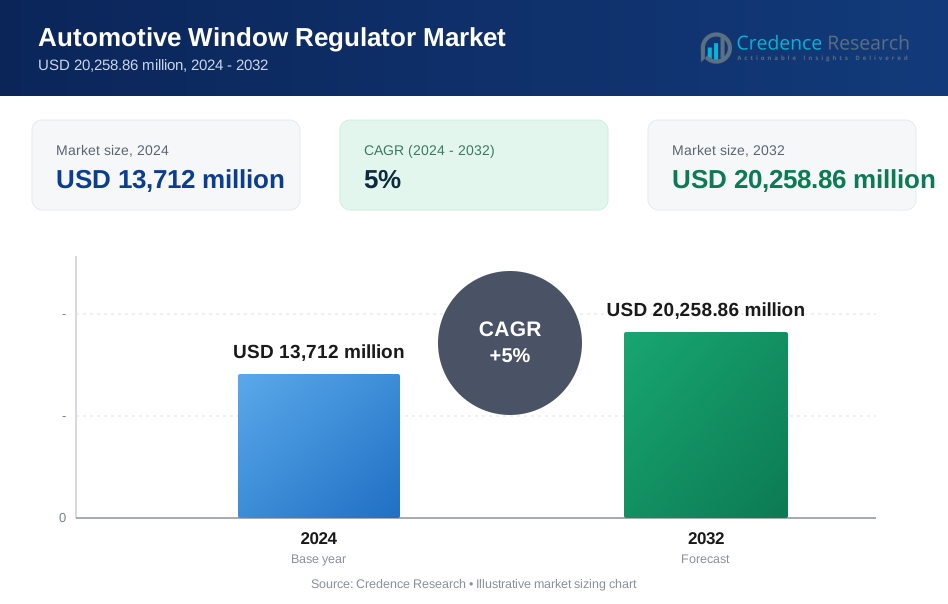
The Automotive Window Regulator Market is projected to grow from USD 13,712 million in 2024 to USD 20258.86 million by 2032, at a CAGR of 5% from 2024 to 2032.
Key drivers of the automotive window regulator market include advancements in automotive technology, rising consumer preference for power window systems, and an increasing emphasis on safety and convenience features. Power window systems, which rely on electric actuators, are becoming standard in many vehicle segments, contributing to a robust market outlook. Furthermore, the growing trend of electric vehicles (EVs) and the push for energy-efficient components are expected to drive demand for lightweight, high-performance window regulators. Additionally, as regulatory standards for vehicle safety and environmental performance continue to tighten, manufacturers are investing in innovations such as anti-pinch systems and noise reduction technologies to meet consumer expectations and industry regulations, further driving market growth.
Regionally, Asia-Pacific holds a significant share of the automotive window regulator market, driven by the high automotive production rates in countries like China, India, and Japan. The region’s rapidly expanding automotive industry, combined with increasing disposable income and growing vehicle ownership, contributes to the demand for advanced window regulation systems. Moreover, favorable government policies supporting automotive production and the rising popularity of electric vehicles in Asia-Pacific are likely to bolster market demand. North America and Europe follow closely, with demand driven by the strong presence of established automotive manufacturers and consumers’ rising preference for advanced features. The Middle East and Africa, along with Latin America, are expected to witness steady growth due to increasing vehicle production and rising demand for modern vehicle features in emerging markets, presenting opportunities for new market entrants.
Market Drivers:
Technological Advancements in Automotive Systems:
One of the primary drivers of the automotive window regulator market is the continuous advancement in automotive technology. As vehicles become more sophisticated, the demand for efficient and reliable window regulation systems has surged. Electric power window systems, which are increasingly standard in modern vehicles, rely on electric actuators and are becoming an essential feature. For instance, Bosch has developed electric power window systems that incorporate anti-pinch technology, enhancing safety by detecting obstacles and reversing the window's direction. The integration of advanced technology, such as anti-pinch systems and noise reduction mechanisms, enhances the functionality of window regulators, improving overall vehicle performance and consumer satisfaction.
Rising Consumer Preference for Power Window Systems:
The growing consumer preference for convenience and comfort has fueled the widespread adoption of power window systems. These systems, which provide ease of use and improved functionality, are becoming standard across various vehicle segments, including economy and mid-range cars. For instance, in emerging markets such as India and China, where higher disposable incomes and rising vehicle ownership are boosting consumer expectations for advanced features. The demand for power windows has particularly increased in emerging markets, where higher disposable incomes and rising vehicle ownership are boosting consumer expectations for advanced features.
Growth of Electric Vehicles (EVs):
The rapid growth of the electric vehicle (EV) market is another key driver for the automotive window regulator market. EVs require specialized, lightweight, and energy-efficient components, including advanced window regulators. As the global automotive industry shifts towards sustainability and electrification, the demand for high-performance, energy-efficient window regulators is expected to grow. For instance, Tesla has implemented innovative window regulator designs in its EVs that reduce weight and improve energy efficiency, contributing to the overall performance of their vehicles. Additionally, EVs often feature cutting-edge technologies, further increasing the adoption of advanced window regulation systems.
Stringent Safety and Environmental Regulations:
Rising safety and environmental regulations are prompting automakers to innovate and integrate advanced features into their vehicles. Regulatory requirements for vehicle safety, including systems that prevent window-related injuries, are pushing manufacturers to enhance window regulator designs. For instance, Federal-Mogul Motorparts has developed window regulators with lightweight, sustainable materials that meet stringent fuel efficiency and carbon emission standards. Similarly, as environmental concerns grow, window regulators are being designed with lightweight, sustainable materials to meet fuel efficiency and carbon emission standards. These developments ensure compliance with regulations while also improving product appeal.
Market Trends:
Integration of Smart Technologies:
A significant trend in the automotive window regulator market is the integration of smart technologies into window systems. Automakers are increasingly incorporating features such as anti-pinch sensors, which prevent injuries by automatically stopping the window’s movement when resistance is detected. For instance, Bosch has developed smart window regulator systems with advanced noise reduction features and anti-pinch technology, significantly enhancing safety and user experience. Moreover, the inclusion of noise reduction technologies in window regulators is gaining popularity, providing quieter operation and improving the overall driving experience. These advancements are being driven by consumer demand for higher comfort, safety, and convenience.
Shift Toward Lightweight Materials:
Another key trend is the use of lightweight materials in window regulator components. As manufacturers focus on improving fuel efficiency and reducing vehicle weight, there is an increasing emphasis on utilizing materials like aluminum and high-strength plastic in window regulator systems. For instance, Magna International has introduced window regulator systems made from lightweight aluminum, significantly reducing overall vehicle weight and improving energy efficiency. These materials not only contribute to lighter vehicle designs but also enhance the durability and performance of the regulators. This trend is particularly important in the context of the growing electric vehicle (EV) market, where weight reduction plays a crucial role in extending driving range and improving energy efficiency.
Rise of Electric Vehicle (EV) Adoption:
The adoption of electric vehicles is significantly influencing the automotive window regulator market. EVs require efficient, energy-saving window regulation systems that can complement their environmentally friendly design. For instance, Tesla has implemented energy-efficient window regulator systems in its vehicles, reducing energy consumption and enhancing overall vehicle performance. As the demand for EVs grows, the automotive industry is shifting toward the development of specialized window regulators that optimize energy consumption while maintaining performance. This trend is likely to continue as the automotive industry accelerates its transition to electrified mobility.
Focus on Sustainability:
Sustainability is becoming a central focus in the automotive window regulator market. Manufacturers are increasingly looking to incorporate recyclable materials and reduce the environmental impact of production processes. For instance, Valeo has developed window regulator systems using recyclable materials, significantly reducing the environmental impact of their production processes. This focus on sustainability is in line with broader industry trends toward greener manufacturing practices and compliance with stricter environmental regulations, reflecting both consumer and regulatory pressure.
Market Challenges Analysis:
Rising Raw Material Costs:
The increasing costs of raw materials such as steel, aluminum, and plastics can significantly impact the production cost of automotive window regulators. Fluctuations in the prices of these materials can result in higher manufacturing expenses, which may ultimately be passed on to consumers, leading to potential price sensitivity. Manufacturers are thus under pressure to balance quality, cost, and performance while maintaining profitability. Furthermore, supply chain disruptions can exacerbate these cost increases, leading to uncertainty in material availability and affecting production timelines. Manufacturers must explore cost-effective alternatives or secure long-term supplier contracts to mitigate these risks.
Technological Advancements and Integration Complexity:
As vehicles increasingly incorporate advanced technologies, such as power windows with integrated sensors, touch controls, and wireless features, manufacturers face the challenge of integrating these new features into window regulators. This requires a high level of innovation, R&D investment, and testing to ensure compatibility with existing automotive systems, which can be both time-consuming and expensive. Additionally, the complexity of these integrated systems demands precision engineering, which raises production costs and could lead to delays in bringing new products to market. The challenge lies in balancing technological advancements with cost-effective production without compromising on quality and performance.
Market Segmentation Analysis:
By Product Type:
The automotive window regulator market is primarily divided into manual and power window regulators. Power window regulators dominate the market due to the increasing demand for convenience and comfort in modern vehicles. However, manual window regulators continue to hold a steady market share, especially in budget-friendly and entry-level vehicles where cost considerations are more prominent.
By Construction Type:
The market is further segmented into cable-based and gear-based regulators. Cable-based regulators are more cost-effective and lightweight, making them popular in mass-market vehicles. Gear-based regulators, on the other hand, offer superior durability and smoother operation, which is why they are often found in premium and luxury vehicles.
By Vehicle Type:
The market caters to passenger vehicles, commercial vehicles, and electric vehicles (EVs). Passenger vehicles represent the largest market segment due to their widespread production globally. The rise of electric vehicles, which incorporate advanced technologies, is expected to further accelerate market growth, particularly as these vehicles demand more innovative window regulation solutions.
Segmentations:
By Product Type:
- Manual
- Automated
By Construction Type:
- Cable Type
-
- Single Rail
- Double Rail
- Arm Type
- Single Arm
- X Arm
By Vehicle Type:
- Passenger Cars
- Light Commercial Vehicles
- Heavy Commercial Vehicles
By Sales Channel:
- OEM
- Aftermarket
Region:
- North America
- U.S.
- Canada
- Mexico
- Europe
- Germany
- France
- U.K.
- Italy
- Spain
- Rest of Europe
- Asia Pacific
- China
- Japan
- India
- South Korea
- South-east Asia
- Rest of Asia Pacific
- Latin America
- Brazil
- Argentina
- Rest of Latin America
- Middle East & Africa
- GCC Countries
- South Africa
- Rest of the Middle East and Africa
Regional Analysis:
North America:
North America holds a significant share of the global automotive window regulator market, accounting for 28% of the total market share. The growth of the market in this region is driven by rising demand for advanced automotive technologies and the increasing production of electric vehicles (EVs). The United States, a major automotive hub, is experiencing a surge in the adoption of power window regulators across both passenger and commercial vehicles. With a well-established automotive manufacturing base and a strong consumer preference for comfort and convenience features, the region continues to drive market demand. However, challenges such as fluctuating raw material costs and regulatory pressures regarding environmental standards impact market dynamics.
Europe:
Europe accounts for 25% of the global market share in automotive window regulators. The region exhibits strong demand for premium and electric vehicles, which typically feature advanced window regulator systems with integrated sensors or touch-based controls. Stringent safety and environmental regulations in Europe drive innovation and compliance with high standards. The rising adoption of EVs, especially in countries like Germany, France, and the UK, is expected to fuel future market growth, as these vehicles incorporate more sophisticated window regulator technologies.
Asia Pacific:
Asia Pacific leads the automotive window regulator market, holding a dominant share of 35%. The region’s rapid industrialization and high vehicle production, particularly in countries such as China, Japan, and India, have significantly boosted the demand for automotive components. A growing middle-class population and increasing disposable income have driven the preference for power window regulators. Moreover, local manufacturers and cost-effective production contribute to competitive pricing in mass-market segments. The rise in electric vehicle production, particularly in China, further stimulates demand for advanced window regulation systems.
Latin America:
Latin America holds 8% of the global automotive window regulator market share. The region’s steady growth is driven by improving economic conditions, rising vehicle production, and increasing consumer demand for comfort features. Expanding automotive industries in countries like Brazil and Mexico, particularly with investments in electric vehicles, are expected to increase demand for both manual and power window regulators.
Middle East and Africa:
The Middle East and Africa account for 4% of the global market share. The demand for automotive window regulators is driven by a preference for luxury and high-end vehicles in countries such as Saudi Arabia and the UAE. Despite challenges from political and economic instability, the market is expected to grow as vehicle sales and infrastructure development continue.
Key Player Analysis:
- Denso Corporation
- Brose Fahrzeugteile GmbH & Co. KG
- Magna International Inc.
- Aisin Seiki Co., Ltd.
- Valeo SA
- Johnson Electric Holdings Limited
- ZF Friedrichshafen AG
- Federal-Mogul Motorparts
- Kuester Automotive
- Tata AutoComp Systems Ltd.
Competitive Analysis:
The automotive window regulator market is highly competitive, with several global and regional players vying for market share. Key companies like Denso Corporation, Magna International, and Brose Fahrzeugteile GmbH & Co. KG lead the market, leveraging advanced technologies and strong manufacturing capabilities. These companies are focusing on innovations in power window regulators, offering solutions that enhance vehicle comfort and performance. For instance, Denso Corporation has developed advanced motor control systems that improve the efficiency and reliability of power windows.
Additionally, smaller players and regional manufacturers are intensifying competition by offering cost-effective alternatives, especially in emerging markets. Manufacturers are also increasingly investing in research and development to meet the rising demand for electric vehicles (EVs) and integrated window systems. As the market evolves, companies are focusing on strategic partnerships, acquisitions, and product differentiation to maintain competitive advantage. Regulatory compliance, technological advancements, and cost optimization remain critical factors for sustained growth in this highly fragmented market.
Recent Developments:
- In January 2024, Magna International Inc. unveiled an e-drive at CES that offers increased efficiency and power. They also debuted anti-drunken driving technology that can detect if a driver is above the blood alcohol limit via cameras and sensors.
- In December 2023, Brose and HASCO renewed their Chinese joint venture contract for another 25 years. Since 1999, Shanghai Brose Automotive Components has produced about 90 million products for Chinese and international car manufacturers, including window regulators.
- In Spring 2024, Valeo SA released 184 new references for window lifts, covering key European vehicles.
- In January 2024, ZF Aftermarket introduced over 770 new parts for passenger cars in North America, including 195 LEMFÖRDER powered window motors, regulators, and assemblies.
Market Concentration & Characteristics:
The automotive window regulator market exhibits moderate concentration, with a few key players such as Denso Corporation, Magna International, and Brose Fahrzeugteile GmbH & Co. KG dominating the global landscape. These leading companies have a significant market share, driven by their technological expertise, strong manufacturing capabilities, and established relationships with OEMs. However, the market also features a large number of regional and smaller players, particularly in emerging markets, offering competitive pricing and catering to local demand. This results in a fragmented market structure where competition is driven by factors such as product innovation, cost efficiency, and customer service. Companies are increasingly focusing on differentiating their products by incorporating advanced technologies, such as electric and integrated window systems, to meet the growing demand for comfort, convenience, and energy efficiency, particularly in electric and luxury vehicle segments.
Report Coverage:
The research report offers an in-depth analysis based on Product type, construction type, vehicle type, sales channel and region. It details leading market players, providing an overview of their business, product offerings, investments, revenue streams, and key applications. Additionally, the report includes insights into the competitive environment, SWOT analysis, current market trends, as well as the primary drivers and constraints. Furthermore, it discusses various factors that have driven market expansion in recent years. The report also explores market dynamics, regulatory scenarios, and technological advancements that are shaping the industry. It assesses the impact of external factors and global economic changes on market growth. Lastly, it provides strategic recommendations for new entrants and established companies to navigate the complexities of the market.
Future Outlook:
- The demand for power window regulators will continue to rise, driven by consumer preference for convenience and comfort features.
- The increasing production of electric vehicles (EVs) will create new growth opportunities, as EVs require advanced window regulator technologies.
- Advancements in sensor technology and integrated systems will lead to the development of more sophisticated window regulators.
- Cost-effective production methods will remain essential for manufacturers to remain competitive, particularly in emerging markets.
- The market will see continued innovation, with a focus on energy-efficient, lightweight materials to meet sustainability goals.
- Regulatory compliance, particularly with safety and environmental standards, will push companies to adopt advanced manufacturing processes.
- The growth of the aftermarket sector will be driven by rising vehicle maintenance and repair needs, boosting demand for replacement window regulators.
- Companies will increasingly collaborate with OEMs to design window regulators that meet specific automotive requirements.
- As global automotive production increases, the need for reliable and durable window regulators will grow across all vehicle segments.
- Regional markets, especially in Asia Pacific, will continue to drive the majority of market growth, with China emerging as a key hub for production and innovation.
Request a Free Sample
Fill in your details and we'll send you a free sample report.
- Sample data tables & charts
- Research methodology
Need a Custom Version of This Report?
Tailor the scope, geography, or segments to your exact requirements.
- Custom geography or segment scope
- Direct access to our analyst team
Frequently Asked Questions
What is the projected growth of the automotive window regulator market?
What are the key drivers for the growth of the automotive window regulator market?
How does the rise of electric vehicles (EVs) impact the automotive window regulator market?
Which regions are driving the growth of the automotive window regulator market?
What innovations are shaping the automotive window regulator market?
Table of Content
Chapter 1. Report Introduction
- 1.1 Report Description & Purpose
- 1.1.1 Report Title & Market Definition
- 1.1.2 Unique Selling Propositions (USP) & Key Differentiators
- 1.1.3 Value Proposition for Stakeholders
- 1.2 Research Objectives
- 1.2.1 Market Sizing Objectives (Volume & Revenue)
- 1.2.2 Segmentation Objectives
- 1.2.3 Competitive Intelligence Objectives
- 1.2.4 Forecast & Scenario Objectives
- 1.3 Report Scope
- 1.3.1 Automotive Window Regulator Scope – Types & Subtypes Covered
- 1.3.2 Geographic Scope – Regions & Countries Covered
- 1.3.3 Historical Period, Base Year & Forecast Period (2024; forecast to 2032)
- 1.3.4 Inclusions & Exclusions
- 1.4 HS Code & Classification Framework
- 1.5 Currency, Units & Pricing Basis
- 1.6 Target Stakeholders
- 1.7 Limitations & Assumptions
Chapter 2. Executive Summary
- 2.1 Global Automotive Window Regulator Market Snapshot
- 2.1.1 Market Size – Historical (2024) & Forecast (2024-2032) (2024: USD 13,712 million → 2032: USD 20,258.86 million)
- 2.1.2 Volume & Revenue – Global Totals
- 2.1.3 Key Market Highlights – Top Five Facts
- 2.2 Automotive Window Regulator Market Segmentation Snapshot
- 2.2.1 Market Split by Region – 2024 vs. 2032
- 2.3 Competitive Snapshot
- 2.3.1 Top 10 Players by Revenue Share – 2024
- 2.3.2 Top 10 Players by Volume Share – 2024
- 2.3.3 Recent Strategic Developments (18-Month Summary)
- 2.4 Key Investment Highlights & Strategic Conclusions
Chapter 3. Automotive Window Regulator Market Dynamics & Industry Analysis
- 3.1 Market Overview & Context
- 3.1.1 Automotive Window Regulator Market Position in the Broader Automotive Value Chain
- 3.1.2 OEM vs. Replacement Market Dynamics
- 3.1.3 Market Maturity & Development Stage by Region
- 3.2 Automotive Window Regulator Market Drivers
- 3.3 Automotive Window Regulator Market Restraints & Challenges
- 3.4 Automotive Window Regulator Market Opportunities
- 3.5 Porter's Five Forces Analysis
- 3.5.1 Threat of New Entrants
- 3.5.2 Bargaining Power of Suppliers
- 3.5.3 Bargaining Power of Buyers
- 3.5.4 Threat of Substitutes
- 3.5.5 Competitive Rivalry – Intensity Assessment
- 3.6 Automotive Window Regulator Value Chain Analysis
- 3.6.1 Upstream – Raw Material/Input Suppliers
- 3.6.1.1 Raw Material/Input 1
- 3.6.1.2 Raw Material/Input 2
- 3.6.1.3 Raw Material/Input 3
- 3.6.2 Midstream – Production/Manufacturing/Service Delivery
- 3.6.2.1 Production/Process Overview
- 3.6.2.2 Key Facility Locations & Capacity by Manufacturer
- 3.6.3 Downstream – Distribution & End Consumer
- 3.6.3.1 Primary Channel – B2B/OEM
- 3.6.3.2 Secondary Channels – Dealer, Retail, Online, Direct
- 3.6.4 Value Chain Profitability Analysis
- 3.6.1 Upstream – Raw Material/Input Suppliers
- 3.7 PESTEL Analysis
- 3.7.1 Political Factors
- 3.7.2 Economic Factors
- 3.7.3 Social Factors
- 3.7.4 Technological Factors
- 3.7.5 Environmental Factors
- 3.7.6 Legal Factors
- 3.8 Automotive Window Regulator Supply Chain Analysis
- 3.8.1 Raw Material/Input Supply Risk Assessment
- 3.8.2 Manufacturing Concentration Risk (Geographic Exposure)
- 3.8.3 Trade Disruption Impact Analysis
- 3.9 Regulatory & Policy Landscape
Note: The regulatory and policy landscape section covers regulations based on their applicability to the market, Automotive Window Regulator category, geography, and scope of the study. Only regulatory frameworks with a material impact on operations, compliance, trade, sustainability, or market access are analyzed in detail.
Chapter 4. Key Investment Pockets & Opportunity Analysis
- 4.1 Automotive Window Regulator Market Attractiveness Analysis
- 4.1.1 By Region – Investment Attractiveness Matrix (Volume × CAGR)
- 4.2 Absolute Revenue Growth Opportunity
- 4.2.1 By Region – Absolute USD Growth Through 2032
- 4.3 Incremental Volume Opportunity
- 4.3.1 By Region – Incremental Volume Through 2032
- 4.3.2 Segment – Incremental Volume
- 4.4 Emerging Submarket Opportunity Deep Dive (Subject to Applicability)
- 4.5 Emerging Market Opportunity Scorecards
- 4.5.1 United States
- 4.5.2 Europe
- 4.5.3 Asia
- 4.5.4 Middle East & Africa
Note: Emerging Market Opportunity Scorecards will be included based on relevance and strategic importance. Regions listed are indicative and may vary depending on data availability and market dynamics.
Chapter 5. Automotive Window Regulator Import-Export Analysis & Trade Flows
- 5.1 Global Trade Overview
- 5.1.1 Global Export Value by Country (2024)
- 5.1.2 Global Export Volume by Country (2024)
- 5.1.3 Global Import Value by Country (2024)
- 5.1.4 Global Import Volume by Country (2024)
- 5.1.5 Net Trade Balance by Country (2024)
- 5.2 Export Analysis – Segment
- 5.2.1 Type 1 (HS Code)
- 5.2.2 Type 2 (HS Code)
- 5.2.3 Type 3 (HS Code)
- 5.2.4 Type 4 (HS Code)
- 5.2.5 Type 5 (HS Code)
- 5.3 Import Analysis – Segment
- 5.3.1 Type 1 (HS Code)
- 5.3.2 Type 2 (HS Code)
- 5.3.3 Type 3 (HS Code)
- 5.3.4 Type 4 (HS Code)
- 5.3.5 Type 5 (HS Code)
- 5.4 Average Unit Trade Prices
- 5.4.1 Average Export Price – Segment & Country
- 5.4.2 Average Import Price – Segment & Source Country
- 5.4.3 Price Trends (2024)
- 5.5 Key Trade Route Analysis
- 5.5.1 Trade Route 1
- 5.5.2 Trade Route 2
- 5.5.3 Trade Route 3
- 5.5.4 Trade Route 4
- 5.5.5 Trade Route 5
- 5.6 Trade Policy Impact Assessment
- 5.6.1 US Anti-Dumping & Section 301 Tariffs
- 5.6.2 EU Customs Union Impact
- 5.6.3 Major Free Trade Agreements
- 5.6.4 USMCA Rules of Origin
Note: Trade policy analysis will be included only where relevant to the Automotive Window Regulator market.
Chapter 6. Competitive Landscape & Company Benchmarking
- 6.1 Automotive Window Regulator Market Concentration & Structure
- 6.1.1 Herfindahl-Hirschman Index (HHI) – vs. 2024
- 6.1.2 Tier 1, Tier 2 & Tier 3 Market Structure
- 6.1.3 Global, Regional & Local Player Dynamics
- 6.2 Automotive Window Regulator Market Share Analysis – 2024
- 6.2.1 Global Revenue Share by Company
- 6.2.2 Global Volume Share by Company
- 6.2.3 Regional Revenue Share
- 6.2.4 Market Share Evolution ( vs. 2024)
- 6.2.5 OEM Segment Share by Company
- 6.2.6 Replacement Segment Share by Company
- 6.3 Production/Delivery Capacity & Facility Analysis
- 6.3.1 Global Installed Capacity
- 6.3.2 Capacity Utilization Rates
- 6.3.3 Production/Output Volume
- 6.3.4 Facility Locations & Capacity Map
- 6.3.5 Planned Capacity Additions
- 6.4 Automotive Window Regulator Competitive Benchmarking Matrix
- 6.4.1 Revenue, Volume, CAGR & Profitability Comparison
- 6.4.2 Channel Revenue Mix
- 6.4.3 Geographic Revenue Exposure
- 6.4.4 R&D Intensity
- 6.4.5 Sustainability Maturity
- 6.5 Strategic Developments in Automotive Window Regulator (Last 24 Months)
- 6.5.1 Mergers, Acquisitions & Divestments
- 6.5.2 New Automotive Window Regulator Launches
- 6.5.3 Facility Expansions
- 6.5.4 Strategic Alliances, Joint Ventures & Partnerships
- 6.5.5 Distribution Expansion & Market Entry
- 6.5.6 Sustainability & ESG Initiatives
- 6.6 Competitive Strategy Mapping
- 6.6.1 Leader, Challenger, Follower & Niche Classification
- 6.6.2 Pricing Strategy Comparison
- 6.6.3 Channel Strategy Matrix
Note: Strategic developments are included based on their materiality and the availability of reliable information.
Chapter 7. Global Automotive Window Regulator Market – By Distribution Channel
- 7.1 Segment Overview
- 7.1.1 Volume & Revenue Split by Channel (2024 & 2032)
- 7.1.2 Channel Mix Evolution (2024-2032)
Chapter 8. Regional Market Analysis – Global Overview
- 8.1 Global Regional Overview
- 8.1.1 Regional Volume Share
- 8.1.2 Regional Revenue Share
- 8.1.3 Regional Volume by Region
- 8.1.4 Regional Revenue by Region
- 8.1.5 Regional Forecast Through 2032
- 8.2 Cross-Regional Segment Analysis
- 8.2.1 By Distribution Channel
- 8.2.2 By Brand/Price Tier
Chapter 9. North America Automotive Window Regulator Market
- 9.1 United States
- 9.2 Canada
- 9.3 Mexico
Chapter 10. Europe Automotive Window Regulator Market
- 10.1 Germany
- 10.2 France
- 10.3 Italy
- 10.4 United Kingdom
- 10.5 Spain
- 10.6 Poland
- 10.7 Russia
- 10.8 Netherlands
- 10.9 Belgium
- 10.10 Sweden
- 10.11 Denmark
- 10.12 Norway
- 10.13 Rest of Europe
Chapter 11. Asia Pacific Automotive Window Regulator Market
- 11.1 China
- 11.2 India
- 11.3 Japan
- 11.4 South Korea
- 11.5 Thailand
- 11.6 Indonesia
- 11.7 Vietnam
- 11.8 Malaysia
- 11.9 Australia
- 11.10 Rest of Asia Pacific
Chapter 12. Latin America Automotive Window Regulator Market
- 12.1 Brazil
- 12.2 Argentina
- 12.3 Colombia
- 12.4 Chile
- 12.5 Rest of Latin America
Chapter 13. Middle East Automotive Window Regulator Market
- 13.1 Saudi Arabia
- 13.2 United Arab Emirates
- 13.3 Turkey
- 13.4 Israel
- 13.5 Iran
- 13.6 Rest of the Middle East
Chapter 14. Africa Automotive Window Regulator Market
- 14.1 South Africa
- 14.2 Egypt
- 14.3 Nigeria
- 14.4 Morocco
- 14.5 Rest of Africa
Chapter 15. Automotive Window Regulator Company Profiles
- 15.1 [Company 01]
- 15.1.1 Company Overview
- 15.1.2 Key Management Personnel
- 15.1.3 Products & Services Portfolio
- 15.1.4 Financial Performance
- 15.1.5 Key Market Focus & Geographic Presence
- 15.1.6 Recent Developments & Strategic Initiatives
Note: The company profile list is preliminary and may change based on research findings, market developments, data availability, and client requirements.
Chapter 16. Appendices
- Appendix A – List of Abbreviations & Acronyms
- Appendix B – Industry Classification Code Reference – Full Series
- Appendix C – Production & Capacity Data Tables
- Appendix D – End-Use & Demand Base Tables
- Appendix E – Consumption & Replacement Rate Assumptions
- Appendix F – ASP Reference Tables
- Appendix G – Manufacturing & Facility Database
- Appendix H – Import-Export Data Tables
- Appendix I – Regulatory Summary Tables
- Appendix J – Primary Research Participant List (Anonymized)
- Appendix K – Primary Research Questionnaire Framework
- Appendix L – Data Sources & Bibliography
- Appendix M – Market Size Divergence & Source Comparison
Chapter 17. Research Methodology
- 17.1 Research Framework & Philosophy
- 17.2 Secondary Research – Sources, Hierarchy & Data Extraction
- 17.3 Data Modeling – Bottom-Up & Top-Down Market Sizing
- 17.4 Primary Research – Stakeholder Framework, LOI & Sample Sizes
- 17.5 Forecast Methodology – Regression, Scenario & Sensitivity Analysis
- 17.6 Quality Control – Four-Layer Validation Framework
- 17.7 Limitations & Standard Assumptions
- 17.8 Disclaimer
