Body Contouring Devices Market Overview:
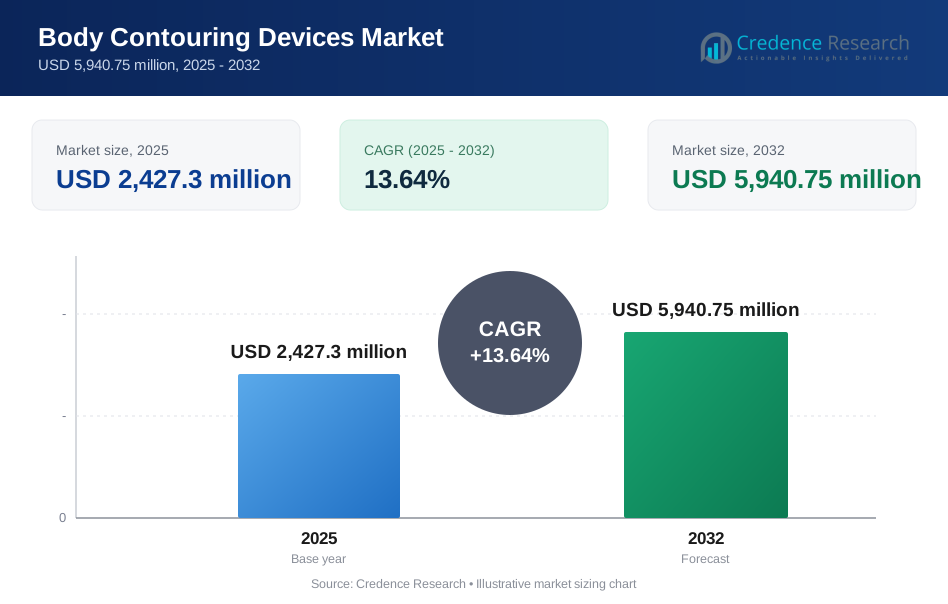
The global Body Contouring Devices Market size was estimated at USD 2,427.3 million in 2025 and is expected to reach USD 5,940.75 million by 2032, growing at a CAGR of 13.64% from 2025 to 2032. Rising preference for non-surgical aesthetic treatments is supporting market expansion as consumers increasingly prioritize visible results with lower downtime and lower perceived procedural risk versus traditional surgery. Demand is also supported by broader provider availability across specialty clinics and medical spas, alongside continued technology upgrades that improve treatment consistency across fat reduction, skin tightening, and muscle-toning indications.
| REPORT ATTRIBUTE | DETAILS |
|---|---|
| Historical Period | 2020-2024 |
| Base Year | 2025 |
| Forecast Period | 2026-2032 |
| Body Contouring Devices Market Size 2025 | USD 2,427.3 million |
| Body Contouring Devices Market, CAGR | 13.64% |
| Body Contouring Devices Market Size 2032 | USD 5,940.75 million |
Key Market Trends & Insights
- Non-invasive & minimally invasive devices led product type demand with a 56.84% share in 2025, reflecting the market’s shift toward low-downtime body shaping.
- Skin tightening & cellulite reduction represented 40.62% of 2025 application revenue, supported by broad consumer relevance across age groups and body areas.
- Hospitals accounted for 62.47% of 2025 end-user revenue, driven by procedural breadth and established infrastructure for aesthetic and surgical workflows.
- North America contributed 38.11% of 2025 revenue, supported by high device penetration and strong clinic networks in major metro markets.
- The market is expected to expand at a 13.64% CAGR during 2025–2032 as providers refresh installed bases and standardize multi-modality treatment offerings.

Segment Analysis
Body contouring demand is increasingly shaped by consumer preference for non-surgical pathways that align with lifestyle constraints and budget predictability. Clinics and medical spas continue to package treatments into multi-session programs, helping providers stabilize utilization and improve patient retention for devices used across fat reduction, muscle toning, and tightening protocols. Technology differentiation remains central to purchase decisions, as providers compare clinical outcomes, comfort profiles, and throughput potential across different energy modalities. Product roadmap cadence also matters, as providers favor platforms that can support add-on indications and software-driven enhancements over the equipment lifecycle.
The market’s application mix reflects a shift from single-goal interventions toward combined outcomes that address fat volume, tissue laxity, and contour definition. Skin tightening and cellulite programs maintain broad appeal because they apply to a large addressable base beyond weight-loss patients, and they can be paired with fat reduction for fuller-body reshaping pathways. Muscle toning has expanded as an “aesthetic fitness” adjacent category, supporting higher-frequency usage in outpatient settings. Provider adoption is also influenced by operational needs such as room turnover, staff training requirements, and predictable protocol execution across diverse patient profiles.
Across end users, hospitals remain important for integrated procedural capabilities, especially where invasive options and anesthesia-supported workflows are offered alongside device-based therapies. Specialty clinics and dermatology centers concentrate volume through aesthetic focus and higher appointment density. Medical spas are expanding access through consumer-friendly models such as memberships and promotions that support repeat engagement. Home-use remains selective and is more constrained by efficacy expectations, safety controls, and regulatory positioning.
By Product Type Insights
Non-invasive & minimally invasive devices accounted for the largest share of 56.84% in 2025. This segment leads because it addresses a wider consumer base that prioritizes minimal downtime and lower perceived risk compared with surgery. Providers also prefer these platforms for repeat-session protocols that support predictable scheduling and recurring revenue through treatment packages. Ongoing technology improvements and multi-indication capability strengthen clinic ROI and drive replacement and upgrade cycles.
By Application Insights
Skin tightening & cellulite reduction accounted for the largest share of 40.62% in 2025. This application leads because skin laxity and cellulite concerns extend beyond weight-loss cohorts and apply across a broader demographic base. Demand is supported by combination protocols that pair tightening with fat reduction to improve overall contour appearance. Clinics also benefit from strong visual before-and-after marketing outcomes, which helps sustain consultation flow and repeat sessions.
By End User Insights
Hospitals accounted for the largest share of 62.47% in 2025. Hospitals lead due to their ability to offer a broader continuum of care that includes both device-based treatments and invasive procedures where appropriate. Capital procurement capacity, standardized clinical governance, and access to trained staff support higher equipment uptime and consistent protocol execution. Hospitals also benefit from established referral pathways that help maintain case flow for contouring-related procedures and adjunct therapies.
Body Contouring Devices Market Drivers
Rising demand for low-downtime aesthetic procedures
Demand is increasing as consumers prioritize treatments that fit into work and lifestyle schedules with limited recovery time. Non-surgical pathways expand eligibility to patients who are not comfortable with surgical risk or extended downtime. Provider marketing emphasizes gradual, natural-looking outcomes, supporting repeat visits and multi-session programs. These dynamics sustain utilization for platforms that can address fat reduction, tightening, and toning within outpatient workflows.
- For instance, Allergan’s CoolSculpting platform has demonstrated average fat layer reductions of about 20–25% in treated areas within a few months, supporting repeat non‑invasive sessions that can be performed in outpatient settings without anesthesia.
Technology innovation and multi-modality platform adoption
Product innovation is improving energy delivery precision, comfort profiles, and protocol consistency across body areas. Multi-modality systems allow providers to address multiple indications using fewer platforms, improving clinic economics and staff training efficiency. Technology roadmaps also support upgrades through software features and new applicators, extending product lifecycles while stimulating incremental capex. These factors increase competitive intensity around differentiated performance and platform versatility.
Expansion of provider channels and aesthetic service accessibility
Growth is supported by the proliferation of specialty clinics, dermatology centers, and medical spas that broaden access beyond hospital settings. These channels often operate with consumer-friendly purchasing models, including memberships and bundled packages that support repeat engagement. Provider networks also increase local availability, reducing friction for consultations and follow-up appointments. Greater access contributes to higher procedure volumes and a broader installed base of equipment.
- For instance, BeautyHealth’s Hydrafacial franchise reports an installed base exceeding 35,000 devices worldwide and millions of treatments performed annually across medical practices, medspas, spa and retail locations, illustrating how omnichannel provider networks increase local availability and reduce friction for consultations and follow‑up visits.
Increasing focus on body shaping outcomes alongside wellness and weight management
Body contouring demand is supported by consumer interest in appearance-focused outcomes even when weight loss is pursued through lifestyle programs. Patients often seek contour refinement for stubborn fat pockets, muscle definition, and skin laxity, which may not be fully addressed through diet and exercise alone. Post-weight-loss and post-bariatric cohorts also contribute incremental demand for tightening and reshaping pathways. These factors support a diversified application mix and sustained demand across multiple treatment goals.
Body Contouring Devices Market Challenges
The market faces challenges related to outcome variability and consumer expectations management across different body types and baseline conditions. Results can depend on protocol adherence, device settings, and clinician technique, creating uneven satisfaction if treatment plans are not well-managed. Pricing pressure is also meaningful in cash-pay aesthetics, where consumers compare alternatives and may delay elective spending during softer discretionary cycles. Providers must balance promotional activity with profitability to protect long-term device ROI.
- For instance, clinical studies of the CoolSculpting cryolipolysis platform from Allergan/AbbVie have shown mean subcutaneous fat layer reductions of about 20–25% after a single treatment cycle, but individual responses in published series range from under 10% to over 30% thickness reduction at 2–3 months follow-up depending on applicator placement and adherence to the recommended protocol, illustrating how technique and settings can materially influence perceived outcomes and satisfaction rates.
Competitive intensity creates additional challenges as vendors frequently launch platform enhancements and new applicators, raising the pace of obsolescence risk for older systems. Smaller providers may delay purchases due to uncertainty about which modality will remain preferred for specific indications. Regulatory requirements and safety monitoring also increase operational complexity, especially when positioning devices for broader clinical claims. These factors can slow procurement decisions and extend sales cycles for capital equipment.
Body Contouring Devices Market Trends and Opportunities
Demand is increasingly shifting toward combined treatment pathways that address fat volume, laxity, and muscle definition in integrated programs. Providers are designing protocols that combine multiple energy modalities to improve overall contour appearance and maintain patient engagement across sessions. This supports opportunities for multi-application platforms and add-on accessories that expand addressable indications. Vendors that enable standardized workflows and simplified training can gain share across multi-site clinic networks.
- For instance, BTL’s Emsculpt Neo platform combines radiofrequency and high‑intensity focused electromagnetic (HIFEM) energy, with clinical data showing up to 30% fat reduction and up to 25% muscle mass increase after a standard four‑session protocol, demonstrating how multi‑modality systems can improve overall contour outcomes in a single program.
Opportunities are also emerging in distributed delivery models where clinics and medical spas expand footprints into secondary cities and high-growth urban corridors. Provider groups are increasingly focused on utilization optimization, service line expansion, and cross-selling across aesthetic indications. This increases interest in platforms that deliver reliable throughput and predictable outcomes across staff skill levels. Over the forecast period, vendors that support financing options, service reliability, and protocol libraries are positioned to benefit from broader channel adoption.
Regional Insights
North America
North America accounted for 38.11% of 2025 revenue, supported by high adoption of energy-based aesthetics systems and strong demand for non-surgical body shaping. Provider density across specialty clinics and medical spas sustains high procedure availability in major metropolitan areas. Patients also show strong willingness to pay for elective aesthetic outcomes, supporting utilization and replacement cycles. Technology upgrades and product refreshes remain important as providers seek consistent outcomes and higher throughput.
Europe
Europe represented 26.37% of 2025 revenue, driven by sustained demand for non-invasive aesthetics and established dermatology and aesthetic medicine infrastructure. Western European markets support steady procedure volumes and structured clinical adoption, particularly for tightening and contour refinement protocols. Providers emphasize safety and predictable outcomes, supporting demand for platforms with strong clinical positioning and service support. Cross-border aesthetic tourism and premium urban clinics also contribute to equipment utilization.
Asia Pacific
Asia Pacific captured 24.58% of 2025 revenue, reflecting expanding access to aesthetic services and rising consumer spending across high-growth urban markets. The region benefits from a growing base of specialty clinics and wellness-oriented service models that promote repeat-session programs. Adoption is also supported by increasing social acceptance of aesthetic procedures and broader digital marketing reach. Competitive pricing and localized partnerships influence vendor success across diverse country markets.
Latin America
Latin America accounted for 6.29% of 2025 revenue, supported by concentrated procedure hubs and strong aesthetic culture in key countries. Demand is driven by outpatient clinics that emphasize visible outcomes and package-based pricing. However, uneven purchasing power and financing constraints can slow capital equipment upgrades. Vendors that provide reliable service coverage and flexible commercial models can expand share in high-volume clinic networks.
Middle East & Africa
Middle East & Africa contributed 4.65% of 2025 revenue, with growth supported by premium private healthcare and aesthetic clinics in higher-income markets. Demand is concentrated in urban centers where elective aesthetics adoption is strongest. Market expansion depends on provider training capacity, service infrastructure, and patient access to cash-pay procedures. Partnerships with regional distributors and clinic groups play an important role in scaling installed bases.
Competitive Landscape
Competition is defined by technology differentiation, platform breadth, and the ability to support multi-indication workflows across fat reduction, tightening, and muscle-toning protocols. Vendors compete on clinical outcomes, comfort profiles, treatment time, and reliability, alongside service responsiveness and consumable economics. Commercial strategies emphasize channel coverage across hospitals, specialty clinics, and medical spas, with financing and upgrade pathways used to accelerate adoption. Brand strength and training ecosystems remain critical for sustaining utilization and repeat purchases.
AbbVie Inc. (Allergan Aesthetics) typically competes through broad aesthetic portfolio alignment and demand-generation programs that support provider consultation flow for non-surgical body shaping. The company’s approach benefits from established clinic relationships and structured commercialization that encourages utilization and platform visibility. Portfolio integration across aesthetics categories supports cross-selling and bundled treatment journeys. Ongoing commercial activation helps sustain installed-base engagement in competitive outpatient channels.
The industry research and growth report includes detailed analyses of the competitive landscape of the market and information about key companies, including:
- AbbVie Inc. (Allergan Aesthetics)
- Bausch Health Companies Inc. (Solta Medical)
- Hologic, Inc. (Cynosure)
- Candela Medical (Candela Corporation)
- InMode Ltd.
- Alma Lasers
- Lumenis (Boston Scientific Corp.)
- Cutera, Inc.
- Venus Concept
- Lutronic Corporation
- BTL Aesthetics
- Fotona
Qualitative and quantitative analysis of companies has been conducted to help clients understand the wider business environment as well as the strengths and weaknesses of key industry players. Data is qualitatively analyzed to categorize companies as pure play, category-focused, industry-focused, and diversified; it is quantitatively analyzed to categorize companies as dominant, leading, strong, tentative, and weak.
Recent Developments
- In February 2025, InMode Australia unveiled QuantumRF, describing it as a next-generation technology for facial and body treatments that supports skin tightening, fat reduction, and contouring. The company positioned this launch as part of its 2025 innovation pipeline aimed at minimally invasive aesthetic procedures with reduced downtime.
- In May 2025, Apyx Medical announced that it had received FDA 510(k) clearance for the AYON Body Contouring System, which it described as the first FDA-cleared all-in-one platform for the aesthetic surgical suite. Apyx also said it was preparing a commercial launch for AYON in the second half of 2025, targeting key opinion leader surgeons in important geographies.
- In July 2025, InMode India launched IgniteRF, a next-generation radiofrequency platform designed for skin tightening, body contouring, and tissue rejuvenation with minimal invasiveness and no downtime. The launch reflects ongoing product innovation in the minimally invasive body contouring segment.
- In September 2025, Apyx Medical initiated the nationwide commercial launch of the AYON Body Contouring System after its earlier regulatory clearance. The company described AYON as a surgeon-designed all-in-one platform integrating fat removal, closed-loop contouring, tissue contraction, and electrosurgical capabilities for comprehensive body contouring procedures
Report Scope
| Report Attribute | Details |
| Market size value in 2025 | USD 2,427.3 million |
| Revenue forecast in 2032 | USD 5,940.75 million |
| Growth rate (CAGR) | 13.64% (2025–2032) |
| Base year | 2025 |
| Forecast period | 2026–2032 |
| Quantitative units | USD million |
| Segments covered | By Product Type Outlook: Non-invasive & minimally invasive devices (Nonsurgical Skin Resurfacing, Nonsurgical Skin tightening, Cellulite treatment, Others); Invasive devices (Liposuction). By Application Outlook: Fat reduction; Skin tightening & cellulite reduction; Muscle toning & definition; Post-bariatric body contouring; Other niche applications. By End User Outlook: Hospitals; Specialty clinics & dermatology centers; Medical spas; Ambulatory surgical centers (ASCs); Home-use / at-home users. |
| Regional scope | North America, Europe, Asia Pacific, Latin America, Middle East & Africa |
| Key companies profiled | AbbVie Inc. (Allergan Aesthetics); Bausch Health Companies Inc. (Solta Medical); Hologic, Inc. (Cynosure); Candela Medical (Candela Corporation); InMode Ltd.; Alma Lasers; Lumenis (Boston Scientific Corp.); Cutera, Inc.; Venus Concept; Lutronic Corporation; BTL Aesthetics; Fotona |
| No. of Pages | 327 |
Segmentation
By Product Type
- Non-invasive & minimally invasive devices
- Nonsurgical Skin Resurfacing
- Nonsurgical Skin tightening
- Cellulite treatment
- Others
- Invasive devices
- Liposuction
By Application
- Fat reduction
- Skin tightening & cellulite reduction
- Muscle toning & definition
- Post-bariatric body contouring
- Other niche applications
By End User
- Hospitals
- Specialty clinics & dermatology centers
- Medical spas
- Ambulatory surgical centers (ASCs)
- Home-use / at-home users
By Region
- North America
- U.S.
- Canada
- Mexico
- Europe
- Germany
- France
- U.K.
- Italy
- Spain
- Rest of Europe
- Asia Pacific
- China
- Japan
- India
- South Korea
- South-east Asia
- Rest of Asia Pacific
- Latin America
- Brazil
- Argentina
- Rest of Latin America
- Middle East & Africa
- GCC Countries
- South Africa
- Rest of the Middle East and Africa
Request a Free Sample
Fill in your details and we'll send you a free sample report.
- Sample data tables & charts
- Research methodology
Need a Custom Version of This Report?
Tailor the scope, geography, or segments to your exact requirements.
- Custom geography or segment scope
- Direct access to our analyst team
Frequently Asked Questions
What is the market size of the Body Contouring Devices Market in 2025?
What is the forecast value of the Body Contouring Devices Market by 2032?
What is the CAGR for the Body Contouring Devices Market during 2025–2032?
What is the largest product type segment in 2025?
Who are the key companies in the Body Contouring Devices Market?
Which region leads the Body Contouring Devices Market in 2025?
Table of Content
Chapter 1 Market Segmentation
- 1.1 Segmentation Framework
- 1.1.1 Product and Service Classification
- 1.1.2 Application and End-Use Classification
- 1.1.3 Technology and Solution Classification
- 1.1.4 Customer and Distribution Channel Classification
- 1.1.5 Geographic Segmentation
- 1.1.6 Market Segment Definitions and Boundaries
Chapter 2 Introduction
- 2.1 Report Objectives and Scope
- 2.2 Product Definition and Industry Terminology
- 2.3 Market Inclusions and Exclusions
- 2.4 Research Process
- 2.4.1 Primary Research and Expert Interviews
- 2.4.2 Secondary Research and Source Review
- 2.4.3 Top-Down and Bottom-Up Estimation
- 2.4.4 Data Triangulation and Verification
- 2.5 Market Size Measurement Basis
- 2.5.1 2025: USD 2,427.3 million → 2032: USD 5,940.75 million
- 2.6 Historical and Forecast Reference Periods
- 2.6.1 Base Year: 2025
- 2.6.2 Forecast Period: 2025-2032
- 2.7 Research Assumptions and Limitations
Chapter 3 Executive Summary
- 3.1 Market Snapshot and Key Findings
- 3.2 Base-Year Market Size, 2025
- 3.3 Forecast Market Size, 2032
- 3.4 Revenue and Volume Growth Outlook
- 3.5 Key Demand and Supply Indicators
- 3.6 Leading Market Segments
- 3.7 Fastest-Growing Market Opportunities
- 3.8 Regional Performance Highlights
- 3.9 Technology and Industry Transformation
- 3.10 Competitive Landscape Summary
- 3.11 Analyst View and Strategic Implications
Chapter 4 Global Body Contouring Devices Market Trends and Developments
- 4.1 Historical Industry Development
- 4.2 Recent Market Trends and Developments
- 4.3 Demand and Customer Behavior Trends
- 4.4 Technology and Product Innovation
- 4.5 Artificial Intelligence, Automation and Digitalization
- 4.6 Local Manufacturing and Supply Chain Realignment
- 4.7 Industry Partnerships, Mergers and Acquisitions
- 4.8 Sustainability and Circular Economy Developments
- 4.9 Government and Private Sector Investment Trends
- 4.10 Emerging Business Models and Commercialization
- 4.11 Industry Developments and Announcements
Chapter 5 Global Body Contouring Devices Market Production, Supply and Demand Analysis
- 5.1 Demand Trend and Consumption Analysis
- 5.2 Demand Forecast, 2025-2032
- 5.3 Production and Output Trend
- 5.4 Production and Output Forecast, 2025-2032
- 5.5 Installed Capacity and Capacity Utilization
- 5.6 Company-Wise Production Plants and Statistics
- 5.6.1 Installed Production Capacity
- 5.6.2 Actual Production
- 5.6.3 Planned Capacity and Expansion Targets
- 5.7 Supply Chain Structure and Procurement Trends
- 5.8 Supply-Demand Gap and Bottlenecks
- 5.9 Import Dependence and Sourcing Structure
- 5.10 Contract Manufacturing and Outsourcing
- 5.11 Regional Supply and Demand Concentration
Chapter 6 Global Body Contouring Devices Market Pricing Analysis
- 6.1 Pricing Structure and Measurement
- 6.2 Historical Pricing Trends
- 6.3 Pricing Outlook, 2025-2032
- 6.4 Average Selling Price and Unit Economics
- 6.5 Pricing by Product and Market Segment
- 6.6 Geographic Pricing Differences
- 6.7 Key Input, Energy, Labor and Logistics Costs
- 6.8 Contract Pricing and Purchasing Models
- 6.9 Pricing Sensitivity and Competitive Positioning
- 6.10 Price, Margin and Profitability Implications
Chapter 7 Global Body Contouring Devices Market Dynamics
- 7.1 Market Growth Drivers
- 7.1.1 Demand-Side Drivers
- 7.1.2 Technology and Innovation Drivers
- 7.1.3 Infrastructure and Investment Drivers
- 7.1.4 Regulatory and Policy Drivers
- 7.2 Market Restraints
- 7.2.1 Cost and Affordability Constraints
- 7.2.2 Technology and Adoption Barriers
- 7.2.3 Supply Chain and Operational Constraints
- 7.3 Market Challenges
- 7.3.1 Competitive Pressure and Margin Erosion
- 7.3.2 Skills, Infrastructure and Implementation Gaps
- 7.4 Emerging Market Opportunities
- 7.5 Market Dynamics Impact and Time-Horizon Assessment
Chapter 8 Global Body Contouring Devices Value Chain Analysis
- 8.1 Industry Value Chain Overview
- 8.2 Upstream Suppliers and Critical Inputs
- 8.3 Technology and Component Providers
- 8.4 Manufacturing or Service Delivery
- 8.5 Distribution, Channel Partners and Integrators
- 8.6 Downstream Applications and End Users
- 8.7 Value Addition and Profit Pools
- 8.8 Vertical Integration and Outsourcing
- 8.9 Supplier Concentration and Risk
- 8.10 Supply Chain Localization and Resilience
Chapter 9 Global Body Contouring Devices Market Regulations and Policies
- 9.1 Relevant Laws, Standards and Compliance Frameworks
- 9.2 Product, Service, Safety and Quality Requirements
- 9.3 Government Policies, Incentives and Subsidies
- 9.4 Imports, Exports and Trade Barriers
- 9.5 Public Procurement and Local Content Requirements
- 9.6 Environmental and Sustainability Compliance
- 9.7 Upcoming Policy Changes and Market Implications
Chapter 10 Global Body Contouring Devices Market Hotspots and Opportunities
- 10.1 Market Opportunity Mapping and Growth Hotspots
- 10.2 High-Growth Applications and Customer Groups
- 10.3 Underserved Markets and White-Space Opportunities
- 10.4 Emerging Technology and Product Opportunities
- 10.5 New Capacity and Investment Hotspots
- 10.6 Market Entry and Expansion Opportunities
- 10.7 Distribution and Partnership Opportunities
- 10.8 Near-Term and Long-Term Commercial Potential
- 10.9 Opportunity Attractiveness and Execution Risks
Chapter 11 Global Body Contouring Devices Market Outlook, 2025-2032
- 11.1 Market Size and Analysis
- 11.1.1 Revenue (Market Measurement: 2025: USD 2,427.3 million → 2032: USD 5,940.75 million)
- 11.1.2 Market Volume and Quantity Sold
- 11.1.3 Historical Market Size
- 11.1.4 Base-Year Market Size, 2025
- 11.2 Market Forecast, 2025-2032
- 11.2.1 Revenue Forecast to 2032
- 11.2.2 Volume Forecast to 2032
- 11.2.3 CAGR and Year-on-Year Growth
- 11.2.4 Incremental Revenue Opportunity
- 11.3 Forecast Assumptions and Scenario Analysis
- 11.3.1 Base-Case Forecast
- 11.3.2 Optimistic and Conservative Scenarios
- 11.3.3 Technology, Pricing and Policy Sensitivities
- 11.4 Market Attractiveness and Growth Outlook
Chapter 12 Global Body Contouring Devices Market Segmentation and Outlook
- 12.1 Segmentation Summary and Market Shares, 2025
- 12.2 Largest and Fastest-Growing Segments
- 12.3 Segment Growth Comparison
- 12.4 Segment Attractiveness and Priority Matrix
Chapter 13 Global Body Contouring Devices Geographic Market Outlook, 2025-2032
- 13.1 Regional Market Size and Share, 2025
- 13.2 Regional Market Forecast, 2025-2032
- 13.3 Regional Pricing, Production and Demand Differences
- 13.4 North America
- 13.4.1 United States
- 13.4.2 Canada
- 13.4.3 Mexico
- 13.5 Europe
- 13.5.1 Germany
- 13.5.2 France
- 13.5.3 Italy
- 13.5.4 United Kingdom
- 13.5.5 Spain
- 13.5.6 Poland
- 13.5.7 Russia
- 13.5.8 Netherlands
- 13.5.9 Belgium
- 13.5.10 Sweden
- 13.5.11 Denmark
- 13.5.12 Norway
- 13.5.13 Rest of Europe
- 13.6 Asia Pacific
- 13.6.1 China
- 13.6.2 India
- 13.6.3 Japan
- 13.6.4 South Korea
- 13.6.5 Thailand
- 13.6.6 Indonesia
- 13.6.7 Vietnam
- 13.6.8 Malaysia
- 13.6.9 Australia
- 13.6.10 Rest of Asia Pacific
- 13.7 Latin America
- 13.7.1 Brazil
- 13.7.2 Argentina
- 13.7.3 Colombia
- 13.7.4 Chile
- 13.7.5 Rest of Latin America
- 13.8 Middle East
- 13.8.1 Saudi Arabia
- 13.8.2 United Arab Emirates
- 13.8.3 Turkey
- 13.8.4 Israel
- 13.8.5 Iran
- 13.8.6 Rest of the Middle East
- 13.9 Africa
- 13.9.1 South Africa
- 13.9.2 Egypt
- 13.9.3 Nigeria
- 13.9.4 Morocco
- 13.9.5 Rest of Africa
- 13.10 Regional Investment, Policy and Supply Chain Differences
- 13.11 Regional Competitive Landscape
- 13.12 Geographic Growth Hotspots
Chapter 14 Global Body Contouring Devices Technology, Innovation and Sustainability Outlook
- 14.1 Technology Landscape and Maturity
- 14.2 Product, Process and Service Innovation
- 14.3 AI, Automation and Digital Tools in the Industry
- 14.4 Technology Adoption and Performance Benchmarking
- 14.5 Innovation Pipeline and R&D Investment
- 14.6 Patent and Intellectual Property Trends
- 14.7 Energy Efficiency and Resource Management
- 14.8 Sustainability, Recycling and Circularity
- 14.9 Technology Roadmap, 2025-2032
- 14.10 Risks of Obsolescence and Technology Substitution
Chapter 15 Global Body Contouring Devices Market Key Strategic Imperatives
- 15.1 Growth and Market Entry Priorities
- 15.2 High-Return Products and Segments
- 15.3 Pricing, Profitability and Cost Optimization
- 15.4 Technology Investment and Product Differentiation
- 15.5 Supply Chain Localization and Resilience
- 15.6 Distribution and Customer Acquisition
- 15.7 Partnership, Acquisition and Capacity Strategy
- 15.8 Regional Expansion Priorities
- 15.9 Short-, Medium- and Long-Term Actions
Chapter 16 Competition Outlook
- 16.1 Industry Competition Characteristics
- 16.2 Market Structure and Concentration
- 16.3 Market Share and Competitive Positioning, 2025
- 16.4 Company-Wise Revenue and Product Benchmarking
- 16.5 Production and Service Capacity Benchmarking
- 16.6 Technology, Pricing and Differentiation
- 16.7 Regional Footprint and Distribution Strength
- 16.8 Mergers, Acquisitions and Strategic Alliances
- 16.9 New Entrants and Competitive Threats
- 16.10 Porter's Five Forces and Industry Attractiveness
- 16.11 Competitive Outlook, 2025-2032
Chapter 17 Company Profiles
- 17.1 Company Coverage and Selection Criteria
- 17.2 Leading Market Participants – Standard Profile Structure
- 17.2.1 Business Description
- 17.2.2 Company Ownership and Geographic Presence
- 17.2.3 Product and Service Portfolio
- 17.2.4 Manufacturing and Operating Footprint
- 17.2.5 Production Capacity and Expansion Plans
- 17.2.6 Financial Performance and Investment
- 17.2.7 Market Share and Competitive Position
- 17.2.8 Technology and Innovation Capabilities
- 17.2.9 Strategic Alliances or Partnerships
- 17.2.10 Recent Developments
- 17.2.11 Growth Strategy and Outlook
- 17.3 Other Relevant Market Participants
Note: Every listed company is profiled on the structure shown under the first company. The company list is preliminary and may change based on research findings, market developments, data availability and client requirements.
Chapter 18 Disclaimer
- 18.1 Research and Forecast Disclaimer
- 18.2 Data Source and Estimation Limitations
Note: The depth of individual sections depends on data availability for this market. Volume, capacity, trade and other unit-based metrics are included where applicable.