
Buprenorphine and Naloxone Market
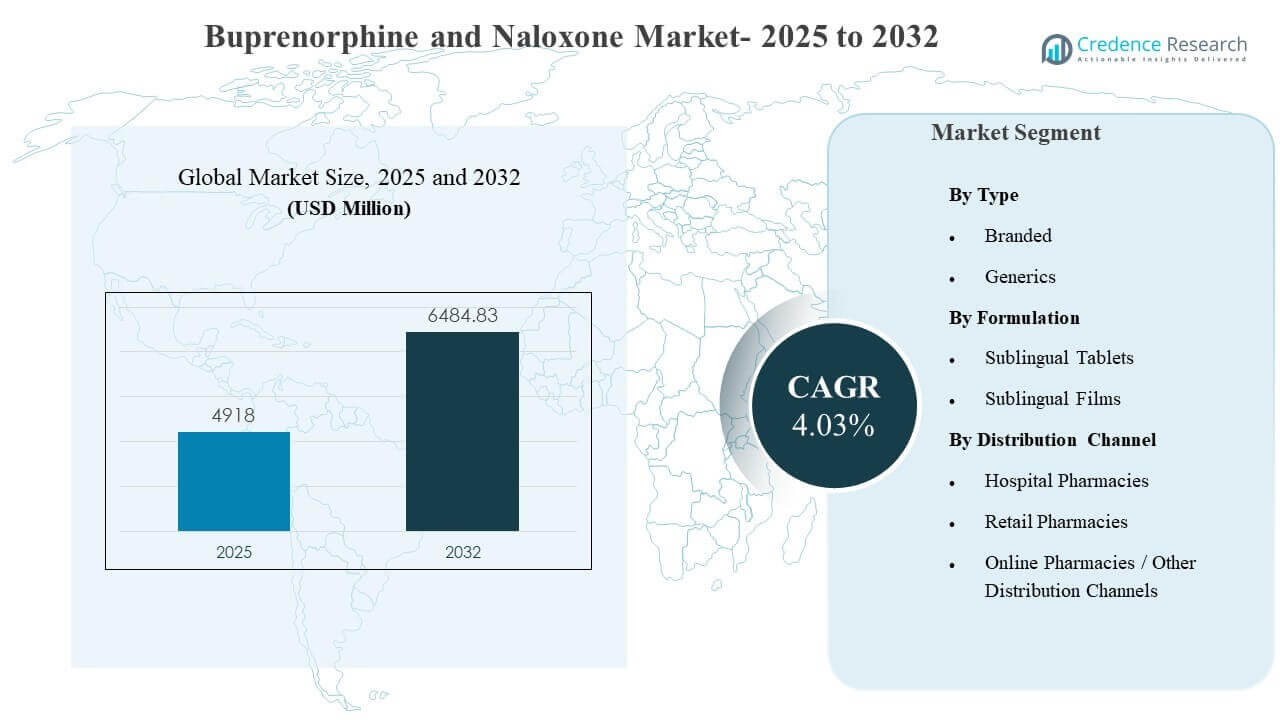
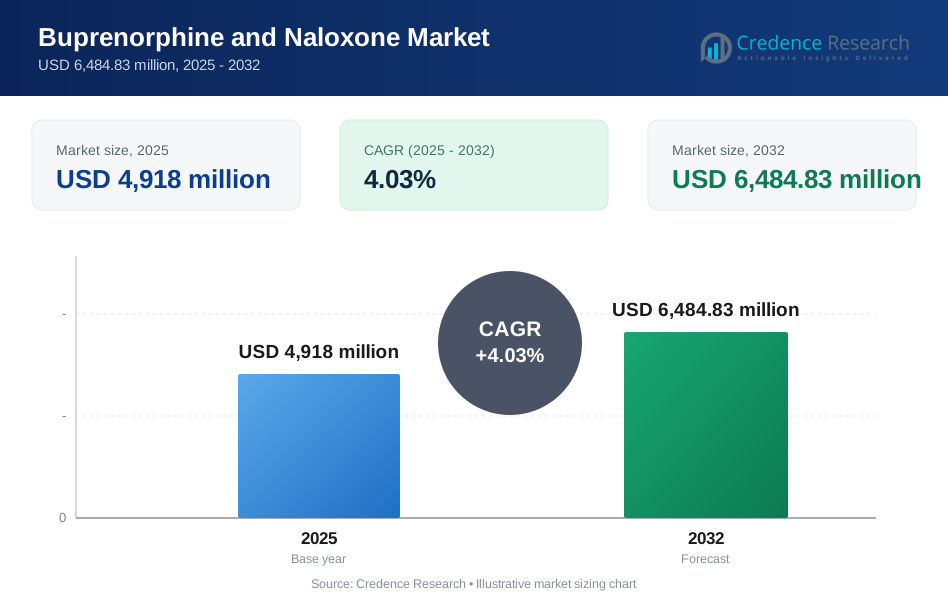
The global Buprenorphine and Naloxone Market size was estimated at USD 4,918 million in 2025 and is expected to reach USD 6,484.83 million by 2032, growing at a CAGR of 4.03% from 2025 to 2032. Demand expansion is primarily driven by rising clinical and policy focus on evidence-based opioid use disorder treatment, which is increasing diagnosis-to-treatment conversion and long-term maintenance therapy volumes across care settings. Buprenorphine and Naloxone Market momentum also benefits from expanding pharmacy access pathways and broader payer coverage for medication-assisted treatment in high-burden geographies.
| REPORT ATTRIBUTE | DETAILS |
|---|---|
| Historical Period | 2020-2024 |
| Base Year | 2025 |
| Forecast Period | 2026-2032 |
| Buprenorphine and Naloxone Market Size 2025 | USD 4,918 million |
| Buprenorphine and Naloxone Market, CAGR | 4.03% |
| Buprenorphine and Naloxone Market Size 2032 | USD 6,484.83 million |
Key Market Trends & Insights
- North America held 57.8% share in 2025, reflecting the largest concentration of treated patient volumes and mature treatment infrastructure.
- Europe accounted for 22.4% share in 2025, supported by structured addiction-care pathways and widening access to substitution therapy programs.
- Generics led By Type with 51.6% share in 2025, strengthened by payer preference and multi-source supply availability.
- Sublingual Tablets led By Formulation with 52.7% share in 2025, driven by broad stocking, familiarity in maintenance protocols, and cost efficiency.
- Retail Pharmacies led By Distribution Channel with 45.9% share in 2025, reflecting refill-heavy demand patterns in stable maintenance therapy.
Segment Analysis
Buprenorphine and Naloxone Market segmentation reflects a balance between affordability-led access expansion and clinically driven formulation choices. By Type, generic penetration continues to rise as therapy volumes scale across outpatient settings and payers apply cost-containment tools such as step edits and preferred formularies. By Formulation, care teams typically align dosage form selection to patient stability, adherence support, and diversion-mitigation practices, which sustains meaningful demand across both tablets and films.
Channel dynamics in the Buprenorphine and Naloxone Market remain closely tied to the treatment pathway from initiation to maintenance. Retail pharmacies capture the highest share due to recurring refills and the community-based nature of long-term therapy. Hospital pharmacies maintain a strong role through emergency and inpatient encounters, discharge planning, and integrated addiction programs that connect patients to outpatient continuation therapy.
By Type Insights
Generics accounted for the largest share of 51.6% in 2025. Generics lead because payers and public programs prioritize lower-cost equivalents to expand covered access for maintenance therapy. Generic availability across multiple dosage strengths supports switching without disrupting dose stabilization plans. Generic competition also increases procurement resilience for high-volume dispensing locations, which reinforces continued preference for multi-source products.
By Formulation Insights
Sublingual Tablets accounted for the largest share of 52.7% in 2025. Sublingual tablets lead due to wide pharmacy stocking, consistent prescribing familiarity, and cost-advantaged acquisition in many reimbursement settings. Sublingual tablets also align well with standardized dispensing workflows used for repeat refills. Sublingual tablet adoption remains supported by clinician comfort in dose titration and long-term maintenance routines.
By Distribution Channel Insights
Retail Pharmacies accounted for the largest share of 45.9% in 2025. Retail pharmacies lead because Buprenorphine and Naloxone Market demand is dominated by recurring refills for stable patients receiving ongoing maintenance therapy. Retail networks provide broad geographic reach and routine dispensing hours that support continuity of care. Retail distribution also benefits from payer network contracting and established e-prescribing workflows used in outpatient addiction treatment.
Buprenorphine and Naloxone Market Drivers
Expanding Opioid Use Disorder Treatment Adoption
Buprenorphine and Naloxone Market growth is supported by broader adoption of medication-assisted treatment across outpatient and community care settings. Healthcare systems are increasing screening, diagnosis, and referral pathways that move more patients into pharmacotherapy. Provider education and clinical guideline alignment are improving confidence in long-term maintenance approaches. Public health initiatives and program funding also strengthen continuity of care, which raises refill volumes and supports steady market expansion.
- For instance, Orexo's 24-week clinical trial (Study OX219-008) evaluating Zubsolv® (buprenorphine/naloxone sublingual tablet) for maintenance treatment of opioid dependence found that less than 1% of participants exited the study due to treatment failure, while a 15% increase in employment was recorded among study participants outcomes that directly reinforce clinical and provider confidence in long-term pharmacotherapy maintenance.
Payer Coverage and Cost-Containment Shaping Utilization
Buprenorphine and Naloxone Market demand is strongly influenced by reimbursement rules and formulary design across public and private payers. Preferred placement for lower-cost options increases utilization scale by reducing out-of-pocket barriers. Step therapy and prior authorization frameworks can standardize product selection and channel routing. Higher treatment persistence improves refill regularity, which supports recurring revenue generation. Pricing pressure also encourages broader generic uptake that expands the treated population.
Growth in Community-Based Access Channels
Buprenorphine and Naloxone Market expansion benefits from the central role of retail pharmacy dispensing in maintenance therapy. Retail access improves geographic availability and supports consistent refill schedules, which is critical for adherence. Digital prescribing and integrated care coordination reduce friction across initiation, stabilization, and continuation phases. Hospital-linked discharge workflows also improve therapy continuation after acute encounters. Improved channel access supports reduced treatment gaps and increases long-term therapy duration.
Increasing Multi-Source Supply and Portfolio Depth
Buprenorphine and Naloxone Market supply depth expands as more manufacturers broaden dosage strengths and dosage-form coverage. Multi-source supply improves procurement stability for large dispensing networks and institutional programs. Wider availability supports switching flexibility when payer rules or contracting preferences change. Manufacturing scale can reduce unit costs and increase affordability across high-volume geographies. Competitive supply dynamics also support ongoing access expansion through improved availability and distribution reliability.
- For instance, Amneal Pharmaceuticals received FDA approval in February 2013 for generic buprenorphine HCl/naloxone HCl tablets entering the market as the 7th largest generic pharmaceutical company in the U.S. at the time and further expanded its buprenorphine dosage-form portfolio in April 2020 with FDA approval of a generic transdermal buprenorphine patch (generic Butrans®).
Buprenorphine and Naloxone Market Challenges
Buprenorphine and Naloxone Market participants face persistent pricing pressure as generic competition increases and payers intensify cost-containment measures. Margin compression can limit investment in differentiation, patient support programs, and supply chain redundancies. Access rules such as prior authorization and quantity limits can create discontinuities in therapy initiation and refill continuity, especially for vulnerable populations. Dispensing restrictions and operational burden can also reduce pharmacy willingness to stock broad inventories across dosage strengths.
Buprenorphine and Naloxone Market growth is also constrained by variability in provider capacity, stigma in care delivery, and uneven treatment infrastructure across regions. Workforce shortages in addiction medicine and limited integrated behavioral health pathways can reduce diagnosis-to-treatment conversion. Diversion concerns add compliance and monitoring overhead that can slow prescribing in some settings. Fragmented care transitions between hospital encounters and outpatient maintenance can also increase drop-off risk, reducing therapy persistence.
- For instance, JAMA Network Open survey of 607 office-based Texas clinicians who attended an X-waiver training course found that of 126 respondents, 61 (48.4%) had obtained the waiver yet of those waivered clinicians, only 22 (36%) were actively prescribing buprenorphine, with the remaining 64% citing complexity of the waiver process, lack of professional support, and referral network gaps as persistent barriers, demonstrating that credentialing alone does not translate into active prescribing capacity.
Buprenorphine and Naloxone Market Trends and Opportunities
Buprenorphine and Naloxone Market trends include stronger integration of treatment into primary care and community health settings, which expands access beyond specialty clinics. Structured care models that combine pharmacotherapy with behavioral support improve persistence and reduce relapse risk, increasing refill continuity. Digital tools supporting prescribing, follow-up, and adherence monitoring are improving coordination across providers and pharmacies. Expansion of pharmacy-based care pathways also creates opportunities for stronger channel partnerships and improved continuity.
- For instance, Bicycle Health’s technology-enabled collaborative care model reported 75% retention at 30 days and 59% retention at 90 days, while insured patients reached 86% retention at 30 days and 80% at 90 days; the company also reported a 9.5% no-show rate, about 70% of new patients seen by a buprenorphine-waivered provider on the same or next business day, and 89% of new patients receiving provider-delivered motivational interviewing
Buprenorphine and Naloxone Market opportunities are rising in regions increasing investment in addiction services and improving medication access frameworks. Product strategies that improve availability across dosage strengths and strengthen distribution resilience can win share in high-volume programs. Contracting strategies focused on payer alignment and reliable supply can strengthen formulary positioning. Patient-centric approaches that reduce friction in refills and transitions of care can increase therapy duration, supporting stable demand across channels.
Regional Insights
North America
North America (57.8% in 2025) leads the Buprenorphine and Naloxone Market due to large treated populations, mature medication-assisted treatment delivery models, and strong retail dispensing integration. High prescription volumes and established reimbursement pathways support consistent refill demand. Broad access through community pharmacies and institutional care transitions strengthens continuity of therapy. Ongoing public health focus on evidence-based opioid use disorder management sustains adoption across states and provinces.
Europe
Europe (22.4% in 2025) remains a major Buprenorphine and Naloxone Market contributor supported by structured addiction-care programs and expanding access to substitution therapies. National health systems influence product mix through formulary design and standardized care pathways. Centralized procurement and guideline-driven prescribing can support steady utilization. Continued program expansion and improved patient access frameworks sustain long-term maintenance therapy volumes.
Asia Pacific
Asia Pacific (13.1% in 2025) shows expanding Buprenorphine and Naloxone Market potential as awareness, diagnosis, and treatment infrastructure improve. Growth is supported by increasing policy attention to opioid dependence management and gradual expansion of regulated access channels. Market development varies widely by country, shaping uneven adoption across urban and rural settings. Improvements in affordability and care integration can increase long-term treatment persistence over time.
Latin America
Latin America (4.2% in 2025) represents an emerging Buprenorphine and Naloxone Market region where access is influenced by treatment capacity, reimbursement coverage, and program availability. Private-sector treatment networks play an important role in several countries, and access remains uneven across geographies. Expansion of public health programs and improved availability through retail channels can support gradual growth. Strengthening clinical pathways and supply reliability can increase sustained utilization.
Middle East & Africa
Middle East & Africa (2.5% in 2025) remains smaller in the Buprenorphine and Naloxone Market due to limited treatment infrastructure and variable access frameworks. Adoption depends on national policy, specialist capacity, and regulated dispensing pathways. Program development and improved care integration can support incremental expansion. Strengthening provider training and improving continuity of therapy across settings can raise treatment persistence in the region.
Competitive Landscape
Buprenorphine and Naloxone Market competition is characterized by strong generic participation alongside branded positioning in specific protocols and patient preference segments. Key strategies include portfolio expansion across dosage strengths, reliable supply and distribution coverage, and payer contracting to secure preferred placement. Manufacturers differentiate through channel execution, competitive pricing, and operational support for high-volume dispensing environments. Competitive intensity remains high as access expansion and cost-containment continue to shape purchasing decisions.
Indivior PLC remains a central reference competitor in the Buprenorphine and Naloxone Market through branded portfolio positioning, lifecycle management activities, and commercial focus on maintaining access in key channels. Indivior PLC strategy emphasizes sustaining prescriber familiarity and supporting continuity of therapy within regulated dispensing pathways. Indivior PLC also competes through contracting discipline and channel execution designed to protect share in the presence of multi-source alternatives. Competitive pressure from generics continues to shape Indivior PLC positioning and portfolio priorities.
The industry research and growth report includes detailed analyses of the competitive landscape of the market and information about key companies, including:
- Indivior PLC
- Dr. Reddy’s Laboratories Ltd.
- Viatris / Mylan N.V.
- Hikma Pharmaceuticals PLC
- Teva Pharmaceutical Industries Ltd.
- Sun Pharmaceutical Industries Ltd.
- Sandoz AG / Sandoz International GmbH
- Alvogen
- Mallinckrodt
- Amneal Pharmaceuticals LLC
Qualitative and quantitative analysis of companies has been conducted to help clients understand the wider business environment as well as the strengths and weaknesses of key industry players. Data is qualitatively analyzed to categorize companies as pure play, category-focused, industry-focused, and diversified; it is quantitatively analyzed to categorize companies as dominant, leading, strong, tentative, and weak.
Recent Developments
- In January 2025, Hikma Pharmaceuticals announced an exclusive six-year commercial partnership with Emergent BioSolutions for the sale of KLOXXADO naloxone HCl nasal spray 8 mg in the U.S. and Canada, strengthening Hikma’s position in the naloxone segment of the market.
- In September 2025, Purdue Pharma expanded its partnership with MMCAP to supply buprenorphine and naloxone tablets CIII, a generic version of Suboxone, to correctional facilities for incarcerated individuals with opioid use disorder at a cost of $0.01 per tablet.
- In December 2025, Orexo AB closed its transaction with Dexcel Pharma USA to acquire the full U.S. rights to Zubsolv, a buprenorphine/naloxone sublingual tablet used for opioid use disorder treatment, marking a notable acquisition in this market.
Report Scope
| Report Attribute | Details |
| Market size value in 2025 | USD 4918 million |
| Revenue forecast in 2032 | USD 6484.83 million |
| Growth rate (CAGR) | 4.03% (2025–2032) |
| Base year | 2025 |
| Forecast period | 2026-2032 |
| Quantitative units | USD million |
| Segments covered | By Type Outlook: Branded, Generics; By Formulation Outlook: Sublingual Tablets, Sublingual Films; By Distribution Channel Outlook: Hospital Pharmacies, Retail Pharmacies, Online Pharmacies / Other Distribution Channels |
| Regional scope | North America, Europe, Asia Pacific, Latin America, Middle East & Africa |
| Key companies profiled | Indivior PLC; Dr. Reddy’s Laboratories Ltd.; Viatris / Mylan N.V.; Hikma Pharmaceuticals PLC; Teva Pharmaceutical Industries Ltd.; Sun Pharmaceutical Industries Ltd.; Sandoz AG / Sandoz International GmbH; Alvogen; Mallinckrodt; Amneal Pharmaceuticals LLC |
| No. of Pages | 328 |
By Segmentation
By Type
- Branded
- Generics
By Formulation
- Sublingual Tablets
- Sublingual Films
By Distribution channel
- Hospital Pharmacies
- Retail Pharmacies
- Online Pharmacies / Other Distribution Channels
By Region
- North America
- U.S.
- Canada
- Mexico
- Europe
- Germany
- France
- U.K.
- Italy
- Spain
- Rest of Europe
- Asia Pacific
- China
- Japan
- India
- South Korea
- South-east Asia
- Rest of Asia Pacific
- Latin America
- Brazil
- Argentina
- Rest of Latin America
- Middle East & Africa
- GCC Countries
- South Africa
- Rest of the Middle East and Africa
Request a Free Sample
Fill in your details and we'll send you a free sample report.
- Sample data tables & charts
- Research methodology
Need a Custom Version of This Report?
Tailor the scope, geography, or segments to your exact requirements.
- Custom geography or segment scope
- Direct access to our analyst team
Frequently Asked Questions
What is the market size and forecast for the Buprenorphine and Naloxone Market?
What is the CAGR for the Buprenorphine and Naloxone Market during 2025–2032?
Which is the largest segment in the Buprenorphine and Naloxone Market?
What factors are driving growth in the Buprenorphine and Naloxone Market?
Who are the leading companies in the Buprenorphine and Naloxone Market?
Which region leads the Buprenorphine and Naloxone Market?
Table of Content
Chapter 1. Report Introduction
- 1.1 Report Description & Purpose
- 1.1.1 Report Title & Market Definition
- 1.1.2 Unique Selling Propositions (USP) & Key Differentiators
- 1.1.3 Value Proposition for Stakeholders
- 1.2 Research Objectives
- 1.2.1 Market Sizing Objectives (Volume & Revenue)
- 1.2.2 Segmentation Objectives
- 1.2.3 Competitive Intelligence Objectives
- 1.2.4 Forecast & Scenario Objectives
- 1.3 Report Scope
- 1.3.1 Buprenorphine and Naloxone Scope – Types & Subtypes Covered
- 1.3.2 Geographic Scope – Regions & Countries Covered
- 1.3.3 Historical Period, Base Year & Forecast Period (2025; forecast to 2032)
- 1.3.4 Inclusions & Exclusions
- 1.4 HS Code & Classification Framework
- 1.5 Currency, Units & Pricing Basis
- 1.6 Target Stakeholders
- 1.7 Limitations & Assumptions
Chapter 2. Executive Summary
- 2.1 Global Buprenorphine and Naloxone Market Snapshot
- 2.1.1 Market Size – Historical (2025) & Forecast (2025-2032) (2025: USD 4,918 million → 2032: USD 6,484.83 million)
- 2.1.2 Volume & Revenue – Global Totals
- 2.1.3 Key Market Highlights – Top Five Facts
- 2.2 Buprenorphine and Naloxone Market Segmentation Snapshot
- 2.2.1 Market Split by Region – 2025 vs. 2032
- 2.3 Competitive Snapshot
- 2.3.1 Top 10 Players by Revenue Share – 2025
- 2.3.2 Top 10 Players by Volume Share – 2025
- 2.3.3 Recent Strategic Developments (18-Month Summary)
- 2.4 Key Investment Highlights & Strategic Conclusions
Chapter 3. Buprenorphine and Naloxone Market Dynamics & Industry Analysis
- 3.1 Market Overview & Context
- 3.1.1 Buprenorphine and Naloxone Market Position in the Broader Automotive Value Chain
- 3.1.2 OEM vs. Replacement Market Dynamics
- 3.1.3 Market Maturity & Development Stage by Region
- 3.2 Buprenorphine and Naloxone Market Drivers
- 3.3 Buprenorphine and Naloxone Market Restraints & Challenges
- 3.4 Buprenorphine and Naloxone Market Opportunities
- 3.5 Porter's Five Forces Analysis
- 3.5.1 Threat of New Entrants
- 3.5.2 Bargaining Power of Suppliers
- 3.5.3 Bargaining Power of Buyers
- 3.5.4 Threat of Substitutes
- 3.5.5 Competitive Rivalry – Intensity Assessment
- 3.6 Buprenorphine and Naloxone Value Chain Analysis
- 3.6.1 Upstream – Raw Material/Input Suppliers
- 3.6.1.1 Raw Material/Input 1
- 3.6.1.2 Raw Material/Input 2
- 3.6.1.3 Raw Material/Input 3
- 3.6.2 Midstream – Production/Manufacturing/Service Delivery
- 3.6.2.1 Production/Process Overview
- 3.6.2.2 Key Facility Locations & Capacity by Manufacturer
- 3.6.3 Downstream – Distribution & End Consumer
- 3.6.3.1 Primary Channel – B2B/OEM
- 3.6.3.2 Secondary Channels – Dealer, Retail, Online, Direct
- 3.6.4 Value Chain Profitability Analysis
- 3.6.1 Upstream – Raw Material/Input Suppliers
- 3.7 PESTEL Analysis
- 3.7.1 Political Factors
- 3.7.2 Economic Factors
- 3.7.3 Social Factors
- 3.7.4 Technological Factors
- 3.7.5 Environmental Factors
- 3.7.6 Legal Factors
- 3.8 Buprenorphine and Naloxone Supply Chain Analysis
- 3.8.1 Raw Material/Input Supply Risk Assessment
- 3.8.2 Manufacturing Concentration Risk (Geographic Exposure)
- 3.8.3 Trade Disruption Impact Analysis
- 3.9 Regulatory & Policy Landscape
Note: The regulatory and policy landscape section covers regulations based on their applicability to the market, Buprenorphine and Naloxone category, geography, and scope of the study. Only regulatory frameworks with a material impact on operations, compliance, trade, sustainability, or market access are analyzed in detail.
Chapter 4. Key Investment Pockets & Opportunity Analysis
- 4.1 Buprenorphine and Naloxone Market Attractiveness Analysis
- 4.1.1 By Region – Investment Attractiveness Matrix (Volume × CAGR)
- 4.2 Absolute Revenue Growth Opportunity
- 4.2.1 By Region – Absolute USD Growth Through 2032
- 4.3 Incremental Volume Opportunity
- 4.3.1 By Region – Incremental Volume Through 2032
- 4.3.2 Segment – Incremental Volume
- 4.4 Emerging Submarket Opportunity Deep Dive (Subject to Applicability)
- 4.5 Emerging Market Opportunity Scorecards
- 4.5.1 United States
- 4.5.2 Europe
- 4.5.3 Asia
- 4.5.4 Middle East & Africa
Note: Emerging Market Opportunity Scorecards will be included based on relevance and strategic importance. Regions listed are indicative and may vary depending on data availability and market dynamics.
Chapter 5. Buprenorphine and Naloxone Import-Export Analysis & Trade Flows
- 5.1 Global Trade Overview
- 5.1.1 Global Export Value by Country (2025)
- 5.1.2 Global Export Volume by Country (2025)
- 5.1.3 Global Import Value by Country (2025)
- 5.1.4 Global Import Volume by Country (2025)
- 5.1.5 Net Trade Balance by Country (2025)
- 5.2 Export Analysis – Segment
- 5.2.1 Type 1 (HS Code)
- 5.2.2 Type 2 (HS Code)
- 5.2.3 Type 3 (HS Code)
- 5.2.4 Type 4 (HS Code)
- 5.2.5 Type 5 (HS Code)
- 5.3 Import Analysis – Segment
- 5.3.1 Type 1 (HS Code)
- 5.3.2 Type 2 (HS Code)
- 5.3.3 Type 3 (HS Code)
- 5.3.4 Type 4 (HS Code)
- 5.3.5 Type 5 (HS Code)
- 5.4 Average Unit Trade Prices
- 5.4.1 Average Export Price – Segment & Country
- 5.4.2 Average Import Price – Segment & Source Country
- 5.4.3 Price Trends (2025)
- 5.5 Key Trade Route Analysis
- 5.5.1 Trade Route 1
- 5.5.2 Trade Route 2
- 5.5.3 Trade Route 3
- 5.5.4 Trade Route 4
- 5.5.5 Trade Route 5
- 5.6 Trade Policy Impact Assessment
- 5.6.1 US Anti-Dumping & Section 301 Tariffs
- 5.6.2 EU Customs Union Impact
- 5.6.3 Major Free Trade Agreements
- 5.6.4 USMCA Rules of Origin
Note: Trade policy analysis will be included only where relevant to the Buprenorphine and Naloxone market.
Chapter 6. Competitive Landscape & Company Benchmarking
- 6.1 Buprenorphine and Naloxone Market Concentration & Structure
- 6.1.1 Herfindahl-Hirschman Index (HHI) – vs. 2025
- 6.1.2 Tier 1, Tier 2 & Tier 3 Market Structure
- 6.1.3 Global, Regional & Local Player Dynamics
- 6.2 Buprenorphine and Naloxone Market Share Analysis – 2025
- 6.2.1 Global Revenue Share by Company
- 6.2.2 Global Volume Share by Company
- 6.2.3 Regional Revenue Share
- 6.2.4 Market Share Evolution ( vs. 2025)
- 6.2.5 OEM Segment Share by Company
- 6.2.6 Replacement Segment Share by Company
- 6.3 Production/Delivery Capacity & Facility Analysis
- 6.3.1 Global Installed Capacity
- 6.3.2 Capacity Utilization Rates
- 6.3.3 Production/Output Volume
- 6.3.4 Facility Locations & Capacity Map
- 6.3.5 Planned Capacity Additions
- 6.4 Buprenorphine and Naloxone Competitive Benchmarking Matrix
- 6.4.1 Revenue, Volume, CAGR & Profitability Comparison
- 6.4.2 Channel Revenue Mix
- 6.4.3 Geographic Revenue Exposure
- 6.4.4 R&D Intensity
- 6.4.5 Sustainability Maturity
- 6.5 Strategic Developments in Buprenorphine and Naloxone (Last 24 Months)
- 6.5.1 Mergers, Acquisitions & Divestments
- 6.5.2 New Buprenorphine and Naloxone Launches
- 6.5.3 Facility Expansions
- 6.5.4 Strategic Alliances, Joint Ventures & Partnerships
- 6.5.5 Distribution Expansion & Market Entry
- 6.5.6 Sustainability & ESG Initiatives
- 6.6 Competitive Strategy Mapping
- 6.6.1 Leader, Challenger, Follower & Niche Classification
- 6.6.2 Pricing Strategy Comparison
- 6.6.3 Channel Strategy Matrix
Note: Strategic developments are included based on their materiality and the availability of reliable information.
Chapter 7. Global Buprenorphine and Naloxone Market – By Distribution Channel
- 7.1 Segment Overview
- 7.1.1 Volume & Revenue Split by Channel (2025 & 2032)
- 7.1.2 Channel Mix Evolution (2025-2032)
Chapter 8. Regional Market Analysis – Global Overview
- 8.1 Global Regional Overview
- 8.1.1 Regional Volume Share
- 8.1.2 Regional Revenue Share
- 8.1.3 Regional Volume by Region
- 8.1.4 Regional Revenue by Region
- 8.1.5 Regional Forecast Through 2032
- 8.2 Cross-Regional Segment Analysis
- 8.2.1 By Distribution Channel
- 8.2.2 By Brand/Price Tier
Chapter 9. North America Buprenorphine and Naloxone Market
- 9.1 United States
- 9.2 Canada
- 9.3 Mexico
Chapter 10. Europe Buprenorphine and Naloxone Market
- 10.1 Germany
- 10.2 France
- 10.3 Italy
- 10.4 United Kingdom
- 10.5 Spain
- 10.6 Poland
- 10.7 Russia
- 10.8 Netherlands
- 10.9 Belgium
- 10.10 Sweden
- 10.11 Denmark
- 10.12 Norway
- 10.13 Rest of Europe
Chapter 11. Asia Pacific Buprenorphine and Naloxone Market
- 11.1 China
- 11.2 India
- 11.3 Japan
- 11.4 South Korea
- 11.5 Thailand
- 11.6 Indonesia
- 11.7 Vietnam
- 11.8 Malaysia
- 11.9 Australia
- 11.10 Rest of Asia Pacific
Chapter 12. Latin America Buprenorphine and Naloxone Market
- 12.1 Brazil
- 12.2 Argentina
- 12.3 Colombia
- 12.4 Chile
- 12.5 Rest of Latin America
Chapter 13. Middle East Buprenorphine and Naloxone Market
- 13.1 Saudi Arabia
- 13.2 United Arab Emirates
- 13.3 Turkey
- 13.4 Israel
- 13.5 Iran
- 13.6 Rest of the Middle East
Chapter 14. Africa Buprenorphine and Naloxone Market
- 14.1 South Africa
- 14.2 Egypt
- 14.3 Nigeria
- 14.4 Morocco
- 14.5 Rest of Africa
Chapter 15. Buprenorphine and Naloxone Company Profiles
- 15.1 [Company 01]
- 15.1.1 Company Overview
- 15.1.2 Key Management Personnel
- 15.1.3 Products & Services Portfolio
- 15.1.4 Financial Performance
- 15.1.5 Key Market Focus & Geographic Presence
- 15.1.6 Recent Developments & Strategic Initiatives
Note: The company profile list is preliminary and may change based on research findings, market developments, data availability, and client requirements.
Chapter 16. Appendices
- Appendix A – List of Abbreviations & Acronyms
- Appendix B – Industry Classification Code Reference – Full Series
- Appendix C – Production & Capacity Data Tables
- Appendix D – End-Use & Demand Base Tables
- Appendix E – Consumption & Replacement Rate Assumptions
- Appendix F – ASP Reference Tables
- Appendix G – Manufacturing & Facility Database
- Appendix H – Import-Export Data Tables
- Appendix I – Regulatory Summary Tables
- Appendix J – Primary Research Participant List (Anonymized)
- Appendix K – Primary Research Questionnaire Framework
- Appendix L – Data Sources & Bibliography
- Appendix M – Market Size Divergence & Source Comparison
Chapter 17. Research Methodology
- 17.1 Research Framework & Philosophy
- 17.2 Secondary Research – Sources, Hierarchy & Data Extraction
- 17.3 Data Modeling – Bottom-Up & Top-Down Market Sizing
- 17.4 Primary Research – Stakeholder Framework, LOI & Sample Sizes
- 17.5 Forecast Methodology – Regression, Scenario & Sensitivity Analysis
- 17.6 Quality Control – Four-Layer Validation Framework
- 17.7 Limitations & Standard Assumptions
- 17.8 Disclaimer
