
Calcifediol Supplements Market
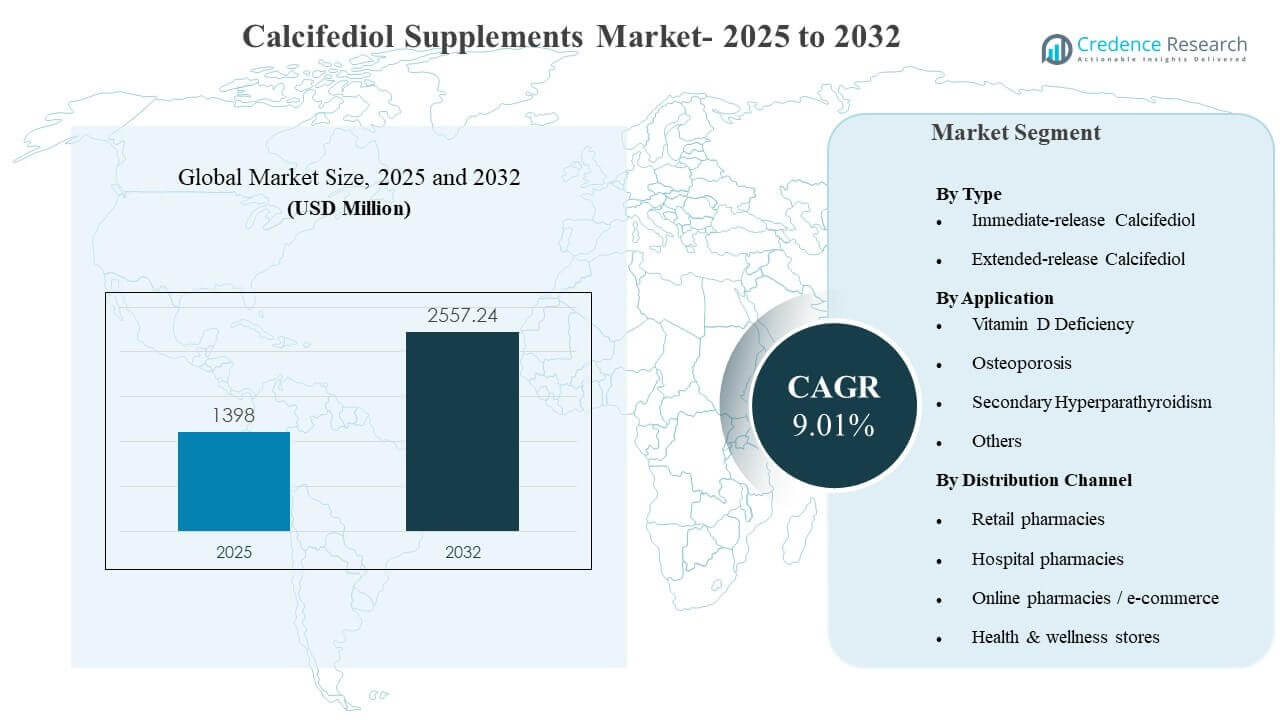
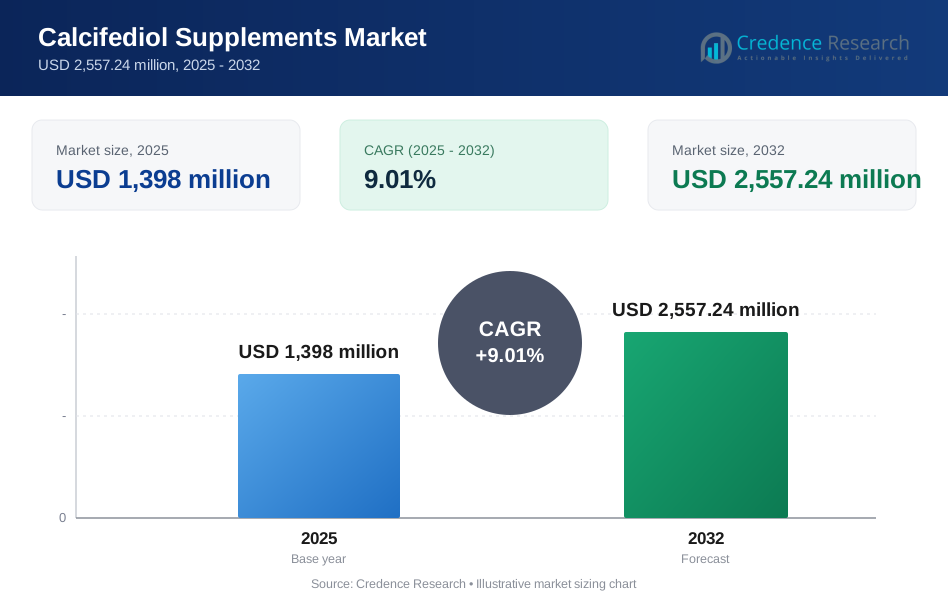
The global Calcifediol Supplements Market size was estimated at USD 1,398 million in 2025 and is expected to reach USD 2,557.24 million by 2032, growing at a CAGR of 9.01% from 2025 to 2032. Demand expansion is primarily driven by rising screening and clinical recognition of vitamin D deficiency and the need for faster, more predictable correction of vitamin D status in select patient groups. Growth is further supported by broader availability across retail and digital channels, alongside increasing focus on bone health and age-related fragility risk management in major economies.
| REPORT ATTRIBUTE | DETAILS |
|---|---|
| Historical Period | 2020-2024 |
| Base Year | 2025 |
| Forecast Period | 2026-2032 |
| Calcifediol Supplements Market Size 2025 | USD 1,398 million |
| Calcifediol Supplements Market, CAGR | 9.01% |
| Calcifediol Supplements Market Size 2032 | USD 2,557.24 million |
Key Market Trends & Insights
- The Calcifediol Supplements Market is projected to expand at a CAGR of 9.01% (2025–2032), reflecting sustained demand across preventive nutrition and clinically guided supplementation pathways.
- North America accounted for 36.8% in 2025, supported by higher testing penetration, stronger consumer supplement spending, and wider access to prescription-aligned calcifediol formats.
- Immediate-release calcifediol held 64.5% share in 2025, driven by broad suitability for routine supplementation and simpler dosing patterns across consumer and outpatient settings.
- Vitamin D deficiency represented 57.8% share in 2025, indicating deficiency correction remains the dominant application versus narrower, condition-specific use cases.
- Retail pharmacies captured 41.6% share in 2025, as pharmacy-led recommendation, convenient refills, and established OTC purchasing behavior continue to anchor demand.
Segment Analysis
Calcifediol supplementation demand is shaped by a blend of consumer wellness use and clinically guided correction of low vitamin D status. Product selection often prioritizes predictable and faster improvement in vitamin D levels, particularly for individuals requiring rapid repletion or consistent response. Calcifediol Supplements Market adoption benefits from expanding awareness of deficiency-related outcomes, including musculoskeletal weakness and fracture risk in aging populations. Channel availability across pharmacies and online platforms supports regular replenishment cycles and improves access in both urban and semi-urban settings.
Application patterns show a clear concentration in deficiency management, with secondary use supported by osteoporosis-related care pathways and condition-linked supplementation needs. Calcifediol Supplements Market participation in secondary hyperparathyroidism remains more clinically anchored, often linked to structured monitoring and physician oversight. In distribution, pharmacy access supports guidance-driven purchases, whereas e-commerce improves convenience and broadens SKU availability. These factors collectively reinforce steady volume growth and widen addressable demand pools.
By Type Insights
Immediate-release Calcifediol accounted for the largest share of 64.5% in 2025. Immediate-release formats align closely with routine supplementation behavior and are widely suited for outpatient use where flexible dosing and rapid correction are prioritized. Product simplicity, wider availability, and easier substitution dynamics further strengthen adoption. Calcifediol Supplements Market demand for immediate-release products is also supported by purchasing patterns that favor straightforward, repeatable regimens.
By Application Insights
Vitamin D Deficiency accounted for the largest share of 57.8% in 2025. Vitamin D deficiency correction remains the broadest and most frequently addressed use case, supported by rising awareness, screening initiatives, and preventive health adoption. Osteoporosis-related supplementation supports additional demand where bone health is actively managed across older demographics. Calcifediol Supplements Market uptake in secondary hyperparathyroidism is more selective and generally tied to monitored, therapy-adjacent care pathways.
By Distribution Channel Insights
Retail pharmacies accounted for the largest share of 41.6% in 2025. Retail pharmacy purchasing is supported by pharmacist-led recommendations, easy access to supplements, and consistent refill behavior. Online pharmacies and e-commerce continue expanding reach by improving convenience, subscription-style reordering, and product assortment visibility. Calcifediol Supplements Market reliance on hospital pharmacies remains stronger for clinically monitored users, whereas health and wellness stores support impulse and lifestyle-driven purchasing.
Market Drivers
Expanding Vitamin D Deficiency Screening And Preventive Health Adoption
Routine vitamin D testing is increasing across primary care and wellness settings, strengthening identification of low vitamin D status and increasing supplementation initiation. Greater patient awareness of deficiency-linked outcomes supports earlier and more frequent supplementation. Clinicians often favor solutions that deliver predictable correction, supporting adoption across deficiency-focused pathways. Calcifediol Supplements Market expansion benefits from higher test-to-treat conversion as diagnostic access improves in developed and emerging economies.
- For instance, Diazyme’s 25-OH Vitamin D assay was developed for automated chemistry analyzers with throughput above 600 tests per hour, and the company states that the assay is FDA-approved and CDC-certified for accuracy and precision, supporting larger-scale routine screening workflows.
Rising Bone Health Focus In Aging Populations
Aging demographics elevate osteoporosis risk, fragility fractures, and musculoskeletal weakness, increasing demand for supportive nutritional interventions. Bone health programs frequently integrate vitamin D status optimization as a foundational element of prevention and maintenance care. Calcifediol-based supplementation is adopted where faster or more reliable vitamin D improvement is preferred. Calcifediol Supplements Market growth is reinforced by long-duration adherence behavior tied to chronic bone health management.
- For instance, OPKO Health’s Rayaldee is engineered as an extended-release calcifediol capsule that provides steady release over 12 hours, starts at 30 mcg once daily, and is maintained to target serum total 25-hydroxyvitamin D levels between 30 and 100 ng/mL, highlighting a measurable formulation advantage for long-duration vitamin D management.
Greater Demand For Faster And More Predictable Vitamin D Status Improvement
Certain patient groups require faster repletion or show inconsistent response to conventional vitamin D supplementation, increasing interest in calcifediol-based solutions. Predictable serum level improvement supports physician confidence and improves adherence among deficiency-sensitive populations. Broader availability across multiple formulations further supports adoption across diverse usage patterns. Calcifediol Supplements Market traction rises as prescribers and consumers prioritize speed-to-target and response consistency.
Wider Channel Access Across Retail And Digital Platforms
Pharmacy networks remain central to discovery and replenishment, supported by counseling-led purchases and established consumer trust. E-commerce improves geographic coverage, supports recurring purchasing, and expands access to specialized formulations. Health and wellness outlets increase visibility for lifestyle-driven buyers and preventative health consumers. Calcifediol Supplements Market demand scales as distribution expands and purchase friction declines across both offline and digital routes.
Market Challenges
Calcifediol supplementation competes with widely available vitamin D3 products that are deeply embedded in consumer routines and often priced lower. Substitution pressure can limit premiumization and slow conversion unless clear differentiation is communicated through clinician guidance or measurable outcomes. Regulatory positioning and labeling variation across regions can also complicate consistent claims and consumer understanding. Calcifediol Supplements Market participants must manage education requirements across both healthcare and retail environments.
- For instance, Faes Farma’s Hidroferol was evaluated in a 12-month randomized trial involving 298 evaluable postmenopausal women, where monthly calcifediol 0.266 mg raised mean 25(OH)D from 12.4 ng/mL at baseline to 26.8 ng/mL at month 4 and maintained 23.9 ng/mL at month 12, while 21.6% of patients remained above 30 ng/mL at month 12 versus 9.2% with monthly cholecalciferol 25,000 IU, giving marketers a quantified efficacy message rather than a generic vitamin D positioning claim.
Clinical use cases such as secondary hyperparathyroidism rely on structured monitoring, which can constrain broader adoption versus general supplementation. Differences in reimbursement, formulary access, and prescribing habits can affect therapy-adjacent product uptake. Supply chain consistency and quality expectations are critical, especially for ingredient producers and contract manufacturers supporting regulated formats. Calcifediol Supplements Market growth depends on maintaining trusted quality standards and reducing adoption barriers across clinical and consumer segments.
Market Trends and Opportunities
Personalized supplementation is expanding, with more consumers and clinicians tailoring vitamin D correction strategies based on baseline status, comorbidities, and response speed expectations. This shift supports demand for differentiated products that deliver consistent outcomes across select user groups. Expanded digital health ecosystems encourage repeat purchasing and adherence through reminders and subscription models. Calcifediol Supplements Market opportunity rises as personalization becomes a mainstream supplement and preventive health behavior.
- For instance, dsm-firmenich’s ampli-D calcifediol ingredient has been clinically proven in more than 15 human studies and is reported to raise blood vitamin D levels 2.5 times faster than conventional vitamin D3, supporting more personalized correction strategies for users who need faster deficiency response.
Innovation in formulation and delivery is increasing, supporting improved convenience, stability, and targeted use in clinically guided supplementation scenarios. Collaborative models between ingredient suppliers, contract manufacturers, and brand owners accelerate new product development and regional expansion. Retail and e-commerce analytics improve targeting and lifecycle engagement, strengthening retention and repurchase rates. Calcifediol Supplements Market participants can capture growth by optimizing channel strategy and aligning products with measurable deficiency-correction outcomes.
Regional Insights
North America
North America leads the Calcifediol Supplements Market with 36.8% share in 2025, supported by robust testing, higher supplement spending, and stronger access to clinical pathways that guide vitamin D correction. Retail pharmacy strength and broad consumer health adoption reinforce steady demand. Product differentiation based on predictable correction supports uptake across both wellness and clinician-guided use.
Europe
Europe represents 27.4% share in 2025, supported by structured deficiency management practices and strong emphasis on bone health across aging populations. Healthcare pathway alignment and pharmacy access support sustained consumption. Market growth remains steady as awareness improves and prevention-oriented supplementation continues expanding.
Asia Pacific
Asia Pacific accounted for 24.1% share in 2025, supported by large population volumes, rising organized retail reach, and fast-growing e-commerce adoption. Urbanization and increased preventive health spending improve supplement penetration. Demand growth accelerates as testing access and health awareness expand across large consumer bases.
Latin America
Latin America contributed 7.1% share in 2025, supported by improving access through retail pharmacy chains and expanding private healthcare activity in key markets. Growth is aided by rising consumer awareness and increasing availability of differentiated supplements. Distribution modernization remains important for broader penetration.
Middle East & Africa
Middle East & Africa represented 4.6% share in 2025, reflecting uneven access and varied affordability across countries. Growth is supported by expanding pharmacy networks and gradual improvement in preventive health adoption. Demand improvement depends on access expansion and strengthened consumer education.
Competitive Landscape
Competition in the Calcifediol Supplements Market centers on formulation differentiation, reliability of vitamin D status improvement, channel penetration, and brand trust. Ingredient quality, regulatory alignment, and manufacturing capability remain important as companies support both consumer wellness supplements and clinically positioned formats. Market participants emphasize partnerships with contract manufacturers, pharmacy distribution expansion, and evidence-led positioning to improve adoption and retention.
DSM-Firmenich participation is anchored in differentiated calcifediol solutions positioned around predictable vitamin D improvement and premium ingredient quality. DSM-Firmenich can support branded supplement programs and partner-led commercialization through scale, quality systems, and formulation support. Strategic positioning in regulated markets can strengthen adoption where novel food authorization and differentiated claims improve visibility. Calcifediol Supplements Market competitive advantage increasingly depends on trusted supply, compliant claims, and channel execution.
The industry research and growth report includes detailed analyses of the competitive landscape of the market and information about key companies, including:
- DSM-Firmenich
- Carbogen AMCIS
- Chemicea
- Midas Pharma
- ApexBio Technology
- Chemvon Biotechnology Co. Ltd.
- Haoyuan Chemexpress Co. Ltd.
- BOC Science
- Pharmaffiliates
- OPKO Pharmaceuticals LLC
- Nouveau Healthcare
- Tocris Bioscience
Qualitative and quantitative analysis of companies has been conducted to help clients understand the wider business environment as well as the strengths and weaknesses of key industry players. Data is qualitatively analyzed to categorize companies as pure play, category-focused, industry-focused, and diversified; it is quantitatively analyzed to categorize companies as dominant, leading, strong, tentative, and weak.
Recent Developments
- In May 2024, dsm-firmenich received EU novel food authorization for ampli-D, its calcifediol (calcidiol) ingredient, and the company said it was granted a five-year exclusive use period to place the product on the market from May 1, 2024. This marked an important commercialization milestone for calcifediol-based vitamin D supplementation in Europe.
- In October 2024, Immunotec launched SunRay, a once-weekly vitamin D supplement in the United States that features rapid-acting calcifediol at 75 mcg and is sold without a prescription. The company described SunRay as a breakthrough product and said it is available exclusively through Immunotec in the U.S.
- In July 2025, Aspen Pharmacare Australia Pty Ltd advanced its calcifediol product VISTELLA, with Australia’s public assessment report finalised on July 9, 2025, for the treatment of vitamin D deficiency in adults. The filing identifies VISTELLA as a calcifediol capsule product sponsored by Aspen Pharmacare Australia, highlighting a notable new branded entry in the calcifediol segment.
Report Scope
| Report Attribute | Details |
| Market size value in 2025 | USD 1,398 million |
| Revenue forecast in 2032 | USD 2,557.24 million |
| Growth rate (CAGR) | 9.01% (2025–2032) |
| Base year | 2025 |
| Forecast period | 2026-2032 |
| Quantitative units | USD million |
| Segments covered | By Type Outlook: Immediate-release Calcifediol, Extended-release Calcifediol; By Application Outlook: Vitamin D Deficiency, Osteoporosis, Secondary Hyperparathyroidism, Others; By Distribution Channel Outlook: Retail pharmacies, Hospital pharmacies, Online pharmacies / e-commerce, Health & wellness stores |
| Regional scope | North America, Europe, Asia Pacific, Latin America, Middle East & Africa |
| Key companies profiled | DSM-Firmenich, Carbogen AMCIS, Chemicea, Midas Pharma, ApexBio Technology, Chemvon Biotechnology Co. Ltd., Haoyuan Chemexpress Co. Ltd., BOC Science, Pharmaffiliates, OPKO Pharmaceuticals LLC, Nouveau Healthcare, Tocris Bioscience |
| No.of Pages | 330 |
Segmentation
By Type
- Immediate-release Calcifediol
- Extended-release Calcifediol
By Application
- Vitamin D Deficiency
- Osteoporosis
- Secondary Hyperparathyroidism
- Others
By Distribution Channel
- Retail pharmacies
- Hospital pharmacies
- Online pharmacies / e-commerce
- Health & wellness stores
By Region
- North America
- U.S.
- Canada
- Mexico
- Europe
- Germany
- France
- U.K.
- Italy
- Spain
- Rest of Europe
- Asia Pacific
- China
- Japan
- India
- South Korea
- South-east Asia
- Rest of Asia Pacific
- Latin America
- Brazil
- Argentina
- Rest of Latin America
- Middle East & Africa
- GCC Countries
- South Africa
- Rest of the Middle East and Africa
Request a Free Sample
Fill in your details and we'll send you a free sample report.
- Sample data tables & charts
- Research methodology
Need a Custom Version of This Report?
Tailor the scope, geography, or segments to your exact requirements.
- Custom geography or segment scope
- Direct access to our analyst team
Frequently Asked Questions
What is the market size of the Calcifediol Supplements Market in 2025 and what is the forecast for 2032?
What is the CAGR of the Calcifediol Supplements Market during 2025–2032?
What is the largest segment in the Calcifediol Supplements Market?
What factors are driving growth in the Calcifediol Supplements Market?
Who are the leading companies in the Calcifediol Supplements Market?
Which region leads the Calcifediol Supplements Market?
Table of Content
Chapter 1. Report Introduction
- 1.1 Report Description & Purpose
- 1.1.1 Report Title & Market Definition
- 1.1.2 Unique Selling Propositions (USP) & Key Differentiators
- 1.1.3 Value Proposition for Stakeholders
- 1.2 Research Objectives
- 1.2.1 Market Sizing Objectives (Volume & Revenue)
- 1.2.2 Segmentation Objectives
- 1.2.3 Competitive Intelligence Objectives
- 1.2.4 Forecast & Scenario Objectives
- 1.3 Report Scope
- 1.3.1 Calcifediol Supplements Scope – Types & Subtypes Covered
- 1.3.2 Geographic Scope – Regions & Countries Covered
- 1.3.3 Historical Period, Base Year & Forecast Period (2025; forecast to 2032)
- 1.3.4 Inclusions & Exclusions
- 1.4 HS Code & Classification Framework
- 1.5 Currency, Units & Pricing Basis
- 1.6 Target Stakeholders
- 1.7 Limitations & Assumptions
Chapter 2. Executive Summary
- 2.1 Global Calcifediol Supplements Market Snapshot
- 2.1.1 Market Size – Historical (2025) & Forecast (2025-2032) (2025: USD 1,398 million → 2032: USD 2,557.24 million)
- 2.1.2 Volume & Revenue – Global Totals
- 2.1.3 Key Market Highlights – Top Five Facts
- 2.2 Calcifediol Supplements Market Segmentation Snapshot
- 2.2.1 Market Split by Region – 2025 vs. 2032
- 2.3 Competitive Snapshot
- 2.3.1 Top 10 Players by Revenue Share – 2025
- 2.3.2 Top 10 Players by Volume Share – 2025
- 2.3.3 Recent Strategic Developments (18-Month Summary)
- 2.4 Key Investment Highlights & Strategic Conclusions
Chapter 3. Calcifediol Supplements Market Dynamics & Industry Analysis
- 3.1 Market Overview & Context
- 3.1.1 Calcifediol Supplements Market Position in the Broader Automotive Value Chain
- 3.1.2 OEM vs. Replacement Market Dynamics
- 3.1.3 Market Maturity & Development Stage by Region
- 3.2 Calcifediol Supplements Market Drivers
- 3.3 Calcifediol Supplements Market Restraints & Challenges
- 3.4 Calcifediol Supplements Market Opportunities
- 3.5 Porter's Five Forces Analysis
- 3.5.1 Threat of New Entrants
- 3.5.2 Bargaining Power of Suppliers
- 3.5.3 Bargaining Power of Buyers
- 3.5.4 Threat of Substitutes
- 3.5.5 Competitive Rivalry – Intensity Assessment
- 3.6 Calcifediol Supplements Value Chain Analysis
- 3.6.1 Upstream – Raw Material/Input Suppliers
- 3.6.1.1 Raw Material/Input 1
- 3.6.1.2 Raw Material/Input 2
- 3.6.1.3 Raw Material/Input 3
- 3.6.2 Midstream – Production/Manufacturing/Service Delivery
- 3.6.2.1 Production/Process Overview
- 3.6.2.2 Key Facility Locations & Capacity by Manufacturer
- 3.6.3 Downstream – Distribution & End Consumer
- 3.6.3.1 Primary Channel – B2B/OEM
- 3.6.3.2 Secondary Channels – Dealer, Retail, Online, Direct
- 3.6.4 Value Chain Profitability Analysis
- 3.6.1 Upstream – Raw Material/Input Suppliers
- 3.7 PESTEL Analysis
- 3.7.1 Political Factors
- 3.7.2 Economic Factors
- 3.7.3 Social Factors
- 3.7.4 Technological Factors
- 3.7.5 Environmental Factors
- 3.7.6 Legal Factors
- 3.8 Calcifediol Supplements Supply Chain Analysis
- 3.8.1 Raw Material/Input Supply Risk Assessment
- 3.8.2 Manufacturing Concentration Risk (Geographic Exposure)
- 3.8.3 Trade Disruption Impact Analysis
- 3.9 Regulatory & Policy Landscape
Note: The regulatory and policy landscape section covers regulations based on their applicability to the market, Calcifediol Supplements category, geography, and scope of the study. Only regulatory frameworks with a material impact on operations, compliance, trade, sustainability, or market access are analyzed in detail.
Chapter 4. Key Investment Pockets & Opportunity Analysis
- 4.1 Calcifediol Supplements Market Attractiveness Analysis
- 4.1.1 By Region – Investment Attractiveness Matrix (Volume × CAGR)
- 4.2 Absolute Revenue Growth Opportunity
- 4.2.1 By Region – Absolute USD Growth Through 2032
- 4.3 Incremental Volume Opportunity
- 4.3.1 By Region – Incremental Volume Through 2032
- 4.3.2 Segment – Incremental Volume
- 4.4 Emerging Submarket Opportunity Deep Dive (Subject to Applicability)
- 4.5 Emerging Market Opportunity Scorecards
- 4.5.1 United States
- 4.5.2 Europe
- 4.5.3 Asia
- 4.5.4 Middle East & Africa
Note: Emerging Market Opportunity Scorecards will be included based on relevance and strategic importance. Regions listed are indicative and may vary depending on data availability and market dynamics.
Chapter 5. Calcifediol Supplements Import-Export Analysis & Trade Flows
- 5.1 Global Trade Overview
- 5.1.1 Global Export Value by Country (2025)
- 5.1.2 Global Export Volume by Country (2025)
- 5.1.3 Global Import Value by Country (2025)
- 5.1.4 Global Import Volume by Country (2025)
- 5.1.5 Net Trade Balance by Country (2025)
- 5.2 Export Analysis – Segment
- 5.2.1 Type 1 (HS Code)
- 5.2.2 Type 2 (HS Code)
- 5.2.3 Type 3 (HS Code)
- 5.2.4 Type 4 (HS Code)
- 5.2.5 Type 5 (HS Code)
- 5.3 Import Analysis – Segment
- 5.3.1 Type 1 (HS Code)
- 5.3.2 Type 2 (HS Code)
- 5.3.3 Type 3 (HS Code)
- 5.3.4 Type 4 (HS Code)
- 5.3.5 Type 5 (HS Code)
- 5.4 Average Unit Trade Prices
- 5.4.1 Average Export Price – Segment & Country
- 5.4.2 Average Import Price – Segment & Source Country
- 5.4.3 Price Trends (2025)
- 5.5 Key Trade Route Analysis
- 5.5.1 Trade Route 1
- 5.5.2 Trade Route 2
- 5.5.3 Trade Route 3
- 5.5.4 Trade Route 4
- 5.5.5 Trade Route 5
- 5.6 Trade Policy Impact Assessment
- 5.6.1 US Anti-Dumping & Section 301 Tariffs
- 5.6.2 EU Customs Union Impact
- 5.6.3 Major Free Trade Agreements
- 5.6.4 USMCA Rules of Origin
Note: Trade policy analysis will be included only where relevant to the Calcifediol Supplements market.
Chapter 6. Competitive Landscape & Company Benchmarking
- 6.1 Calcifediol Supplements Market Concentration & Structure
- 6.1.1 Herfindahl-Hirschman Index (HHI) – vs. 2025
- 6.1.2 Tier 1, Tier 2 & Tier 3 Market Structure
- 6.1.3 Global, Regional & Local Player Dynamics
- 6.2 Calcifediol Supplements Market Share Analysis – 2025
- 6.2.1 Global Revenue Share by Company
- 6.2.2 Global Volume Share by Company
- 6.2.3 Regional Revenue Share
- 6.2.4 Market Share Evolution ( vs. 2025)
- 6.2.5 OEM Segment Share by Company
- 6.2.6 Replacement Segment Share by Company
- 6.3 Production/Delivery Capacity & Facility Analysis
- 6.3.1 Global Installed Capacity
- 6.3.2 Capacity Utilization Rates
- 6.3.3 Production/Output Volume
- 6.3.4 Facility Locations & Capacity Map
- 6.3.5 Planned Capacity Additions
- 6.4 Calcifediol Supplements Competitive Benchmarking Matrix
- 6.4.1 Revenue, Volume, CAGR & Profitability Comparison
- 6.4.2 Channel Revenue Mix
- 6.4.3 Geographic Revenue Exposure
- 6.4.4 R&D Intensity
- 6.4.5 Sustainability Maturity
- 6.5 Strategic Developments in Calcifediol Supplements (Last 24 Months)
- 6.5.1 Mergers, Acquisitions & Divestments
- 6.5.2 New Calcifediol Supplements Launches
- 6.5.3 Facility Expansions
- 6.5.4 Strategic Alliances, Joint Ventures & Partnerships
- 6.5.5 Distribution Expansion & Market Entry
- 6.5.6 Sustainability & ESG Initiatives
- 6.6 Competitive Strategy Mapping
- 6.6.1 Leader, Challenger, Follower & Niche Classification
- 6.6.2 Pricing Strategy Comparison
- 6.6.3 Channel Strategy Matrix
Note: Strategic developments are included based on their materiality and the availability of reliable information.
Chapter 7. Global Calcifediol Supplements Market – By Distribution Channel
- 7.1 Segment Overview
- 7.1.1 Volume & Revenue Split by Channel (2025 & 2032)
- 7.1.2 Channel Mix Evolution (2025-2032)
Chapter 8. Regional Market Analysis – Global Overview
- 8.1 Global Regional Overview
- 8.1.1 Regional Volume Share
- 8.1.2 Regional Revenue Share
- 8.1.3 Regional Volume by Region
- 8.1.4 Regional Revenue by Region
- 8.1.5 Regional Forecast Through 2032
- 8.2 Cross-Regional Segment Analysis
- 8.2.1 By Distribution Channel
- 8.2.2 By Brand/Price Tier
Chapter 9. North America Calcifediol Supplements Market
- 9.1 United States
- 9.2 Canada
- 9.3 Mexico
Chapter 10. Europe Calcifediol Supplements Market
- 10.1 Germany
- 10.2 France
- 10.3 Italy
- 10.4 United Kingdom
- 10.5 Spain
- 10.6 Poland
- 10.7 Russia
- 10.8 Netherlands
- 10.9 Belgium
- 10.10 Sweden
- 10.11 Denmark
- 10.12 Norway
- 10.13 Rest of Europe
Chapter 11. Asia Pacific Calcifediol Supplements Market
- 11.1 China
- 11.2 India
- 11.3 Japan
- 11.4 South Korea
- 11.5 Thailand
- 11.6 Indonesia
- 11.7 Vietnam
- 11.8 Malaysia
- 11.9 Australia
- 11.10 Rest of Asia Pacific
Chapter 12. Latin America Calcifediol Supplements Market
- 12.1 Brazil
- 12.2 Argentina
- 12.3 Colombia
- 12.4 Chile
- 12.5 Rest of Latin America
Chapter 13. Middle East Calcifediol Supplements Market
- 13.1 Saudi Arabia
- 13.2 United Arab Emirates
- 13.3 Turkey
- 13.4 Israel
- 13.5 Iran
- 13.6 Rest of the Middle East
Chapter 14. Africa Calcifediol Supplements Market
- 14.1 South Africa
- 14.2 Egypt
- 14.3 Nigeria
- 14.4 Morocco
- 14.5 Rest of Africa
Chapter 15. Calcifediol Supplements Company Profiles
- 15.1 [Company 01]
- 15.1.1 Company Overview
- 15.1.2 Key Management Personnel
- 15.1.3 Products & Services Portfolio
- 15.1.4 Financial Performance
- 15.1.5 Key Market Focus & Geographic Presence
- 15.1.6 Recent Developments & Strategic Initiatives
Note: The company profile list is preliminary and may change based on research findings, market developments, data availability, and client requirements.
Chapter 16. Appendices
- Appendix A – List of Abbreviations & Acronyms
- Appendix B – Industry Classification Code Reference – Full Series
- Appendix C – Production & Capacity Data Tables
- Appendix D – End-Use & Demand Base Tables
- Appendix E – Consumption & Replacement Rate Assumptions
- Appendix F – ASP Reference Tables
- Appendix G – Manufacturing & Facility Database
- Appendix H – Import-Export Data Tables
- Appendix I – Regulatory Summary Tables
- Appendix J – Primary Research Participant List (Anonymized)
- Appendix K – Primary Research Questionnaire Framework
- Appendix L – Data Sources & Bibliography
- Appendix M – Market Size Divergence & Source Comparison
Chapter 17. Research Methodology
- 17.1 Research Framework & Philosophy
- 17.2 Secondary Research – Sources, Hierarchy & Data Extraction
- 17.3 Data Modeling – Bottom-Up & Top-Down Market Sizing
- 17.4 Primary Research – Stakeholder Framework, LOI & Sample Sizes
- 17.5 Forecast Methodology – Regression, Scenario & Sensitivity Analysis
- 17.6 Quality Control – Four-Layer Validation Framework
- 17.7 Limitations & Standard Assumptions
- 17.8 Disclaimer
