
Cardiac Surgery Instruments Market Overview:
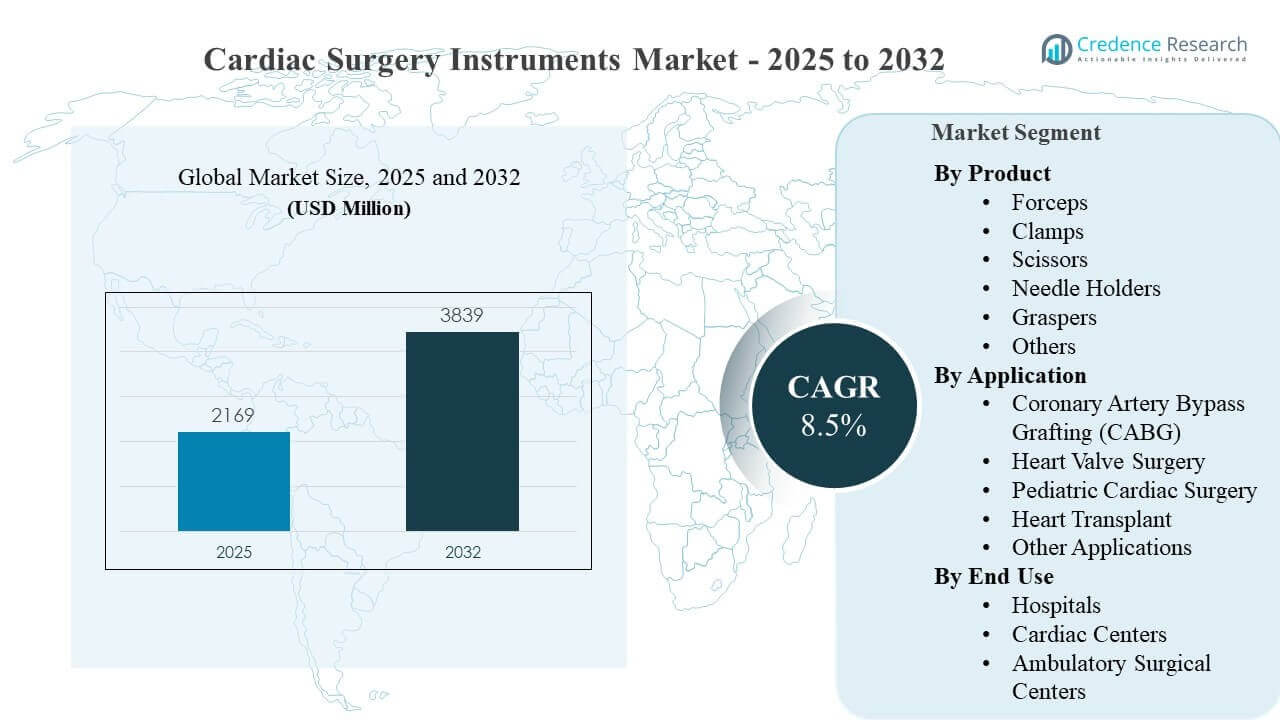
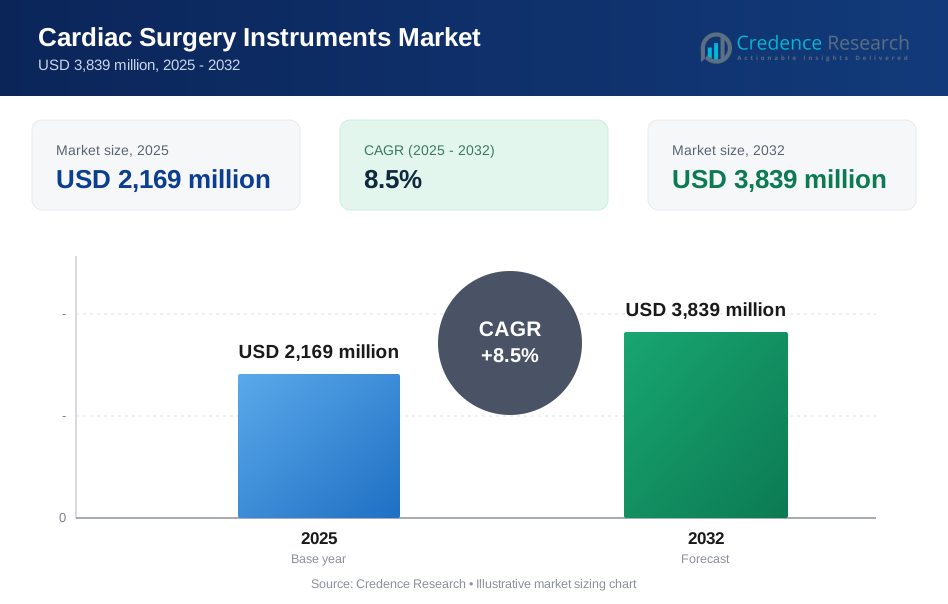
The global Cardiac Surgery Instruments Market size was estimated at USD 2,169 million in 2025 and is expected to reach USD 3,839 million by 2032, growing at a CAGR of 8.5% from 2025 to 2032. Growth is primarily driven by sustained cardiac procedure volumes and the increasing need for precise, durable, and ergonomically optimized surgical tools that support complex open and minimally invasive cardiac interventions. Demand is further supported by ongoing upgrades in operating room capabilities across major hospital systems and specialized cardiac centers, which strengthens recurring purchasing cycles for instrument sets and reprocessing-ready designs.
| REPORT ATTRIBUTE | DETAILS |
|---|---|
| Historical Period | 2020-2024 |
| Base Year | 2025 |
| Forecast Period | 2026-2032 |
| Cardiac Surgery Instruments Market Size 2025 | USD 2,169 million |
| Cardiac Surgery Instruments Market, CAGR | 8.5% |
| Cardiac Surgery Instruments Market Size 2032 | USD 3,839 million |
Key Market Trends & Insights
- The market expands from USD 2,169 million (2025) to USD 3,839 million (2032), reflecting an 8.5% CAGR (2025–2032).
- Forceps accounted for the largest 20.1% share in 2025, supported by their frequent use across core cardiac procedures and precision handling requirements.
- Coronary Artery Bypass Grafting (CABG) held the leading 30.2% share in 2025, reflecting broad clinical reliance on bypass interventions for advanced coronary disease.
- Hospitals represented 79.4% share in 2025, indicating continued concentration of complex cardiac surgery in hospital-based operating rooms with ICU-backed pathways.
- North America led with 46.8% share in 2025, underlining the region’s high procedural throughput and established procurement capacity.
Segment Analysis
Cardiac surgery instrument demand is shaped by procedure complexity, sterilization and reprocessing intensity, and the need for consistency across operating teams. High-acuity cardiac procedures require standardized instrument sets with repeatable performance, which supports stable replacement cycles and preference for durable materials. The market also benefits from continuous refinement in instrument ergonomics and precision, particularly for minimally invasive and advanced cardiac workflows where tactile control and atraumatic handling are critical.
Buying behavior in this market is dominated by institutional procurement, with strong emphasis on product reliability, sterilization compatibility, and availability of complete tray solutions aligned with procedure-specific needs. Purchasing decisions increasingly consider total lifecycle cost, including reprocessing durability, service support, and standardization across multiple operating rooms. In parallel, select outpatient cardiac pathways are expanding in some markets, which can gradually increase demand for compact and specialized sets designed for efficient turnover.
By Product Insights
Forceps accounted for the largest share of 20.1% in 2025. Forceps are routinely required across CABG, valve surgery, pediatric cardiac procedures, and transplant-related steps, making them one of the most consistently utilized instruments in cardiac trays. The segment benefits from demand for atraumatic tissue handling and precise vessel manipulation that supports better intraoperative control. As surgical teams prioritize consistent handling and durability through repeated sterilization cycles, premium forceps designs see sustained procurement. Standardization across cardiac programs also reinforces recurring volume purchases for forceps families used across multiple procedure types.
By Application Insights
Coronary Artery Bypass Grafting (CABG) accounted for the largest share of 30.2% in 2025. CABG remains a key interventional approach for complex coronary artery disease, sustaining steady procedural volume and instrument utilization intensity. CABG workflows require broad and repeated use of clamps, forceps, needle holders, and scissors, supporting higher instrument demand per case compared with narrower procedures. The segment also benefits from the continuing requirement for consistent outcomes in high-risk patient populations, which reinforces investment in reliable, high-performance instrument sets. Ongoing refinement in procedural approaches and perioperative pathways further encourages hospitals to upgrade and standardize CABG instrument inventories.
By End Use Insights
Hospitals accounted for the largest share of 79.4% in 2025. Hospitals remain the primary setting for complex cardiac operations because they provide integrated surgical teams, advanced anesthesia support, imaging, and intensive care infrastructure. High procedure throughput in hospitals increases instrument wear, sterilization load, and replacement frequency, supporting recurring demand. Large hospital systems also drive standardization of instrument trays across sites, which strengthens volume purchasing and long-term vendor relationships. While outpatient settings are expanding for select pathways, hospitals continue to anchor the majority of cardiac surgery instrument utilization due to case complexity and safety requirements.
Cardiac Surgery Instruments Market Drivers
Rising Burden of Cardiovascular Disease and Procedure Volumes
A sustained global burden of cardiovascular disease supports long-term demand for cardiac surgery procedures that rely on broad instrument utilization. Increasing prevalence of coronary artery disease and structural heart conditions contributes to recurring need for CABG and valve interventions. Procedure volumes translate directly into higher sterilization cycles, wear, and replacement requirements for high-use instruments. Hospitals and cardiac centers also invest in standardized sets to improve efficiency, further supporting recurring purchasing patterns.
- For instance, Edwards Lifesciences reported that more than 450,000 patients worldwide have been treated with its surgical or TAVR valves using RESILIA tissue, and its 947-patient eight-year analysis showed 99.3% freedom from structural valve deterioration and 99.2% freedom from reoperation due to structural valve deterioration, demonstrating sustained technology adoption in valve-related cardiac procedures.
Expansion of Advanced and Minimally Invasive Cardiac Surgery Workflows
Minimally invasive and advanced cardiac techniques increase the need for precision instruments that provide controlled handling and reliable performance in restricted operative fields. Instrument design improvements in ergonomics and tactile control support adoption of these approaches across more institutions. As programs expand minimally invasive capabilities, procurement shifts toward specialized sets and upgraded variants of core tools. This dynamic supports both unit growth and value growth through premiumization of frequently used instruments.
Institutional Standardization and Quality-Driven Procurement
Hospitals increasingly standardize instrument trays to reduce variability, improve operating room efficiency, and support consistent outcomes. Standardization encourages repeat purchasing from validated suppliers and increases the importance of product reliability, reprocessing durability, and service support. Procurement decisions often emphasize total lifecycle performance, not only upfront price, which benefits established vendors with broad portfolios. These factors drive stable, recurring demand and reinforce long-term supplier relationships.
- For instance, Aesculap states that its PTFE permanent germ barrier system is validated for 5,000 sterilization cycles, its permanent filter remains germ-impermeable through 1,000 cleaning and sterilization cycles, and the company has more than 10 FDA clearances that support hospital standardization on one sterile-container brand.
Upgrading of Surgical Infrastructure Across Hospitals and Cardiac Centers
Many healthcare systems continue investing in operating room modernization and surgical capacity improvements, which supports upgrades of instrument inventories. Cardiac centers seek high-performance instrument sets aligned with procedure requirements and team preferences. As facilities expand surgical throughput, instrument consumption rises due to increased reprocessing and wear. The result is steady demand across core product categories, particularly those used in nearly every procedure.
Cardiac Surgery Instruments Market Challenges
Supply chain complexity and sterilization-related quality requirements create operational challenges for both suppliers and providers. Maintaining consistent steel quality, instrument tolerances, and finishing standards is critical because minor variations can affect intraoperative performance. Healthcare providers also face budget constraints and tender-driven procurement, which can pressure pricing and extend purchasing cycles. In addition, managing inventory availability across multiple operating rooms requires strong logistics and vendor reliability.
- For instance, B. Braun’s Aesculap PrimeLine sterile container system uses a Permanent Sterile Protection System validated for 5,000 sterilization cycles, while its Basis permanent filters are specified for 1,000 cleaning and sterilization cycles, showing how suppliers use long-life sterile barrier technology to improve reprocessing consistency and reduce replacement frequency in instrument workflows.
The market also faces challenges tied to competition and differentiation in mature product categories. Many instruments are standardized, which can intensify price-based competition and make it harder for suppliers to justify premium pricing without clear clinical or operational benefits. Reprocessing intensity can accelerate wear, making durability a key differentiator, but performance claims must be supported by consistent outcomes in real hospital use. Compliance requirements and documentation can further increase the burden on vendors supporting large institutional customers.
Cardiac Surgery Instruments Market Trends and Opportunities
A key trend is the growing focus on ergonomics, precision handling, and surgeon-preferred designs to support consistent performance across high-volume procedures. Instrument sets increasingly align with specific workflows for CABG, valve surgery, pediatric cardiac surgery, and transplant pathways, encouraging procedure-focused tray optimization. This supports opportunities for suppliers offering modular sets, consistent quality, and dependable supply continuity. Product differentiation also increasingly considers reprocessing durability, corrosion resistance, and long-life performance under repeated sterilization cycles.
Another trend is the gradual expansion of outpatient cardiac pathways for select procedures, which can increase demand for compact, efficient, and procedure-ready instrument configurations. As ambulatory surgical centers expand capabilities, there is an opportunity for tailored tray solutions optimized for faster turnover and standardized protocols. Suppliers that provide training support, tray standardization services, and reliable replenishment programs can strengthen adoption. Over time, these trends can diversify purchasing beyond traditional hospital channels while maintaining hospitals as the primary demand anchor.
- For instance, Medtronic describes hospital programs that shifted selected cardiac procedures from overnight stay to day treatment, while published multicenter evidence on contemporary AF ablation pathways shows that same-day discharge can be achieved in more than 90% of cases under a standardized protocol, reinforcing the need for compact, procedure-ready setups in ambulatory environments.
Regional Insights
North America
North America led the market with a 46.8% share in 2025, supported by high procedure volumes, strong hospital procurement capacity, and broad availability of specialized cardiac programs. The region benefits from established supply chains and standardized purchasing across large hospital networks that emphasize consistent quality and performance. Ongoing operating room modernization and emphasis on efficiency reinforce recurring demand for replacement and upgraded instrument sets. High reprocessing intensity further sustains steady replacement cycles across core instruments.
Europe
Europe held a 36.1% share in 2025, reflecting the presence of large tertiary hospitals, established cardiac surgical capacity, and sustained demand for CABG and valve procedures. Procurement in the region often prioritizes standardization, durability, and compliance-ready documentation, which supports steady purchasing of validated instrument sets. Hospitals and cardiac centers continue to refresh inventories to maintain performance and ensure consistent outcomes. Demand is reinforced by procedure continuity across public and private healthcare systems.
Asia Pacific
Asia Pacific accounted for a 10.9% share in 2025, supported by expanding surgical capacity in major urban centers and growing access to advanced cardiac care. The region’s growth is linked to increasing procedural volumes and gradual upgrades in operating infrastructure. Demand rises as hospitals build specialized cardiac programs and standardize surgical trays. Over time, improving access and modernization can raise both unit demand and preference for higher-quality instruments.
Latin America
Latin America represented a 4.7% share in 2025, with demand driven by leading hospitals and cardiac centers in major cities and a steady need for core cardiac procedures. Procurement patterns often emphasize cost-effectiveness alongside reliability and reprocessing performance. As surgical capacity and quality frameworks strengthen, there is scope for expanded adoption of standardized sets. Supplier reliability and consistent availability remain important considerations for institutional buyers.
Middle East & Africa
The Middle East & Africa accounted for a 1.5% share in 2025, supported by demand concentrated in advanced hospitals and specialized centers. Growth is associated with healthcare infrastructure development and investments in surgical capacity in key countries. Buyers typically prioritize dependable supply, standardized sets, and instruments compatible with rigorous sterilization needs. Expansion of advanced cardiac programs can gradually increase demand for higher-performance instrument configurations.
Competitive Landscape
Competition in the cardiac surgery instruments market is shaped by portfolio breadth, quality consistency, reprocessing durability, and the ability to support standardized tray solutions across hospitals and cardiac centers. Suppliers differentiate through material quality, ergonomic design, precision tolerances, and service support that improves uptime and replenishment reliability. Long-term vendor relationships are strengthened by consistent availability and the ability to align instrument sets with procedure-specific needs. Institutional procurement dynamics also favor suppliers capable of meeting compliance documentation requirements and supporting multi-site standardization.
- Braun Melsungen AG is positioned as a major participant by leveraging a broad surgical portfolio, strong institutional relationships, and emphasis on consistent instrument quality for high-acuity procedures. The company’s approach typically aligns with hospital procurement needs for standardized sets and reliable reprocessing performance, which supports long-term supply agreements. Focus on surgical ecosystem integration can strengthen retention within large hospital networks and specialized cardiac centers. This positioning supports stability in repeat purchasing cycles driven by throughput and instrument wear.
The industry research and growth report includes detailed analyses of the competitive landscape of the market and information about key companies, including:
- B. Braun Melsungen AG
- Becton, Dickinson and Company (BD)
- Teleflex Incorporated
- Medline Industries, LP
- KLS Martin Group
- STILLE AB
- Sklar Corporation
- Wexler Surgical
- Surtex Instruments Limited
- Scanlan International
- Delacroix-Chevalier
- Symmetry Surgical
Qualitative and quantitative analysis of companies has been conducted to help clients understand the wider business environment as well as the strengths and weaknesses of key industry players. Data is qualitatively analyzed to categorize companies as pure play, category-focused, industry-focused, and diversified; it is quantitatively analyzed to categorize companies as dominant, leading, strong, tentative, and weak.
Recent Developments
- In January 2025, Boston Scientific announced the acquisition of the remaining 74% of Bolt Medical for $443 million upfront, with additional milestone payments, to strengthen its cardiovascular portfolio with Bolt’s laser-based intravascular lithotripsy technology for coronary and peripheral artery disease.
- In February 2025, Meril launched an advanced cardiovascular surgical product line that included the Dafodil Neo pericardial bioprosthesis for aortic and mitral valve replacement, the Miltonia bi-leaflet mechanical heart valve, surgical sutures, and cardiac suture needles aimed at improving surgical precision and patient safety.
- In October 2025, Medtronic launched the Avalus Ultra Bioprosthesis valve in India as its next-generation surgical aortic heart valve, expanding its cardiac surgery portfolio with a product designed to support easier implantation and future valve-in-valve reinterventions.
- In January 2026, SynCardia and Hydrix entered a development collaboration to advance Emperor, SynCardia’s next-generation fully implantable total artificial heart, under a multi-year program focused on engineering and regulatory milestones.
Report Scope
| Report Attribute | Details |
| Market size value in 2025 | USD 2169 million |
| Revenue forecast in 2032 | USD 3839 million |
| Growth rate (CAGR) | 8.5% (2025–2032) |
| Base year | 2025 |
| Forecast period | 2026-2032 |
| Quantitative units | USD million |
| Segments covered | By Product Outlook: Forceps, Clamps, Scissors, Needle Holders, Graspers, Others; By Application Outlook: Coronary Artery Bypass Grafting (CABG), Heart Valve Surgery, Pediatric Cardiac Surgery, Heart Transplant, Other Applications; By End Use Outlook: Hospitals, Cardiac Centers, Ambulatory Surgical Centers |
| Regional scope | North America, Europe, Asia Pacific, Latin America, Middle East & Africa |
| Key companies profiled | B. Braun Melsungen AG; Becton, Dickinson and Company (BD); Teleflex Incorporated; Medline Industries, LP; KLS Martin Group; STILLE AB; Sklar Corporation; Wexler Surgical; Surtex Instruments Limited; Scanlan International; Delacroix-Chevalier; Symmetry Surgical |
| No. of Pages | 332 |
Segmentation
By Product
- Forceps
- Clamps
- Scissors
- Needle Holders
- Graspers
- Others
By Application
- Coronary Artery Bypass Grafting (CABG)
- Heart Valve Surgery
- Pediatric Cardiac Surgery
- Heart Transplant
- Other Applications
By End Use
- Hospitals
- Cardiac Centers
- Ambulatory Surgical Centers
By Region
- North America
- U.S.
- Canada
- Mexico
- Europe
- Germany
- France
- U.K.
- Italy
- Spain
- Rest of Europe
- Asia Pacific
- China
- Japan
- India
- South Korea
- South-east Asia
- Rest of Asia Pacific
- Latin America
- Brazil
- Argentina
- Rest of Latin America
- Middle East & Africa
- GCC Countries
- South Africa
- Rest of the Middle East and Africa
Request a Free Sample
Fill in your details and we'll send you a free sample report.
- Sample data tables & charts
- Research methodology
Need a Custom Version of This Report?
Tailor the scope, geography, or segments to your exact requirements.
- Custom geography or segment scope
- Direct access to our analyst team
Frequently Asked Questions
What is the market size and forecast for the Cardiac Surgery Instruments Market?
What is the CAGR for the Cardiac Surgery Instruments Market?
Which is the largest segment in the market?
What factors are driving growth in this market?
Who are the leading companies in the Cardiac Surgery Instruments Market?
Which region leads the market?
Table of Content
Chapter 1. Report Introduction
- 1.1 Report Description & Purpose
- 1.1.1 Report Title & Market Definition
- 1.1.2 Unique Selling Propositions (USP) & Key Differentiators
- 1.1.3 Value Proposition for Stakeholders
- 1.2 Research Objectives
- 1.2.1 Market Sizing Objectives (Volume & Revenue)
- 1.2.2 Segmentation Objectives
- 1.2.3 Competitive Intelligence Objectives
- 1.2.4 Forecast & Scenario Objectives
- 1.3 Report Scope
- 1.3.1 Cardiac Surgery Instruments Scope – Types & Subtypes Covered
- 1.3.2 Geographic Scope – Regions & Countries Covered
- 1.3.3 Historical Period, Base Year & Forecast Period (2025; forecast to 2032)
- 1.3.4 Inclusions & Exclusions
- 1.4 HS Code & Classification Framework
- 1.5 Currency, Units & Pricing Basis
- 1.6 Target Stakeholders
- 1.7 Limitations & Assumptions
Chapter 2. Executive Summary
- 2.1 Global Cardiac Surgery Instruments Market Snapshot
- 2.1.1 Market Size – Historical (2025) & Forecast (2025-2032) (2025: USD 2,169 million → 2032: USD 3,839 million)
- 2.1.2 Volume & Revenue – Global Totals
- 2.1.3 Key Market Highlights – Top Five Facts
- 2.2 Cardiac Surgery Instruments Market Segmentation Snapshot
- 2.2.1 Market Split by Region – 2025 vs. 2032
- 2.3 Competitive Snapshot
- 2.3.1 Top 10 Players by Revenue Share – 2025
- 2.3.2 Top 10 Players by Volume Share – 2025
- 2.3.3 Recent Strategic Developments (18-Month Summary)
- 2.4 Key Investment Highlights & Strategic Conclusions
Chapter 3. Cardiac Surgery Instruments Market Dynamics & Industry Analysis
- 3.1 Market Overview & Context
- 3.1.1 Cardiac Surgery Instruments Market Position in the Broader Automotive Value Chain
- 3.1.2 OEM vs. Replacement Market Dynamics
- 3.1.3 Market Maturity & Development Stage by Region
- 3.2 Cardiac Surgery Instruments Market Drivers
- 3.3 Cardiac Surgery Instruments Market Restraints & Challenges
- 3.4 Cardiac Surgery Instruments Market Opportunities
- 3.5 Porter's Five Forces Analysis
- 3.5.1 Threat of New Entrants
- 3.5.2 Bargaining Power of Suppliers
- 3.5.3 Bargaining Power of Buyers
- 3.5.4 Threat of Substitutes
- 3.5.5 Competitive Rivalry – Intensity Assessment
- 3.6 Cardiac Surgery Instruments Value Chain Analysis
- 3.6.1 Upstream – Raw Material/Input Suppliers
- 3.6.1.1 Raw Material/Input 1
- 3.6.1.2 Raw Material/Input 2
- 3.6.1.3 Raw Material/Input 3
- 3.6.2 Midstream – Production/Manufacturing/Service Delivery
- 3.6.2.1 Production/Process Overview
- 3.6.2.2 Key Facility Locations & Capacity by Manufacturer
- 3.6.3 Downstream – Distribution & End Consumer
- 3.6.3.1 Primary Channel – B2B/OEM
- 3.6.3.2 Secondary Channels – Dealer, Retail, Online, Direct
- 3.6.4 Value Chain Profitability Analysis
- 3.6.1 Upstream – Raw Material/Input Suppliers
- 3.7 PESTEL Analysis
- 3.7.1 Political Factors
- 3.7.2 Economic Factors
- 3.7.3 Social Factors
- 3.7.4 Technological Factors
- 3.7.5 Environmental Factors
- 3.7.6 Legal Factors
- 3.8 Cardiac Surgery Instruments Supply Chain Analysis
- 3.8.1 Raw Material/Input Supply Risk Assessment
- 3.8.2 Manufacturing Concentration Risk (Geographic Exposure)
- 3.8.3 Trade Disruption Impact Analysis
- 3.9 Regulatory & Policy Landscape
Note: The regulatory and policy landscape section covers regulations based on their applicability to the market, Cardiac Surgery Instruments category, geography, and scope of the study. Only regulatory frameworks with a material impact on operations, compliance, trade, sustainability, or market access are analyzed in detail.
Chapter 4. Key Investment Pockets & Opportunity Analysis
- 4.1 Cardiac Surgery Instruments Market Attractiveness Analysis
- 4.1.1 By Region – Investment Attractiveness Matrix (Volume × CAGR)
- 4.2 Absolute Revenue Growth Opportunity
- 4.2.1 By Region – Absolute USD Growth Through 2032
- 4.3 Incremental Volume Opportunity
- 4.3.1 By Region – Incremental Volume Through 2032
- 4.3.2 Segment – Incremental Volume
- 4.4 Emerging Submarket Opportunity Deep Dive (Subject to Applicability)
- 4.5 Emerging Market Opportunity Scorecards
- 4.5.1 United States
- 4.5.2 Europe
- 4.5.3 Asia
- 4.5.4 Middle East & Africa
Note: Emerging Market Opportunity Scorecards will be included based on relevance and strategic importance. Regions listed are indicative and may vary depending on data availability and market dynamics.
Chapter 5. Cardiac Surgery Instruments Import-Export Analysis & Trade Flows
- 5.1 Global Trade Overview
- 5.1.1 Global Export Value by Country (2025)
- 5.1.2 Global Export Volume by Country (2025)
- 5.1.3 Global Import Value by Country (2025)
- 5.1.4 Global Import Volume by Country (2025)
- 5.1.5 Net Trade Balance by Country (2025)
- 5.2 Export Analysis – Segment
- 5.2.1 Type 1 (HS Code)
- 5.2.2 Type 2 (HS Code)
- 5.2.3 Type 3 (HS Code)
- 5.2.4 Type 4 (HS Code)
- 5.2.5 Type 5 (HS Code)
- 5.3 Import Analysis – Segment
- 5.3.1 Type 1 (HS Code)
- 5.3.2 Type 2 (HS Code)
- 5.3.3 Type 3 (HS Code)
- 5.3.4 Type 4 (HS Code)
- 5.3.5 Type 5 (HS Code)
- 5.4 Average Unit Trade Prices
- 5.4.1 Average Export Price – Segment & Country
- 5.4.2 Average Import Price – Segment & Source Country
- 5.4.3 Price Trends (2025)
- 5.5 Key Trade Route Analysis
- 5.5.1 Trade Route 1
- 5.5.2 Trade Route 2
- 5.5.3 Trade Route 3
- 5.5.4 Trade Route 4
- 5.5.5 Trade Route 5
- 5.6 Trade Policy Impact Assessment
- 5.6.1 US Anti-Dumping & Section 301 Tariffs
- 5.6.2 EU Customs Union Impact
- 5.6.3 Major Free Trade Agreements
- 5.6.4 USMCA Rules of Origin
Note: Trade policy analysis will be included only where relevant to the Cardiac Surgery Instruments market.
Chapter 6. Competitive Landscape & Company Benchmarking
- 6.1 Cardiac Surgery Instruments Market Concentration & Structure
- 6.1.1 Herfindahl-Hirschman Index (HHI) – vs. 2025
- 6.1.2 Tier 1, Tier 2 & Tier 3 Market Structure
- 6.1.3 Global, Regional & Local Player Dynamics
- 6.2 Cardiac Surgery Instruments Market Share Analysis – 2025
- 6.2.1 Global Revenue Share by Company
- 6.2.2 Global Volume Share by Company
- 6.2.3 Regional Revenue Share
- 6.2.4 Market Share Evolution ( vs. 2025)
- 6.2.5 OEM Segment Share by Company
- 6.2.6 Replacement Segment Share by Company
- 6.3 Production/Delivery Capacity & Facility Analysis
- 6.3.1 Global Installed Capacity
- 6.3.2 Capacity Utilization Rates
- 6.3.3 Production/Output Volume
- 6.3.4 Facility Locations & Capacity Map
- 6.3.5 Planned Capacity Additions
- 6.4 Cardiac Surgery Instruments Competitive Benchmarking Matrix
- 6.4.1 Revenue, Volume, CAGR & Profitability Comparison
- 6.4.2 Channel Revenue Mix
- 6.4.3 Geographic Revenue Exposure
- 6.4.4 R&D Intensity
- 6.4.5 Sustainability Maturity
- 6.5 Strategic Developments in Cardiac Surgery Instruments (Last 24 Months)
- 6.5.1 Mergers, Acquisitions & Divestments
- 6.5.2 New Cardiac Surgery Instruments Launches
- 6.5.3 Facility Expansions
- 6.5.4 Strategic Alliances, Joint Ventures & Partnerships
- 6.5.5 Distribution Expansion & Market Entry
- 6.5.6 Sustainability & ESG Initiatives
- 6.6 Competitive Strategy Mapping
- 6.6.1 Leader, Challenger, Follower & Niche Classification
- 6.6.2 Pricing Strategy Comparison
- 6.6.3 Channel Strategy Matrix
Note: Strategic developments are included based on their materiality and the availability of reliable information.
Chapter 7. Global Cardiac Surgery Instruments Market – By Distribution Channel
- 7.1 Segment Overview
- 7.1.1 Volume & Revenue Split by Channel (2025 & 2032)
- 7.1.2 Channel Mix Evolution (2025-2032)
Chapter 8. Regional Market Analysis – Global Overview
- 8.1 Global Regional Overview
- 8.1.1 Regional Volume Share
- 8.1.2 Regional Revenue Share
- 8.1.3 Regional Volume by Region
- 8.1.4 Regional Revenue by Region
- 8.1.5 Regional Forecast Through 2032
- 8.2 Cross-Regional Segment Analysis
- 8.2.1 By Distribution Channel
- 8.2.2 By Brand/Price Tier
Chapter 9. North America Cardiac Surgery Instruments Market
- 9.1 United States
- 9.2 Canada
- 9.3 Mexico
Chapter 10. Europe Cardiac Surgery Instruments Market
- 10.1 Germany
- 10.2 France
- 10.3 Italy
- 10.4 United Kingdom
- 10.5 Spain
- 10.6 Poland
- 10.7 Russia
- 10.8 Netherlands
- 10.9 Belgium
- 10.10 Sweden
- 10.11 Denmark
- 10.12 Norway
- 10.13 Rest of Europe
Chapter 11. Asia Pacific Cardiac Surgery Instruments Market
- 11.1 China
- 11.2 India
- 11.3 Japan
- 11.4 South Korea
- 11.5 Thailand
- 11.6 Indonesia
- 11.7 Vietnam
- 11.8 Malaysia
- 11.9 Australia
- 11.10 Rest of Asia Pacific
Chapter 12. Latin America Cardiac Surgery Instruments Market
- 12.1 Brazil
- 12.2 Argentina
- 12.3 Colombia
- 12.4 Chile
- 12.5 Rest of Latin America
Chapter 13. Middle East Cardiac Surgery Instruments Market
- 13.1 Saudi Arabia
- 13.2 United Arab Emirates
- 13.3 Turkey
- 13.4 Israel
- 13.5 Iran
- 13.6 Rest of the Middle East
Chapter 14. Africa Cardiac Surgery Instruments Market
- 14.1 South Africa
- 14.2 Egypt
- 14.3 Nigeria
- 14.4 Morocco
- 14.5 Rest of Africa
Chapter 15. Cardiac Surgery Instruments Company Profiles
- 15.1 [Company 01]
- 15.1.1 Company Overview
- 15.1.2 Key Management Personnel
- 15.1.3 Products & Services Portfolio
- 15.1.4 Financial Performance
- 15.1.5 Key Market Focus & Geographic Presence
- 15.1.6 Recent Developments & Strategic Initiatives
Note: The company profile list is preliminary and may change based on research findings, market developments, data availability, and client requirements.
Chapter 16. Appendices
- Appendix A – List of Abbreviations & Acronyms
- Appendix B – Industry Classification Code Reference – Full Series
- Appendix C – Production & Capacity Data Tables
- Appendix D – End-Use & Demand Base Tables
- Appendix E – Consumption & Replacement Rate Assumptions
- Appendix F – ASP Reference Tables
- Appendix G – Manufacturing & Facility Database
- Appendix H – Import-Export Data Tables
- Appendix I – Regulatory Summary Tables
- Appendix J – Primary Research Participant List (Anonymized)
- Appendix K – Primary Research Questionnaire Framework
- Appendix L – Data Sources & Bibliography
- Appendix M – Market Size Divergence & Source Comparison
Chapter 17. Research Methodology
- 17.1 Research Framework & Philosophy
- 17.2 Secondary Research – Sources, Hierarchy & Data Extraction
- 17.3 Data Modeling – Bottom-Up & Top-Down Market Sizing
- 17.4 Primary Research – Stakeholder Framework, LOI & Sample Sizes
- 17.5 Forecast Methodology – Regression, Scenario & Sensitivity Analysis
- 17.6 Quality Control – Four-Layer Validation Framework
- 17.7 Limitations & Standard Assumptions
- 17.8 Disclaimer
