
Cervical Cancer Diagnostics And Therapeutics Market Overview:
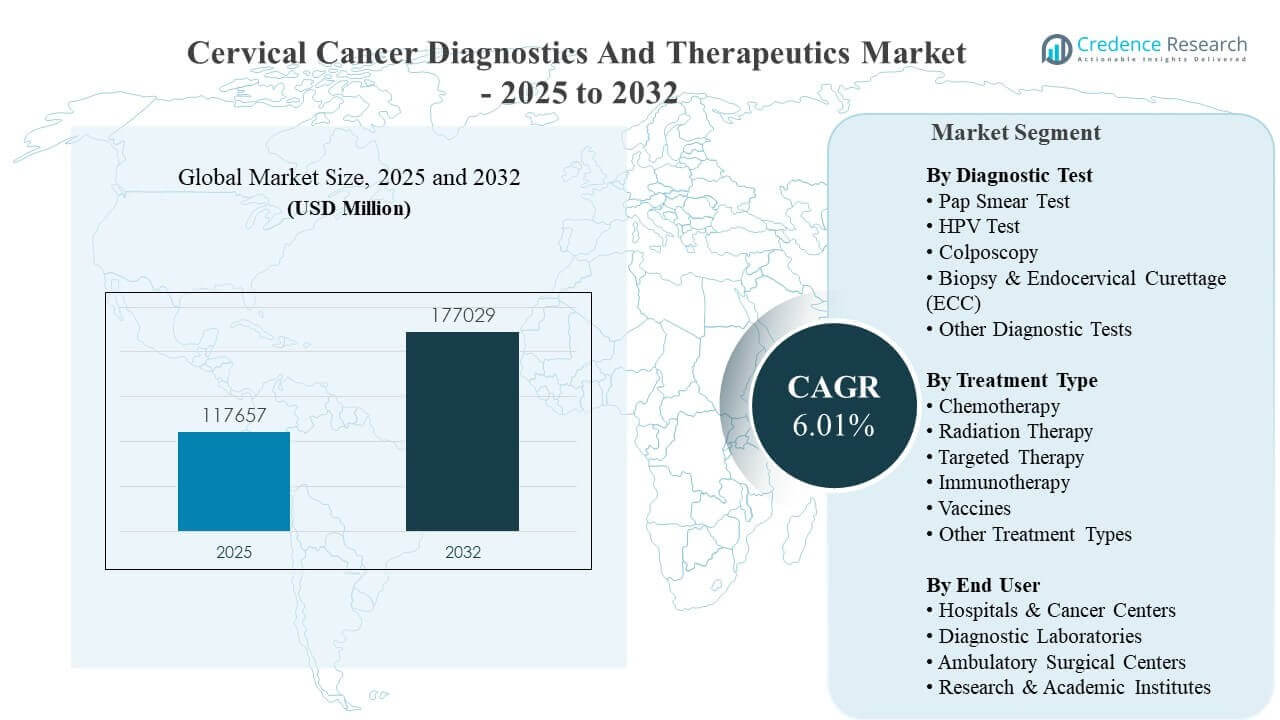
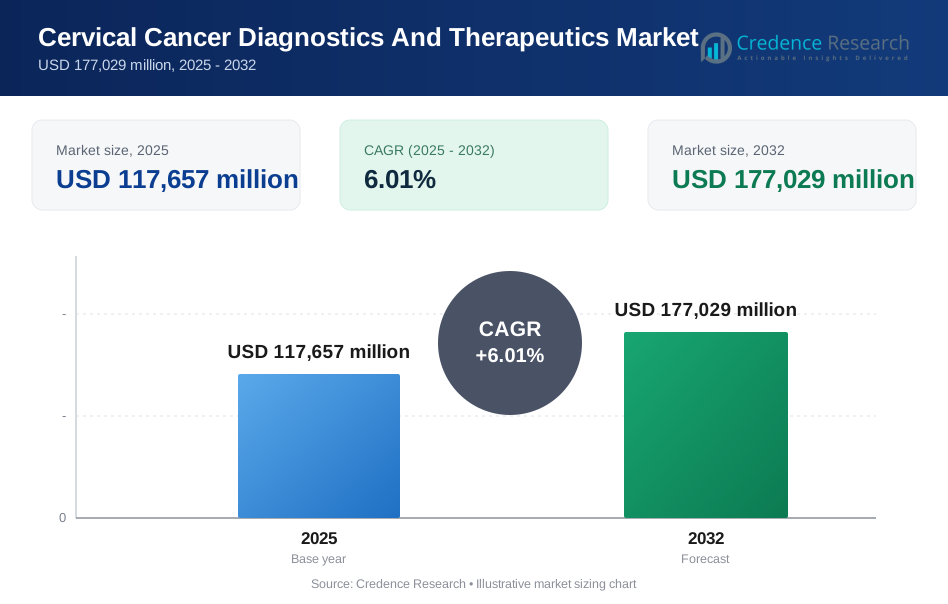
The global Cervical Cancer Diagnostics And Therapeutics Market size was estimated at USD 117,657 million in 2025 and is expected to reach USD 177,029 million by 2032, growing at a CAGR of 6.01% from 2025 to 2032. Rising screening intensity and earlier detection, supported by expanding HPV testing access and broader guideline-driven screening adoption, continues to shift clinical pathways toward higher test volumes and earlier intervention. Increasing uptake of combination regimens and biomarker-informed treatment selection is reinforcing the transition toward more targeted care models across major healthcare systems.
| REPORT ATTRIBUTE | DETAILS |
|---|---|
| Historical Period | 2020-2024 |
| Base Year | 2025 |
| Forecast Period | 2026-2032 |
| Cervical Cancer Diagnostics And Therapeutics Market Size 2025 | USD 117,657 million |
| Cervical Cancer Diagnostics And Therapeutics Market, CAGR | 6.01% |
| Cervical Cancer Diagnostics And Therapeutics Market Size 2032 | USD 177,029 million |
Key Market Trends & Insights
- North America accounted for 39.8% of market revenue in 2025, reflecting high screening penetration, stronger reimbursement depth, and broader access to oncology therapeutics.
- Asia Pacific held 21.9% share in 2025 and represents the fastest expansion potential as public screening initiatives and diagnostic capacity scale across large populations.
- Pap Smear Test captured a leading 32.8% share in 2025, supported by entrenched screening workflows and strong clinical familiarity in organized screening settings.
- Chemotherapy represented 31.6% share in 2025, underpinned by its continued role in multi-modality protocols across locally advanced and metastatic disease pathways.
- Hospitals & Cancer Centers accounted for 62.4% share in 2025, driven by their concentration of multidisciplinary oncology services and access to complex treatment infrastructure.
Segment Analysis
Demand is shaped by two tightly linked value pools: screening-led diagnostics that determine patient flow into care pathways, and therapeutics that expand in value as patients progress to advanced lines of treatment. Test purchasing decisions emphasize clinical validity, throughput, automation compatibility, and the availability of end-to-end workflow support spanning sample collection, assay execution, and reporting. Treatment adoption is influenced by guideline alignment, payer coverage, clinician familiarity, and the ability of regimens to integrate into established chemoradiotherapy pathways.
Across providers, the care pathway is increasingly centered on risk stratification, where higher-risk results trigger colposcopy and biopsy confirmation, followed by stage-guided therapy selection. Large integrated hospitals and cancer centers remain the core settings for complex care delivery, while diagnostic laboratories gain importance through centralized testing scale and standardized quality systems. Over time, increased use of immuno-oncology and targeted agents is expected to elevate the therapeutic mix, particularly in settings where biomarker testing is integrated into routine clinical decision-making.
By Diagnostic Test Insights
Pap Smear Test accounted for the largest share of 32.8% in 2025. Strong integration into routine screening programs, clinician familiarity, and well-established follow-up algorithms support sustained testing volumes across many health systems. The test continues to benefit from broad provider training and workflow fit in high-throughput screening settings, especially where organized screening remains dominant. Continued use in triage pathways and alongside HPV testing also supports its large installed base, even as screening strategies evolve.
By Treatment Type Insights
Chemotherapy accounted for the largest share of 31.6% in 2025. Chemotherapy remains widely used across stages, including combination regimens aligned with standard-of-care protocols, reinforcing durable utilization. Many treatment pathways continue to rely on chemotherapy as a backbone therapy, including integration with radiation therapy in selected settings. The breadth of clinical familiarity, established dosing practices, and widespread availability across healthcare facilities sustains its leading position within the overall treatment mix.
By End User Insights
Hospitals & Cancer Centers accounted for the largest share of 62.4% in 2025. These settings consolidate diagnostics, staging, surgery, radiation infrastructure, infusion services, and multidisciplinary oncology teams, which drives higher procedure and treatment volumes. Integrated care pathways reduce fragmentation across testing, confirmation, and therapy initiation, supporting more consistent patient management. Hospital-based systems also have stronger access to advanced therapeutics and supporting services, reinforcing their leadership in both diagnostic throughput and treatment delivery.
Cervical Cancer Diagnostics And Therapeutics Market Drivers
Expansion of screening coverage and earlier detection pathways
Organized screening initiatives and expanded access to cervical cancer testing are increasing the number of patients identified earlier in the disease course. Improved diagnostic infrastructure and standardized clinical protocols support wider deployment of HPV testing, cytology, and follow-on diagnostic procedures. Earlier detection increases demand for confirmatory diagnostics such as colposcopy and biopsy, while also expanding the population eligible for timely interventions. This pathway effect strengthens both diagnostic volumes and downstream therapy utilization as patients are managed more systematically.
Rising therapeutic intensity in locally advanced and metastatic care
Treatment pathways for cervical cancer increasingly emphasize multi-modality care, expanding the role of systemic therapies alongside established radiation and surgical approaches. Broader use of combination regimens and improving clinical pathway standardization strengthens therapy utilization across hospital and cancer center settings. As more patients receive structured treatment sequences, demand rises for drugs that can be integrated into existing protocols with manageable safety profiles. This supports sustained growth in therapy adoption and reinforces value expansion within the therapeutics pool.
- For instance, Merck reported in KEYNOTE-A18 that KEYTRUDA plus chemoradiotherapy reduced the risk of death by 33% versus chemoradiotherapy alone, with a 36-month overall survival rate of 82.6% compared with 74.8%, underscoring how combination regimens are intensifying therapeutic use in high-risk locally advanced cervical cancer.
Increased integration of molecular testing into clinical decision-making
Molecular testing, including HPV assays and related workflows, is becoming more central to screening strategy selection and risk stratification. Greater use of molecular approaches supports more standardized decision pathways, improving consistency across provider settings. Laboratory adoption is driven by throughput needs, automation compatibility, and the push for reproducible results across large testing volumes. Over time, deeper integration of molecular diagnostics strengthens demand for platform-based testing and expanded test menus.
Strengthening healthcare infrastructure and oncology capacity
Investment in diagnostic laboratories, cancer centers, and specialized women’s health services supports higher capacity for screening, confirmation, and treatment delivery. Expansion of oncology services improves access to radiation therapy, systemic therapies, and supportive care, enabling more complete treatment pathways. Improved referral systems and specialist availability reduce care gaps, supporting better patient throughput across the continuum. These structural improvements reinforce sustained demand growth across both diagnostics and therapeutics.
- For instance, Elekta reported an installed base of more than 7,500 devices and software solutions across 2,500 clinics worldwide, and also stated that it achieved its goal of providing radiotherapy access to 300 million additional people in underserved markets by the end of fiscal 2024/25, highlighting how large-scale vendor deployment contributes to broader oncology treatment capacity.
Cervical Cancer Diagnostics And Therapeutics Market Challenges
Coverage variability and unequal access to screening continue to constrain market performance in parts of Asia Pacific, Latin America, and Middle East & Africa. Capacity limitations for colposcopy, pathology confirmation, and follow-on care can reduce the effectiveness of screening expansion, weakening conversion from screening to treatment initiation. In addition, health system fragmentation can delay diagnosis confirmation and create discontinuities in patient follow-up. These barriers can suppress both diagnostic repeat rates and therapy uptake in under-resourced settings.
Cost pressures and reimbursement variability also influence adoption of advanced diagnostics and newer oncology regimens. Hospitals and payers often require strong clinical and economic justification, which can delay uptake of newer technologies even when clinical rationale is clear. Operational challenges such as lab staffing shortages, sample logistics complexity, and equipment maintenance can impact testing turnaround times and service consistency. Competitive pressure further increases pricing sensitivity, particularly for commoditized testing and widely available therapy backbones.
- For instance, BD states that its BD COR system requires less than 1 hour of daily hands-on time, only 2 workflow interactions, and can deliver up to 660 results in one 8-hour shift on a dual GX setup, highlighting strong lab productivity under staffing and cost constraints.
Cervical Cancer Diagnostics And Therapeutics Market Trends and Opportunities
Care delivery models increasingly emphasize centralized diagnostics and standardized pathways, driving consolidation of testing volumes into high-throughput laboratories. This supports investment in automation, workflow digitization, and integrated reporting, improving operational efficiency and consistency in large screening programs. As testing becomes more systematized, vendors that offer scalable platforms and service support are positioned to expand placements and recurring consumable demand. This trend strengthens long-term demand visibility for diagnostic suppliers.
- For instance, Roche’s cobas 6800 system is designed for large centralized molecular laboratories and can deliver up to 576 results in 8 hours and up to 2,112 in 24 hours, while also offering walkaway time of up to 4 hours, which directly supports high-volume cervical screening workflows and platform standardization.
Therapeutics innovation is creating opportunities for more personalized care pathways, including combination strategies and biomarker-informed treatment selection. Higher clinical focus on treatment sequencing and response durability supports continued interest in regimens that can be integrated into existing care pathways. Expansion of specialist cancer centers and better access to systemic therapies increases the reachable patient pool for advanced treatment. These shifts open room for differentiated offerings that can demonstrate clear clinical value in real-world settings.
Regional Insights
North America
North America held 39.8% share in 2025, supported by strong screening penetration, broad diagnostic infrastructure, and high access to oncology therapeutics. Hospitals and cancer centers drive care delivery through integrated services spanning testing, staging, and treatment initiation. Reimbursement depth and clinical guideline adherence support consistent utilization across both diagnostics and therapeutics. The region also benefits from higher patient awareness and more structured follow-up pathways.
Europe
Europe captured 26.7% share in 2025, supported by established screening programs and robust public healthcare delivery models across major countries. Mature oncology networks and standardized care pathways help sustain consistent volumes for diagnostics and treatment. Adoption is influenced by reimbursement frameworks and national program design, shaping modality utilization and pathway standardization. Continued modernization of laboratory capacity supports efficiency improvements and broader screening coverage.
Asia Pacific
Asia Pacific accounted for 21.9% share in 2025 and represents the most scalable growth pool as diagnostic capacity, public screening initiatives, and oncology infrastructure expand. Large population bases and rising healthcare investment increase the reachable screening population over time. Market momentum is driven by capacity build-out in diagnostic laboratories, improving referral pathways, and expanding access to hospital-based oncology services. As screening uptake rises, downstream demand for confirmatory diagnostics and treatment intensifies.
Latin America
Latin America represented 6.9% share in 2025, with growth shaped by improving screening access and gradual strengthening of diagnostic and oncology service networks. Market development depends on program consistency, payer coverage, and the ability to ensure follow-up from screening to confirmation. Major cities and leading hospitals drive the highest adoption of advanced diagnostics and therapeutics. Continued improvements in public health initiatives can increase testing volumes and earlier-stage case identification.
Middle East & Africa
Middle East & Africa held 4.7% share in 2025, with market performance influenced by infrastructure disparities and variable screening penetration. Access to colposcopy, pathology services, and oncology treatment capacity remains uneven, concentrating demand in urban tertiary hospitals and private networks. Growth is supported by gradual investment in healthcare infrastructure and women’s health services. Strengthening referral networks and standardized care pathways can improve screening-to-treatment conversion over time.
Competitive Landscape
Competition spans diagnostic platform providers, assay manufacturers, and oncology pharmaceutical companies, with differentiation centered on clinical performance, workflow integration, menu breadth, and service support. In diagnostics, competitive positioning is shaped by instrument installed base, assay reliability, throughput, and compatibility with centralized laboratory operations. In therapeutics, companies compete through regimen outcomes, label breadth, combination strategies, and alignment with evolving standards of care. Partnerships, clinical evidence generation, and portfolio breadth remain key levers for share capture across both halves of the market.
- Hoffmann-La Roche Ltd. maintains a strong position through scale-driven diagnostics capabilities that support high-throughput molecular testing workflows and integrated laboratory operations. The company’s approach emphasizes platform-driven placements that reinforce recurring assay demand and standardized processing in centralized laboratories. Ongoing enhancements to screening workflows and improvements in sample-to-result pathways support customer retention and expansion in systems prioritizing efficiency. Roche’s broader capabilities across diagnostics also enable end-to-end alignment between screening, confirmation workflows, and care pathway support.
The industry research and growth report includes detailed analyses of the competitive landscape of the market and information about key companies, including:
- F. Hoffmann-La Roche Ltd.
- Abbott Laboratories
- Hologic, Inc.
- Becton, Dickinson and Company (BD)
- QIAGEN N.V.
- Semens Healthineers AG
- Merck & Co., Inc.
- GlaxoSmithKline plc (GSK)
- Bristol-Myers Squibb Company
- Pfizer Inc.
- AstraZeneca plc
- Novartis AG
Qualitative and quantitative analysis of companies has been conducted to help clients understand the wider business environment as well as the strengths and weaknesses of key industry players. Data is qualitatively analyzed to categorize companies as pure play, category-focused, industry-focused, and diversified; it is quantitatively analyzed to categorize companies as dominant, leading, strong, tentative, and weak.
Recent Developments
- In May 2025, PHASE Scientific International Limited launched the world's largest urine-based cervical cancer (HPV) screening clinical study in Guang'an, Sichuan Province, China, marking a new era of non-invasive cervical cancer screening that plans to include 17,000 eligible women to evaluate urine-based HPV DNA testing, methylation testing, and AI-powered visual evaluation from colposcopy images.
- In May 2025, the U.S. FDA approved the Teal Wand by Teal Health, the first at-home cervical cancer screening test that allows women to self-collect samples at home for HPV testing, significantly increasing screening accessibility and comfort by eliminating the need for clinic visits.
- In September 2025, Molbio Diagnostics received validation from India's Department of Biotechnology for its Truenat® HPV-HR Plus, India's first indigenously developed chip-based RT-PCR test kit that enables rapid detection of eight high-risk HPV genotypes linked to over 96% of cervical cancer cases.
- In June 2025, Hera Biotech acquired HeraFem, a point-of-care cervical cancer diagnostic device developed by Hera Diagnostics, enhancing its women's health platform with a device that demonstrates 91% sensitivity for detecting cervical intraepithelial neoplasia grade 2 (CIN2+) lesions through electrical and optical spectroscopy combined with AI algorithms.
Report Scope
| Report Attribute | Details |
| Market size value in 2025 | USD 117657 million |
| Revenue forecast in 2032 | USD 177029 million |
| Growth rate (CAGR) | 6.01% (2025–2032) |
| Base year | 2025 |
| Forecast period | 2026–2032 |
| Quantitative units | USD million |
| Segments covered | By Diagnostic Test Outlook: Pap Smear Test, HPV Test, Colposcopy, Biopsy & Endocervical Curettage (ECC), Other Diagnostic Tests; By Treatment Type Outlook: Chemotherapy, Radiation Therapy, Targeted Therapy, Immunotherapy, Vaccines, Other Treatment Types; By End User Outlook: Hospitals & Cancer Centers, Diagnostic Laboratories, Ambulatory Surgical Centers, Research & Academic Institutes |
| Regional scope | North America, Europe, Asia Pacific, Latin America, Middle East & Africa |
| Key companies profiled | F. Hoffmann-La Roche Ltd., Abbott Laboratories, Hologic, Inc., Becton, Dickinson and Company (BD), QIAGEN N.V., Siemens Healthineers AG, Merck & Co., Inc., GlaxoSmithKline plc (GSK), Bristol-Myers Squibb Company, Pfizer Inc., AstraZeneca plc, Novartis AG |
| No. of Pages | 330 |
Segmentation
By Diagnostic Test
- Pap Smear Test
- HPV Test
- Colposcopy
- Biopsy & Endocervical Curettage (ECC)
- Other Diagnostic Tests
By Treatment Type
- Chemotherapy
- Radiation Therapy
- Targeted Therapy
- Immunotherapy
- Vaccines
- Other Treatment Types
By End User
- Hospitals & Cancer Centers
- Diagnostic Laboratories
- Ambulatory Surgical Centers
- Research & Academic Institutes
By Region
- North America
- U.S.
- Canada
- Mexico
- Europe
- Germany
- France
- U.K.
- Italy
- Spain
- Rest of Europe
- Asia Pacific
- China
- Japan
- India
- South Korea
- South-east Asia
- Rest of Asia Pacific
- Latin America
- Brazil
- Argentina
- Rest of Latin America
- Middle East & Africa
- GCC Countries
- South Africa
- Rest of the Middle East and Africa
Request a Free Sample
Fill in your details and we'll send you a free sample report.
- Sample data tables & charts
- Research methodology
Need a Custom Version of This Report?
Tailor the scope, geography, or segments to your exact requirements.
- Custom geography or segment scope
- Direct access to our analyst team
Frequently Asked Questions
What is the market size and forecast for the Cervical Cancer Diagnostics And Therapeutics Market?
What is the CAGR for the Cervical Cancer Diagnostics And Therapeutics Market during 2025–2032?
Which segment is the largest by diagnostic test in 2025?
What are the key factors driving market growth?
Who are the leading companies in the market?
Which region leads the market in 2025?
Table of Content
Chapter 1. Report Introduction
- 1.1 Report Description & Purpose
- 1.1.1 Report Title & Market Definition
- 1.1.2 Unique Selling Propositions (USP) & Key Differentiators
- 1.1.3 Value Proposition for Stakeholders
- 1.2 Research Objectives
- 1.2.1 Market Sizing Objectives (Volume & Revenue)
- 1.2.2 Segmentation Objectives
- 1.2.3 Competitive Intelligence Objectives
- 1.2.4 Forecast & Scenario Objectives
- 1.3 Report Scope
- 1.3.1 Cervical Cancer Diagnostics And Therapeutics Scope – Types & Subtypes Covered
- 1.3.2 Geographic Scope – Regions & Countries Covered
- 1.3.3 Historical Period, Base Year & Forecast Period (2025; forecast to 2032)
- 1.3.4 Inclusions & Exclusions
- 1.4 HS Code & Classification Framework
- 1.5 Currency, Units & Pricing Basis
- 1.6 Target Stakeholders
- 1.7 Limitations & Assumptions
Chapter 2. Executive Summary
- 2.1 Global Cervical Cancer Diagnostics And Therapeutics Market Snapshot
- 2.1.1 Market Size – Historical (2025) & Forecast (2025-2032) (2025: USD 117,657 million → 2032: USD 177,029 million)
- 2.1.2 Volume & Revenue – Global Totals
- 2.1.3 Key Market Highlights – Top Five Facts
- 2.2 Cervical Cancer Diagnostics And Therapeutics Market Segmentation Snapshot
- 2.2.1 Market Split by Region – 2025 vs. 2032
- 2.3 Competitive Snapshot
- 2.3.1 Top 10 Players by Revenue Share – 2025
- 2.3.2 Top 10 Players by Volume Share – 2025
- 2.3.3 Recent Strategic Developments (18-Month Summary)
- 2.4 Key Investment Highlights & Strategic Conclusions
Chapter 3. Cervical Cancer Diagnostics And Therapeutics Market Dynamics & Industry Analysis
- 3.1 Market Overview & Context
- 3.1.1 Cervical Cancer Diagnostics And Therapeutics Market Position in the Broader Automotive Value Chain
- 3.1.2 OEM vs. Replacement Market Dynamics
- 3.1.3 Market Maturity & Development Stage by Region
- 3.2 Cervical Cancer Diagnostics And Therapeutics Market Drivers
- 3.3 Cervical Cancer Diagnostics And Therapeutics Market Restraints & Challenges
- 3.4 Cervical Cancer Diagnostics And Therapeutics Market Opportunities
- 3.5 Porter's Five Forces Analysis
- 3.5.1 Threat of New Entrants
- 3.5.2 Bargaining Power of Suppliers
- 3.5.3 Bargaining Power of Buyers
- 3.5.4 Threat of Substitutes
- 3.5.5 Competitive Rivalry – Intensity Assessment
- 3.6 Cervical Cancer Diagnostics And Therapeutics Value Chain Analysis
- 3.6.1 Upstream – Raw Material/Input Suppliers
- 3.6.1.1 Raw Material/Input 1
- 3.6.1.2 Raw Material/Input 2
- 3.6.1.3 Raw Material/Input 3
- 3.6.2 Midstream – Production/Manufacturing/Service Delivery
- 3.6.2.1 Production/Process Overview
- 3.6.2.2 Key Facility Locations & Capacity by Manufacturer
- 3.6.3 Downstream – Distribution & End Consumer
- 3.6.3.1 Primary Channel – B2B/OEM
- 3.6.3.2 Secondary Channels – Dealer, Retail, Online, Direct
- 3.6.4 Value Chain Profitability Analysis
- 3.6.1 Upstream – Raw Material/Input Suppliers
- 3.7 PESTEL Analysis
- 3.7.1 Political Factors
- 3.7.2 Economic Factors
- 3.7.3 Social Factors
- 3.7.4 Technological Factors
- 3.7.5 Environmental Factors
- 3.7.6 Legal Factors
- 3.8 Cervical Cancer Diagnostics And Therapeutics Supply Chain Analysis
- 3.8.1 Raw Material/Input Supply Risk Assessment
- 3.8.2 Manufacturing Concentration Risk (Geographic Exposure)
- 3.8.3 Trade Disruption Impact Analysis
- 3.9 Regulatory & Policy Landscape
Note: The regulatory and policy landscape section covers regulations based on their applicability to the market, Cervical Cancer Diagnostics And Therapeutics category, geography, and scope of the study. Only regulatory frameworks with a material impact on operations, compliance, trade, sustainability, or market access are analyzed in detail.
Chapter 4. Key Investment Pockets & Opportunity Analysis
- 4.1 Cervical Cancer Diagnostics And Therapeutics Market Attractiveness Analysis
- 4.1.1 By Region – Investment Attractiveness Matrix (Volume × CAGR)
- 4.2 Absolute Revenue Growth Opportunity
- 4.2.1 By Region – Absolute USD Growth Through 2032
- 4.3 Incremental Volume Opportunity
- 4.3.1 By Region – Incremental Volume Through 2032
- 4.3.2 Segment – Incremental Volume
- 4.4 Emerging Submarket Opportunity Deep Dive (Subject to Applicability)
- 4.5 Emerging Market Opportunity Scorecards
- 4.5.1 United States
- 4.5.2 Europe
- 4.5.3 Asia
- 4.5.4 Middle East & Africa
Note: Emerging Market Opportunity Scorecards will be included based on relevance and strategic importance. Regions listed are indicative and may vary depending on data availability and market dynamics.
Chapter 5. Cervical Cancer Diagnostics And Therapeutics Import-Export Analysis & Trade Flows
- 5.1 Global Trade Overview
- 5.1.1 Global Export Value by Country (2025)
- 5.1.2 Global Export Volume by Country (2025)
- 5.1.3 Global Import Value by Country (2025)
- 5.1.4 Global Import Volume by Country (2025)
- 5.1.5 Net Trade Balance by Country (2025)
- 5.2 Export Analysis – Segment
- 5.2.1 Type 1 (HS Code)
- 5.2.2 Type 2 (HS Code)
- 5.2.3 Type 3 (HS Code)
- 5.2.4 Type 4 (HS Code)
- 5.2.5 Type 5 (HS Code)
- 5.3 Import Analysis – Segment
- 5.3.1 Type 1 (HS Code)
- 5.3.2 Type 2 (HS Code)
- 5.3.3 Type 3 (HS Code)
- 5.3.4 Type 4 (HS Code)
- 5.3.5 Type 5 (HS Code)
- 5.4 Average Unit Trade Prices
- 5.4.1 Average Export Price – Segment & Country
- 5.4.2 Average Import Price – Segment & Source Country
- 5.4.3 Price Trends (2025)
- 5.5 Key Trade Route Analysis
- 5.5.1 Trade Route 1
- 5.5.2 Trade Route 2
- 5.5.3 Trade Route 3
- 5.5.4 Trade Route 4
- 5.5.5 Trade Route 5
- 5.6 Trade Policy Impact Assessment
- 5.6.1 US Anti-Dumping & Section 301 Tariffs
- 5.6.2 EU Customs Union Impact
- 5.6.3 Major Free Trade Agreements
- 5.6.4 USMCA Rules of Origin
Note: Trade policy analysis will be included only where relevant to the Cervical Cancer Diagnostics And Therapeutics market.
Chapter 6. Competitive Landscape & Company Benchmarking
- 6.1 Cervical Cancer Diagnostics And Therapeutics Market Concentration & Structure
- 6.1.1 Herfindahl-Hirschman Index (HHI) – vs. 2025
- 6.1.2 Tier 1, Tier 2 & Tier 3 Market Structure
- 6.1.3 Global, Regional & Local Player Dynamics
- 6.2 Cervical Cancer Diagnostics And Therapeutics Market Share Analysis – 2025
- 6.2.1 Global Revenue Share by Company
- 6.2.2 Global Volume Share by Company
- 6.2.3 Regional Revenue Share
- 6.2.4 Market Share Evolution ( vs. 2025)
- 6.2.5 OEM Segment Share by Company
- 6.2.6 Replacement Segment Share by Company
- 6.3 Production/Delivery Capacity & Facility Analysis
- 6.3.1 Global Installed Capacity
- 6.3.2 Capacity Utilization Rates
- 6.3.3 Production/Output Volume
- 6.3.4 Facility Locations & Capacity Map
- 6.3.5 Planned Capacity Additions
- 6.4 Cervical Cancer Diagnostics And Therapeutics Competitive Benchmarking Matrix
- 6.4.1 Revenue, Volume, CAGR & Profitability Comparison
- 6.4.2 Channel Revenue Mix
- 6.4.3 Geographic Revenue Exposure
- 6.4.4 R&D Intensity
- 6.4.5 Sustainability Maturity
- 6.5 Strategic Developments in Cervical Cancer Diagnostics And Therapeutics (Last 24 Months)
- 6.5.1 Mergers, Acquisitions & Divestments
- 6.5.2 New Cervical Cancer Diagnostics And Therapeutics Launches
- 6.5.3 Facility Expansions
- 6.5.4 Strategic Alliances, Joint Ventures & Partnerships
- 6.5.5 Distribution Expansion & Market Entry
- 6.5.6 Sustainability & ESG Initiatives
- 6.6 Competitive Strategy Mapping
- 6.6.1 Leader, Challenger, Follower & Niche Classification
- 6.6.2 Pricing Strategy Comparison
- 6.6.3 Channel Strategy Matrix
Note: Strategic developments are included based on their materiality and the availability of reliable information.
Chapter 7. Global Cervical Cancer Diagnostics And Therapeutics Market – By Distribution Channel
- 7.1 Segment Overview
- 7.1.1 Volume & Revenue Split by Channel (2025 & 2032)
- 7.1.2 Channel Mix Evolution (2025-2032)
Chapter 8. Regional Market Analysis – Global Overview
- 8.1 Global Regional Overview
- 8.1.1 Regional Volume Share
- 8.1.2 Regional Revenue Share
- 8.1.3 Regional Volume by Region
- 8.1.4 Regional Revenue by Region
- 8.1.5 Regional Forecast Through 2032
- 8.2 Cross-Regional Segment Analysis
- 8.2.1 By Distribution Channel
- 8.2.2 By Brand/Price Tier
Chapter 9. North America Cervical Cancer Diagnostics And Therapeutics Market
- 9.1 United States
- 9.2 Canada
- 9.3 Mexico
Chapter 10. Europe Cervical Cancer Diagnostics And Therapeutics Market
- 10.1 Germany
- 10.2 France
- 10.3 Italy
- 10.4 United Kingdom
- 10.5 Spain
- 10.6 Poland
- 10.7 Russia
- 10.8 Netherlands
- 10.9 Belgium
- 10.10 Sweden
- 10.11 Denmark
- 10.12 Norway
- 10.13 Rest of Europe
Chapter 11. Asia Pacific Cervical Cancer Diagnostics And Therapeutics Market
- 11.1 China
- 11.2 India
- 11.3 Japan
- 11.4 South Korea
- 11.5 Thailand
- 11.6 Indonesia
- 11.7 Vietnam
- 11.8 Malaysia
- 11.9 Australia
- 11.10 Rest of Asia Pacific
Chapter 12. Latin America Cervical Cancer Diagnostics And Therapeutics Market
- 12.1 Brazil
- 12.2 Argentina
- 12.3 Colombia
- 12.4 Chile
- 12.5 Rest of Latin America
Chapter 13. Middle East Cervical Cancer Diagnostics And Therapeutics Market
- 13.1 Saudi Arabia
- 13.2 United Arab Emirates
- 13.3 Turkey
- 13.4 Israel
- 13.5 Iran
- 13.6 Rest of the Middle East
Chapter 14. Africa Cervical Cancer Diagnostics And Therapeutics Market
- 14.1 South Africa
- 14.2 Egypt
- 14.3 Nigeria
- 14.4 Morocco
- 14.5 Rest of Africa
Chapter 15. Cervical Cancer Diagnostics And Therapeutics Company Profiles
- 15.1 [Company 01]
- 15.1.1 Company Overview
- 15.1.2 Key Management Personnel
- 15.1.3 Products & Services Portfolio
- 15.1.4 Financial Performance
- 15.1.5 Key Market Focus & Geographic Presence
- 15.1.6 Recent Developments & Strategic Initiatives
Note: The company profile list is preliminary and may change based on research findings, market developments, data availability, and client requirements.
Chapter 16. Appendices
- Appendix A – List of Abbreviations & Acronyms
- Appendix B – Industry Classification Code Reference – Full Series
- Appendix C – Production & Capacity Data Tables
- Appendix D – End-Use & Demand Base Tables
- Appendix E – Consumption & Replacement Rate Assumptions
- Appendix F – ASP Reference Tables
- Appendix G – Manufacturing & Facility Database
- Appendix H – Import-Export Data Tables
- Appendix I – Regulatory Summary Tables
- Appendix J – Primary Research Participant List (Anonymized)
- Appendix K – Primary Research Questionnaire Framework
- Appendix L – Data Sources & Bibliography
- Appendix M – Market Size Divergence & Source Comparison
Chapter 17. Research Methodology
- 17.1 Research Framework & Philosophy
- 17.2 Secondary Research – Sources, Hierarchy & Data Extraction
- 17.3 Data Modeling – Bottom-Up & Top-Down Market Sizing
- 17.4 Primary Research – Stakeholder Framework, LOI & Sample Sizes
- 17.5 Forecast Methodology – Regression, Scenario & Sensitivity Analysis
- 17.6 Quality Control – Four-Layer Validation Framework
- 17.7 Limitations & Standard Assumptions
- 17.8 Disclaimer
