
Croatia Pharmaceutical Market Overview:
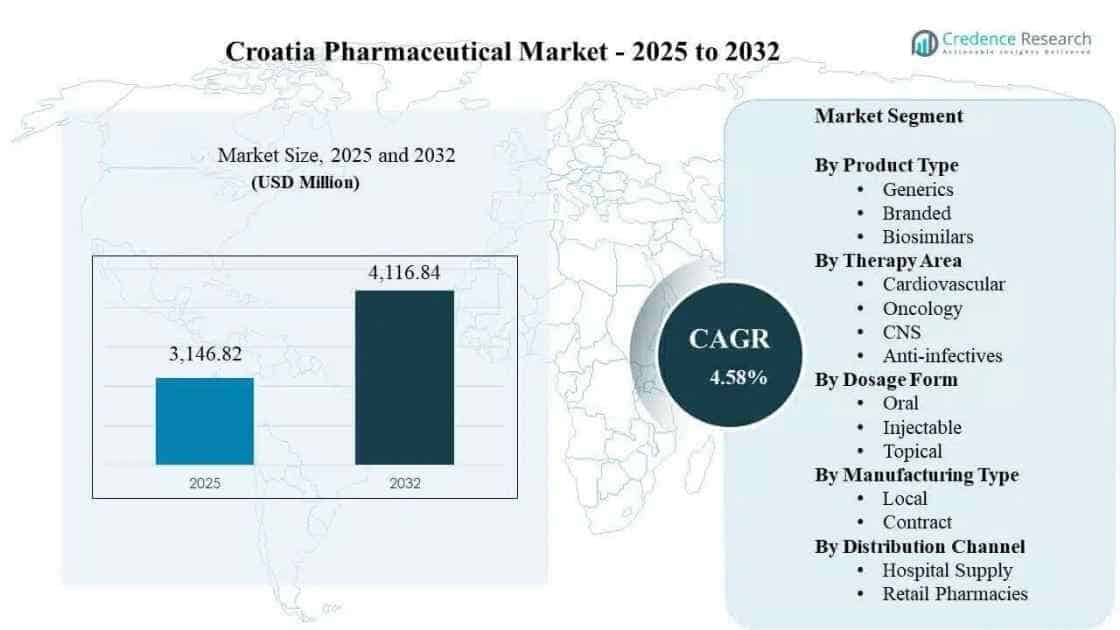
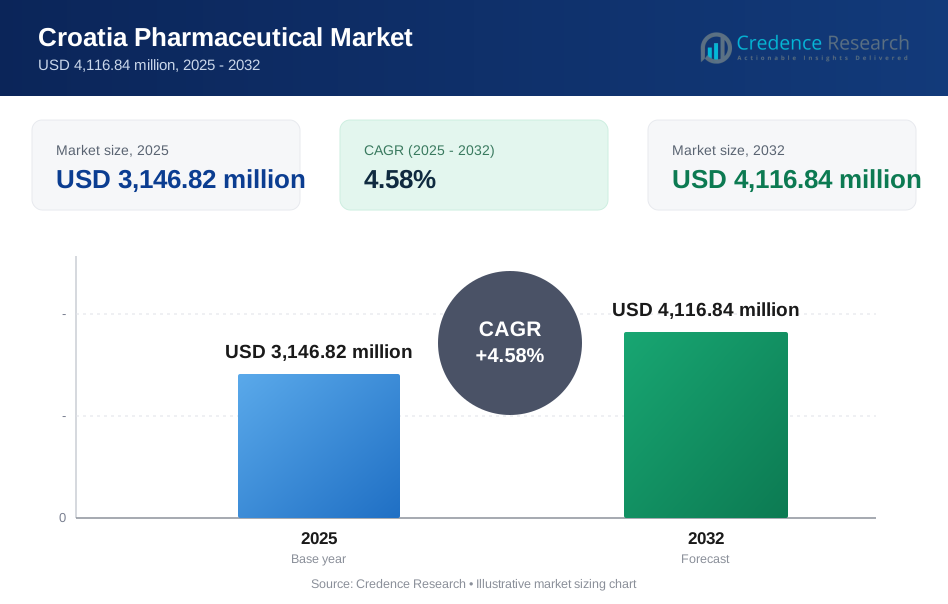
The Croatia Pharmaceutical Market size was estimated at USD 3,146.82 million in 2025 and is expected to reach USD 4,116.84 million by 2032, growing at a CAGR of 4.58% from 2025 to 2032. Market demand is being shaped by chronic disease management needs across cardiovascular and CNS care, alongside higher-complexity treatment pathways in oncology that continue to influence prescribing and reimbursement priorities. Market momentum is also supported by efforts to improve treatment access, strengthen hospital procurement efficiency, and maintain continuity of supply across retail pharmacy and institutional channels.
| REPORT ATTRIBUTE | DETAILS |
|---|---|
| Historical Period | 2020-2024 |
| Base Year | 2025 |
| Forecast Period | 2026-2032 |
| Croatia Pharmaceutical Market Size 2025 | USD 3,146.82 million |
| Croatia Pharmaceutical Market, CAGR | 4.58% |
| Croatia Pharmaceutical Market Size 2032 | USD 4,116.84 million |
Key Market Trends & Insights
- The Croatia Pharmaceutical Market is projected to expand from USD 3,146.82 million in 2025 to USD 4,116.84 million by 2032, at a 4.58% CAGR from 2025 to 2032.
- Branded products accounted for the largest product share at 64.70% in 2025, supported by specialty therapy mix and differentiated clinical positioning.
- Oral dosage forms led with a 55.90% share in 2025, reflecting convenience, adherence advantages, and high use in chronic maintenance regimens.
- Hospital supply represented 51.60% in 2025, supported by specialty protocols, inpatient use, and centralized purchasing for high-value therapies.
- Market performance in Croatia is being shaped by reimbursement discipline, generic substitution practices, hospital tendering, and the role of domestic manufacturing in supporting supply resilience.
Segment Analysis
The Croatia Pharmaceutical Market is closely influenced by payer oversight, reimbursement controls, and utilization patterns that shape therapy access, pricing, and substitution. Budget sensitivity continues to reinforce emphasis on cost-effective therapy selection and consistent dispensing practices across hospitals and retail pharmacies. Wholesale and distribution structures support supply-chain efficiency and disciplined channel economics, affecting how manufacturers and distributors manage availability, service levels, and tender participation. Therapy choices and product mix reflect a balance between branded innovation and cost-containment policies. Pricing frameworks and substitution mechanisms encourage competition at market entry, especially for generics and biosimilars, while supporting evidence-backed positioning for premium products in specialty categories. Domestic production capacity and regional supply connections remain important for continuity, helping stakeholders manage supply reliability and maintain access across both routine and specialized therapies.Commercial execution in Croatia reflects steady competition among local and multinational suppliers. Companies that align product portfolios with reimbursement requirements, maintain dependable supply, and build strong engagement with pharmacies and hospital buyers are better positioned to sustain share across chronic-care categories and selected specialty segments.
By Product Type Insights Branded products accounted for the largest share of 64.70% in 2025. Branded positioning benefits from differentiated clinical evidence, specialty indications, and physician preference in categories where outcomes and tolerability drive therapy selection. Oncology and other complex therapy areas continue to support branded demand because treatment decisions are often protocol-based and specialist-led. Lifecycle strategies, including new indications and improved formulations, also help sustain branded utilization across hospital and specialist care settings. By Therapy Area Insights Therapy demand in Croatia is shaped by chronic disease prevalence, aging-related care needs, and the structure of specialist treatment pathways. Cardiovascular and CNS categories support consistent prescription demand due to long-term disease management requirements. Oncology demand is influenced by hospital-based administration, specialist prescribing, and evolving treatment standards that increase therapy complexity and budget impact. Anti-infectives remain affected by seasonal infection patterns and stewardship practices that shape prescribing intensity and product selection. Manufacturers with broad portfolios and payer-aligned clinical evidence are better positioned to maintain access across therapy areas. By Dosage Form Insights Oral dosage forms accounted for the largest share of 55.90% in 2025. Oral therapies remain the preferred route for many chronic conditions because they support convenience, easier adherence, and broad compatibility with primary care treatment models. Established production scale for oral solids and liquids supports reliable availability across high-volume categories such as cardiovascular and CNS therapies. Retail pharmacy workflows also favor oral regimens for maintenance treatment, reinforcing repeat prescription volumes and long-term patient use. By Manufacturing Type Insights Manufacturing choices in the Croatia Pharmaceutical Market are shaped by regulatory compliance, quality requirements, cost efficiency, and supply resilience. Local manufacturing supports continuity of supply and can improve responsiveness to tender demand, forecast changes, and institutional procurement requirements. Contract manufacturing provides flexibility, specialized production capabilities, and a faster route to scale-up without large capital investment. Many companies use a mixed sourcing strategy that combines local, regional, and external production capacity to balance resilience, compliance, and cost-to-serve. By Distribution Channel Insights Hospital supply accounted for the largest share of 51.60% in 2025. Hospital procurement remains central for specialty medicines, oncology therapies, and inpatient treatment regimens, where centralized purchasing and guideline-based use shape demand. Tendering and formulary decisions place strong emphasis on supply reliability, clinical value, and total treatment cost. Retail pharmacies remain essential for chronic therapy refills and patient convenience, supporting steady downstream demand for oral maintenance medicines and other frequently dispensed products.Croatia Pharmaceutical Market Drivers
Chronic disease burden and aging-care needs Croatia Pharmaceutical Market growth is supported by steady demand for long-term management of cardiovascular and CNS conditions. Primary care prescribing patterns favor ongoing therapy use, reinforcing recurring dispensing volumes. Demographic aging trends increase utilization of maintenance regimens and monitoring-linked prescriptions. Reimbursement systems emphasize continuity and adherence, supporting stable consumption across core categories. Portfolio breadth and reliable availability remain central to capturing recurring demand. For instance, Novartis reported that twice-yearly Leqvio reduced LDL-C by 59% after 360 days, and 85% of patients achieved guideline-recommended LDL-C targets by day 90, showing how adherence-oriented cardiovascular innovation can support recurring chronic-care utilization. Specialty therapy expansion in oncology and complex care Croatia Pharmaceutical Market demand is being reinforced by oncology and other specialty areas that rely on protocol-based treatment and specialist oversight. Hospital-based administration concentrates high-value medicines and supports structured utilization patterns. Product differentiation through evidence, outcomes, and tolerability influences access decisions and prescribing preference. Label expansions and pipeline progress among major suppliers continue to shape competitive positioning. Specialty growth also elevates the importance of supply reliability and channel coordination. For instance, Roche’s PHESGO reduced treatment time by about 90%, with administration taking roughly 8 minutes for the loading dose and about 5 minutes for maintenance doses instead of the much longer intravenous schedule, highlighting how convenience and service efficiency can influence oncology treatment adoption. Policy-driven cost containment and substitution dynamics Croatia Pharmaceutical Market conditions encourage price competition through reimbursement design and entry requirements that promote generics and biosimilars. Market-access decisions often prioritize budget impact, driving selection toward cost-effective options where therapeutic outcomes remain comparable. Substitution incentives influence pharmacy-level dispensing, supporting volume stability for lower-cost products. Pricing mechanisms also push manufacturers to optimize portfolio mix and supply efficiency. Competitive execution increasingly depends on tender readiness and payer-aligned value messaging. Distribution efficiency and channel modernization Croatia Pharmaceutical Market performance is influenced by procurement processes and distribution models that focus on reliable delivery and controlled channel margins. Wholesale and pharmacy economics can shape stocking decisions and promotional emphasis across retail networks. Hospital procurement frameworks reward suppliers that deliver stable supply and service quality. Digital ordering, inventory optimization, and better demand forecasting support smoother channel operations. Firms that coordinate institutional and retail supply chains can reduce disruption risk and improve service levels.Croatia Pharmaceutical Market Challenges
Participants in the Croatia Pharmaceutical Market face continued pricing and reimbursement pressure, especially in high-volume categories exposed to substitution and tender competition. Strong payer scrutiny on budget impact can slow uptake for premium therapies and increase the evidence threshold for reimbursement access. Parallel trade and broader European supply dynamics can add complexity to inventory planning and product availability. Manufacturing interruptions and logistics constraints can quickly raise stockout risk, making compliance and supply reliability increasingly important. Competition also intensifies around portfolio breadth, contracting capabilities, and tender readiness, creating challenges for smaller suppliers with limited scale in distribution and commercial reach. Hospital procurement frameworks can favor established suppliers with proven service performance, making new entrant expansion more difficult. Consolidation in pharmacy retail can also shift negotiating leverage, increasing pricing pressure and service expectations. In parallel, regulatory updates and pharmacovigilance obligations continue to raise operating complexity and fixed compliance costs.Croatia Pharmaceutical Market Trends and Opportunities
Opportunities in the Croatia Pharmaceutical Market are expanding around biosimilar adoption, value-focused formularies, and structured cost optimization across reimbursement-sensitive categories. Manufacturers with strong pharmacoeconomic evidence and dependable supply capabilities can strengthen penetration where lower-cost but clinically comparable products are favored. Portfolio strategies that combine high-volume generics with selected specialty products can improve relevance across both institutional and retail channels. Patient support and adherence-focused initiatives can also strengthen persistence in chronic-care categories and support repeat prescription demand. A further trend is the growing focus on supply resilience and regional manufacturing support to reduce disruption risk. Flexible sourcing approaches and contract manufacturing partnerships are being used to manage capacity needs and support product launches more efficiently. Greater attention to real-world outcomes and value-based positioning is also helping branded suppliers differentiate within a cost-conscious market. Distribution modernization and improved forecasting capabilities continue to create efficiency gains for hospitals, wholesalers, and pharmacies.Regional Insights
City of Zagreb The City of Zagreb is the strongest pharmaceutical demand center in Croatia because it combines the country’s highest regional GDP per capita, at EUR 34,518 in 2023, with the highest concentration of health facilities and health workers in central Croatia. Specialist services are more concentrated in Zagreb and other large cities, and mental health services are still heavily institution-based in these urban centers. This supports stronger demand for branded, specialty, hospital-administered, and diagnostic-linked therapies, particularly in oncology, CNS, and other complex-care categories. North Croatia North Croatia represents a steady pharmaceutical demand region supported by relatively solid purchasing power, with GDP per capita of EUR 17,332 in 2023, and a broad county-based care structure that includes publicly owned primary health care centers and county public health institutes. Demand in this region is likely to remain centered on cardiovascular, CNS, and other long-term therapies that move mainly through retail pharmacy channels. Compared with Zagreb, the region is less driven by tertiary specialty volumes and more by recurring chronic-care prescriptions, oral dosage demand, and cost-conscious reimbursement dynamics. Pannonian Croatia Pannonian Croatia should be viewed as the most price-sensitive pharmaceutical region in the country. It recorded the lowest GDP per capita at EUR 13,861 in 2023 and the highest at-risk-of-poverty rate at 28.6% in 2025 among Croatia’s four statistical regions. Official health-system summaries also note fewer facilities and health workers in rural parts of central and eastern Croatia, which increases the importance of access, distribution reach, and dependable local supply. As a result, regional demand is likely to remain more concentrated in reimbursed generics, essential chronic therapies, and high-volume pharmacy products than in rapid specialty-drug expansion. Adriatic Croatia Adriatic Croatia combines mid-range purchasing power, with GDP per capita of EUR 16,796 in 2023, and a highly seasonal pharmaceutical demand profile. The region recorded 88.4 million tourist nights in 2024, compared with 2.65 million in the City of Zagreb, 1.36 million in Pannonian Croatia, and 1.26 million in North Croatia. At the same time, official health-system reporting highlights access constraints in remote coastal areas and on the islands. This creates a regional pharmaceutical market shaped by both resident chronic-care demand and seasonal surges in pharmacy footfall, acute-care medicines, and supply-chain planning across coastal and island distribution networks.Competitive Landscape
Competition in the Croatia Pharmaceutical Market reflects a mix of domestic players and multinational pharmaceutical companies competing across hospital tenders, specialty channels, and retail pharmacy dispensing. Product breadth, reliable supply, and payer-aligned pricing remain central to sustaining share in high-volume categories. Specialty positioning and evidence-based differentiation are more important in oncology and other complex-care segments, where protocol-driven treatment shapes purchasing decisions. Distribution reach and pharmacy engagement also remain important, particularly for chronic-care portfolios that depend on repeat dispensing. Pliva remains a major local reference point in the Croatia Pharmaceutical Market because of its domestic manufacturing relevance, established distribution presence, and strength in high-volume medicine categories. Companies with local or regional production capabilities can benefit from stronger supply continuity and faster response to institutional requirements. Alignment with reimbursement realities, substitution trends, and wholesaler relationships remains essential to maintaining competitiveness in Croatia’s payer-sensitive pharmaceutical environment.The industry research and growth report includes detailed analyses of the competitive landscape of the market and information about key companies, including:
Qualitative and quantitative analysis of companies has been conducted to help clients understand the wider business environment as well as the strengths and weaknesses of key industry players. Data is qualitatively analyzed to categorize companies as pure play, category-focused, industry-focused, and diversified; it is quantitatively analyzed to categorize companies as dominant, leading, strong, tentative, and weak.
Recent Developments
- In November 2025, Biofrontera Pharma GmbH entered into a promotion and distribution agreement with Croatian pharmaceutical company Propharma d.o.o. to commercialise Ameluz in Croatia, with Propharma responsible for reimbursement activities and future promotion and distribution in the Croatian market.
- In December 2025, Atlantic Grupa announced that its pharmacy chain Farmacia would acquire Belupo’s Deltis Pharm pharmacies in Croatia, making it a significant acquisition update in the country’s pharmaceutical retail and distribution space.
- In January 2026, Galenika acquired 100% of Slovenian company Sanofarm and said the transaction would strengthen its presence in the Adria region, making it a relevant regional acquisition update for companies active in and around the Croatia pharmaceutical market.
Report Scope
| Report Attribute | Details |
| Market size value in 2025 | USD 3,146.82 million |
| Revenue forecast in 2032 | USD 4,116.84 million |
| Growth rate (CAGR) | 4.58% (2025–2032) |
| Base year | 2025 |
| Forecast period | 2026-2032 |
| Quantitative units | USD million |
| Segments covered | By Product Type Outlook: Generics, Branded, Biosimilars; By Therapy Area Outlook: Cardiovascular, Oncology, CNS, Anti-infectives; By Dosage Form Outlook: Oral, Injectable, Topical; By Manufacturing Type Outlook: Local, Contract; By Distribution Channel Outlook: Hospital Supply, Retail Pharmacies |
| Regional scope | City of Zagreb, North Croatia, Pannonian Croatia, Adriatic Croatia |
| Key companies profiled | Pliva, Novartis, Pfizer, Sanofi, Roche, Bayer, Teva, Krka, Sandoz, AstraZeneca |
| No.of Pages | 328 |
Segmentation
By Product Type
- Generics
- Branded
- Biosimilars
By Therapy Area
- Cardiovascular
- Oncology
- CNS
- Anti-infectives
By Dosage Form
- Oral
- Injectable
- Topical
By Manufacturing Type
- Local
- Contract
By Distribution Channel
- Hospital Supply
- Retail Pharmacies
By Region
- City of Zagreb
- North Croatia
- Pannonian Croatia
- Adriatic Croatia
Request a Free Sample
Fill in your details and we'll send you a free sample report.
- Sample data tables & charts
- Research methodology
Need a Custom Version of This Report?
Tailor the scope, geography, or segments to your exact requirements.
- Custom geography or segment scope
- Direct access to our analyst team
Frequently Asked Questions
What is the Croatia Pharmaceutical Market size and forecast?
What is the CAGR for Croatia Pharmaceutical Market?
What is the largest segment in Croatia Pharmaceutical Market?
What factors are driving growth in Croatia Pharmaceutical Market?
Which companies are leading in Croatia Pharmaceutical Market?
Table of Content
Chapter 1. Report Introduction
- 1.1 Report Description & Purpose
- 1.1.1 Report Title & Market Definition
- 1.1.2 Unique Selling Propositions (USP) & Key Differentiators
- 1.1.3 Value Proposition for Stakeholders
- 1.2 Research Objectives
- 1.2.1 Market Sizing Objectives (Volume & Revenue)
- 1.2.2 Segmentation Objectives
- 1.2.3 Competitive Intelligence Objectives
- 1.2.4 Forecast & Scenario Objectives
- 1.3 Report Scope
- 1.3.1 Croatia Pharmaceutical Scope – Types & Subtypes Covered
- 1.3.2 Geographic Scope – Regions & Countries Covered
- 1.3.3 Historical Period, Base Year & Forecast Period (2025; forecast to 2032)
- 1.3.4 Inclusions & Exclusions
- 1.4 HS Code & Classification Framework
- 1.5 Currency, Units & Pricing Basis
- 1.6 Target Stakeholders
- 1.7 Limitations & Assumptions
Chapter 2. Executive Summary
- 2.1 Global Croatia Pharmaceutical Market Snapshot
- 2.1.1 Market Size – Historical (2025) & Forecast (2025-2032) (2025: USD 3,146.82 million → 2032: USD 4,116.84 million)
- 2.1.2 Volume & Revenue – Global Totals
- 2.1.3 Key Market Highlights – Top Five Facts
- 2.2 Croatia Pharmaceutical Market Segmentation Snapshot
- 2.2.1 Market Split by Region – 2025 vs. 2032
- 2.3 Competitive Snapshot
- 2.3.1 Top 10 Players by Revenue Share – 2025
- 2.3.2 Top 10 Players by Volume Share – 2025
- 2.3.3 Recent Strategic Developments (18-Month Summary)
- 2.4 Key Investment Highlights & Strategic Conclusions
Chapter 3. Croatia Pharmaceutical Market Dynamics & Industry Analysis
- 3.1 Market Overview & Context
- 3.1.1 Croatia Pharmaceutical Market Position in the Broader Automotive Value Chain
- 3.1.2 OEM vs. Replacement Market Dynamics
- 3.1.3 Market Maturity & Development Stage by Region
- 3.2 Croatia Pharmaceutical Market Drivers
- 3.3 Croatia Pharmaceutical Market Restraints & Challenges
- 3.4 Croatia Pharmaceutical Market Opportunities
- 3.5 Porter's Five Forces Analysis
- 3.5.1 Threat of New Entrants
- 3.5.2 Bargaining Power of Suppliers
- 3.5.3 Bargaining Power of Buyers
- 3.5.4 Threat of Substitutes
- 3.5.5 Competitive Rivalry – Intensity Assessment
- 3.6 Croatia Pharmaceutical Value Chain Analysis
- 3.6.1 Upstream – Raw Material/Input Suppliers
- 3.6.1.1 Raw Material/Input 1
- 3.6.1.2 Raw Material/Input 2
- 3.6.1.3 Raw Material/Input 3
- 3.6.2 Midstream – Production/Manufacturing/Service Delivery
- 3.6.2.1 Production/Process Overview
- 3.6.2.2 Key Facility Locations & Capacity by Manufacturer
- 3.6.3 Downstream – Distribution & End Consumer
- 3.6.3.1 Primary Channel – B2B/OEM
- 3.6.3.2 Secondary Channels – Dealer, Retail, Online, Direct
- 3.6.4 Value Chain Profitability Analysis
- 3.6.1 Upstream – Raw Material/Input Suppliers
- 3.7 PESTEL Analysis
- 3.7.1 Political Factors
- 3.7.2 Economic Factors
- 3.7.3 Social Factors
- 3.7.4 Technological Factors
- 3.7.5 Environmental Factors
- 3.7.6 Legal Factors
- 3.8 Croatia Pharmaceutical Supply Chain Analysis
- 3.8.1 Raw Material/Input Supply Risk Assessment
- 3.8.2 Manufacturing Concentration Risk (Geographic Exposure)
- 3.8.3 Trade Disruption Impact Analysis
- 3.9 Regulatory & Policy Landscape
Note: The regulatory and policy landscape section covers regulations based on their applicability to the market, Croatia Pharmaceutical category, geography, and scope of the study. Only regulatory frameworks with a material impact on operations, compliance, trade, sustainability, or market access are analyzed in detail.
Chapter 4. Key Investment Pockets & Opportunity Analysis
- 4.1 Croatia Pharmaceutical Market Attractiveness Analysis
- 4.1.1 By Region – Investment Attractiveness Matrix (Volume × CAGR)
- 4.2 Absolute Revenue Growth Opportunity
- 4.2.1 By Region – Absolute USD Growth Through 2032
- 4.3 Incremental Volume Opportunity
- 4.3.1 By Region – Incremental Volume Through 2032
- 4.3.2 Segment – Incremental Volume
- 4.4 Emerging Submarket Opportunity Deep Dive (Subject to Applicability)
- 4.5 Emerging Market Opportunity Scorecards
- 4.5.1 United States
- 4.5.2 Europe
- 4.5.3 Asia
- 4.5.4 Middle East & Africa
Note: Emerging Market Opportunity Scorecards will be included based on relevance and strategic importance. Regions listed are indicative and may vary depending on data availability and market dynamics.
Chapter 5. Croatia Pharmaceutical Import-Export Analysis & Trade Flows
- 5.1 Global Trade Overview
- 5.1.1 Global Export Value by Country (2025)
- 5.1.2 Global Export Volume by Country (2025)
- 5.1.3 Global Import Value by Country (2025)
- 5.1.4 Global Import Volume by Country (2025)
- 5.1.5 Net Trade Balance by Country (2025)
- 5.2 Export Analysis – Segment
- 5.2.1 Type 1 (HS Code)
- 5.2.2 Type 2 (HS Code)
- 5.2.3 Type 3 (HS Code)
- 5.2.4 Type 4 (HS Code)
- 5.2.5 Type 5 (HS Code)
- 5.3 Import Analysis – Segment
- 5.3.1 Type 1 (HS Code)
- 5.3.2 Type 2 (HS Code)
- 5.3.3 Type 3 (HS Code)
- 5.3.4 Type 4 (HS Code)
- 5.3.5 Type 5 (HS Code)
- 5.4 Average Unit Trade Prices
- 5.4.1 Average Export Price – Segment & Country
- 5.4.2 Average Import Price – Segment & Source Country
- 5.4.3 Price Trends (2025)
- 5.5 Key Trade Route Analysis
- 5.5.1 Trade Route 1
- 5.5.2 Trade Route 2
- 5.5.3 Trade Route 3
- 5.5.4 Trade Route 4
- 5.5.5 Trade Route 5
- 5.6 Trade Policy Impact Assessment
- 5.6.1 US Anti-Dumping & Section 301 Tariffs
- 5.6.2 EU Customs Union Impact
- 5.6.3 Major Free Trade Agreements
- 5.6.4 USMCA Rules of Origin
Note: Trade policy analysis will be included only where relevant to the Croatia Pharmaceutical market.
Chapter 6. Competitive Landscape & Company Benchmarking
- 6.1 Croatia Pharmaceutical Market Concentration & Structure
- 6.1.1 Herfindahl-Hirschman Index (HHI) – vs. 2025
- 6.1.2 Tier 1, Tier 2 & Tier 3 Market Structure
- 6.1.3 Global, Regional & Local Player Dynamics
- 6.2 Croatia Pharmaceutical Market Share Analysis – 2025
- 6.2.1 Global Revenue Share by Company
- 6.2.2 Global Volume Share by Company
- 6.2.3 Regional Revenue Share
- 6.2.4 Market Share Evolution ( vs. 2025)
- 6.2.5 OEM Segment Share by Company
- 6.2.6 Replacement Segment Share by Company
- 6.3 Production/Delivery Capacity & Facility Analysis
- 6.3.1 Global Installed Capacity
- 6.3.2 Capacity Utilization Rates
- 6.3.3 Production/Output Volume
- 6.3.4 Facility Locations & Capacity Map
- 6.3.5 Planned Capacity Additions
- 6.4 Croatia Pharmaceutical Competitive Benchmarking Matrix
- 6.4.1 Revenue, Volume, CAGR & Profitability Comparison
- 6.4.2 Channel Revenue Mix
- 6.4.3 Geographic Revenue Exposure
- 6.4.4 R&D Intensity
- 6.4.5 Sustainability Maturity
- 6.5 Strategic Developments in Croatia Pharmaceutical (Last 24 Months)
- 6.5.1 Mergers, Acquisitions & Divestments
- 6.5.2 New Croatia Pharmaceutical Launches
- 6.5.3 Facility Expansions
- 6.5.4 Strategic Alliances, Joint Ventures & Partnerships
- 6.5.5 Distribution Expansion & Market Entry
- 6.5.6 Sustainability & ESG Initiatives
- 6.6 Competitive Strategy Mapping
- 6.6.1 Leader, Challenger, Follower & Niche Classification
- 6.6.2 Pricing Strategy Comparison
- 6.6.3 Channel Strategy Matrix
Note: Strategic developments are included based on their materiality and the availability of reliable information.
Chapter 7. Global Croatia Pharmaceutical Market – By Distribution Channel
- 7.1 Segment Overview
- 7.1.1 Volume & Revenue Split by Channel (2025 & 2032)
- 7.1.2 Channel Mix Evolution (2025-2032)
Chapter 8. Regional Market Analysis – Global Overview
- 8.1 Global Regional Overview
- 8.1.1 Regional Volume Share
- 8.1.2 Regional Revenue Share
- 8.1.3 Regional Volume by Region
- 8.1.4 Regional Revenue by Region
- 8.1.5 Regional Forecast Through 2032
- 8.2 Cross-Regional Segment Analysis
- 8.2.1 By Distribution Channel
- 8.2.2 By Brand/Price Tier
Chapter 9. North America Croatia Pharmaceutical Market
- 9.1 United States
- 9.2 Canada
- 9.3 Mexico
Chapter 10. Europe Croatia Pharmaceutical Market
- 10.1 Germany
- 10.2 France
- 10.3 Italy
- 10.4 United Kingdom
- 10.5 Spain
- 10.6 Poland
- 10.7 Russia
- 10.8 Netherlands
- 10.9 Belgium
- 10.10 Sweden
- 10.11 Denmark
- 10.12 Norway
- 10.13 Rest of Europe
Chapter 11. Asia Pacific Croatia Pharmaceutical Market
- 11.1 China
- 11.2 India
- 11.3 Japan
- 11.4 South Korea
- 11.5 Thailand
- 11.6 Indonesia
- 11.7 Vietnam
- 11.8 Malaysia
- 11.9 Australia
- 11.10 Rest of Asia Pacific
Chapter 12. Latin America Croatia Pharmaceutical Market
- 12.1 Brazil
- 12.2 Argentina
- 12.3 Colombia
- 12.4 Chile
- 12.5 Rest of Latin America
Chapter 13. Middle East Croatia Pharmaceutical Market
- 13.1 Saudi Arabia
- 13.2 United Arab Emirates
- 13.3 Turkey
- 13.4 Israel
- 13.5 Iran
- 13.6 Rest of the Middle East
Chapter 14. Africa Croatia Pharmaceutical Market
- 14.1 South Africa
- 14.2 Egypt
- 14.3 Nigeria
- 14.4 Morocco
- 14.5 Rest of Africa
Chapter 15. Croatia Pharmaceutical Company Profiles
- 15.1 [Company 01]
- 15.1.1 Company Overview
- 15.1.2 Key Management Personnel
- 15.1.3 Products & Services Portfolio
- 15.1.4 Financial Performance
- 15.1.5 Key Market Focus & Geographic Presence
- 15.1.6 Recent Developments & Strategic Initiatives
Note: The company profile list is preliminary and may change based on research findings, market developments, data availability, and client requirements.
Chapter 16. Appendices
- Appendix A – List of Abbreviations & Acronyms
- Appendix B – Industry Classification Code Reference – Full Series
- Appendix C – Production & Capacity Data Tables
- Appendix D – End-Use & Demand Base Tables
- Appendix E – Consumption & Replacement Rate Assumptions
- Appendix F – ASP Reference Tables
- Appendix G – Manufacturing & Facility Database
- Appendix H – Import-Export Data Tables
- Appendix I – Regulatory Summary Tables
- Appendix J – Primary Research Participant List (Anonymized)
- Appendix K – Primary Research Questionnaire Framework
- Appendix L – Data Sources & Bibliography
- Appendix M – Market Size Divergence & Source Comparison
Chapter 17. Research Methodology
- 17.1 Research Framework & Philosophy
- 17.2 Secondary Research – Sources, Hierarchy & Data Extraction
- 17.3 Data Modeling – Bottom-Up & Top-Down Market Sizing
- 17.4 Primary Research – Stakeholder Framework, LOI & Sample Sizes
- 17.5 Forecast Methodology – Regression, Scenario & Sensitivity Analysis
- 17.6 Quality Control – Four-Layer Validation Framework
- 17.7 Limitations & Standard Assumptions
- 17.8 Disclaimer
