
Cerebrospinal Fluid Management Market Overview:
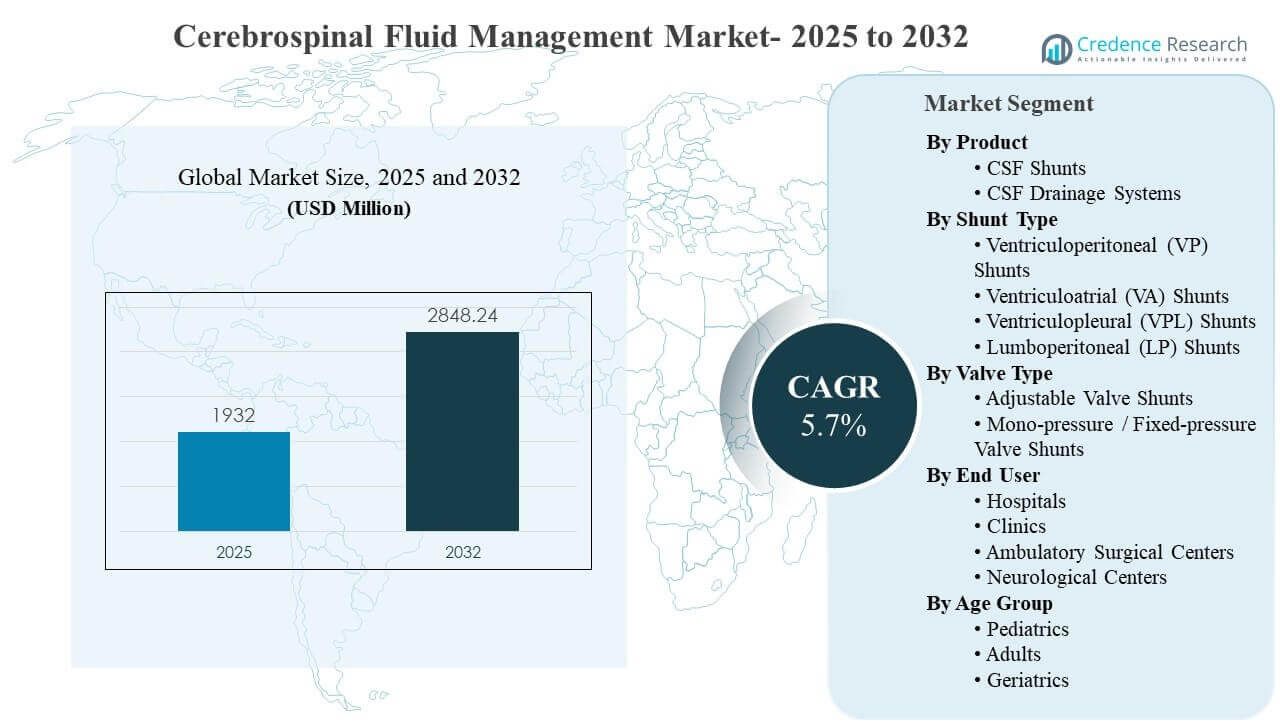
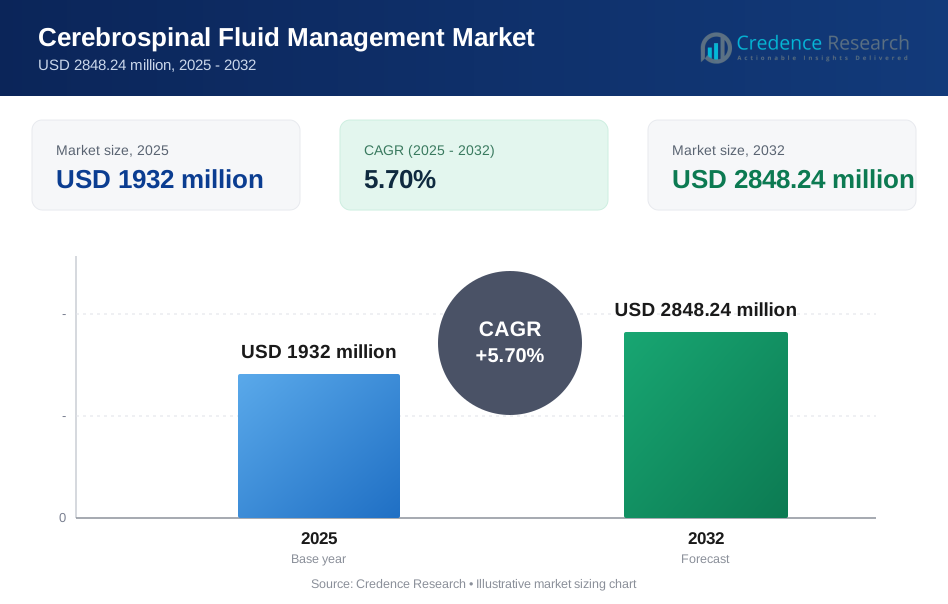
The global Cerebrospinal Fluid Management Market size was estimated at USD 1932 million in 2025 and is expected to reach USD 2848.24 million by 2032, growing at a CAGR of 5.7% from 2025 to 2032. Market growth is being driven by sustained procedural demand for hydrocephalus management and neurocritical care workflows that rely on dependable CSF diversion and drainage solutions. Technology upgrades in valves, catheter materials, and infection-risk mitigation features continue to shape purchasing decisions and replacement cycles across acute and chronic care settings.
| REPORT ATTRIBUTE | DETAILS |
|---|---|
| Historical Period | 2020-2024 |
| Base Year | 2025 |
| Forecast Period | 2026-2032 |
| Cerebrospinal Fluid Management Market Size 2025 | USD 1932 million |
| Cerebrospinal Fluid Management Market, CAGR | 5.7% |
| Cerebrospinal Fluid Management Market Size 2032 | USD 2848.24 million |
Key Market Trends & Insights
- The Cerebrospinal Fluid Management Market is forecast to expand from USD 1932 million (2025) to USD 2848.24 million (2032) at 5.7% CAGR (2025–2032).
- CSF Shunts held 63.7% share in 2025, reflecting their central role in long-term CSF diversion pathways.
- Hospitals accounted for 70.6% share in 2025, supported by ICU access, neuroimaging availability, and higher-acuity case concentration.
- Pediatrics represented 49.3% share in 2025, aligned with congenital and early-life hydrocephalus case volumes and long-term management needs.
- Regionally, Asia Pacific led with 28.9% in 2025, followed by Europe at 26.2%, indicating a strong balance between procedure access and capacity expansion.
Segment Analysis
Cerebrospinal Fluid Management Market demand is anchored in two core clinical needs: long-term diversion using implanted shunts and short-term drainage in neurocritical care settings. Purchasing criteria typically prioritize reliability, infection-risk controls, and ease of management because device performance directly influences revision rates, ICU stays, and overall care burden. Programmable valve adoption supports individualized pressure management, helping clinicians adapt therapy as patient physiology and symptoms change over time. These factors strengthen replacement demand and reinforce structured procurement patterns in high-volume treatment centers.
Care delivery models also influence mix shifts across end users, with hospitals retaining the bulk of procedure value due to emergency readiness and complex revision capability. However, the role of outpatient pathways continues to expand where appropriate, supported by procedural standardization and improved perioperative workflows. Patient mix across pediatrics, adults, and geriatrics creates distinct utilization patterns, since congenital hydrocephalus often drives long-term lifetime management, while older adult cases increasingly reflect diagnosis and intervention for normal pressure hydrocephalus. Overall, the market remains shaped by the intersection of clinical outcomes, workflow efficiency, and long-term follow-up requirements.
By Product Insights
CSF Shunts accounted for the largest share of 63.7% in 2025. CSF shunts remain central to chronic hydrocephalus management because they provide continuous diversion and long-duration symptom control. Hospitals and neurosurgical teams prioritize dependable shunt performance since failures can trigger urgent revisions and extended care. Technology differentiation such as programmable control and improved catheter materials supports premium positioning and replacement cycles. The installed base of shunt patients also sustains recurring demand for follow-up interventions and system upgrades.
By Shunt Type Insights
Ventriculoperitoneal (VP) shunts are typically used as the standard diversion approach in many hydrocephalus pathways due to established clinical familiarity and broad applicability across patient profiles. Ventriculoatrial (VA) and ventriculopleural (VPL) shunts are selected more often when anatomical constraints, prior abdominal complications, or repeated failures limit VP suitability. Lumboperitoneal (LP) shunts are used in specific indications and practice patterns, often shaped by institutional preferences and case selection criteria. Across all shunt types, revision history, infection risk, and surgeon comfort strongly influence selection.
By Valve Type Insights
Adjustable valve shunts are increasingly preferred when clinicians require flexibility to modify pressure settings without additional invasive intervention. This approach supports more individualized management as symptoms evolve, particularly in patients with variable intracranial dynamics across recovery phases. Mono-pressure or fixed-pressure valves remain important in settings where simplicity, cost, and standardized protocols drive purchasing decisions. Valve choice is also influenced by imaging workflows, follow-up intensity, and the balance between adjustability benefits and operational simplicity.
By End User Insights
Hospitals accounted for the largest share of 70.6% in 2025. Hospital settings dominate because CSF diversion and drainage procedures often require neuroimaging, ICU monitoring, and multidisciplinary neurosurgical readiness. Higher-acuity cases, emergency presentations, and complex revisions are concentrated in hospitals, which consolidates procedure revenue in this channel. Hospitals also lead procurement due to formal device evaluation and standardized care pathways. Clinics, ambulatory surgical centers, and neurological centers grow in importance for follow-up, select procedures, and ongoing valve management workflows.
By Age Group Insights
Pediatrics accounted for the largest share of 49.3% in 2025. Pediatric demand is supported by congenital hydrocephalus and early-life neurological conditions requiring long-term CSF diversion. Clinical management often spans multiple years, increasing exposure to revisions, adjustments, and follow-up visits that reinforce device utilization. Adult cases reflect mixed etiologies including trauma and secondary hydrocephalus patterns, supporting steady demand for both shunting and drainage. Geriatric growth is reinforced by increased recognition and treatment pathways for older adult hydrocephalus presentations.
Cerebrospinal Fluid Management Market Drivers
Rising Hydrocephalus and Neurocritical Care Procedure Demand
Cerebrospinal Fluid Management Market growth is supported by sustained procedural volumes for hydrocephalus treatment and neurocritical care drainage. CSF shunts remain essential for long-term diversion, particularly where chronic symptom control is required. Acute settings also rely on drainage systems to manage elevated intracranial pressure and stabilize patients during neurological emergencies. As diagnostic pathways improve and referral networks mature, more patients enter structured intervention and follow-up programs.
- For instance, a large retrospective dataset of 10,587 surgical cases using Integra LifeSciences' Bactiseal antibiotic-impregnated catheter a rifampicin- and clindamycin-coated ventricular catheter recorded a postoperative infection rate of 3.6% in the antibiotic-impregnated group versus 7.2% in patients receiving non-impregnated catheters, representing a 50% relative reduction in infection incidence.
Technology Upgrades in Valves, Catheters, and System Reliability
Device innovation continues to lift market value through upgrades that improve control, reliability, and clinical confidence. Programmable valve functionality supports individualized pressure tuning and may reduce avoidable revisions in certain care pathways. Catheter and system improvements are pursued to reduce occlusion risk and enhance durability across extended use. These technology-driven differentiators strengthen replacement demand and support premium procurement in high-acuity treatment centers.
- For instance, a pediatric study of B. Braun Miethke's proGAV®2.0 showed that revisions fell from 1.77 to 0.25 per patient per year versus fixed-pressure valves, while 12-month shunt survival improved from 58.3% to 80.4%. Mean time to revision also increased from 31.0 months to 37.1 months, indicating better durability and fewer re-interventions.
Hospital-Centered Care Pathways and Standardized Procurement
Hospitals remain the primary site for complex neurosurgical interventions due to ICU access, neuroimaging support, and emergency readiness. Standardized protocols and multidisciplinary teams reinforce consistent device selection and procedural throughput. Procurement processes emphasize evidence-based performance, workflow compatibility, and supplier reliability because complications can drive high downstream costs. These factors collectively sustain the dominant role of hospitals in both shunting and drainage-related procedures.
Expanding Follow-Up and Long-Term Management Needs
CSF diversion therapies often require long-term monitoring and periodic interventions over a patient’s lifetime. Pediatric patients, in particular, can require repeated assessments, adjustments, or revisions as growth and physiology change. Follow-up intensity increases the importance of durable systems and manageable valve strategies across different care settings. As longitudinal management becomes more structured, demand rises for devices and services that simplify monitoring and reduce complications.
Cerebrospinal Fluid Management Market Challenges
Complication risk remains a core challenge for Cerebrospinal Fluid Management Market adoption and cost control. Shunt malfunction, infection, and obstruction can lead to revision procedures that increase clinical burden and healthcare spending. Drainage systems also require strict handling protocols and monitoring, which increases operational complexity in busy ICU environments. Variability in outcomes across patient populations and care settings can create conservative purchasing behavior and extended evaluation cycles.
Economic and access constraints also limit broader adoption of premium device features in many regions. Budget limitations can shift purchasing toward lower-cost configurations even when advanced options offer management advantages. Uneven availability of specialized neurosurgical teams and neuro-ICU infrastructure affects procedure penetration, particularly outside major urban centers. These constraints slow market expansion in lower-resource settings and contribute to regional variability in adoption patterns.
- For instance, B. Braun’s MIETHKE proGAV 2.0 offers infinitely variable pressure settings from 0 to 20 cmH2O and is MRI compatible up to 3 Tesla without requiring post-MRI X-ray control, highlighting the kind of premium programmable functionality that may face slower uptake in cost-sensitive and infrastructure-limited settings.
Market Trends and Opportunities
The market is increasingly shaped by product differentiation focused on management convenience and risk reduction. Programmable valve adoption continues to expand where clinician follow-up workflows support adjustment-based management. Infection-control strategies, improved catheter materials, and workflow-friendly drainage configurations are used to reduce complications and simplify care delivery. These trends support value-based purchasing and encourage hospitals to standardize around fewer, more reliable system options.
For instance, Integra LifeSciences’ CODMAN CERTAS Plus programmable valve provides 8 settings, including a “Virtual Off” setting, is MRI resistant up to 3 Tesla, and can be paired with BACTISEAL antimicrobial catheters that have shown protection against gram-positive bacterial colonization for 28 days and complete kill of adhered bacteria in under 52 hours.
Opportunities are also growing in regions where neurosurgical capacity and neurocritical care infrastructure are expanding. Training programs, improved referral pathways, and broader access to diagnostic imaging can increase the addressable intervention pool. As outpatient and step-down care models mature, non-hospital settings may capture a larger role in selected procedures and follow-up services. Suppliers that align product design to workflow efficiency and service support can strengthen share gains.
Regional Insights
North America
North America held 33.4% share in 2025, supported by mature neurosurgical infrastructure and consistent access to neurocritical care resources. Hospital procurement remains strongly structured, favoring suppliers with broad portfolios and reliable service coverage. Adoption of differentiated valve technologies and infection-risk mitigation features remains a key contributor to value growth. Clinical pathways emphasize standardized follow-up and evidence-driven device selection.
Europe
Europe accounted for 26.2% share in 2025, supported by established public and private healthcare systems with stable neurosurgery capacity. Procedure volumes are reinforced by organized referral networks and consistent access to imaging and specialist care. Standardization and protocol-driven purchasing are common, supporting predictable demand cycles. Product selection often balances performance, availability, and procurement cost controls.
Asia Pacific
Asia Pacific led with 28.9% share in 2025, reflecting expanding neurosurgical capacity and improving access to advanced care in large-population markets. Growth is supported by increasing hospital buildouts, rising specialist availability, and broader adoption of neurocritical care pathways. As procedure access expands beyond top-tier centers, demand increases for systems that are reliable and easier to manage operationally. Suppliers with strong distribution and clinical education support can accelerate adoption.
Latin America
Latin America held 6.3% share in 2025, with demand concentrated in major urban hospitals and specialized neurosurgery centers. Access variability and procurement constraints continue to influence device mix and technology adoption. Market growth is supported by gradual expansion of tertiary care capabilities and stronger referral pathways. Service availability and training support are important drivers of supplier selection in this region.
Middle East & Africa
Middle East & Africa represented 5.2% share in 2025, reflecting uneven access to neurosurgical services and neuro-ICU infrastructure across countries. Demand is typically concentrated in high-capability centers, with broader adoption limited by resource availability. Growth opportunities are linked to healthcare investment, specialist training, and improved diagnostic capacity. Supplier success often depends on distributor strength, service support, and workflow-aligned device offerings.
Competitive Landscape
Competition in the Cerebrospinal Fluid Management Market is shaped by portfolio breadth, neurosurgery specialization, and differentiation through valve technology, catheter design, and infection-risk mitigation strategies. Suppliers compete on clinical performance consistency, reliability under demanding ICU conditions, and the ability to support standardized hospital protocols. Market positioning is strengthened by surgeon familiarity, training support, and responsive field service because device complications can have high downstream consequences. Product refresh cycles and incremental innovation remain key tools to defend installed base share and expand adoption.
Medtronic plc maintains a strong position through established neurosurgical relationships, broad procedural coverage, and a focus on dependable implanted shunt solutions used in chronic hydrocephalus pathways. Medtronic plc’s competitiveness benefits from scale in hospital contracting and the ability to support multi-site healthcare systems with consistent supply and service. Medtronic plc also competes through clinical education and workflow alignment to reduce complexity in follow-up management. This positioning supports stable demand in high-volume centers where reliability and outcomes consistency are prioritized.
The industry research and growth report includes detailed analyses of the competitive landscape of the market and information about key companies, including:
- Medtronic plc
- Integra LifeSciences Holdings Corporation
- B. Braun SE
- Sophysa SA
- Spiegelberg GmbH & Co. KG
- Natus Medical Incorporated
- Möller Medical GmbH
- DePuy Synthes (Johnson & Johnson)
- Codman EDS
- Phoenix Biomedical Corp.
- BeckerSmith Medical, Inc.
- Argi Group Health Services Ltd. Sti.
- Delta Surgical Limited
Qualitative and quantitative analysis of companies has been conducted to help clients understand the wider business environment as well as the strengths and weaknesses of key industry players. Data is qualitatively analyzed to categorize companies as pure play, category-focused, industry-focused, and diversified; it is quantitatively analyzed to categorize companies as dominant, leading, strong, tentative, and weak.
Recent Developments
- In February 2026, Pharaoh Neuro raised $20 million in new funding to advance development and regulatory activities for its Neurapheresis closed-loop CSF management platform, which is designed to circulate and filter a patient's own autologous cerebrospinal fluid without the need for replacement fluids; the company simultaneously appointed a new CEO and Chief Medical Officer.
- In November 2025, Medtronic plc expanded its R&D footprint by making a significant investment in its Engineering & Innovation Center in India, with the initiative focused on accelerating collaborative innovation and specialized training in advanced neurological device technologies, including next-generation CSF management solutions.
Report Scope
| Report Attribute | Details |
| Market size value in 2025 | USD 1932 million |
| Revenue forecast in 2032 | USD 2848.24 million |
| Growth rate (CAGR) | 5.7% (2025–2032) |
| Base year | 2025 |
| Forecast period | 2026-2032 |
| Quantitative units | USD million |
| Segments covered | By Product Outlook: CSF Shunts, CSF Drainage Systems; By Shunt Type Outlook: VP Shunts, VA Shunts, VPL Shunts, LP Shunts; By Valve Type Outlook: Adjustable Valve Shunts, Mono-pressure / Fixed-pressure Valve Shunts; By End User Outlook: Hospitals, Clinics, Ambulatory Surgical Centers, Neurological Centers; By Age Group Outlook: Pediatrics, Adults, Geriatrics |
| Regional scope | North America, Europe, Asia Pacific, Latin America, Middle East & Africa |
| Key companies profiled | Medtronic plc; Integra LifeSciences Holdings Corporation; B. Braun SE; Sophysa SA; Spiegelberg GmbH & Co. KG; Natus Medical Incorporated; Möller Medical GmbH; DePuy Synthes (Johnson & Johnson); Codman EDS; Phoenix Biomedical Corp.; BeckerSmith Medical, Inc.; Argi Group Health Services Ltd. Sti.; Delta Surgical Limited |
| No. of Pages | 336 |
Segmentation
By Product
- CSF Shunts
- CSF Drainage Systems
By Shunt Type
- Ventriculoperitoneal (VP) Shunts
- Ventriculoatrial (VA) Shunts
- Ventriculopleural (VPL) Shunts
- Lumboperitoneal (LP) Shunts
By Valve Type
- Adjustable Valve Shunts
- Mono-pressure / Fixed-pressure Valve Shunts
By End User
- Hospitals
- Clinics
- Ambulatory Surgical Centers
- Neurological Centers
By Age Group
- Pediatrics
- Adults
- Geriatrics
By Region
- North America
- U.S.
- Canada
- Mexico
- Europe
- Germany
- France
- U.K.
- Italy
- Spain
- Rest of Europe
- Asia Pacific
- China
- Japan
- India
- South Korea
- South-east Asia
- Rest of Asia Pacific
- Latin America
- Brazil
- Argentina
- Rest of Latin America
- Middle East & Africa
- GCC Countries
- South Africa
- Rest of the Middle East and Africa
Request a Free Sample
Fill in your details and we'll send you a free sample report.
- Sample data tables & charts
- Research methodology
Need a Custom Version of This Report?
Tailor the scope, geography, or segments to your exact requirements.
- Custom geography or segment scope
- Direct access to our analyst team
Frequently Asked Questions
What is the market size and forecast for the Cerebrospinal Fluid Management Market?
What is the CAGR for the Cerebrospinal Fluid Management Market?
What is the largest segment in 2025?
What factors are driving growth in this market?
Who are the leading companies in the Cerebrospinal Fluid Management Market?
Which region leads the Cerebrospinal Fluid Management Market in 2025?
Who are the main players in the global CSF (cerebrospinal fluid) management industry?
Table of Content
Chapter 1. Report Introduction
- 1.1 Report Description & Purpose
- 1.1.1 Report Title & Market Definition
- 1.1.2 Unique Selling Propositions (USP) & Key Differentiators
- 1.1.3 Value Proposition for Stakeholders
- 1.2 Research Objectives
- 1.2.1 Market Sizing Objectives (Volume & Revenue)
- 1.2.2 Segmentation Objectives
- 1.2.3 Competitive Intelligence Objectives
- 1.2.4 Forecast & Scenario Objectives
- 1.3 Report Scope
- 1.3.1 Cerebrospinal Fluid Management Scope – Types & Subtypes Covered
- 1.3.2 Geographic Scope – Regions & Countries Covered
- 1.3.3 Historical Period, Base Year & Forecast Period (2025; forecast to 2032)
- 1.3.4 Inclusions & Exclusions
- 1.4 HS Code & Classification Framework
- 1.5 Currency, Units & Pricing Basis
- 1.6 Target Stakeholders
- 1.7 Limitations & Assumptions
Chapter 2. Executive Summary
- 2.1 Global Cerebrospinal Fluid Management Market Snapshot
- 2.1.1 Market Size – Historical (2025) & Forecast (2025-2032) (2025: USD 1932 million → 2032: USD 2848.24 million)
- 2.1.2 Volume & Revenue – Global Totals
- 2.1.3 Key Market Highlights – Top Five Facts
- 2.2 Cerebrospinal Fluid Management Market Segmentation Snapshot
- 2.2.1 Market Split by Region – 2025 vs. 2032
- 2.3 Competitive Snapshot
- 2.3.1 Top 10 Players by Revenue Share – 2025
- 2.3.2 Top 10 Players by Volume Share – 2025
- 2.3.3 Recent Strategic Developments (18-Month Summary)
- 2.4 Key Investment Highlights & Strategic Conclusions
Chapter 3. Cerebrospinal Fluid Management Market Dynamics & Industry Analysis
- 3.1 Market Overview & Context
- 3.1.1 Cerebrospinal Fluid Management Market Position in the Broader Automotive Value Chain
- 3.1.2 OEM vs. Replacement Market Dynamics
- 3.1.3 Market Maturity & Development Stage by Region
- 3.2 Cerebrospinal Fluid Management Market Drivers
- 3.3 Cerebrospinal Fluid Management Market Restraints & Challenges
- 3.4 Cerebrospinal Fluid Management Market Opportunities
- 3.5 Porter's Five Forces Analysis
- 3.5.1 Threat of New Entrants
- 3.5.2 Bargaining Power of Suppliers
- 3.5.3 Bargaining Power of Buyers
- 3.5.4 Threat of Substitutes
- 3.5.5 Competitive Rivalry – Intensity Assessment
- 3.6 Cerebrospinal Fluid Management Value Chain Analysis
- 3.6.1 Upstream – Raw Material/Input Suppliers
- 3.6.1.1 Raw Material/Input 1
- 3.6.1.2 Raw Material/Input 2
- 3.6.1.3 Raw Material/Input 3
- 3.6.2 Midstream – Production/Manufacturing/Service Delivery
- 3.6.2.1 Production/Process Overview
- 3.6.2.2 Key Facility Locations & Capacity by Manufacturer
- 3.6.3 Downstream – Distribution & End Consumer
- 3.6.3.1 Primary Channel – B2B/OEM
- 3.6.3.2 Secondary Channels – Dealer, Retail, Online, Direct
- 3.6.4 Value Chain Profitability Analysis
- 3.6.1 Upstream – Raw Material/Input Suppliers
- 3.7 PESTEL Analysis
- 3.7.1 Political Factors
- 3.7.2 Economic Factors
- 3.7.3 Social Factors
- 3.7.4 Technological Factors
- 3.7.5 Environmental Factors
- 3.7.6 Legal Factors
- 3.8 Cerebrospinal Fluid Management Supply Chain Analysis
- 3.8.1 Raw Material/Input Supply Risk Assessment
- 3.8.2 Manufacturing Concentration Risk (Geographic Exposure)
- 3.8.3 Trade Disruption Impact Analysis
- 3.9 Regulatory & Policy Landscape
Note: The regulatory and policy landscape section covers regulations based on their applicability to the market, Cerebrospinal Fluid Management category, geography, and scope of the study. Only regulatory frameworks with a material impact on operations, compliance, trade, sustainability, or market access are analyzed in detail.
Chapter 4. Key Investment Pockets & Opportunity Analysis
- 4.1 Cerebrospinal Fluid Management Market Attractiveness Analysis
- 4.1.1 By Region – Investment Attractiveness Matrix (Volume × CAGR)
- 4.2 Absolute Revenue Growth Opportunity
- 4.2.1 By Region – Absolute USD Growth Through 2032
- 4.3 Incremental Volume Opportunity
- 4.3.1 By Region – Incremental Volume Through 2032
- 4.3.2 Segment – Incremental Volume
- 4.4 Emerging Submarket Opportunity Deep Dive (Subject to Applicability)
- 4.5 Emerging Market Opportunity Scorecards
- 4.5.1 United States
- 4.5.2 Europe
- 4.5.3 Asia
- 4.5.4 Middle East & Africa
Note: Emerging Market Opportunity Scorecards will be included based on relevance and strategic importance. Regions listed are indicative and may vary depending on data availability and market dynamics.
Chapter 5. Cerebrospinal Fluid Management Import-Export Analysis & Trade Flows
- 5.1 Global Trade Overview
- 5.1.1 Global Export Value by Country (2025)
- 5.1.2 Global Export Volume by Country (2025)
- 5.1.3 Global Import Value by Country (2025)
- 5.1.4 Global Import Volume by Country (2025)
- 5.1.5 Net Trade Balance by Country (2025)
- 5.2 Export Analysis – Segment
- 5.2.1 Type 1 (HS Code)
- 5.2.2 Type 2 (HS Code)
- 5.2.3 Type 3 (HS Code)
- 5.2.4 Type 4 (HS Code)
- 5.2.5 Type 5 (HS Code)
- 5.3 Import Analysis – Segment
- 5.3.1 Type 1 (HS Code)
- 5.3.2 Type 2 (HS Code)
- 5.3.3 Type 3 (HS Code)
- 5.3.4 Type 4 (HS Code)
- 5.3.5 Type 5 (HS Code)
- 5.4 Average Unit Trade Prices
- 5.4.1 Average Export Price – Segment & Country
- 5.4.2 Average Import Price – Segment & Source Country
- 5.4.3 Price Trends (2025)
- 5.5 Key Trade Route Analysis
- 5.5.1 Trade Route 1
- 5.5.2 Trade Route 2
- 5.5.3 Trade Route 3
- 5.5.4 Trade Route 4
- 5.5.5 Trade Route 5
- 5.6 Trade Policy Impact Assessment
- 5.6.1 US Anti-Dumping & Section 301 Tariffs
- 5.6.2 EU Customs Union Impact
- 5.6.3 Major Free Trade Agreements
- 5.6.4 USMCA Rules of Origin
Note: Trade policy analysis will be included only where relevant to the Cerebrospinal Fluid Management market.
Chapter 6. Competitive Landscape & Company Benchmarking
- 6.1 Cerebrospinal Fluid Management Market Concentration & Structure
- 6.1.1 Herfindahl-Hirschman Index (HHI) – vs. 2025
- 6.1.2 Tier 1, Tier 2 & Tier 3 Market Structure
- 6.1.3 Global, Regional & Local Player Dynamics
- 6.2 Cerebrospinal Fluid Management Market Share Analysis – 2025
- 6.2.1 Global Revenue Share by Company
- 6.2.2 Global Volume Share by Company
- 6.2.3 Regional Revenue Share
- 6.2.4 Market Share Evolution ( vs. 2025)
- 6.2.5 OEM Segment Share by Company
- 6.2.6 Replacement Segment Share by Company
- 6.3 Production/Delivery Capacity & Facility Analysis
- 6.3.1 Global Installed Capacity
- 6.3.2 Capacity Utilization Rates
- 6.3.3 Production/Output Volume
- 6.3.4 Facility Locations & Capacity Map
- 6.3.5 Planned Capacity Additions
- 6.4 Cerebrospinal Fluid Management Competitive Benchmarking Matrix
- 6.4.1 Revenue, Volume, CAGR & Profitability Comparison
- 6.4.2 Channel Revenue Mix
- 6.4.3 Geographic Revenue Exposure
- 6.4.4 R&D Intensity
- 6.4.5 Sustainability Maturity
- 6.5 Strategic Developments in Cerebrospinal Fluid Management (Last 24 Months)
- 6.5.1 Mergers, Acquisitions & Divestments
- 6.5.2 New Cerebrospinal Fluid Management Launches
- 6.5.3 Facility Expansions
- 6.5.4 Strategic Alliances, Joint Ventures & Partnerships
- 6.5.5 Distribution Expansion & Market Entry
- 6.5.6 Sustainability & ESG Initiatives
- 6.6 Competitive Strategy Mapping
- 6.6.1 Leader, Challenger, Follower & Niche Classification
- 6.6.2 Pricing Strategy Comparison
- 6.6.3 Channel Strategy Matrix
Note: Strategic developments are included based on their materiality and the availability of reliable information.
Chapter 7. Global Cerebrospinal Fluid Management Market – By Distribution Channel
- 7.1 Segment Overview
- 7.1.1 Volume & Revenue Split by Channel (2025 & 2032)
- 7.1.2 Channel Mix Evolution (2025-2032)
Chapter 8. Regional Market Analysis – Global Overview
- 8.1 Global Regional Overview
- 8.1.1 Regional Volume Share
- 8.1.2 Regional Revenue Share
- 8.1.3 Regional Volume by Region
- 8.1.4 Regional Revenue by Region
- 8.1.5 Regional Forecast Through 2032
- 8.2 Cross-Regional Segment Analysis
- 8.2.1 By Distribution Channel
- 8.2.2 By Brand/Price Tier
Chapter 9. North America Cerebrospinal Fluid Management Market
- 9.1 United States
- 9.2 Canada
- 9.3 Mexico
Chapter 10. Europe Cerebrospinal Fluid Management Market
- 10.1 Germany
- 10.2 France
- 10.3 Italy
- 10.4 United Kingdom
- 10.5 Spain
- 10.6 Poland
- 10.7 Russia
- 10.8 Netherlands
- 10.9 Belgium
- 10.10 Sweden
- 10.11 Denmark
- 10.12 Norway
- 10.13 Rest of Europe
Chapter 11. Asia Pacific Cerebrospinal Fluid Management Market
- 11.1 China
- 11.2 India
- 11.3 Japan
- 11.4 South Korea
- 11.5 Thailand
- 11.6 Indonesia
- 11.7 Vietnam
- 11.8 Malaysia
- 11.9 Australia
- 11.10 Rest of Asia Pacific
Chapter 12. Latin America Cerebrospinal Fluid Management Market
- 12.1 Brazil
- 12.2 Argentina
- 12.3 Colombia
- 12.4 Chile
- 12.5 Rest of Latin America
Chapter 13. Middle East Cerebrospinal Fluid Management Market
- 13.1 Saudi Arabia
- 13.2 United Arab Emirates
- 13.3 Turkey
- 13.4 Israel
- 13.5 Iran
- 13.6 Rest of the Middle East
Chapter 14. Africa Cerebrospinal Fluid Management Market
- 14.1 South Africa
- 14.2 Egypt
- 14.3 Nigeria
- 14.4 Morocco
- 14.5 Rest of Africa
Chapter 15. Cerebrospinal Fluid Management Company Profiles
- 15.1 [Company 01]
- 15.1.1 Company Overview
- 15.1.2 Key Management Personnel
- 15.1.3 Products & Services Portfolio
- 15.1.4 Financial Performance
- 15.1.5 Key Market Focus & Geographic Presence
- 15.1.6 Recent Developments & Strategic Initiatives
Note: The company profile list is preliminary and may change based on research findings, market developments, data availability, and client requirements.
Chapter 16. Appendices
- Appendix A – List of Abbreviations & Acronyms
- Appendix B – Industry Classification Code Reference – Full Series
- Appendix C – Production & Capacity Data Tables
- Appendix D – End-Use & Demand Base Tables
- Appendix E – Consumption & Replacement Rate Assumptions
- Appendix F – ASP Reference Tables
- Appendix G – Manufacturing & Facility Database
- Appendix H – Import-Export Data Tables
- Appendix I – Regulatory Summary Tables
- Appendix J – Primary Research Participant List (Anonymized)
- Appendix K – Primary Research Questionnaire Framework
- Appendix L – Data Sources & Bibliography
- Appendix M – Market Size Divergence & Source Comparison
Chapter 17. Research Methodology
- 17.1 Research Framework & Philosophy
- 17.2 Secondary Research – Sources, Hierarchy & Data Extraction
- 17.3 Data Modeling – Bottom-Up & Top-Down Market Sizing
- 17.4 Primary Research – Stakeholder Framework, LOI & Sample Sizes
- 17.5 Forecast Methodology – Regression, Scenario & Sensitivity Analysis
- 17.6 Quality Control – Four-Layer Validation Framework
- 17.7 Limitations & Standard Assumptions
- 17.8 Disclaimer
