| REPORT ATTRIBUTE | DETAILS |
|---|---|
| Historical Period | 2019-2022 |
| Base Year | 2023 |
| Forecast Period | 2024-2032 |
| Advanced Electronic Technologies for the Intelligence Community Market Size 2023 | USD 10512.2 Million |
| Advanced Electronic Technologies for the Intelligence Community Market, CAGR | 19.2% |
| Advanced Electronic Technologies for the Intelligence Community Market Size 2032 | USD 51071.7 Million |
Market Insights
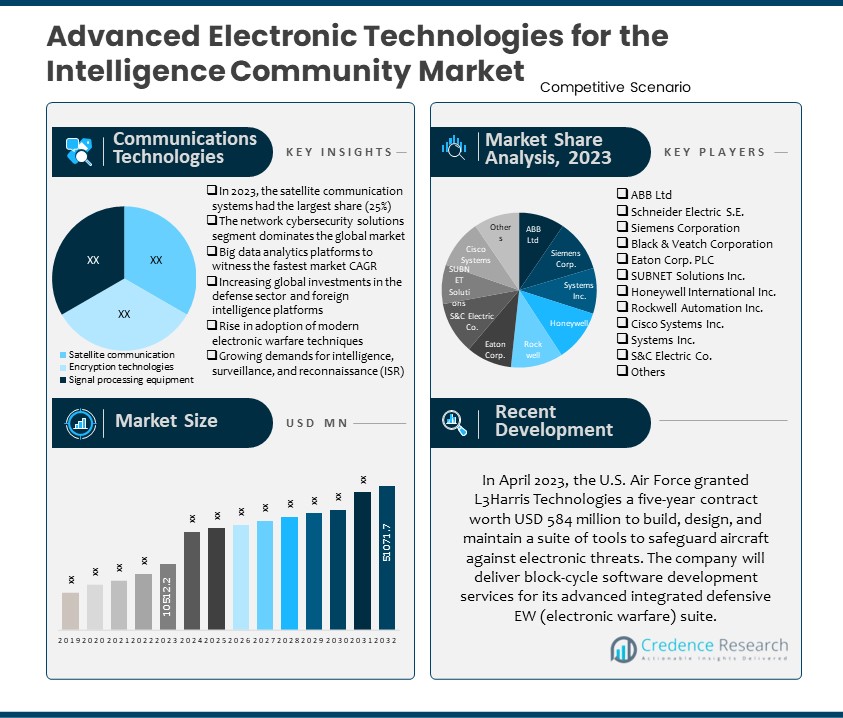
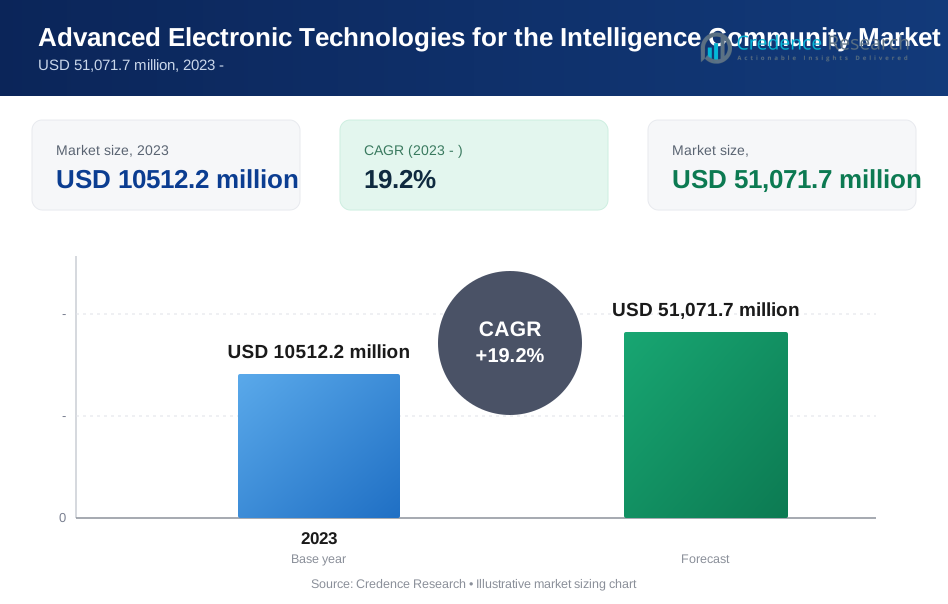
- The global demand for advanced electronic technologies in the intelligence community market was valued at USD 10512.2 million in 2023 and is expected to reach USD 51071.7 million in 2032, growing at a CAGR of 19.2% between 2024 and 2032.
- Satellite communication systems are the market leader in communications technologies, accounting for more than 25% of total value in 2023, while the tactical radios category is predicted to grow substantially during the forecast time frame.
- The geospatial intelligence (GEOINT) tools segment leads the global demand for advanced electronic technologies for the intelligence community market, accounting for more than 28% in 2023.
- Over the projection period, the identity verification software category is expected to expand at the highest rate, while biometric identification systems (fingerprint, iris, facial recognition) dominated the market in 2023 with a 30% revenue share.
- The network security systems dominated the market with 32% of the total revenue share by the cybersecurity solutions segment. In contrast, cyber threat intelligence platforms will expand fastest over the projected period.
- With an impressive market share of more than 34% by 2023 and estimates for considerable CAGR growth, electronic warfare simulation tools will likely continue to lead the market.
- North America is leading the continued growth of advanced electronic technologies for the intelligence community sector, accounting for more than one-third of the market in 2023, while Europe and Asia Pacific together account for just under 57%. Europe controlled more than 23% of the market in 2023.
- Increased global investments in emerging technologies such as quantum encryption, AI-driven predictive analytics, autonomous systems, and secure communication platforms are driving market growth and diversification within the intelligence sector.
Executive Summary
Market Definition
The market for advanced electronic technologies in the intelligence community encompasses a range of cutting-edge technologies, systems, and solutions that are utilized by government agencies, defense organizations, intelligence services, and related entities for gathering, analyzing, processing, and securing critical information and intelligence. These technologies are designed to enhance situational awareness, support decision-making processes, protect national security interests, and enable effective intelligence operations across various domains, including communications, surveillance, reconnaissance, data analysis, cybersecurity, electronic warfare, biometric identification, and training simulations. Key players in this market include technology providers, defense contractors, cybersecurity firms, communication equipment manufacturers, and specialized solution providers catering to the intelligence and national security sectors.
Market Overview
The global advanced electronic technologies for the intelligence community market has witnessed consistent growth over recent years and is set to grow at a CAGR of 19.2% between 2024 and 2032. The market was valued at USD 10512.2 million in 2023 and is anticipated to reach USD 51071.7 million in 2032.
Increased worldwide military expenditures are predicted to drive the expansion of advanced electronic technologies for the intelligence community market. Military expenditure, often known as defense spending or defense budget, is the total amount of money that a government spends on its military forces and defense-related activities. Electronic warfare capabilities add to military spending by increasing the efficacy and effectiveness of defense operations, lowering costs, and protecting military assets and troops. For example, in April 2023, as reported by SIPRI (Stockholm International Peace Research Institute), a Sweden-based international organization, global military spending increased by 3.7% in real terms in 2022, reaching a record $2240 billion. China's military budget has also climbed for the 26th consecutive year. Investment in R&D activities in this sector has increased by 20% year on year, which indicates a high priority for improving these technologies.
Major companies that provide advanced electronic technology to the intelligence community sector are focusing on revolutionary products like defensive electronic weaponry systems. Defensive electronic warfare technologies are a type of military technology that protects against and counters electronic threats and attacks. They are primarily used to defend military assets, soldiers, and key infrastructure against hostile electronics and electromagnetic activity. For example, in November 2021, Israel Aerospace Industries (IAI), an Israeli aerospace and defense corporation, launched a defensive electronic warfare system. The system is designed to target a wide range of threats, including telecommunication cables, ships, missiles, UAVs, and low probability of interception (LPOI) radars. The active electronically scanned array technique serves as the foundation for defensive electronic warfare systems. IAI introduced electronic warfare weapons with the goal of identifying and neutralizing a wide spectrum of threats.
Segmentation by Communications Technologies
- Satellite communication systems continue to dominate the communications technologies category, capturing a market share of over 25% in 2023. This dominance is attributed to their widespread use in long-range communication, data transmission, and global coverage capabilities.
- The market for tactical radios is expected to expand immensely, owing to their essential function in secure and dependable communication for military, law enforcement, and emergency response activities. The increasing demand for portable, ruggedized radios with advanced encryption features contributes to this growth.
Segmentation by Surveillance and Reconnaissance Technologies
- Unmanned aerial vehicles (UAVs) and drones emerged as primary surveillance and reconnaissance technologies, collectively accounting for more than 24% of the market share in 2023. This is due to their versatility, real-time data acquisition capabilities, and cost-effectiveness make them indispensable assets for intelligence gathering, border surveillance, and disaster response.
- Thermal imaging and remote sensing technologies cater to specific niche applications within the intelligence community market, including environmental monitoring, infrastructure inspection, and wildlife surveillance. These technologies offer enhanced situational awareness and detection capabilities in various operational scenarios.
Segmentation by Data Analysis and Intelligence Tools
- Big data analytics platforms are projected to experience a notable market CAGR due to the increasing volume, velocity, and variety of data generated by intelligence sources. These platforms leverage AI, machine learning, and predictive analytics to extract actionable insights, detect patterns, and support decision-making processes within the intelligence community.
- The geospatial intelligence (GEOINT) tools category dominates the market with over 28% share in 2023, owing to the significance of geospatial data integration, mapping, visualization, and geospatial intelligence analysis in intelligence operations, strategic planning, and threat assessment.
Segmentation by Cybersecurity Solutions
- The cyber threat intelligence platforms segment is expected to increase at a rapid CAGR on account of increasing cybersecurity risks, advanced persistent threats (APTs), and hostile cyber activities targeting government networks, essential services, and sensitive data. Cyber threat intelligence platforms primarily provide actionable insights, threat detection, and threat mitigation tactics to help improve cyber resilience and protect against cyberattacks.
- Network security systems remain the dominant cybersecurity solutions category, commanding a market share of nearly 32% in 2023. These systems encompass firewalls, intrusion detection/prevention systems (IDS/IPS), secure gateways, and endpoint security solutions designed to safeguard networks, data transmissions, and digital assets from unauthorized access, data breaches, and cyber threats.
Segmentation by Electronic Warfare (EW) Technologies
- Electronic countermeasures (ECM) technologies maintain a majority share of the intelligence community market, exceeding 22% in 2023. ECM technologies encompass electronic jamming, signal disruption, radar decoys, and electronic warfare support (ES) measures to counter adversary threats, protect friendly communications, and maintain electromagnetic spectrum superiority.
- Spectrum monitoring and management tools address the diverse electronic warfare (EW) technologies needs for the intelligence community market, including spectrum analysis, frequency allocation, spectrum monitoring, and spectrum situational awareness. These tools enable efficient spectrum utilization, interference detection, and spectrum security measures in contested electromagnetic environments.
Segmentation by Biometric and Identity Verification Technologies
- Biometric identification systems, including fingerprint, iris, and facial recognition technologies, emerge as the leading market category, commanding a revenue share of 30% in 2023. These systems offer secure and efficient identity verification solutions for access control, border security, law enforcement, and identity authentication applications within the intelligence community.
- The identity verification software segment has the highest market CAGR, attributed to the growing use of AI-powered identity verification solutions, digital identity management platforms, and identity proofing technologies to combat identity theft, fraud, and unauthorized access in digital environments.
Segmentation by Training and Simulation Systems
- Electronic warfare simulation tools dominate the global market, capturing a total revenue share of 34% in 2023. These simulation tools simulate electronic warfare scenarios, tactics, and environments to train personnel, test electronic warfare systems, and evaluate operational readiness in realistic training simulations.
- Virtual reality (VR) and augmented reality (AR) training systems are the fastest-growing market segment, largely due to innovations in immersive technology, training effectiveness, and scenario-based training simulations for intelligence analysts, military personnel, and security professionals.
Segmentation by Region
- North America maintains its leadership position in the growth of advanced electronic technologies for the intelligence community industry, accounting for more than one-third of the global market in 2023. This dominance is attributed to high defense budgets, robust technological infrastructure, and strong investments in intelligence capabilities across government agencies.
- In 2023, Europe and Asia Pacific collectively contributed nearly 57% of the market share, with Europe holding a dominant position of over 23%. The increased focus on cybersecurity, intelligence modernization, and collaborative defense initiatives drives European market growth. On the other hand, Asia Pacific largely benefits from rising defense spending, regional security challenges, and new developments in reconnaissance and surveillance technologies.
- The rest of the world, including Latin America, the Middle East, and Africa, offers unexplored opportunities for advanced electronic technologies for the intelligence community market. These regions are witnessing growing investments in defense modernization, intelligence infrastructure development, and cybersecurity capabilities, which are creating potential growth prospects for market players and solution providers.
North America had the largest market revenue share in 2023. The expansion is primarily due to increased financing for electronic warfare capabilities by regional governments such as the United States. The U.S. electronic warfare sector offers a robust ecosystem for defense companies, research institutes, and government agencies committed to expanding electronic warfare technologies. For instance, 60% of all U.S. military drones now have more effective electronic warfare abilities. North American firms, including industry giants like Northrop Grumman, Raytheon Technology, Lockheed Martin, and BAE Systems, are well-known for their transformations in electronic warfare systems and technology. Moreover, the U.S. government also spends large funds to support the research and procurement of modern digital warfare gadgets. For example, in 2022, the U.S. alone spent nearly $1.5 billion researching next-generation electronic warfare equipment, a 25% increase over the previous year.
Europe is the second largest market for advanced electronic technologies for the intelligence community after North America. Collaborative defense projects among member states, particularly within the frameworks of the European Union and NATO, help to increase the regional market share. For example, in March 2023, Elbit Systems Ltd was given a contract to provide EW self-defense equipment for a fighter jet being supplied to a NATO member state in Europe. Elbit Systems supplied the aircraft with an EW Self-Defense Kit, which contains a Countermeasure Delivery System (CMDS) and Radar Warning Receiver (RWR). In recent years, the European market has also seen a 30% growth in the implementation of uncrewed aerial vehicles (UAVs) for electronic warfare, which demonstrates the regional strategic priority of these technologies.
The Asia-Pacific market is expected to develop at the fastest CAGR during the forecast period. India, China, South Korea, Japan, and other nations in this region have been making substantial investments in electronic warfare procurement, development, and research in order to improve their strategic positioning and overall national security. These investments cover a wide spectrum of electronic warfare technologies, including electronic attack, protection, and support measures. For example, in March 2022, the Indian Air Force announced plans to develop an upgraded EW kit for its fighter jets. The Indian defense ministry has signed a USD 409 million contract with Bharat Electronics Limited (BEL) to deliver the Indian Air Force modern fighter aircraft with these capabilities.
Key Highlights of the Report
The advanced electronic technologies for the intelligence community market are segmented by communications technologies, surveillance and reconnaissance technologies, data analysis and intelligence tools, cybersecurity solutions, electronic warfare (EW) technologies, biometric and identity verification technologies, training and simulation systems, and region. Within the communications technologies segment, satellite communication systems stand out as a leading choice for secure and reliable data transmission, while tactical radios gain traction for their versatility in meeting specialized communication needs. Surveillance and reconnaissance technologies showcase a shift towards unmanned aerial vehicles (UAVs) and drones, which offer real-time data-gathering capabilities and enhance situational awareness.
The expanding demand for Intelligence, Surveillance, and Reconnaissance (ISR) capabilities is a major driver of the market for advanced electronic technology in the intelligence community. ISR is key in military operations as it provides decision-makers with critical details and situational awareness. Electronic warfare systems allow for the intercept and gathering of electronic signals such as radar emissions, communications, and electronic signatures. These devices offer superior capabilities for detecting and monitoring adversary electromagnetic activity. This increases the success and effectiveness of military operations. The growing requirement for ISR capabilities necessitates the development of modern electronic warfare systems capable of intercepting, analyzing, and exploiting electronic signals. The market for electronic warfare equipment is further expanding as military forces recognize the value of real-time and accurate intelligence.
What are the Main Drivers of the Advanced Electronic Technologies for the Intelligence Community Market?
The escalating complexity and diversity of security threats, including cyberattacks, terrorism, and geopolitical tensions, drive the market demand for advanced surveillance, reconnaissance, and cybersecurity solutions. The growing adoption of unmanned systems like UAVs and drones, coupled with the need for real-time situational awareness and decision-making, further propels the market forward. Moreover, stringent regulatory requirements, data privacy concerns, and the imperative to stay ahead in an information-driven era contribute to the continuous market innovation and adoption of advanced electronic technologies by intelligence agencies and defense organizations globally.
What are the Major Challenges Faced by the Advanced Electronic Technologies for the Intelligence Community Market?
One of the key market challenges is the rapid evolution of highly advanced cyber threats, which necessitates continuous innovation and investment in cybersecurity solutions to protect sensitive information and communication networks. Besides, interoperability issues among diverse technologies and platforms pose integration barriers, hindering seamless data exchange and collaboration across intelligence systems. Furthermore, stringent regulatory frameworks, export controls, higher initial investments, and compliance requirements add complexity to technology development and deployment processes.
What are the Growth Opportunities in the Advanced Electronic Technologies for the Intelligence Community Market?
The growing adoption of cloud-based solutions, AI-driven analytics, and machine learning algorithms presents market opportunities for enhanced data processing, intelligence analysis, and decision-making capabilities. Additionally, the rising demand for cybersecurity solutions, including threat intelligence platforms, encryption technologies, and secure communication systems, creates a lucrative market segment. Moreover, advancements in biometric identification, identity verification software, and electronic warfare technologies lead to market developments by addressing critical security and operational requirements.
Market Drivers
Several factors contribute to the growth of advanced electronic technologies for the intelligence community market. The following are the key factors propelling the market for advanced electronic technology in the intelligence community:
Geopolitical Conflicts and Security Concerns
Geopolitical tensions, regional conflicts, terrorism, cyber threats, and asymmetric warfare are among the key factors fueling the market adoption of advanced electronic technologies in the intelligence community. Governments and defense organizations are increasingly investing in these technologies to strengthen national security, protect critical infrastructure, counter threats from state and non-state actors, and ensure strategic advantage in complex geopolitical environments. The rise of hybrid warfare tactics, including information warfare, cyber-attacks, propaganda campaigns, and disinformation operations, has heightened the need for advanced electronic technologies that can detect, prevent, and respond to such threats effectively. This includes cybersecurity solutions to safeguard networks and data, electronic warfare systems to counter hostile electronic activities, and intelligence analysis tools to detect and analyze malicious activities in cyberspace and other domains.
Moreover, the growing focus on intelligence sharing, collaboration among allied nations, and joint intelligence operations further drives the demand for interoperable and scalable electronic technologies that can facilitate seamless communication, information sharing, and coordinated responses to global security challenges. For example, in August 2022, the United States stated that the Russia-Ukraine conflict is encouraging the U.S. Army to deploy its in-development jammers as soon as feasible. The Russian government invested substantially in EW systems, which were used to block GPS signals and identify smart bombs supplied by Western nations, among other things. The war has shown the expanding role of electronic warfare in modern conflicts, as well as the methods and technologies used by both sides.
Market Restraints
The advanced electronic technologies for the intelligence community market confront multiple challenges that may impede its market expansion. These consist of the following:
High Investments in Early Phases
The development of military electronic warfare systems necessitates significant R&D investment. These devices require a major capital expenditure for integration into national military networks. Electronic warfare also must be coordinated with multiple command & control systems, anti-aircraft weaponry, missiles, and fire control systems. These systems are extremely expensive to set up and maintain. Thus, the lengthy manufacturing procedures and higher cost of these technologies serve as a barrier to market growth.
Military electronic warfare systems are becoming more complex due to the requirement for components that can perform several functions while consuming less energy and being smaller and lighter. As part of the continual modernization of military electronics, electronic warfare systems must be modified to match the design standards of supporting electronic devices and instruments. Keeping up with the increasing product upgrade process and technological improvements is a major challenge for vendors. As a result, the high expenses of developing and maintaining modern electronic products hinder market growth in the intelligence community.
Opportunities
The advanced electronic technologies for the intelligence community market present substantial growth opportunities on a global scale. These consist of the following:
Rise in Adoption of Modern Warfare Techniques
Defense forces all over the world are turning to modern warfare strategies such as electronic warfare, digital warfare, and network-oriented warfare. These tactics require large amounts of battlefield-related information to control and monitor military operations. Hence, UAVs are increasingly being used to collect data in real-time through intelligence, surveillance, and reconnaissance (ISR) activities. Also, UAVs can now take clear pictures of battlegrounds due to developments in payload technology, including high-resolution recording devices, electro-optics, and infrared systems. Thus, real-time information provided by UAVs is crucial in military operations for tracking the movement of vehicles and soldiers. These ISR missions are carried out by defense forces all around the world using UAVs like the RQ-1 Predator, BQM-155 Hunter, and CL-289 Piver. As a result, the growing demand for new warfare strategies promotes the development of innovative electronic technology for the intelligence community market.
Modern electronic warfare (EW) systems are becoming more digitized and interconnected with broader network-centric warfare (NCW) capacities. This enables real-time data exchange, enhanced situational awareness, and coordinated reaction to threats. For example, in July 2023, Raytheon Technologies secured a contract with the Naval Air Systems Command to operate the Next-Generation Jammer (NGJ) Mid-Band (MB). The deal was worth USD 26.6 million and covered the development, testing, and design of the NGJ-MB software.
Competitive Landscape
Key Players
The competitive landscape in the advanced electronic technologies for the intelligence community market is characterized by intense competition and strategic innovation among industry players. The following are a few of the most prominent market players and their market shares:
- ABB Ltd
- Schneider Electric S.E.
- Siemens Corporation
- Black & Veatch Corporation
- Eaton Corp. PLC
- SUBNET Solutions Inc.
- Honeywell International Inc.
- Rockwell Automation Inc.
- Cisco Systems Inc.
- GE Open Systems International Inc.
- Systems Inc.
- S&C Electric Co.
- Others
These companies invest heavily in R&D initiatives to enhance their product portfolios and stay ahead of market trends. Key players in this landscape actively focus on developing innovative solutions across various technology categories, including communications, surveillance, data analysis, cybersecurity, electronic warfare, biometrics, identity verification, and training systems.
In June 2023, Elbit Systems secured a new contract from Airbus Helicopters to deliver airborne EW self-defense technologies for the Luftwaffe CH-53 GS/GE freight helicopters. The contract consists of the delivery of a Countermeasure Delivery System (CMDS), EW Controller (EWC), and Digital Radar Warning Receiver (RWR), all of which upgraded the mission success and operational effectiveness of the helicopter.
In February 2023, DISA, the Defence Information Systems Agency, introduced a cloud-based electronic warfare intelligence tool. The cloud-based Electromagnetic Battle Management tool, or EMBM-J, consolidates many streams of data into a streamlined, shared interface for commanders.
In February 2023, Israel Aerospace Industries and MBDA Germany signed a memorandum of understanding (MoU) to establish a partnership in electronic air defense and digital warfare training for the German Armed Forces.
In December 2022, the Australian Department of Defense awarded Thales Group a contract for SEA 1442 Phase 3, a Tactical Maritime Wide Area Network (MTWAN). It aimed to modernize communications for the Royal Australian Navy by providing network-centric warfare capabilities.
In October 2022, Centum Electronics Ltd of India and Rafael Advanced Systems of Israel signed a memorandum of understanding (MoU) to collaborate on the development of an electronic warfare (EW) system to support the Indian Coast Guard and Indian Navy.
In June 2022, Leonardo S.p.A. released Newton, a software tool that simulates the most recent threats to military forces and the defensive measures they can use to improve survival. Newton can help to speed and validate the development of new EW (electronic warfare) technologies, tactics, and approaches. Newton is also the first commercial tool that simulates integrated defensive aid suites for land, sea, and air troops using infrared (IR), electro-optic (EO), and radio frequency (RF) sensors and effectors.
In April 2022, Israel successfully tested its new 'Iron Beam' laser-based air defense system. This is the first energy-based weapon system in the world that shoots down incoming mortars, rockets, and UAVs with a laser.
Summary of Key Findings
- The market is segmented by communications technologies, surveillance and reconnaissance technologies, data analysis and intelligence tools, cybersecurity solutions, electronic warfare (EW) technologies, biometric and identity verification technologies, training and simulation systems, and region.
- Electronic warfare technologies are used across a broad range of platforms, such as land, naval, airborne, and space, which demonstrates their adaptability in protecting military assets and achieving electromagnetic spectrum superiority.
- Rising cybersecurity threats, including cyberattacks, data breaches, and information warfare, are boosting the market demand for robust cybersecurity solutions, encryption technologies, threat intelligence platforms, and secure communication networks within the intelligence community.
- Governments and defense agencies worldwide are increasing investments and funding for research, development, and deployment of advanced electronic technologies to address evolving security threats and enhance national security capabilities.
Future Outlook
- The development and integration of quantum computing, quantum encryption, and quantum sensing technologies are gaining market traction in the intelligence community for their potential to enhance data security, cryptographic protocols, and computational capabilities.
- The global market is expected to increase steadily in the coming years as companies prioritize improved electronic warfare technologies. Continued technology developments, expanded applications, and attention to sustainability set the market for further growth and innovation in the years ahead.
How CXOs Can Benefit from the Credence Research Advanced Electronic Technologies for the Intelligence Community Market Report
The Credence Research Market Insight Report on Advanced Electronic Technologies for the Intelligence Community provides CXOs with a comprehensive overview of the market, including:
- Market Size and Growth Forecast: The report offers detailed estimates of the market size for advanced electronic technologies in the intelligence community, segmented by communications technologies, surveillance & reconnaissance technologies, data analysis and intelligence tools, cybersecurity solutions, electronic warfare (EW) technologies, biometric and identity verification technologies, training and simulation systems, and region. It also includes growth forecasts up to 2032, highlighting key trends and drivers shaping the market landscape.
- Market Segmentation: The report segments the advanced electronic technologies for the intelligence community market by communications technologies, surveillance & reconnaissance technologies, data analysis and intelligence tools, cybersecurity solutions, electronic warfare (EW) technologies, biometric and identity verification technologies, training and simulation systems, and region. This segmentation helps in understanding market dynamics and identifying growth opportunities in specific segments.
- Competitive Landscape: The report profiles major players in the advanced electronic technologies market for the intelligence community, outlining their strategies, product portfolios, partnerships, and market performance. CXOs can leverage this information to benchmark their strategies, assess competitive positioning, and identify potential collaboration opportunities.
- Key Trends and Drivers: The report analyzes the key trends and drivers influencing the adoption and growth of advanced electronic technologies in the intelligence community. CXOs gain valuable insights into technological innovations, regulatory developments, market trends, and emerging opportunities that can impact their strategic decision-making and investment priorities.
CXOs can utilize the insights from the Credence Research Market Insight Report on Advanced Electronic Technologies for the Intelligence Community to:
- Identify Growth Opportunities: The report helps CXOs identify growth opportunities in specific technology segments such as satellite communication systems, UAVs and drones, big data analytics platforms, cybersecurity solutions, and biometric identification systems. For instance, the report highlights the increasing demand for AI-driven cybersecurity solutions and the integration of IoT devices in surveillance systems as key growth areas.
- Make Informed Investment Decisions: CXOs can make informed investment decisions based on market trends, competitive analysis, and technology advancements highlighted in the report. For example, insights into the adoption of cloud-based intelligence solutions and the shift towards software-defined radios (SDRs) in tactical communication systems can guide investment strategies.
- Develop Competitive Strategies: The report assists CXOs in developing competitive strategies by providing insights into market positioning, product differentiation, and customer preferences. For instance, understanding the competitive landscape of geospatial intelligence (GEOINT) tools and electronic countermeasures (ECM) technologies can inform strategy development for market penetration or product innovation.
- Track Market Developments: CXOs can stay updated on market developments and emerging trends by leveraging the report's analysis of key market drivers, challenges, and opportunities. This enables proactive decision-making, risk management, and adaptation to changing market dynamics such as geopolitical shifts, regulatory changes, and technological disruptions.
Overall, the Credence Research Advanced Electronic Technologies for the Intelligence Community Market Report is a valuable resource for CXOs looking to gain a deeper understanding of the market and identify growth opportunities.
Segmentation
- By Communications Technologies
- Secure communication systems
- Satellite communication systems
- Encryption technologies
- Tactical radios
- Signal processing equipment
- By Surveillance and Reconnaissance Technologies
- Unmanned aerial vehicles (UAVs) and drones
- High-resolution imaging systems
- Radar and sonar systems
- Thermal imaging technology
- Remote sensing technology
- By Data Analysis and Intelligence Tools
- Big data analytics platforms
- Machine learning and artificial intelligence (AI) algorithms for data interpretation
- Data fusion and integration software
- Geospatial Intelligence (GEOINT) tools
- Cyber-physical systems for intelligence gathering
- By Cybersecurity Solutions
- Network security systems
- Intrusion detection and prevention systems (IDPS)
- Encryption and data protection solutions
- Cyber threat intelligence platforms
- Security information and event management (SIEM) systems
- By Electronic Warfare (EW) Technologies
- Electronic countermeasures (ECM)
- Electronic support measures (ESM)
- Radar jamming systems
- Direction-finding systems
- Spectrum monitoring and management tools
- By Biometric and Identity Verification Technologies
- Biometric identification systems (fingerprint, iris, facial recognition)
- Identity verification software
- Access control systems
- Forensic analysis tools
- By Training and Simulation Systems
- Virtual reality (VR) and augmented reality (AR) training systems
- Simulation software for mission planning and execution
- Cybersecurity training platforms
- Electronic warfare simulation tools
- By Region
- North America
- The U.S.
- Canada
- Mexico
- Europe
- Germany
- France
- The U.K.
- Italy
- Spain
- Rest of Europe
- Asia Pacific
- China
- Japan
- India
- South Korea
- South-east Asia
- Rest of Asia Pacific
- Latin America
- Brazil
- Argentina
- Rest of Latin America
- Middle East & Africa
- GCC Countries
- South Africa
- Rest of the Middle East and Africa
- North America
Request a Free Sample
Fill in your details and we'll send you a free sample report.
- Sample data tables & charts
- Research methodology
Market Dynamics
Escalating Cybersecurity Threats
The intelligence community faces increasingly sophisticated cyberattacks and advanced persistent threats targeting government networks and sensitive data, driving demand for robust cybersecurity solutions and threat intelligence platforms.
Geopolitical Tensions and Modern Warfare
Rising geopolitical conflicts and the adoption of hybrid and electronic warfare tactics are prompting governments to invest in advanced electronic and cybersecurity technologies to protect national security and maintain strategic advantage.
Integration of AI and Big Data Analytics
The exponential growth of data from intelligence sources necessitates advanced analytics platforms leveraging AI and machine learning to extract actionable insights, detect threats, and support rapid decision-making.
Defense Modernization and Increased Military Spending
Global increases in defense budgets, particularly in North America and Asia Pacific, are fueling investments in next-generation cybersecurity, electronic warfare, and secure communication systems for intelligence operations.
Need a Custom Version of This Report?
Tailor the scope, geography, or segments to your exact requirements.
- Custom geography or segment scope
- Direct access to our analyst team
Frequently Asked Questions
What is the current size of the global advanced electronic technologies for the intelligence community market?
What is the expected growth rate of advanced electronic technologies for the intelligence community market between 2024 and 2032?
Which category is leading the market revenue share in terms of communications technologies?
Which training and simulation systems segment governs the global advanced electronic technologies demand for the intelligence community market?
Who are the major players in the global advanced electronic technologies for the intelligence community market?
Table of Content
Chapter 1 Market Segmentation
- 1.1 Segmentation Framework
- 1.1.1 Product and Service Classification
- 1.1.2 Application and End-Use Classification
- 1.1.3 Technology and Solution Classification
- 1.1.4 Customer and Distribution Channel Classification
- 1.1.5 Geographic Segmentation
- 1.1.6 Market Segment Definitions and Boundaries
- 1.2 By Cybersecurity Solutions
- 1.2.1 Network security systems
- 1.2.2 Intrusion detection and prevention systems (IDPS)
- 1.2.3 Encryption and data protection solutions
- 1.2.4 Cyber threat intelligence platforms
- 1.2.5 Security information and event management (SIEM) systems
- 1.3 By Data Analysis and Intelligence Tools
- 1.3.1 Big data analytics platforms
- 1.3.2 Machine learning and AI algorithms for data interpretation
- 1.3.3 Data fusion and integration software
- 1.3.4 Geospatial Intelligence (GEOINT) tools
- 1.4 By Biometric and Identity Verification Technologies
- 1.4.1 Biometric identification systems (fingerprint, iris, facial recognition)
- 1.4.2 Identity verification software
- 1.4.3 Access control systems
Chapter 2 Introduction
- 2.1 Report Objectives and Scope
- 2.2 Product Definition and Industry Terminology
- 2.3 Market Inclusions and Exclusions
- 2.4 Research Process
- 2.4.1 Primary Research and Expert Interviews
- 2.4.2 Secondary Research and Source Review
- 2.4.3 Top-Down and Bottom-Up Estimation
- 2.4.4 Data Triangulation and Verification
- 2.5 Market Size Measurement Basis
- 2.5.1 2023: USD 10512.2 million → 2032: USD 51,071.7 million
- 2.6 Historical and Forecast Reference Periods
- 2.6.1 Base Year: 2023
- 2.6.2 Forecast Period: 2023-2032
- 2.7 Research Assumptions and Limitations
Chapter 3 Executive Summary
- 3.1 Market Snapshot and Key Findings
- 3.2 Base-Year Market Size, 2023
- 3.3 Forecast Market Size, 2032
- 3.4 Revenue and Volume Growth Outlook
- 3.5 Key Demand and Supply Indicators
- 3.6 Leading Market Segments
- 3.7 Fastest-Growing Market Opportunities
- 3.8 Regional Performance Highlights
- 3.9 Technology and Industry Transformation
- 3.10 Competitive Landscape Summary
- 3.11 Analyst View and Strategic Implications
Chapter 4 Global Advanced Electronic Technologies for the Intelligence Community Market Trends and Developments
- 4.1 Historical Industry Development
- 4.2 Recent Market Trends and Developments
- 4.3 Demand and Customer Behavior Trends
- 4.4 Technology and Product Innovation
- 4.5 Artificial Intelligence, Automation and Digitalization
- 4.6 Local Manufacturing and Supply Chain Realignment
- 4.7 Industry Partnerships, Mergers and Acquisitions
- 4.8 Sustainability and Circular Economy Developments
- 4.9 Government and Private Sector Investment Trends
- 4.10 Emerging Business Models and Commercialization
- 4.11 Industry Developments and Announcements
Chapter 5 Global Advanced Electronic Technologies for the Intelligence Community Market Supply and Demand Analysis
- 5.1 Demand Trend and Consumption Analysis
- 5.2 Demand Forecast, 2023-2032
- 5.3 Supply Chain Structure and Procurement Trends
- 5.4 Supply-Demand Gap and Bottlenecks
- 5.5 Import Dependence and Sourcing Structure
- 5.6 Regional Supply and Demand Concentration
Chapter 6 Global Advanced Electronic Technologies for the Intelligence Community Market Pricing Analysis
- 6.1 Pricing Structure and Measurement
- 6.2 Historical Pricing Trends
- 6.3 Pricing Outlook, 2023-2032
- 6.4 Pricing by Product and Market Segment
- 6.5 Geographic Pricing Differences
- 6.6 Key Input, Energy, Labor and Logistics Costs
- 6.7 Contract Pricing and Purchasing Models
- 6.8 Pricing Sensitivity and Competitive Positioning
- 6.9 Price, Margin and Profitability Implications
Chapter 7 Global Advanced Electronic Technologies for the Intelligence Community Market Dynamics
- 7.1 Market Growth Drivers
- 7.1.1 Demand-Side Drivers
- 7.1.2 Technology and Innovation Drivers
- 7.1.3 Infrastructure and Investment Drivers
- 7.1.4 Regulatory and Policy Drivers
- 7.2 Market Restraints
- 7.2.1 Cost and Affordability Constraints
- 7.2.2 Technology and Adoption Barriers
- 7.2.3 Supply Chain and Operational Constraints
- 7.3 Market Challenges
- 7.3.1 Competitive Pressure and Margin Erosion
- 7.3.2 Skills, Infrastructure and Implementation Gaps
- 7.4 Emerging Market Opportunities
- 7.5 Market Dynamics Impact and Time-Horizon Assessment
Chapter 8 Global Advanced Electronic Technologies for the Intelligence Community Value Chain Analysis
- 8.1 Industry Value Chain Overview
- 8.2 Upstream Suppliers and Critical Inputs
- 8.3 Technology and Component Providers
- 8.4 Manufacturing or Service Delivery
- 8.5 Distribution, Channel Partners and Integrators
- 8.6 Downstream Applications and End Users
- 8.7 Value Addition and Profit Pools
- 8.8 Vertical Integration and Outsourcing
- 8.9 Supplier Concentration and Risk
- 8.10 Supply Chain Localization and Resilience
Chapter 9 Global Advanced Electronic Technologies for the Intelligence Community Market Regulations and Policies
- 9.1 Relevant Laws, Standards and Compliance Frameworks
- 9.2 Product, Service, Safety and Quality Requirements
- 9.3 Government Policies, Incentives and Subsidies
- 9.4 Imports, Exports and Trade Barriers
- 9.5 Public Procurement and Local Content Requirements
- 9.6 Data Protection, AI and Cybersecurity Compliance
- 9.7 Upcoming Policy Changes and Market Implications
Chapter 10 Global Advanced Electronic Technologies for the Intelligence Community Market Hotspots and Opportunities
- 10.1 Market Opportunity Mapping and Growth Hotspots
- 10.2 High-Growth Applications and Customer Groups
- 10.3 Underserved Markets and White-Space Opportunities
- 10.4 Emerging Technology and Product Opportunities
- 10.5 New Capacity and Investment Hotspots
- 10.6 Market Entry and Expansion Opportunities
- 10.7 Distribution and Partnership Opportunities
- 10.8 Near-Term and Long-Term Commercial Potential
- 10.9 Opportunity Attractiveness and Execution Risks
Chapter 11 Global Advanced Electronic Technologies for the Intelligence Community Market Outlook, 2023-2032
- 11.1 Market Size and Analysis
- 11.1.1 Revenue (Market Measurement: 2023: USD 10512.2 million → 2032: USD 51,071.7 million)
- 11.1.2 Historical Market Size
- 11.1.3 Base-Year Market Size, 2023
- 11.2 Market Forecast, 2023-2032
- 11.2.1 Revenue Forecast to 2032
- 11.2.2 CAGR and Year-on-Year Growth
- 11.2.3 Incremental Revenue Opportunity
- 11.3 Forecast Assumptions and Scenario Analysis
- 11.3.1 Base-Case Forecast
- 11.3.2 Optimistic and Conservative Scenarios
- 11.3.3 Technology, Pricing and Policy Sensitivities
- 11.4 Market Attractiveness and Growth Outlook
Chapter 12 Global Advanced Electronic Technologies for the Intelligence Community Market Segmentation and Outlook
- 12.1 Segmentation Summary and Market Shares, 2023
- 12.2 Largest and Fastest-Growing Segments
- 12.3 By Cybersecurity Solutions - Market Size and Forecast, 2023-2032
- 12.3.1 Segment Definition and Scope
- 12.3.2 Historical Market Size
- 12.3.3 Revenue Forecast, 2023-2032
- 12.3.4 Base-Year Market Share, 2023
- 12.3.5 Segment CAGR and Growth Drivers
- 12.3.6 Subsegment Market Size and Forecast
- 12.3.6.1 Network security systems
- 12.3.6.2 Intrusion detection and prevention systems (IDPS)
- 12.3.6.3 Encryption and data protection solutions
- 12.3.6.4 Cyber threat intelligence platforms
- 12.3.6.5 Security information and event management (SIEM) systems
- 12.3.7 Subsegment Pricing and Adoption Trends
- 12.3.8 Leading Suppliers and Competition
- 12.3.9 Regional Demand and Opportunities
- 12.4 By Data Analysis and Intelligence Tools - Market Size and Forecast, 2023-2032
- 12.4.1 Segment Definition and Scope
- 12.4.2 Historical Market Size
- 12.4.3 Revenue Forecast, 2023-2032
- 12.4.4 Base-Year Market Share, 2023
- 12.4.5 Segment CAGR and Growth Drivers
- 12.4.6 Subsegment Market Size and Forecast
- 12.4.6.1 Big data analytics platforms
- 12.4.6.2 Machine learning and AI algorithms for data interpretation
- 12.4.6.3 Data fusion and integration software
- 12.4.6.4 Geospatial Intelligence (GEOINT) tools
- 12.4.7 Subsegment Pricing and Adoption Trends
- 12.4.8 Leading Suppliers and Competition
- 12.4.9 Regional Demand and Opportunities
- 12.5 By Biometric and Identity Verification Technologies - Market Size and Forecast, 2023-2032
- 12.5.1 Segment Definition and Scope
- 12.5.2 Historical Market Size
- 12.5.3 Revenue Forecast, 2023-2032
- 12.5.4 Base-Year Market Share, 2023
- 12.5.5 Segment CAGR and Growth Drivers
- 12.5.6 Subsegment Market Size and Forecast
- 12.5.6.1 Biometric identification systems (fingerprint, iris, facial recognition)
- 12.5.6.2 Identity verification software
- 12.5.6.3 Access control systems
- 12.5.7 Subsegment Pricing and Adoption Trends
- 12.5.8 Leading Suppliers and Competition
- 12.5.9 Regional Demand and Opportunities
- 12.6 Segment Growth Comparison
- 12.7 Segment Attractiveness and Priority Matrix
Chapter 13 Global Advanced Electronic Technologies for the Intelligence Community Geographic Market Outlook, 2023-2032
- 13.1 Regional Market Size and Share, 2023
- 13.2 Regional Market Forecast, 2023-2032
- 13.3 Regional Pricing, Production and Demand Differences
- 13.4 North America
- 13.4.1 United States
- 13.4.2 Canada
- 13.4.3 Mexico
- 13.5 Europe
- 13.5.1 Germany
- 13.5.2 France
- 13.5.3 Italy
- 13.5.4 United Kingdom
- 13.5.5 Spain
- 13.5.6 Poland
- 13.5.7 Russia
- 13.5.8 Netherlands
- 13.5.9 Belgium
- 13.5.10 Sweden
- 13.5.11 Denmark
- 13.5.12 Norway
- 13.5.13 Rest of Europe
- 13.6 Asia Pacific
- 13.6.1 China
- 13.6.2 India
- 13.6.3 Japan
- 13.6.4 South Korea
- 13.6.5 Thailand
- 13.6.6 Indonesia
- 13.6.7 Vietnam
- 13.6.8 Malaysia
- 13.6.9 Australia
- 13.6.10 Rest of Asia Pacific
- 13.7 Latin America
- 13.7.1 Brazil
- 13.7.2 Argentina
- 13.7.3 Colombia
- 13.7.4 Chile
- 13.7.5 Rest of Latin America
- 13.8 Middle East
- 13.8.1 Saudi Arabia
- 13.8.2 United Arab Emirates
- 13.8.3 Turkey
- 13.8.4 Israel
- 13.8.5 Iran
- 13.8.6 Rest of the Middle East
- 13.9 Africa
- 13.9.1 South Africa
- 13.9.2 Egypt
- 13.9.3 Nigeria
- 13.9.4 Morocco
- 13.9.5 Rest of Africa
- 13.10 Regional Investment, Policy and Supply Chain Differences
- 13.11 Regional Competitive Landscape
- 13.12 Geographic Growth Hotspots
Chapter 14 Global Advanced Electronic Technologies for the Intelligence Community Technology, Innovation and Sustainability Outlook
- 14.1 Technology Landscape and Maturity
- 14.2 Product, Process and Service Innovation
- 14.3 AI, Automation and Digital Tools in the Industry
- 14.4 Technology Adoption and Performance Benchmarking
- 14.5 Innovation Pipeline and R&D Investment
- 14.6 Patent and Intellectual Property Trends
- 14.7 Energy Efficiency and Resource Management
- 14.8 Sustainability, Recycling and Circularity
- 14.9 Technology Roadmap, 2023-2032
- 14.10 Risks of Obsolescence and Technology Substitution
Chapter 15 Global Advanced Electronic Technologies for the Intelligence Community Market Key Strategic Imperatives
- 15.1 Growth and Market Entry Priorities
- 15.2 High-Return Products and Segments
- 15.3 Pricing, Profitability and Cost Optimization
- 15.4 Technology Investment and Product Differentiation
- 15.5 Supply Chain Localization and Resilience
- 15.6 Distribution and Customer Acquisition
- 15.7 Partnership, Acquisition and Capacity Strategy
- 15.8 Regional Expansion Priorities
- 15.9 Short-, Medium- and Long-Term Actions
Chapter 16 Competition Outlook
- 16.1 Industry Competition Characteristics
- 16.2 Market Structure and Concentration
- 16.3 Market Share and Competitive Positioning, 2023
- 16.4 Company-Wise Revenue and Product Benchmarking
- 16.5 Production and Service Capacity Benchmarking
- 16.6 Technology, Pricing and Differentiation
- 16.7 Regional Footprint and Distribution Strength
- 16.8 Mergers, Acquisitions and Strategic Alliances
- 16.9 New Entrants and Competitive Threats
- 16.10 Porter's Five Forces and Industry Attractiveness
- 16.11 Competitive Outlook, 2023-2032
Chapter 17 Company Profiles
- 17.1 Company Coverage and Selection Criteria
- 17.2 Raytheon Technologies
- 17.2.1 Business Description
- 17.2.2 Company Ownership and Geographic Presence
- 17.2.3 Product and Service Portfolio
- 17.2.4 Manufacturing and Operating Footprint
- 17.2.5 Financial Performance and Investment
- 17.2.6 Market Share and Competitive Position
- 17.2.7 Technology and Innovation Capabilities
- 17.2.8 Strategic Alliances or Partnerships
- 17.2.9 Recent Developments
- 17.2.10 Growth Strategy and Outlook
- 17.3 Northrop Grumman
- 17.4 Lockheed Martin
- 17.5 BAE Systems
- 17.6 Elbit Systems
- 17.7 Thales Group
- 17.8 Leonardo S.p.A.
- 17.9 Cisco Systems Inc.
- 17.10 Honeywell International Inc.
- 17.11 Israel Aerospace Industries (IAI)
- 17.12 Other Relevant Market Participants
Note: Every listed company is profiled on the structure shown under the first company. The company list is preliminary and may change based on research findings, market developments, data availability and client requirements.
Chapter 18 Disclaimer
- 18.1 Research and Forecast Disclaimer
- 18.2 Data Source and Estimation Limitations
Note: The depth of individual sections depends on data availability for this market. Volume, capacity, trade and other unit-based metrics are included where applicable.