Decentralized Clinical Trials Market Overview:
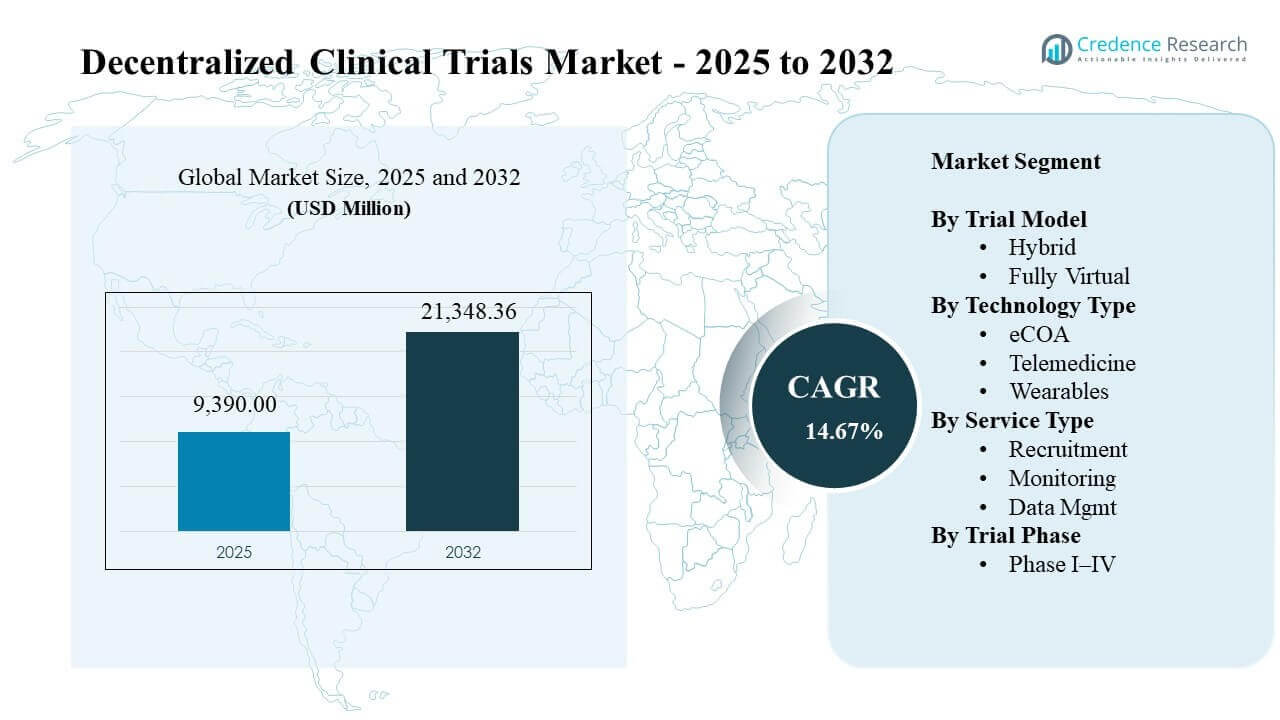
The global Decentralized Clinical Trials Market size was estimated at USD 9,390.00 million in 2025 and is expected to reach USD 21,348.36 million by 2032, growing at a CAGR of 14.67% from 2025 to 2032. Growth is driven primarily by sponsor and CRO shifts toward patient-centric execution models that reduce travel burden, expand access to broader populations, and improve retention for complex protocols. Expansion of integrated trial technology stacks and decentralized operations across major regions continues to support wider adoption across therapeutic areas and trial phases.
| REPORT ATTRIBUTE | DETAILS |
|---|---|
| Historical Period | 2020-2024 |
| Base Year | 2025 |
| Forecast Period | 2026-2032 |
| Decentralized Clinical Trials Market Size 2025 | USD 9,390.00 million |
| Decentralized Clinical Trials Market, CAGR | 14.67% |
| Decentralized Clinical Trials Market Size 2032 | USD 21,348.36 million |
Key Market Trends & Insights
- The Decentralized Clinical Trials Market is projected to expand from USD 9,390.00 million (2025) to USD 21,348.36 million (2032) at 14.67% CAGR (2025–2032).
- Hybrid trials held 61.8% share in 2025, reflecting strong demand for flexible designs that combine remote elements with necessary in-person procedures.
- North America accounted for 38.9% share in 2025, supported by mature eClinical infrastructure and high sponsor concentration.
- Europe represented 25.6% share in 2025, aided by established multinational trial operations and strong CRO and site networks.
- Asia Pacific captured 22.7% share in 2025, underpinned by expanding trial capacity and increasing participation in global development programs.
Segment Analysis
Decentralized clinical trials are reshaping execution by shifting trial activities closer to participants through a blend of telemedicine visits, digital endpoints, and remote data capture. Sponsors prioritize operating models that preserve data integrity and patient safety while reducing reliance on frequent site visits. This shift increases demand for integrated workflows spanning participant engagement, remote monitoring, and multi-source data handling. Market growth is also reinforced by rising protocol complexity and the need to sustain enrollment and adherence across dispersed populations.
Technology enablement is a central adoption lever because decentralized execution depends on dependable digital touchpoints and consistent operational oversight. eCOA tools improve capture of patient-reported outcomes in structured formats, telemedicine supports routine interactions and follow-ups, and wearables expand the feasibility of higher-frequency data collection. Service providers differentiate through their ability to orchestrate recruitment and retention, standardize monitoring processes, and manage data flows across diverse sources. Adoption expands most quickly when sponsors can deploy decentralized elements without disrupting compliance workflows.
By Trial Model Insights
Hybrid accounted for the largest share of 61.8% in 2025. Hybrid designs remain favored because they balance convenience with the control required for safety assessments, specialized procedures, and complex endpoints. Hybrid execution supports broader eligibility by reducing travel burden while preserving structured on-site visits where clinically necessary. Sponsors also adopt hybrid models to de-risk fully remote operations and maintain consistent oversight across diverse sites and geographies.
By Technology Type Insights
Technology adoption is shaped by how effectively tools reduce friction for participants and study teams while maintaining auditability and data quality. eCOA remains foundational for digitizing patient input and improving timeliness of outcome capture. Telemedicine expands access to clinician interactions across geographies and enables faster issue resolution during follow-ups. Wearables strengthen decentralized endpoint strategies by enabling passive and higher-frequency monitoring, particularly in chronic disease and real-world-like settings.
By Service Type Insights
Service demand rises as decentralized execution increases operational complexity across recruitment, monitoring, and data management. Recruitment services focus on extending reach beyond traditional site catchment areas and improving participant matching for eligibility and diversity goals. Monitoring services emphasize consistent oversight across remote touchpoints, including risk-based approaches and faster identification of protocol deviations. Data management services become more important as studies incorporate multiple data streams that require integration, cleaning, traceability, and governance.
By Trial Phase Insights
Adoption varies by trial phase based on endpoint intensity, safety requirements, and the need for specialized procedures. Later-phase studies often use decentralized elements to scale recruitment and retention across larger participant pools and broader geographies. Earlier-phase studies tend to apply hybrid approaches that preserve on-site supervision for intensive monitoring and frequent clinical assessments. Over time, protocol redesign and technology integration are expanding decentralized feasibility across a wider portion of Phase I–IV activity.
Decentralized Clinical Trials Market Drivers
Patient-centric trial execution to improve enrollment and retention
Sponsors and CROs increasingly use decentralized elements to reduce participant travel burden and improve adherence throughout study timelines. Remote touchpoints enable more consistent follow-ups and reduce missed visits, which supports data completeness and protocol compliance. Flexible scheduling and localized services can also improve participation among rural and mobility-limited populations. The Decentralized Clinical Trials Market benefits as decentralized execution becomes a practical pathway to sustain enrollment in competitive indication areas.
Digital health infrastructure and toolchain integration
The expansion of eCOA, telemedicine, and wearable ecosystems strengthens feasibility of decentralized execution across indications. Integrated platforms reduce fragmentation by connecting participant engagement, remote assessments, and data capture into standardized workflows. Better integration also supports faster study startup by enabling repeatable configurations across programs and geographies. The Decentralized Clinical Trials Market grows as technology stacks become easier to deploy, validate, and operate at scale.
Rising protocol complexity and operational pressure on sites
Protocol designs continue to add endpoints, assessments, and data requirements that raise demands on sites and participants. Decentralized components help redistribute tasks through remote visits, home-based services, and local care delivery where appropriate. This approach reduces bottlenecks and improves throughput when site capacity is constrained. The Decentralized Clinical Trials Market expands when decentralized execution becomes an operational strategy to manage complexity without compromising oversight.
- For instance, Science 37 and Catalent reported that across 17 studies their direct-to-patient model enrolled nearly 1,700 patients, with a single Direct-to-Patient Site contributing an average 26% of total study populations and enrolling 9 patients per month, equivalent to more than 15 traditional brick-and-mortar locations.
Need for broader reach and diversity in trial populations
Sponsors are increasingly focused on expanding access to underrepresented populations to improve generalizability of outcomes and meet stakeholder expectations. Decentralized activities improve geographic reach and enable more inclusive participation by lowering logistical barriers. Localized trial services also support consistent engagement and reduce dropout risk in populations with limited access to academic sites. The Decentralized Clinical Trials Market strengthens as trial designs prioritize broader participation and real-world-like convenience.
- For instance, Medable shared Tufts CSDD PACT data covering 69 clinical trials showing Asian participation at 20.9% in DCT-enabled trials versus 14.2% in traditional trials, American Indian or Alaska Native enrollment at 1.9% versus 0.5%, and female participation at 55.7% versus 49.0%.
Decentralized Clinical Trials Market Challenges
Decentralized execution increases operational complexity because activities shift across homes, local providers, and virtual settings. Study teams must manage variability in participant environments, technology proficiency, and local healthcare access. Data integrity controls become more demanding when multiple devices, platforms, and service partners contribute to endpoint capture. The Decentralized Clinical Trials Market faces execution risk when workflows are fragmented and governance standards vary across sites and geographies.
- For instance, THREAD has scaled its decentralized clinical trial platform across 60 countries and supported studies involving more than 100,000 participants, while using a unified data architecture to centralize inputs from telehealth visits, wearables, patients, caregivers, and remote nurses into a single research environment, demonstrating the level of technical coordination needed to prevent fragmented workflows.
Regulatory expectations and privacy requirements create additional coordination burdens across jurisdictions. Differences in telemedicine rules, data residency practices, and informed consent requirements can slow rollout and require localized protocol adaptations. Technology validation, audit readiness, and cybersecurity controls add cost and time to implementation. The Decentralized Clinical Trials Market can experience slower adoption when sponsors lack standardized playbooks for compliant execution across multiple regions.
Decentralized Clinical Trials Market Trends and Opportunities
Hybridization is becoming a default design approach because it enables remote convenience without fully replacing site infrastructure. Sponsors increasingly standardize decentralized modules, such as eConsent, eCOA, and remote follow-ups, and reuse them across programs to reduce setup time. This modular approach supports faster scaling and encourages consistent operational practices across studies. The Decentralized Clinical Trials Market gains momentum as hybrid designs become embedded in trial planning and execution.
- For instance, Medable reported that its decentralized technologies had already been deployed across more than 44,000 clinical sites and more than 600,000 patients worldwide, while its Japan-focused implementation achieved eCOA adherence above 99% with all sites and clinical research associates fully trained before first-patient-in, demonstrating how reusable hybrid modules can support both scale and operational consistency.
Platform consolidation and interoperability are growing priorities as sponsors seek to reduce tool sprawl and improve operational visibility. Unified workflows across recruitment, engagement, telemedicine, and endpoint capture improve coordination and enable better oversight. Opportunities increase for providers that can integrate multi-source data, maintain traceability, and support scalable deployments across regions. The Decentralized Clinical Trials Market benefits as buyers favor vendors that simplify execution and reduce integration burden.
Regional Insights
North America
North America accounted for 38.9% share in 2025, supported by high sponsor density and mature trial operations. The region benefits from strong digital health adoption and deep availability of trial technology vendors and CRO services. Decentralized and hybrid execution models are commonly used to address enrollment competition and improve participant convenience across large geographies. Investment in integrated eClinical workflows continues to reinforce adoption across phases and therapeutic areas.
Europe
Europe represented 25.6% share in 2025, driven by established multinational clinical development activity and strong site networks. Adoption expands as sponsors deploy standardized decentralized elements that can be adapted to country-level requirements. Hybrid execution remains practical for protocols requiring specialized procedures while still reducing participant travel burden. Demand continues to rise for interoperable workflows that support governance, traceability, and consistent oversight across multiple markets.
Asia Pacific
Asia Pacific captured 22.7% share in 2025 as regional trial capacity expands and global development programs broaden participation. The region’s growth is supported by increasing investment in healthcare infrastructure and wider availability of digital tools that enable remote touchpoints. Hybrid approaches are often prioritized to balance convenience with operational consistency across diverse settings. Providers that simplify deployment and support multi-language, multi-country execution gain traction in sponsor selection.
Latin America
Latin America held 7.1% share in 2025, reflecting steady adoption with concentration in select trial hubs. Decentralized execution is often used to improve retention and reduce travel burden where participant logistics can limit adherence. Operational success depends on consistent local support, reliable connectivity, and streamlined coordination between sites and remote services. Growth improves as sponsors standardize processes and scale proven hybrid modules across programs.
Middle East & Africa
Middle East & Africa represented 5.7% share in 2025, with adoption shaped by variability in infrastructure and trial ecosystem maturity across countries. Decentralized activities gain traction when they address geographic access challenges and support consistent participant engagement. Hybrid models remain important where on-site oversight is needed for complex assessments. Expansion improves as regional capabilities strengthen and sponsors increase long-term investment in trial enablement.
Competitive Landscape
Competition spans decentralized trial platform providers, eClinical technology vendors, and CROs offering end-to-end execution capabilities. Differentiation centers on integrated orchestration of participant engagement, remote assessments, and multi-source data workflows with strong governance controls. Vendors compete on speed of study build, operational reliability, interoperability, and global scalability across languages and regulatory environments. Partnerships with logistics and service networks also influence buyer decisions for fully virtual and hybrid models.
Medable is positioned around enabling configurable decentralized execution through technology workflows that support common remote trial touchpoints. The company’s approach emphasizes scalable deployment of study experiences while maintaining standardized processes that help sponsors and CROs manage operational consistency. Differentiation typically depends on how effectively platforms simplify configuration, support multi-country rollout, and integrate with broader eClinical stacks. Competitive strength improves when deployment time is reduced and protocol changes can be implemented with minimal disruption.
The industry research and growth report includes detailed analyses of the competitive landscape of the market and information about key companies, including:
- Medable
- Science 37
- IQVIA
- Parexel
- Oracle Health Sciences
- Signant Health
- Medidata
- Clario
- Castor
- Thread Research
Qualitative and quantitative analysis of companies has been conducted to help clients understand the wider business environment as well as the strengths and weaknesses of key industry players. Data is qualitatively analyzed to categorize companies as pure play, category-focused, industry-focused, and diversified; it is quantitatively analyzed to categorize companies as dominant, leading, strong, tentative, and weak.
Recent Developments
- In March 2025, ICON partnered with Mural Health to improve participant and site experience in clinical trials by using the Mural Link platform for participant payments, travel support, tax management, communication, and analytics. The partnership was announced on March 4, 2025, and is intended to reduce barriers to participation and ease administrative burden on sites.
- In March 2025, Tempus AI announced the acquisition of Deep 6 AI to strengthen its clinical trial matching and recruitment capabilities. The deal was announced on March 10, 2025, and adds Deep 6 AI’s network of more than 750 provider sites and over 30 million patients to Tempus’s platform.
- In March 2025, Care Access announced the acquisition of CEMEC, a Brazil-based clinical research center, to expand research access across Latin America. The acquisition was announced on March 10, 2025, and is designed to combine Care Access’s community-based research model and mobile health capabilities with CEMEC’s local clinical research presence.
- In August 2024, Medable launched Medable Studio, a new no-code application for configuring, translating, validating, and launching eCOA Plus tools such as eCOA, eConsent, Televisit, and Sensors into clinical trials. The product launch was announced on August 14, 2024, and the company said it was built to help sponsors bring studies live faster and improve enrollment efficiency.
Report Scope
| Report Attribute | Details |
| Market size value in 2025 | USD 9,390.00 million |
| Revenue forecast in 2032 | USD 21,348.36 million |
| Growth rate (CAGR) | 14.67% (2025–2032) |
| Base year | 2025 |
| Forecast period | 2026-2032 |
| Quantitative units | USD million |
| Segments covered | By Trial Model: Hybrid, Fully Virtual; By Technology Type: eCOA, Telemedicine, Wearables; By Service Type: Recruitment, Monitoring, Data Mgmt; By Trial Phase: Phase I–IV |
| Regional scope | North America, Europe, Asia Pacific, Latin America, Middle East & Africa |
| Key companies profiled | Medable; Science 37; IQVIA; Parexel; Oracle Health Sciences; Signant Health; Medidata; Clario; Castor; Thread Research |
| No.of Pages | 328 |
Segmentation
By Trial Model
- Hybrid
- Fully Virtual
By Technology Type
- eCOA
- Telemedicine
- Wearables
By Service Type
- Recruitment
- Monitoring
- Data Mgmt
By Trial Phase
- Phase I–IV
By Region
- North America
- U.S.
- Canada
- Mexico
- Europe
- Germany
- France
- U.K.
- Italy
- Spain
- Rest of Europe
- Asia Pacific
- China
- Japan
- India
- South Korea
- South-east Asia
- Rest of Asia Pacific
- Latin America
- Brazil
- Argentina
- Rest of Latin America
- Middle East & Africa
- GCC Countries
- South Africa
- Rest of the Middle East and Africa

Request a Free Sample
Fill in your details and we'll send you a free sample report.
- Sample data tables & charts
- Research methodology
Need a Custom Version of This Report?
Tailor the scope, geography, or segments to your exact requirements.
- Custom geography or segment scope
- Direct access to our analyst team
Frequently Asked Questions
What is the market size and forecast for the Decentralized Clinical Trials Market?
What is the CAGR for the Decentralized Clinical Trials Market?
Which segment is the largest in the Decentralized Clinical Trials Market?
What factors are driving growth in the Decentralized Clinical Trials Market?
Who are the leading companies in the Decentralized Clinical Trials Market?
Which region leads the Decentralized Clinical Trials Market?
Table of Content
Chapter 1 Market Segmentation
- 1.1 Segmentation Framework
- 1.1.1 Product and Service Classification
- 1.1.2 Application and End-Use Classification
- 1.1.3 Technology and Solution Classification
- 1.1.4 Customer and Distribution Channel Classification
- 1.1.5 Geographic Segmentation
- 1.1.6 Market Segment Definitions and Boundaries
Chapter 2 Introduction
- 2.1 Report Objectives and Scope
- 2.2 Product Definition and Industry Terminology
- 2.3 Market Inclusions and Exclusions
- 2.4 Research Process
- 2.4.1 Primary Research and Expert Interviews
- 2.4.2 Secondary Research and Source Review
- 2.4.3 Top-Down and Bottom-Up Estimation
- 2.4.4 Data Triangulation and Verification
- 2.5 Market Size Measurement Basis
- 2.5.1 2025: USD 9,390.00 million → 2032: USD 21,348.36 million
- 2.6 Historical and Forecast Reference Periods
- 2.6.1 Base Year: 2025
- 2.6.2 Forecast Period: 2025-2032
- 2.7 Research Assumptions and Limitations
Chapter 3 Executive Summary
- 3.1 Market Snapshot and Key Findings
- 3.2 Base-Year Market Size, 2025
- 3.3 Forecast Market Size, 2032
- 3.4 Revenue and Volume Growth Outlook
- 3.5 Key Demand and Supply Indicators
- 3.6 Leading Market Segments
- 3.7 Fastest-Growing Market Opportunities
- 3.8 Regional Performance Highlights
- 3.9 Technology and Industry Transformation
- 3.10 Competitive Landscape Summary
- 3.11 Analyst View and Strategic Implications
Chapter 4 Global Decentralized Clinical Trials Market Trends and Developments
- 4.1 Historical Industry Development
- 4.2 Recent Market Trends and Developments
- 4.3 Demand and Customer Behavior Trends
- 4.4 Technology and Product Innovation
- 4.5 Artificial Intelligence, Automation and Digitalization
- 4.6 Local Manufacturing and Supply Chain Realignment
- 4.7 Industry Partnerships, Mergers and Acquisitions
- 4.8 Sustainability and Circular Economy Developments
- 4.9 Government and Private Sector Investment Trends
- 4.10 Emerging Business Models and Commercialization
- 4.11 Industry Developments and Announcements
Chapter 5 Global Decentralized Clinical Trials Market Production, Supply and Demand Analysis
- 5.1 Demand Trend and Consumption Analysis
- 5.2 Demand Forecast, 2025-2032
- 5.3 Production and Output Trend
- 5.4 Production and Output Forecast, 2025-2032
- 5.5 Installed Capacity and Capacity Utilization
- 5.6 Company-Wise Production Plants and Statistics
- 5.6.1 Installed Production Capacity
- 5.6.2 Actual Production
- 5.6.3 Planned Capacity and Expansion Targets
- 5.7 Supply Chain Structure and Procurement Trends
- 5.8 Supply-Demand Gap and Bottlenecks
- 5.9 Import Dependence and Sourcing Structure
- 5.10 Contract Manufacturing and Outsourcing
- 5.11 Regional Supply and Demand Concentration
Chapter 6 Global Decentralized Clinical Trials Market Pricing Analysis
- 6.1 Pricing Structure and Measurement
- 6.2 Historical Pricing Trends
- 6.3 Pricing Outlook, 2025-2032
- 6.4 Average Selling Price and Unit Economics
- 6.5 Pricing by Product and Market Segment
- 6.6 Geographic Pricing Differences
- 6.7 Key Input, Energy, Labor and Logistics Costs
- 6.8 Contract Pricing and Purchasing Models
- 6.9 Pricing Sensitivity and Competitive Positioning
- 6.10 Price, Margin and Profitability Implications
Chapter 7 Global Decentralized Clinical Trials Market Dynamics
- 7.1 Market Growth Drivers
- 7.1.1 Demand-Side Drivers
- 7.1.2 Technology and Innovation Drivers
- 7.1.3 Infrastructure and Investment Drivers
- 7.1.4 Regulatory and Policy Drivers
- 7.2 Market Restraints
- 7.2.1 Cost and Affordability Constraints
- 7.2.2 Technology and Adoption Barriers
- 7.2.3 Supply Chain and Operational Constraints
- 7.3 Market Challenges
- 7.3.1 Competitive Pressure and Margin Erosion
- 7.3.2 Skills, Infrastructure and Implementation Gaps
- 7.4 Emerging Market Opportunities
- 7.5 Market Dynamics Impact and Time-Horizon Assessment
Chapter 8 Global Decentralized Clinical Trials Value Chain Analysis
- 8.1 Industry Value Chain Overview
- 8.2 Upstream Suppliers and Critical Inputs
- 8.3 Technology and Component Providers
- 8.4 Manufacturing or Service Delivery
- 8.5 Distribution, Channel Partners and Integrators
- 8.6 Downstream Applications and End Users
- 8.7 Value Addition and Profit Pools
- 8.8 Vertical Integration and Outsourcing
- 8.9 Supplier Concentration and Risk
- 8.10 Supply Chain Localization and Resilience
Chapter 9 Global Decentralized Clinical Trials Market Regulations and Policies
- 9.1 Relevant Laws, Standards and Compliance Frameworks
- 9.2 Product, Service, Safety and Quality Requirements
- 9.3 Government Policies, Incentives and Subsidies
- 9.4 Imports, Exports and Trade Barriers
- 9.5 Public Procurement and Local Content Requirements
- 9.6 Environmental and Sustainability Compliance
- 9.7 Upcoming Policy Changes and Market Implications
Chapter 10 Global Decentralized Clinical Trials Market Hotspots and Opportunities
- 10.1 Market Opportunity Mapping and Growth Hotspots
- 10.2 High-Growth Applications and Customer Groups
- 10.3 Underserved Markets and White-Space Opportunities
- 10.4 Emerging Technology and Product Opportunities
- 10.5 New Capacity and Investment Hotspots
- 10.6 Market Entry and Expansion Opportunities
- 10.7 Distribution and Partnership Opportunities
- 10.8 Near-Term and Long-Term Commercial Potential
- 10.9 Opportunity Attractiveness and Execution Risks
Chapter 11 Global Decentralized Clinical Trials Market Outlook, 2025-2032
- 11.1 Market Size and Analysis
- 11.1.1 Revenue (Market Measurement: 2025: USD 9,390.00 million → 2032: USD 21,348.36 million)
- 11.1.2 Market Volume and Quantity Sold
- 11.1.3 Historical Market Size
- 11.1.4 Base-Year Market Size, 2025
- 11.2 Market Forecast, 2025-2032
- 11.2.1 Revenue Forecast to 2032
- 11.2.2 Volume Forecast to 2032
- 11.2.3 CAGR and Year-on-Year Growth
- 11.2.4 Incremental Revenue Opportunity
- 11.3 Forecast Assumptions and Scenario Analysis
- 11.3.1 Base-Case Forecast
- 11.3.2 Optimistic and Conservative Scenarios
- 11.3.3 Technology, Pricing and Policy Sensitivities
- 11.4 Market Attractiveness and Growth Outlook
Chapter 12 Global Decentralized Clinical Trials Market Segmentation and Outlook
- 12.1 Segmentation Summary and Market Shares, 2025
- 12.2 Largest and Fastest-Growing Segments
- 12.3 Segment Growth Comparison
- 12.4 Segment Attractiveness and Priority Matrix
Chapter 13 Global Decentralized Clinical Trials Geographic Market Outlook, 2025-2032
- 13.1 Regional Market Size and Share, 2025
- 13.2 Regional Market Forecast, 2025-2032
- 13.3 Regional Pricing, Production and Demand Differences
- 13.4 North America
- 13.4.1 United States
- 13.4.2 Canada
- 13.4.3 Mexico
- 13.5 Europe
- 13.5.1 Germany
- 13.5.2 France
- 13.5.3 Italy
- 13.5.4 United Kingdom
- 13.5.5 Spain
- 13.5.6 Poland
- 13.5.7 Russia
- 13.5.8 Netherlands
- 13.5.9 Belgium
- 13.5.10 Sweden
- 13.5.11 Denmark
- 13.5.12 Norway
- 13.5.13 Rest of Europe
- 13.6 Asia Pacific
- 13.6.1 China
- 13.6.2 India
- 13.6.3 Japan
- 13.6.4 South Korea
- 13.6.5 Thailand
- 13.6.6 Indonesia
- 13.6.7 Vietnam
- 13.6.8 Malaysia
- 13.6.9 Australia
- 13.6.10 Rest of Asia Pacific
- 13.7 Latin America
- 13.7.1 Brazil
- 13.7.2 Argentina
- 13.7.3 Colombia
- 13.7.4 Chile
- 13.7.5 Rest of Latin America
- 13.8 Middle East
- 13.8.1 Saudi Arabia
- 13.8.2 United Arab Emirates
- 13.8.3 Turkey
- 13.8.4 Israel
- 13.8.5 Iran
- 13.8.6 Rest of the Middle East
- 13.9 Africa
- 13.9.1 South Africa
- 13.9.2 Egypt
- 13.9.3 Nigeria
- 13.9.4 Morocco
- 13.9.5 Rest of Africa
- 13.10 Regional Investment, Policy and Supply Chain Differences
- 13.11 Regional Competitive Landscape
- 13.12 Geographic Growth Hotspots
Chapter 14 Global Decentralized Clinical Trials Technology, Innovation and Sustainability Outlook
- 14.1 Technology Landscape and Maturity
- 14.2 Product, Process and Service Innovation
- 14.3 AI, Automation and Digital Tools in the Industry
- 14.4 Technology Adoption and Performance Benchmarking
- 14.5 Innovation Pipeline and R&D Investment
- 14.6 Patent and Intellectual Property Trends
- 14.7 Energy Efficiency and Resource Management
- 14.8 Sustainability, Recycling and Circularity
- 14.9 Technology Roadmap, 2025-2032
- 14.10 Risks of Obsolescence and Technology Substitution
Chapter 15 Global Decentralized Clinical Trials Market Key Strategic Imperatives
- 15.1 Growth and Market Entry Priorities
- 15.2 High-Return Products and Segments
- 15.3 Pricing, Profitability and Cost Optimization
- 15.4 Technology Investment and Product Differentiation
- 15.5 Supply Chain Localization and Resilience
- 15.6 Distribution and Customer Acquisition
- 15.7 Partnership, Acquisition and Capacity Strategy
- 15.8 Regional Expansion Priorities
- 15.9 Short-, Medium- and Long-Term Actions
Chapter 16 Competition Outlook
- 16.1 Industry Competition Characteristics
- 16.2 Market Structure and Concentration
- 16.3 Market Share and Competitive Positioning, 2025
- 16.4 Company-Wise Revenue and Product Benchmarking
- 16.5 Production and Service Capacity Benchmarking
- 16.6 Technology, Pricing and Differentiation
- 16.7 Regional Footprint and Distribution Strength
- 16.8 Mergers, Acquisitions and Strategic Alliances
- 16.9 New Entrants and Competitive Threats
- 16.10 Porter's Five Forces and Industry Attractiveness
- 16.11 Competitive Outlook, 2025-2032
Chapter 17 Company Profiles
- 17.1 Company Coverage and Selection Criteria
- 17.2 Leading Market Participants – Standard Profile Structure
- 17.2.1 Business Description
- 17.2.2 Company Ownership and Geographic Presence
- 17.2.3 Product and Service Portfolio
- 17.2.4 Manufacturing and Operating Footprint
- 17.2.5 Production Capacity and Expansion Plans
- 17.2.6 Financial Performance and Investment
- 17.2.7 Market Share and Competitive Position
- 17.2.8 Technology and Innovation Capabilities
- 17.2.9 Strategic Alliances or Partnerships
- 17.2.10 Recent Developments
- 17.2.11 Growth Strategy and Outlook
- 17.3 Other Relevant Market Participants
Note: Every listed company is profiled on the structure shown under the first company. The company list is preliminary and may change based on research findings, market developments, data availability and client requirements.
Chapter 18 Disclaimer
- 18.1 Research and Forecast Disclaimer
- 18.2 Data Source and Estimation Limitations
Note: The depth of individual sections depends on data availability for this market. Volume, capacity, trade and other unit-based metrics are included where applicable.