
Cutaneous T Cell Lymphoma Market Overview:
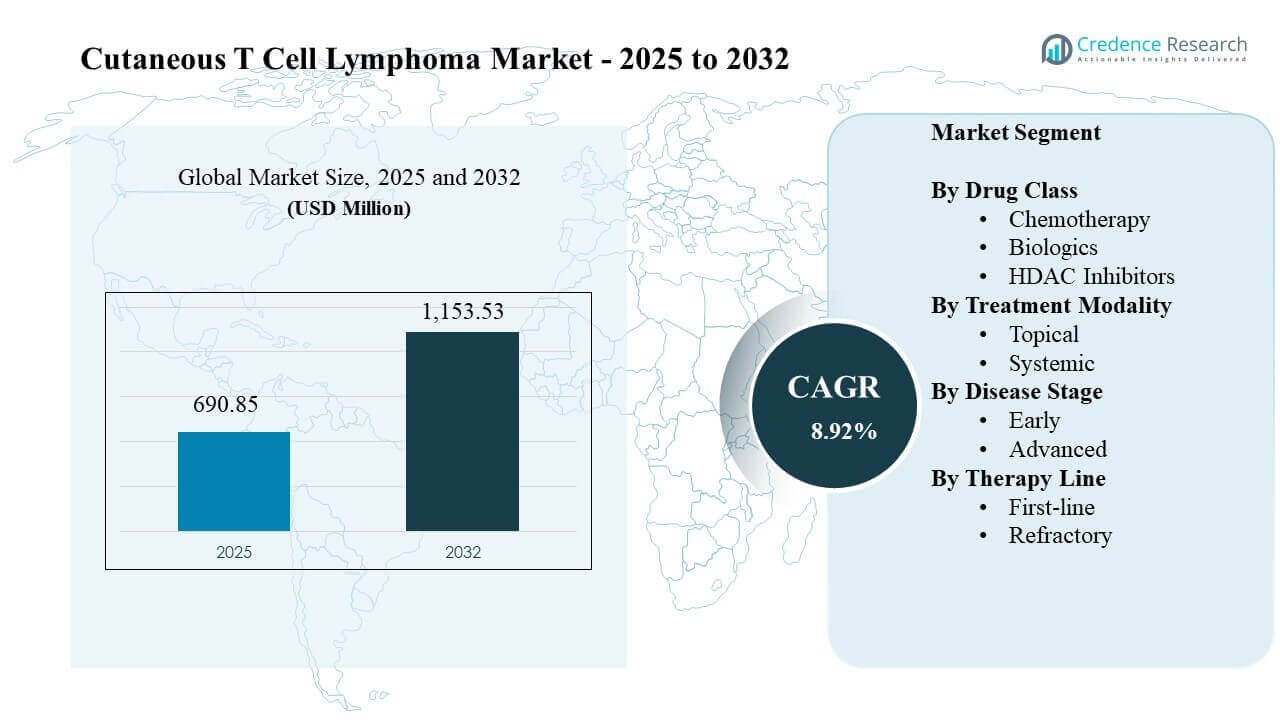
The global Cutaneous T Cell Lymphoma Market size was estimated at USD 690.85 million in 2025 and is expected to reach USD 1,153.53 million by 2032, growing at a CAGR of 8.92% from 2025 to 2032. Growth is anchored in improving diagnosis and referral into specialist dermatology-oncology pathways, which expands treatment initiation and supports longer therapy duration as disease is monitored over time. Treatment sequencing is also shifting toward targeted and immune-based options for persistent disease, supported by clinical evidence generation and specialist center adoption across major health systems.
| REPORT ATTRIBUTE | DETAILS |
|---|---|
| Historical Period | 2020-2024 |
| Base Year | 2025 |
| Forecast Period | 2026-2032 |
| Cutaneous T-Cell Lymphoma Market Size 2025 | USD 690.85 million |
| Cutaneous T-Cell Lymphoma Market, CAGR | 8.92% |
| Cutaneous T-Cell Lymphoma Market Size 2032 | USD 1,153.53 million |
Key Market Trends & Insights
- The Cutaneous T Cell Lymphoma Market is projected to expand at a CAGR of 8.92% during 2025–2032.
- The U.S. accounted for about 70% of the CTCL market share within the 7MM in 2024, reflecting high diagnosis intensity and specialty access.
- The CTCL market across the 7MM was valued at about USD 1,042 million in 2025, reflecting concentrated revenue in specialty-treated populations.
- Mycosis fungoides is expected to remain the largest disease-type contributor in CTCL treatment framing, reaching 60.4% share by 2035.
- After 18 weeks of HyBryte treatment, 75% of CTCL patients achieved “Treatment Success,” signaling continued innovation in skin-directed therapy options.
Segment Analysis
Treatment demand in the Cutaneous T Cell Lymphoma Market is shaped by a stepwise care pathway that often starts with skin-directed management and escalates toward systemic therapy as disease burden increases. Disease heterogeneity drives variation in treatment intensity, with persistent symptoms and relapse risk reinforcing the need for durable disease control. Specialist-driven care models also influence segment performance because therapy selection frequently depends on staging, prior response, and tolerability considerations.
Segment positioning is also influenced by where care is delivered and how quickly patients enter specialty pathways. Earlier detection supports timely initiation of skin-directed regimens, but persistent or progressive disease shifts utilization toward systemic agents used in later lines. As clinical evidence expands for targeted and immune-based approaches, clinicians increasingly tailor sequencing, which supports demand across drug classes and therapy lines.
By Drug Class Insights
Biologics are positioned as the leading class in many treatment pathways because targeted activity and differentiated safety profiles fit specialist-driven sequencing for persistent disease. Clinical practice tends to favor mechanisms that can sustain control when skin-directed approaches become insufficient. Evidence generation in specialty centers reinforces clinician confidence in biologic-based regimens and supports adoption within structured pathways. Chemotherapy remains relevant for select patients and settings, but value concentration often shifts toward targeted options as sequencing evolves. HDAC inhibitors continue to play a role as part of systemic treatment choices in relapsed or refractory care.
By Treatment Modality Insights
Systemic treatment is expected to account for the larger value concentration because advanced and refractory disease typically requires multi-cycle regimens managed by specialty teams. Treatment intensity and duration are often greater in systemic care, which can lift per-patient therapy value. Topical therapy remains foundational in skin-directed management, particularly earlier in the disease course, and it supports symptom control and lesion management. Modality choice is closely tied to clinical stage, response durability, and patient tolerance, which keeps both modalities relevant across the pathway. Integrated care models across dermatology and oncology also improve continuity, supporting sustained therapy utilization.
By Disease Stage Insights
Early-stage disease tends to lead in treated patient volume because diagnosis frequently occurs at patch or plaque stages and patients remain in long-term management frameworks. Skin-directed management, close monitoring, and periodic escalation steps support steady utilization over time. Advanced-stage disease commands higher clinical complexity, which increases reliance on systemic therapies, specialty infusion capacity, and coordinated supportive care. Stage-linked escalation creates a consistent flow of patients from early management into advanced care, which sustains demand across therapeutic options. Specialist referral networks strongly influence stage distribution in treated populations.
By Therapy Line Insights
First-line therapy typically leads in utilization because it represents the largest entry pool of treated patients following diagnosis and staging. Standardized pathways guide initial treatment selection and monitoring, supporting consistent demand across first-line regimens. Refractory care remains strategically important because relapse, persistence, or intolerance can require therapy switching and more complex sequencing. Specialist centers play a key role in refractory management by optimizing regimen choice and coordinating supportive care. As evidence expands, sequencing strategies continue to evolve across therapy lines.
Cutaneous T-Cell Lymphoma Market Drivers
Strengthening diagnosis and specialist referral pathways
Improved recognition of persistent skin symptoms and faster referral to specialist dermatology-oncology care increases treated prevalence in Cutaneous T Cell Lymphoma Market pathways. Structured diagnostic workups and staging approaches support earlier treatment initiation and more consistent follow-up. Greater clinical awareness also reduces time to diagnosis for eligible patients, which supports sustained management over longer windows. Concentration of care in specialty centers improves treatment selection and monitoring. These factors collectively reinforce higher therapy uptake across lines.
- For instance, Invivoscribe’s IdentiClone TCRB + TCRG T-Cell Clonality Assay was validated using more than 400 clinical samples across more than 30 independent testing centers in Europe, and combined TCRB plus TCRG testing reached 94% sensitivity versus 91% for TCRB alone and 89% for TCRG alone, supporting more reliable molecular confirmation in suspected lymphoproliferative disease workups.
Expanding use of targeted and immune-based systemic therapies
Treatment strategies increasingly emphasize targeted mechanisms and immune-based approaches for patients who need systemic control. Specialist confidence grows as clinical evidence matures and real-world experience expands in referral centers. Broader adoption supports more predictable treatment sequencing across therapy lines and disease stages. Therapy differentiation by efficacy and tolerability supports continued switching and sequencing in persistent disease. This dynamic strengthens systemic utilization and supports demand across multiple drug classes.
- For instance, Kyowa Kirin’s mogamulizumab showed a 28.0% overall response rate versus 4.8% with vorinostat in the phase 3 MAVORIC trial of 372 patients with relapsed or refractory mycosis fungoides or Sézary syndrome, and 10.8% of mogamulizumab-treated patients maintained responses for at least 12 months, reinforcing specialist confidence in immune-based sequencing.
Longer-duration management and chronic-care utilization patterns
Many patients require extended monitoring and repeated intervention cycles, which sustains therapy utilization beyond short treatment windows. Disease persistence and symptom burden can drive ongoing care, including maintenance-like approaches in clinical practice. Longitudinal management frameworks encourage consistent follow-up, which improves adherence and reduces drop-off from care pathways. Specialist-based monitoring also supports earlier recognition of progression, enabling timely escalation. These patterns underpin steady demand across modalities.
Evidence generation and clinical positioning for skin-directed options
Ongoing clinical updates and comparative evidence for skin-directed approaches support clinician decision-making in defined populations. Skin-directed therapies remain important for controlling visible lesions and improving quality of life, especially earlier in the disease course. Data visibility reinforces differentiation versus alternative options and supports sustained prescribing where clinically appropriate. Improved protocols and practical guidance also help standardize use in specialty clinics. This supports demand for topical approaches even as systemic care expands.
Cutaneous T-Cell Lymphoma Market Challenges
Access variability remains a persistent constraint because specialist capacity, diagnostic workups, and therapy availability differ across health systems. Patients may experience delays in diagnosis or referral, which can postpone treatment initiation and reduce continuity of care. Reimbursement scrutiny for specialty therapies can shape prescribing patterns, especially where cost controls influence step-through requirements. Clinical heterogeneity also complicates treatment selection, which increases variation in outcomes and care pathways. These factors can slow uniform adoption across regions.
- For instance, DermTech reported that its PLAplus melanoma test added TERT promoter mutation analysis to its existing RNA-based assay and increased sensitivity from 91% to 97% while maintaining a negative predictive value above 99%, with a stated probability of missing melanoma below 1%.
Treatment sequencing complexity can also limit optimal therapy utilization in routine practice. Adverse-event management, monitoring requirements, and comorbidity considerations can constrain therapy intensity for some patients. Care fragmentation between dermatology and oncology settings may disrupt follow-up and delay escalation when disease progresses. Limited comparability across clinical evidence sources can create uncertainty for clinicians evaluating alternatives. This can moderate uptake of newer options in some settings.
Market Trends and Opportunities
Specialty care models are increasingly integrating dermatology, oncology, and supportive services to improve continuity and accelerate escalation decisions. This creates opportunities for therapies aligned with structured pathways and clear monitoring approaches. Growing emphasis on evidence-backed differentiation supports adoption for products with clinically meaningful outcomes and practical administration. Digital follow-up tools and structured symptom tracking can also strengthen adherence and allow earlier recognition of progression. These trends support steady expansion in treated prevalence and therapy utilization.
- For instance, Kyowa Kirin’s defucosylated anti-CCR4 antibody mogamulizumab demonstrated multicompartment activity in the phase 3 MAVORIC study, with response rates of 42% in skin and 68% in blood, while median time to response was 1.1 months in blood, 3.0 months in skin, and 3.3 months in lymph nodes, supporting its fit within structured monitoring pathways.
Pipeline innovation and comparative evidence generation create opportunities to refine sequencing and expand addressable subpopulations. Therapies that demonstrate differentiated tolerability or disease-control durability can gain traction in refractory settings. Real-world evidence and head-to-head analyses can support formulary access and reduce uncertainty in clinician choice. Expanded specialist education and guideline alignment can further broaden adoption in non-tertiary settings. These factors collectively improve commercialization pathways for differentiated CTCL options.
Regional Insights
North America
North America is expected to remain the leading region due to stronger diagnosis intensity, broad access to specialist pathways, and established use of specialty oncology therapies. Concentration of care in dedicated centers supports consistent staging, monitoring, and escalation decisions. Reimbursement structures can enable access to targeted and immune-based options, although payer controls may influence sequencing. Strong clinical trial participation also supports evidence generation and clinician familiarity. These factors support sustained therapy utilization over time.
Europe
Europe benefits from established tertiary referral networks and structured clinical pathways that support consistent diagnostic workups and follow-up. Access to specialty therapies varies by country, which can affect uptake speed and treatment sequencing. Cost-effectiveness and reimbursement evaluations can shape adoption of premium therapies, especially outside major markets. Specialist density and treatment protocol standardization support stable demand in leading countries. Regional variation in access remains a key differentiator within Europe.
Asia Pacific
Asia Pacific is expected to show strong growth momentum as specialty capacity expands and access to advanced diagnostics improves in major hospital systems. Urban tertiary centers are likely to drive adoption as referral patterns strengthen and clinical expertise broadens. Increasing availability of advanced therapies and specialist-led protocols supports deeper treatment penetration over time. Differences in reimbursement coverage and specialist availability can still create uneven adoption across countries. Ongoing capacity build-out supports longer-term expansion.
Latin America
Latin America is expected to remain smaller in market value due to uneven specialist availability and variability in access to advanced diagnostics and specialty therapies. Patients may face delays in referral to experienced centers, which can affect treatment initiation and continuity. Public-private coverage differences can influence access to premium therapies and supportive care. Where specialist centers are present, structured pathways support better monitoring and escalation. Improved access and capability development represent key growth levers.
Middle East & Africa
Middle East and Africa is expected to have a smaller share due to limited specialist density in many markets and inconsistent access to advanced diagnostics and specialty oncology drugs. Care pathways can be fragmented, with variable referral structures and treatment availability. Centers of excellence in select countries may support higher-quality care, but access remains uneven across the broader region. Procurement and reimbursement constraints can influence therapy selection and continuity. Expansion of specialist services and diagnostics capacity would support growth.
Competitive Landscape
Competition in the Cutaneous T Cell Lymphoma Market is shaped by differentiated mechanisms, specialist-driven adoption, and evidence generation that supports positioning in sequencing pathways. Companies compete on clinical outcomes, tolerability profiles, and the practicality of administration within specialty clinics. Portfolio breadth across oncology and specialty therapeutics can support stronger stakeholder engagement and pathway integration. Clinical visibility through congress presence and comparative evidence also influences adoption. Sustained differentiation is tied to proof of benefit in persistent and refractory disease.
Kyowa Kirin is positioned around specialty oncology execution and evidence-led clinical engagement, supporting adoption where referral pathways concentrate CTCL care. Specialist-centric commercialization and medical education can strengthen prescribing consistency in experienced centers. A focused approach to pathway integration, including sequencing considerations and monitoring practices, supports durable presence in systemic care settings. Continued emphasis on clinical data visibility helps reinforce clinician familiarity. This supports competitive resilience as treatment paradigms evolve.
The industry research and growth report includes detailed analyses of the competitive landscape of the market and information about key companies, including:
- Kyowa Kirin
- Bausch Health
- Helsinn
- Merck & Co.
- Johnson & Johnson
- Celgene
- Eisai
- Seattle Genetics
- Takeda
- Soligenix
Qualitative and quantitative analysis of companies has been conducted to help clients understand the wider business environment as well as the strengths and weaknesses of key industry players. Data is qualitatively analyzed to categorize companies as pure play, category-focused, industry-focused, and diversified; it is quantitatively analyzed to categorize companies as dominant, leading, strong, tentative, and weak.
Recent Developments
- In October 2025, Citius Oncology entered an exclusive commercialization agreement with EVERSANA to support the planned fourth-quarter 2025 U.S. launch of LYMPHIR for relapsed or refractory cutaneous T-cell lymphoma. The partnership was designed to strengthen launch readiness through integrated commercialization services, including medical information, pharmacovigilance, revenue cycle management, analytics, and channel support.
- In December 2025, Citius Oncology announced the U.S. commercial launch of LYMPHIR (denileukin diftitox-cxdl) for adult patients with relapsed or refractory Stage I-III cutaneous T-cell lymphoma after at least one prior systemic therapy. The company described LYMPHIR as its first marketed product and positioned the launch as a major step in expanding treatment options in a market with limited therapies.
- In February 2026, Citius Oncology signed an exclusive distribution agreement with Uniphar to expand access to LYMPHIR outside the United States. The agreement supports international distribution through managed access programs in selected markets and reflects the company’s broader strategy to grow LYMPHIR’s presence globally in cutaneous T-cell lymphoma treatment.
- In October 2025, Citius Oncology also entered an exclusive distribution agreement with Integris Pharma S.A. as part of its named-patient access strategy for LYMPHIR in Europe and nearby regions. This partnership covered Greece, Cyprus, Malta, Bulgaria, Romania, Croatia, Serbia, Albania, Bosnia and Herzegovina, Kosovo, Montenegro, and North Macedonia, helping the company widen early international access for eligible CTCL patients.
Report Scope
| Report Attribute | Details |
| Market size value in 2025 | USD 690.85 million |
| Revenue forecast in 2032 | USD 1,153.53 million |
| Growth rate (CAGR) | 8.92% (2025–2032) |
| Base year | 2025 |
| Forecast period | 2026-2032 |
| Quantitative units | USD million |
| Segments covered | By Drug Class Outlook: Chemotherapy, Biologics, HDAC Inhibitors; By Treatment Modality Outlook: Topical, Systemic; By Disease Stage Outlook: Early, Advanced; By Therapy Line Outlook: First-line, Refractory |
| Regional scope | North America, Europe, Asia Pacific, Latin America, Middle East & Africa |
| Key companies profiled | Kyowa Kirin, Bausch Health, Helsinn, Merck & Co., Johnson & Johnson, Celgene, Eisai, Seattle Genetics, Takeda, Soligenix |
| No.of Pages | 332 |
Segmentation
By Drug Class
- Chemotherapy
- Biologics
- HDAC Inhibitors
By Treatment Modality
- Topical
- Systemic
By Disease Stage
- Early
- Advanced
By Therapy Line
- First-line
- Refractory
By Region
- North America
- U.S.
- Canada
- Mexico
- Europe
- Germany
- France
- U.K.
- Italy
- Spain
- Rest of Europe
- Asia Pacific
- China
- Japan
- India
- South Korea
- South-east Asia
- Rest of Asia Pacific
- Latin America
- Brazil
- Argentina
- Rest of Latin America
- Middle East & Africa
- GCC Countries
- South Africa
- Rest of the Middle East and Africa

Request a Free Sample
Fill in your details and we'll send you a free sample report.
- Sample data tables & charts
- Research methodology
Need a Custom Version of This Report?
Tailor the scope, geography, or segments to your exact requirements.
- Custom geography or segment scope
- Direct access to our analyst team
Frequently Asked Questions
What is the Cutaneous T Cell Lymphoma Market size in 2025 and the forecast for 2032?
What is the CAGR for the Cutaneous T Cell Lymphoma Market during 2025–2032?
Which segment is expected to be the largest in the Cutaneous T Cell Lymphoma Market?
What factors are driving growth in the Cutaneous T Cell Lymphoma Market?
Who are the leading companies in the Cutaneous T Cell Lymphoma Market?
Which region leads the Cutaneous T Cell Lymphoma Market?
Table of Content
Chapter 1 Market Segmentation
- 1.1 Segmentation Framework
- 1.1.1 Product and Service Classification
- 1.1.2 Application and End-Use Classification
- 1.1.3 Technology and Solution Classification
- 1.1.4 Customer and Distribution Channel Classification
- 1.1.5 Geographic Segmentation
- 1.1.6 Market Segment Definitions and Boundaries
Chapter 2 Introduction
- 2.1 Report Objectives and Scope
- 2.2 Product Definition and Industry Terminology
- 2.3 Market Inclusions and Exclusions
- 2.4 Research Process
- 2.4.1 Primary Research and Expert Interviews
- 2.4.2 Secondary Research and Source Review
- 2.4.3 Top-Down and Bottom-Up Estimation
- 2.4.4 Data Triangulation and Verification
- 2.5 Market Size Measurement Basis
- 2.5.1 2025: USD 690.85 million → 2032: USD 1,153.53 million
- 2.6 Historical and Forecast Reference Periods
- 2.6.1 Base Year: 2025
- 2.6.2 Forecast Period: 2025-2032
- 2.7 Research Assumptions and Limitations
Chapter 3 Executive Summary
- 3.1 Market Snapshot and Key Findings
- 3.2 Base-Year Market Size, 2025
- 3.3 Forecast Market Size, 2032
- 3.4 Revenue and Volume Growth Outlook
- 3.5 Key Demand and Supply Indicators
- 3.6 Leading Market Segments
- 3.7 Fastest-Growing Market Opportunities
- 3.8 Regional Performance Highlights
- 3.9 Technology and Industry Transformation
- 3.10 Competitive Landscape Summary
- 3.11 Analyst View and Strategic Implications
Chapter 4 Global Cutaneous T-Cell Lymphoma Market Trends and Developments
- 4.1 Historical Industry Development
- 4.2 Recent Market Trends and Developments
- 4.3 Demand and Customer Behavior Trends
- 4.4 Technology and Product Innovation
- 4.5 Artificial Intelligence, Automation and Digitalization
- 4.6 Local Manufacturing and Supply Chain Realignment
- 4.7 Industry Partnerships, Mergers and Acquisitions
- 4.8 Sustainability and Circular Economy Developments
- 4.9 Government and Private Sector Investment Trends
- 4.10 Emerging Business Models and Commercialization
- 4.11 Industry Developments and Announcements
Chapter 5 Global Cutaneous T-Cell Lymphoma Market Production, Supply and Demand Analysis
- 5.1 Demand Trend and Consumption Analysis
- 5.2 Demand Forecast, 2025-2032
- 5.3 Production and Output Trend
- 5.4 Production and Output Forecast, 2025-2032
- 5.5 Installed Capacity and Capacity Utilization
- 5.6 Company-Wise Production Plants and Statistics
- 5.6.1 Installed Production Capacity
- 5.6.2 Actual Production
- 5.6.3 Planned Capacity and Expansion Targets
- 5.7 Supply Chain Structure and Procurement Trends
- 5.8 Supply-Demand Gap and Bottlenecks
- 5.9 Import Dependence and Sourcing Structure
- 5.10 Contract Manufacturing and Outsourcing
- 5.11 Regional Supply and Demand Concentration
Chapter 6 Global Cutaneous T-Cell Lymphoma Market Pricing Analysis
- 6.1 Pricing Structure and Measurement
- 6.2 Historical Pricing Trends
- 6.3 Pricing Outlook, 2025-2032
- 6.4 Average Selling Price and Unit Economics
- 6.5 Pricing by Product and Market Segment
- 6.6 Geographic Pricing Differences
- 6.7 Key Input, Energy, Labor and Logistics Costs
- 6.8 Contract Pricing and Purchasing Models
- 6.9 Pricing Sensitivity and Competitive Positioning
- 6.10 Price, Margin and Profitability Implications
Chapter 7 Global Cutaneous T-Cell Lymphoma Market Dynamics
- 7.1 Market Growth Drivers
- 7.1.1 Demand-Side Drivers
- 7.1.2 Technology and Innovation Drivers
- 7.1.3 Infrastructure and Investment Drivers
- 7.1.4 Regulatory and Policy Drivers
- 7.2 Market Restraints
- 7.2.1 Cost and Affordability Constraints
- 7.2.2 Technology and Adoption Barriers
- 7.2.3 Supply Chain and Operational Constraints
- 7.3 Market Challenges
- 7.3.1 Competitive Pressure and Margin Erosion
- 7.3.2 Skills, Infrastructure and Implementation Gaps
- 7.4 Emerging Market Opportunities
- 7.5 Market Dynamics Impact and Time-Horizon Assessment
Chapter 8 Global Cutaneous T-Cell Lymphoma Value Chain Analysis
- 8.1 Industry Value Chain Overview
- 8.2 Upstream Suppliers and Critical Inputs
- 8.3 Technology and Component Providers
- 8.4 Manufacturing or Service Delivery
- 8.5 Distribution, Channel Partners and Integrators
- 8.6 Downstream Applications and End Users
- 8.7 Value Addition and Profit Pools
- 8.8 Vertical Integration and Outsourcing
- 8.9 Supplier Concentration and Risk
- 8.10 Supply Chain Localization and Resilience
Chapter 9 Global Cutaneous T-Cell Lymphoma Market Regulations and Policies
- 9.1 Relevant Laws, Standards and Compliance Frameworks
- 9.2 Product, Service, Safety and Quality Requirements
- 9.3 Government Policies, Incentives and Subsidies
- 9.4 Imports, Exports and Trade Barriers
- 9.5 Public Procurement and Local Content Requirements
- 9.6 Environmental and Sustainability Compliance
- 9.7 Upcoming Policy Changes and Market Implications
Chapter 10 Global Cutaneous T-Cell Lymphoma Market Hotspots and Opportunities
- 10.1 Market Opportunity Mapping and Growth Hotspots
- 10.2 High-Growth Applications and Customer Groups
- 10.3 Underserved Markets and White-Space Opportunities
- 10.4 Emerging Technology and Product Opportunities
- 10.5 New Capacity and Investment Hotspots
- 10.6 Market Entry and Expansion Opportunities
- 10.7 Distribution and Partnership Opportunities
- 10.8 Near-Term and Long-Term Commercial Potential
- 10.9 Opportunity Attractiveness and Execution Risks
Chapter 11 Global Cutaneous T-Cell Lymphoma Market Outlook, 2025-2032
- 11.1 Market Size and Analysis
- 11.1.1 Revenue (Market Measurement: 2025: USD 690.85 million → 2032: USD 1,153.53 million)
- 11.1.2 Market Volume and Quantity Sold
- 11.1.3 Historical Market Size
- 11.1.4 Base-Year Market Size, 2025
- 11.2 Market Forecast, 2025-2032
- 11.2.1 Revenue Forecast to 2032
- 11.2.2 Volume Forecast to 2032
- 11.2.3 CAGR and Year-on-Year Growth
- 11.2.4 Incremental Revenue Opportunity
- 11.3 Forecast Assumptions and Scenario Analysis
- 11.3.1 Base-Case Forecast
- 11.3.2 Optimistic and Conservative Scenarios
- 11.3.3 Technology, Pricing and Policy Sensitivities
- 11.4 Market Attractiveness and Growth Outlook
Chapter 12 Global Cutaneous T-Cell Lymphoma Market Segmentation and Outlook
- 12.1 Segmentation Summary and Market Shares, 2025
- 12.2 Largest and Fastest-Growing Segments
- 12.3 Segment Growth Comparison
- 12.4 Segment Attractiveness and Priority Matrix
Chapter 13 Global Cutaneous T-Cell Lymphoma Geographic Market Outlook, 2025-2032
- 13.1 Regional Market Size and Share, 2025
- 13.2 Regional Market Forecast, 2025-2032
- 13.3 Regional Pricing, Production and Demand Differences
- 13.4 North America
- 13.4.1 United States
- 13.4.2 Canada
- 13.4.3 Mexico
- 13.5 Europe
- 13.5.1 Germany
- 13.5.2 France
- 13.5.3 Italy
- 13.5.4 United Kingdom
- 13.5.5 Spain
- 13.5.6 Poland
- 13.5.7 Russia
- 13.5.8 Netherlands
- 13.5.9 Belgium
- 13.5.10 Sweden
- 13.5.11 Denmark
- 13.5.12 Norway
- 13.5.13 Rest of Europe
- 13.6 Asia Pacific
- 13.6.1 China
- 13.6.2 India
- 13.6.3 Japan
- 13.6.4 South Korea
- 13.6.5 Thailand
- 13.6.6 Indonesia
- 13.6.7 Vietnam
- 13.6.8 Malaysia
- 13.6.9 Australia
- 13.6.10 Rest of Asia Pacific
- 13.7 Latin America
- 13.7.1 Brazil
- 13.7.2 Argentina
- 13.7.3 Colombia
- 13.7.4 Chile
- 13.7.5 Rest of Latin America
- 13.8 Middle East
- 13.8.1 Saudi Arabia
- 13.8.2 United Arab Emirates
- 13.8.3 Turkey
- 13.8.4 Israel
- 13.8.5 Iran
- 13.8.6 Rest of the Middle East
- 13.9 Africa
- 13.9.1 South Africa
- 13.9.2 Egypt
- 13.9.3 Nigeria
- 13.9.4 Morocco
- 13.9.5 Rest of Africa
- 13.10 Regional Investment, Policy and Supply Chain Differences
- 13.11 Regional Competitive Landscape
- 13.12 Geographic Growth Hotspots
Chapter 14 Global Cutaneous T-Cell Lymphoma Technology, Innovation and Sustainability Outlook
- 14.1 Technology Landscape and Maturity
- 14.2 Product, Process and Service Innovation
- 14.3 AI, Automation and Digital Tools in the Industry
- 14.4 Technology Adoption and Performance Benchmarking
- 14.5 Innovation Pipeline and R&D Investment
- 14.6 Patent and Intellectual Property Trends
- 14.7 Energy Efficiency and Resource Management
- 14.8 Sustainability, Recycling and Circularity
- 14.9 Technology Roadmap, 2025-2032
- 14.10 Risks of Obsolescence and Technology Substitution
Chapter 15 Global Cutaneous T-Cell Lymphoma Market Key Strategic Imperatives
- 15.1 Growth and Market Entry Priorities
- 15.2 High-Return Products and Segments
- 15.3 Pricing, Profitability and Cost Optimization
- 15.4 Technology Investment and Product Differentiation
- 15.5 Supply Chain Localization and Resilience
- 15.6 Distribution and Customer Acquisition
- 15.7 Partnership, Acquisition and Capacity Strategy
- 15.8 Regional Expansion Priorities
- 15.9 Short-, Medium- and Long-Term Actions
Chapter 16 Competition Outlook
- 16.1 Industry Competition Characteristics
- 16.2 Market Structure and Concentration
- 16.3 Market Share and Competitive Positioning, 2025
- 16.4 Company-Wise Revenue and Product Benchmarking
- 16.5 Production and Service Capacity Benchmarking
- 16.6 Technology, Pricing and Differentiation
- 16.7 Regional Footprint and Distribution Strength
- 16.8 Mergers, Acquisitions and Strategic Alliances
- 16.9 New Entrants and Competitive Threats
- 16.10 Porter's Five Forces and Industry Attractiveness
- 16.11 Competitive Outlook, 2025-2032
Chapter 17 Company Profiles
- 17.1 Company Coverage and Selection Criteria
- 17.2 Leading Market Participants – Standard Profile Structure
- 17.2.1 Business Description
- 17.2.2 Company Ownership and Geographic Presence
- 17.2.3 Product and Service Portfolio
- 17.2.4 Manufacturing and Operating Footprint
- 17.2.5 Production Capacity and Expansion Plans
- 17.2.6 Financial Performance and Investment
- 17.2.7 Market Share and Competitive Position
- 17.2.8 Technology and Innovation Capabilities
- 17.2.9 Strategic Alliances or Partnerships
- 17.2.10 Recent Developments
- 17.2.11 Growth Strategy and Outlook
- 17.3 Other Relevant Market Participants
Note: Every listed company is profiled on the structure shown under the first company. The company list is preliminary and may change based on research findings, market developments, data availability and client requirements.
Chapter 18 Disclaimer
- 18.1 Research and Forecast Disclaimer
- 18.2 Data Source and Estimation Limitations
Note: The depth of individual sections depends on data availability for this market. Volume, capacity, trade and other unit-based metrics are included where applicable.

