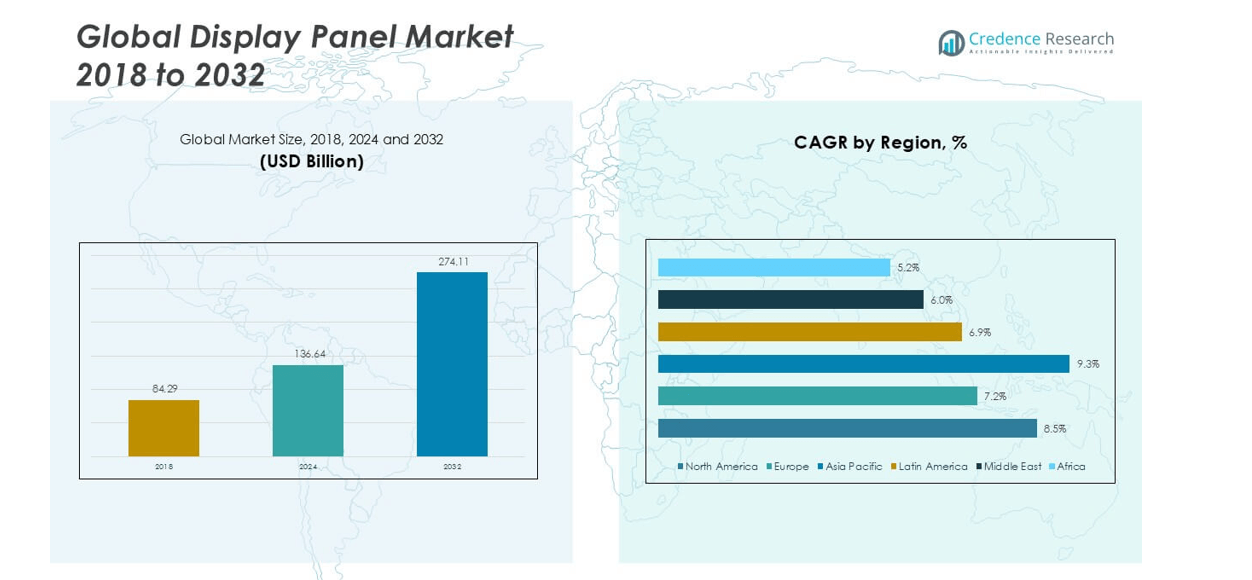
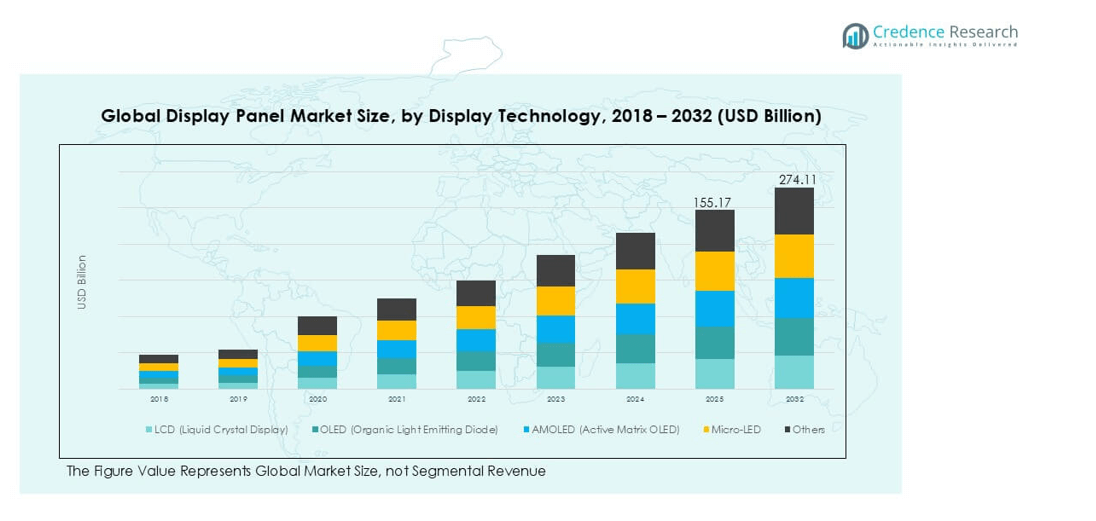
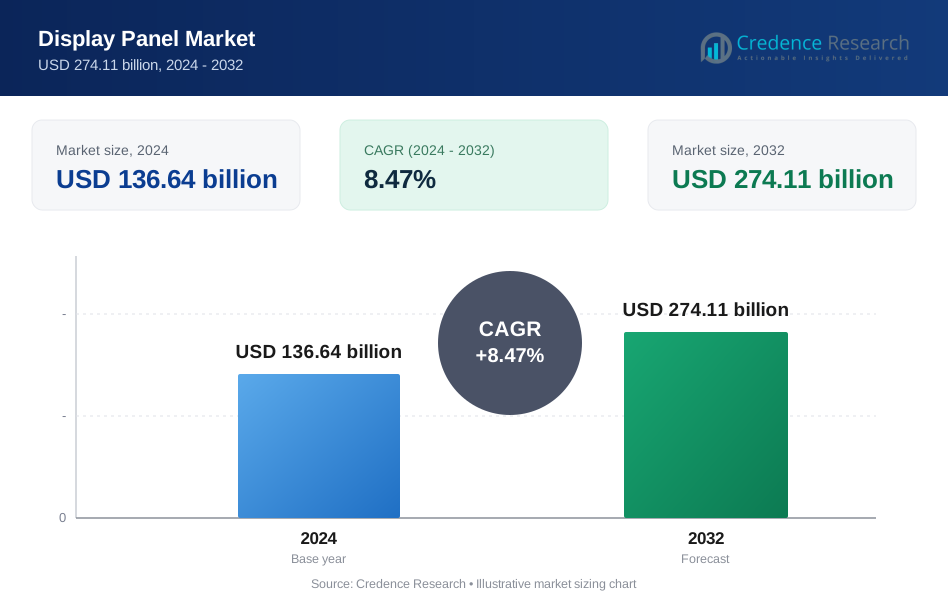
The Display Panel market size was valued at USD 84.29 billion in 2018, reached USD 136.64 billion in 2024, and is anticipated to reach USD 274.11 billion by 2032, at a CAGR of 8.47% during the forecast period.
| REPORT ATTRIBUTE | DETAILS |
|---|---|
| Historical Period | 2020-2023 |
| Base Year | 2024 |
| Forecast Period | 2025-2032 |
| Display Panel Market Size 2024 | USD 136.64 billion |
| Display Panel Market, CAGR | 8.47% |
| Display Panel Market Size 2032 | USD 274.11 billion |
The display panel market is driven by leading players including BOE Technology Group, Samsung Display, LG Display, Innolux, Sharp, Japan Display, Tianma Microelectronics, Visionox, AU Optronics, and CSOT. These companies focus on innovation in OLED, AMOLED, and emerging Micro-LED technologies while maintaining strong production capacity in LCD panels. Asia Pacific dominated the market in 2024 with 45% share, supported by large-scale manufacturing hubs in China, South Korea, and Japan, alongside rising consumer electronics demand. North America followed with 28% share, driven by advanced adoption of premium televisions, monitors, and smartphones. Europe accounted for 18% share, benefitting from growing automotive and energy-efficient display integration.
Market Insights
- The display panel market was valued at USD 136.64 billion in 2024 and is projected to reach USD 274.11 billion by 2032, growing at a CAGR of 8.47% during the forecast period.
- Strong demand for smartphones, tablets, and televisions continues to drive growth, with LCD holding the largest share, while OLED and AMOLED technologies gain traction in premium devices.
- Key trends include rising adoption of Micro-LED for high-end displays, expansion of AR/VR applications using micro-displays, and increasing focus on energy-efficient and eco-friendly panels.
- The competitive landscape features major players such as BOE, Samsung Display, LG Display, Innolux, Sharp, and AU Optronics, all investing heavily in R&D and scaling production capacity to meet global demand.
- Regionally, Asia Pacific led with 45% share in 2024, followed by North America with 28% and Europe with 18%, while Latin America, Middle East, and Africa together accounted for under 10%, reflecting growth potential in emerging markets.
Market Segmentation Analysis:
By Display Technology
The display technology segment is led by LCD, accounting for more than 40% market share in 2024. LCD’s dominance stems from its cost efficiency, wide adoption in televisions, monitors, and budget smartphones, and strong supply chain availability. OLED and AMOLED are gaining traction with premium smartphone and television manufacturers due to superior picture quality, flexibility, and energy efficiency. Micro-LED, though emerging, is expected to expand rapidly in high-end applications because of its brightness and durability. Others, including e-paper and plasma panels, hold niche roles in specialized uses.
- For instance, Samsung shipped over 135 million AMOLED smartphone displays in 2023, strengthening the shift toward premium display technologies.
By Panel Size
Large panels above 13 inches dominate the panel size segment with nearly 50% market share in 2024. Growth is fueled by demand in televisions, digital signage, and large-format monitors. Small and medium-sized panels between 2 to 13 inches are also significant, driven by smartphones, tablets, and laptops. Micro displays below 2 inches, though a smaller portion, serve niche applications such as smartwatches, AR/VR headsets, and military optics. Expanding consumer preference for bigger viewing experiences and rising adoption of high-resolution TVs remain the key growth drivers.
- For instance, BOE Technology shipped over 70 million TV panels larger than 32 inches in 2023, supporting global demand for large-format displays.
By Application
Smartphones and tablets lead the application segment, capturing over 35% share in 2024. Rising smartphone penetration, especially in Asia-Pacific, and rapid adoption of OLED and AMOLED technologies fuel this growth. Television displays represent the second-largest share, supported by increasing demand for 4K and 8K panels in home entertainment. Desktop monitors and laptops maintain steady growth due to remote work trends and gaming applications. Digital signage is expanding in retail and transportation sectors, enhancing customer engagement. Other applications, such as automotive displays and wearables, provide emerging opportunities in specialized markets.
Market Overview
Rising Demand for Smartphones and Consumer Electronics
The rapid increase in smartphone penetration globally drives strong demand for display panels, especially in emerging economies. Consumers prefer larger, high-resolution, and energy-efficient displays, pushing manufacturers to adopt advanced technologies such as OLED and AMOLED. In addition, rising sales of tablets, laptops, and wearables further support market expansion. Smartphone leaders continue to integrate premium display features, including higher refresh rates and foldable panels, creating new opportunities. With the global shift toward digital lifestyles and increased consumer spending on electronics, this segment remains a core driver for display panel growth.
- For instance, in 2023, Apple shipped over 232 million iPhones, including the iPhone 15 series and older models. While many of these were equipped with high-resolution OLED or Super Retina XDR displays supplied by Samsung and LG Display
Advancements in Display Technologies
Continuous innovations in display technologies, including Micro-LED and AMOLED, significantly strengthen market development. Micro-LED panels offer superior brightness, color accuracy, and energy efficiency, making them attractive for premium televisions and AR/VR devices. AMOLED is widely adopted in flagship smartphones due to its thin design and flexible application. Ongoing R&D investments by major players such as Samsung, LG, and BOE enhance production efficiency and reduce costs, expanding accessibility. These advancements improve user experience while addressing energy-saving requirements, thereby propelling adoption across consumer electronics, automotive displays, and next-generation wearables.
- For instance, Samsung invested over USD 3.1 billion in 2023 to expand its OLED and Micro-LED production lines, enabling shipment of more than 150 million AMOLED panels for global smartphone brands.
Growing Adoption of Large-Screen Displays
Consumer demand for immersive viewing experiences continues to expand the market for large-screen televisions, monitors, and digital signage. In 2024, large panels above 13 inches accounted for the majority market share, supported by rising 4K and 8K television sales. Retailers, airports, and entertainment venues increasingly deploy digital signage solutions for advertising and customer engagement. Meanwhile, the popularity of online streaming platforms fuels demand for home entertainment systems with larger, high-resolution screens. These preferences, combined with falling panel prices and wider availability, reinforce the dominance of large-screen displays as a significant growth driver.
Key Trends & Opportunities
Expansion of AR/VR and Wearable Displays
The rising adoption of AR/VR headsets in gaming, healthcare, and industrial training presents a major opportunity for micro and flexible displays. Micro-LED and OLED technologies support these applications with superior clarity and compact size, ideal for immersive experiences. Additionally, wearable devices such as smartwatches and fitness trackers continue to expand globally, requiring innovative display solutions that combine durability with energy efficiency. Companies investing in this niche will benefit from strong demand in both consumer and enterprise markets.
- For instance, Meta shipped over 10 million Quest 2 VR headsets by 2023, each equipped with fast-switch LCD panels supplied by BOE, demonstrating the scale of display demand in immersive devices.
Shift Toward Energy-Efficient and Eco-Friendly Panels
Sustainability initiatives across industries are pushing display panel manufacturers to focus on energy-efficient technologies. Low-power consumption in OLED and Micro-LED displays is increasingly valued in consumer electronics. Governments and regulators emphasize eco-friendly production practices, reducing the environmental impact of panel manufacturing. This trend creates opportunities for companies that integrate recyclable materials and energy-efficient designs into their product lines. As consumers become more environmentally conscious, adoption of greener display technologies is expected to accelerate.
Key Challenges
High Manufacturing Costs of Advanced Displays
Despite strong demand, the high cost of producing OLED and Micro-LED panels poses a major challenge. Advanced displays require complex production techniques, precision equipment, and high material costs, limiting adoption in mid-range and budget devices. Yield rates for Micro-LED production remain low, further driving up expenses. These cost barriers restrict wider availability and delay mass adoption, particularly in price-sensitive markets such as Asia-Pacific and Latin America. Manufacturers must improve efficiency and scalability to overcome this obstacle.
Supply Chain Disruptions and Market Volatility
The display panel industry is highly vulnerable to global supply chain disruptions. Dependence on specific regions, particularly East Asia, for raw materials and panel assembly creates risks during geopolitical tensions or pandemics. Shortages of semiconductors and disruptions in logistics have already impacted panel availability in recent years. Fluctuating raw material prices also contribute to instability in production costs. Such volatility makes it difficult for manufacturers to maintain consistent pricing strategies and meet rising global demand, creating uncertainty in long-term growth.
Regional Analysis
North America
North America accounted for 28% of the global display panel market in 2024, with a value of USD 38.64 billion, up from USD 24.22 billion in 2018. The market is projected to reach USD 77.85 billion by 2032, expanding at a CAGR of 8.5%. Growth is driven by strong adoption of high-end televisions, smartphones, and gaming monitors, supported by early technology adoption trends. Increasing demand for large-format displays in home entertainment and digital signage across retail and transportation further strengthens the region’s position.
Europe
Europe held 18% market share in 2024, reaching USD 24.19 billion from USD 15.78 billion in 2018. The market is forecast to expand to USD 44.13 billion by 2032, registering a CAGR of 7.2%. Strong demand for OLED televisions, coupled with rising adoption of display technologies in automotive applications, supports market expansion. The region benefits from technological innovations by European automotive manufacturers and rising consumer preference for energy-efficient devices, which encourage wider integration of premium displays across industries.
Asia Pacific
Asia Pacific dominated the global market with 45% share in 2024, valued at USD 61.81 billion, rising from USD 36.77 billion in 2018. It is projected to reach USD 131.57 billion by 2032, advancing at the highest CAGR of 9.3%. The region’s leadership is attributed to large-scale manufacturing in China, South Korea, and Japan, coupled with booming consumer electronics demand in India and Southeast Asia. Expanding smartphone penetration, rising adoption of OLED and AMOLED technologies, and government support for advanced manufacturing reinforce Asia Pacific’s market dominance.
Latin America
Latin America represented 5% of the global market in 2024, valued at USD 6.51 billion, up from USD 4.07 billion in 2018. The market is set to grow to USD 11.59 billion by 2032, at a CAGR of 6.9%. Growth is supported by increasing sales of affordable smartphones and televisions in Brazil and Mexico, where middle-class populations are expanding. Demand for digital signage in retail and hospitality also contributes to regional momentum. However, limited local manufacturing and high import dependence restrain faster market penetration.
Middle East
The Middle East accounted for 3% of global market share in 2024, valued at USD 3.26 billion, compared to USD 2.21 billion in 2018. The market is projected to reach USD 5.43 billion by 2032, growing at a CAGR of 6.0%. Expanding investments in smart city projects, digital signage, and entertainment infrastructure drive display panel adoption. Countries such as the UAE and Saudi Arabia are focusing on advanced consumer technologies and commercial display installations, though the market remains reliant on imports for large-scale supply.
Africa
Africa contributed 2% market share in 2024, reaching USD 2.23 billion from USD 1.24 billion in 2018. It is expected to expand to USD 3.52 billion by 2032, at a CAGR of 5.2%. Market growth is supported by increasing demand for low-cost smartphones and televisions, particularly in South Africa and Nigeria. Rising internet penetration and the spread of mobile-based services drive the need for improved display technologies. However, limited manufacturing infrastructure and affordability challenges restrict faster expansion compared to other regions.
Market Segmentations:
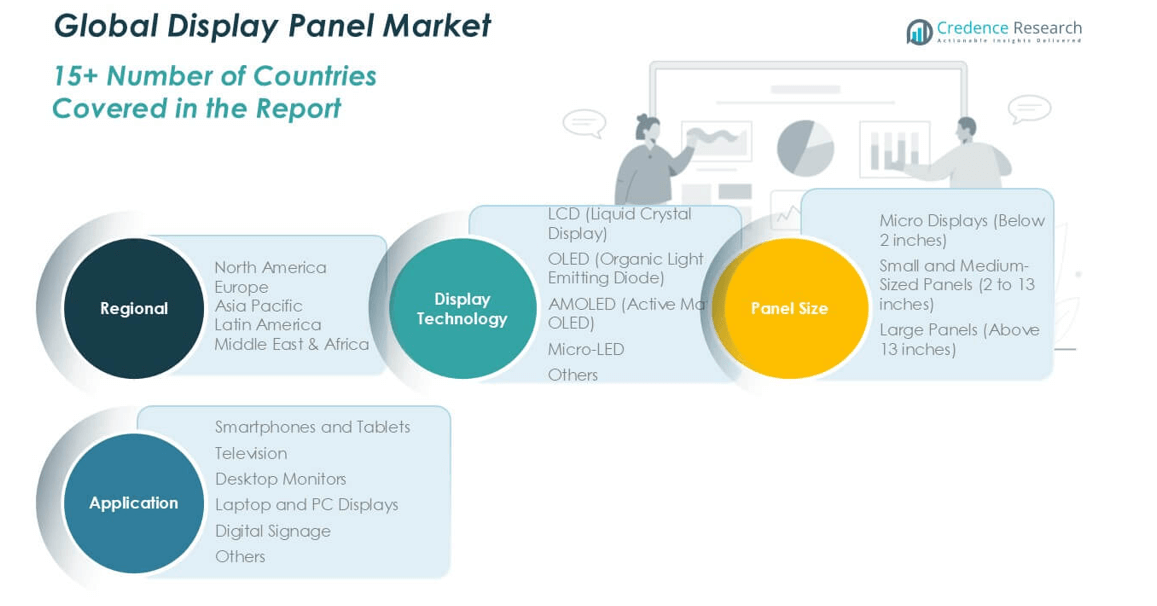
By Display Technology
- LCD (Liquid Crystal Display)
- OLED (Organic Light Emitting Diode)
- AMOLED (Active Matrix OLED)
- Micro-LED
- Others
By Panel Size
- Micro Displays (Below 2 inches)
- Small and Medium-Sized Panels (2 to 13 inches)
- Large Panels (Above 13 inches)
By Application
- Smartphones and Tablets
- Television
- Desktop Monitors
- Laptop and PC Displays
- Digital Signage
- Others
By Geography
- North America
- U.S.
- Canada
- Mexico
- Europe
- UK
- France
- Germany
- Italy
- Spain
- Russia
- Belgium
- Netherlands
- Austria
- Sweden
- Poland
- Denmark
- Switzerland
- Rest of Europe
- Asia Pacific
- China
- Japan
- South Korea
- India
- Australia
- Thailand
- Indonesia
- Vietnam
- Malaysia
- Philippines
- Taiwan
- Rest of Asia Pacific
- Latin America
- Brazil
- Argentina
- Peru
- Chile
- Colombia
- Rest of Latin America
- Middle East
- UAE
- KSA
- Israel
- Turkey
- Iran
- Rest of Middle East
- Africa
- Egypt
- Nigeria
- Algeria
- Morocco
- Rest of Africa
Competitive Landscape
The display panel market is highly competitive, led by key players such as BOE Technology Group Co., Ltd., Samsung Display Co., Ltd., LG Display Co., Ltd., Innolux Corporation, Sharp Corporation, Japan Display Inc., Tianma Microelectronics Co., Ltd., Visionox Technology, Inc., AU Optronics Corp, and CSOT (China Star Optoelectronics Technology). These companies dominate through strong manufacturing capacity, technological innovation, and global distribution networks. BOE and Samsung lead in OLED and AMOLED advancements, while LG Display focuses on large OLED panels for televisions. Sharp and Japan Display emphasize small and medium-sized displays for smartphones and automotive applications. AU Optronics and Innolux expand production for LCD and OLED to serve diverse markets. Tianma and Visionox strengthen their presence in flexible OLED for smartphones and wearables. Strategic collaborations, R&D investments, and expansion into Micro-LED production are shaping competition. The market is further defined by pricing pressures, rapid innovation cycles, and regional manufacturing dominance in Asia-Pacific.\
Key Player Analysis
- BOE Technology Group Co., Ltd.
- Samsung Display Co., Ltd.
- LG Display Co., Ltd.
- Innolux Corporation
- Sharp Corporation
- Japan Display Inc.
- Tianma Microelectronics Co., Ltd.
- Visionox Technology, Inc.
- AU Optronics Corp
- CSOT (China Star Optoelectronics Technology)
Recent Developments
- In July 2025, Innolux agreed to acquire Pioneer for USD 1.1 billion to accelerate automotive smart-cockpit capabilities.
- In July 2025, PlayNitride opened a USD 19 million Micro-LED plant in Kunshan to expand cross-strait production reach.
- In June 2025, LG Electronics (LG) will unveil its latest lifestyle OLED TVs, the LG OLED Objet Collection.LG has teamed up with premium Dutch lifestyle brand, Moooi, to showcase a stylish, modern living solution. The resulting collaboration, which embraces Moooi’s signature ‘A Life Extraordinary’ exhibition theme, features the perfect pairing of LG’s latest lifestyle TVs and Moooi’s extraordinary design products.
- In June 2025, Japan Display Inc. secured USD 664.4 million in funding from Ichigo Trust and asset sales to fund diversification.
- In May 2024, Samsung Electronics unveiled its latest lineup of MicroLED, QLED 8K and Lifestyle TVs ahead of CES 2024. With the introduction of new display sizes, 8K AI upscaling capabilities, innovative display orientation technology, and more, Samsung showcased how its 2024 offerings redefine immersion and revolutionize home integration.
Report Coverage
The research report offers an in-depth analysis based on Display Technology, Panel Size, Application and Geography. It details leading market players, providing an overview of their business, product offerings, investments, revenue streams, and key applications. Additionally, the report includes insights into the competitive environment, SWOT analysis, current market trends, as well as the primary drivers and constraints. Furthermore, it discusses various factors that have driven market expansion in recent years. The report also explores market dynamics, regulatory scenarios, and technological advancements that are shaping the industry. It assesses the impact of external factors and global economic changes on market growth. Lastly, it provides strategic recommendations for new entrants and established companies to navigate the complexities of the market.
Future Outlook
- The market will witness strong growth driven by rising demand for smartphones and premium devices.
- OLED and AMOLED technologies will expand further in consumer electronics and automotive displays.
- Micro-LED adoption will accelerate in high-end televisions, AR/VR devices, and digital signage.
- Large-sized panels will remain dominant as consumers prefer immersive viewing experiences.
- Flexible and foldable displays will gain traction in next-generation smartphones and wearables.
- Energy-efficient and eco-friendly panels will see higher adoption due to sustainability concerns.
- Asia Pacific will continue to lead, supported by strong manufacturing hubs and consumer demand.
- North America and Europe will grow steadily with focus on advanced displays for automotive and gaming.
- Competition among top players will intensify with heavy R&D investments and new product launches.
- Emerging markets in Latin America, Middle East, and Africa will create fresh opportunities for expansion.
Request a Free Sample
Fill in your details and we'll send you a free sample report.
- Sample data tables & charts
- Research methodology
Market Dynamics
Proliferation of Smartphones and Consumer Electronics
The rapid increase in global smartphone penetration, especially in emerging economies, is driving demand for advanced display panels. Consumers are seeking larger, high-resolution, and energy-efficient screens, pushing manufacturers to adopt OLED, AMOLED, and other premium technologies.
Advancements in Display Technologies
Continuous innovation in display technologies such as Micro-LED, OLED, and AMOLED is enhancing panel performance, energy efficiency, and flexibility. These advancements are expanding the use of high-end displays in premium televisions, AR/VR devices, and next-generation wearables.
Growing Demand for Large-Screen and High-Resolution Displays
Consumer preference for immersive viewing experiences is fueling demand for large-format panels in televisions, monitors, and digital signage. The popularity of 4K and 8K TVs, along with the expansion of digital signage in commercial spaces, is a significant growth driver.
Expansion of AR/VR and Wearable Applications
The adoption of AR/VR headsets and wearable devices is creating new opportunities for micro and flexible display panels. Technologies like Micro-LED and OLED are particularly suited for these applications due to their compact size, clarity, and energy efficiency.
Focus on Energy Efficiency and Sustainability
Increasing regulatory and consumer emphasis on sustainability is pushing manufacturers to develop energy-efficient and eco-friendly display panels. Adoption of low-power technologies and recyclable materials is becoming a key differentiator in the market.
Need a Custom Version of This Report?
Tailor the scope, geography, or segments to your exact requirements.
- Custom geography or segment scope
- Direct access to our analyst team
Frequently Asked Questions
What is the current market size for Display Panel market, and what is its projected size in 2032?
At what Compound Annual Growth Rate is the Display Panel market projected to grow between 2025 and 2032?
Which Display Panel market segment held the largest share in 2024?
What are the primary factors fueling the growth of the Display Panel market?
Who are the leading companies in the Display Panel market?
Table of Content
Chapter 1 Market Segmentation
- 1.1 Segmentation Framework
- 1.1.1 Product and Service Classification
- 1.1.2 Application and End-Use Classification
- 1.1.3 Technology and Solution Classification
- 1.1.4 Customer and Distribution Channel Classification
- 1.1.5 Geographic Segmentation
- 1.1.6 Market Segment Definitions and Boundaries
- 1.2 By Panel Size
- 1.2.1 Micro Displays (Below 2 inches)
- 1.2.2 Small and Medium-Sized Panels (2 to 13 inches)
- 1.2.3 Large Panels (Above 13 inches)
- 1.3 By Application
- 1.3.1 Smartphones and Tablets
- 1.3.2 Television
- 1.3.3 Desktop Monitors
- 1.3.4 Laptop and PC Displays
- 1.3.5 Digital Signage
- 1.3.6 Others
- 1.4 By Display Technology
- 1.4.1 LCD (Liquid Crystal Display)
- 1.4.2 OLED (Organic Light Emitting Diode)
- 1.4.3 AMOLED (Active Matrix OLED)
- 1.4.4 Micro-LED
- 1.4.5 Others
Chapter 2 Introduction
- 2.1 Report Objectives and Scope
- 2.2 Product Definition and Industry Terminology
- 2.3 Market Inclusions and Exclusions
- 2.4 Research Process
- 2.4.1 Primary Research and Expert Interviews
- 2.4.2 Secondary Research and Source Review
- 2.4.3 Top-Down and Bottom-Up Estimation
- 2.4.4 Data Triangulation and Verification
- 2.5 Market Size Measurement Basis
- 2.5.1 2024: USD 136.64 billion → 2032: USD 274.11 billion
- 2.6 Historical and Forecast Reference Periods
- 2.6.1 Base Year: 2024
- 2.6.2 Forecast Period: 2024-2032
- 2.7 Research Assumptions and Limitations
Chapter 3 Executive Summary
- 3.1 Market Snapshot and Key Findings
- 3.2 Base-Year Market Size, 2024
- 3.3 Forecast Market Size, 2032
- 3.4 Revenue and Volume Growth Outlook
- 3.5 Key Demand and Supply Indicators
- 3.6 Leading Market Segments
- 3.7 Fastest-Growing Market Opportunities
- 3.8 Regional Performance Highlights
- 3.9 Technology and Industry Transformation
- 3.10 Competitive Landscape Summary
- 3.11 Analyst View and Strategic Implications
Chapter 4 Global Display Panel Market Trends and Developments
- 4.1 Historical Industry Development
- 4.2 Recent Market Trends and Developments
- 4.3 Demand and Customer Behavior Trends
- 4.4 Technology and Product Innovation
- 4.5 Artificial Intelligence, Automation and Digitalization
- 4.6 Local Manufacturing and Supply Chain Realignment
- 4.7 Industry Partnerships, Mergers and Acquisitions
- 4.8 Sustainability and Circular Economy Developments
- 4.9 Government and Private Sector Investment Trends
- 4.10 Emerging Business Models and Commercialization
- 4.11 Industry Developments and Announcements
Chapter 5 Global Display Panel Market Production, Supply and Demand Analysis
- 5.1 Demand Trend and Consumption Analysis
- 5.2 Demand Forecast, 2024-2032
- 5.3 Production and Output Trend
- 5.4 Production and Output Forecast, 2024-2032
- 5.5 Installed Capacity and Capacity Utilization
- 5.6 Company-Wise Production Plants and Statistics
- 5.6.1 Installed Production Capacity
- 5.6.2 Actual Production
- 5.6.3 Planned Capacity and Expansion Targets
- 5.7 Supply Chain Structure and Procurement Trends
- 5.8 Supply-Demand Gap and Bottlenecks
- 5.9 Import Dependence and Sourcing Structure
- 5.10 Contract Manufacturing and Outsourcing
- 5.11 Regional Supply and Demand Concentration
Chapter 6 Global Display Panel Market Pricing Analysis
- 6.1 Pricing Structure and Measurement
- 6.2 Historical Pricing Trends
- 6.3 Pricing Outlook, 2024-2032
- 6.4 Average Selling Price and Unit Economics
- 6.5 Pricing by Product and Market Segment
- 6.6 Geographic Pricing Differences
- 6.7 Key Input, Energy, Labor and Logistics Costs
- 6.8 Contract Pricing and Purchasing Models
- 6.9 Pricing Sensitivity and Competitive Positioning
- 6.10 Price, Margin and Profitability Implications
Chapter 7 Global Display Panel Market Dynamics
- 7.1 Market Growth Drivers
- 7.1.1 Demand-Side Drivers
- 7.1.2 Technology and Innovation Drivers
- 7.1.3 Infrastructure and Investment Drivers
- 7.1.4 Regulatory and Policy Drivers
- 7.2 Market Restraints
- 7.2.1 Cost and Affordability Constraints
- 7.2.2 Technology and Adoption Barriers
- 7.2.3 Supply Chain and Operational Constraints
- 7.3 Market Challenges
- 7.3.1 Competitive Pressure and Margin Erosion
- 7.3.2 Skills, Infrastructure and Implementation Gaps
- 7.4 Emerging Market Opportunities
- 7.5 Market Dynamics Impact and Time-Horizon Assessment
Chapter 8 Global Display Panel Value Chain Analysis
- 8.1 Industry Value Chain Overview
- 8.2 Upstream Suppliers and Critical Inputs
- 8.3 Technology and Component Providers
- 8.4 Manufacturing or Service Delivery
- 8.5 Distribution, Channel Partners and Integrators
- 8.6 Downstream Applications and End Users
- 8.7 Value Addition and Profit Pools
- 8.8 Vertical Integration and Outsourcing
- 8.9 Supplier Concentration and Risk
- 8.10 Supply Chain Localization and Resilience
Chapter 9 Global Display Panel Market Regulations and Policies
- 9.1 Relevant Laws, Standards and Compliance Frameworks
- 9.2 Product, Service, Safety and Quality Requirements
- 9.3 Government Policies, Incentives and Subsidies
- 9.4 Imports, Exports and Trade Barriers
- 9.5 Public Procurement and Local Content Requirements
- 9.6 Environmental and Sustainability Compliance
- 9.7 Data Protection, AI and Cybersecurity Compliance
- 9.8 Upcoming Policy Changes and Market Implications
Chapter 10 Global Display Panel Market Hotspots and Opportunities
- 10.1 Market Opportunity Mapping and Growth Hotspots
- 10.2 High-Growth Applications and Customer Groups
- 10.3 Underserved Markets and White-Space Opportunities
- 10.4 Emerging Technology and Product Opportunities
- 10.5 New Capacity and Investment Hotspots
- 10.6 Market Entry and Expansion Opportunities
- 10.7 Distribution and Partnership Opportunities
- 10.8 Near-Term and Long-Term Commercial Potential
- 10.9 Opportunity Attractiveness and Execution Risks
Chapter 11 Global Display Panel Market Outlook, 2024-2032
- 11.1 Market Size and Analysis
- 11.1.1 Revenue (Market Measurement: 2024: USD 136.64 billion → 2032: USD 274.11 billion)
- 11.1.2 Market Volume and Quantity Sold
- 11.1.3 Historical Market Size
- 11.1.4 Base-Year Market Size, 2024
- 11.2 Market Forecast, 2024-2032
- 11.2.1 Revenue Forecast to 2032
- 11.2.2 Volume Forecast to 2032
- 11.2.3 CAGR and Year-on-Year Growth
- 11.2.4 Incremental Revenue Opportunity
- 11.3 Forecast Assumptions and Scenario Analysis
- 11.3.1 Base-Case Forecast
- 11.3.2 Optimistic and Conservative Scenarios
- 11.3.3 Technology, Pricing and Policy Sensitivities
- 11.4 Market Attractiveness and Growth Outlook
Chapter 12 Global Display Panel Market Segmentation and Outlook
- 12.1 Segmentation Summary and Market Shares, 2024
- 12.2 Largest and Fastest-Growing Segments
- 12.3 By Panel Size - Market Size and Forecast, 2024-2032
- 12.3.1 Segment Definition and Scope
- 12.3.2 Historical Market Size
- 12.3.3 Revenue Forecast, 2024-2032
- 12.3.4 Volume Forecast, 2024-2032
- 12.3.5 Base-Year Market Share, 2024
- 12.3.6 Segment CAGR and Growth Drivers
- 12.3.7 Subsegment Market Size and Forecast
- 12.3.7.1 Micro Displays (Below 2 inches)
- 12.3.7.2 Small and Medium-Sized Panels (2 to 13 inches)
- 12.3.7.3 Large Panels (Above 13 inches)
- 12.3.8 Subsegment Pricing and Adoption Trends
- 12.3.9 Leading Suppliers and Competition
- 12.3.10 Regional Demand and Opportunities
- 12.4 By Application - Market Size and Forecast, 2024-2032
- 12.4.1 Segment Definition and Scope
- 12.4.2 Historical Market Size
- 12.4.3 Revenue Forecast, 2024-2032
- 12.4.4 Volume Forecast, 2024-2032
- 12.4.5 Base-Year Market Share, 2024
- 12.4.6 Segment CAGR and Growth Drivers
- 12.4.7 Subsegment Market Size and Forecast
- 12.4.7.1 Smartphones and Tablets
- 12.4.7.2 Television
- 12.4.7.3 Desktop Monitors
- 12.4.7.4 Laptop and PC Displays
- 12.4.7.5 Digital Signage
- 12.4.7.6 Others
- 12.4.8 Subsegment Pricing and Adoption Trends
- 12.4.9 Leading Suppliers and Competition
- 12.4.10 Regional Demand and Opportunities
- 12.5 By Display Technology - Market Size and Forecast, 2024-2032
- 12.5.1 Segment Definition and Scope
- 12.5.2 Historical Market Size
- 12.5.3 Revenue Forecast, 2024-2032
- 12.5.4 Volume Forecast, 2024-2032
- 12.5.5 Base-Year Market Share, 2024
- 12.5.6 Segment CAGR and Growth Drivers
- 12.5.7 Subsegment Market Size and Forecast
- 12.5.7.1 LCD (Liquid Crystal Display)
- 12.5.7.2 OLED (Organic Light Emitting Diode)
- 12.5.7.3 AMOLED (Active Matrix OLED)
- 12.5.7.4 Micro-LED
- 12.5.7.5 Others
- 12.5.8 Subsegment Pricing and Adoption Trends
- 12.5.9 Leading Suppliers and Competition
- 12.5.10 Regional Demand and Opportunities
- 12.6 Segment Growth Comparison
- 12.7 Segment Attractiveness and Priority Matrix
Chapter 13 Global Display Panel End-Use and Application Market Outlook
- 13.1 End-Use Industry and Customer Demand Structure
- 13.2 Leading Applications and Customer Groups
- 13.3 End-Use Market Size, Share and Forecast
- 13.4 Major End-Use Industry Deep Dives
- 13.4.1 Customer Requirements and Use Cases
- 13.4.2 Demand and Replacement Cycles
- 13.4.3 Technical and Regulatory Considerations
- 13.4.4 Purchasing and Procurement Models
- 13.4.5 Leading Vendors and Distribution Channels
- 13.4.6 Forecast and Commercial Opportunities
- 13.5 Emerging Applications and Cross-Segment Demand
- 13.6 End-Use Industry Investment Priorities
Chapter 14 Global Display Panel Geographic Market Outlook, 2024-2032
- 14.1 Regional Market Size and Share, 2024
- 14.2 Regional Market Forecast, 2024-2032
- 14.3 Regional Pricing, Production and Demand Differences
- 14.4 North America
- 14.4.1 United States
- 14.4.2 Canada
- 14.4.3 Mexico
- 14.5 Europe
- 14.5.1 Germany
- 14.5.2 France
- 14.5.3 Italy
- 14.5.4 United Kingdom
- 14.5.5 Spain
- 14.5.6 Poland
- 14.5.7 Russia
- 14.5.8 Netherlands
- 14.5.9 Belgium
- 14.5.10 Sweden
- 14.5.11 Denmark
- 14.5.12 Norway
- 14.5.13 Rest of Europe
- 14.6 Asia Pacific
- 14.6.1 China
- 14.6.2 India
- 14.6.3 Japan
- 14.6.4 South Korea
- 14.6.5 Thailand
- 14.6.6 Indonesia
- 14.6.7 Vietnam
- 14.6.8 Malaysia
- 14.6.9 Australia
- 14.6.10 Rest of Asia Pacific
- 14.7 Latin America
- 14.7.1 Brazil
- 14.7.2 Argentina
- 14.7.3 Colombia
- 14.7.4 Chile
- 14.7.5 Rest of Latin America
- 14.8 Middle East
- 14.8.1 Saudi Arabia
- 14.8.2 United Arab Emirates
- 14.8.3 Turkey
- 14.8.4 Israel
- 14.8.5 Iran
- 14.8.6 Rest of the Middle East
- 14.9 Africa
- 14.9.1 South Africa
- 14.9.2 Egypt
- 14.9.3 Nigeria
- 14.9.4 Morocco
- 14.9.5 Rest of Africa
- 14.10 Regional Investment, Policy and Supply Chain Differences
- 14.11 Regional Competitive Landscape
- 14.12 Geographic Growth Hotspots
Chapter 15 Global Display Panel Technology, Innovation and Sustainability Outlook
- 15.1 Technology Landscape and Maturity
- 15.2 Product, Process and Service Innovation
- 15.3 AI, Automation and Digital Tools in the Industry
- 15.4 Technology Adoption and Performance Benchmarking
- 15.5 Innovation Pipeline and R&D Investment
- 15.6 Patent and Intellectual Property Trends
- 15.7 Energy Efficiency and Resource Management
- 15.8 Sustainability, Recycling and Circularity
- 15.9 Technology Roadmap, 2024-2032
- 15.10 Risks of Obsolescence and Technology Substitution
Chapter 16 Global Display Panel Market Key Strategic Imperatives
- 16.1 Growth and Market Entry Priorities
- 16.2 High-Return Products and Segments
- 16.3 Pricing, Profitability and Cost Optimization
- 16.4 Technology Investment and Product Differentiation
- 16.5 Supply Chain Localization and Resilience
- 16.6 Distribution and Customer Acquisition
- 16.7 Partnership, Acquisition and Capacity Strategy
- 16.8 Regional Expansion Priorities
- 16.9 Short-, Medium- and Long-Term Actions
Chapter 17 Competition Outlook
- 17.1 Industry Competition Characteristics
- 17.2 Market Structure and Concentration
- 17.3 Market Share and Competitive Positioning, 2024
- 17.4 Company-Wise Revenue and Product Benchmarking
- 17.5 Production and Service Capacity Benchmarking
- 17.6 Technology, Pricing and Differentiation
- 17.7 Regional Footprint and Distribution Strength
- 17.8 Mergers, Acquisitions and Strategic Alliances
- 17.9 New Entrants and Competitive Threats
- 17.10 Porter's Five Forces and Industry Attractiveness
- 17.11 Competitive Outlook, 2024-2032
Chapter 18 Company Profiles
- 18.1 Company Coverage and Selection Criteria
- 18.2 BOE Technology Group Co., Ltd.
- 18.2.1 Business Description
- 18.2.2 Company Ownership and Geographic Presence
- 18.2.3 Product and Service Portfolio
- 18.2.4 Manufacturing and Operating Footprint
- 18.2.5 Production Capacity and Expansion Plans
- 18.2.6 Financial Performance and Investment
- 18.2.7 Market Share and Competitive Position
- 18.2.8 Technology and Innovation Capabilities
- 18.2.9 Strategic Alliances or Partnerships
- 18.2.10 Recent Developments
- 18.2.11 Growth Strategy and Outlook
- 18.3 Samsung Display Co., Ltd.
- 18.4 LG Display Co., Ltd.
- 18.5 Innolux Corporation
- 18.6 Sharp Corporation
- 18.7 Japan Display Inc.
- 18.8 Tianma Microelectronics Co., Ltd.
- 18.9 Visionox Technology, Inc.
- 18.10 AU Optronics Corp
- 18.11 CSOT (China Star Optoelectronics Technology)
- 18.12 Other Relevant Market Participants
Note: Every listed company is profiled on the structure shown under the first company. The company list is preliminary and may change based on research findings, market developments, data availability and client requirements.
Chapter 19 Disclaimer
- 19.1 Research and Forecast Disclaimer
- 19.2 Data Source and Estimation Limitations
Note: The depth of individual sections depends on data availability for this market. Volume, capacity, trade and other unit-based metrics are included where applicable.