
Market Overview:
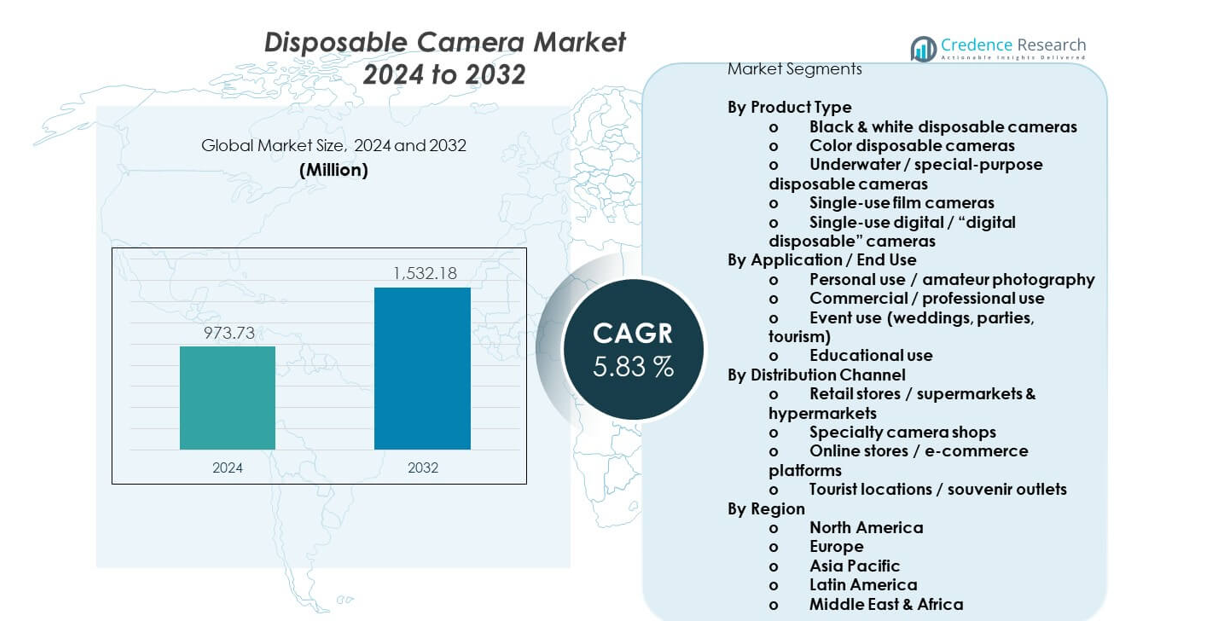
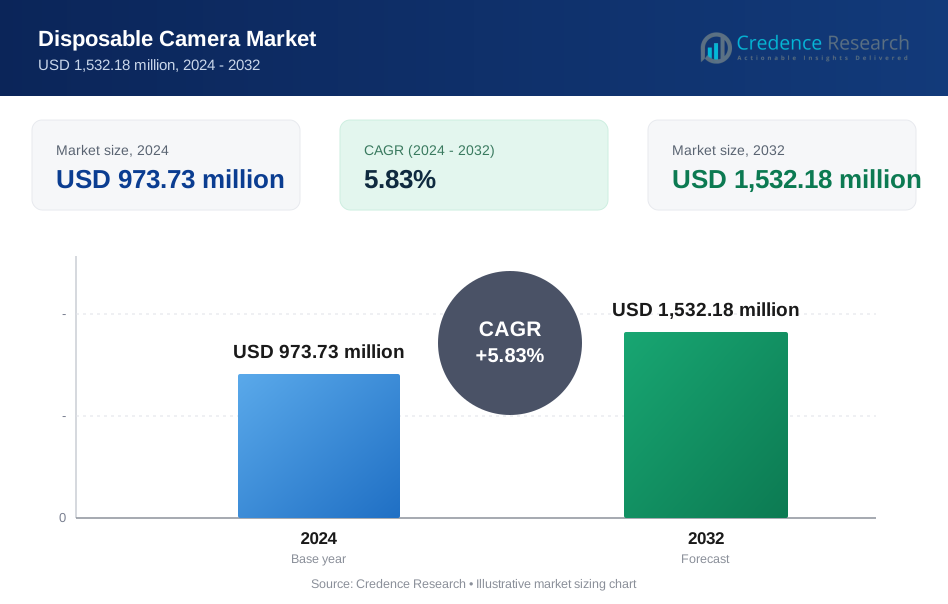
The Disposable camera market is projected to grow from USD 973.73 million in 2024 to an estimated USD 1532.18 million by 2032, with a CAGR of 5.83% from 2024 to 2032.
| REPORT ATTRIBUTE | DETAILS |
|---|---|
| Historical Period | 2020-2023 |
| Base Year | 2024 |
| Forecast Period | 2025-2032 |
| Disposable Camera Market Size 2024 | UUSD 973.73 million |
| Disposable Camera Market, CAGR | 5.83% |
| Disposable Camera Market Size 2032 | SD 1532.18 million |
Growing nostalgia and social media influence push stronger interest in analog images. Event planners use disposable cameras for weddings and parties due to instant use. Travelers choose these cameras for rugged environments where digital gear feels risky. Film developers offer reliable processing support across urban centers. Brands highlight easy handling to attract beginners who prefer low-effort photography. This steady shift supports new distribution and themed product lines. Rising demand from hobby groups strengthens long-term market momentum.
North America leads due to strong retail networks and active film communities. Europe follows with growing adoption among creative groups and tourism spots. Asia Pacific emerges fast due to rising youth engagement and rising interest in retro trends. Countries with active wedding industries show stronger uptake across urban regions. Latin America records growing demand due to rising cultural events. The Middle East and Africa expand slowly but gain traction through tourism and gifting trends.
Market Insights:
- The Disposable camera market reached USD 973.73 million in 2024 and is expected to hit USD 1532.18 million by 2032, growing at a CAGR of 5.83% driven by tourism, events, and rising nostalgia appeal.
- North America (35%), Europe (30%), and Asia Pacific (25%) lead the market due to strong film communities, tourism demand, and active youth engagement supporting consistent adoption.
- Asia Pacific stands as the fastest-growing region with a 25% share, supported by expanding urban youth interest, fashion-led trends, and a rising tourism sector.
- Color disposable cameras hold the largest product share with broad adoption across travel, events, and personal photography due to ease of use and stronger visual appeal.
- Retail stores account for the highest distribution share, driven by impulse purchases, wide product visibility, and strong sales during travel and event seasons.
Market Drivers:
Growing Consumer Shift Toward Nostalgia-Driven Photography Experiences
The Disposable camera market grows due to rising interest in nostalgic image formats among young adults. Many buyers seek grainy texture and natural tones that digital tools cannot replicate. Events such as weddings and festivals drive higher purchase cycles across retail stores. It attracts beginners who prefer simple point-and-shoot handling without technical learning. Travel groups use these cameras for rugged locations where digital devices feel unsafe. Social media trends push film-based aesthetics that boost organic demand. Creative photographers test low-light and candid styles using disposable units. Brands introduce themed variants that strengthen long-term consumer engagement.
- For instance, the Kodak FunSaver includes ISO 800 film with 27 exposures, which enables better low-light performance (despite inherently having more visible grain).
Expanding Use Across Events, Travel Activities, and Creative Hobby Segments
Demand rises through adoption across birthdays, travel tours, and social celebrations. Users value quick operation that captures moments without preparation. It gains traction during outdoor trips where water or dust can damage digital gear. Rental agencies include disposable cameras in adventure kits for tourists. Creative communities promote film-based looks that support artistic storytelling. Retailers bundle film development services to increase repeat sales. Youth engagement drives strong store turnover for event-focused packs. Growing social engagement sustains steady market traction across multiple user groups.
- For instance, Lomography’s Simple Use Reloadable Camera uses ISO 400 film with color-gel filters that create stylized images favored by creative hobbyists.
Wider Availability Through Retail Chains, Specialty Stores, and E-Commerce Platforms
Industry expansion accelerates with broad distribution across global locations. Retail chains stock multiple themed variants to meet diverse consumer needs. Specialty stores highlight analog photography as a lifestyle trend. It gains further reach through online platforms offering curated sets and gift packs. Shopper reviews influence new users seeking budget-friendly photography tools. Holiday seasons boost gifting demand for novelty-based camera designs. Tour operators supply single-use options for adventure groups. Better retail presence supports continuous buying activity across the year.
Rising Influence of Social Media Culture on Analog Aesthetics and Creative Expression
Social platforms popularize vintage-style photos shared by influencers and hobby creators. Many content makers use disposable cameras to achieve natural color tones. The Disposable camera market gains visibility through viral posts and trend cycles. It becomes a symbol of raw storytelling among youth audiences. Creative projects rely on film looks to capture emotional scenes. Retail brands highlight these trends through themed packaging lines. Travel bloggers use disposable cameras for candid trip documentation. Growing online engagement fuels stronger interest in analog expression.
Market Trends:
Growth of Limited-Edition Designs and Event-Focused Custom Prints
Brands introduce themed camera designs to appeal to weddings, travel groups, and seasonal buyers. Custom packaging allows event planners to match decorations and guest themes. The Disposable camera market gains traction through exclusive releases that attract collectors. Retailers promote limited runs that create urgency among hobby users. Travel stores highlight waterproof and rugged editions for outdoor use. Influencer collaborations help brands launch creative design variations. Gifting culture supports demand for personalized camera packs. Limited-edition models drive repeat purchases within niche user segments.
- For instance, Kodak’s Sport Waterproof Camera operates up to 15 meters underwater, supporting adventure-focused limited editions.
Rising Popularity of Film-Inspired Aesthetic Across Youth Communities
Film-style tones shape visual trends across social platforms. Young audiences prefer grainy, unedited looks during personal and travel shoots. The Disposable camera market benefits from this cultural shift toward analog appearance. Photographers use film-based shots to build distinctive portfolios. Street photography groups adopt disposable cameras for candid visuals. Brands respond with color-tinted variants that deepen creative control. Retail stores showcase these styles through photo samples and displays. Youth-driven aesthetic interest keeps demand strong across urban markets.
- For instance, Ilford’s HP5 Plus Single-Use Camera includes ISO 400 black-and-white film known for its classic grain and contrast profile.
Growing Preference for Low-Tech, Spontaneous Photography Experiences
Consumers seek simple tools that replace feature-heavy digital devices. Disposable cameras help users focus on moments rather than settings. The Disposable camera market expands as minimal-tech experiences become trend-worthy. Travelers pick these cameras for unpredictable adventures. Event organizers distribute them to encourage guest participation. Creative hobbyists enjoy the surprise factor of delayed film results. Retailers offer multi-pack bundles to support casual usage. Low-tech appeal supports consistent interest across many buyer groups.
Expansion of Hybrid Retail-Processing Partnerships Supporting Film Revival
More retailers partner with processing labs to ease film development. Stores offer prepaid envelopes and drop-off points for convenience. The Disposable camera market benefits from smoother processing timelines for users. Film labs upgrade equipment to handle rising film volume. Retailers promote same-week development options for frequent users. Hobby groups support film revival through community drives. Brands highlight these services in marketing campaigns. Improved access to processing sustains high retention across film users.
Market Challenges Analysis:
Strong Competition From Digital Devices and Smartphone Photography
The Disposable camera market faces pressure from advanced smartphone cameras with instant sharing features. Many users prefer digital tools for speed and convenience. It struggles to match the editing flexibility that apps provide. Retail access decreases in some regions due to declining store space. Film development delays discourage buyers seeking fast results. Environmental concerns about plastic waste affect public perception. Brands must adjust packaging and messaging to counter digital dominance. Growth slows in regions with high smartphone penetration.
Limited Film Processing Infrastructure Across Several Regions
Film labs operate in fewer locations compared to digital service options. Processing delays affect user satisfaction during peak seasons. The Disposable camera market depends heavily on third-party labs that face capacity issues. Many rural areas lack nearby development centers. Shipping film increases turnaround times for many buyers. Retailers struggle to maintain consistent processing networks. High operational costs limit new lab openings. Limited access reduces repeat purchase behavior among casual users.
Market Opportunities:
Rising Demand for Event-Based and Tourism-Focused Camera Packs
The Disposable camera market gains strong opportunity through curated event bundles. Wedding planners adopt multi-pack units for guest engagement. Tourism points promote rugged models for outdoor activities. Retailers build themed sets that match cultural festivals. It benefits from new demand streams across gifting and celebrations. Event organizers support customization for branding and souvenirs. Growth strengthens through dedicated travel retail outlets. Rising sales around holiday seasons enhance long-term potential.
Emerging Appeal of Eco-Friendly Materials and Sustainable Designs
Consumers seek greener camera builds with reduced plastic content. Recyclable materials support brand visibility among conscious buyers. The Disposable camera market can expand through biodegradable casings and reusable outer shells. Retailers promote sustainability tags that attract younger audiences. Film labs support recycling programs for used units. Eco-focused messaging improves brand loyalty across global markets. It enables premium pricing and differentiation. Sustainable innovation builds new growth space for future product lines.
Market Segmentation Analysis:
By Product Type
The Disposable camera market expands through diverse product formats that meet different user needs. Black and white variants attract hobby photographers who prefer vintage tones. Color disposable cameras lead due to broad consumer acceptance across events and travel. Underwater and special-purpose models gain traction among adventure users seeking simple rugged gear. Single-use film cameras maintain dominance through strong nostalgia appeal. Single-use digital units grow slowly but attract tech-curious buyers who want hybrid ease. It benefits from product lines that target both casual and creative segments.
- For instance, the Jolt Digital Disposable Camera features built-in memory and simple USB transfer, merging analog-style simplicity with digital convenience.
By Application / End Use
Personal use supports steady demand across young adults who enjoy spontaneous image capture. Amateur users value simple operation that removes the need for settings or learning curves. Commercial and professional groups adopt disposable units for themed shoots and hospitality events. Event use remains strong due to weddings, parties, and travel packages that include multi-camera kits. Educational use appears in workshops and school programs where low-risk tools help teach fundamentals. It gains momentum across mixed end-user clusters that seek convenience and creative texture.
- For instance, many photography classes use the Ilford HP5 Single-Use Camera with 36 exposures to introduce film basics.
By Distribution Channel
Retail stores and supermarkets drive significant share through widespread accessibility and impulse purchases. Specialty camera shops promote premium variants for hobby users who value film aesthetics. Online platforms expand reach through curated bundles, seasonal themes, and easy delivery. Tourist locations and souvenir outlets record high volumes during peak travel seasons. It benefits from a balanced distribution network that supports frequent purchases across diverse customer groups.
Segmentation:
By Product Type
- Black & white disposable cameras
- Color disposable cameras
- Underwater / special-purpose disposable cameras
- Single-use film cameras
- Single-use digital / “digital disposable” cameras
By Application / End Use
- Personal use / amateur photography
- Commercial / professional use
- Event use (weddings, parties, tourism)
- Educational use
By Distribution Channel
- Retail stores / supermarkets & hypermarkets
- Specialty camera shops
- Online stores / e-commerce platforms
- Tourist locations / souvenir outlets
By Region
- North America
- U.S.
- Canada
- Mexico
- Europe
- Germany
- France
- U.K.
- Italy
- Spain
- Rest of Europe
- Asia Pacific
- China
- Japan
- India
- South Korea
- South-east Asia
- Rest of Asia Pacific
- Latin America
- Brazil
- Argentina
- Rest of Latin America
- Middle East & Africa
- GCC Countries
- South Africa
- Rest of the Middle East and Africa
Regional Analysis:
North America
The Disposable camera market records the largest share in North America at roughly 35%, driven by strong retail presence and active film communities across the U.S. and Canada. Tourist destinations support stable demand through event kits and travel bundles. Consumers show high interest in nostalgic formats promoted by social platforms and creative groups. Specialty stores maintain steady circulation of film-based products that attract hobby users. Wedding planners and event organizers support recurring orders throughout the year. It benefits from strong brand visibility and broad distribution.
Europe
Europe holds about 30% share due to strong adoption across creative users, cultural events, and photography communities. Countries such as the U.K., Germany, and France show high traction for film revival trends. Retail stores promote themed disposable units for holidays and festivals. Travel-heavy regions support robust sales during peak tourism seasons. Film labs across major cities sustain reliable processing networks that encourage repeat use. It gains support from a broad consumer base that values analog aesthetics.
Asia Pacific, Latin America, and Middle East & Africa
Asia Pacific secures nearly 25% share driven by youth engagement, fashion-led trends, and expanding tourism. Urban markets in Japan, South Korea, and Australia show strong acceptance of film-based photography. Latin America contributes around 7%, supported by cultural events, wedding industries, and rising retail availability. The Middle East & Africa holds close to 3%, with growth tied to tourism and gifting products. Retail expansion and online platforms strengthen access across developing economies. It shows steady growth momentum across emerging regions supported by rising social interest in analog imaging.
Key Player Analysis:
- Fujifilm Holdings Corporation (Fujifilm)
- Eastman Kodak Company (Kodak)
- Ilford Photo / Harman Technology
- AgfaPhoto / Agfa-Gevaert Group
- Rollei
- Lomography
- Konica
- Olympus Corporation
- Vivitar
- Panasonic
Competitive Analysis:
The Disposable camera market features strong competition led by Fujifilm, Kodak, Ilford, AgfaPhoto, Rollei, and Lomography. These brands focus on product variety, film quality, and retail coverage to retain users across events and tourism segments. It benefits from steady interest in nostalgia-driven formats that support long-term sales. Fujifilm and Kodak dominate supply through wide distribution and consistent processing support. Smaller brands target niche groups with themed designs and creative variants. Online platforms increase visibility for emerging labels that offer special-purpose models. Competitive intensity remains stable due to limited replacements for film-based experiences.
Recent Developments:
- In August 2025, Fujifilm Holdings Corporation (Fujifilm) launched a new disposable camera product called the Quicksnap, expanding its range of instant and disposable cameras. This launch reflects Fujifilm's continued innovation in consumer photography devices with an emphasis on simplicity and convenience for users.
- In August 2024, Eastman Kodak Company (Kodak) underwent an ownership change for its Kodak Alaris division, acquired by Los Angeles-based Kingswood. Although not directly a product launch, this acquisition impacts Kodak's imaging business segment, which includes disposable camera lines under licensing arrangements.
Report Coverage:
The research report offers an in-depth analysis based on by Product Type and By Application / End Use. It details leading market players, providing an overview of their business, product offerings, investments, revenue streams, and key applications. Additionally, the report includes insights into the competitive environment, SWOT analysis, current market trends, as well as the primary drivers and constraints. Furthermore, it discusses various factors that have driven market expansion in recent years. The report also explores market dynamics, regulatory scenarios, and technological advancements that are shaping the industry. It assesses the impact of external factors and global economic changes on market growth. Lastly, it provides strategic recommendations for new entrants and established companies to navigate the complexities of the market.
Future Outlook:
- Growing interest in nostalgic photography will support steady adoption across youth groups.
- Event planners will integrate multi-pack cameras into wedding and party kits.
- Tourism locations will expand sales through waterproof and adventure-focused models.
- Brands will introduce creative themes and limited designs to attract hobby users.
- Expansion of online retail will improve access in emerging markets.
- Film labs will enhance processing capacity to handle rising development volumes.
- Sustainability features will influence new product designs and packaging formats.
- Educational programs will adopt disposable units for introductory photography courses.
- Partnerships between retailers and film processors will strengthen service reliability.
- Hybrid digital-disposable concepts will attract tech-curious consumers seeking simple tools.
Request a Free Sample
Fill in your details and we'll send you a free sample report.
- Sample data tables & charts
- Research methodology
Need a Custom Version of This Report?
Tailor the scope, geography, or segments to your exact requirements.
- Custom geography or segment scope
- Direct access to our analyst team
Frequently Asked Questions
What is the current market size for Disposable camera market, and what is its projected size in 2032?
At what Compound Annual Growth Rate is the Disposable camera market projected to grow between 2025 and 2032?
Which is the leading region of the market for disposable cameras?
What are the key drivers for the growth of the disposable camera market?
Which is the major segment in the disposable camera market by application?
Who are the leading companies in the Disposable camera market?
Table of Content
Chapter 1. Report Introduction
- 1.1 Report Description & Purpose
- 1.1.1 Report Title & Market Definition
- 1.1.2 Unique Selling Propositions (USP) & Key Differentiators
- 1.1.3 Value Proposition for Stakeholders
- 1.2 Research Objectives
- 1.2.1 Market Sizing Objectives (Volume & Revenue) (Volume Where Applicable)
- 1.2.2 Segmentation Objectives
- 1.2.3 Competitive Intelligence Objectives
- 1.2.4 Forecast & Scenario Objectives
- 1.3 Report Scope
- 1.3.1 Disposable Camera Scope – Segments & Subsegments Covered
- 1.3.2 Geographic Scope – Regions & Countries Covered
- 1.3.3 Historical Period, Base Year & Forecast Period (2024; forecast to 2032)
- 1.3.4 Inclusions & Exclusions
- 1.4 Industry Classification & Applicable Codes
- 1.5 Currency, Measurement Units & Valuation Basis
- 1.6 Target Stakeholders
- 1.7 Limitations & Assumptions
Chapter 2. Executive Summary
- 2.1 Global Disposable Camera Market Snapshot
- 2.1.1 Market Size – Historical (2024) & Forecast (2024-2032) (2024: USD 973.73 million → 2032: USD 1,532.18 million)
- 2.1.2 Volume & Revenue – Global Totals (Volume Where Applicable)
- 2.1.3 Key Market Highlights – Top Five Facts
- 2.2 Disposable Camera Market Segmentation Snapshot
- 2.2.1 Market Split by Region – 2024 vs. 2032
- 2.3 Competitive Snapshot
- 2.3.1 Top 10 Players by Revenue Share – 2024
- 2.3.2 Top 10 Players by Volume Share – 2024 (Volume Where Applicable)
- 2.3.3 Recent Strategic Developments (18-Month Summary)
- 2.4 Key Investment Highlights & Strategic Conclusions
Chapter 3. Disposable Camera Market Dynamics & Industry Analysis
- 3.1 Market Overview & Context
- 3.1.1 Disposable Camera Market Position in the Broader Industry Value Chain
- 3.1.2 Demand Structure & Purchasing Dynamics
- 3.1.3 Market Maturity & Development Stage by Region
- 3.2 Disposable Camera Market Drivers
- 3.3 Disposable Camera Market Restraints & Challenges
- 3.4 Disposable Camera Market Opportunities
- 3.5 Porter's Five Forces Analysis
- 3.5.1 Threat of New Entrants
- 3.5.2 Bargaining Power of Suppliers
- 3.5.3 Bargaining Power of Buyers
- 3.5.4 Threat of Substitutes
- 3.5.5 Competitive Rivalry – Intensity Assessment
- 3.6 Disposable Camera Value Chain Analysis
- 3.6.1 Upstream – Key Inputs, Resources & Suppliers
- 3.6.1.1 Key Input/Resource 1
- 3.6.1.2 Key Input/Resource 2
- 3.6.1.3 Key Input/Resource 3
- 3.6.2 Midstream – Core Operations & Value Creation
- 3.6.2.1 Operating Model & Process Overview
- 3.6.2.2 Key Operating Locations & Capabilities by Company
- 3.6.3 Downstream – Market Channels & End Users
- 3.6.3.1 Direct Sales & Customer Engagement Channels
- 3.6.3.2 Indirect Sales, Intermediaries & Partner Channels
- 3.6.4 Value Chain Profitability Analysis
- 3.6.1 Upstream – Key Inputs, Resources & Suppliers
- 3.7 PESTEL Analysis
- 3.7.1 Political Factors
- 3.7.2 Economic Factors
- 3.7.3 Social Factors
- 3.7.4 Technological Factors
- 3.7.5 Environmental Factors
- 3.7.6 Legal Factors
- 3.8 Disposable Camera Supply Chain Analysis
- 3.8.1 Critical Input & Resource Availability Risk Assessment
- 3.8.2 Supplier & Operational Concentration Risk (Geographic Exposure)
- 3.8.3 Supply & Service Disruption Impact Analysis
- 3.9 Regulatory & Policy Landscape
Note: The regulatory and policy landscape section covers regulations based on their applicability to the market, Disposable Camera category, geography, and scope of the study. Only regulatory frameworks with a material impact on operations, compliance, trade, sustainability, or market access are analyzed in detail.
Chapter 4. Key Investment Pockets & Opportunity Analysis
- 4.1 Disposable Camera Market Attractiveness Analysis
- 4.1.1 By Region – Investment Attractiveness Matrix (Market Size × CAGR)
- 4.2 Absolute Revenue Growth Opportunity
- 4.2.1 By Region – Absolute Revenue Growth Through 2032
- 4.3 Incremental Demand Opportunity
- 4.3.1 By Region – Incremental Demand Through 2032
- 4.3.2 Segment – Incremental Demand
- 4.4 Emerging Submarket Opportunity Deep Dive (Subject to Applicability)
- 4.5 Priority Market Opportunity Scorecards
- 4.5.1 United States
- 4.5.2 Europe
- 4.5.3 Asia
- 4.5.4 Middle East & Africa
Note: Priority market opportunity scorecards reflect the geographic scope and strategic relevance of the study. Listed markets are indicative and may be adapted to the industry.
Chapter 5. Disposable Camera Cross-Border Trade & Market Access Analysis
- 5.1 International Trade & Cross-Border Activity Overview
- 5.1.1 Global Export Value by Country (2024)
- 5.1.2 Global Export Volume by Country (2024) (Volume Where Applicable)
- 5.1.3 Global Import Value by Country (2024)
- 5.1.4 Global Import Volume by Country (2024) (Volume Where Applicable)
- 5.1.5 Net Trade Balance by Country (2024)
- 5.2 Export Analysis – Segment
- 5.2.1 Category 1 (Applicable Classification Code)
- 5.2.2 Category 2 (Applicable Classification Code)
- 5.2.3 Category 3 (Applicable Classification Code)
- 5.2.4 Category 4 (Applicable Classification Code)
- 5.2.5 Category 5 (Applicable Classification Code)
- 5.3 Import Analysis – Segment
- 5.3.1 Category 1 (Applicable Classification Code)
- 5.3.2 Category 2 (Applicable Classification Code)
- 5.3.3 Category 3 (Applicable Classification Code)
- 5.3.4 Category 4 (Applicable Classification Code)
- 5.3.5 Category 5 (Applicable Classification Code)
- 5.4 Cross-Border Pricing & Transaction Benchmarks
- 5.4.1 Export Pricing – Segment & Country
- 5.4.2 Import Pricing – Segment & Source Country
- 5.4.3 Price Trends (2024)
- 5.5 Key Cross-Border Trade & Delivery Routes
- 5.5.1 Cross-Border Trade/Delivery Route 1
- 5.5.2 Cross-Border Trade/Delivery Route 2
- 5.5.3 Cross-Border Trade/Delivery Route 3
- 5.5.4 Cross-Border Trade/Delivery Route 4
- 5.5.5 Cross-Border Trade/Delivery Route 5
- 5.6 Trade Policy & Market Access Impact Assessment
- 5.6.1 Tariff & Non-Tariff Barriers
- 5.6.2 Regional Trade & Economic Integration Frameworks
- 5.6.3 Bilateral & Multilateral Trade Agreements
- 5.6.4 Cross-Border Operating, Licensing & Localization Requirements
Note: This chapter applies where cross-border trade or delivery is relevant to Disposable Camera. Goods, services, and digital offerings are assessed using applicable classifications and transaction measures. Import-export volumes, trade balances, and route analyses are included only where meaningful to the market.
Chapter 6. Competitive Landscape & Company Benchmarking
- 6.1 Disposable Camera Market Concentration & Structure
- 6.1.1 Herfindahl-Hirschman Index (HHI) – the historical period vs. 2024
- 6.1.2 Leading, Mid-Sized & Emerging Player Structure
- 6.1.3 Global, Regional & Local Player Dynamics
- 6.2 Disposable Camera Market Share Analysis – 2024
- 6.2.1 Global Revenue Share by Company
- 6.2.2 Global Volume Share by Company (Volume Where Applicable)
- 6.2.3 Regional Revenue Share
- 6.2.4 Market Share Evolution (the historical period vs. 2024)
- 6.2.5 Company Market Share by Key Segment
- 6.2.6 Company Market Share by Customer Group
- 6.3 Operating Scale, Capacity & Infrastructure Analysis
- 6.3.1 Global Operating Scale & Supply Capacity
- 6.3.2 Resource Utilization & Operating Efficiency
- 6.3.3 Output, Service Delivery & Activity Metrics
- 6.3.4 Operating Footprint & Infrastructure Map
- 6.3.5 Planned Operational & Capacity Expansion
- 6.4 Disposable Camera Competitive Benchmarking Matrix
- 6.4.1 Revenue, Growth, Profitability & Operating Metric Comparison
- 6.4.2 Channel Revenue Mix
- 6.4.3 Geographic Revenue Exposure
- 6.4.4 R&D Intensity
- 6.4.5 Sustainability Maturity
- 6.5 Strategic Developments in Disposable Camera (Last 24 Months)
- 6.5.1 Mergers, Acquisitions & Divestments
- 6.5.2 New Products, Services & Solutions in Disposable Camera
- 6.5.3 Operational & Infrastructure Expansions
- 6.5.4 Strategic Alliances, Joint Ventures & Partnerships
- 6.5.5 Distribution Expansion & Market Entry
- 6.5.6 Sustainability & ESG Initiatives
- 6.6 Competitive Strategy Mapping
- 6.6.1 Leader, Challenger, Follower & Niche Classification
- 6.6.2 Pricing Strategy Comparison
- 6.6.3 Channel Strategy Matrix
Note: Strategic developments are included based on their materiality and the availability of reliable information.
Chapter 7. Global Disposable Camera Market – By Sales & Delivery Channel
- 7.1 Segment Overview
- 7.1.1 Volume & Revenue Split by Channel (2024 & 2032) (Volume Where Applicable)
- 7.1.2 Channel Mix Evolution (2024-2032)
Chapter 8. Regional Market Analysis – Global Overview
- 8.1 Global Regional Overview
- 8.1.1 Regional Volume Share (Volume Where Applicable)
- 8.1.2 Regional Revenue Share
- 8.1.3 Regional Volume by Region (Volume Where Applicable)
- 8.1.4 Regional Revenue by Region
- 8.1.5 Regional Forecast Through 2032
- 8.2 Cross-Regional Segment Analysis
- 8.2.1 By Sales & Delivery Channel
- 8.2.2 By Competitive Positioning & Price Tier
Chapter 9. North America Disposable Camera Market
- 9.1 United States
- 9.2 Canada
- 9.3 Mexico
Chapter 10. Europe Disposable Camera Market
- 10.1 Germany
- 10.2 France
- 10.3 Italy
- 10.4 United Kingdom
- 10.5 Spain
- 10.6 Poland
- 10.7 Russia
- 10.8 Netherlands
- 10.9 Belgium
- 10.10 Sweden
- 10.11 Denmark
- 10.12 Norway
- 10.13 Rest of Europe
Chapter 11. Asia Pacific Disposable Camera Market
- 11.1 China
- 11.2 India
- 11.3 Japan
- 11.4 South Korea
- 11.5 Thailand
- 11.6 Indonesia
- 11.7 Vietnam
- 11.8 Malaysia
- 11.9 Australia
- 11.10 Rest of Asia Pacific
Chapter 12. Latin America Disposable Camera Market
- 12.1 Brazil
- 12.2 Argentina
- 12.3 Colombia
- 12.4 Chile
- 12.5 Rest of Latin America
Chapter 13. Middle East Disposable Camera Market
- 13.1 Saudi Arabia
- 13.2 United Arab Emirates
- 13.3 Turkey
- 13.4 Israel
- 13.5 Iran
- 13.6 Rest of the Middle East
Chapter 14. Africa Disposable Camera Market
- 14.1 South Africa
- 14.2 Egypt
- 14.3 Nigeria
- 14.4 Morocco
- 14.5 Rest of Africa
Chapter 15. Disposable Camera Company Profiles
- 15.1 [Company 01]
- 15.1.1 Company Overview
- 15.1.2 Key Management Personnel
- 15.1.3 Products & Services Portfolio
- 15.1.4 Financial Performance
- 15.1.5 Key Market Focus & Geographic Presence
- 15.1.6 Recent Developments & Strategic Initiatives
Note: The company profile list is preliminary and may change based on research findings, market developments, data availability, and client requirements.
Chapter 16. Appendices
- Appendix A – List of Abbreviations & Acronyms
- Appendix B – Industry Classification Code Reference – Full Series
- Appendix C – Supply, Output & Operating Capacity Data Tables
- Appendix D – End-Use & Demand Base Tables
- Appendix E – Demand, Adoption & Usage Assumptions
- Appendix F – Pricing & Revenue Metric Reference Tables
- Appendix G – Company Operations & Infrastructure Database
- Appendix H – Cross-Border Trade & Activity Data Tables (Where Applicable)
- Appendix I – Regulatory Summary Tables
- Appendix J – Primary Research Participant List (Anonymized)
- Appendix K – Primary Research Questionnaire Framework
- Appendix L – Data Sources & Bibliography
- Appendix M – Market Size Divergence & Source Comparison
Chapter 17. Research Methodology
- 17.1 Research Framework & Philosophy
- 17.2 Secondary Research – Sources, Hierarchy & Data Extraction
- 17.3 Data Modeling – Bottom-Up & Top-Down Market Sizing
- 17.4 Primary Research – Stakeholder Framework, LOI & Sample Sizes
- 17.5 Forecast Methodology – Regression, Scenario & Sensitivity Analysis
- 17.6 Quality Control – Four-Layer Validation Framework
- 17.7 Limitations & Standard Assumptions
- 17.8 Disclaimer
