
| REPORT ATTRIBUTE | DETAILS |
|---|---|
| Historical Period | 2019-2022 |
| Base Year | 2023 |
| Forecast Period | 2024-2032 |
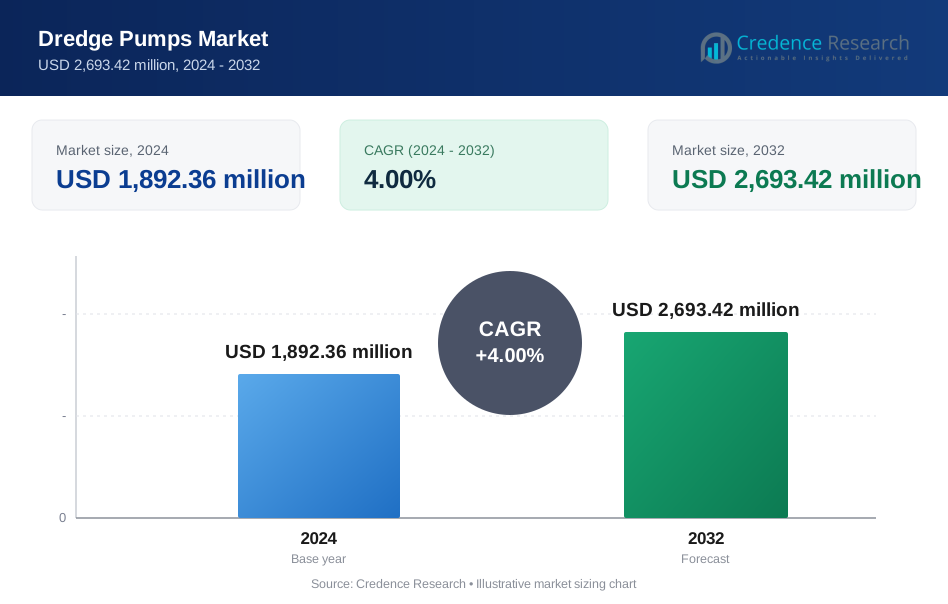
| Global Dredge Pumps Market Size 2023 | USD 1,892.36 million |
| Global Dredge Pumps Market, CAGR | 4.00% |
| Global Dredge Pumps Market Size 2032 | USD 2,693.42 million |
Market Overview
The Global Dredge Pumps Market is experiencing substantial growth, with projections indicating an expansion from USD 1,892.36 million in 2023 to an estimated USD 2,693.42 million by 2032. This growth trajectory corresponds to a steady compound annual growth rate (CAGR) of 4.00% from 2024 to 2032. The market's upward trend is underpinned by significant investments in infrastructure development and coastal protection projects worldwide. As nations focus on enhancing their navigational routes and expanding their maritime capabilities, the demand for dredge pumps, which are pivotal in excavation and removal of sediment from water bodies, is set to increase. This forecast period marks a critical phase for stakeholders in the dredge pumps sector as they align their strategies to capture the growth opportunities presented by these market dynamics.
Driving this market are several key factors, including increasing coastal activities, such as port expansion and coastal defense mechanisms, along with stringent regulations regarding marine pollution which mandate regular dredging operations. Technological advancements in dredge pump manufacturing that enhance efficiency and reduce environmental impact also contribute significantly to the market's expansion. Additionally, the surge in maritime commerce and the consequent need for deeper and well-maintained ports fuel the demand for dredge pumps. Trends such as the integration of automation and real-time monitoring in dredging operations are further shaping the market landscape, making processes more precise and cost-effective.
Geographically, the Asia-Pacific region dominates the Global Dredge Pumps Market, driven by rapid industrialization and increasing maritime activities in countries such as China and India. North America and Europe also hold substantial market shares, supported by advanced technological infrastructure and stringent environmental regulations. Key players in the global market include EDDY Pump Corporation, Damen Shipyards Group, Weir Group, and Xylem Inc. These companies are at the forefront of technological innovation and strategic expansions, consistently enhancing their product offerings to meet the evolving needs of the global market. The competitive landscape is characterized by a blend of product development and strategic partnerships, positioning these firms to capitalize on the burgeoning market opportunities.
Market Drivers
Infrastructure Development and Urbanization:
The increasing global focus on infrastructure development, particularly in coastal and marine sectors, is a significant driver for the dredge pumps market. For instance, as urbanization intensifies and populations concentrate in coastal areas, there is a heightened demand for dredging activities to maintain navigable waterways, construct ports, and protect coastal environments from erosion. Dredge pumps play a pivotal role in these projects by facilitating the excavation, transportation, and placement of sediments, thereby enabling the expansion and maintenance of ports, harbors, and coastal defenses.
Rising Maritime Trade and Navigation Needs:
The expansion of global trade and maritime transport is another key driver. For instance, growing international trade volumes necessitate efficient and deep-water ports capable of accommodating larger vessels. Dredge pumps are indispensable for deepening and widening channels to allow safe passage of ships, thereby enhancing port efficiency and reducing logistics costs. Moreover, the increasing size of container ships and bulk carriers necessitates continuous dredging operations to maintain channel depths and prevent sedimentation, driving ongoing demand for dredge pump systems.
Environmental Regulations and Sustainability Initiatives:
Stringent environmental regulations aimed at protecting marine ecosystems and mitigating pollution are driving innovations in dredging technologies, thereby influencing the market. For instance, modern dredge pumps are designed to minimize environmental impact through improved efficiency, reduced energy consumption, and enhanced sediment management practices. Additionally, sustainability initiatives promote the use of eco-friendly dredging techniques and materials, encouraging market players to invest in cleaner technologies that align with regulatory requirements and societal expectations.
Technological Advancements and Operational Efficiency:
Advances in dredge pump technology are accelerating market growth by improving operational efficiency and reducing maintenance downtime. Innovations such as remote monitoring systems, automated dredging processes, and adaptive control systems optimize dredge pump performance, enhance operational safety, and reduce overall project costs. Furthermore, the integration of digital technologies and data analytics enables real-time monitoring of dredging operations, facilitating proactive maintenance and optimizing dredge pump utilization. These technological advancements not only improve productivity but also support sustainable dredging practices by minimizing environmental disturbance and optimizing resource utilization.
Market Trends
Adoption of Automation and Remote Monitoring:
One of the prominent trends in the dredge pumps market is the increasing adoption of automation and remote monitoring technologies. For instance, these advancements allow operators to monitor dredging operations in real-time, optimize pump performance, and enhance operational efficiency. Automated dredge pumps enable precise dredging operations, reducing human error and operational costs while improving safety.
Focus on Environmental Sustainability:
Environmental sustainability has become a critical focus in the dredge pumps market For instance, manufacturers are developing eco-friendly dredge pump systems that minimize dredging-related disturbances to marine ecosystems. Innovations include advanced sediment management techniques, energy-efficient pump designs, and the use of biodegradable lubricants and materials. These initiatives align with stringent environmental regulations and support sustainable dredging practices.
Integration of IoT and AI Technologies:
The integration of Internet of Things (IoT) and Artificial Intelligence (AI) technologies is transforming dredging operations. For instance, IoT-enabled sensors collect real-time data on pump performance, sediment levels, and environmental conditions. AI algorithms analyze this data to optimize dredge pump operations, predict maintenance needs, and improve overall efficiency. This trend enhances decision-making capabilities and operational outcomes in dredging projects.
Development of Hybrid and Electric Dredge Pumps:
There is a growing shift towards hybrid and electric dredge pumps as industries seek to reduce carbon footprints and operating costs. For instance, hybrid pumps combine diesel engines with electric motors or energy storage systems, offering flexibility and efficiency in power management. Electric dredge pumps eliminate emissions during operation, making them suitable for environmentally sensitive areas and urban environments where noise and air pollution are concerns.
Increasing Demand for Cutter Suction Dredgers:
Cutter suction dredgers (CSDs) are gaining popularity due to their versatility and efficiency in various dredging applications. These dredgers equipped with powerful dredge pumps are capable of excavating and transporting a wide range of sediments, including hard soils and rocks. The demand for CSDs is driven by infrastructure projects, port expansions, and coastal protection initiatives worldwide.
Focus on Maintenance and Lifecycle Cost Reduction:
There is a growing emphasis on reducing maintenance costs and extending the lifecycle of dredge pumps. Manufacturers are integrating durable materials, corrosion-resistant coatings, and predictive maintenance technologies into pump designs. Predictive maintenance uses data analytics to anticipate component failures, schedule maintenance proactively, and optimize spare parts inventory, thereby minimizing downtime and operational disruptions.
Market Expansion in Developing Regions:
The dredge pumps market is expanding in developing regions, driven by rapid industrialization, urbanization, and infrastructure development. Countries in Asia-Pacific, Latin America, and Africa are witnessing increased investments in port infrastructure, coastal management projects, and dredging activities to support economic growth and maritime trade. This geographical expansion presents new opportunities for market players to establish partnerships, localize production, and capture emerging market segments.
Market Restraints and Challenges
High Initial Investment Costs:
One of the primary challenges facing the market is the high initial investment required for dredge pump systems. The cost of acquiring and deploying advanced dredge pumps, especially those equipped with cutting-edge technologies such as automation and IoT, can be substantial. This financial barrier limits adoption, particularly among small and medium-sized enterprises (SMEs) and entities operating under budget constraints, thereby slowing market expansion.
Operational and Maintenance Costs:
Beyond initial investments, dredge pump operators face considerable ongoing operational and maintenance costs. These costs encompass fuel expenses for diesel-powered pumps, regular maintenance to prevent wear and tear, and periodic upgrades to comply with evolving environmental regulations. Managing these expenses effectively while maintaining profitability poses a significant challenge, especially in competitive market environments.
Regulatory Compliance and Environmental Concerns:
Stringent environmental regulations governing dredging activities pose a challenge to market participants. Compliance with regulations related to sediment disposal, noise pollution, and habitat protection requires investments in technology and operational practices that minimize environmental impact. Adhering to these regulations adds complexity and cost to dredge pump operations, influencing project timelines and operational strategies.
Complexity in Project Approval Processes:
Dredging projects often involve complex approval processes, requiring permits from multiple regulatory bodies and stakeholders. Delays in obtaining permits and approvals can prolong project timelines and increase costs, impacting the profitability of dredge pump operators. Navigating bureaucratic procedures and addressing environmental assessments and community consultations present logistical challenges that can hinder market growth.
Technological and Innovation Challenges:
While technological advancements drive market growth, they also present challenges related to innovation and adaptation. Rapid technological changes require continuous investment in research and development (R&D) to stay competitive. Smaller manufacturers and new entrants may struggle to keep pace with larger, established companies that have the resources to innovate and scale technological advancements in dredge pump design and functionality.
Global Economic Uncertainty and Market Volatility:
Economic fluctuations and geopolitical tensions can impact infrastructure investments and maritime trade, directly affecting the demand for dredge pumps. Uncertainties in global trade policies, currency fluctuations, and geopolitical conflicts may lead to project delays or cancellations, influencing market stability and investment decisions in the dredge pumps sector.
Skills Shortages and Workforce Challenges:
The specialized nature of dredge pump operations requires skilled labor and technical expertise. Shortages in skilled dredge operators, engineers, and maintenance personnel pose challenges to market expansion and project execution. Addressing workforce shortages through training programs and recruitment initiatives is essential to meet growing industry demands and sustain operational efficiency.
Market Segmentation Analysis
By Type
Horizontal dredge pumps are essential in dredging operations requiring efficient movement of large volumes of sediment and debris. Known for their robust design and ability to handle abrasive materials, these pumps are favored in diverse applications such as harbor maintenance, river dredging, and land reclamation projects. Vertical dredge pumps, on the other hand, feature a compact design suitable for deep-water dredging operations. They excel in applications demanding high discharge pressures and are effective in managing thick slurries and solids. Widely used in mining, offshore dredging, and environmental projects where depth and operational efficiency are crucial, vertical dredge pumps play a pivotal role in enhancing dredging capabilities in various challenging environments. Submersible dredge pumps, designed to function underwater, offer versatility and portability. Ideal for shallow water dredging and confined spaces, they efficiently handle both solid materials and liquids. These pumps find application in tasks such as lake and pond dredging, environmental remediation, and underwater excavation, contributing to effective and precise dredging operations across different settings.
By Application
In the mining and mineral sector, these pumps facilitate the extraction and transport of minerals and sediments, crucial for slurry transportation, tailings management, and dredging in mining ponds. Designed to handle abrasive materials, they ensure efficient operations. In construction, metallurgy, and the chemical industry, dredge pumps are vital for dewatering, foundation excavation, and maintaining industrial waterways. They support sand and gravel extraction, aggregate processing, and the management of corrosive chemicals and hazardous materials, enhancing operational safety and efficiency. Within the pulp and paper industry, dredge pumps manage pulp mill effluents, transport wood chips, and maintain water intake channels, ensuring smooth manufacturing operations while meeting environmental standards. In power generation, dredge pumps play a crucial role in maintaining operations around cooling water intakes, hydroelectric dams, and nuclear power plants. They manage water flow rates, prevent sediment buildup in reservoirs, and guarantee uninterrupted facility operations, demonstrating their essential contribution to efficient power generation processes.
Segments
Based on Type
- Horizontal Dredge Pumps
- Vertical Dredge Pumps
- Submersible Dredge Pumps
Based on Application
- Mining & Mineral Industry
- Construction, Metallurgy, and Chemical Industry
- Pulp & Paper Industry
- Power Generation
Based on Geography:
- North America
- The U.S.
- Canada
- Mexico
- Europe
- Germany
- France
- The U.K.
- Italy
- Spain
- Rest of Europe
- Asia Pacific
- China
- Japan
- India
- South Korea
- South-east Asia
- Rest of Asia Pacific
- Latin America
- Brazil
- Argentina
- Rest of Latin America
- Middle East & Africa
- GCC Countries
- South Africa
- Rest of Middle East and Africa
Regional Analysis
Asia-Pacific (40%):
Asia-Pacific holds the largest market share in the Global Dredge Pumps Market, accounting for approximately 40%. The region's dominance is fueled by extensive infrastructure projects, rapid urbanization, and significant investments in port expansions and coastal developments. Countries like China, India, and Australia lead in dredging activities, supported by government initiatives to enhance maritime trade and manage water resources effectively. The demand for dredge pumps in Asia-Pacific is further boosted by the mining sector's need for efficient slurry transportation and environmental dredging projects to mitigate pollution and maintain water quality standards.
North America (25%):
North America commands a substantial market share of around 25% in the Global Dredge Pumps Market. The region benefits from advanced technological infrastructure and stringent environmental regulations governing dredging operations. The United States and Canada are prominent contributors, leveraging dredge pumps for harbor maintenance, inland waterway dredging, and environmental restoration projects. Growing investments in renewable energy infrastructure and sustainable dredging practices propel market growth in North America, with a focus on minimizing ecological impact and enhancing operational efficiency.
Europe (20%):
Europe holds a significant market share of approximately 20% in the Global Dredge Pumps Market. The region's market is driven by extensive maritime trade, inland waterway transport, and coastal protection initiatives. Countries such as the Netherlands, Belgium, and Germany lead in dredging activities, employing advanced dredge pump technologies for port maintenance, land reclamation, and offshore energy projects. Regulatory frameworks promoting sustainable dredging practices and environmental stewardship shape market strategies in Europe, emphasizing the adoption of eco-friendly dredge pump solutions and innovative sediment management techniques.
Key players
- Dragflow
- Metso
- Weir Group
- ITT Goulds Pumps
- Grundfos
- Flowserve
- Royal IHC
- Tsurumi Pump
- EBARA Pumps
- Xylem
- LEO Group
- Excellence Pump Industry
Competitive Analysis
In the highly competitive Global Dredge Pumps Market, these key players leverage diverse strategies to maintain market leadership. Companies like Dragflow and Metso emphasize technological innovation, offering robust dredge pump solutions tailored to specific industry needs. Weir Group and ITT Goulds Pumps focus on global market expansion through strategic acquisitions and partnerships, enhancing their product portfolios and geographic reach. Grundfos and Flowserve prioritize sustainability and efficiency, integrating eco-friendly designs and advanced materials into their dredge pump offerings. Royal IHC and Tsurumi Pump differentiate themselves with specialized dredge pump applications in offshore oil & gas and environmental sectors. EBARA Pumps and Xylem lead in water management solutions, leveraging extensive R&D and customer-centric approaches. LEO Group and Excellence Pump Industry emphasize cost-effectiveness and reliability, catering to diverse market segments with dependable dredge pump solutions. Overall, competitive differentiation through innovation, global expansion, and sustainability remains pivotal for maintaining competitiveness in the Global Dredge Pumps Market.
Recent Developments
In January 2023, Haven Dredging Ltd. introduced Tiamat, an innovative dredging solution developed by Harwich Haven Authority. Tiamat promises environmentally beneficial and economically viable dredging processes, potentially cutting costs in half and reducing harmful emissions by up to 90%. Haven Dredging aims to revolutionize port authorities and dredging businesses with cleaner, greener, and more efficient dredging operations.
In August 2023, C-Job Naval Architects unveiled multiple concept designs for methanol-powered dredgers. These designs enable dredgers to transition seamlessly from traditional diesel fuels to methanol, offering significant operational flexibility. C-Job Naval Architects has also joined two consortiums-the MENENS project and the Green Marine Methanol consortium-to advance research and adoption of methanol as a marine fuel. This strategic involvement underscores the company's commitment to pioneering sustainable solutions in maritime transportation and enhancing environmental stewardship in the industry.
Market Concentration and Characteristics
The Global Dredge Pumps Market exhibits moderate to high market concentration characterized by a competitive landscape dominated by a few key players. Companies such as Dragflow, Metso, Weir Group, and Xylem hold significant market shares, leveraging extensive product portfolios, technological advancements, and global distribution networks to maintain their competitive edge. The market is driven by continuous innovation in dredge pump technologies, with a focus on enhancing efficiency, reducing environmental impact, and meeting stringent regulatory requirements. Market concentration is further influenced by strategic initiatives such as mergers, acquisitions, and partnerships aimed at expanding market presence and enhancing product offerings. Overall, the Global Dredge Pumps Market is defined by intense competition among leading players, fueled by innovation and strategic investments in sustainable dredging solutions.
Report Coverage
The research report offers an in-depth analysis based on Type and Application. It details leading market players, providing an overview of their business, product offerings, investments, revenue streams, and key applications. Additionally, the report includes insights into the competitive environment, SWOT analysis, current market trends, as well as the primary drivers and constraints. Furthermore, it discusses various factors that have driven market expansion in recent years. The report also explores market dynamics, regulatory scenarios, and technological advancements that are shaping the industry. It assesses the impact of external factors and global economic changes on market growth. Lastly, it provides strategic recommendations for new entrants and established companies to navigate the complexities of the market.
Future Outlook
- Continued innovation in dredge pump technologies, including automation and AI integration, will enhance operational efficiency and reduce environmental impact.
- Increasing regulatory pressures and environmental awareness will drive demand for eco-friendly dredge pump solutions that minimize carbon footprints and enhance sustainability.
- Growth in emerging economies, particularly in Asia-Pacific and Latin America, will present lucrative opportunities for market expansion and infrastructure development.
- Adoption of electric and hybrid dredge pumps will increase, driven by the need for cleaner and more efficient dredging operations.
- Growth in offshore oil & gas exploration and renewable energy projects will spur demand for specialized dredge pump solutions tailored to deep-sea applications.
- Increasing collaborations among key players and research institutions will foster innovation and accelerate the development of advanced dredge pump technologies.
- Rising awareness of lifecycle costs and operational efficiency will drive demand for comprehensive maintenance and after-sales services for dredge pump systems.
- Emphasis on enhancing dredging operation safety through improved equipment design, training programs, and compliance with stringent safety regulations.
- Continued mergers and acquisitions among major players will reshape the competitive landscape, fostering market consolidation and strategic alliances.
- Economic uncertainties and geopolitical factors will influence market dynamics, necessitating agile strategies to mitigate risks and capitalize on emerging opportunities in the Global Dredge Pumps Market.
Request a Free Sample
Fill in your details and we'll send you a free sample report.
- Sample data tables & charts
- Research methodology
Market Dynamics
Infrastructure Development and Urbanization
Rapid urbanization and large-scale infrastructure projects, especially in coastal and riverine areas, are driving demand for dredge pumps to maintain navigable waterways, expand ports, and protect against coastal erosion.
Rising Maritime Trade and Navigation Needs
The growth of global maritime trade and the increasing size of vessels require deeper and better-maintained ports, necessitating continuous dredging operations and thus boosting the demand for efficient dredge pump systems.
Environmental Regulations and Sustainability Initiatives
Stringent environmental regulations and sustainability goals are pushing the adoption of advanced dredge pumps that minimize ecological impact, improve sediment management, and comply with pollution control standards.
Technological Advancements and Operational Efficiency
Innovations such as automation, IoT integration, and predictive maintenance are enhancing the efficiency, reliability, and cost-effectiveness of dredge pumps, making them more attractive for large-scale and complex dredging projects.
Expansion in Developing Regions
Emerging economies, particularly in Asia-Pacific and Latin America, are investing heavily in port infrastructure, mining, and water management, creating significant new opportunities for dredge pump manufacturers.
Need a Custom Version of This Report?
Tailor the scope, geography, or segments to your exact requirements.
- Custom geography or segment scope
- Direct access to our analyst team
Frequently Asked Questions
What is the projected growth of the Global Dredge Pumps Market?
What factors are driving the growth of the Global Dredge Pumps Market?
Which regions dominate the Global Dredge Pumps Market, and why?
Who are the key players in the Global Dredge Pumps Market?
What are the primary applications of dredge pumps across industries?
How is environmental sustainability addressed in the dredge pumps industry?
Table of Content
Chapter 1 Market Segmentation
- 1.1 Segmentation Framework
- 1.1.1 Product and Service Classification
- 1.1.2 Application and End-Use Classification
- 1.1.3 Technology and Solution Classification
- 1.1.4 Customer and Distribution Channel Classification
- 1.1.5 Geographic Segmentation
- 1.1.6 Market Segment Definitions and Boundaries
- 1.2 By Type
- 1.2.1 Horizontal Dredge Pumps
- 1.2.2 Vertical Dredge Pumps
- 1.2.3 Submersible Dredge Pumps
- 1.3 By Application
- 1.3.1 Mining & Mineral Industry
- 1.3.2 Construction, Metallurgy, and Chemical Industry
- 1.3.3 Pulp & Paper Industry
- 1.3.4 Power Generation
Chapter 2 Introduction
- 2.1 Report Objectives and Scope
- 2.2 Product Definition and Industry Terminology
- 2.3 Market Inclusions and Exclusions
- 2.4 Research Process
- 2.4.1 Primary Research and Expert Interviews
- 2.4.2 Secondary Research and Source Review
- 2.4.3 Top-Down and Bottom-Up Estimation
- 2.4.4 Data Triangulation and Verification
- 2.5 Market Size Measurement Basis
- 2.5.1 2024: USD 1,892.36 million → 2032: USD 2,693.42 million
- 2.6 Historical and Forecast Reference Periods
- 2.6.1 Base Year: 2024
- 2.6.2 Forecast Period: 2024-2032
- 2.7 Research Assumptions and Limitations
Chapter 3 Executive Summary
- 3.1 Market Snapshot and Key Findings
- 3.2 Base-Year Market Size, 2024
- 3.3 Forecast Market Size, 2032
- 3.4 Revenue and Volume Growth Outlook
- 3.5 Key Demand and Supply Indicators
- 3.6 Leading Market Segments
- 3.7 Fastest-Growing Market Opportunities
- 3.8 Regional Performance Highlights
- 3.9 Technology and Industry Transformation
- 3.10 Competitive Landscape Summary
- 3.11 Analyst View and Strategic Implications
Chapter 4 Global Dredge Pumps Market Trends and Developments
- 4.1 Historical Industry Development
- 4.2 Recent Market Trends and Developments
- 4.3 Demand and Customer Behavior Trends
- 4.4 Technology and Product Innovation
- 4.5 Artificial Intelligence, Automation and Digitalization
- 4.6 Local Manufacturing and Supply Chain Realignment
- 4.7 Industry Partnerships, Mergers and Acquisitions
- 4.8 Sustainability and Circular Economy Developments
- 4.9 Government and Private Sector Investment Trends
- 4.10 Emerging Business Models and Commercialization
- 4.11 Industry Developments and Announcements
Chapter 5 Global Dredge Pumps Market Production, Supply and Demand Analysis
- 5.1 Demand Trend and Consumption Analysis
- 5.2 Demand Forecast, 2024-2032
- 5.3 Production and Output Trend
- 5.4 Production and Output Forecast, 2024-2032
- 5.5 Installed Capacity and Capacity Utilization
- 5.6 Company-Wise Production Plants and Statistics
- 5.6.1 Installed Production Capacity
- 5.6.2 Actual Production
- 5.6.3 Planned Capacity and Expansion Targets
- 5.7 Supply Chain Structure and Procurement Trends
- 5.8 Supply-Demand Gap and Bottlenecks
- 5.9 Import Dependence and Sourcing Structure
- 5.10 Contract Manufacturing and Outsourcing
- 5.11 Regional Supply and Demand Concentration
Chapter 6 Global Dredge Pumps Market Pricing Analysis
- 6.1 Pricing Structure and Measurement
- 6.2 Historical Pricing Trends
- 6.3 Pricing Outlook, 2024-2032
- 6.4 Average Selling Price and Unit Economics
- 6.5 Pricing by Product and Market Segment
- 6.6 Geographic Pricing Differences
- 6.7 Key Input, Energy, Labor and Logistics Costs
- 6.8 Contract Pricing and Purchasing Models
- 6.9 Pricing Sensitivity and Competitive Positioning
- 6.10 Price, Margin and Profitability Implications
Chapter 7 Global Dredge Pumps Market Dynamics
- 7.1 Market Growth Drivers
- 7.1.1 Demand-Side Drivers
- 7.1.2 Technology and Innovation Drivers
- 7.1.3 Infrastructure and Investment Drivers
- 7.1.4 Regulatory and Policy Drivers
- 7.2 Market Restraints
- 7.2.1 Cost and Affordability Constraints
- 7.2.2 Technology and Adoption Barriers
- 7.2.3 Supply Chain and Operational Constraints
- 7.3 Market Challenges
- 7.3.1 Competitive Pressure and Margin Erosion
- 7.3.2 Skills, Infrastructure and Implementation Gaps
- 7.4 Emerging Market Opportunities
- 7.5 Market Dynamics Impact and Time-Horizon Assessment
Chapter 8 Global Dredge Pumps Value Chain Analysis
- 8.1 Industry Value Chain Overview
- 8.2 Upstream Suppliers and Critical Inputs
- 8.3 Technology and Component Providers
- 8.4 Manufacturing or Service Delivery
- 8.5 Distribution, Channel Partners and Integrators
- 8.6 Downstream Applications and End Users
- 8.7 Value Addition and Profit Pools
- 8.8 Vertical Integration and Outsourcing
- 8.9 Supplier Concentration and Risk
- 8.10 Supply Chain Localization and Resilience
Chapter 9 Global Dredge Pumps Market Regulations and Policies
- 9.1 Relevant Laws, Standards and Compliance Frameworks
- 9.2 Product, Service, Safety and Quality Requirements
- 9.3 Government Policies, Incentives and Subsidies
- 9.4 Imports, Exports and Trade Barriers
- 9.5 Public Procurement and Local Content Requirements
- 9.6 Environmental and Sustainability Compliance
- 9.7 Upcoming Policy Changes and Market Implications
Chapter 10 Global Dredge Pumps Market Hotspots and Opportunities
- 10.1 Market Opportunity Mapping and Growth Hotspots
- 10.2 High-Growth Applications and Customer Groups
- 10.3 Underserved Markets and White-Space Opportunities
- 10.4 Emerging Technology and Product Opportunities
- 10.5 New Capacity and Investment Hotspots
- 10.6 Market Entry and Expansion Opportunities
- 10.7 Distribution and Partnership Opportunities
- 10.8 Near-Term and Long-Term Commercial Potential
- 10.9 Opportunity Attractiveness and Execution Risks
Chapter 11 Global Dredge Pumps Market Outlook, 2024-2032
- 11.1 Market Size and Analysis
- 11.1.1 Revenue (Market Measurement: 2024: USD 1,892.36 million → 2032: USD 2,693.42 million)
- 11.1.2 Market Volume and Quantity Sold
- 11.1.3 Historical Market Size
- 11.1.4 Base-Year Market Size, 2024
- 11.2 Market Forecast, 2024-2032
- 11.2.1 Revenue Forecast to 2032
- 11.2.2 Volume Forecast to 2032
- 11.2.3 CAGR and Year-on-Year Growth
- 11.2.4 Incremental Revenue Opportunity
- 11.3 Forecast Assumptions and Scenario Analysis
- 11.3.1 Base-Case Forecast
- 11.3.2 Optimistic and Conservative Scenarios
- 11.3.3 Technology, Pricing and Policy Sensitivities
- 11.4 Market Attractiveness and Growth Outlook
Chapter 12 Global Dredge Pumps Market Segmentation and Outlook
- 12.1 Segmentation Summary and Market Shares, 2024
- 12.2 Largest and Fastest-Growing Segments
- 12.3 By Type - Market Size and Forecast, 2024-2032
- 12.3.1 Segment Definition and Scope
- 12.3.2 Historical Market Size
- 12.3.3 Revenue Forecast, 2024-2032
- 12.3.4 Volume Forecast, 2024-2032
- 12.3.5 Base-Year Market Share, 2024
- 12.3.6 Segment CAGR and Growth Drivers
- 12.3.7 Subsegment Market Size and Forecast
- 12.3.7.1 Horizontal Dredge Pumps
- 12.3.7.2 Vertical Dredge Pumps
- 12.3.7.3 Submersible Dredge Pumps
- 12.3.8 Subsegment Pricing and Adoption Trends
- 12.3.9 Leading Suppliers and Competition
- 12.3.10 Regional Demand and Opportunities
- 12.4 By Application - Market Size and Forecast, 2024-2032
- 12.4.1 Segment Definition and Scope
- 12.4.2 Historical Market Size
- 12.4.3 Revenue Forecast, 2024-2032
- 12.4.4 Volume Forecast, 2024-2032
- 12.4.5 Base-Year Market Share, 2024
- 12.4.6 Segment CAGR and Growth Drivers
- 12.4.7 Subsegment Market Size and Forecast
- 12.4.7.1 Mining & Mineral Industry
- 12.4.7.2 Construction, Metallurgy, and Chemical Industry
- 12.4.7.3 Pulp & Paper Industry
- 12.4.7.4 Power Generation
- 12.4.8 Subsegment Pricing and Adoption Trends
- 12.4.9 Leading Suppliers and Competition
- 12.4.10 Regional Demand and Opportunities
- 12.5 Segment Growth Comparison
- 12.6 Segment Attractiveness and Priority Matrix
Chapter 13 Global Dredge Pumps End-Use and Application Market Outlook
- 13.1 End-Use Industry and Customer Demand Structure
- 13.2 Leading Applications and Customer Groups
- 13.3 End-Use Market Size, Share and Forecast
- 13.4 Major End-Use Industry Deep Dives
- 13.4.1 Customer Requirements and Use Cases
- 13.4.2 Demand and Replacement Cycles
- 13.4.3 Technical and Regulatory Considerations
- 13.4.4 Purchasing and Procurement Models
- 13.4.5 Leading Vendors and Distribution Channels
- 13.4.6 Forecast and Commercial Opportunities
- 13.5 Emerging Applications and Cross-Segment Demand
- 13.6 End-Use Industry Investment Priorities
Chapter 14 Global Dredge Pumps Geographic Market Outlook, 2024-2032
- 14.1 Regional Market Size and Share, 2024
- 14.2 Regional Market Forecast, 2024-2032
- 14.3 Regional Pricing, Production and Demand Differences
- 14.4 North America
- 14.4.1 United States
- 14.4.2 Canada
- 14.4.3 Mexico
- 14.5 Europe
- 14.5.1 Germany
- 14.5.2 France
- 14.5.3 Italy
- 14.5.4 United Kingdom
- 14.5.5 Spain
- 14.5.6 Poland
- 14.5.7 Russia
- 14.5.8 Netherlands
- 14.5.9 Belgium
- 14.5.10 Sweden
- 14.5.11 Denmark
- 14.5.12 Norway
- 14.5.13 Rest of Europe
- 14.6 Asia Pacific
- 14.6.1 China
- 14.6.2 India
- 14.6.3 Japan
- 14.6.4 South Korea
- 14.6.5 Thailand
- 14.6.6 Indonesia
- 14.6.7 Vietnam
- 14.6.8 Malaysia
- 14.6.9 Australia
- 14.6.10 Rest of Asia Pacific
- 14.7 Latin America
- 14.7.1 Brazil
- 14.7.2 Argentina
- 14.7.3 Colombia
- 14.7.4 Chile
- 14.7.5 Rest of Latin America
- 14.8 Middle East
- 14.8.1 Saudi Arabia
- 14.8.2 United Arab Emirates
- 14.8.3 Turkey
- 14.8.4 Israel
- 14.8.5 Iran
- 14.8.6 Rest of the Middle East
- 14.9 Africa
- 14.9.1 South Africa
- 14.9.2 Egypt
- 14.9.3 Nigeria
- 14.9.4 Morocco
- 14.9.5 Rest of Africa
- 14.10 Regional Investment, Policy and Supply Chain Differences
- 14.11 Regional Competitive Landscape
- 14.12 Geographic Growth Hotspots
Chapter 15 Global Dredge Pumps Technology, Innovation and Sustainability Outlook
- 15.1 Technology Landscape and Maturity
- 15.2 Product, Process and Service Innovation
- 15.3 AI, Automation and Digital Tools in the Industry
- 15.4 Technology Adoption and Performance Benchmarking
- 15.5 Innovation Pipeline and R&D Investment
- 15.6 Patent and Intellectual Property Trends
- 15.7 Energy Efficiency and Resource Management
- 15.8 Sustainability, Recycling and Circularity
- 15.9 Technology Roadmap, 2024-2032
- 15.10 Risks of Obsolescence and Technology Substitution
Chapter 16 Global Dredge Pumps Market Key Strategic Imperatives
- 16.1 Growth and Market Entry Priorities
- 16.2 High-Return Products and Segments
- 16.3 Pricing, Profitability and Cost Optimization
- 16.4 Technology Investment and Product Differentiation
- 16.5 Supply Chain Localization and Resilience
- 16.6 Distribution and Customer Acquisition
- 16.7 Partnership, Acquisition and Capacity Strategy
- 16.8 Regional Expansion Priorities
- 16.9 Short-, Medium- and Long-Term Actions
Chapter 17 Competition Outlook
- 17.1 Industry Competition Characteristics
- 17.2 Market Structure and Concentration
- 17.3 Market Share and Competitive Positioning, 2024
- 17.4 Company-Wise Revenue and Product Benchmarking
- 17.5 Production and Service Capacity Benchmarking
- 17.6 Technology, Pricing and Differentiation
- 17.7 Regional Footprint and Distribution Strength
- 17.8 Mergers, Acquisitions and Strategic Alliances
- 17.9 New Entrants and Competitive Threats
- 17.10 Porter's Five Forces and Industry Attractiveness
- 17.11 Competitive Outlook, 2024-2032
Chapter 18 Company Profiles
- 18.1 Company Coverage and Selection Criteria
- 18.2 Dragflow
- 18.2.1 Business Description
- 18.2.2 Company Ownership and Geographic Presence
- 18.2.3 Product and Service Portfolio
- 18.2.4 Manufacturing and Operating Footprint
- 18.2.5 Production Capacity and Expansion Plans
- 18.2.6 Financial Performance and Investment
- 18.2.7 Market Share and Competitive Position
- 18.2.8 Technology and Innovation Capabilities
- 18.2.9 Strategic Alliances or Partnerships
- 18.2.10 Recent Developments
- 18.2.11 Growth Strategy and Outlook
- 18.3 Metso
- 18.4 Weir Group
- 18.5 ITT Goulds Pumps
- 18.6 Grundfos
- 18.7 Flowserve
- 18.8 Royal IHC
- 18.9 Tsurumi Pump
- 18.10 EBARA Pumps
- 18.11 Xylem
- 18.12 Other Relevant Market Participants
Note: Every listed company is profiled on the structure shown under the first company. The company list is preliminary and may change based on research findings, market developments, data availability and client requirements.
Chapter 19 Disclaimer
- 19.1 Research and Forecast Disclaimer
- 19.2 Data Source and Estimation Limitations
Note: The depth of individual sections depends on data availability for this market. Volume, capacity, trade and other unit-based metrics are included where applicable.
