
| REPORT ATTRIBUTE | DETAILS |
|---|---|
| Historical Period | 2019-2022 |
| Base Year | 2023 |
| Forecast Period | 2024-2032 |
| Egypt Data Center Cooling Market Size 2023 | USD 51.36 million |
| Egypt Data Center Cooling Market, CAGR | 10.36% |
| Egypt Data Center Cooling Market Size 2032 | USD 125.58 million |
Market Overview
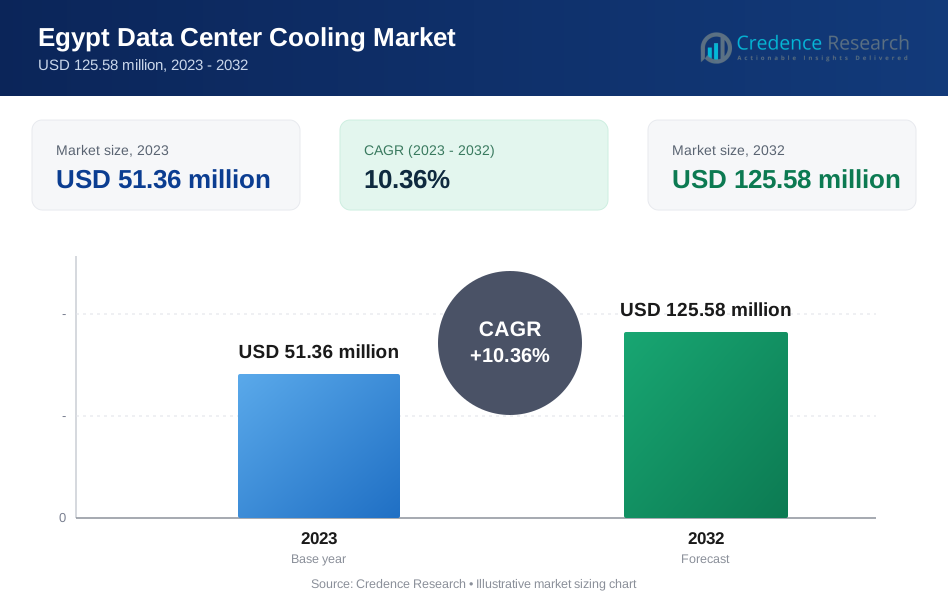
The Egypt Data Center Cooling Market is projected to grow from USD 51.36 million in 2023 to an estimated USD 125.58 million by 2032, with a compound annual growth rate (CAGR) of 10.36% from 2024 to 2032. This robust growth is driven by the increasing demand for data storage and processing capabilities, fueled by the rapid digitization across industries in Egypt.
Key drivers contributing to the growth of the data center cooling market in Egypt include the expansion of cloud computing services, the adoption of artificial intelligence (AI), and the rise in data traffic from various sectors. Additionally, trends such as the use of sustainable cooling technologies and the integration of innovative energy-efficient systems are further shaping the market landscape.
Geographically, the Cairo region is expected to dominate the market due to its concentration of data centers and growing digital economy. Other key regions contributing to market growth include Alexandria and Suez. Leading players in the Egypt data center cooling market include Vertiv Group Corp., Schneider Electric, Airedale International Air Conditioning Ltd., Stulz GmbH, and Rittal GmbH & Co. KG, who are focusing on innovation and strategic partnerships to expand their presence in the country.
Market Drivers
Rapid Expansion of Data Centers in Egypt
The increasing demand for data storage and processing in Egypt is driving the rapid expansion of data centers. As businesses and government sectors embrace digitization, the need for secure and reliable data infrastructure has become essential. The growth in e-commerce, financial services, and telecommunications is contributing to a surge in data generation, which, in turn, creates a heightened demand for large-scale data centers equipped with advanced cooling solutions. The rise in cloud computing services, supported by investments from global cloud providers, has also accelerated the establishment of data centers in Egypt. For instance, according to a recent survey by the Egyptian Ministry of Communications and Information Technology, the number of data centers in Egypt has doubled over the past five years, with a significant portion of these new facilities being large-scale operations requiring sophisticated cooling systems. Cooling systems are critical in ensuring these facilities operate efficiently by preventing overheating and maintaining optimal performance, thus reducing the risk of downtime. As data centers continue to grow in both number and size, the demand for energy-efficient and scalable cooling technologies is expected to rise significantly, driving the overall market growth in Egypt.
Increasing Focus on Energy Efficiency and Sustainability
Energy efficiency is becoming a critical focus for data center operators in Egypt due to rising energy costs and environmental concerns. The Egyptian government, along with global organizations, is pushing for sustainable practices in various sectors, including IT and data centers. As data centers are energy-intensive, cooling systems account for a substantial portion of their overall energy consumption. Thus, there is a growing need for innovative cooling solutions that minimize energy usage while maintaining effective temperature control. For instance, a recent study by the Egyptian Environmental Affairs Agency found that data centers in the country consume approximately 3% of the total national electricity output, with cooling systems accounting for nearly half of this consumption. Technologies such as liquid cooling, air economization, and the use of renewable energy sources for powering cooling systems are gaining traction in the market. Additionally, businesses are increasingly adopting energy-efficient designs and practices like server virtualization and efficient airflow management to optimize energy consumption. These trends are expected to bolster the demand for advanced data center cooling systems that align with sustainability goals, making energy efficiency a key driver in the growth of the Egypt data center cooling market.
Adoption of Advanced Cooling Technologies
The adoption of advanced cooling technologies is reshaping the landscape of the Egypt data center cooling market. Traditional air-based cooling systems are being replaced or supplemented by more efficient and technologically advanced solutions to address the challenges posed by higher-density data centers. Liquid cooling technologies, such as immersion cooling and direct-to-chip cooling, are gaining popularity as they offer greater efficiency in handling the heat generated by densely packed servers. These technologies are particularly suited for high-performance computing (HPC) environments and data centers supporting artificial intelligence (AI) and machine learning applications, which generate significantly more heat than conventional data centers. For instance, a survey conducted by the Egyptian Information Technology Industry Development Agency (ITIDA) revealed that over 30% of large data centers in Egypt have either implemented or are planning to implement liquid cooling solutions within the next two years. Additionally, modular and scalable cooling solutions are becoming more prevalent, allowing operators to adapt their cooling infrastructure to the growing size and complexity of their data centers. The adoption of these advanced cooling systems not only enhances efficiency but also helps operators achieve significant cost savings over time by reducing energy consumption and maintenance needs. As a result, the ongoing shift towards these cutting-edge technologies is expected to drive sustained growth in the Egypt data center cooling market.
Government Initiatives and Investment in Digital Infrastructure
The Egyptian government’s commitment to enhancing the country’s digital infrastructure is a major driver of the data center cooling market. As part of its Vision 2030 initiative, the government aims to establish Egypt as a regional hub for information and communication technology (ICT). This involves large-scale investments in data centers, fiber-optic networks, and other digital infrastructure projects to support the growing demand for digital services. Public-private partnerships (PPPs) have also been instrumental in attracting foreign investment in the data center sector. For instance, global tech giants are collaborating with local entities to build data centers that meet international standards. These initiatives not only boost the capacity of Egypt’s data centers but also create a demand for sophisticated cooling systems that can handle the increasing workload while ensuring operational efficiency. Furthermore, the Egyptian government’s focus on promoting renewable energy and energy-efficient technologies complements the drive for sustainable cooling solutions in data centers. By fostering a conducive environment for digital infrastructure growth, these government-led initiatives are propelling the demand for advanced data center cooling technologies across Egypt.
Market Trends
Emerging Cooling Technologies:
The Egypt data center cooling market is experiencing a significant shift towards advanced cooling solutions. Immersion cooling and direct-to-chip cooling are gaining traction as operators seek more efficient ways to manage heat dissipation. For instance, a major telecom provider in Cairo recently implemented an immersion cooling system in their new data center, resulting in a substantial reduction in cooling energy consumption. This trend is expected to continue as more facilities recognize the benefits of these innovative technologies. The adoption of liquid cooling solutions is particularly pronounced in high-performance computing environments, where traditional air cooling methods struggle to keep up with increasing power densities. As Egypt positions itself as a regional tech hub, the demand for these cutting-edge cooling technologies is likely to grow further.
Green Data Center Initiatives:
Sustainability has become a key focus in Egypt's data center industry, with a strong emphasis on developing green data centers. The government has been actively promoting eco-friendly practices in the sector. For example, the Ministry of Communications and Information Technology recently announced a partnership with a leading technology company to establish a state-of-the-art green data center in the New Administrative Capital. This facility will utilize renewable energy sources and incorporate energy-efficient cooling systems to minimize its carbon footprint. Additionally, several existing data centers in Alexandria and Giza have begun retrofitting their cooling infrastructure with more environmentally friendly options. These initiatives are not only reducing the environmental impact of data centers but also aligning with Egypt's broader sustainability goals and attracting environmentally conscious clients.
Market Restraints and Challenges
High Initial Investment and Operational Costs
One of the major restraints in the Egypt data center cooling market is the high initial investment required for deploying advanced cooling systems. Establishing energy-efficient and cutting-edge cooling technologies such as liquid cooling, air economization, or other sophisticated methods requires substantial capital expenditure. Additionally, operational costs related to the maintenance and regular servicing of these systems can further strain budgets, especially for smaller data center operators or businesses with limited financial resources. Despite the long-term benefits of reduced energy consumption, the significant upfront costs pose a barrier to widespread adoption, particularly in a market that is still in a growth phase. For instance, a survey conducted by the Egyptian Ministry of Communications and Information Technology found that many local businesses cited high costs as the primary reason for delaying the implementation of advanced cooling infrastructure. This financial challenge can slow market expansion, as companies struggle to balance the need for efficient cooling with budget constraints.
Infrastructure and Energy Supply Limitations
Another challenge faced by the Egypt data center cooling market is the country's limitations in infrastructure and energy supply. Data centers are energy-intensive, and efficient cooling systems demand a consistent and reliable power source. However, Egypt's energy grid has historically faced challenges, including intermittent supply issues in certain regions. This can hinder the optimal functioning of cooling systems, leading to inefficiencies and potential operational risks. For example, a report by the Egyptian Electric Utility and Consumer Protection Regulatory Agency highlighted that power outages in some areas still occur, affecting the reliability of data center operations. Furthermore, the availability of reliable internet connectivity and modern infrastructure in more rural areas lags behind urban regions like Cairo, restricting the potential for data center development outside major cities. A study by the Information Technology Industry Development Agency (ITIDA) revealed that the concentration of data centers in urban areas is partly due to these infrastructure limitations. Without significant improvements in these foundational areas, the growth of the data center cooling market may be constrained by infrastructure bottlenecks and energy supply inconsistencies.
Market Segmentation Analysis
By Component
The Egypt data center cooling market is divided into solutions and services segments. The solutions segment encompasses various cooling systems, including air conditioners, precision air conditioners, chillers, and air handling units. These systems are essential for maintaining optimal temperatures in data centers, ensuring the longevity and performance of critical IT equipment. For instance, a survey conducted by the Egyptian Information Technology Industry Development Agency (ITIDA) found that a significant portion of data centers in Egypt are investing in advanced cooling solutions to improve energy efficiency.The services segment, which includes installation & deployment, support & consulting, and maintenance services, is gaining prominence in the market. This growth is driven by the increasing complexity of cooling systems and the need for specialized expertise to manage them effectively. For instance, a report by the Egyptian Ministry of Communications and Information Technology highlighted that many companies are outsourcing their data center cooling management to specialized service providers to ensure optimal performance and reduce operational costs.
By Application
The application segment of the Egypt data center cooling market encompasses various industries, including Telecom & IT, Retail & BFSI (Banking, Financial Services, and Insurance), Healthcare, Energy, and others. The Telecom & IT sector currently holds the largest market share, driven by the rapid digitalization and increasing data traffic in Egypt. For instance, a study conducted by the National Telecom Regulatory Authority of Egypt revealed that the country's data consumption has been growing exponentially, necessitating the expansion and upgrading of data center infrastructure. The BFSI and healthcare sectors are also experiencing significant growth in terms of data center cooling requirements. This trend is attributed to the increasing adoption of digital banking services and electronic health records. For example, a survey by the Central Bank of Egypt found that a majority of banks in the country are investing in modernizing their data centers, with cooling systems being a key focus area. The energy sector is emerging as a crucial application area for data center cooling solutions, driven by the need for efficient cooling systems in energy-intensive environments. For instance, the Egyptian Electricity Holding Company reported an increase in the number of data centers being established to support smart grid initiatives, creating a demand for advanced cooling technologies.
Segments
Based on Component
- Solution
- Services
Based on Application
- Telecom & IT
- Retail & BFSI
- Healthcare
- Energy
- Others
Based on Solution
- Air Conditioners
- Precision Air Conditioners
- Chillers
- Air Handling Units
- Others
Based on Containment
- Raised Floor with Containment
- Hot Aisle Containment (HAC)
- Cold Aisle Containment (CAC)
- Raised Floor without Containment
Based on Services
- Installation & Deployment
- Support & Consulting
- Maintenance Services
Based on Cooling Type
- Raised Floor
- Non-Raised Floors
Based on Structure
- Rack-based Cooling
- Row-based Cooling
- Room-based Cooling
Based on Region
- Cairo
- Alexandria
- Suez
- Other Regions
Regional Analysis
Cairo (50%)
Cairo dominates the Egypt data center cooling market, accounting for approximately 50% of the market share. As the capital city and the country's main business hub, Cairo is home to a large number of data centers supporting various industries such as telecommunications, banking, and IT services. The government's focus on enhancing digital infrastructure in the city has attracted substantial investments from both local and international companies. For instance, the Egyptian government launched the first government data center in Cairo, spanning 23,500 square meters along the Ain Sokhna highway. Cairo's high demand for data storage and processing capabilities has spurred the adoption of advanced cooling technologies, making it the leading region for data center cooling solutions in Egypt. Additionally, major cloud service providers have set up operations in Cairo, further boosting the demand for efficient and scalable cooling systems.
Alexandria (20%):
Alexandria holds a market share of approximately 20% in the Egypt data center cooling market. As the second-largest city and a key port, Alexandria has seen increasing investment in its digital and telecommunication infrastructure. The rise in e-commerce, shipping logistics, and financial services has contributed to the growth of data centers in the region. This expansion has driven the need for reliable cooling solutions to ensure the smooth operation of data centers. For instance, the Egyptian government has been implementing its 2035 Integrated Sustainable Energy Strategy, aiming to increase the adoption of renewable energy sources for electricity generation. Alexandria's proximity to European and Middle Eastern markets has also made it an attractive location for companies seeking to establish regional data centers, further contributing to the growth of the cooling market.
Key players
- Stulz GmbH
- Rittal GmbH & Co. KG
- Schneider Electric SE
- Vertiv Group Corp.
- Mitsubishi Electric Hydronics & IT Cooling Systems SpA
- Asetek A/S
- Johnson Controls International PLC
- Emerson Electric Co.
Competitive Analysis
The Egypt Data Center Cooling Market is highly competitive, with several prominent global players striving to expand their market presence. Schneider Electric, Vertiv Group Corp., and Rittal GmbH are leading companies known for their advanced, energy-efficient cooling solutions tailored for large-scale data centers. Stulz GmbH and Mitsubishi Electric focus on innovative technologies like precision cooling and liquid-based systems, which are gaining traction in Egypt. Asetek A/S is recognized for its expertise in liquid cooling technologies, appealing to high-density data centers. Johnson Controls International and Emerson Electric Co. offer comprehensive HVAC and cooling solutions with a strong emphasis on sustainability and energy efficiency. These companies leverage technological advancements, strategic partnerships, and localized services to enhance their competitive edge in Egypt, as the market continues to grow due to the increasing demand for data center infrastructure.
Recent Developments
- In December 2023, Vertiv acquired CoolTera Ltd., a provider of coolant distribution infrastructure for data center liquid cooling technology. While this acquisition wasn't specific to Egypt, it strengthens Vertiv's capabilities in liquid cooling solutions, which could potentially benefit their operations in Egypt and other markets.
- In November 2023, Schneider Electric extended its collaboration with Compass Datacenters through a multi-year agreement valued at $3 billion. This partnership focuses on producing and distributing prefabricated modular data center solutions, which could potentially impact their offerings in Egypt.
- In May 2023, STULZ announced the launch of CyberCool CMU, an innovative coolant management and distribution unit (CDU) designed to maximize heat exchange efficiency in liquid cooling solutions. While not specific to Egypt, this product could be relevant to the Egyptian market.
- In June 2023, Johnson Controls announced the creation of a new data center-focused organization called Global Data Center Solutions. This new entity aims to provide integrated solutions to data center customers worldwide, which could include operations in Egypt.
Market Concentration and Characteristics
The Egypt Data Center Cooling Market exhibits a moderately concentrated structure, with a few key global players, such as Schneider Electric, Vertiv Group Corp., and Stulz GmbH, dominating the market. These companies, along with others like Rittal GmbH and Mitsubishi Electric, control a significant portion of the market due to their extensive product portfolios and strong focus on energy-efficient, innovative cooling solutions. The market is characterized by increasing demand for advanced cooling technologies, driven by the expansion of data centers and the rise in digital services. While global players hold a competitive advantage due to their technical expertise and global reach, local companies and service providers are gaining momentum through strategic partnerships and localized offerings that cater to the specific needs of Egypt’s growing data center infrastructure.
Report Coverage
The research report offers an in-depth analysis based on Component, Application, Solution, Containment, Services, Cooling Type, Structure and Region. It details leading market players, providing an overview of their business, product offerings, investments, revenue streams, and key applications. Additionally, the report includes insights into the competitive environment, SWOT analysis, current market trends, as well as the primary drivers and constraints. Furthermore, it discusses various factors that have driven market expansion in recent years. The report also explores market dynamics, regulatory scenarios, and technological advancements that are shaping the industry. It assesses the impact of external factors and global economic changes on market growth. Lastly, it provides strategic recommendations for new entrants and established companies to navigate the complexities of the market.
Future Outlook
- The Egypt Data Center Cooling Market is expected to witness steady growth, driven by increasing demand for data storage and cloud services across various industries.
- Data centers in Egypt will increasingly adopt advanced cooling technologies such as liquid cooling and precision air conditioners to enhance efficiency and reduce energy consumption.
- With rising energy costs, data center operators in Egypt will prioritize energy-efficient cooling solutions to minimize operational expenses and support sustainability goals.
- The market will see a growing preference for modular and scalable cooling systems, allowing operators to easily adapt to expanding data center infrastructures.
- Ongoing investments in Egypt's digital infrastructure, particularly in cities like Cairo and Alexandria, will drive further demand for reliable and efficient cooling solutions.
- As cloud computing and AI technologies become more prevalent, the heat generated by data centers will necessitate the use of advanced cooling systems to maintain operational efficiency.
- Government initiatives to promote renewable energy and sustainable practices will encourage the adoption of green cooling technologies in data centers across Egypt.
- The Egypt Data Center Cooling Market will experience heightened competition, with global companies vying for market share by offering innovative and cost-effective cooling solutions.
- Local service providers will play an increasingly important role in the market by offering tailored solutions that address specific regional needs and support efficient data center cooling operations.
- As data center expansion extends beyond major cities, smaller regions in Egypt will present new opportunities for growth in the cooling market, particularly in underserved areas.
Request a Free Sample
Fill in your details and we'll send you a free sample report.
- Sample data tables & charts
- Research methodology
Need a Custom Version of This Report?
Tailor the scope, geography, or segments to your exact requirements.
- Custom geography or segment scope
- Direct access to our analyst team
Frequently Asked Questions
What is the market size of the Egypt Data Center Cooling Market in 2023 and 2032,and what is the expected CAGR?
What are the key factors driving the growth of the Egypt data center cooling market?
Which regions dominate the Egypt Data Center Cooling Market?
What cooling technologies are gaining traction in Egypt’s data centers?
Table of Content
Chapter 1. Report Introduction
- 1.1 Report Description & Purpose
- 1.1.1 Report Title & Market Definition
- 1.1.2 Unique Selling Propositions (USP) & Key Differentiators
- 1.1.3 Value Proposition for Stakeholders
- 1.2 Research Objectives
- 1.2.1 Market Sizing Objectives (Volume & Revenue)
- 1.2.2 Segmentation Objectives
- 1.2.3 Competitive Intelligence Objectives
- 1.2.4 Forecast & Scenario Objectives
- 1.3 Report Scope
- 1.3.1 Egypt Data Center Cooling Scope – Types & Subtypes Covered
- 1.3.2 Geographic Scope – Regions & Countries Covered
- 1.3.3 Historical Period, Base Year & Forecast Period (2023; forecast to 2032)
- 1.3.4 Inclusions & Exclusions
- 1.4 HS Code & Classification Framework
- 1.5 Currency, Units & Pricing Basis
- 1.6 Target Stakeholders
- 1.7 Limitations & Assumptions
Chapter 2. Executive Summary
- 2.1 Global Egypt Data Center Cooling Market Snapshot
- 2.1.1 Market Size – Historical (2023) & Forecast (2023-2032) (2023: USD 51.36 million → 2032: USD 125.58 million)
- 2.1.2 Volume & Revenue – Global Totals
- 2.1.3 Key Market Highlights – Top Five Facts
- 2.2 Egypt Data Center Cooling Market Segmentation Snapshot
- 2.2.1 Market Split by Region – 2023 vs. 2032
- 2.3 Competitive Snapshot
- 2.3.1 Top 10 Players by Revenue Share – 2023
- 2.3.2 Top 10 Players by Volume Share – 2023
- 2.3.3 Recent Strategic Developments (18-Month Summary)
- 2.4 Key Investment Highlights & Strategic Conclusions
Chapter 3. Egypt Data Center Cooling Market Dynamics & Industry Analysis
- 3.1 Market Overview & Context
- 3.1.1 Egypt Data Center Cooling Market Position in the Broader Automotive Value Chain
- 3.1.2 OEM vs. Replacement Market Dynamics
- 3.1.3 Market Maturity & Development Stage by Region
- 3.2 Egypt Data Center Cooling Market Drivers
- 3.3 Egypt Data Center Cooling Market Restraints & Challenges
- 3.4 Egypt Data Center Cooling Market Opportunities
- 3.5 Porter's Five Forces Analysis
- 3.5.1 Threat of New Entrants
- 3.5.2 Bargaining Power of Suppliers
- 3.5.3 Bargaining Power of Buyers
- 3.5.4 Threat of Substitutes
- 3.5.5 Competitive Rivalry – Intensity Assessment
- 3.6 Egypt Data Center Cooling Value Chain Analysis
- 3.6.1 Upstream – Raw Material/Input Suppliers
- 3.6.1.1 Raw Material/Input 1
- 3.6.1.2 Raw Material/Input 2
- 3.6.1.3 Raw Material/Input 3
- 3.6.2 Midstream – Production/Manufacturing/Service Delivery
- 3.6.2.1 Production/Process Overview
- 3.6.2.2 Key Facility Locations & Capacity by Manufacturer
- 3.6.3 Downstream – Distribution & End Consumer
- 3.6.3.1 Primary Channel – B2B/OEM
- 3.6.3.2 Secondary Channels – Dealer, Retail, Online, Direct
- 3.6.4 Value Chain Profitability Analysis
- 3.6.1 Upstream – Raw Material/Input Suppliers
- 3.7 PESTEL Analysis
- 3.7.1 Political Factors
- 3.7.2 Economic Factors
- 3.7.3 Social Factors
- 3.7.4 Technological Factors
- 3.7.5 Environmental Factors
- 3.7.6 Legal Factors
- 3.8 Egypt Data Center Cooling Supply Chain Analysis
- 3.8.1 Raw Material/Input Supply Risk Assessment
- 3.8.2 Manufacturing Concentration Risk (Geographic Exposure)
- 3.8.3 Trade Disruption Impact Analysis
- 3.9 Regulatory & Policy Landscape
Note: The regulatory and policy landscape section covers regulations based on their applicability to the market, Egypt Data Center Cooling category, geography, and scope of the study. Only regulatory frameworks with a material impact on operations, compliance, trade, sustainability, or market access are analyzed in detail.
Chapter 4. Key Investment Pockets & Opportunity Analysis
- 4.1 Egypt Data Center Cooling Market Attractiveness Analysis
- 4.1.1 By Region – Investment Attractiveness Matrix (Volume × CAGR)
- 4.2 Absolute Revenue Growth Opportunity
- 4.2.1 By Region – Absolute USD Growth Through 2032
- 4.3 Incremental Volume Opportunity
- 4.3.1 By Region – Incremental Volume Through 2032
- 4.3.2 Segment – Incremental Volume
- 4.4 Emerging Submarket Opportunity Deep Dive (Subject to Applicability)
- 4.5 Emerging Market Opportunity Scorecards
- 4.5.1 United States
- 4.5.2 Europe
- 4.5.3 Asia
- 4.5.4 Middle East & Africa
Note: Emerging Market Opportunity Scorecards will be included based on relevance and strategic importance. Regions listed are indicative and may vary depending on data availability and market dynamics.
Chapter 5. Egypt Data Center Cooling Import-Export Analysis & Trade Flows
- 5.1 Global Trade Overview
- 5.1.1 Global Export Value by Country (2023)
- 5.1.2 Global Export Volume by Country (2023)
- 5.1.3 Global Import Value by Country (2023)
- 5.1.4 Global Import Volume by Country (2023)
- 5.1.5 Net Trade Balance by Country (2023)
- 5.2 Export Analysis – Segment
- 5.2.1 Type 1 (HS Code)
- 5.2.2 Type 2 (HS Code)
- 5.2.3 Type 3 (HS Code)
- 5.2.4 Type 4 (HS Code)
- 5.2.5 Type 5 (HS Code)
- 5.3 Import Analysis – Segment
- 5.3.1 Type 1 (HS Code)
- 5.3.2 Type 2 (HS Code)
- 5.3.3 Type 3 (HS Code)
- 5.3.4 Type 4 (HS Code)
- 5.3.5 Type 5 (HS Code)
- 5.4 Average Unit Trade Prices
- 5.4.1 Average Export Price – Segment & Country
- 5.4.2 Average Import Price – Segment & Source Country
- 5.4.3 Price Trends (2023)
- 5.5 Key Trade Route Analysis
- 5.5.1 Trade Route 1
- 5.5.2 Trade Route 2
- 5.5.3 Trade Route 3
- 5.5.4 Trade Route 4
- 5.5.5 Trade Route 5
- 5.6 Trade Policy Impact Assessment
- 5.6.1 US Anti-Dumping & Section 301 Tariffs
- 5.6.2 EU Customs Union Impact
- 5.6.3 Major Free Trade Agreements
- 5.6.4 USMCA Rules of Origin
Note: Trade policy analysis will be included only where relevant to the Egypt Data Center Cooling market.
Chapter 6. Competitive Landscape & Company Benchmarking
- 6.1 Egypt Data Center Cooling Market Concentration & Structure
- 6.1.1 Herfindahl-Hirschman Index (HHI) – vs. 2023
- 6.1.2 Tier 1, Tier 2 & Tier 3 Market Structure
- 6.1.3 Global, Regional & Local Player Dynamics
- 6.2 Egypt Data Center Cooling Market Share Analysis – 2023
- 6.2.1 Global Revenue Share by Company
- 6.2.2 Global Volume Share by Company
- 6.2.3 Regional Revenue Share
- 6.2.4 Market Share Evolution ( vs. 2023)
- 6.2.5 OEM Segment Share by Company
- 6.2.6 Replacement Segment Share by Company
- 6.3 Production/Delivery Capacity & Facility Analysis
- 6.3.1 Global Installed Capacity
- 6.3.2 Capacity Utilization Rates
- 6.3.3 Production/Output Volume
- 6.3.4 Facility Locations & Capacity Map
- 6.3.5 Planned Capacity Additions
- 6.4 Egypt Data Center Cooling Competitive Benchmarking Matrix
- 6.4.1 Revenue, Volume, CAGR & Profitability Comparison
- 6.4.2 Channel Revenue Mix
- 6.4.3 Geographic Revenue Exposure
- 6.4.4 R&D Intensity
- 6.4.5 Sustainability Maturity
- 6.5 Strategic Developments in Egypt Data Center Cooling (Last 24 Months)
- 6.5.1 Mergers, Acquisitions & Divestments
- 6.5.2 New Egypt Data Center Cooling Launches
- 6.5.3 Facility Expansions
- 6.5.4 Strategic Alliances, Joint Ventures & Partnerships
- 6.5.5 Distribution Expansion & Market Entry
- 6.5.6 Sustainability & ESG Initiatives
- 6.6 Competitive Strategy Mapping
- 6.6.1 Leader, Challenger, Follower & Niche Classification
- 6.6.2 Pricing Strategy Comparison
- 6.6.3 Channel Strategy Matrix
Note: Strategic developments are included based on their materiality and the availability of reliable information.
Chapter 7. Global Egypt Data Center Cooling Market – By Distribution Channel
- 7.1 Segment Overview
- 7.1.1 Volume & Revenue Split by Channel (2023 & 2032)
- 7.1.2 Channel Mix Evolution (2023-2032)
Chapter 8. Regional Market Analysis – Global Overview
- 8.1 Global Regional Overview
- 8.1.1 Regional Volume Share
- 8.1.2 Regional Revenue Share
- 8.1.3 Regional Volume by Region
- 8.1.4 Regional Revenue by Region
- 8.1.5 Regional Forecast Through 2032
- 8.2 Cross-Regional Segment Analysis
- 8.2.1 By Distribution Channel
- 8.2.2 By Brand/Price Tier
Chapter 9. North America Egypt Data Center Cooling Market
- 9.1 United States
- 9.2 Canada
- 9.3 Mexico
Chapter 10. Europe Egypt Data Center Cooling Market
- 10.1 Germany
- 10.2 France
- 10.3 Italy
- 10.4 United Kingdom
- 10.5 Spain
- 10.6 Poland
- 10.7 Russia
- 10.8 Netherlands
- 10.9 Belgium
- 10.10 Sweden
- 10.11 Denmark
- 10.12 Norway
- 10.13 Rest of Europe
Chapter 11. Asia Pacific Egypt Data Center Cooling Market
- 11.1 China
- 11.2 India
- 11.3 Japan
- 11.4 South Korea
- 11.5 Thailand
- 11.6 Indonesia
- 11.7 Vietnam
- 11.8 Malaysia
- 11.9 Australia
- 11.10 Rest of Asia Pacific
Chapter 12. Latin America Egypt Data Center Cooling Market
- 12.1 Brazil
- 12.2 Argentina
- 12.3 Colombia
- 12.4 Chile
- 12.5 Rest of Latin America
Chapter 13. Middle East Egypt Data Center Cooling Market
- 13.1 Saudi Arabia
- 13.2 United Arab Emirates
- 13.3 Turkey
- 13.4 Israel
- 13.5 Iran
- 13.6 Rest of the Middle East
Chapter 14. Africa Egypt Data Center Cooling Market
- 14.1 South Africa
- 14.2 Egypt
- 14.3 Nigeria
- 14.4 Morocco
- 14.5 Rest of Africa
Chapter 15. Egypt Data Center Cooling Company Profiles
- 15.1 [Company 01]
- 15.1.1 Company Overview
- 15.1.2 Key Management Personnel
- 15.1.3 Products & Services Portfolio
- 15.1.4 Financial Performance
- 15.1.5 Key Market Focus & Geographic Presence
- 15.1.6 Recent Developments & Strategic Initiatives
Note: The company profile list is preliminary and may change based on research findings, market developments, data availability, and client requirements.
Chapter 16. Appendices
- Appendix A – List of Abbreviations & Acronyms
- Appendix B – Industry Classification Code Reference – Full Series
- Appendix C – Production & Capacity Data Tables
- Appendix D – End-Use & Demand Base Tables
- Appendix E – Consumption & Replacement Rate Assumptions
- Appendix F – ASP Reference Tables
- Appendix G – Manufacturing & Facility Database
- Appendix H – Import-Export Data Tables
- Appendix I – Regulatory Summary Tables
- Appendix J – Primary Research Participant List (Anonymized)
- Appendix K – Primary Research Questionnaire Framework
- Appendix L – Data Sources & Bibliography
- Appendix M – Market Size Divergence & Source Comparison
Chapter 17. Research Methodology
- 17.1 Research Framework & Philosophy
- 17.2 Secondary Research – Sources, Hierarchy & Data Extraction
- 17.3 Data Modeling – Bottom-Up & Top-Down Market Sizing
- 17.4 Primary Research – Stakeholder Framework, LOI & Sample Sizes
- 17.5 Forecast Methodology – Regression, Scenario & Sensitivity Analysis
- 17.6 Quality Control – Four-Layer Validation Framework
- 17.7 Limitations & Standard Assumptions
- 17.8 Disclaimer
