
| REPORT ATTRIBUTE | DETAILS |
|---|---|
| Historical Period | 2020-2023 |
| Base Year | 2024 |
| Forecast Period | 2025-2032 |
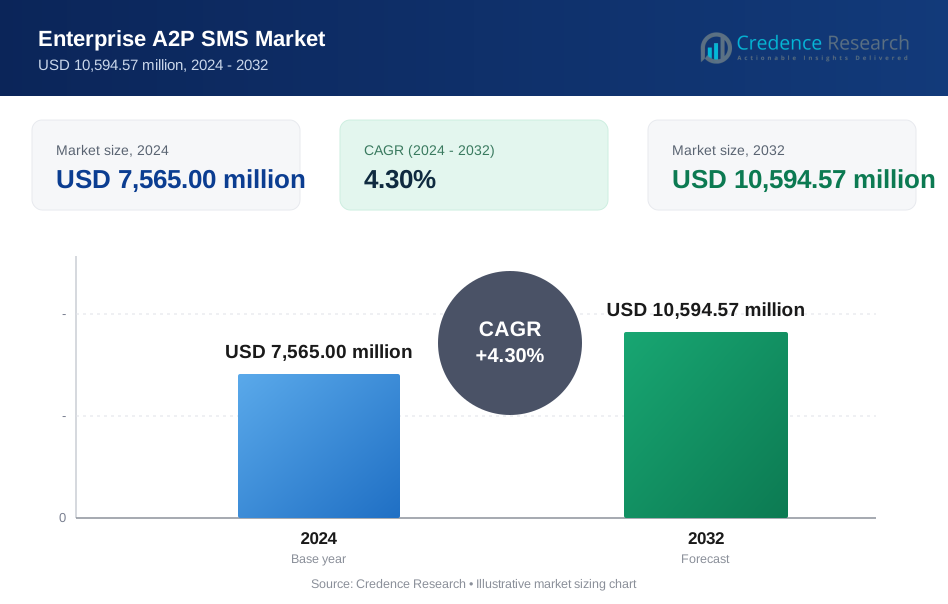
| Enterprise Application to Person (A2P) SMS Market Size 2024 | USD 7,565.00 Million |
| Enterprise Application to Person (A2P) SMS Market, CAGR | 4.30% |
| Enterprise Application to Person (A2P) SMS Market Size 2032 | USD 10,594.57 Million |
Market Overview
The global Enterprise Application to Person (A2P) SMS Market is projected to grow from USD 7,565.00 million in 2024 to an estimated USD 10,594.57 million by 2032, with a compound annual growth rate (CAGR) of 4.30% from 2025 to 2032. This growth is driven by the increasing adoption of mobile marketing strategies and the need for businesses to engage customers through reliable messaging channels.
Key market drivers include the rising demand for customer engagement solutions and the widespread use of smartphones, which facilitate the delivery and receipt of A2P messages. Additionally, industries such as banking, financial services, and insurance (BFSI) are increasingly utilizing A2P SMS for transaction alerts and notifications, further propelling market growth.
Geographically, North America and Europe hold significant market shares due to the early adoption of A2P messaging services, while the Asia-Pacific region is expected to witness the highest growth rate during the forecast period. Key players in the market include Twilio Inc., Sinch AB, and Infobip Ltd., which offer comprehensive A2P SMS solutions to cater to the diverse needs of businesses worldwide.
Market Insights
- The global A2P SMS market is projected to grow from USD 7,565.00 million in 2024 to USD 10,594.57 million by 2032, at a CAGR of 4.30% from 2025 to 2032.
- Increasing adoption of mobile marketing and personalized customer engagement is fueling the demand for A2P SMS solutions globally.
- The growing reliance on A2P SMS for transactional messaging and two-factor authentication across BFSI and e-commerce sectors is accelerating market growth.
- Rising concerns around SMS spam, fraud, and strict regulatory frameworks are limiting unrestricted A2P SMS deployment in certain regions.
- Network congestion and inconsistent message deliverability in rural or developing areas pose challenges to service quality and reliability.
- North America and Europe currently dominate the market due to early technological adoption and strong industry demand.
- Asia-Pacific is projected to witness the fastest growth owing to expanding mobile penetration, digital services, and enterprise adoption of messaging platforms.
Market Drivers
Enhanced Customer Experience and Real-Time Communication
The need for real-time communication and an enhanced customer experience has become a crucial driver of the A2P SMS market. Businesses across industries are recognizing that customers expect immediate responses and timely information. A2P SMS allows businesses to provide real-time updates on order status, delivery tracking, appointment reminders, and customer support requests, which enhances the overall customer experience.A2P SMS also allows companies to offer a seamless and personalized service, such as sending loyalty program updates, event reminders, and personalized promotions directly to customers' mobile devices. This level of personalization helps businesses foster stronger relationships with their customers, building trust and increasing brand loyalty. Moreover, SMS messages can be delivered regardless of the user's location or network conditions, ensuring a consistent customer experience even in areas with poor internet connectivity.As the competition for customer attention becomes more intense, companies are turning to A2P SMS to provide instant communication that meets customers' expectations for speed, convenience, and relevance. This demand for real-time engagement and personalized messaging continues to drive the expansion of the A2P SMS market across various sectors, including retail, healthcare, and travel.
Growing Smartphone Penetration and Internet Access Worldwide
The global increase in smartphone penetration and internet access is another critical factor contributing to the growth of the A2P SMS market. As smartphones have become an integral part of daily life, their widespread use has created an ideal platform for the delivery of A2P SMS messages. With billions of smartphone users globally, businesses can reach a vast audience through SMS, regardless of the user's geographic location or internet access.Smartphone users are increasingly relying on their devices not only for communication but also for accessing services, making purchases, and managing their personal affairs. A2P SMS fits well within this ecosystem, offering an effective and non-intrusive way to engage users on the go. Furthermore, the growing adoption of 4G and 5G networks has improved the speed and reliability of mobile services, enhancing the effectiveness of A2P SMS as a communication channel.In regions such as Asia-Pacific, where smartphone penetration is rapidly increasing, A2P SMS is seeing significant adoption. The combination of high mobile phone usage, expanding internet access, and the increasing use of mobile apps and services creates a favorable environment for A2P SMS growth. As more users across emerging markets gain access to affordable smartphones and mobile data plans, the reach of A2P SMS continues to expand, making it an essential tool for businesses looking to connect with a global customer base.
Increasing Adoption of Mobile Marketing and Customer Engagement Strategies
The growing demand for mobile marketing has been a significant driver of the global Enterprise Application to Person (A2P) SMS market. As businesses increasingly recognize the importance of customer engagement, A2P SMS has emerged as a preferred communication channel due to its high open rates and direct delivery to consumers' mobile devices. For instance, companies like banks and retailers use A2P SMS to send personalized promotional offers and service updates, which are often read within minutes of receipt. This high engagement rate makes A2P SMS an ideal tool for businesses aiming to engage their customers effectively. Businesses across various industries are leveraging A2P SMS for marketing campaigns, driving customer loyalty and retention. The simplicity and cost-effectiveness of A2P SMS allow businesses to reach large audiences with personalized messages.As more companies seek to establish meaningful connections with their customers, A2P SMS offers an efficient and reliable medium to convey timely and relevant information, making it a pivotal part of mobile marketing strategies. For instance, government surveys highlight the effectiveness of SMS in reaching a wide audience, particularly in regions with high mobile penetration. This trend of increasing mobile marketing adoption is expected to continue fueling the growth of the A2P SMS market as businesses continue to seek innovative ways to engage with their customers.
Rising Need for Transactional Messaging in Banking, Financial Services, and Insurance (BFSI)
One of the most significant drivers of A2P SMS adoption is the rising demand for transactional messaging, particularly in the banking, financial services, and insurance (BFSI) sectors. Financial institutions are increasingly relying on A2P SMS to deliver essential notifications such as one-time passcodes (OTPs), account activity alerts, transaction confirmations, and fraud alerts. For instance, surveys from financial regulatory bodies indicate that SMS provides a secure and reliable means of communication that ensures timely delivery of critical information, which is crucial in the fast-paced and security-sensitive financial sector. With the growing importance of cybersecurity and fraud prevention, A2P SMS plays a vital role in safeguarding user accounts and ensuring that customers are informed about any suspicious activities or changes in their financial status.Regulatory bodies in various regions are also driving the adoption of A2P SMS, as many financial regulations require institutions to inform customers of specific actions via secure communication channels. This regulatory push, coupled with the need for real-time alerts, is driving the growth of the A2P SMS market within the BFSI sector. For instance, government surveys show that the use of SMS for transactional purposes helps build trust and enhance customer satisfaction by providing immediate updates on financial activities. This trend is expected to continue as digital payments and online banking services expand, thus reinforcing the role of A2P SMS in the BFSI sector.
Market Trends
Shift Towards Personalization and Targeted Messaging
Another key trend shaping the A2P SMS market is the shift towards greater personalization and targeted messaging. Consumers today expect personalized and relevant communications from the businesses they engage with, and A2P SMS is an effective tool for delivering tailored messages that cater to individual customer preferences and behaviors.Through data analytics and customer segmentation, businesses are increasingly using A2P SMS to send targeted messages based on factors such as past purchases, browsing history, location, and demographic information. This level of personalization enhances the overall customer experience by providing timely and relevant offers, updates, and notifications. For instance, a retail brand may use A2P SMS to send personalized discounts or reminders to customers based on their shopping habits, improving the chances of converting these messages into sales.The shift towards personalization is also being driven by the integration of A2P SMS with customer relationship management (CRM) systems and marketing automation platforms. These integrations allow businesses to automate the sending of personalized messages at scale, reducing the manual effort required and ensuring that the right message reaches the right customer at the right time. This trend of hyper-targeted communication is expected to continue gaining momentum as businesses seek to build stronger relationships with their customers and improve engagement.
Expansion of A2P SMS Use in Customer Support and Service
A growing trend in the A2P SMS market is the increased use of SMS for customer support and service interactions. Many businesses are now utilizing A2P SMS to offer real-time customer service, resolve issues, and provide information to customers quickly and efficiently. The simplicity and speed of SMS make it an ideal platform for addressing customer inquiries, answering frequently asked questions (FAQs), and providing updates on service requests or product issues.This trend is particularly prevalent in industries such as travel, hospitality, and healthcare, where customers often need immediate assistance. For instance, airlines use A2P SMS to notify passengers about flight delays, gate changes, and boarding instructions. Similarly, healthcare providers may use SMS to remind patients about upcoming appointments or to notify them of important health updates.Additionally, businesses are using SMS to provide proactive customer support, such as sending reminders for scheduled maintenance, service appointments, or subscription renewals. By leveraging A2P SMS for customer service, companies are able to provide an efficient, non-intrusive, and direct channel of communication, resulting in improved customer satisfaction and reduced response times.
Rise of Rich Communication Services (RCS) Integration with A2P SMS
One of the most notable trends in the global Enterprise Application to Person (A2P) SMS market is the growing adoption and integration of Rich Communication Services (RCS) with traditional SMS. RCS offers more interactive and dynamic messaging capabilities compared to standard SMS, enabling businesses to enhance the customer experience through multimedia content, such as images, videos, carousels, and quick reply buttons, all within a native messaging environment. For instance, companies like Sinch have seen significant growth in RCS adoption, with businesses leveraging these services to transform customer interactions. Unlike traditional SMS, which is limited to text-based communication, RCS provides a more immersive messaging experience that aligns with modern consumer expectations for rich, engaging, and branded content.The integration of A2P SMS with RCS allows businesses to combine the reliability and simplicity of SMS with the advanced functionality of RCS, thereby improving customer interaction and engagement. This trend is particularly noticeable in industries such as retail, banking, and hospitality, where companies are using RCS to send order confirmations, promotional offers, and even real-time customer support. As mobile carriers around the world expand their support for RCS, its usage in A2P messaging is expected to grow, driving a more sophisticated approach to customer communication. RCS also offers enhanced security features, such as end-to-end encryption, which makes it a compelling alternative to traditional SMS for businesses looking to provide secure and engaging experiences to their customers.
Increased Use of A2P SMS for Customer Authentication and Security
The increasing reliance on digital platforms and services has led to a surge in the use of A2P SMS for customer authentication and security. Businesses, particularly in sectors such as banking, e-commerce, and telecommunications, are leveraging A2P SMS to send one-time passcodes (OTPs) and two-factor authentication (2FA) codes to verify the identity of their users. For instance, financial institutions like HSBC and JPMorgan Chase use A2P SMS for 2FA to prevent unauthorized access and fraud. This trend is driven by the rising concerns over data privacy, cyber threats, and identity theft.SMS-based authentication provides an additional layer of security by ensuring that only authorized users can access their accounts or complete transactions. The widespread adoption of smartphones, along with the ease and accessibility of SMS, has made it an effective method of authentication. Many regulatory bodies have also mandated the use of two-factor authentication for certain types of transactions, further propelling the demand for A2P SMS in securing online interactions. As security concerns continue to grow and businesses face increasing scrutiny over data protection, A2P SMS offers a simple and effective solution for verifying user identity and enhancing online security. This trend is expected to continue as organizations look for secure and cost-efficient ways to protect customer accounts and sensitive information.
Market Challenges
Message Deliverability and Network Quality Issues
Another significant challenge for the A2P SMS market is ensuring high message deliverability and overcoming network quality issues. While SMS is generally a reliable and robust communication channel, there are still instances where messages fail to be delivered due to network congestion, carrier restrictions, or poor coverage in certain regions. In some cases, mobile network operators impose filtering or blocking measures on A2P messages, particularly if they are deemed to be unsolicited or spam-like in nature. This can lead to message delays or failures in reaching the intended recipients, impacting the effectiveness of A2P SMS campaigns.Additionally, mobile network issues such as service outages, signal disruptions, or limited connectivity in remote or rural areas can hamper the delivery of time-sensitive messages, such as those used for customer authentication, alerts, and notifications. For businesses that rely heavily on A2P SMS to communicate critical information to their customers, these delivery issues can result in customer dissatisfaction and reduced trust in the service. Ensuring consistent, high-quality delivery across various network environments and regions is an ongoing challenge for businesses looking to maximize the potential of A2P SMS.
Regulatory and Compliance Issues
Regulatory and Compliance Issues in the global Enterprise Application to Person (A2P) SMS market highlight significant challenges for businesses. For instance, surveys and reports from regulatory authorities and organizations reveal that compliance with diverse national regulations is a critical hurdle. Countries such as France have specific rules, like restricting marketing SMS outside business hours, while in Malaysia, message headers must clarify that recipients incur no charges. These variations necessitate businesses to adapt operations to each region's unique legal framework, complicating global campaigns. Additionally, consumer protection laws like GDPR in Europe enforce strict data privacy standards, requiring explicit customer consent for marketing messages. This is echoed by findings from industry consultations, which indicate that non-compliance risks include financial penalties and reputational harm.Furthermore, the rise of SMS-based fraud has prompted regulators to introduce measures such as sender identity verification and spam monitoring systems. Research indicates that mobile operators often struggle with outdated firewall rules, leaving gaps for fraudulent activities. Consumer complaints also serve as a key data source for regulators to refine policies. Reports suggest that businesses must collaborate with regulators and adopt advanced technological solutions to ensure compliance and safeguard consumer trust. These regulatory complexities underscore the need for robust strategies to navigate the evolving landscape of A2P SMS globally.
Market Opportunities
Expansion in Emerging Markets
One of the most significant opportunities in the global Enterprise Application to Person (A2P) SMS market lies in the expansion of mobile communication services in emerging markets. Regions such as Asia-Pacific, Latin America, the Middle East, and Africa are experiencing rapid growth in mobile phone penetration, particularly smartphones, which has created a vast untapped market for A2P SMS services. As internet access becomes more widespread in these regions, the demand for mobile-based communication solutions, including A2P SMS, is expected to increase. For businesses operating in these areas, leveraging A2P SMS for marketing, customer support, and transactional messaging offers an efficient, cost-effective, and highly engaging means of connecting with a broad consumer base. The ability to reach customers in regions with limited access to other digital communication platforms, such as email or apps, presents a significant growth opportunity for A2P SMS providers.
Integration with Omnichannel Marketing Strategies
Another opportunity for the A2P SMS market is its growing integration with omnichannel marketing strategies. As businesses strive to deliver seamless and personalized customer experiences across various touchpoints, integrating A2P SMS with other digital channels like email, social media, and mobile apps has become increasingly important. A2P SMS allows businesses to send targeted and real-time messages that complement and enhance the customer journey, helping to drive engagement and conversions. By combining A2P SMS with other communication tools, businesses can offer a more cohesive, cross-channel experience that meets the evolving expectations of today's consumers. This integration is expected to accelerate A2P SMS adoption, particularly in industries like retail, banking, and healthcare, where timely, relevant, and personalized communication is crucial.
Market Segmentation Analysis
By Deployment Type:
The market is divided into cloud-based and on-premises deployment models. Cloud-based A2P SMS solutions are witnessing significant growth due to their scalability, flexibility, and cost-effectiveness. They are particularly favored by small and medium-sized enterprises (SMEs) that require minimal infrastructure investment and rapid deployment. On the other hand, large organizations with stringent data control and compliance requirements continue to rely on on-premises deployments, especially in industries like banking and healthcare. However, the overall shift toward digital transformation is propelling the cloud segment to grow at a faster pace during the forecast period.
By Application:
The A2P SMS market serves a wide range of applications, including pushed content services, customer relationship management (CRM) services, promotion and marketing, and others such as information services and workforce management. Among these, promotional and marketing services dominate the market due to the high demand for customer engagement, brand awareness, and real-time offers. CRM services are also growing steadily as businesses aim to enhance customer loyalty through timely and personalized communication. Pushed content services and other applications add value by supporting critical information dissemination and internal workforce coordination.
Segments
Based on Deployment Type
- Cloud
- On-premises
Based on Application
- Pushed Content Services
- Customer Relationship Management Services
- Promotion and Marketing
- Others (Information Services, Workforce Management)
Based on End User
- BFSI
- Retail and E-Commerce
- Travel and Hospitality
- Healthcare
- Others
Based on Region
- North America
- U.S.
- Canada
- Mexico
- Europe
- Germany
- France
- U.K.
- Italy
- Spain
- Rest of Europe
- Asia Pacific
- China
- Japan
- India
- South Korea
- South-east Asia
- Rest of Asia Pacific
- Latin America
- Brazil
- Argentina
- Rest of Latin America
- Middle East & Africa
- GCC Countries
- South Africa
- Rest of the Middle East and Africa
Regional Analysis
Asia-Pacific (40%)
Leading the global A2P SMS market, the Asia-Pacific region accounted for approximately 40% of the market share in 2024. This dominance is driven by high smartphone penetration and extensive use of SMS-based services in countries like China and India. In China, large-scale e-commerce platforms such as Alibaba and JD.com rely on A2P SMS for transaction alerts and authentication. Similarly, India, with over 1 billion mobile connections and an increasing adoption of digital payments, extensively uses A2P SMS for government programs, financial services, and healthcare notifications. Indonesia also contributes significantly, with expanding telecom infrastructure and mobile banking adoption bolstering the region's dominance.
North America (25%)
Holding approximately 25% of the global market share in 2024, North America benefits from advanced technological infrastructure and high adoption rates across industries such as banking, retail, and technology. The United States processes over 50 billion A2P SMS messages annually, driven by financial institutions implementing SMS-based two-factor authentication (2FA) for secure transactions. Canada, with its strong focus on data privacy and regulatory compliance, leverages A2P SMS for real-time notifications in banking and healthcare, aligning with stringent standards like the Personal Information Protection and Electronic Documents Act (PIPEDA).
Key players
- AT&T Inc.
- Tata Communications
- Vonage Holdings Corp.
- SAP SE
- NTT Communications
Competitive Analysis
The global Enterprise Application to Person (A2P) SMS market is highly competitive, with key players focusing on strategic partnerships, technological innovation, and global expansion to strengthen their market presence. AT&T Inc. leverages its robust network infrastructure and diversified service portfolio to maintain a strong foothold in the telecom sector. Tata Communications and NTT Communications continue to expand their A2P messaging services across emerging markets, capitalizing on increasing mobile penetration. Vonage Holdings Corp. is enhancing its capabilities through cloud-based communication platforms, while SAP SE integrates A2P messaging into its enterprise software solutions, offering seamless communication tools for businesses. The competitive landscape is also marked by growing investments in cloud deployment and secure messaging platforms, as companies seek to offer scalable and reliable A2P SMS services. Innovation, service quality, and regional outreach remain key factors shaping competition among these leading players.
Recent Developments
- In 2024, Tata Communications maintained a significant position in the market, offering advanced mobility platforms and SMS services tailored for global enterprises.
- Effective October 1, 2024, AT&T increased pass-through fees for various A2P messaging services, impacting businesses utilizing 10-digit long code (10DLC) and Toll-Free text messaging. This change affects messaging activities on the AT&T network, with the updated charges reflected in November invoices.
- In 2023, Vonage invested in cloud-based communication solutions, including A2P SMS, to enhance customer engagement for businesses. Their unified communications platform offers features such as SMS and MMS support, voicemail, and integrations with leading CRMs and business productivity apps, providing scalable and flexible communication strategies for enterprises.
Market Concentration and Characteristics
The Global Enterprise Application to Person (A2P) SMS Market exhibits a moderately concentrated structure, with a few dominant players such as AT&T Inc., Tata Communications, SAP SE, Vonage Holdings Corp., and NTT Communications holding significant market shares. These companies benefit from robust infrastructure, extensive global reach, and established customer bases, allowing them to lead in service delivery and innovation. The market is characterized by high entry barriers due to regulatory compliance requirements, the need for carrier partnerships, and infrastructure investments. It also features strong demand for reliable, real-time communication services across sectors such as BFSI, retail, healthcare, and travel. The increasing integration of A2P SMS with cloud platforms and omnichannel communication strategies further shapes the market’s dynamic nature, while regional differences in regulations, mobile penetration, and technological adoption contribute to a diverse competitive environment.
Report Coverage
The research report offers an in-depth analysis based on Deployment Type, Application, End User and Region. It details leading market players, providing an overview of their business, product offerings, investments, revenue streams, and key applications. Additionally, the report includes insights into the competitive environment, SWOT analysis, current market trends, as well as the primary drivers and constraints. Furthermore, it discusses various factors that have driven market expansion in recent years. The report also explores market dynamics, regulatory scenarios, and technological advancements that are shaping the industry. It assesses the impact of external factors and global economic changes on market growth. Lastly, it provides strategic recommendations for new entrants and established companies to navigate the complexities of the market.
Future Outlook
- The A2P SMS market is expected to continue its upward trajectory, driven by increasing demand for secure and real-time business communication globally.
- Enterprises will increasingly shift to cloud-based A2P SMS platforms for greater scalability, cost-efficiency, and seamless integration with digital ecosystems.
- The integration of artificial intelligence and automation will enhance message personalization, timing, and delivery, improving overall customer engagement.
- As cybersecurity threats rise, A2P SMS will remain a critical tool for sending OTPs and authentication codes across banking, fintech, and e-commerce sectors.
- More businesses will adopt A2P SMS for real-time customer service interactions, including alerts, reminders, FAQs, and feedback collection.
- Rapid smartphone penetration and expanding digital infrastructure in Asia-Pacific, Latin America, and Africa will unlock substantial growth opportunities.
- A2P SMS will evolve through RCS integration, enabling richer, interactive messaging formats while preserving reliability and global reach.
- Businesses will invest more in secure messaging systems to ensure compliance with tightening global regulations like GDPR and data protection laws.
- New verticals such as healthcare, logistics, and education will increasingly adopt A2P SMS for timely communication and operational efficiency.
- A2P SMS will play a vital role in omnichannel strategies, complementing email, social media, and push notifications to deliver cohesive customer experiences.
Request a Free Sample
Fill in your details and we'll send you a free sample report.
- Sample data tables & charts
- Research methodology
Need a Custom Version of This Report?
Tailor the scope, geography, or segments to your exact requirements.
- Custom geography or segment scope
- Direct access to our analyst team
Frequently Asked Questions
What is the projected market size for the Enterprise A2P SMS market by 2032?
What are the key factors driving the growth of the A2P SMS market?
Which industries are the main adopters of A2P SMS services?
Which regions are leading the A2P SMS market?
Table of Content
Chapter 1. Report Introduction
- 1.1 Report Description & Purpose
- 1.1.1 Report Title & Market Definition
- 1.1.2 Unique Selling Propositions (USP) & Key Differentiators
- 1.1.3 Value Proposition for Stakeholders
- 1.2 Research Objectives
- 1.2.1 Market Sizing Objectives (Volume & Revenue)
- 1.2.2 Segmentation Objectives
- 1.2.3 Competitive Intelligence Objectives
- 1.2.4 Forecast & Scenario Objectives
- 1.3 Report Scope
- 1.3.1 Enterprise A2P SMS Scope – Types & Subtypes Covered
- 1.3.2 Geographic Scope – Regions & Countries Covered
- 1.3.3 Historical Period, Base Year & Forecast Period (2024; forecast to 2032)
- 1.3.4 Inclusions & Exclusions
- 1.4 HS Code & Classification Framework
- 1.5 Currency, Units & Pricing Basis
- 1.6 Target Stakeholders
- 1.7 Limitations & Assumptions
Chapter 2. Executive Summary
- 2.1 Global Enterprise A2P SMS Market Snapshot
- 2.1.1 Market Size – Historical (2024) & Forecast (2024-2032) (2024: USD 7,565.00 million → 2032: USD 10,594.57 million)
- 2.1.2 Volume & Revenue – Global Totals
- 2.1.3 Key Market Highlights – Top Five Facts
- 2.2 Enterprise A2P SMS Market Segmentation Snapshot
- 2.2.1 Market Split by Region – 2024 vs. 2032
- 2.3 Competitive Snapshot
- 2.3.1 Top 10 Players by Revenue Share – 2024
- 2.3.2 Top 10 Players by Volume Share – 2024
- 2.3.3 Recent Strategic Developments (18-Month Summary)
- 2.4 Key Investment Highlights & Strategic Conclusions
Chapter 3. Enterprise A2P SMS Market Dynamics & Industry Analysis
- 3.1 Market Overview & Context
- 3.1.1 Enterprise A2P SMS Market Position in the Broader Automotive Value Chain
- 3.1.2 OEM vs. Replacement Market Dynamics
- 3.1.3 Market Maturity & Development Stage by Region
- 3.2 Enterprise A2P SMS Market Drivers
- 3.3 Enterprise A2P SMS Market Restraints & Challenges
- 3.4 Enterprise A2P SMS Market Opportunities
- 3.5 Porter's Five Forces Analysis
- 3.5.1 Threat of New Entrants
- 3.5.2 Bargaining Power of Suppliers
- 3.5.3 Bargaining Power of Buyers
- 3.5.4 Threat of Substitutes
- 3.5.5 Competitive Rivalry – Intensity Assessment
- 3.6 Enterprise A2P SMS Value Chain Analysis
- 3.6.1 Upstream – Raw Material/Input Suppliers
- 3.6.1.1 Raw Material/Input 1
- 3.6.1.2 Raw Material/Input 2
- 3.6.1.3 Raw Material/Input 3
- 3.6.2 Midstream – Production/Manufacturing/Service Delivery
- 3.6.2.1 Production/Process Overview
- 3.6.2.2 Key Facility Locations & Capacity by Manufacturer
- 3.6.3 Downstream – Distribution & End Consumer
- 3.6.3.1 Primary Channel – B2B/OEM
- 3.6.3.2 Secondary Channels – Dealer, Retail, Online, Direct
- 3.6.4 Value Chain Profitability Analysis
- 3.6.1 Upstream – Raw Material/Input Suppliers
- 3.7 PESTEL Analysis
- 3.7.1 Political Factors
- 3.7.2 Economic Factors
- 3.7.3 Social Factors
- 3.7.4 Technological Factors
- 3.7.5 Environmental Factors
- 3.7.6 Legal Factors
- 3.8 Enterprise A2P SMS Supply Chain Analysis
- 3.8.1 Raw Material/Input Supply Risk Assessment
- 3.8.2 Manufacturing Concentration Risk (Geographic Exposure)
- 3.8.3 Trade Disruption Impact Analysis
- 3.9 Regulatory & Policy Landscape
Note: The regulatory and policy landscape section covers regulations based on their applicability to the market, Enterprise A2P SMS category, geography, and scope of the study. Only regulatory frameworks with a material impact on operations, compliance, trade, sustainability, or market access are analyzed in detail.
Chapter 4. Key Investment Pockets & Opportunity Analysis
- 4.1 Enterprise A2P SMS Market Attractiveness Analysis
- 4.1.1 By Region – Investment Attractiveness Matrix (Volume × CAGR)
- 4.2 Absolute Revenue Growth Opportunity
- 4.2.1 By Region – Absolute USD Growth Through 2032
- 4.3 Incremental Volume Opportunity
- 4.3.1 By Region – Incremental Volume Through 2032
- 4.3.2 Segment – Incremental Volume
- 4.4 Emerging Submarket Opportunity Deep Dive (Subject to Applicability)
- 4.5 Emerging Market Opportunity Scorecards
- 4.5.1 United States
- 4.5.2 Europe
- 4.5.3 Asia
- 4.5.4 Middle East & Africa
Note: Emerging Market Opportunity Scorecards will be included based on relevance and strategic importance. Regions listed are indicative and may vary depending on data availability and market dynamics.
Chapter 5. Enterprise A2P SMS Import-Export Analysis & Trade Flows
- 5.1 Global Trade Overview
- 5.1.1 Global Export Value by Country (2024)
- 5.1.2 Global Export Volume by Country (2024)
- 5.1.3 Global Import Value by Country (2024)
- 5.1.4 Global Import Volume by Country (2024)
- 5.1.5 Net Trade Balance by Country (2024)
- 5.2 Export Analysis – Segment
- 5.2.1 Type 1 (HS Code)
- 5.2.2 Type 2 (HS Code)
- 5.2.3 Type 3 (HS Code)
- 5.2.4 Type 4 (HS Code)
- 5.2.5 Type 5 (HS Code)
- 5.3 Import Analysis – Segment
- 5.3.1 Type 1 (HS Code)
- 5.3.2 Type 2 (HS Code)
- 5.3.3 Type 3 (HS Code)
- 5.3.4 Type 4 (HS Code)
- 5.3.5 Type 5 (HS Code)
- 5.4 Average Unit Trade Prices
- 5.4.1 Average Export Price – Segment & Country
- 5.4.2 Average Import Price – Segment & Source Country
- 5.4.3 Price Trends (2024)
- 5.5 Key Trade Route Analysis
- 5.5.1 Trade Route 1
- 5.5.2 Trade Route 2
- 5.5.3 Trade Route 3
- 5.5.4 Trade Route 4
- 5.5.5 Trade Route 5
- 5.6 Trade Policy Impact Assessment
- 5.6.1 US Anti-Dumping & Section 301 Tariffs
- 5.6.2 EU Customs Union Impact
- 5.6.3 Major Free Trade Agreements
- 5.6.4 USMCA Rules of Origin
Note: Trade policy analysis will be included only where relevant to the Enterprise A2P SMS market.
Chapter 6. Competitive Landscape & Company Benchmarking
- 6.1 Enterprise A2P SMS Market Concentration & Structure
- 6.1.1 Herfindahl-Hirschman Index (HHI) – vs. 2024
- 6.1.2 Tier 1, Tier 2 & Tier 3 Market Structure
- 6.1.3 Global, Regional & Local Player Dynamics
- 6.2 Enterprise A2P SMS Market Share Analysis – 2024
- 6.2.1 Global Revenue Share by Company
- 6.2.2 Global Volume Share by Company
- 6.2.3 Regional Revenue Share
- 6.2.4 Market Share Evolution ( vs. 2024)
- 6.2.5 OEM Segment Share by Company
- 6.2.6 Replacement Segment Share by Company
- 6.3 Production/Delivery Capacity & Facility Analysis
- 6.3.1 Global Installed Capacity
- 6.3.2 Capacity Utilization Rates
- 6.3.3 Production/Output Volume
- 6.3.4 Facility Locations & Capacity Map
- 6.3.5 Planned Capacity Additions
- 6.4 Enterprise A2P SMS Competitive Benchmarking Matrix
- 6.4.1 Revenue, Volume, CAGR & Profitability Comparison
- 6.4.2 Channel Revenue Mix
- 6.4.3 Geographic Revenue Exposure
- 6.4.4 R&D Intensity
- 6.4.5 Sustainability Maturity
- 6.5 Strategic Developments in Enterprise A2P SMS (Last 24 Months)
- 6.5.1 Mergers, Acquisitions & Divestments
- 6.5.2 New Enterprise A2P SMS Launches
- 6.5.3 Facility Expansions
- 6.5.4 Strategic Alliances, Joint Ventures & Partnerships
- 6.5.5 Distribution Expansion & Market Entry
- 6.5.6 Sustainability & ESG Initiatives
- 6.6 Competitive Strategy Mapping
- 6.6.1 Leader, Challenger, Follower & Niche Classification
- 6.6.2 Pricing Strategy Comparison
- 6.6.3 Channel Strategy Matrix
Note: Strategic developments are included based on their materiality and the availability of reliable information.
Chapter 7. Global Enterprise A2P SMS Market – By Distribution Channel
- 7.1 Segment Overview
- 7.1.1 Volume & Revenue Split by Channel (2024 & 2032)
- 7.1.2 Channel Mix Evolution (2024-2032)
Chapter 8. Regional Market Analysis – Global Overview
- 8.1 Global Regional Overview
- 8.1.1 Regional Volume Share
- 8.1.2 Regional Revenue Share
- 8.1.3 Regional Volume by Region
- 8.1.4 Regional Revenue by Region
- 8.1.5 Regional Forecast Through 2032
- 8.2 Cross-Regional Segment Analysis
- 8.2.1 By Distribution Channel
- 8.2.2 By Brand/Price Tier
Chapter 9. North America Enterprise A2P SMS Market
- 9.1 United States
- 9.2 Canada
- 9.3 Mexico
Chapter 10. Europe Enterprise A2P SMS Market
- 10.1 Germany
- 10.2 France
- 10.3 Italy
- 10.4 United Kingdom
- 10.5 Spain
- 10.6 Poland
- 10.7 Russia
- 10.8 Netherlands
- 10.9 Belgium
- 10.10 Sweden
- 10.11 Denmark
- 10.12 Norway
- 10.13 Rest of Europe
Chapter 11. Asia Pacific Enterprise A2P SMS Market
- 11.1 China
- 11.2 India
- 11.3 Japan
- 11.4 South Korea
- 11.5 Thailand
- 11.6 Indonesia
- 11.7 Vietnam
- 11.8 Malaysia
- 11.9 Australia
- 11.10 Rest of Asia Pacific
Chapter 12. Latin America Enterprise A2P SMS Market
- 12.1 Brazil
- 12.2 Argentina
- 12.3 Colombia
- 12.4 Chile
- 12.5 Rest of Latin America
Chapter 13. Middle East Enterprise A2P SMS Market
- 13.1 Saudi Arabia
- 13.2 United Arab Emirates
- 13.3 Turkey
- 13.4 Israel
- 13.5 Iran
- 13.6 Rest of the Middle East
Chapter 14. Africa Enterprise A2P SMS Market
- 14.1 South Africa
- 14.2 Egypt
- 14.3 Nigeria
- 14.4 Morocco
- 14.5 Rest of Africa
Chapter 15. Enterprise A2P SMS Company Profiles
- 15.1 [Company 01]
- 15.1.1 Company Overview
- 15.1.2 Key Management Personnel
- 15.1.3 Products & Services Portfolio
- 15.1.4 Financial Performance
- 15.1.5 Key Market Focus & Geographic Presence
- 15.1.6 Recent Developments & Strategic Initiatives
Note: The company profile list is preliminary and may change based on research findings, market developments, data availability, and client requirements.
Chapter 16. Appendices
- Appendix A – List of Abbreviations & Acronyms
- Appendix B – Industry Classification Code Reference – Full Series
- Appendix C – Production & Capacity Data Tables
- Appendix D – End-Use & Demand Base Tables
- Appendix E – Consumption & Replacement Rate Assumptions
- Appendix F – ASP Reference Tables
- Appendix G – Manufacturing & Facility Database
- Appendix H – Import-Export Data Tables
- Appendix I – Regulatory Summary Tables
- Appendix J – Primary Research Participant List (Anonymized)
- Appendix K – Primary Research Questionnaire Framework
- Appendix L – Data Sources & Bibliography
- Appendix M – Market Size Divergence & Source Comparison
Chapter 17. Research Methodology
- 17.1 Research Framework & Philosophy
- 17.2 Secondary Research – Sources, Hierarchy & Data Extraction
- 17.3 Data Modeling – Bottom-Up & Top-Down Market Sizing
- 17.4 Primary Research – Stakeholder Framework, LOI & Sample Sizes
- 17.5 Forecast Methodology – Regression, Scenario & Sensitivity Analysis
- 17.6 Quality Control – Four-Layer Validation Framework
- 17.7 Limitations & Standard Assumptions
- 17.8 Disclaimer
