Market Overview:
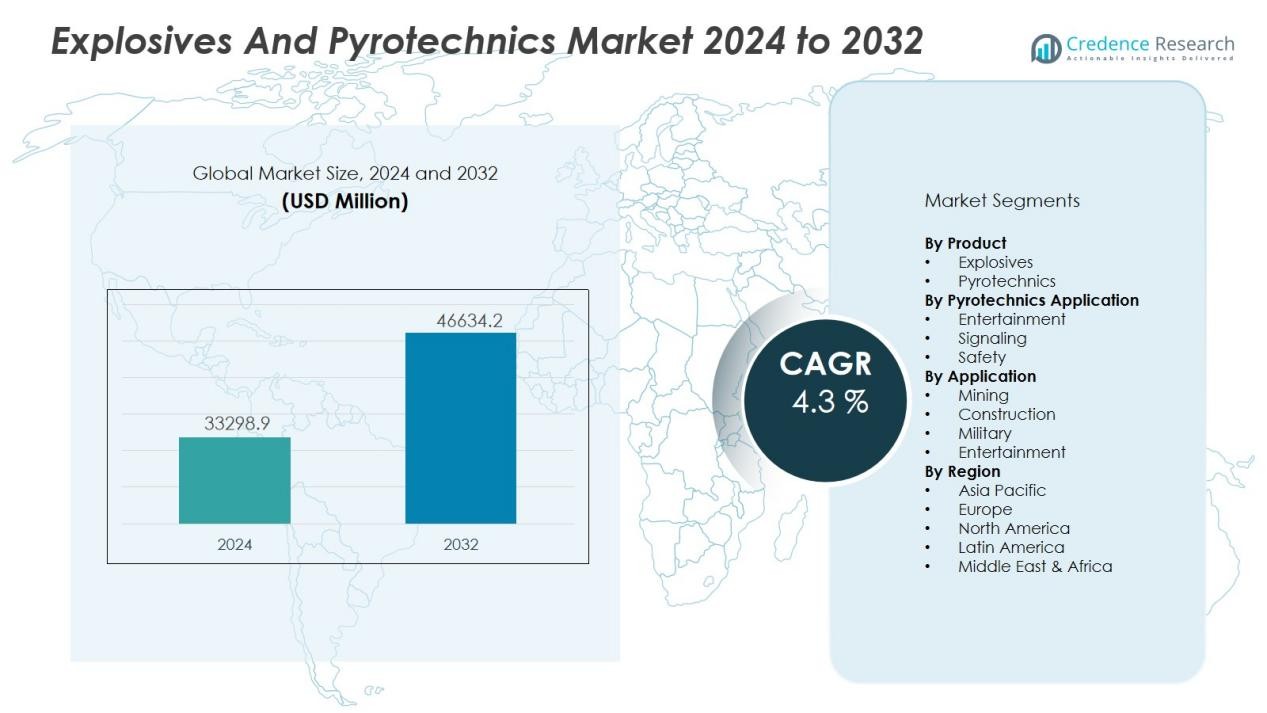
The Explosives and Pyrotechnics Market size was valued at USD 33298.9 million in 2024 and is anticipated to reach USD 46634.2 million by 2032, at a CAGR of 4.3 % during the forecast period (2024-2032).
| REPORT ATTRIBUTE | DETAILS |
|---|---|
| Historical Period | 2020-2024 |
| Base Year | 2024 |
| Forecast Period | 2025-2032 |
| Explosives and Pyrotechnics Market Size 2024 | USD 33298.9 Million |
| Explosives and Pyrotechnics Market , CAGR | 4.3 % |
| Explosives and Pyrotechnics Market Size 2032 | USD 46634.2 Million |
Market growth is primarily fueled by rapid industrialization, ongoing urban infrastructure projects, and the expansion of mining activities in resource-rich regions. Defense modernization programs, counter-terrorism measures, and border security initiatives are boosting the demand for military-grade explosives. In the civilian segment, the popularity of large-scale entertainment events, festivals, and sports ceremonies is elevating pyrotechnics consumption. Technological advancements in product safety, environmental compliance, and precision blasting techniques are further strengthening industry growth prospects.
Regionally, Asia-Pacific leads the market due to rapid urban expansion, growing mining output, and strong demand from China, India, and Australia. North America maintains a significant share, supported by established mining industries and robust defense procurement. Europe follows closely, with stringent safety regulations driving product innovation. Emerging markets in Africa and Latin America are gaining momentum, propelled by infrastructure investments and untapped mineral reserves.
Market Insights:
- The explosives and pyrotechnics market was valued at USD 33,298.9 million in 2024 and is expected to reach USD 46,634.2 million by 2032, growing at a CAGR of 4.3% during 2024–2032.
- Market growth is supported by rapid industrialization, large-scale infrastructure projects, and expansion of mining activities in resource-rich regions.
- Rising defense budgets, modernization programs, and heightened security needs are driving demand for advanced military-grade explosives.
- The entertainment sector contributes significantly through growing use of fireworks and special effects in festivals, sports events, and public celebrations.
- Technological advancements such as precision blasting systems, low-smoke fireworks, and automated detonation controls are enhancing safety and environmental compliance.
- Stringent regulations, high safety risks, and volatility in raw material supply remain key challenges impacting production and profitability.
- Asia-Pacific leads the market due to strong mining output, infrastructure development, and cultural demand for fireworks, followed by North America and Europe with robust defense procurement and innovation-focused regulations.
Market Drivers:
Expansion of Mining and Infrastructure Projects:
The explosives and pyrotechnics market benefits from the rapid growth of mining and infrastructure development worldwide. Large-scale extraction of coal, metals, and minerals demands high-performance blasting agents to enhance operational efficiency. Infrastructure projects such as highways, tunnels, dams, and railways require controlled blasting techniques to meet safety and precision standards. Governments and private players are investing heavily in construction and resource development, sustaining consistent demand for commercial explosives.
Rising Defense and Security Requirements:
Defense modernization programs and heightened security needs are driving the explosives and pyrotechnics market. Military-grade explosives are critical for combat operations, ammunition production, and strategic defense initiatives. Increased defense budgets in both developed and emerging nations support procurement and innovation in explosive technologies. The demand is reinforced by global geopolitical tensions, counter-terrorism measures, and border control operations that require advanced demolition and detonation systems.
- For instance, Northrop Grumman successfully delivered over 100000 Precision-Guided Mortar Munitions to the U.S. Army in 2023, demonstrating its role in equipping modern defense forces with high-accuracy explosive systems.
Growing Demand in Entertainment and Event Industries:
The entertainment sector significantly contributes to the explosives and pyrotechnics market through the rising use of fireworks and special effects. Major public events, sports ceremonies, and cultural festivals increasingly feature large-scale pyrotechnic displays. Event organizers seek advanced, safer, and environmentally compliant products to deliver impactful performances. This trend not only sustains steady sales but also encourages product diversification to meet different cultural and regional preferences.
- For instance, Fireworks by Grucci fired 479,651 shells during the 2014 Dubai New Year’s Eve display, showcasing its programmable “pixel shell” technology for precise, computer-timed effects.
Technological Advancements and Safety Innovations:
Technological progress is reshaping the explosives and pyrotechnics market through enhanced safety, efficiency, and environmental compliance. Innovations include precision blasting systems, reduced-smoke fireworks, and automated detonation controls. These developments minimize environmental impact while improving operational outcomes in mining, construction, and entertainment. The industry is also witnessing increased adoption of digital monitoring systems to ensure safe handling, storage, and transportation of explosive materials.
Market Trends:
Shift Toward Environmentally Sustainable and Safer Products:
The explosives and pyrotechnics market is experiencing a clear shift toward eco-friendly and safer product formulations. Manufacturers are developing low-smoke, reduced-toxicity pyrotechnics to address environmental regulations and community safety concerns. In the mining and construction sectors, water-based and non-nitroglycerin explosives are gaining traction due to lower environmental risks. The adoption of biodegradable and recyclable materials in fireworks packaging is also expanding, particularly in regions with strict waste management policies. Companies are prioritizing safety features such as advanced detonator controls and remote ignition systems to reduce accidents during handling and use. This trend aligns with global sustainability goals while maintaining product performance standards.
- For instance, Orica successfully implemented tertiary catalyst abatement technology that delivers up to 95% abatement efficiency, reducing total greenhouse gas emissions at their Kooragang Island facility by almost 50%.
Integration of Digital Technologies and Automation:
The explosives and pyrotechnics market is leveraging digitalization to improve operational precision, safety, and cost efficiency. Automated blasting systems, GPS-guided detonation, and real-time monitoring tools are transforming mining and construction operations. Data-driven blast design software enables better fragmentation results, reduced vibration, and optimized resource utilization. In the pyrotechnics segment, computer-controlled firing systems allow synchronized and customized displays for large-scale events. These technological upgrades are enhancing efficiency and minimizing human error across industries. The integration of IoT and AI for predictive maintenance and safety monitoring is also gaining traction, offering competitive advantages to early adopters.
- For instance, In 2024, Pyro Spectaculars used their FireOne computerized firing platform to coordinate over 80,000 pyrotechnic cues at the Macy’s 4th of July Fireworks in New York, achieving a record level of precision and safety
Market Challenges Analysis:
Stringent Regulatory Compliance and Safety Risks:
The explosives and pyrotechnics market faces significant challenges due to strict government regulations governing production, storage, transportation, and usage. Compliance with safety protocols and environmental standards requires substantial investment in training, infrastructure, and monitoring systems. Any lapse can lead to severe legal consequences, operational shutdowns, or reputational damage. High accident risks during manufacturing and handling add to the operational burden, demanding constant vigilance. These factors increase operational costs and create entry barriers for smaller players.
Volatility in Raw Material Supply and Rising Costs:
The explosives and pyrotechnics market is impacted by fluctuations in raw material availability and prices, particularly for chemicals like ammonium nitrate, potassium perchlorate, and other oxidizing agents. Global supply chain disruptions, geopolitical tensions, and trade restrictions can delay production schedules and inflate costs. Dependence on imports for certain raw materials makes manufacturers vulnerable to currency fluctuations and export bans. Rising energy costs further compound operational expenses, challenging profit margins. Companies must adopt strategic sourcing and cost-optimization measures to remain competitive under these conditions.
Market Opportunities:
Expansion in Emerging Economies and Untapped Markets:
The explosives and pyrotechnics market has strong growth potential in emerging economies due to rapid infrastructure development, mining expansion, and rising demand for entertainment-based pyrotechnics. Countries in Africa, Latin America, and Southeast Asia are increasing investments in roads, railways, tunnels, and mining projects, creating consistent demand for commercial explosives. Large-scale cultural events and festivals in these regions also drive the use of fireworks and special effects. Untapped mineral reserves and government-backed industrialization initiatives present opportunities for market penetration. Strategic partnerships with local distributors and event organizers can enhance market reach and brand visibility.
Innovation in Eco-Friendly and Smart Technologies:
The explosives and pyrotechnics market can benefit from innovation in sustainable and technologically advanced products. Development of low-emission, biodegradable fireworks and safer explosive formulations aligns with environmental and safety regulations, attracting both institutional and commercial buyers. Integration of IoT-enabled monitoring, automated detonation systems, and precision blasting tools enhances operational efficiency across mining, construction, and defense applications. Customized pyrotechnic displays for global sporting events, concerts, and tourism-driven attractions offer a lucrative niche. Investment in R&D for advanced formulations and digital control solutions can differentiate market players and secure long-term competitiveness.
Market Segmentation Analysis:
By Product:
The explosives and pyrotechnics market is segmented into explosives and pyrotechnics. The explosives segment dominates due to extensive use in mining, construction, and defense operations. It includes blasting agents, propellants, and high explosives designed for controlled demolition and excavation. Pyrotechnics, though smaller in market share, exhibit steady growth driven by demand for fireworks, flares, and special effects. Manufacturers are focusing on low-emission, safer formulations to meet environmental and safety regulations across both segments.
- For instance, Cobra Firing Systems launched its 18R2 wireless firing module with military-grade encryption, enabling synchronized pyrotechnic displays across up to 1000 firing modules in a single event, ensuring both safety and precision in modern pyrotechnics.
By Application:
Applications span mining, construction, military, and entertainment. Mining remains the largest application area, supported by global demand for coal, metals, and minerals. The construction sector relies on controlled blasting for infrastructure projects such as tunnels, dams, and highways. Defense applications demand advanced explosives for ammunition, demolition, and strategic operations. The entertainment industry contributes to the explosives and pyrotechnics market through large-scale fireworks displays and event-based special effects.
- For instance, Grucci Fireworks set a Guinness World Record in Dubai on New Year’s Eve 2018 by launching 479,651 fireworks in a single event, highlighting how advanced pyrotechnics elevate entertainment experiences globally.
By Pyrotechnics Application:
By pyrotechnics application, the market includes entertainment, signaling, and safety uses. Entertainment dominates, fueled by cultural festivals, national celebrations, and international sporting events. Signaling pyrotechnics are essential in maritime, military, and emergency response scenarios, ensuring high visibility in critical conditions. Safety-related uses, such as warning flares and hazard markers, support industrial and defense needs. It continues to attract innovation, with manufacturers integrating eco-friendly materials and precision ignition systems to improve safety and performance across various uses.
Segmentations:
By Product:
- Explosives
- Pyrotechnics
By Application:
- Mining
- Construction
- Military
- Entertainment
By Pyrotechnics Application:
- Entertainment
- Signaling
- Safety
By Region:
- Asia-Pacific
- North America
- Europe
- Latin America
- Middle East & Africa
Regional Analysis:
Asia-Pacific :
Asia-Pacific holds the largest market share in the explosives and pyrotechnics market, driven by rapid industrialization, extensive mining activities, and a strong cultural affinity for fireworks. China and India dominate regional demand due to large-scale infrastructure projects, high mining output, and the widespread use of pyrotechnics in festivals and public celebrations. Australia contributes significantly with its well-established mining industry and advanced blasting technologies. Government investments in transport, energy, and urban development sustain the need for commercial explosives. Seasonal peaks in pyrotechnics demand during cultural and sporting events further boost market performance. The region continues to invest in safety and environmental compliance to meet evolving regulatory requirements.
North America :
North America holds a significant market share in the explosives and pyrotechnics market, supported by robust defense procurement programs and a mature mining sector. The United States leads in defense-grade explosives production for military applications and strategic operations. Canada adds value with its resource extraction industries, particularly in precious metals and energy minerals. High adoption of advanced blasting systems improves operational safety and efficiency across construction and mining projects. Stringent safety regulations push manufacturers to invest in innovation and compliance measures. Seasonal fireworks demand remains steady, driven by national holidays and large-scale entertainment events.
Europe :
Europe holds a considerable market share in the explosives and pyrotechnics market, fueled by strict regulatory frameworks and a focus on sustainable product development. Countries such as Germany, the United Kingdom, and France drive demand through defense contracts, construction activities, and controlled use of pyrotechnics in entertainment. The region’s strong emphasis on environmental compliance encourages the adoption of eco-friendly explosives and low-emission fireworks. Innovation in digital blasting and remote ignition systems supports efficiency and safety goals. Mining demand, though limited compared to other regions, is sustained by specialized mineral extraction projects. Cultural events and tourism-related entertainment also contribute to steady pyrotechnics consumption across key markets.
Key Player Analysis:
- Hanwha Corp.
- LSB Industries
- Solar Industries India
- Zambelli Fireworks
- Angelfire Pyrotechnics
- Melrose Pyrotechnics
- Skyburst
- Entertainment Fire-works
- Supreme Fireworks UK
- Celebration Fireworks
Competitive Analysis:
The explosives and pyrotechnics market is highly competitive, with global and regional players leveraging product innovation, safety advancements, and strategic partnerships to strengthen their positions. Key companies include Hanwha Corp., LSB Industries, Solar Industries India, Zambelli Fireworks, Angelfire Pyrotechnics, Melrose Pyrotechnics, Skyburst, and Impact Pyro. It is characterized by diversified offerings across commercial explosives, military-grade products, and pyrotechnic displays for entertainment and safety applications. Leading players invest in R&D to develop eco-friendly formulations, precision blasting systems, and advanced ignition technologies to meet stringent safety and environmental standards. Market competition is influenced by the ability to secure large-scale contracts in mining, construction, defense, and event management sectors. Regional manufacturers focus on localized production and cost optimization, while global firms pursue mergers, acquisitions, and export expansion to capture emerging opportunities. Consistent innovation, regulatory compliance, and operational efficiency remain critical success factors in this evolving market landscape.
Recent Developments:
- In July 2025, LSB Industries reported its latest quarterly operating results, with recent highlights focused on strong growth in industrial demand and volume, but there is no acquisition or partnership announcement mentioned for this period.
- In August 2025, Zambelli Fireworks was featured handling large-scale pyrotechnics for events this summer, including Colorado’s biggest shows, and continues to be selected for flagship city productions across the U.S.
- In August 2025, Skyburst competed at the 2025 British Firework Championships in Plymouth, UK, putting on a headline pyrotechnic display.
Market Concentration & Characteristics:
The explosives and pyrotechnics market is moderately concentrated, with a mix of global corporations and regional manufacturers competing through product innovation, safety compliance, and distribution reach. It features established players with strong technological capabilities and extensive supply networks, alongside niche companies catering to specialized applications. High entry barriers exist due to stringent regulations, significant capital requirements, and the need for advanced safety infrastructure. The market is characterized by steady demand from mining, construction, defense, and entertainment sectors, with cyclical peaks driven by seasonal events. Technological advancements in eco-friendly formulations, precision blasting, and automated ignition systems are shaping competitive dynamics. Strategic partnerships, mergers, and localized manufacturing facilities are common approaches to strengthening market presence.
Report Coverage:
The research report offers an in-depth analysis based on Product, Application, Pyrotechnics Application and Region. It details leading Market players, providing an overview of their business, product offerings, investments, revenue streams, and key applications. Additionally, the report includes insights into the competitive environment, SWOT analysis, current Market trends, as well as the primary drivers and constraints. Furthermore, it discusses various factors that have driven Market expansion in recent years. The report also explores Market dynamics, regulatory scenarios, and technological advancements that are shaping the industry. It assesses the impact of external factors and global economic changes on Market growth. Lastly, it provides strategic recommendations for new entrants and established companies to navigate the complexities of the Market.
Future Outlook:
- Demand for advanced, eco-friendly explosives and low-emission pyrotechnics will grow due to stricter environmental regulations and safety standards.
- Integration of IoT, AI, and automation in blasting and ignition systems will enhance precision, efficiency, and operational safety.
- Emerging economies will drive significant consumption through infrastructure expansion, mining activities, and cultural event celebrations.
- Defense modernization initiatives will sustain demand for military-grade explosives with higher performance and controlled detonation features.
- Seasonal events, large-scale sports tournaments, and tourism-focused entertainment will boost the pyrotechnics segment.
- R&D investment will focus on biodegradable fireworks, reduced-smoke formulations, and safer handling technologies.
- Global supply chain optimization will be critical to mitigate raw material volatility and ensure uninterrupted production.
- Collaboration between manufacturers and regulatory bodies will promote safer industry practices and innovation compliance.
- Customized pyrotechnic solutions for entertainment and commercial applications will create niche growth opportunities.
- Consolidation through mergers, acquisitions, and strategic alliances will reshape competitive dynamics and expand market reach.

Request a Free Sample
Fill in your details and we'll send you a free sample report.
- Sample data tables & charts
- Research methodology
Market Dynamics
Expansion of Mining and Infrastructure Projects
Rapid industrialization and large-scale infrastructure development, especially in Asia-Pacific and emerging markets, are driving demand for high-performance explosives for mining, tunneling, and construction. These projects require controlled blasting techniques to ensure safety and efficiency, sustaining consistent market growth.
Rising Defense and Security Requirements
Increasing defense budgets and modernization programs in both developed and emerging economies are fueling demand for advanced military-grade explosives. Heightened security needs, border control, and counter-terrorism initiatives further boost procurement of specialized explosive systems.
Growing Demand in Entertainment and Event Industries
The popularity of large-scale entertainment events, festivals, and sports ceremonies is elevating the use of pyrotechnics for fireworks and special effects. Event organizers are seeking safer, environmentally compliant products, driving innovation and steady sales in the pyrotechnics segment.
Technological Advancements and Safety Innovations
Innovations such as precision blasting systems, low-smoke fireworks, and automated detonation controls are enhancing operational safety and environmental compliance. These advancements are making explosives and pyrotechnics more efficient and acceptable under stringent regulatory frameworks.
Shift Toward Environmentally Sustainable and Safer Products
Stricter environmental regulations and community safety concerns are pushing manufacturers to develop low-emission, biodegradable, and safer explosive and pyrotechnic formulations. This trend is opening new market opportunities and ensuring compliance with global sustainability goals.
Need a Custom Version of This Report?
Tailor the scope, geography, or segments to your exact requirements.
- Custom geography or segment scope
- Direct access to our analyst team
Frequently Asked Questions
What is the current market size for the explosives and pyrotechnics market, and what is its projected size in 2032?
At what Compound Annual Growth Rate is the explosives and pyrotechnics market projected to grow between 2024 and 2032?
Which explosives and pyrotechnics market segment held the largest share in 2024?
What are the primary factors fueling the growth of the explosives and pyrotechnics market?
Who are the leading companies in the explosives and pyrotechnics market?
Which region commanded the largest share of the explosives and pyrotechnics market in 2024?
Table of Content
Chapter 1 Market Segmentation
- 1.1 Segmentation Framework
- 1.1.1 Product and Service Classification
- 1.1.2 Application and End-Use Classification
- 1.1.3 Technology and Solution Classification
- 1.1.4 Customer and Distribution Channel Classification
- 1.1.5 Geographic Segmentation
- 1.1.6 Market Segment Definitions and Boundaries
- 1.2 By Product
- 1.2.1 Explosives
- 1.2.2 Pyrotechnics
- 1.3 By Application
- 1.3.1 Mining
- 1.3.2 Construction
- 1.3.3 Military
- 1.3.4 Entertainment
- 1.4 By Pyrotechnics Application
- 1.4.1 Entertainment
- 1.4.2 Signaling
- 1.4.3 Safety
Chapter 2 Introduction
- 2.1 Report Objectives and Scope
- 2.2 Product Definition and Industry Terminology
- 2.3 Market Inclusions and Exclusions
- 2.4 Research Process
- 2.4.1 Primary Research and Expert Interviews
- 2.4.2 Secondary Research and Source Review
- 2.4.3 Top-Down and Bottom-Up Estimation
- 2.4.4 Data Triangulation and Verification
- 2.5 Market Size Measurement Basis
- 2.5.1 2024: USD 33,298.9 million → 2032: USD 46,634.2 million
- 2.6 Historical and Forecast Reference Periods
- 2.6.1 Base Year: 2024
- 2.6.2 Forecast Period: 2024-2032
- 2.7 Research Assumptions and Limitations
Chapter 3 Executive Summary
- 3.1 Market Snapshot and Key Findings
- 3.2 Base-Year Market Size, 2024
- 3.3 Forecast Market Size, 2032
- 3.4 Revenue and Volume Growth Outlook
- 3.5 Key Demand and Supply Indicators
- 3.6 Leading Market Segments
- 3.7 Fastest-Growing Market Opportunities
- 3.8 Regional Performance Highlights
- 3.9 Technology and Industry Transformation
- 3.10 Competitive Landscape Summary
- 3.11 Analyst View and Strategic Implications
Chapter 4 Global Explosives & Pyrotechnics Market Trends and Developments
- 4.1 Historical Industry Development
- 4.2 Recent Market Trends and Developments
- 4.3 Demand and Customer Behavior Trends
- 4.4 Technology and Product Innovation
- 4.5 Artificial Intelligence, Automation and Digitalization
- 4.6 Local Manufacturing and Supply Chain Realignment
- 4.7 Industry Partnerships, Mergers and Acquisitions
- 4.8 Sustainability and Circular Economy Developments
- 4.9 Government and Private Sector Investment Trends
- 4.10 Emerging Business Models and Commercialization
- 4.11 Industry Developments and Announcements
Chapter 5 Global Explosives & Pyrotechnics Market Production, Supply and Demand Analysis
- 5.1 Demand Trend and Consumption Analysis
- 5.2 Demand Forecast, 2024-2032
- 5.3 Production and Output Trend
- 5.4 Production and Output Forecast, 2024-2032
- 5.5 Installed Capacity and Capacity Utilization
- 5.6 Company-Wise Production Plants and Statistics
- 5.6.1 Installed Production Capacity
- 5.6.2 Actual Production
- 5.6.3 Planned Capacity and Expansion Targets
- 5.7 Supply Chain Structure and Procurement Trends
- 5.8 Supply-Demand Gap and Bottlenecks
- 5.9 Import Dependence and Sourcing Structure
- 5.10 Contract Manufacturing and Outsourcing
- 5.11 Regional Supply and Demand Concentration
Chapter 6 Global Explosives & Pyrotechnics Market Pricing Analysis
- 6.1 Pricing Structure and Measurement
- 6.2 Historical Pricing Trends
- 6.3 Pricing Outlook, 2024-2032
- 6.4 Average Selling Price and Unit Economics
- 6.5 Pricing by Product and Market Segment
- 6.6 Geographic Pricing Differences
- 6.7 Key Input, Energy, Labor and Logistics Costs
- 6.8 Contract Pricing and Purchasing Models
- 6.9 Pricing Sensitivity and Competitive Positioning
- 6.10 Price, Margin and Profitability Implications
Chapter 7 Global Explosives & Pyrotechnics Market Dynamics
- 7.1 Market Growth Drivers
- 7.1.1 Demand-Side Drivers
- 7.1.2 Technology and Innovation Drivers
- 7.1.3 Infrastructure and Investment Drivers
- 7.1.4 Regulatory and Policy Drivers
- 7.2 Market Restraints
- 7.2.1 Cost and Affordability Constraints
- 7.2.2 Technology and Adoption Barriers
- 7.2.3 Supply Chain and Operational Constraints
- 7.3 Market Challenges
- 7.3.1 Competitive Pressure and Margin Erosion
- 7.3.2 Skills, Infrastructure and Implementation Gaps
- 7.4 Emerging Market Opportunities
- 7.5 Market Dynamics Impact and Time-Horizon Assessment
Chapter 8 Global Explosives & Pyrotechnics Value Chain Analysis
- 8.1 Industry Value Chain Overview
- 8.2 Upstream Suppliers and Critical Inputs
- 8.3 Technology and Component Providers
- 8.4 Manufacturing or Service Delivery
- 8.5 Distribution, Channel Partners and Integrators
- 8.6 Downstream Applications and End Users
- 8.7 Value Addition and Profit Pools
- 8.8 Vertical Integration and Outsourcing
- 8.9 Supplier Concentration and Risk
- 8.10 Supply Chain Localization and Resilience
Chapter 9 Global Explosives & Pyrotechnics Market Regulations and Policies
- 9.1 Relevant Laws, Standards and Compliance Frameworks
- 9.2 Product, Service, Safety and Quality Requirements
- 9.3 Government Policies, Incentives and Subsidies
- 9.4 Imports, Exports and Trade Barriers
- 9.5 Public Procurement and Local Content Requirements
- 9.6 Environmental and Sustainability Compliance
- 9.7 Upcoming Policy Changes and Market Implications
Chapter 10 Global Explosives & Pyrotechnics Market Hotspots and Opportunities
- 10.1 Market Opportunity Mapping and Growth Hotspots
- 10.2 High-Growth Applications and Customer Groups
- 10.3 Underserved Markets and White-Space Opportunities
- 10.4 Emerging Technology and Product Opportunities
- 10.5 New Capacity and Investment Hotspots
- 10.6 Market Entry and Expansion Opportunities
- 10.7 Distribution and Partnership Opportunities
- 10.8 Near-Term and Long-Term Commercial Potential
- 10.9 Opportunity Attractiveness and Execution Risks
Chapter 11 Global Explosives & Pyrotechnics Market Outlook, 2024-2032
- 11.1 Market Size and Analysis
- 11.1.1 Revenue (Market Measurement: 2024: USD 33,298.9 million → 2032: USD 46,634.2 million)
- 11.1.2 Market Volume and Quantity Sold
- 11.1.3 Historical Market Size
- 11.1.4 Base-Year Market Size, 2024
- 11.2 Market Forecast, 2024-2032
- 11.2.1 Revenue Forecast to 2032
- 11.2.2 Volume Forecast to 2032
- 11.2.3 CAGR and Year-on-Year Growth
- 11.2.4 Incremental Revenue Opportunity
- 11.3 Forecast Assumptions and Scenario Analysis
- 11.3.1 Base-Case Forecast
- 11.3.2 Optimistic and Conservative Scenarios
- 11.3.3 Technology, Pricing and Policy Sensitivities
- 11.4 Market Attractiveness and Growth Outlook
Chapter 12 Global Explosives & Pyrotechnics Market Segmentation and Outlook
- 12.1 Segmentation Summary and Market Shares, 2024
- 12.2 Largest and Fastest-Growing Segments
- 12.3 By Product - Market Size and Forecast, 2024-2032
- 12.3.1 Segment Definition and Scope
- 12.3.2 Historical Market Size
- 12.3.3 Revenue Forecast, 2024-2032
- 12.3.4 Volume Forecast, 2024-2032
- 12.3.5 Base-Year Market Share, 2024
- 12.3.6 Segment CAGR and Growth Drivers
- 12.3.7 Subsegment Market Size and Forecast
- 12.3.7.1 Explosives
- 12.3.7.2 Pyrotechnics
- 12.3.8 Subsegment Pricing and Adoption Trends
- 12.3.9 Leading Suppliers and Competition
- 12.3.10 Regional Demand and Opportunities
- 12.4 By Application - Market Size and Forecast, 2024-2032
- 12.4.1 Segment Definition and Scope
- 12.4.2 Historical Market Size
- 12.4.3 Revenue Forecast, 2024-2032
- 12.4.4 Volume Forecast, 2024-2032
- 12.4.5 Base-Year Market Share, 2024
- 12.4.6 Segment CAGR and Growth Drivers
- 12.4.7 Subsegment Market Size and Forecast
- 12.4.7.1 Mining
- 12.4.7.2 Construction
- 12.4.7.3 Military
- 12.4.7.4 Entertainment
- 12.4.8 Subsegment Pricing and Adoption Trends
- 12.4.9 Leading Suppliers and Competition
- 12.4.10 Regional Demand and Opportunities
- 12.5 By Pyrotechnics Application - Market Size and Forecast, 2024-2032
- 12.5.1 Segment Definition and Scope
- 12.5.2 Historical Market Size
- 12.5.3 Revenue Forecast, 2024-2032
- 12.5.4 Volume Forecast, 2024-2032
- 12.5.5 Base-Year Market Share, 2024
- 12.5.6 Segment CAGR and Growth Drivers
- 12.5.7 Subsegment Market Size and Forecast
- 12.5.7.1 Entertainment
- 12.5.7.2 Signaling
- 12.5.7.3 Safety
- 12.5.8 Subsegment Pricing and Adoption Trends
- 12.5.9 Leading Suppliers and Competition
- 12.5.10 Regional Demand and Opportunities
- 12.6 Segment Growth Comparison
- 12.7 Segment Attractiveness and Priority Matrix
Chapter 13 Global Explosives & Pyrotechnics End-Use and Application Market Outlook
- 13.1 End-Use Industry and Customer Demand Structure
- 13.2 Leading Applications and Customer Groups
- 13.3 End-Use Market Size, Share and Forecast
- 13.4 Major End-Use Industry Deep Dives
- 13.4.1 Customer Requirements and Use Cases
- 13.4.2 Demand and Replacement Cycles
- 13.4.3 Technical and Regulatory Considerations
- 13.4.4 Purchasing and Procurement Models
- 13.4.5 Leading Vendors and Distribution Channels
- 13.4.6 Forecast and Commercial Opportunities
- 13.5 Emerging Applications and Cross-Segment Demand
- 13.6 End-Use Industry Investment Priorities
Chapter 14 Global Explosives & Pyrotechnics Geographic Market Outlook, 2024-2032
- 14.1 Regional Market Size and Share, 2024
- 14.2 Regional Market Forecast, 2024-2032
- 14.3 Regional Pricing, Production and Demand Differences
- 14.4 North America
- 14.4.1 United States
- 14.4.2 Canada
- 14.4.3 Mexico
- 14.5 Europe
- 14.5.1 Germany
- 14.5.2 France
- 14.5.3 Italy
- 14.5.4 United Kingdom
- 14.5.5 Spain
- 14.5.6 Poland
- 14.5.7 Russia
- 14.5.8 Netherlands
- 14.5.9 Belgium
- 14.5.10 Sweden
- 14.5.11 Denmark
- 14.5.12 Norway
- 14.5.13 Rest of Europe
- 14.6 Asia Pacific
- 14.6.1 China
- 14.6.2 India
- 14.6.3 Japan
- 14.6.4 South Korea
- 14.6.5 Thailand
- 14.6.6 Indonesia
- 14.6.7 Vietnam
- 14.6.8 Malaysia
- 14.6.9 Australia
- 14.6.10 Rest of Asia Pacific
- 14.7 Latin America
- 14.7.1 Brazil
- 14.7.2 Argentina
- 14.7.3 Colombia
- 14.7.4 Chile
- 14.7.5 Rest of Latin America
- 14.8 Middle East
- 14.8.1 Saudi Arabia
- 14.8.2 United Arab Emirates
- 14.8.3 Turkey
- 14.8.4 Israel
- 14.8.5 Iran
- 14.8.6 Rest of the Middle East
- 14.9 Africa
- 14.9.1 South Africa
- 14.9.2 Egypt
- 14.9.3 Nigeria
- 14.9.4 Morocco
- 14.9.5 Rest of Africa
- 14.10 Regional Investment, Policy and Supply Chain Differences
- 14.11 Regional Competitive Landscape
- 14.12 Geographic Growth Hotspots
Chapter 15 Global Explosives & Pyrotechnics Technology, Innovation and Sustainability Outlook
- 15.1 Technology Landscape and Maturity
- 15.2 Product, Process and Service Innovation
- 15.3 AI, Automation and Digital Tools in the Industry
- 15.4 Technology Adoption and Performance Benchmarking
- 15.5 Innovation Pipeline and R&D Investment
- 15.6 Patent and Intellectual Property Trends
- 15.7 Energy Efficiency and Resource Management
- 15.8 Sustainability, Recycling and Circularity
- 15.9 Technology Roadmap, 2024-2032
- 15.10 Risks of Obsolescence and Technology Substitution
Chapter 16 Global Explosives & Pyrotechnics Market Key Strategic Imperatives
- 16.1 Growth and Market Entry Priorities
- 16.2 High-Return Products and Segments
- 16.3 Pricing, Profitability and Cost Optimization
- 16.4 Technology Investment and Product Differentiation
- 16.5 Supply Chain Localization and Resilience
- 16.6 Distribution and Customer Acquisition
- 16.7 Partnership, Acquisition and Capacity Strategy
- 16.8 Regional Expansion Priorities
- 16.9 Short-, Medium- and Long-Term Actions
Chapter 17 Competition Outlook
- 17.1 Industry Competition Characteristics
- 17.2 Market Structure and Concentration
- 17.3 Market Share and Competitive Positioning, 2024
- 17.4 Company-Wise Revenue and Product Benchmarking
- 17.5 Production and Service Capacity Benchmarking
- 17.6 Technology, Pricing and Differentiation
- 17.7 Regional Footprint and Distribution Strength
- 17.8 Mergers, Acquisitions and Strategic Alliances
- 17.9 New Entrants and Competitive Threats
- 17.10 Porter's Five Forces and Industry Attractiveness
- 17.11 Competitive Outlook, 2024-2032
Chapter 18 Company Profiles
- 18.1 Company Coverage and Selection Criteria
- 18.2 Hanwha Corp.
- 18.2.1 Business Description
- 18.2.2 Company Ownership and Geographic Presence
- 18.2.3 Product and Service Portfolio
- 18.2.4 Manufacturing and Operating Footprint
- 18.2.5 Production Capacity and Expansion Plans
- 18.2.6 Financial Performance and Investment
- 18.2.7 Market Share and Competitive Position
- 18.2.8 Technology and Innovation Capabilities
- 18.2.9 Strategic Alliances or Partnerships
- 18.2.10 Recent Developments
- 18.2.11 Growth Strategy and Outlook
- 18.3 LSB Industries
- 18.4 Solar Industries India
- 18.5 Zambelli Fireworks
- 18.6 Angelfire Pyrotechnics
- 18.7 Melrose Pyrotechnics
- 18.8 Skyburst
- 18.9 Impact Pyro
- 18.10 Entertainment Fire-works
- 18.11 Supreme Fireworks UK
- 18.12 Other Relevant Market Participants
Note: Every listed company is profiled on the structure shown under the first company. The company list is preliminary and may change based on research findings, market developments, data availability and client requirements.
Chapter 19 Disclaimer
- 19.1 Research and Forecast Disclaimer
- 19.2 Data Source and Estimation Limitations
Note: The depth of individual sections depends on data availability for this market. Volume, capacity, trade and other unit-based metrics are included where applicable.