
Annatto Market Overview:
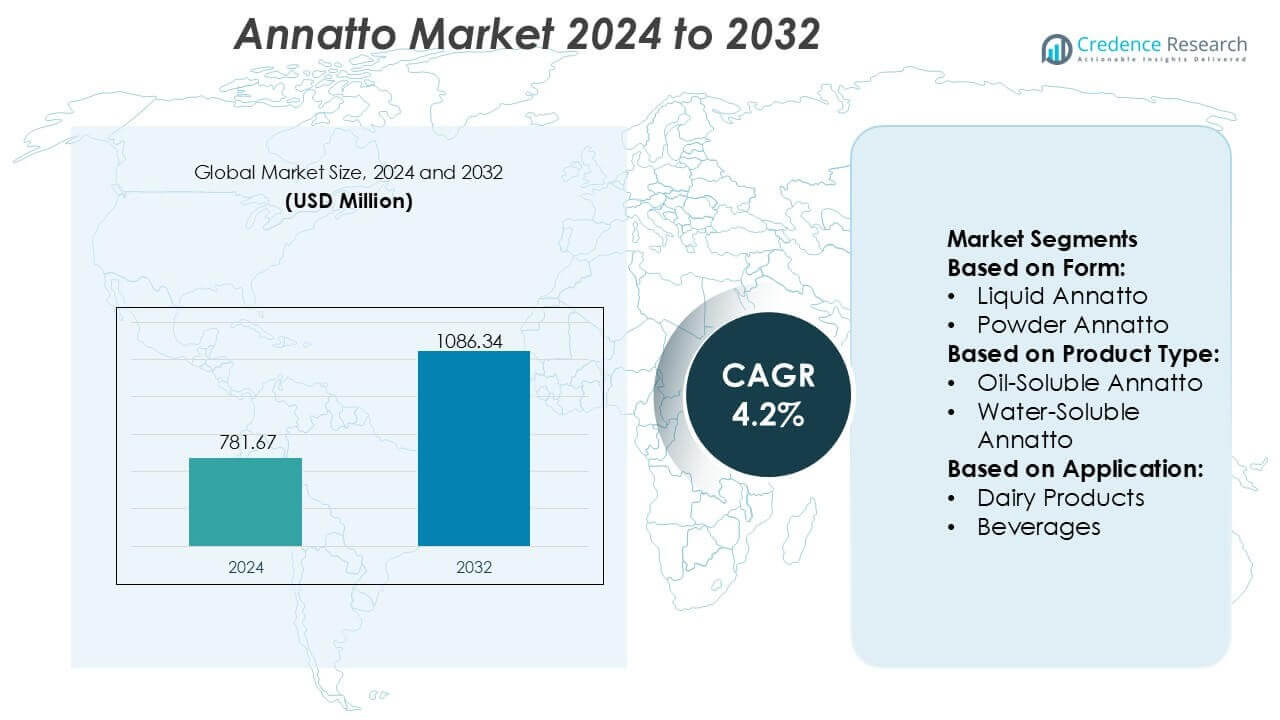
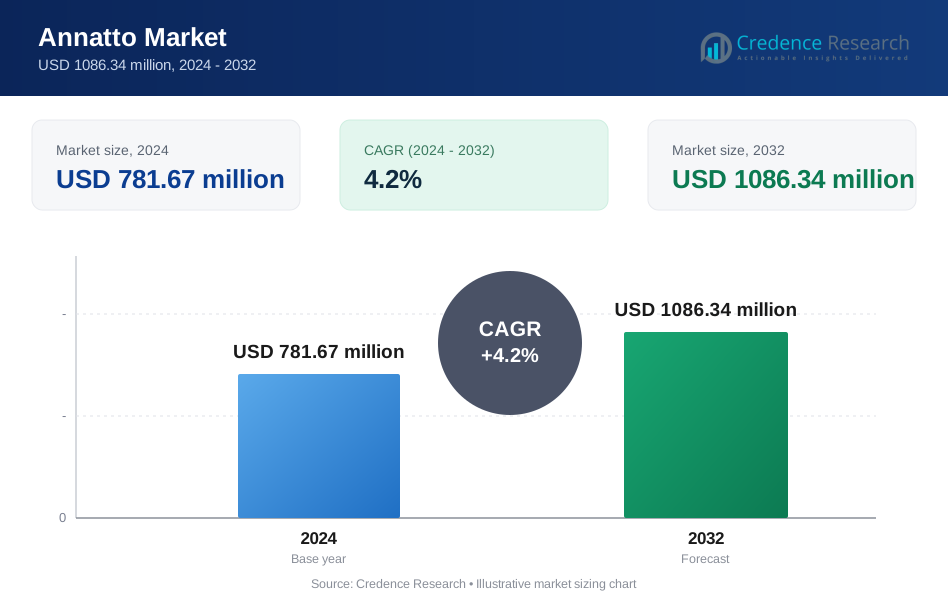
Annatto Market size was valued USD 781.67 million in 2024 and is anticipated to reach USD 1086.34 million by 2032, at a CAGR of 4.2% during the forecast period.
| REPORT ATTRIBUTE | DETAILS |
|---|---|
| Historical Period | 2020-2023 |
| Base Year | 2024 |
| Forecast Period | 2025-2032 |
| Annatto Market Size 2024 | USD 781.67 million |
| Annatto Market, CAGR | 4.2% |
| Annatto Market Size 2032 | USD 1086.34 million |
Annatto Market Insights
- Market growth is driven by increasing clean-label demand, regulatory pressure on synthetic additives, and strong usage in dairy, bakery, beverages, and savory foods, with dairy products holding the dominant application share due to consistent color requirements.
- Key market trends include advancements in extraction efficiency, emulsified and water-dispersible formulations, and growing emphasis on traceability and sustainable sourcing to meet manufacturer and consumer expectations.
- Competitive dynamics reflect the presence of established global suppliers and regional specialists competing on formulation expertise, color stability, application customization, and long-term supply partnerships.
- Regionally, Asia-Pacific leads the global Annatto Market with an exact 34% market share, driven by expanding food processing capacity, rising packaged food consumption, cost-efficient raw material availability, and rapid urbanization.
Annatto Market Segmentation Analysis:
By Form
The Annatto Market by form shows clear dominance of Liquid Annatto, which accounts for an estimated 56% market share due to its superior dispersibility, uniform color intensity, and ease of integration into liquid and semi-solid food systems. Liquid formulations enable precise dosing and consistent hue control, which food manufacturers prioritize in large-scale processing. Strong adoption in dairy, beverages, and sauces further supports dominance. Powder Annatto follows, favored for dry blends and longer shelf stability, particularly in bakery and snack applications. However, slower solubility and additional processing steps limit its broader penetration compared to liquid variants.
- For instance, Oterra has commercialized liquid annatto color solutions engineered for high process stability, with validated heat tolerance up to 135 °C during short-time thermal processing and consistent color performance across pH 3.0 to 7.0, enabling direct use in UHT beverages and processed cheese lines without reformulation.
By Product Type
Within product types, Oil-Soluble Annatto leads the segment with an estimated 44% market share, driven by its widespread use in fat-rich food matrices such as cheese, butter, margarine, and processed snacks. Its strong affinity with lipids ensures stable coloration during thermal processing and extended storage. Water-Soluble Annatto maintains steady demand in beverages and low-fat dairy, supported by clean-label positioning. Emulsified Annatto shows rising adoption in complex formulations requiring dual-phase compatibility, though higher formulation costs and processing complexity currently restrict its share compared to oil-soluble variants.
- For instance, Vinayak Ingredients (INDIA) Pvt. Ltd. provides oil-soluble annatto extracts (Bixin) engineered for high-heat food applications. These extracts are validated for thermal stability during processing at temperatures of 130 °C to 160 °C, making them suitable for processed cheese and extruded snacks.
By Application
By application, Dairy Products dominate the Annatto Market, holding approximately 48% market share, supported by extensive use in cheese, butter, yogurt, and flavored milk products to achieve consistent yellow-to-orange hues. Regulatory acceptance of annatto as a natural colorant and strong consumer preference for clean-label dairy drive sustained demand. Bakery and Confectionery and Snacks and Savory Products follow, benefiting from visual appeal enhancement. Beverages, Meat Products, and Sauces & Dressings contribute moderate shares, with growth driven by reformulation efforts replacing synthetic dyes with plant-derived alternatives.
Key Growth Drivers
Rising Demand for Natural Food Colorants
Food and beverage manufacturers increasingly replace synthetic dyes with natural alternatives to meet clean-label expectations and regulatory scrutiny. Annatto benefits from strong acceptance due to its plant origin, stable hue range from yellow to orange, and compatibility with multiple formulations. Regulatory bodies in several regions restrict artificial colors, accelerating reformulation efforts across dairy, snacks, and beverages. Consumer preference for recognizable ingredients strengthens annatto adoption, while its long history of safe use supports confidence among manufacturers seeking compliant, naturally derived color solutions.
- For instance, Kalsec has advanced annatto-based color systems produced using controlled extraction and standardization processes that deliver batch-to-batch color consistency within ±1.0 absorbance unit at 450 nm, while maintaining functional stability during thermal processing up to 140 °C, enabling reliable performance in pasteurized dairy and cooked snack applications without synthetic additives.
Expansion of Processed and Packaged Food Consumption
Growth in processed and convenience foods directly supports annatto demand, particularly in cheese, butter, bakery fillings, and savory snacks. Urbanization, changing lifestyles, and higher disposable incomes increase reliance on packaged foods with consistent appearance. Annatto offers reliable color performance during processing and storage, making it suitable for large-scale food manufacturing. Its effectiveness in fat-based systems aligns well with dairy and snack applications, allowing producers to maintain visual consistency while scaling production volumes across domestic and export-oriented markets.
- For instance, Mangalam Enterprise supplies oil-soluble annatto color preparations engineered for fat-based systems that maintain color integrity during thermal processing up to approximately 130 °C to 160 °C, demonstrating a robust shelf stability of 18 months under sealed storage conditions.
Growing Applications Beyond Food and Beverages
Annatto usage extends beyond food into cosmetics, pharmaceuticals, and nutraceuticals, supporting broader market expansion. In cosmetics, manufacturers use annatto-derived pigments in lip products and creams due to consumer demand for botanical ingredients. Pharmaceutical and nutraceutical formulators value annatto for capsule coloring and functional properties linked to carotenoids. This diversification reduces reliance on food-only demand and improves market resilience. Ongoing product development across multiple end-use industries continues to strengthen annatto’s long-term growth trajectory.
Key Trends & Opportunities
Innovation in Formulation and Solubility Technologies
Manufacturers invest in advanced extraction and formulation techniques to improve annatto stability, solubility, and shade control. Emulsified and water-dispersible annatto solutions address technical challenges in beverages and low-fat applications. Improved standardization enhances batch-to-batch consistency, which large food processors require. These innovations expand annatto’s usable application range, enabling penetration into products previously dominated by synthetic or alternative natural colorants, while supporting premium positioning through higher-performance formulations.
- For instance, Sensient Colors LLC has developed proprietary annatto emulsions capable of maintaining optical color consistency within ΔE ≤ 1.5 after high-shear homogenization at 20,000 rpm and verified stability during pasteurization at 95 °C, supporting reliable performance in acidified beverages and ready-to-drink formulations without phase separation.
Rising Demand from Plant-Based and Clean-Label Products
The rapid growth of plant-based foods creates strong opportunities for annatto, which aligns with vegan and vegetarian labeling requirements. Producers of plant-based dairy alternatives, meat analogs, and ready-to-eat meals seek natural colors that match traditional product appearance. Annatto’s compatibility with plant-based fats and proteins supports this demand. Clean-label positioning further strengthens its appeal, encouraging suppliers to develop minimally processed, traceable annatto solutions tailored for emerging plant-based formulations.
- For instance, AICA Color has developed annatto color solutions specifically optimized for plant-based applications, validated for stable dispersion across pH 4.0 to 7.5 and thermal resistance up to 150 °C, with documented shelf stability of 15 months, enabling reliable performance in plant-based cheese analogs and ready meals without synthetic additives.
Sustainability and Traceability Focus in Supply Chains
Food and ingredient companies increasingly prioritize sustainable sourcing and transparent supply chains. This trend creates opportunities for annatto producers to differentiate through responsible farming practices, improved traceability, and farmer partnerships. Buyers favor suppliers that demonstrate environmental stewardship and ethical sourcing. Certifications, origin transparency, and reduced solvent usage in extraction enhance brand value. Sustainability-driven procurement strategies encourage long-term contracts, supporting stable demand and investment across annatto-producing regions.
Key Challenges
Raw Material Price Volatility and Supply Dependence
Annatto production depends heavily on agricultural output, exposing the market to climate variability, crop diseases, and yield fluctuations. Weather disruptions in key producing regions affect seed availability and pricing stability. Limited geographic concentration of annatto cultivation increases supply risk for manufacturers. Price volatility complicates long-term procurement planning and margin management, particularly for small and mid-sized processors that lack diversified sourcing strategies or forward-contracting capabilities.
Competition from Alternative Natural Colorants
Annatto faces growing competition from other natural colorants such as turmeric, paprika, beta-carotene, and emerging fermentation-based pigments. These alternatives compete on color intensity, stability, and application-specific performance. Some offer broader shade ranges or improved heat and light stability, influencing buyer selection. Continuous innovation and cost optimization remain essential for annatto suppliers to defend market share and maintain relevance amid an expanding portfolio of natural coloring solutions.
Regional Analysis
North America
North America holds a significant position in the Annatto Market with an estimated 31% market share, supported by strong demand for natural food colorants and strict regulatory oversight of synthetic additives. Food and beverage manufacturers actively reformulate products to meet clean-label and non-GMO requirements, particularly in dairy, snacks, and bakery applications. The United States leads regional consumption due to its large processed food industry and high consumer awareness of natural ingredients. Advanced food processing infrastructure and strong supplier–manufacturer collaboration further support consistent annatto adoption across large-scale and specialty food segments.
Europe
Europe accounts for approximately 27% of the global Annatto Market, driven by stringent food safety regulations and widespread clean-label adoption. Regulatory bodies closely monitor artificial color usage, encouraging manufacturers to shift toward plant-based alternatives such as annatto. Demand remains strong in cheese, butter, and confectionery products, especially in Western Europe. Countries including Germany, France, and the United Kingdom emphasize ingredient transparency and sustainability, reinforcing annatto uptake. The region also supports steady growth through premium food categories and rising interest in natural cosmetics and nutraceutical applications.
Asia-Pacific
Asia-Pacific represents the largest regional share at around 34%, driven by expanding food processing industries, population growth, and rising consumption of packaged foods. Rapid urbanization and changing dietary habits increase demand for visually appealing processed foods, particularly in China, India, and Southeast Asia. Annatto benefits from cost-effective production, growing local sourcing, and increasing awareness of natural ingredients. Regional manufacturers adopt annatto in dairy analogs, snacks, and traditional food products. Favorable agricultural conditions and improving extraction capabilities further strengthen Asia-Pacific’s leadership position.
Latin America
Latin America holds close to 6% of the Annatto Market, supported by its role as a key production hub for annatto seeds. Countries such as Brazil and Peru benefit from favorable climatic conditions and established cultivation practices. While domestic consumption remains moderate, strong export demand supports regional market value. Annatto plays a prominent role in traditional foods, processed meats, and sauces. Ongoing investments in agricultural efficiency, farmer training, and export-oriented processing enhance supply reliability and improve the region’s integration into global annatto value chains.
Middle East & Africa
The Middle East & Africa region accounts for roughly 2% of the global Annatto Market, reflecting early-stage but steadily growing adoption. Expansion of the packaged food sector, particularly in Gulf countries, supports rising demand for natural colorants. Food imports and increasing presence of multinational food brands accelerate annatto usage to meet global formulation standards. In Africa, growth remains gradual due to limited processing infrastructure, but improving urbanization and dietary shifts support long-term potential. Regulatory harmonization and increased awareness of natural ingredients gradually strengthen regional demand.
Annatto Market Segmentations:
By Form:
- Liquid Annatto
- Powder Annatto
By Product Type:
- Oil-Soluble Annatto
- Water-Soluble Annatto
By Application:
- Dairy Products
- Beverages
By Geography
- North America
- U.S.
- Canada
- Mexico
- Europe
- Germany
- France
- U.K.
- Italy
- Spain
- Rest of Europe
- Asia Pacific
- China
- Japan
- India
- South Korea
- South-east Asia
- Rest of Asia Pacific
- Latin America
- Brazil
- Argentina
- Rest of Latin America
- Middle East & Africa
- GCC Countries
- South Africa
- Rest of the Middle East and Africa
Competitive Landscape
The Annatto Market features a competitive landscape shaped by a mix of global ingredient suppliers and specialized regional producers, including Oterra, Vinayak Ingredients (INDIA) Pvt., Kalsec, Mangalam Enterprise, Sensient Colors LLC, AICA Color, Givaudan Sense Colour, Aarkay Food Products Ltd., BIOCONCOLORS, and Naturex. The Annatto Market exhibits a moderately consolidated competitive landscape characterized by the presence of established ingredient manufacturers and specialized natural color producers.
Companies compete on the basis of color consistency, formulation stability, and compliance with evolving food safety and labeling regulations. Continuous investment in extraction efficiency, emulsification techniques, and standardization processes enhances product performance across diverse applications such as dairy, bakery, beverages, and snacks.
Market participants emphasize clean-label positioning, sustainable sourcing, and traceable supply chains to meet rising customer expectations. Strategic focus on customized solutions, technical support, and long-term supply agreements strengthens relationships with food processors, while operational efficiency and quality assurance remain critical factors for maintaining competitive advantage in global and regional markets.
Key Player Analysis
- Oterra
- Vinayak Ingredients (INDIA) Pvt.
- Kalsec
- Mangalam Enterprise
- Sensient Colors LLC
- AICA Color
- Givaudan Sense Colour
- Aarkay Food Products Ltd.
- BIOCONCOLORS
- Naturex
Recent Developments
- In May 2025, Everwell Health has acquired American River Nutrition (ARN) from Designs for Health, integrating ARN’s patented annatto-based ingredients such as DeltaGold (a tocopherol-free source of tocotrienols) and GG-Gold (geranylgeraniol) into its functional ingredient platform to strengthen its healthy aging portfolio and U.S.-based manufacturing capabilities.
- In May 2025, Syngenta entered a multi-year collaboration with Tropic Biosciences to fast-track gene-edited coffee, rice, and banana varieties that feature stronger disease resistance and better nutritional profiles. The partners will apply Tropic’s GEiGS gene-editing platform to move these crops toward commercial release.
- In February 2025, Oterra has opened a new color blending and application center in Kochi, Kerala, India. The facility, located within Oterra's Akay Natural Ingredients subsidiary, serves markets in India, the Asia Pacific, and the Middle East. The center includes color blending and application laboratories to assist customers in adopting natural color solutions.
Report Coverage
The research report offers an in-depth analysis based on Form, Product Type, Application and Geography. It details leading market players, providing an overview of their business, product offerings, investments, revenue streams, and key applications. Additionally, the report includes insights into the competitive environment, SWOT analysis, current market trends, as well as the primary drivers and constraints. Furthermore, it discusses various factors that have driven market expansion in recent years. The report also explores market dynamics, regulatory scenarios, and technological advancements that are shaping the industry. It assesses the impact of external factors and global economic changes on market growth. Lastly, it provides strategic recommendations for new entrants and established companies to navigate the complexities of the market.
Future Outlook
- Demand for annatto will continue to rise as food manufacturers accelerate the shift toward natural and clean-label color solutions.
- Expanded use in dairy alternatives, plant-based foods, and ready-to-eat products will support steady market growth.
- Ongoing improvements in extraction and formulation technologies will enhance color stability and application flexibility.
- Increased regulatory scrutiny of synthetic additives will further strengthen annatto adoption across global food systems.
- Growth in cosmetic and nutraceutical applications will diversify end-use demand beyond food and beverages.
- Sustainable sourcing and traceable supply chains will become critical factors in supplier selection.
- Product standardization and shade consistency will gain importance for large-scale industrial users.
- Emerging markets will drive incremental demand through expanding processed food consumption.
- Strategic partnerships between ingredient suppliers and food manufacturers will support long-term market expansion.
- Innovation in water-dispersible and emulsified formats will unlock new application opportunities.
Request a Free Sample
Fill in your details and we'll send you a free sample report.
- Sample data tables & charts
- Research methodology
Need a Custom Version of This Report?
Tailor the scope, geography, or segments to your exact requirements.
- Custom geography or segment scope
- Direct access to our analyst team
Frequently Asked Questions
What is the current market size for the Annatto Market, and what is its projected size in 2032?
At what Compound Annual Growth Rate is the Annatto Market projected to grow between 2024 and 2032?
Which Annatto Market segment held the largest share in 2024?
What are the primary factors fueling the growth of the Annatto Market?
Who are the leading companies in the Annatto Market?
Which region commanded the largest share of the Annatto Market in 2024?
Table of Content
Chapter 1. Report Introduction
- 1.1 Report Description & Purpose
- 1.1.1 Report Title & Market Definition
- 1.1.2 Unique Selling Propositions (USP) & Key Differentiators
- 1.1.3 Value Proposition for Stakeholders
- 1.2 Research Objectives
- 1.2.1 Market Sizing Objectives (Volume & Revenue)
- 1.2.2 Segmentation Objectives
- 1.2.3 Competitive Intelligence Objectives
- 1.2.4 Forecast & Scenario Objectives
- 1.3 Report Scope
- 1.3.1 Annatto Scope – Types & Subtypes Covered
- 1.3.2 Geographic Scope – Regions & Countries Covered
- 1.3.3 Historical Period, Base Year & Forecast Period (2024; forecast to 2032)
- 1.3.4 Inclusions & Exclusions
- 1.4 HS Code & Classification Framework
- 1.5 Currency, Units & Pricing Basis
- 1.6 Target Stakeholders
- 1.7 Limitations & Assumptions
Chapter 2. Executive Summary
- 2.1 Global Annatto Market Snapshot
- 2.1.1 Market Size – Historical (2024) & Forecast (2024-2032) (2024: USD 781.67 million → 2032: USD 1086.34 million)
- 2.1.2 Volume & Revenue – Global Totals
- 2.1.3 Key Market Highlights – Top Five Facts
- 2.2 Annatto Market Segmentation Snapshot
- 2.2.1 Market Split by Region – 2024 vs. 2032
- 2.3 Competitive Snapshot
- 2.3.1 Top 10 Players by Revenue Share – 2024
- 2.3.2 Top 10 Players by Volume Share – 2024
- 2.3.3 Recent Strategic Developments (18-Month Summary)
- 2.4 Key Investment Highlights & Strategic Conclusions
Chapter 3. Annatto Market Dynamics & Industry Analysis
- 3.1 Market Overview & Context
- 3.1.1 Annatto Market Position in the Broader Automotive Value Chain
- 3.1.2 OEM vs. Replacement Market Dynamics
- 3.1.3 Market Maturity & Development Stage by Region
- 3.2 Annatto Market Drivers
- 3.3 Annatto Market Restraints & Challenges
- 3.4 Annatto Market Opportunities
- 3.5 Porter's Five Forces Analysis
- 3.5.1 Threat of New Entrants
- 3.5.2 Bargaining Power of Suppliers
- 3.5.3 Bargaining Power of Buyers
- 3.5.4 Threat of Substitutes
- 3.5.5 Competitive Rivalry – Intensity Assessment
- 3.6 Annatto Value Chain Analysis
- 3.6.1 Upstream – Raw Material/Input Suppliers
- 3.6.1.1 Raw Material/Input 1
- 3.6.1.2 Raw Material/Input 2
- 3.6.1.3 Raw Material/Input 3
- 3.6.2 Midstream – Production/Manufacturing/Service Delivery
- 3.6.2.1 Production/Process Overview
- 3.6.2.2 Key Facility Locations & Capacity by Manufacturer
- 3.6.3 Downstream – Distribution & End Consumer
- 3.6.3.1 Primary Channel – B2B/OEM
- 3.6.3.2 Secondary Channels – Dealer, Retail, Online, Direct
- 3.6.4 Value Chain Profitability Analysis
- 3.6.1 Upstream – Raw Material/Input Suppliers
- 3.7 PESTEL Analysis
- 3.7.1 Political Factors
- 3.7.2 Economic Factors
- 3.7.3 Social Factors
- 3.7.4 Technological Factors
- 3.7.5 Environmental Factors
- 3.7.6 Legal Factors
- 3.8 Annatto Supply Chain Analysis
- 3.8.1 Raw Material/Input Supply Risk Assessment
- 3.8.2 Manufacturing Concentration Risk (Geographic Exposure)
- 3.8.3 Trade Disruption Impact Analysis
- 3.9 Regulatory & Policy Landscape
Note: The regulatory and policy landscape section covers regulations based on their applicability to the market, Annatto category, geography, and scope of the study. Only regulatory frameworks with a material impact on operations, compliance, trade, sustainability, or market access are analyzed in detail.
Chapter 4. Key Investment Pockets & Opportunity Analysis
- 4.1 Annatto Market Attractiveness Analysis
- 4.1.1 By Region – Investment Attractiveness Matrix (Volume × CAGR)
- 4.2 Absolute Revenue Growth Opportunity
- 4.2.1 By Region – Absolute USD Growth Through 2032
- 4.3 Incremental Volume Opportunity
- 4.3.1 By Region – Incremental Volume Through 2032
- 4.3.2 Segment – Incremental Volume
- 4.4 Emerging Submarket Opportunity Deep Dive (Subject to Applicability)
- 4.5 Emerging Market Opportunity Scorecards
- 4.5.1 United States
- 4.5.2 Europe
- 4.5.3 Asia
- 4.5.4 Middle East & Africa
Note: Emerging Market Opportunity Scorecards will be included based on relevance and strategic importance. Regions listed are indicative and may vary depending on data availability and market dynamics.
Chapter 5. Annatto Import-Export Analysis & Trade Flows
- 5.1 Global Trade Overview
- 5.1.1 Global Export Value by Country (2024)
- 5.1.2 Global Export Volume by Country (2024)
- 5.1.3 Global Import Value by Country (2024)
- 5.1.4 Global Import Volume by Country (2024)
- 5.1.5 Net Trade Balance by Country (2024)
- 5.2 Export Analysis – Segment
- 5.2.1 Type 1 (HS Code)
- 5.2.2 Type 2 (HS Code)
- 5.2.3 Type 3 (HS Code)
- 5.2.4 Type 4 (HS Code)
- 5.2.5 Type 5 (HS Code)
- 5.3 Import Analysis – Segment
- 5.3.1 Type 1 (HS Code)
- 5.3.2 Type 2 (HS Code)
- 5.3.3 Type 3 (HS Code)
- 5.3.4 Type 4 (HS Code)
- 5.3.5 Type 5 (HS Code)
- 5.4 Average Unit Trade Prices
- 5.4.1 Average Export Price – Segment & Country
- 5.4.2 Average Import Price – Segment & Source Country
- 5.4.3 Price Trends (2024)
- 5.5 Key Trade Route Analysis
- 5.5.1 Trade Route 1
- 5.5.2 Trade Route 2
- 5.5.3 Trade Route 3
- 5.5.4 Trade Route 4
- 5.5.5 Trade Route 5
- 5.6 Trade Policy Impact Assessment
- 5.6.1 US Anti-Dumping & Section 301 Tariffs
- 5.6.2 EU Customs Union Impact
- 5.6.3 Major Free Trade Agreements
- 5.6.4 USMCA Rules of Origin
Note: Trade policy analysis will be included only where relevant to the Annatto market.
Chapter 6. Competitive Landscape & Company Benchmarking
- 6.1 Annatto Market Concentration & Structure
- 6.1.1 Herfindahl-Hirschman Index (HHI) – vs. 2024
- 6.1.2 Tier 1, Tier 2 & Tier 3 Market Structure
- 6.1.3 Global, Regional & Local Player Dynamics
- 6.2 Annatto Market Share Analysis – 2024
- 6.2.1 Global Revenue Share by Company
- 6.2.2 Global Volume Share by Company
- 6.2.3 Regional Revenue Share
- 6.2.4 Market Share Evolution ( vs. 2024)
- 6.2.5 OEM Segment Share by Company
- 6.2.6 Replacement Segment Share by Company
- 6.3 Production/Delivery Capacity & Facility Analysis
- 6.3.1 Global Installed Capacity
- 6.3.2 Capacity Utilization Rates
- 6.3.3 Production/Output Volume
- 6.3.4 Facility Locations & Capacity Map
- 6.3.5 Planned Capacity Additions
- 6.4 Annatto Competitive Benchmarking Matrix
- 6.4.1 Revenue, Volume, CAGR & Profitability Comparison
- 6.4.2 Channel Revenue Mix
- 6.4.3 Geographic Revenue Exposure
- 6.4.4 R&D Intensity
- 6.4.5 Sustainability Maturity
- 6.5 Strategic Developments in Annatto (Last 24 Months)
- 6.5.1 Mergers, Acquisitions & Divestments
- 6.5.2 New Annatto Launches
- 6.5.3 Facility Expansions
- 6.5.4 Strategic Alliances, Joint Ventures & Partnerships
- 6.5.5 Distribution Expansion & Market Entry
- 6.5.6 Sustainability & ESG Initiatives
- 6.6 Competitive Strategy Mapping
- 6.6.1 Leader, Challenger, Follower & Niche Classification
- 6.6.2 Pricing Strategy Comparison
- 6.6.3 Channel Strategy Matrix
Note: Strategic developments are included based on their materiality and the availability of reliable information.
Chapter 7. Global Annatto Market – By Distribution Channel
- 7.1 Segment Overview
- 7.1.1 Volume & Revenue Split by Channel (2024 & 2032)
- 7.1.2 Channel Mix Evolution (2024-2032)
Chapter 8. Regional Market Analysis – Global Overview
- 8.1 Global Regional Overview
- 8.1.1 Regional Volume Share
- 8.1.2 Regional Revenue Share
- 8.1.3 Regional Volume by Region
- 8.1.4 Regional Revenue by Region
- 8.1.5 Regional Forecast Through 2032
- 8.2 Cross-Regional Segment Analysis
- 8.2.1 By Distribution Channel
- 8.2.2 By Brand/Price Tier
Chapter 9. North America Annatto Market
- 9.1 United States
- 9.2 Canada
- 9.3 Mexico
Chapter 10. Europe Annatto Market
- 10.1 Germany
- 10.2 France
- 10.3 Italy
- 10.4 United Kingdom
- 10.5 Spain
- 10.6 Poland
- 10.7 Russia
- 10.8 Netherlands
- 10.9 Belgium
- 10.10 Sweden
- 10.11 Denmark
- 10.12 Norway
- 10.13 Rest of Europe
Chapter 11. Asia Pacific Annatto Market
- 11.1 China
- 11.2 India
- 11.3 Japan
- 11.4 South Korea
- 11.5 Thailand
- 11.6 Indonesia
- 11.7 Vietnam
- 11.8 Malaysia
- 11.9 Australia
- 11.10 Rest of Asia Pacific
Chapter 12. Latin America Annatto Market
- 12.1 Brazil
- 12.2 Argentina
- 12.3 Colombia
- 12.4 Chile
- 12.5 Rest of Latin America
Chapter 13. Middle East Annatto Market
- 13.1 Saudi Arabia
- 13.2 United Arab Emirates
- 13.3 Turkey
- 13.4 Israel
- 13.5 Iran
- 13.6 Rest of the Middle East
Chapter 14. Africa Annatto Market
- 14.1 South Africa
- 14.2 Egypt
- 14.3 Nigeria
- 14.4 Morocco
- 14.5 Rest of Africa
Chapter 15. Annatto Company Profiles
- 15.1 [Company 01]
- 15.1.1 Company Overview
- 15.1.2 Key Management Personnel
- 15.1.3 Products & Services Portfolio
- 15.1.4 Financial Performance
- 15.1.5 Key Market Focus & Geographic Presence
- 15.1.6 Recent Developments & Strategic Initiatives
Note: The company profile list is preliminary and may change based on research findings, market developments, data availability, and client requirements.
Chapter 16. Appendices
- Appendix A – List of Abbreviations & Acronyms
- Appendix B – Industry Classification Code Reference – Full Series
- Appendix C – Production & Capacity Data Tables
- Appendix D – End-Use & Demand Base Tables
- Appendix E – Consumption & Replacement Rate Assumptions
- Appendix F – ASP Reference Tables
- Appendix G – Manufacturing & Facility Database
- Appendix H – Import-Export Data Tables
- Appendix I – Regulatory Summary Tables
- Appendix J – Primary Research Participant List (Anonymized)
- Appendix K – Primary Research Questionnaire Framework
- Appendix L – Data Sources & Bibliography
- Appendix M – Market Size Divergence & Source Comparison
Chapter 17. Research Methodology
- 17.1 Research Framework & Philosophy
- 17.2 Secondary Research – Sources, Hierarchy & Data Extraction
- 17.3 Data Modeling – Bottom-Up & Top-Down Market Sizing
- 17.4 Primary Research – Stakeholder Framework, LOI & Sample Sizes
- 17.5 Forecast Methodology – Regression, Scenario & Sensitivity Analysis
- 17.6 Quality Control – Four-Layer Validation Framework
- 17.7 Limitations & Standard Assumptions
- 17.8 Disclaimer
