Market Overview
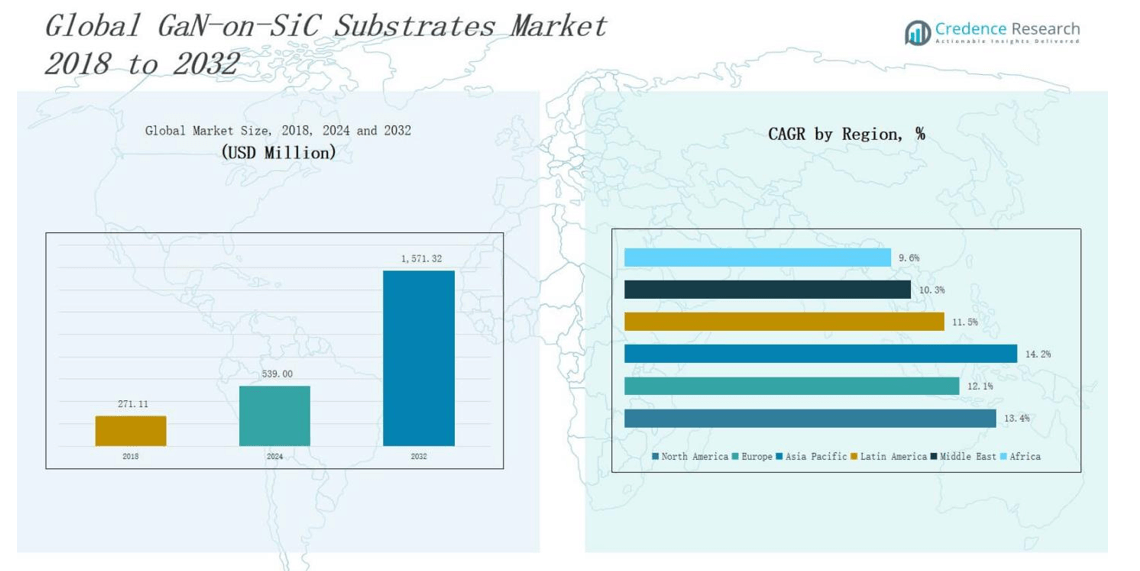
The GaN-on-SiC Substrates Market size was valued at USD 271.11 million in 2018 to USD 539.00 million in 2024 and is anticipated to reach USD 1,571.32 million by 2032, at a CAGR of 13.34% during the forecast period.
| REPORT ATTRIBUTE | DETAILS |
|---|---|
| Historical Period | 2020-2023 |
| Base Year | 2024 |
| Forecast Period | 2025-2032 |
| GaN-on-SiC Substrates Market Size 2024 | USD 539.00 million |
| GaN-on-SiC Substrates Market, CAGR | 13.34% |
| GaN-on-SiC Substrates Market Size 2032 | USD 1,571.32 million |
The GaN-on-SiC substrates market is driven by rising demand for high-frequency, high-power electronic devices across aerospace, defense, and 5G infrastructure. Superior thermal conductivity and power efficiency of GaN-on-SiC over traditional materials fuel its adoption in RF amplifiers, satellite communication, and radar systems. Market growth is supported by increasing investments in compound semiconductor R&D and expanding deployment of electric vehicles and wireless base stations. Key trends include the shift toward miniaturized, energy-efficient components, integration of GaN technology in LIDAR and power electronics, and growing collaborations between foundries and substrate manufacturers to optimize cost, yield, and production scalability.
The GaN-on-SiC Substrates Market shows strong growth across Asia Pacific, North America, and Europe, with Asia Pacific holding the largest share due to robust semiconductor manufacturing and 5G rollout. North America leads in defense and aerospace adoption, while Europe focuses on automotive and energy-efficient electronics. Latin America, the Middle East, and Africa show emerging demand in telecom and power sectors. Key players include Wolfspeed, Sumitomo Electric Industries, Coherent Corp., Qorvo, MACOM, NGK Insulators, Saint-Gobain, NTT Advanced Technology, Sino Nitride Semiconductor, and Freiberger Compound Materials.
Market Insights
- The GaN-on-SiC Substrates Market was valued at USD 539.00 million in 2024 and is projected to reach USD 1,571.32 million by 2032, growing at a CAGR of 13.34%.
- Asia Pacific leads the market with a 46% share, driven by robust 5G deployment, EV expansion, and semiconductor manufacturing in China, Japan, and South Korea.
- North America holds 26% market share, supported by high defense spending, aerospace innovation, and presence of key players like Wolfspeed and Qorvo.
- Europe contributes 16% of the global market, focusing on automotive electrification, power-efficient electronics, and defense applications.
- Key growth drivers include demand for high-frequency, high-power devices, superior thermal performance, and expanding 5G and radar infrastructure.
- Major challenges include high production costs, limited economies of scale, and supply chain constraints related to silicon carbide material sourcing.
- Prominent players include Wolfspeed, Sumitomo Electric Industries, Coherent Corp., Qorvo, MACOM, NGK Insulators, Saint-Gobain, NTT Advanced Technology, Sino Nitride Semiconductor, and Freiberger Compound Materials.
Market Drivers
Rising Demand for High-Power, High-Frequency Applications
The GaN-on-SiC Substrates Market is propelled by its superior performance in high-power, high-frequency applications. It enables compact, energy-efficient devices ideal for RF amplifiers, radar systems, and satellite communications. Defense and aerospace sectors rely on its thermal conductivity and power density to support mission-critical systems. Telecom operators also benefit from its efficiency in 5G base stations. GaN-on-SiC reduces cooling requirements and extends device lifespan. This demand sustains its growing relevance across critical infrastructure deployments.
- For instance, in the telecom sector, Nokia has deployed GaN-on-SiC-powered radio units in its AirScale 5G base stations, improving power efficiency and network coverage.
Superiority in Thermal Conductivity and Power Density
Thermal management challenges in modern electronics increase the appeal of GaN-on-SiC substrates. It delivers enhanced heat dissipation and supports higher current densities, outperforming silicon and GaN-on-silicon alternatives. Engineers prioritize it for robust, compact power systems where heat reliability is a concern. The market gains traction in power electronics, especially in harsh environments. Its benefits extend device reliability in defense-grade and aerospace equipment. GaN-on-SiC Substrates Market growth reflects a clear shift in thermal management standards.
- For instance, GaN devices grown on 4H-SiC substrates demonstrate thermal conductivities comparable to high-quality bulk GaN, ensuring greater heat removal efficiency critical for high-power applications.
Rapid Expansion of 5G and Wireless Infrastructure
Deployment of 5G networks and wireless backhaul drives strong adoption of GaN-on-SiC substrates. Telecom infrastructure providers seek substrates that support high-frequency and wide-band performance. GaN-on-SiC meets this need while improving energy efficiency and reducing signal distortion. It supports the increased data demand and low-latency requirements of modern networks. Countries investing in 5G expansion further amplify this demand. The GaN-on-SiC Substrates Market benefits directly from telecom modernization and spectrum upgrades.
Growing Investments in Advanced Defense and Radar Systems
Defense modernization programs globally incorporate advanced radar and electronic warfare systems requiring GaN-on-SiC. It offers the durability and performance necessary for long-range, high-resolution radar. Governments allocate significant funding toward semiconductor advancements for military applications. GaN-on-SiC ensures stable performance under extreme temperatures and electromagnetic interference. Suppliers expand fabrication capabilities to meet stringent defense standards. The GaN-on-SiC Substrates Market capitalizes on sustained military procurement and technological superiority requirements.
Market Trends
Increasing Integration in 5G, Aerospace, and Defense Systems
The GaN-on-SiC Substrates Market is witnessing strong traction from its integration in 5G infrastructure, satellite systems, and advanced radar platforms. It supports high-performance RF components that deliver stable operation in wide bandwidth and extreme temperature conditions. OEMs increasingly prefer it for long-range radar, electronic warfare, and base station amplifiers. It enables higher data transmission speeds, lower latency, and improved signal integrity. This trend strengthens its position in high-reliability sectors demanding superior thermal and power performance.
- For instance, Raytheon Technologies uses GaN-on-SiC technology in its AN/SPY-6 radar systems to enhance detection range and target resolution for naval defense.
Emergence of Strategic Collaborations and Technology Licensing Deals
Manufacturers and foundries are entering strategic partnerships to improve GaN-on-SiC yield and reduce production costs. This trend involves long-term supply agreements, IP licensing, and joint R&D for scaling substrate innovation. It helps streamline production, improve design customization, and accelerate product qualification. Foundries collaborate with defense contractors and telecom OEMs to meet application-specific requirements. The GaN-on-SiC Substrates Market benefits from this collaborative model that boosts commercial scalability and reduces technological entry barriers for new entrants.
- For instance, SweGaN in Sweden is expanding its production capacity with a new wafer plant capable of manufacturing up to 40,000 GaN-on-SiC epitaxial wafers annually, supporting applications in 5G, defense, and EV power switches.
Expansion of Wafer Size and Manufacturing Capacity
A key trend involves the transition from 4-inch to 6-inch and even 8-inch GaN-on-SiC wafers to improve throughput and reduce costs. Manufacturers invest in advanced epitaxy and metrology tools to enhance process precision. This enables better substrate uniformity, reduces defects, and improves device yield. It supports large-scale production for RF and power applications. The GaN-on-SiC Substrates Market leverages these manufacturing advancements to meet volume demand from telecom, automotive, and aerospace sectors without compromising on quality.
Growing Adoption in EV Power Modules and High-Voltage Systems
Electric vehicles and renewable energy systems now incorporate GaN-on-SiC substrates for power electronics. It delivers higher breakdown voltage, reduced switching losses, and improved thermal handling over traditional materials. OEMs use it in onboard chargers, inverters, and DC-DC converters. It supports compact designs and higher energy efficiency. The GaN-on-SiC Substrates Market expands its footprint in automotive electrification, driven by performance requirements in high-voltage systems and continuous demand for fast-charging infrastructure.
Market Challenges Analysis
High Manufacturing Costs and Limited Economies of Scale
The GaN-on-SiC Substrates Market faces significant cost-related challenges due to expensive raw materials and complex fabrication processes. Producing high-quality SiC wafers requires advanced crystal growth and polishing techniques, which increase capital expenditure. Small production volumes further limit cost efficiency, hindering broader commercial adoption. It remains a costlier alternative to GaN-on-Silicon in high-volume applications. This cost disparity creates adoption barriers in cost-sensitive sectors such as consumer electronics and industrial automation. Manufacturers must invest in scaling and yield improvement to stay competitive.
Technical Complexity and Supply Chain Constraints
Production of GaN-on-SiC substrates involves intricate epitaxial growth, thermal management, and material compatibility control. Yield rates often fluctuate due to crystal defects and process variability, impacting device reliability and scalability. The GaN-on-SiC Substrates Market struggles with a limited number of qualified suppliers, creating supply bottlenecks and long lead times. It remains vulnerable to geopolitical tensions affecting critical raw materials like silicon carbide. This limits its availability for emerging sectors where consistent supply and design flexibility are essential.
Market Opportunities
Expansion into Power Electronics for Electric Mobility and Renewable Energy
The GaN-on-SiC Substrates Market holds strong potential in electric vehicles and renewable energy systems. Demand for compact, high-efficiency power modules in EV inverters, onboard chargers, and solar inverters creates new growth avenues. It enables faster switching speeds, higher power densities, and improved thermal performance, which are critical for next-generation electrification platforms. Automotive OEMs and energy integrators are testing GaN-on-SiC for advanced traction systems. The market benefits from regulatory mandates promoting low-emission transportation and grid modernization.
Emerging Applications in LIDAR, Satellite Communications, and Space Electronics
Adoption of GaN-on-SiC substrates is expanding into high-frequency, high-reliability applications such as LIDAR, phased-array antennas, and satellite communications. It delivers superior performance under vacuum, radiation, and thermal stress, making it ideal for aerospace missions and deep-space systems. Emerging commercial space ventures seek reliable RF power amplifiers built on GaN-on-SiC. The GaN-on-SiC Substrates Market gains from increasing demand for space-based data services, autonomous vehicle navigation, and advanced defense surveillance systems. It supports a wide range of mission-critical innovations.
Market Segmentation Analysis:
By Wafer Size
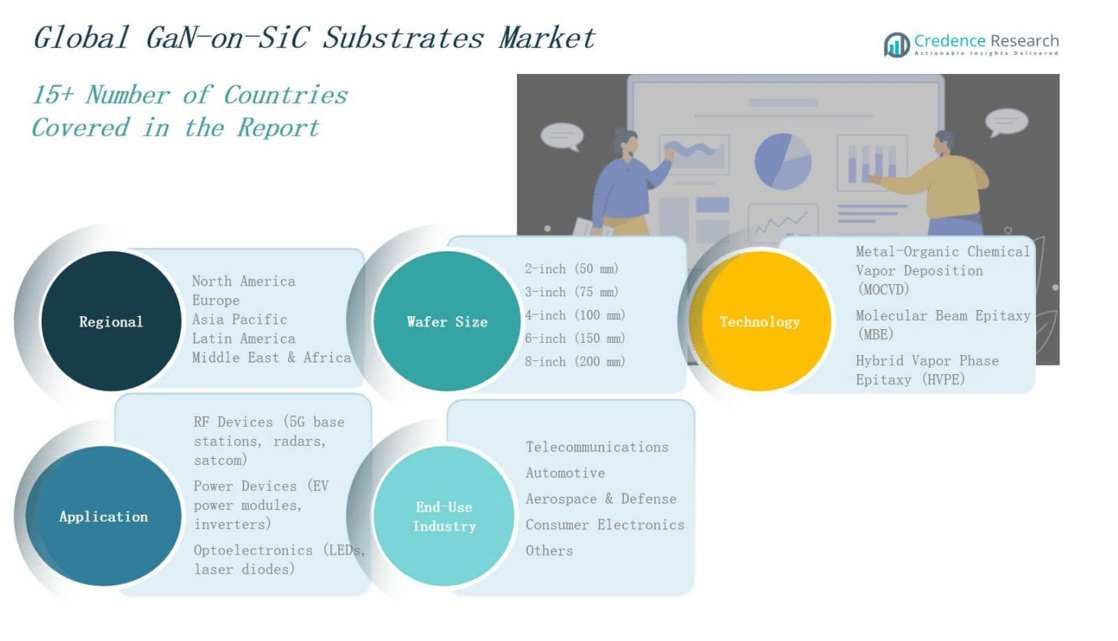
The GaN-on-SiC Substrates Market is segmented by wafer size into 2-inch, 3-inch, 4-inch, 6-inch, and 8-inch formats. 4-inch and 6-inch wafers currently dominate the market due to their commercial maturity and higher adoption in RF and power applications. The shift toward 6-inch and 8-inch wafers is accelerating, driven by demand for greater throughput and improved manufacturing economies. It supports large-scale production for telecom and defense sectors. Smaller wafers remain in use for R&D and low-volume specialty applications.
- For instance, Qorvo continues to utilize 4-inch GaN-on-SiC wafers for its high-frequency defense-grade components, while introducing pilot-scale 6-inch wafer usage for next-gen phased array systems.
By Technology
Based on technology, the GaN-on-SiC Substrates Market includes Metal-Organic Chemical Vapor Deposition (MOCVD), Molecular Beam Epitaxy (MBE), and Hybrid Vapor Phase Epitaxy (HVPE). MOCVD leads the segment due to its proven scalability and consistent film quality. MBE is preferred for precise material control in niche applications, particularly in defense and aerospace. HVPE shows growth potential in high-yield, cost-sensitive production. It helps improve substrate throughput while maintaining quality, making it attractive for telecom and automotive adoption.
- For instance, Cree (now Wolfspeed) uses MOCVD in its Durham, North Carolina facility for the mass production of GaN-on-SiC substrates used in RF and power electronics. MBE is favored for its atomic-layer precision in defense and aerospace applications.
By Application
The GaN-on-SiC Substrates Market covers RF Devices, Power Devices, and Optoelectronics. RF Devices represent the largest segment, driven by demand from 5G base stations, radar systems, and satellite communication. Power Devices are expanding rapidly with the rise of electric vehicles and renewable energy systems requiring efficient, high-voltage switching components. Optoelectronics holds a smaller share but finds relevance in high-brightness LEDs and advanced laser diodes. It benefits sectors requiring compact, high-performance optical solutions.
Segments:
Based on Wafer Size:
- 2-inch (50 mm)
- 3-inch (75 mm)
- 4-inch (100 mm)
- 6-inch (150 mm)
- 8-inch (200 mm)
Based on Technology:
- Metal-Organic Chemical Vapor Deposition (MOCVD)
- Molecular Beam Epitaxy (MBE)
- Hybrid Vapor Phase Epitaxy (HVPE)
Based on Application:
- RF Devices (5G base stations, radars, satellite communication)
- Power Devices (EV power modules, inverters)
- Optoelectronics (LEDs, laser diodes)
Based on End-Use Industry:
- Telecommunications
- Automotive
- Aerospace & Defense
- Consumer Electronics
- Others
Based on Region:
- North America
- U.S.
- Canada
- Mexico
- Europe
- Germany
- France
- U.K.
- Italy
- Spain
- Rest of Europe
- Asia Pacific
- China
- Japan
- India
- South Korea
- South-east Asia
- Rest of Asia Pacific
- Latin America
- Brazil
- Argentina
- Rest of Latin America
- Middle East & Africa
- GCC Countries
- South Africa
- Rest of the Middle East and Africa
Regional Analysis
North America
The North America GaN-on-SiC Substrates Market size was valued at USD 75.49 million in 2018 to USD 147.64 million in 2024 and is anticipated to reach USD 432.29 million by 2032, at a CAGR of 13.4% during the forecast period. North America holds a 26% share of the global market, driven by strong demand from aerospace, defense, and 5G infrastructure. The U.S. leads regional adoption due to high R&D investments and government-backed semiconductor programs. It benefits from robust industrial and military requirements for high-frequency, high-power devices. Defense modernization and satellite communications fuel technology deployment across RF and power segments. Key players in the region include Wolfspeed, Qorvo, and MACOM.
Europe
The Europe GaN-on-SiC Substrates Market size was valued at USD 53.77 million in 2018 to USD 101.40 million in 2024 and is anticipated to reach USD 270.45 million by 2032, at a CAGR of 12.1% during the forecast period. Europe accounts for around 16% of the global market, with growth supported by increased adoption in automotive and industrial power electronics. Germany, France, and the UK lead deployments across EV platforms and defense applications. It benefits from strong collaborations between research institutes and semiconductor manufacturers. The region emphasizes energy-efficient technologies aligned with regulatory targets. European aerospace firms also adopt GaN-on-SiC for radar and communication systems.
Asia Pacific
The Asia Pacific GaN-on-SiC Substrates Market size was valued at USD 119.62 million in 2018 to USD 246.52 million in 2024 and is anticipated to reach USD 762.10 million by 2032, at a CAGR of 14.2% during the forecast period. Asia Pacific dominates the global market with a 46% share, led by China, Japan, South Korea, and Taiwan. It benefits from large-scale semiconductor manufacturing, growing 5G rollout, and expanding EV production. Foundries and OEMs invest in GaN-on-SiC for high-frequency RF devices and power electronics. The region’s government policies and funding boost domestic capabilities. It plays a central role in global supply chains and capacity scaling.
Latin America
The Latin America GaN-on-SiC Substrates Market size was valued at USD 12.26 million in 2018 to USD 24.06 million in 2024 and is anticipated to reach USD 61.73 million by 2032, at a CAGR of 11.5% during the forecast period. Latin America holds a 4% share of the global market, with demand rising from telecom upgrades and renewable energy initiatives. Brazil and Mexico lead regional adoption due to expanding electronics and automotive sectors. It faces challenges related to limited fabrication infrastructure. Government-led clean energy programs are expected to stimulate GaN-based power module integration. Telecom providers explore high-efficiency RF solutions to enhance network capacity.
Middle East
The Middle East GaN-on-SiC Substrates Market size was valued at USD 6.33 million in 2018 to USD 11.29 million in 2024 and is anticipated to reach USD 26.62 million by 2032, at a CAGR of 10.3% during the forecast period. The region accounts for nearly 2% of the global market, driven by defense investments and satellite connectivity initiatives. Countries like Israel and the UAE are deploying GaN-based radar and communication systems. It shows gradual interest in 5G infrastructure and energy-efficient power electronics. Market potential is linked to strategic partnerships with international semiconductor firms. Limited domestic manufacturing capacity presents a challenge for broader uptake.
Africa
The Africa GaN-on-SiC Substrates Market size was valued at USD 3.63 million in 2018 to USD 8.09 million in 2024 and is anticipated to reach USD 18.12 million by 2032, at a CAGR of 9.6% during the forecast period. Africa holds a 1% share of the global market and remains in the early stages of GaN-on-SiC adoption. It sees emerging interest from telecom and off-grid renewable energy sectors. Countries like South Africa and Egypt drive regional demand through modernization projects. It lacks localized semiconductor manufacturing infrastructure. International collaborations may improve access to high-efficiency RF and power technologies. Growth depends on foreign investment and digital connectivity initiatives.
Key Player Analysis
- MACOM
- Sino Nitride Semiconductor
- Freiberger Compound Materials
- Qorvo
- II-VI Incorporated (Coherent Corp.)
- NGK Insulators
- Cree, Inc. (Wolfspeed)
- NTT Advanced Technology
- Saint-Gobain
- Sumitomo Electric Industries
Competitive Analysis
The GaN-on-SiC Substrates Market features a competitive landscape led by vertically integrated players and specialized material suppliers. Key companies such as Wolfspeed, Sumitomo Electric Industries, and II-VI Incorporated (Coherent Corp.) focus on expanding wafer production and improving substrate quality. It shows increasing consolidation, with players forming strategic alliances to scale capacity and reduce costs. Firms like MACOM and Qorvo target performance-critical RF applications, while others like NGK Insulators and Saint-Gobain emphasize thermal management solutions. Emerging participants such as Sino Nitride Semiconductor and Freiberger Compound Materials are gaining traction through advanced epitaxy and localized supply models. The market rewards players with strong IP portfolios, high-volume manufacturing capability, and consistent substrate yield. It remains innovation-driven, with technology differentiation in wafer size, thermal conductivity, and defect control influencing competitive positioning. Players invest in facility upgrades and long-term contracts with aerospace, telecom, and automotive customers to secure market share and ensure sustained growth.
Recent Developments
- In November 2024, MACOM was selected by the U.S. Department of Defense to lead a CHIPS Act-funded project focused on developing advanced GaN-on-SiC technologies for high-voltage RF and microwave systems.
- In December 2024, ROHM Semiconductor Europe entered a strategic partnership with TSMC to co-develop GaN-based solutions targeting next-generation automotive applications.
- On April 1, 2025, Sanken Electric, a Japanese semiconductor company, acquired Powdec K.K., a firm specializing in GaN semiconductor epitaxial substrates and GaN crystal growth.
- On June 30, 2025, Wolfspeed initiated a prepackaged Chapter 11 restructuring to reduce USD 4.6 billion in debt and reinforce its financial position for continued growth in SiC and GaN technologies.
Market Concentration & Characteristics
The GaN-on-SiC Substrates Market exhibits a moderately concentrated structure with a few dominant players controlling a significant share of global production. Key participants such as Wolfspeed, Sumitomo Electric Industries, and Coherent Corp. maintain strong vertical integration and proprietary wafer technologies. It features high entry barriers due to capital-intensive manufacturing, complex crystal growth processes, and strict performance standards. The market prioritizes product quality, substrate uniformity, and yield consistency across applications like RF devices and power modules. It demonstrates strong demand from aerospace, defense, and telecom sectors, requiring substrates with superior thermal management and high-frequency capability. Suppliers focus on expanding wafer sizes and enhancing process control to achieve cost efficiency and scale. Collaborative R&D between foundries and OEMs supports innovation and application-specific customization. The GaN-on-SiC Substrates Market rewards firms with robust technical capabilities, long-term supply contracts, and established relationships with Tier 1 device manufacturers across North America, Asia Pacific, and Europe.
Report Coverage
The research report offers an in-depth analysis based on Wafer Size, Technology, Application, End-User Industry and Region. It details leading market players, providing an overview of their business, product offerings, investments, revenue streams, and key applications. Additionally, the report includes insights into the competitive environment, SWOT analysis, current market trends, as well as the primary drivers and constraints. Furthermore, it discusses various factors that have driven market expansion in recent years. The report also explores market dynamics, regulatory scenarios, and technological advancements that are shaping the industry. It assesses the impact of external factors and global economic changes on market growth. Lastly, it provides strategic recommendations for new entrants and established companies to navigate the complexities of the market.
Future Outlook
- Demand for GaN-on-SiC substrates will rise with increasing deployment of 5G infrastructure and mmWave networks.
- Adoption in electric vehicle power modules will accelerate due to the need for high-efficiency, compact systems.
- Aerospace and defense sectors will expand usage in radar, satellite, and electronic warfare applications.
- Manufacturers will focus on scaling 6-inch and 8-inch wafer production to improve yield and reduce costs.
- Integration of GaN-on-SiC in LIDAR systems will grow in autonomous driving and industrial automation.
- Strategic partnerships between foundries and OEMs will strengthen to address application-specific performance needs.
- The supply chain will diversify as new players invest in domestic production and silicon carbide sourcing.
- Semiconductor companies will increase R&D spending to improve thermal conductivity and defect density control.
- Regulatory push for energy-efficient electronics will support wider adoption across telecom and power sectors.
- Emerging markets in Latin America, Middle East, and Africa will create new demand for RF and power solutions.

Request a Free Sample
Fill in your details and we'll send you a free sample report.
- Sample data tables & charts
- Research methodology
Need a Custom Version of This Report?
Tailor the scope, geography, or segments to your exact requirements.
- Custom geography or segment scope
- Direct access to our analyst team
Frequently Asked Questions
What is the current size of the GaN-on-SiC Substrates Market?
What are the key segments within the GaN-on-SiC Substrates Market?
What are some challenges faced by the GaN-on-SiC Substrates Market?
Who are the major players in the GaN-on-SiC Substrates Market?
Table of Content
Chapter 1. Report Introduction
- 1.1 Report Description & Purpose
- 1.1.1 Report Title & Market Definition
- 1.1.2 Unique Selling Propositions (USP) & Key Differentiators
- 1.1.3 Value Proposition for Stakeholders
- 1.2 Research Objectives
- 1.2.1 Market Sizing Objectives (Volume & Revenue)
- 1.2.2 Segmentation Objectives
- 1.2.3 Competitive Intelligence Objectives
- 1.2.4 Forecast & Scenario Objectives
- 1.3 Report Scope
- 1.3.1 GaN-on-SiC Substrates Scope – Types & Subtypes Covered
- 1.3.2 Geographic Scope – Regions & Countries Covered
- 1.3.3 Historical Period, Base Year & Forecast Period (2024; forecast to 2032)
- 1.3.4 Inclusions & Exclusions
- 1.4 HS Code & Classification Framework
- 1.5 Currency, Units & Pricing Basis
- 1.6 Target Stakeholders
- 1.7 Limitations & Assumptions
Chapter 2. Executive Summary
- 2.1 Global GaN-on-SiC Substrates Market Snapshot
- 2.1.1 Market Size – Historical (2024) & Forecast (2024-2032) (2024: USD 539.00 million → 2032: USD 1,571.32 million)
- 2.1.2 Volume & Revenue – Global Totals
- 2.1.3 Key Market Highlights – Top Five Facts
- 2.2 GaN-on-SiC Substrates Market Segmentation Snapshot
- 2.2.1 Market Split by Region – 2024 vs. 2032
- 2.3 Competitive Snapshot
- 2.3.1 Top 10 Players by Revenue Share – 2024
- 2.3.2 Top 10 Players by Volume Share – 2024
- 2.3.3 Recent Strategic Developments (18-Month Summary)
- 2.4 Key Investment Highlights & Strategic Conclusions
Chapter 3. GaN-on-SiC Substrates Market Dynamics & Industry Analysis
- 3.1 Market Overview & Context
- 3.1.1 GaN-on-SiC Substrates Market Position in the Broader Automotive Value Chain
- 3.1.2 OEM vs. Replacement Market Dynamics
- 3.1.3 Market Maturity & Development Stage by Region
- 3.2 GaN-on-SiC Substrates Market Drivers
- 3.3 GaN-on-SiC Substrates Market Restraints & Challenges
- 3.4 GaN-on-SiC Substrates Market Opportunities
- 3.5 Porter's Five Forces Analysis
- 3.5.1 Threat of New Entrants
- 3.5.2 Bargaining Power of Suppliers
- 3.5.3 Bargaining Power of Buyers
- 3.5.4 Threat of Substitutes
- 3.5.5 Competitive Rivalry – Intensity Assessment
- 3.6 GaN-on-SiC Substrates Value Chain Analysis
- 3.6.1 Upstream – Raw Material/Input Suppliers
- 3.6.1.1 Raw Material/Input 1
- 3.6.1.2 Raw Material/Input 2
- 3.6.1.3 Raw Material/Input 3
- 3.6.2 Midstream – Production/Manufacturing/Service Delivery
- 3.6.2.1 Production/Process Overview
- 3.6.2.2 Key Facility Locations & Capacity by Manufacturer
- 3.6.3 Downstream – Distribution & End Consumer
- 3.6.3.1 Primary Channel – B2B/OEM
- 3.6.3.2 Secondary Channels – Dealer, Retail, Online, Direct
- 3.6.4 Value Chain Profitability Analysis
- 3.6.1 Upstream – Raw Material/Input Suppliers
- 3.7 PESTEL Analysis
- 3.7.1 Political Factors
- 3.7.2 Economic Factors
- 3.7.3 Social Factors
- 3.7.4 Technological Factors
- 3.7.5 Environmental Factors
- 3.7.6 Legal Factors
- 3.8 GaN-on-SiC Substrates Supply Chain Analysis
- 3.8.1 Raw Material/Input Supply Risk Assessment
- 3.8.2 Manufacturing Concentration Risk (Geographic Exposure)
- 3.8.3 Trade Disruption Impact Analysis
- 3.9 Regulatory & Policy Landscape
Note: The regulatory and policy landscape section covers regulations based on their applicability to the market, GaN-on-SiC Substrates category, geography, and scope of the study. Only regulatory frameworks with a material impact on operations, compliance, trade, sustainability, or market access are analyzed in detail.
Chapter 4. Key Investment Pockets & Opportunity Analysis
- 4.1 GaN-on-SiC Substrates Market Attractiveness Analysis
- 4.1.1 By Region – Investment Attractiveness Matrix (Volume × CAGR)
- 4.2 Absolute Revenue Growth Opportunity
- 4.2.1 By Region – Absolute USD Growth Through 2032
- 4.3 Incremental Volume Opportunity
- 4.3.1 By Region – Incremental Volume Through 2032
- 4.3.2 Segment – Incremental Volume
- 4.4 Emerging Submarket Opportunity Deep Dive (Subject to Applicability)
- 4.5 Emerging Market Opportunity Scorecards
- 4.5.1 United States
- 4.5.2 Europe
- 4.5.3 Asia
- 4.5.4 Middle East & Africa
Note: Emerging Market Opportunity Scorecards will be included based on relevance and strategic importance. Regions listed are indicative and may vary depending on data availability and market dynamics.
Chapter 5. GaN-on-SiC Substrates Import-Export Analysis & Trade Flows
- 5.1 Global Trade Overview
- 5.1.1 Global Export Value by Country (2024)
- 5.1.2 Global Export Volume by Country (2024)
- 5.1.3 Global Import Value by Country (2024)
- 5.1.4 Global Import Volume by Country (2024)
- 5.1.5 Net Trade Balance by Country (2024)
- 5.2 Export Analysis – Segment
- 5.2.1 Type 1 (HS Code)
- 5.2.2 Type 2 (HS Code)
- 5.2.3 Type 3 (HS Code)
- 5.2.4 Type 4 (HS Code)
- 5.2.5 Type 5 (HS Code)
- 5.3 Import Analysis – Segment
- 5.3.1 Type 1 (HS Code)
- 5.3.2 Type 2 (HS Code)
- 5.3.3 Type 3 (HS Code)
- 5.3.4 Type 4 (HS Code)
- 5.3.5 Type 5 (HS Code)
- 5.4 Average Unit Trade Prices
- 5.4.1 Average Export Price – Segment & Country
- 5.4.2 Average Import Price – Segment & Source Country
- 5.4.3 Price Trends (2024)
- 5.5 Key Trade Route Analysis
- 5.5.1 Trade Route 1
- 5.5.2 Trade Route 2
- 5.5.3 Trade Route 3
- 5.5.4 Trade Route 4
- 5.5.5 Trade Route 5
- 5.6 Trade Policy Impact Assessment
- 5.6.1 US Anti-Dumping & Section 301 Tariffs
- 5.6.2 EU Customs Union Impact
- 5.6.3 Major Free Trade Agreements
- 5.6.4 USMCA Rules of Origin
Note: Trade policy analysis will be included only where relevant to the GaN-on-SiC Substrates market.
Chapter 6. Competitive Landscape & Company Benchmarking
- 6.1 GaN-on-SiC Substrates Market Concentration & Structure
- 6.1.1 Herfindahl-Hirschman Index (HHI) – vs. 2024
- 6.1.2 Tier 1, Tier 2 & Tier 3 Market Structure
- 6.1.3 Global, Regional & Local Player Dynamics
- 6.2 GaN-on-SiC Substrates Market Share Analysis – 2024
- 6.2.1 Global Revenue Share by Company
- 6.2.2 Global Volume Share by Company
- 6.2.3 Regional Revenue Share
- 6.2.4 Market Share Evolution ( vs. 2024)
- 6.2.5 OEM Segment Share by Company
- 6.2.6 Replacement Segment Share by Company
- 6.3 Production/Delivery Capacity & Facility Analysis
- 6.3.1 Global Installed Capacity
- 6.3.2 Capacity Utilization Rates
- 6.3.3 Production/Output Volume
- 6.3.4 Facility Locations & Capacity Map
- 6.3.5 Planned Capacity Additions
- 6.4 GaN-on-SiC Substrates Competitive Benchmarking Matrix
- 6.4.1 Revenue, Volume, CAGR & Profitability Comparison
- 6.4.2 Channel Revenue Mix
- 6.4.3 Geographic Revenue Exposure
- 6.4.4 R&D Intensity
- 6.4.5 Sustainability Maturity
- 6.5 Strategic Developments in GaN-on-SiC Substrates (Last 24 Months)
- 6.5.1 Mergers, Acquisitions & Divestments
- 6.5.2 New GaN-on-SiC Substrates Launches
- 6.5.3 Facility Expansions
- 6.5.4 Strategic Alliances, Joint Ventures & Partnerships
- 6.5.5 Distribution Expansion & Market Entry
- 6.5.6 Sustainability & ESG Initiatives
- 6.6 Competitive Strategy Mapping
- 6.6.1 Leader, Challenger, Follower & Niche Classification
- 6.6.2 Pricing Strategy Comparison
- 6.6.3 Channel Strategy Matrix
Note: Strategic developments are included based on their materiality and the availability of reliable information.
Chapter 7. Global GaN-on-SiC Substrates Market – By Distribution Channel
- 7.1 Segment Overview
- 7.1.1 Volume & Revenue Split by Channel (2024 & 2032)
- 7.1.2 Channel Mix Evolution (2024-2032)
Chapter 8. Regional Market Analysis – Global Overview
- 8.1 Global Regional Overview
- 8.1.1 Regional Volume Share
- 8.1.2 Regional Revenue Share
- 8.1.3 Regional Volume by Region
- 8.1.4 Regional Revenue by Region
- 8.1.5 Regional Forecast Through 2032
- 8.2 Cross-Regional Segment Analysis
- 8.2.1 By Distribution Channel
- 8.2.2 By Brand/Price Tier
Chapter 9. North America GaN-on-SiC Substrates Market
- 9.1 United States
- 9.2 Canada
- 9.3 Mexico
Chapter 10. Europe GaN-on-SiC Substrates Market
- 10.1 Germany
- 10.2 France
- 10.3 Italy
- 10.4 United Kingdom
- 10.5 Spain
- 10.6 Poland
- 10.7 Russia
- 10.8 Netherlands
- 10.9 Belgium
- 10.10 Sweden
- 10.11 Denmark
- 10.12 Norway
- 10.13 Rest of Europe
Chapter 11. Asia Pacific GaN-on-SiC Substrates Market
- 11.1 China
- 11.2 India
- 11.3 Japan
- 11.4 South Korea
- 11.5 Thailand
- 11.6 Indonesia
- 11.7 Vietnam
- 11.8 Malaysia
- 11.9 Australia
- 11.10 Rest of Asia Pacific
Chapter 12. Latin America GaN-on-SiC Substrates Market
- 12.1 Brazil
- 12.2 Argentina
- 12.3 Colombia
- 12.4 Chile
- 12.5 Rest of Latin America
Chapter 13. Middle East GaN-on-SiC Substrates Market
- 13.1 Saudi Arabia
- 13.2 United Arab Emirates
- 13.3 Turkey
- 13.4 Israel
- 13.5 Iran
- 13.6 Rest of the Middle East
Chapter 14. Africa GaN-on-SiC Substrates Market
- 14.1 South Africa
- 14.2 Egypt
- 14.3 Nigeria
- 14.4 Morocco
- 14.5 Rest of Africa
Chapter 15. GaN-on-SiC Substrates Company Profiles
- 15.1 [Company 01]
- 15.1.1 Company Overview
- 15.1.2 Key Management Personnel
- 15.1.3 Products & Services Portfolio
- 15.1.4 Financial Performance
- 15.1.5 Key Market Focus & Geographic Presence
- 15.1.6 Recent Developments & Strategic Initiatives
Note: The company profile list is preliminary and may change based on research findings, market developments, data availability, and client requirements.
Chapter 16. Appendices
- Appendix A – List of Abbreviations & Acronyms
- Appendix B – Industry Classification Code Reference – Full Series
- Appendix C – Production & Capacity Data Tables
- Appendix D – End-Use & Demand Base Tables
- Appendix E – Consumption & Replacement Rate Assumptions
- Appendix F – ASP Reference Tables
- Appendix G – Manufacturing & Facility Database
- Appendix H – Import-Export Data Tables
- Appendix I – Regulatory Summary Tables
- Appendix J – Primary Research Participant List (Anonymized)
- Appendix K – Primary Research Questionnaire Framework
- Appendix L – Data Sources & Bibliography
- Appendix M – Market Size Divergence & Source Comparison
Chapter 17. Research Methodology
- 17.1 Research Framework & Philosophy
- 17.2 Secondary Research – Sources, Hierarchy & Data Extraction
- 17.3 Data Modeling – Bottom-Up & Top-Down Market Sizing
- 17.4 Primary Research – Stakeholder Framework, LOI & Sample Sizes
- 17.5 Forecast Methodology – Regression, Scenario & Sensitivity Analysis
- 17.6 Quality Control – Four-Layer Validation Framework
- 17.7 Limitations & Standard Assumptions
- 17.8 Disclaimer