| REPORT ATTRIBUTE | DETAILS |
|---|---|
| Historical Period | 2020-2023 |
| Base Year | 2024 |
| Forecast Period | 2025-2032 |
| Graphene Quantum Capacitors Market Size 2024 | USD 285.1 million |
| Graphene Quantum Capacitors Market, CAGR | 15.20% |
| Graphene Quantum Capacitors Market Size 2032 | USD 886.4 million |
Market Overview:
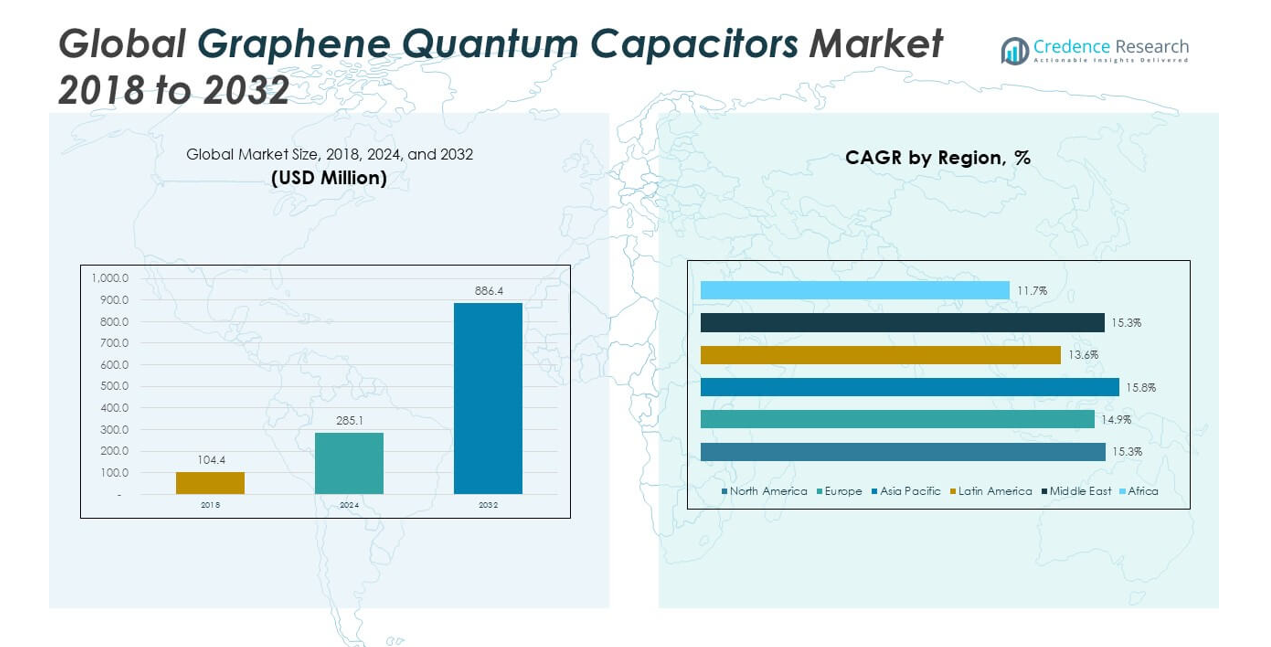
The Graphene Quantum Capacitors Market size was valued at USD 104.4 million in 2018 to USD 285.1 million in 2024 and is anticipated to reach USD 886.4 million by 2032, at a CAGR of 15.20% during the forecast period.
Several factors are fueling the expansion of the graphene quantum capacitors market. Primarily, the exceptional electrical conductivity, high surface area, and quantum-level charge storage of graphene-based materials enable capacitors to outperform conventional technologies in terms of energy density and cycle life. This is particularly valuable in aerospace and defense, where size, weight, and durability are mission-critical. Growing adoption of electric vehicles and high-performance consumer electronics further intensifies the demand for efficient and rapid energy storage systems. In addition, robust R&D initiatives, supported by government funding and public-private partnerships, are accelerating the commercialization of graphene technologies. Notably, programs such as the EU’s Graphene Flagship and similar initiatives in the U.S., China, and India are enabling innovations that strengthen market adoption. The rising emphasis on clean energy systems and miniaturized power devices also contributes to long-term demand.
Regionally, North America leads the global graphene quantum capacitors market, supported by strong investments in aerospace, defense, and energy storage research. The U.S. has been at the forefront, with extensive university-led and government-backed research programs that advance graphene-based technologies. Asia Pacific, however, is emerging as the fastest-growing region due to rapid industrialization, expanding electric vehicle production, and strong government support for advanced materials innovation in China, South Korea, Japan, and India. Europe maintains a steady growth trajectory, driven by its commitment to sustainable energy solutions and significant funding under initiatives like the Graphene Flagship project. Meanwhile, Latin America and the Middle East & Africa are gradually entering the market, though their share remains limited due to infrastructure challenges and slower commercialization of graphene-based applications.
Market Insights:
- The Graphene Quantum Capacitors Market was valued at USD 285.1 million in 2024 and is projected to reach USD 886.4 million by 2032, growing at a CAGR of 15.20%.
- Graphene’s superior conductivity, energy density, and cycle life make it ideal for high-performance storage in aerospace, defense, and electric mobility.
- Rising adoption of electric vehicles and smart consumer devices is driving demand for compact, fast-charging, and thermally stable capacitor technologies.
- Government-backed R&D initiatives, such as the EU’s Graphene Flagship and projects in the U.S., China, and India, are accelerating market commercialization.
- Challenges such as high production costs and limited scalability hinder large-scale adoption, especially for small and mid-sized manufacturers.
- The market’s commercial maturity remains limited, with integration issues, lack of standards, and reliability validation slowing broader deployment.
- Regionally, North America leads due to strong research investments, while Asia Pacific is the fastest-growing region, fueled by industrialization and EV expansion.
Market Drivers:
Emerging Demand for High-Performance Energy Storage Solutions
The increasing need for advanced energy storage technologies across multiple industries is driving the growth of the Graphene Quantum Capacitors Market. Traditional capacitors and batteries often face limitations in energy density, charge-discharge speed, and durability. Graphene quantum capacitors, with their high surface area and quantum-level charge accumulation, offer an ideal alternative. Their ability to rapidly store and discharge energy without significant degradation supports use in applications requiring immediate power delivery. This includes defense, aerospace, and electric mobility, where high energy efficiency and reliability are critical. The transition toward electrification across these sectors continues to elevate demand for innovative and compact storage systems.
Expansion of Electric Vehicles and Smart Consumer Devices
The growing penetration of electric vehicles (EVs), hybrid systems, and smart electronic devices fuels the requirement for compact, high-capacity capacitors. The Graphene Quantum Capacitors Market benefits directly from this trend, as manufacturers seek faster charging and longer-lasting energy storage components. Graphene-based solutions outperform conventional lithium-ion systems in terms of cycle life and thermal stability, making them suitable for high-frequency and high-power use. Consumer electronics also require increasingly efficient power systems to support miniaturization and multi-functionality. Companies investing in next-generation smartphones, wearable devices, and IoT platforms are exploring graphene quantum capacitors to gain competitive advantage. The rapid evolution of portable technologies ensures continued momentum for this market.
Growing Investments in Research and Development Activities
Strong R&D activities are accelerating the commercialization of graphene quantum capacitor technologies. Governments, academic institutions, and private companies are collectively investing in scalable manufacturing processes, materials innovation, and performance optimization. The Graphene Quantum Capacitors Market benefits from national-level programs like the European Union’s Graphene Flagship and collaborative projects across North America and Asia. These initiatives promote cross-sector integration of graphene in high-impact applications, including renewable energy, aviation, and smart infrastructure. Continuous advancements in fabrication methods and quantum material science are improving performance metrics and reducing production costs. This creates a more viable path toward large-scale industrial adoption.
- For example, the University of Birmingham and Paragraf have received £3.4 million (~$4.2 million) in funding to scale graphene production and develop graphene sensors for quantum computing and electric vehicle battery management. The collaboration aims to address manufacturing and cryogenic challenges for quantum technology applications.
Rising Focus on Sustainability and Grid Integration
The global emphasis on clean energy adoption and sustainable grid technologies supports the long-term outlook for advanced capacitors. Graphene quantum capacitors, with their environmentally friendly profiles and long operating lives, align with goals of reducing waste and improving energy efficiency. The Graphene Quantum Capacitors Market responds to the increasing integration of renewable energy sources, where fast and efficient energy storage is essential. Their rapid response characteristics make them ideal for load balancing and peak shaving in modern power grids. Governments and utilities are gradually deploying pilot projects that incorporate graphene-based components into energy systems. This trend strengthens the market's position within the future of energy infrastructure.
- For example, HydroGraph’s FGA-1, certified at 99.8% carbon purity, is being used to develop hybrid battery systems that reduce the cost and environmental impact of solar energy storage.
Market Trends:
Rising Demand for Next-Generation Energy Storage Technologies
The global push for more efficient, compact, and durable energy storage systems is a primary force driving innovation in the Graphene Quantum Capacitors Market. Traditional batteries often face limitations in cycle life, charge time, and energy density, which graphene-based solutions can overcome. Graphene quantum capacitors offer exceptional electrical conductivity and large surface area, enabling faster charge-discharge cycles without significant wear. These properties make them highly suitable for sectors such as aerospace, defense, and medical equipment, where energy reliability and precision are vital. Their unique quantum behavior also supports performance beyond what conventional capacitors can deliver. The market benefits from increased awareness and preference for technologies that enhance operational efficiency in demanding environments.
- For example, PureGRAPH® materials have demonstrated an 85% improvement in energy density and 300% better capacitance than activated carbon cells, with up to 10,000 cycle life. These supercapacitors are specifically targeted for demanding environments such as aerospace and defense, as verified in First Graphene’s official press releases and technical briefs.
Acceleration in Electric Mobility and Smart Consumer Devices
The rapid electrification of transport systems and the growth of connected consumer electronics continue to fuel the need for high-performance energy components. The Graphene Quantum Capacitors Market aligns with this demand, offering lightweight and fast-charging alternatives to bulkier energy storage technologies. Electric vehicles, drones, and hybrid transport platforms require power systems that respond instantly and perform consistently over thousands of cycles. Graphene quantum capacitors meet these requirements, especially under thermal and mechanical stress. Consumer products like smartphones, wearables, and tablets also benefit from the space-saving and performance advantages of these capacitors. Manufacturers across electronics and mobility sectors are integrating such solutions into next-generation product designs.
Strong Public and Private Sector Investments in Graphene Innovation
Intensive research funding and industry partnerships are accelerating the development and adoption of graphene quantum capacitors. The Graphene Quantum Capacitors Market gains momentum from government-supported initiatives such as the EU’s Graphene Flagship and national innovation programs in the U.S., Japan, China, and India. These efforts promote collaboration between research institutions and commercial manufacturers to scale up production, enhance material quality, and lower costs. Universities and startups are also contributing through breakthroughs in quantum behavior and nanomaterial fabrication. These advancements are critical for optimizing energy density, reducing leakage, and improving device integration. Sustained investment ensures a steady pipeline of technology improvements and market-ready products.
Alignment with Sustainable Energy and Grid Modernization Goals
The transition toward low-carbon energy systems and decentralized power generation supports long-term growth in advanced energy storage markets. The Graphene Quantum Capacitors Market plays a role in enabling more efficient and responsive energy systems, especially where renewable energy sources are involved. These capacitors can stabilize voltage fluctuations and support fast response applications like grid balancing and peak load management. Their long cycle life and low environmental impact meet regulatory and sustainability goals across regions. Energy storage developers are exploring these capacitors for smart grids, microgrids, and energy harvesting systems. This strategic fit with global energy goals positions the market for broad application and policy support.
- The ARMS project, for example, uses atomic layer deposition (ALD) to coat graphene-based electrodes with ultrathin metal oxides, boosting energy density to over 50 Wh/kg while preserving rapid charge-discharge capability. This approach also leverages bio-based carbon materials to minimize environmental impact and enhance scalability.
Market Challenges Analysis:
High Production Costs and Scalability Limitations
One of the most significant challenges facing the Graphene Quantum Capacitors Market is the high cost of graphene synthesis and device fabrication. Current production techniques, such as chemical vapor deposition and exfoliation, remain expensive and often lack the consistency required for large-scale commercial manufacturing. These limitations restrict the availability of high-quality graphene with uniform properties, which is critical for quantum capacitor performance. It creates a barrier for small and mid-sized enterprises aiming to enter the market or expand production capabilities. The lack of cost-effective, scalable processes delays widespread adoption across consumer electronics, automotive, and industrial sectors. The market requires technological breakthroughs in materials processing to achieve competitive pricing and high-volume output.
Limited Commercial Maturity and Integration Challenges
The Graphene Quantum Capacitors Market remains in an early stage of commercialization, which limits its immediate application across mainstream sectors. Despite promising research and prototypes, few commercially viable products have reached mass deployment. It faces integration issues when adapting to existing electronic systems that rely on conventional capacitors or batteries. Compatibility, standardization, and performance validation continue to pose technical hurdles, especially in safety-critical industries. Manufacturers are cautious in adopting unproven technologies that lack long-term reliability data and certification frameworks. The absence of established supply chains, industry standards, and regulatory clarity also hinders market confidence and slows product development cycles.
Market Opportunities:
Expanding Applications in Next-Generation Electronics and Mobility
The growing demand for compact, high-efficiency energy storage systems in consumer electronics and electric mobility creates significant opportunities for the Graphene Quantum Capacitors Market. It can address the need for fast-charging, long-life components in smartphones, wearables, electric vehicles, and drones. As devices become more multifunctional and miniaturized, the performance advantages of graphene quantum capacitors offer a strategic fit. Manufacturers focusing on product differentiation and technological innovation are likely to invest in this technology to meet evolving market expectations. The ability to integrate energy storage within limited space while maintaining high reliability enhances its potential across premium device categories. Rising investments in clean transportation also support broader adoption in electric and hybrid vehicles.
Integration into Renewable Energy and Grid Infrastructure
Ongoing efforts to modernize power grids and expand renewable energy deployment create a favorable environment for advanced storage technologies. The Graphene Quantum Capacitors Market is well positioned to support applications such as load balancing, voltage regulation, and power buffering in smart grid systems. Its rapid charge-discharge capacity and extended operational life align with the technical requirements of decentralized energy networks. Utility companies and energy developers are exploring these solutions to improve efficiency and grid stability. Demand for scalable, low-maintenance energy storage systems is expected to rise with the growth of solar and wind infrastructure. This opens pathways for commercial-scale implementation of graphene quantum capacitor-based systems.
Market Segmentation Analysis:
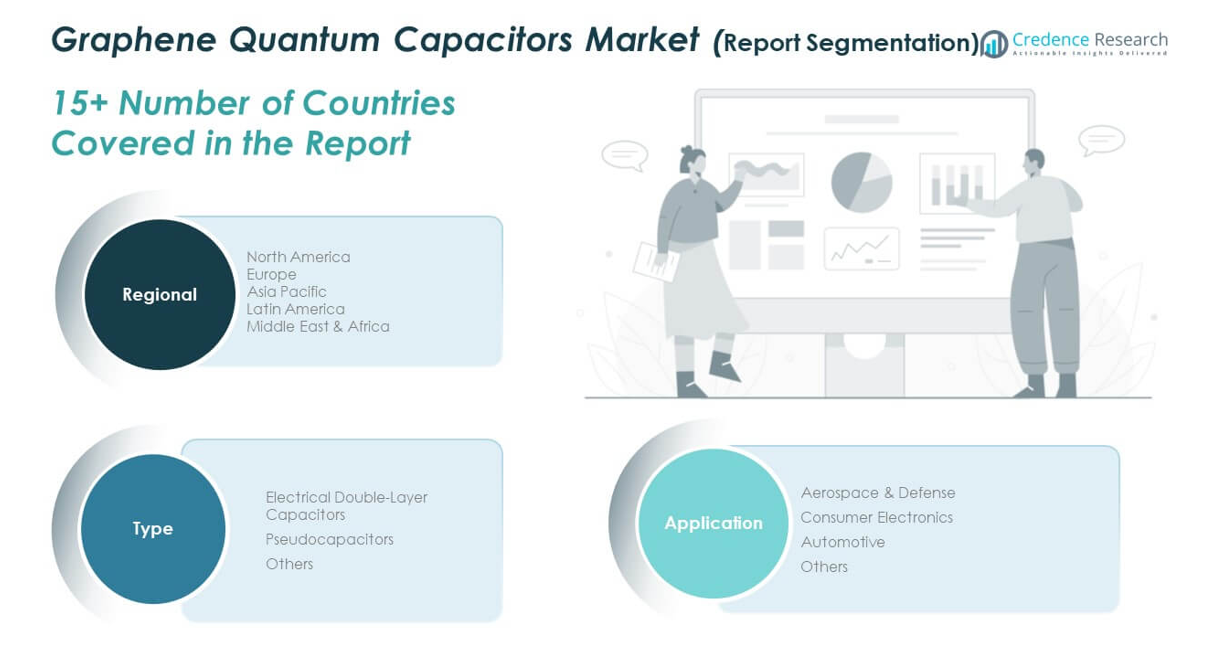
The Graphene Quantum Capacitors Market is segmented
By type into Electrical Double Layer Capacitors, Pseudocapacitors, and Others. Electrical Double Layer Capacitors dominate the market due to their superior power density, fast charge-discharge capabilities, and longer cycle life. Pseudocapacitors are gaining momentum in high-energy applications, leveraging faradaic charge transfer mechanisms to deliver enhanced energy density. The “Others” category includes hybrid capacitors and experimental technologies that combine features of both primary types and cater to emerging niche applications.
- For instance, HydroGraph Clean Power Inc.developed FGA-1 fractal graphene for hybrid supercapacitors, achieving 4x the performance of activated carbon in third-party tests by Volfpack Energy. This hybrid approach blends EDLC and pseudocapacitive mechanisms.
By application, the market is divided into Aerospace & Defense, Consumer Electronics, Automotive, and Others. The Graphene Quantum Capacitors Market sees strong adoption in aerospace and defense due to its ability to deliver high-performance energy storage in compact and durable formats. Consumer electronics represent a rapidly expanding segment as manufacturers seek fast-charging and space-efficient power sources. The automotive sector benefits from the integration of graphene capacitors in electric vehicles for quick energy bursts and regenerative braking systems. Other applications include industrial tools and portable medical devices requiring compact and reliable energy storage.
- For instance, Skeleton Technologies supplies graphene-based ultracapacitors for regenerative braking systems in hybrid and electric buses, including deployments with Škoda Electric. These ultracapacitors enable rapid energy capture during braking and discharge during acceleration, improving energy efficiency and reducing strain on battery systems.
Segmentation:
By Type:
- Electrical Double‑Layer Capacitors
- Pseudocapacitors
- Others
By Application:
- Aerospace & Defense
- Consumer Electronics
- Automotive
- Others
By Region:
- North America
- U.S.
- Canada
- Mexico
- Europe
- Germany
- France
- U.K.
- Italy
- Spain
- Rest of Europe
- Asia Pacific
- China
- Japan
- India
- South Korea
- South-east Asia
- Rest of Asia Pacific
- Latin America
- Brazil
- Argentina
- Rest of Latin America
- Middle East & Africa
- GCC Countries
- South Africa
- Rest of the Middle East and Africa
Regional Analysis:
The North America Graphene Quantum Capacitors Market size was valued at USD 21.64 million in 2018 to USD 59.42 million in 2024 and is anticipated to reach USD 186.13 million by 2032, at a CAGR of 15.30% during the forecast period. North America holds a significant share in the Graphene Quantum Capacitors Market, driven by advanced R&D infrastructure, strong industrial adoption, and robust defense applications. It accounts for nearly 26.5% of the global market in 2024, reflecting a consistent trend of technological leadership and early adoption. The United States leads with innovations backed by both public funding and private investments across aerospace, electronics, and energy sectors. Graphene-based storage solutions are being explored for grid applications, wearables, and electric vehicles. Companies in the region are actively filing patents and commercializing prototypes at a faster pace. The growing interest in quantum-enabled technologies will further support long-term regional dominance.
The Europe Graphene Quantum Capacitors Market size was valued at USD 23.91 million in 2018 to USD 64.30 million in 2024 and is anticipated to reach USD 195.88 million by 2032, at a CAGR of 14.90% during the forecast period. Europe commands roughly 28.6% of the global market share in 2024, supported by the EU’s strategic focus on graphene commercialization and sustainability goals. The Graphene Quantum Capacitors Market benefits from institutional funding and collaborative projects under the EU’s Graphene Flagship initiative. Countries like Germany, France, and the UK lead in industrial integration, particularly in automotive, renewable energy, and aerospace sectors. European manufacturers are prioritizing low-carbon and recyclable materials, which aligns with the eco-friendly profile of graphene. The region’s well-regulated environment also accelerates technology standardization and certification. Market growth will continue as more industries adopt quantum capacitor solutions to meet energy efficiency and environmental standards.
The Asia Pacific Graphene Quantum Capacitors Market size was valued at USD 38.64 million in 2018 to USD 109.17 million in 2024 and is anticipated to reach USD 354.54 million by 2032, at a CAGR of 15.80% during the forecast period. Asia Pacific holds the largest share in the Graphene Quantum Capacitors Market, contributing nearly 48.5% of global revenue in 2024. China, South Korea, Japan, and India are driving regional momentum through manufacturing expansion, favorable policies, and increased R&D funding. It is witnessing rapid adoption in consumer electronics, electric vehicles, and energy storage infrastructure. Companies in this region are scaling graphene production capacity to reduce costs and improve commercial viability. Strong government backing and access to large domestic markets give the region a strategic advantage. Continued investment in innovation and infrastructure will maintain its lead through the forecast period.
The Latin America Graphene Quantum Capacitors Market size was valued at USD 6.27 million in 2018 to USD 15.89 million in 2024 and is anticipated to reach USD 44.32 million by 2032, at a CAGR of 13.60% during the forecast period. Latin America represents a smaller but steadily growing portion of the Graphene Quantum Capacitors Market, accounting for 6.8% of global market share in 2024. Brazil and Mexico lead regional activity, focusing on automotive components, industrial tools, and early-stage clean tech applications. The market is driven by localized research collaborations and the adoption of lightweight, high-performance materials in niche industries. Limited infrastructure and higher technology costs currently restrict broader uptake. However, pilot projects and academic partnerships are helping build foundational capabilities. Growth prospects remain positive with increased attention toward renewable integration and electric mobility in urban centers.
The Middle East Graphene Quantum Capacitors Market size was valued at USD 8.94 million in 2018 to USD 24.51 million in 2024 and is anticipated to reach USD 76.58 million by 2032, at a CAGR of 15.30% during the forecast period. The Middle East holds a moderate share of the global Graphene Quantum Capacitors Market at 10.9% in 2024, reflecting its focus on advanced energy solutions and industrial diversification. Countries such as the UAE and Saudi Arabia are investing in cutting-edge technologies through national innovation agendas. It benefits from growing interest in smart city projects, grid modernization, and sustainable construction. Universities and research centers in the region are collaborating with global partners to enhance graphene material capabilities. The availability of capital and strategic focus on non-oil sectors provide favorable conditions for market growth. It is expected to expand further with rising investments in advanced mobility and aerospace systems.
The Africa Graphene Quantum Capacitors Market size was valued at USD 5.04 million in 2018 to USD 11.85 million in 2024 and is anticipated to reach USD 28.90 million by 2032, at a CAGR of 11.70% during the forecast period. Africa accounts for the smallest share in the Graphene Quantum Capacitors Market, contributing only 5.2% of global revenue in 2024. The market remains at an early developmental stage, with limited industrial adoption and infrastructure. South Africa leads regional activity, supported by research institutions and university-led pilot projects in energy and mining applications. It faces challenges related to cost, supply chain access, and technical skill availability. Despite these constraints, interest in renewable energy systems and off-grid storage is growing. With proper investment and policy alignment, Africa holds potential for long-term niche adoption.
Key Player Analysis:
- SPEL Technologies Private Limited
- Infineon Technologies AG
- Fuji Electric Co., Ltd.
- Skeleton Technologies
- Shenzhen CRC New Energy Co., Ltd.
- Other Key Players
Competitive Analysis:
The Graphene Quantum Capacitors Market features a competitive landscape characterized by innovation-driven strategies and early-stage collaborations. Key players focus on research partnerships, patent development, and pilot-scale manufacturing to secure technological leadership. It remains dominated by a mix of specialized nanomaterials firms, advanced capacitor manufacturers, and university spin-offs. Companies are investing in scalable production methods and application-specific prototypes for sectors such as aerospace, electric vehicles, and consumer electronics. The market sees continuous entry of startups leveraging graphene’s unique properties to disrupt traditional capacitor formats. Established corporations often partner with academic institutions to accelerate commercialization timelines and improve material consistency. Competitive advantage hinges on fabrication precision, quantum performance optimization, and integration with existing energy systems. As commercialization progresses, players with strong IP portfolios, cost-effective manufacturing, and multi-industry adaptability are expected to gain market share and drive product standardization across applications.
Recent Developments:
- In May 2025, Infineon Technologies AG launched a new family of radiation-hardened Gallium Nitride (GaN) transistors, including one of the first devices certified to the DLA JANS standard for use in harsh space environments. These transistors, based on Infineon's CoolGan™ technology, are designed for mission-critical applications in space vehicles and deep space probes, offering high efficiency and reliability.
- In May 2025, Skeleton Technologies launched GrapheneGPU, a high-performance energy storage and optimization system designed specifically for AI data centers. Utilizing Skeleton’s proprietary Curved Graphene material, GrapheneGPU reduces AI energy consumption by up to 45% and lowers power connection requirements by 44%, while boosting computing performance by 40%.
- In January 2023, SPEL Technologies Private Limited signed a Memorandum of Understanding (MoU) with Neutrino Energy Group GmbH (Germany) to jointly develop the ambitious Self-Charging Pi-Car Project, with a proposed investment of €2.5 billion by Neutrino Energy Group. This partnership aims to leverage SPEL’s advanced supercapacitor and battery technologies for next-generation energy storage solutions.
Market Concentration & Characteristics:
The Graphene Quantum Capacitors Market is moderately concentrated, with a small number of specialized players leading early-stage development and commercialization. It is characterized by high R&D intensity, limited large-scale manufacturing, and strong reliance on academic and institutional research collaborations. Most participants operate in niche segments, targeting high-performance applications in aerospace, defense, and advanced electronics. The market emphasizes innovation, proprietary technologies, and material quality over volume production. Entry barriers remain high due to complex fabrication processes, limited raw material scalability, and the need for precision engineering. It continues to evolve rapidly, shaped by advancements in quantum materials science and growing demand for compact, energy-dense storage solutions.
Report Coverage:
The research report offers an in-depth analysis based on type and application. It details leading market players, providing an overview of their business, product offerings, investments, revenue streams, and key applications. Additionally, the report includes insights into the competitive environment, SWOT analysis, current market trends, as well as the primary drivers and constraints. Furthermore, it discusses various factors that have driven market expansion in recent years. The report also explores market dynamics, regulatory scenarios, and technological advancements that are shaping the industry. It assesses the impact of external factors and global economic changes on market growth. Lastly, it provides strategic recommendations for new entrants and established companies to navigate the complexities of the market.
Future Outlook:
- Demand for compact, high-efficiency energy storage will drive wider adoption across electronics and mobility sectors.
- Ongoing advancements in graphene synthesis techniques will reduce production costs and enhance scalability.
- Increased integration with electric vehicle architectures will create new commercial opportunities.
- Strategic collaborations between research institutions and industry players will accelerate technology validation.
- Growth in renewable energy installations will support deployment in grid stabilization and power buffering.
- Government funding and policy support in key regions will strengthen commercialization pathways.
- Emergence of standardized testing protocols will improve reliability and promote industry-wide confidence.
- Expansion into defense and aerospace applications will diversify end-use markets.
- Rising interest in quantum computing and next-gen electronics will open specialized use cases.
- Market competition will intensify as new entrants introduce disruptive innovations and scalable solutions.

Request a Free Sample
Fill in your details and we'll send you a free sample report.
- Sample data tables & charts
- Research methodology
Market Dynamics
Emerging Demand for High-Performance Energy Storage Solutions
Graphene quantum capacitors offer superior energy density, rapid charge-discharge cycles, and long cycle life, making them highly attractive for sectors like aerospace, defense, and electric mobility where reliability and efficiency are critical. Their ability to outperform traditional capacitors and batteries is driving adoption in mission-critical and high-frequency applications.
Expansion of Electric Vehicles and Smart Consumer Devices
The proliferation of electric vehicles, hybrid systems, and advanced consumer electronics is fueling demand for compact, fast-charging, and thermally stable energy storage. Graphene quantum capacitors enable manufacturers to deliver longer-lasting, high-performance products that meet the evolving needs of mobility and portable technology markets.
Growing Investments in Research and Development Activities
Significant government and private sector investments in R&D, including initiatives like the EU’s Graphene Flagship and national programs in the U.S., China, and India, are accelerating the commercialization of graphene quantum capacitors. These efforts are improving material quality, reducing costs, and enabling integration into a wider range of applications.
Rising Focus on Sustainability and Grid Integration
The global shift toward clean energy and grid modernization is increasing the need for advanced, environmentally friendly energy storage solutions. Graphene quantum capacitors, with their long operational life and low environmental impact, are being adopted in renewable energy systems and smart grids for load balancing and peak shaving.
Advancements in Graphene Synthesis and Manufacturing Scalability
Ongoing technological progress in graphene production methods is gradually reducing costs and improving scalability, making high-quality graphene more accessible for commercial capacitor manufacturing. These advancements are critical for enabling large-scale adoption across automotive, electronics, and industrial sectors.
Need a Custom Version of This Report?
Tailor the scope, geography, or segments to your exact requirements.
- Custom geography or segment scope
- Direct access to our analyst team
Frequently Asked Questions
What is the current size of the Graphene Quantum Capacitors Market?
What are the key segments within the Graphene Quantum Capacitors Market?
What are some challenges faced by the Graphene Quantum Capacitors Market?
Who are the major players in the Graphene Quantum Capacitors Market?
Table of Content
Chapter 1 Market Segmentation
- 1.1 Segmentation Framework
- 1.1.1 Product and Service Classification
- 1.1.2 Application and End-Use Classification
- 1.1.3 Technology and Solution Classification
- 1.1.4 Customer and Distribution Channel Classification
- 1.1.5 Geographic Segmentation
- 1.1.6 Market Segment Definitions and Boundaries
- 1.2 By Type
- 1.2.1 Electrical Double‑Layer Capacitors
- 1.2.2 Pseudocapacitors
- 1.2.3 Others
- 1.3 By Application
- 1.3.1 Aerospace & Defense
- 1.3.2 Consumer Electronics
- 1.3.3 Automotive
- 1.3.4 Others
Chapter 2 Introduction
- 2.1 Report Objectives and Scope
- 2.2 Product Definition and Industry Terminology
- 2.3 Market Inclusions and Exclusions
- 2.4 Research Process
- 2.4.1 Primary Research and Expert Interviews
- 2.4.2 Secondary Research and Source Review
- 2.4.3 Top-Down and Bottom-Up Estimation
- 2.4.4 Data Triangulation and Verification
- 2.5 Market Size Measurement Basis
- 2.5.1 2024: USD 285.1 million → 2032: USD 886.4 million
- 2.6 Historical and Forecast Reference Periods
- 2.6.1 Base Year: 2024
- 2.6.2 Forecast Period: 2024-2032
- 2.7 Research Assumptions and Limitations
Chapter 3 Executive Summary
- 3.1 Market Snapshot and Key Findings
- 3.2 Base-Year Market Size, 2024
- 3.3 Forecast Market Size, 2032
- 3.4 Revenue and Volume Growth Outlook
- 3.5 Key Demand and Supply Indicators
- 3.6 Leading Market Segments
- 3.7 Fastest-Growing Market Opportunities
- 3.8 Regional Performance Highlights
- 3.9 Technology and Industry Transformation
- 3.10 Competitive Landscape Summary
- 3.11 Analyst View and Strategic Implications
Chapter 4 Global Graphene Quantum Capacitors Market Trends and Developments
- 4.1 Historical Industry Development
- 4.2 Recent Market Trends and Developments
- 4.3 Demand and Customer Behavior Trends
- 4.4 Technology and Product Innovation
- 4.5 Artificial Intelligence, Automation and Digitalization
- 4.6 Local Manufacturing and Supply Chain Realignment
- 4.7 Industry Partnerships, Mergers and Acquisitions
- 4.8 Sustainability and Circular Economy Developments
- 4.9 Government and Private Sector Investment Trends
- 4.10 Emerging Business Models and Commercialization
- 4.11 Industry Developments and Announcements
Chapter 5 Global Graphene Quantum Capacitors Market Production, Supply and Demand Analysis
- 5.1 Demand Trend and Consumption Analysis
- 5.2 Demand Forecast, 2024-2032
- 5.3 Production and Output Trend
- 5.4 Production and Output Forecast, 2024-2032
- 5.5 Installed Capacity and Capacity Utilization
- 5.6 Company-Wise Production Plants and Statistics
- 5.6.1 Installed Production Capacity
- 5.6.2 Actual Production
- 5.6.3 Planned Capacity and Expansion Targets
- 5.7 Supply Chain Structure and Procurement Trends
- 5.8 Supply-Demand Gap and Bottlenecks
- 5.9 Import Dependence and Sourcing Structure
- 5.10 Contract Manufacturing and Outsourcing
- 5.11 Regional Supply and Demand Concentration
Chapter 6 Global Graphene Quantum Capacitors Market Pricing Analysis
- 6.1 Pricing Structure and Measurement
- 6.2 Historical Pricing Trends
- 6.3 Pricing Outlook, 2024-2032
- 6.4 Average Selling Price and Unit Economics
- 6.5 Pricing by Product and Market Segment
- 6.6 Geographic Pricing Differences
- 6.7 Key Input, Energy, Labor and Logistics Costs
- 6.8 Contract Pricing and Purchasing Models
- 6.9 Pricing Sensitivity and Competitive Positioning
- 6.10 Price, Margin and Profitability Implications
Chapter 7 Global Graphene Quantum Capacitors Market Dynamics
- 7.1 Market Growth Drivers
- 7.1.1 Demand-Side Drivers
- 7.1.2 Technology and Innovation Drivers
- 7.1.3 Infrastructure and Investment Drivers
- 7.1.4 Regulatory and Policy Drivers
- 7.2 Market Restraints
- 7.2.1 Cost and Affordability Constraints
- 7.2.2 Technology and Adoption Barriers
- 7.2.3 Supply Chain and Operational Constraints
- 7.3 Market Challenges
- 7.3.1 Competitive Pressure and Margin Erosion
- 7.3.2 Skills, Infrastructure and Implementation Gaps
- 7.4 Emerging Market Opportunities
- 7.5 Market Dynamics Impact and Time-Horizon Assessment
Chapter 8 Global Graphene Quantum Capacitors Value Chain Analysis
- 8.1 Industry Value Chain Overview
- 8.2 Upstream Suppliers and Critical Inputs
- 8.3 Technology and Component Providers
- 8.4 Manufacturing or Service Delivery
- 8.5 Distribution, Channel Partners and Integrators
- 8.6 Downstream Applications and End Users
- 8.7 Value Addition and Profit Pools
- 8.8 Vertical Integration and Outsourcing
- 8.9 Supplier Concentration and Risk
- 8.10 Supply Chain Localization and Resilience
Chapter 9 Global Graphene Quantum Capacitors Market Regulations and Policies
- 9.1 Relevant Laws, Standards and Compliance Frameworks
- 9.2 Product, Service, Safety and Quality Requirements
- 9.3 Government Policies, Incentives and Subsidies
- 9.4 Imports, Exports and Trade Barriers
- 9.5 Public Procurement and Local Content Requirements
- 9.6 Environmental and Sustainability Compliance
- 9.7 Upcoming Policy Changes and Market Implications
Chapter 10 Global Graphene Quantum Capacitors Market Hotspots and Opportunities
- 10.1 Market Opportunity Mapping and Growth Hotspots
- 10.2 High-Growth Applications and Customer Groups
- 10.3 Underserved Markets and White-Space Opportunities
- 10.4 Emerging Technology and Product Opportunities
- 10.5 New Capacity and Investment Hotspots
- 10.6 Market Entry and Expansion Opportunities
- 10.7 Distribution and Partnership Opportunities
- 10.8 Near-Term and Long-Term Commercial Potential
- 10.9 Opportunity Attractiveness and Execution Risks
Chapter 11 Global Graphene Quantum Capacitors Market Outlook, 2024-2032
- 11.1 Market Size and Analysis
- 11.1.1 Revenue (Market Measurement: 2024: USD 285.1 million → 2032: USD 886.4 million)
- 11.1.2 Market Volume and Quantity Sold
- 11.1.3 Historical Market Size
- 11.1.4 Base-Year Market Size, 2024
- 11.2 Market Forecast, 2024-2032
- 11.2.1 Revenue Forecast to 2032
- 11.2.2 Volume Forecast to 2032
- 11.2.3 CAGR and Year-on-Year Growth
- 11.2.4 Incremental Revenue Opportunity
- 11.3 Forecast Assumptions and Scenario Analysis
- 11.3.1 Base-Case Forecast
- 11.3.2 Optimistic and Conservative Scenarios
- 11.3.3 Technology, Pricing and Policy Sensitivities
- 11.4 Market Attractiveness and Growth Outlook
Chapter 12 Global Graphene Quantum Capacitors Market Segmentation and Outlook
- 12.1 Segmentation Summary and Market Shares, 2024
- 12.2 Largest and Fastest-Growing Segments
- 12.3 By Type - Market Size and Forecast, 2024-2032
- 12.3.1 Segment Definition and Scope
- 12.3.2 Historical Market Size
- 12.3.3 Revenue Forecast, 2024-2032
- 12.3.4 Volume Forecast, 2024-2032
- 12.3.5 Base-Year Market Share, 2024
- 12.3.6 Segment CAGR and Growth Drivers
- 12.3.7 Subsegment Market Size and Forecast
- 12.3.7.1 Electrical Double‑Layer Capacitors
- 12.3.7.2 Pseudocapacitors
- 12.3.7.3 Others
- 12.3.8 Subsegment Pricing and Adoption Trends
- 12.3.9 Leading Suppliers and Competition
- 12.3.10 Regional Demand and Opportunities
- 12.4 By Application - Market Size and Forecast, 2024-2032
- 12.4.1 Segment Definition and Scope
- 12.4.2 Historical Market Size
- 12.4.3 Revenue Forecast, 2024-2032
- 12.4.4 Volume Forecast, 2024-2032
- 12.4.5 Base-Year Market Share, 2024
- 12.4.6 Segment CAGR and Growth Drivers
- 12.4.7 Subsegment Market Size and Forecast
- 12.4.7.1 Aerospace & Defense
- 12.4.7.2 Consumer Electronics
- 12.4.7.3 Automotive
- 12.4.7.4 Others
- 12.4.8 Subsegment Pricing and Adoption Trends
- 12.4.9 Leading Suppliers and Competition
- 12.4.10 Regional Demand and Opportunities
- 12.5 Segment Growth Comparison
- 12.6 Segment Attractiveness and Priority Matrix
Chapter 13 Global Graphene Quantum Capacitors End-Use and Application Market Outlook
- 13.1 End-Use Industry and Customer Demand Structure
- 13.2 Leading Applications and Customer Groups
- 13.3 End-Use Market Size, Share and Forecast
- 13.4 Major End-Use Industry Deep Dives
- 13.4.1 Customer Requirements and Use Cases
- 13.4.2 Demand and Replacement Cycles
- 13.4.3 Technical and Regulatory Considerations
- 13.4.4 Purchasing and Procurement Models
- 13.4.5 Leading Vendors and Distribution Channels
- 13.4.6 Forecast and Commercial Opportunities
- 13.5 Emerging Applications and Cross-Segment Demand
- 13.6 End-Use Industry Investment Priorities
Chapter 14 Global Graphene Quantum Capacitors Geographic Market Outlook, 2024-2032
- 14.1 Regional Market Size and Share, 2024
- 14.2 Regional Market Forecast, 2024-2032
- 14.3 Regional Pricing, Production and Demand Differences
- 14.4 North America
- 14.4.1 United States
- 14.4.2 Canada
- 14.4.3 Mexico
- 14.5 Europe
- 14.5.1 Germany
- 14.5.2 France
- 14.5.3 Italy
- 14.5.4 United Kingdom
- 14.5.5 Spain
- 14.5.6 Poland
- 14.5.7 Russia
- 14.5.8 Netherlands
- 14.5.9 Belgium
- 14.5.10 Sweden
- 14.5.11 Denmark
- 14.5.12 Norway
- 14.5.13 Rest of Europe
- 14.6 Asia Pacific
- 14.6.1 China
- 14.6.2 India
- 14.6.3 Japan
- 14.6.4 South Korea
- 14.6.5 Thailand
- 14.6.6 Indonesia
- 14.6.7 Vietnam
- 14.6.8 Malaysia
- 14.6.9 Australia
- 14.6.10 Rest of Asia Pacific
- 14.7 Latin America
- 14.7.1 Brazil
- 14.7.2 Argentina
- 14.7.3 Colombia
- 14.7.4 Chile
- 14.7.5 Rest of Latin America
- 14.8 Middle East
- 14.8.1 Saudi Arabia
- 14.8.2 United Arab Emirates
- 14.8.3 Turkey
- 14.8.4 Israel
- 14.8.5 Iran
- 14.8.6 Rest of the Middle East
- 14.9 Africa
- 14.9.1 South Africa
- 14.9.2 Egypt
- 14.9.3 Nigeria
- 14.9.4 Morocco
- 14.9.5 Rest of Africa
- 14.10 Regional Investment, Policy and Supply Chain Differences
- 14.11 Regional Competitive Landscape
- 14.12 Geographic Growth Hotspots
Chapter 15 Global Graphene Quantum Capacitors Technology, Innovation and Sustainability Outlook
- 15.1 Technology Landscape and Maturity
- 15.2 Product, Process and Service Innovation
- 15.3 AI, Automation and Digital Tools in the Industry
- 15.4 Technology Adoption and Performance Benchmarking
- 15.5 Innovation Pipeline and R&D Investment
- 15.6 Patent and Intellectual Property Trends
- 15.7 Energy Efficiency and Resource Management
- 15.8 Sustainability, Recycling and Circularity
- 15.9 Technology Roadmap, 2024-2032
- 15.10 Risks of Obsolescence and Technology Substitution
Chapter 16 Global Graphene Quantum Capacitors Market Key Strategic Imperatives
- 16.1 Growth and Market Entry Priorities
- 16.2 High-Return Products and Segments
- 16.3 Pricing, Profitability and Cost Optimization
- 16.4 Technology Investment and Product Differentiation
- 16.5 Supply Chain Localization and Resilience
- 16.6 Distribution and Customer Acquisition
- 16.7 Partnership, Acquisition and Capacity Strategy
- 16.8 Regional Expansion Priorities
- 16.9 Short-, Medium- and Long-Term Actions
Chapter 17 Competition Outlook
- 17.1 Industry Competition Characteristics
- 17.2 Market Structure and Concentration
- 17.3 Market Share and Competitive Positioning, 2024
- 17.4 Company-Wise Revenue and Product Benchmarking
- 17.5 Production and Service Capacity Benchmarking
- 17.6 Technology, Pricing and Differentiation
- 17.7 Regional Footprint and Distribution Strength
- 17.8 Mergers, Acquisitions and Strategic Alliances
- 17.9 New Entrants and Competitive Threats
- 17.10 Porter's Five Forces and Industry Attractiveness
- 17.11 Competitive Outlook, 2024-2032
Chapter 18 Company Profiles
- 18.1 Company Coverage and Selection Criteria
- 18.2 SPEL Technologies Private Limited
- 18.2.1 Business Description
- 18.2.2 Company Ownership and Geographic Presence
- 18.2.3 Product and Service Portfolio
- 18.2.4 Manufacturing and Operating Footprint
- 18.2.5 Production Capacity and Expansion Plans
- 18.2.6 Financial Performance and Investment
- 18.2.7 Market Share and Competitive Position
- 18.2.8 Technology and Innovation Capabilities
- 18.2.9 Strategic Alliances or Partnerships
- 18.2.10 Recent Developments
- 18.2.11 Growth Strategy and Outlook
- 18.3 Infineon Technologies AG
- 18.4 Fuji Electric Co., Ltd.
- 18.5 Skeleton Technologies
- 18.6 Shenzhen CRC New Energy Co., Ltd.
- 18.7 First Graphene Ltd.
- 18.8 HydroGraph Clean Power Inc.
- 18.9 Paragraf
- 18.10 Volfpack Energy
- 18.11 Maxwell Technologies (a Tesla company)
- 18.12 Other Relevant Market Participants
Note: Every listed company is profiled on the structure shown under the first company. The company list is preliminary and may change based on research findings, market developments, data availability and client requirements.
Chapter 19 Disclaimer
- 19.1 Research and Forecast Disclaimer
- 19.2 Data Source and Estimation Limitations
Note: The depth of individual sections depends on data availability for this market. Volume, capacity, trade and other unit-based metrics are included where applicable.