
| REPORT ATTRIBUTE | DETAILS |
|---|---|
| Historical Period | 2020-2023 |
| Base Year | 2024 |
| Forecast Period | 2025-2032 |
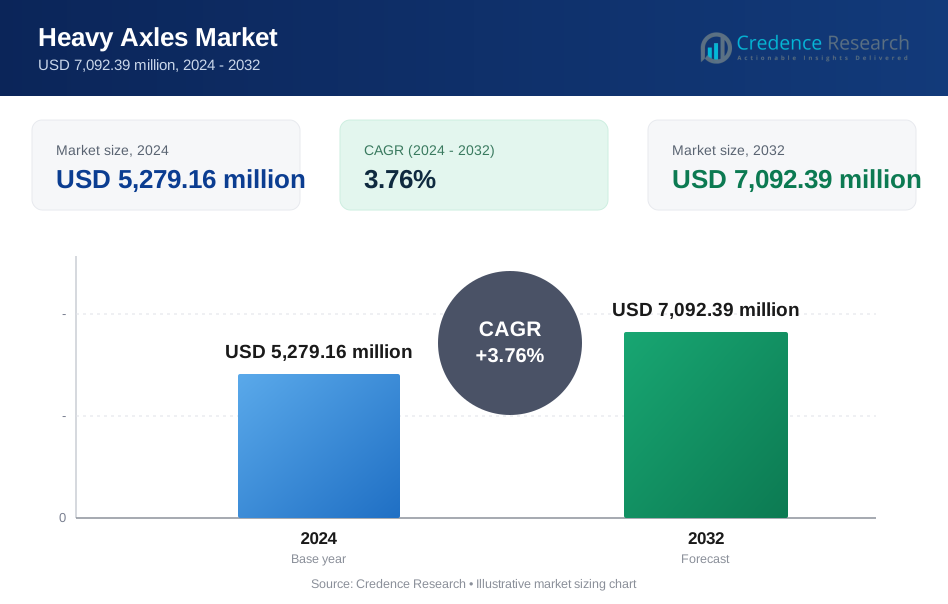
| Heavy Axles Market Size 2024 | USD 5,279.16 million |
| Heavy Axles Market, CAGR | 3.76% |
| Heavy Axles Market Size 2032 | USD 7,092.39 million |
Market Overview
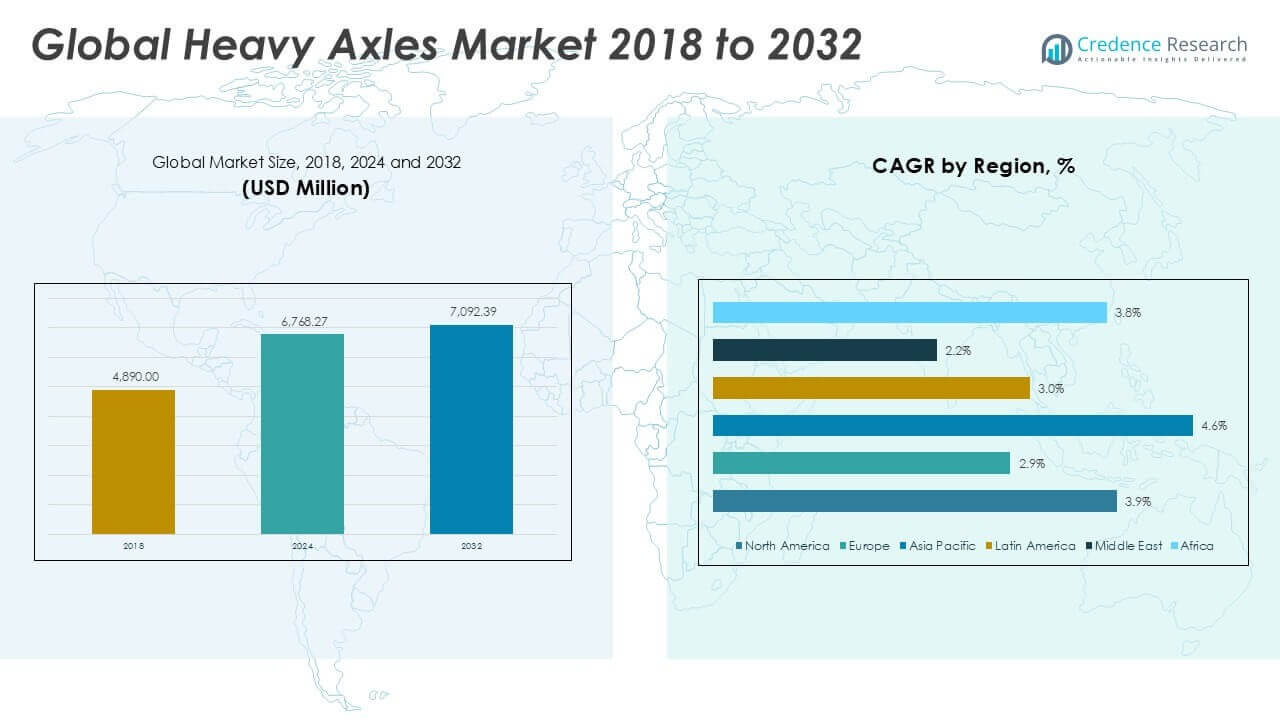
The Global Heavy Axles Market is projected to grow from USD 5,279.16 million in 2024 to an estimated USD 7,092.39 million by 2032, registering a compound annual growth rate (CAGR) of 3.76% from 2025 to 2032.
Key drivers of the Heavy Axles Market include the growing demand for fuel-efficient and heavy-duty vehicles that require robust axle systems to support heavier loads and improve safety. Trends show a shift toward the integration of lightweight materials such as high-strength steel and aluminum alloys to reduce vehicle weight and improve fuel efficiency. Additionally, advancements in axle technology, including improved suspension and braking systems, are gaining traction. Regulatory mandates focused on vehicle safety and emissions further push manufacturers to innovate and adopt more efficient heavy axle solutions.
Geographically, North America and Europe hold significant shares in the Heavy Axles Market, driven by well-established automotive industries and stringent safety regulations. The Asia Pacific region is expected to witness the fastest growth, fueled by rapid urbanization, infrastructure projects, and rising vehicle production in countries like China and India. Key players dominating this market include Meritor, Dana Incorporated, JTEKT Corporation, ZF Friedrichshafen AG, and Hyundai Wia Corporation, who continuously focus on product innovation and strategic partnerships to strengthen their market presence globally.
Market Insights
- The Global Heavy Axles Market is projected to grow steadily from USD 5,279.16 million in 2024 to USD 7,092.39 million by 2032, with a CAGR of 3.76%.
- Rising industrialization and expanding logistics sectors increase demand for durable heavy axles in trucks, trailers, and off-road vehicles.
- Growing emphasis on fuel efficiency and safety drives adoption of lightweight materials such as high-strength steel and aluminum alloys.
- Regulatory mandates on vehicle emissions and safety compel manufacturers to innovate axle designs and integrate advanced braking and suspension systems.
- North America and Europe dominate the market due to mature automotive industries and strict regulations, maintaining significant regional shares.
- Asia Pacific is the fastest-growing region, supported by rapid urbanization, infrastructure development, and increased heavy vehicle production in China and India.
- Market challenges include fluctuating raw material costs and compliance with evolving regulations, which affect manufacturing expenses and product development cycles.
Market Drivers
Increasing Demand for Heavy-Duty Vehicles in Logistics and Construction Industries
The rising need for heavy-duty vehicles in logistics, construction, and mining sectors strongly drives the Global Heavy Axles Market. Growing industrial activities and infrastructure development require trucks and trailers capable of carrying heavier loads safely and efficiently. Heavy axles provide the necessary strength and durability to support these demanding applications, boosting their adoption. Expansion of e-commerce and transportation networks further increases fleet sizes, intensifying demand for reliable axle systems. Manufacturers continue to improve axle designs to enhance load capacity and vehicle performance. This increased utilization of heavy vehicles creates a consistent market pull for advanced axle solutions.
- For instance, unit sales in the heavy commercial vehicles market in India reached 376,060 vehicles in 2025, reflecting the growing demand for logistics and construction applications.
Advancements in Material Technology Enhancing Axle Performance and Efficiency
Innovations in material science significantly impact the Global Heavy Axles Market by enabling production of lighter, stronger axle components. Use of high-strength steel, aluminum alloys, and composite materials reduces overall vehicle weight while maintaining structural integrity. Lighter axles improve fuel efficiency and reduce emissions in heavy vehicles, aligning with global sustainability goals. It also enhances vehicle maneuverability and extends component lifespan, reducing maintenance costs. These material advancements encourage manufacturers to develop new axle models that meet stricter regulatory standards and customer expectations for durability and efficiency.
- For instance, advancements in axle materials have led to weight reductions of up to 30%, improving fuel efficiency and vehicle performance in commercial applications
Implementation of Stringent Safety and Emission Regulations Driving Product Innovation
Governments worldwide enforce stringent safety and emission regulations that influence the Global Heavy Axles Market dynamics. Regulations require heavy vehicles to meet specific standards for load handling, braking performance, and environmental impact. It motivates manufacturers to innovate axle designs integrating advanced braking systems and lightweight materials to comply with these rules. Enhanced safety features contribute to accident reduction and operational reliability, increasing demand for compliant axle products. The regulatory pressure fosters continuous research and development, accelerating the introduction of next-generation heavy axle solutions.
Growth of Emerging Markets and Infrastructure Development Expanding Vehicle Fleet Demand
Rapid urbanization and industrialization in emerging economies fuel the Global Heavy Axles Market growth by increasing heavy vehicle production and usage. Countries in Asia Pacific, Latin America, and Africa invest heavily in road construction, mining, and logistics infrastructure, necessitating robust transportation solutions. This expansion creates demand for heavy axles capable of withstanding challenging terrain and harsh operating conditions. It prompts local and international manufacturers to expand production capacities and tailor products for regional requirements. The growing fleet sizes in these regions represent significant opportunities for market players to increase their footprint and revenue.
Market Trends
Emerging Trend of Lightweight Materials to Improve Vehicle Efficiency
The Global Heavy Axles Market shows a clear trend toward the adoption of lightweight materials to enhance vehicle performance and fuel efficiency. Manufacturers increasingly use high-strength steel, aluminum alloys, and composite materials to reduce axle weight without compromising durability. It enables heavy vehicles to carry larger payloads while lowering fuel consumption and emissions. This shift supports compliance with environmental regulations and meets customer demand for cost-effective, sustainable solutions. Development of new fabrication techniques helps integrate these materials efficiently into axle production. The trend promotes innovation in axle design and encourages partnerships between material suppliers and axle manufacturers.
- For instance, a study on drive axle housing for Steyr heavy trucks found that using high-strength steel and optimized fabrication techniques reduced axle weight while maintaining durability, leading to improved fuel efficiency.
Growing Integration of Advanced Suspension and Braking Technologies
The Global Heavy Axles Market experiences a strong focus on integrating advanced suspension and braking systems within axle assemblies. Innovations such as electronic braking, air suspension, and adaptive dampers improve vehicle safety and ride quality. It allows better load distribution, reduces wear on components, and enhances overall driving stability. Manufacturers incorporate smart sensors and control systems to optimize axle performance under varying road and load conditions. This technological trend supports regulatory compliance and offers fleet operators improved operational efficiency. Continuous development in this area drives the adoption of more sophisticated axle solutions worldwide.
- For instance, electronic stability control and adaptive damping technologies have been increasingly integrated into commercial heavy vehicles to enhance load distribution and driving stability, as highlighted in industry reviews on next-generation automotive suspension.
Increasing Adoption of Modular Axle Systems for Versatility and Maintenance Ease
Modular axle systems gain traction in the Global Heavy Axles Market due to their flexibility and ease of maintenance. It allows manufacturers and fleet operators to customize axle configurations according to specific vehicle requirements and applications. Modular designs simplify repair and replacement processes, minimizing downtime and reducing operating costs. This approach enhances the adaptability of heavy vehicles across diverse industries such as construction, mining, and transportation. Growing demand for cost-efficient fleet management supports the rise of modular axle adoption. Market players invest in research to expand modular offerings with improved compatibility and performance.
Expansion of Aftermarket Services and Digital Solutions to Enhance Customer Support
The Global Heavy Axles Market witnesses increased focus on aftermarket services and digital solutions to strengthen customer relationships and optimize asset management. Providers offer predictive maintenance, remote diagnostics, and real-time monitoring to detect potential failures early and schedule timely repairs. It improves vehicle uptime and reduces unexpected breakdowns, which is crucial for heavy vehicle operations. Digital platforms enable better inventory management and faster service response. The trend encourages manufacturers and service providers to invest in technology-driven support systems. Enhanced aftermarket offerings boost customer satisfaction and create new revenue streams for market participants.
Market Challenges
High Production Costs and Raw Material Price Volatility Affecting Market Profitability
The Global Heavy Axles Market faces significant challenges due to high production costs and fluctuating raw material prices. Manufacturing heavy axles requires specialized materials such as high-strength steel and advanced alloys, which often experience price volatility. It increases overall production expenses and affects profit margins for manufacturers. The need to balance cost with quality and durability puts pressure on companies to optimize their supply chains and manufacturing processes. Small and medium-sized manufacturers may struggle to absorb these costs, limiting their competitiveness. This financial strain could slow innovation and expansion in some regions.
- For instance, the heavy axles market saw the introduction of over 10 advanced axle designs in recent years, aimed at improving durability and reducing manufacturing costs
Stringent Regulatory Compliance and Complex Technical Requirements Hinder Market Growth
Compliance with rigorous safety, environmental, and performance regulations presents a major challenge to the Global Heavy Axles Market. It requires continuous investment in research and development to design axles that meet evolving standards. Meeting technical requirements for durability, weight, and emission reduction demands advanced engineering and testing capabilities. Manufacturers face extended product development cycles and increased certification costs. These factors create barriers for new entrants and pressure existing players to maintain high standards. Navigating complex regulatory landscapes across different regions further complicates market expansion efforts.
Market Opportunities
Expanding Infrastructure Development and Industrial Growth Driving Market Opportunities
The Global Heavy Axles Market benefits from expanding infrastructure projects and rapid industrial growth worldwide. Increasing investments in transportation, construction, and mining sectors create strong demand for heavy-duty vehicles equipped with reliable axle systems. It presents significant opportunities for manufacturers to supply innovative and durable axles designed to handle heavier loads and challenging operating conditions. Emerging economies in Asia Pacific and Latin America offer substantial growth potential due to urbanization and expanding commercial vehicle fleets. The rising focus on upgrading existing infrastructure in developed regions further supports steady market expansion. Companies that tailor products to regional needs and invest in local production will capitalize on these growth prospects.
Technological Advancements and Aftermarket Services Enhancing Competitive Advantage
Technological innovation in materials and axle design opens new opportunities for the Global Heavy Axles Market. It can improve fuel efficiency, reduce emissions, and enhance vehicle safety, meeting increasing regulatory demands and customer expectations. The adoption of lightweight alloys and smart sensor integration provides avenues for product differentiation and premium offerings. Expanding aftermarket services, including predictive maintenance and digital monitoring, create value-added solutions that strengthen customer relationships and generate recurring revenue. Firms investing in these areas can secure competitive advantages and long-term market share. Collaboration with technology providers and continuous R\&D will be critical to capturing emerging opportunities in this evolving market.
Market Segmentation Analysis
By Type
The Global Heavy Axles Market segments by type include single axles, tandem axles, and tridem axles. Single axles hold a significant share due to their application in lighter heavy vehicles and ease of maintenance. Tandem axles dominate in medium to heavy-duty trucks and trailers, offering better load distribution and stability. Tridem axles find use in specialized heavy transport vehicles requiring maximum load capacity and enhanced maneuverability. Each type serves distinct vehicle requirements, driving demand based on specific operational needs.
By Application
The market segments by application include construction, mining, agriculture, and transportation industries. Construction leads demand due to the high usage of heavy vehicles like dump trucks and loaders equipped with heavy axles for robust performance. Mining requires durable axle systems capable of withstanding harsh terrain and heavy loads. Agriculture relies on heavy axles for tractors and harvesters, focusing on reliability and durability. The transportation sector uses heavy axles extensively in freight and logistics vehicles, emphasizing efficiency and safety.
By Material
Material segmentation covers steel, aluminum, and composite heavy axles. Steel remains the dominant material due to its strength and cost-effectiveness in heavy-duty applications. Aluminum gains traction for its lightweight properties, contributing to improved fuel efficiency and lower emissions. Composite materials see growing interest because they offer a balance between weight reduction and durability, though their adoption currently remains limited due to higher costs and production complexities.
By Load Capacity
The Global Heavy Axles Market categorizes load capacity into light duty, medium duty, and heavy duty segments. Light-duty axles serve smaller heavy vehicles with moderate load requirements. Medium-duty axles cater to vehicles operating in construction and transportation with mid-range payloads. Heavy-duty axles target vehicles carrying the highest loads, including mining and specialized transport equipment, requiring maximum strength and durability to ensure safety and performance under extreme conditions.
Segments
Based on Type
- Single Axles
- Tandem Axles
- Tridem Axles
Based on Application
- Construction
- Mining
- Agriculture
- Transportation
Based on Material
- Steel
- Aluminum
- Composite
Based on Load Capacity
- Light Duty
- Medium Duty
- Heavy Duty
Based on Region
- North America
- U.S.
- Canada
- Mexico
- Europe
- UK
- France
- Germany
- Italy
- Spain
- Russia
- Belgium
- Netherlands
- Austria
- Sweden
- Poland
- Denmark
- Switzerland
- Rest of Europe
- Asia Pacific
- China
- Japan
- South Korea
- India
- Australia
- Thailand
- Indonesia
- Vietnam
- Malaysia
- Philippines
- Taiwan
- Rest of Asia Pacific
- Latin America
- Brazil
- Argentina
- Peru
- Chile
- Colombia
- Rest of Latin America
- Middle East
- UAE
- KSA
- Israel
- Turkey
- Iran
- Rest of Middle East
- Africa
- Egypt
- Nigeria
- Algeria
- Morocco
- Rest of Africa
Regional Analysis
North America Heavy Axles Market
The North America Heavy Axles Market held a substantial share of approximately 28.4% of the global market in 2024, valued at USD 1,893.56 million, and is expected to reach USD 2,554.43 million by 2032, registering a CAGR of 3.9%. The region accounts for a significant portion of the global market due to its well-established automotive and heavy vehicle manufacturing industries. Strong infrastructure development and stringent safety regulations drive demand for advanced heavy axle solutions. The presence of major manufacturers and technological innovation further strengthen North America’s market dominance. The U.S. and Canada contribute heavily to this growth, supported by expanding logistics and construction activities.
Europe Heavy Axles Market
Europe’s Heavy Axles Market held a regional market share of around 15.1% in 2024, with a valuation of USD 1,007.27 million, and is forecast to reach USD 1,253.95 million by 2032 with a CAGR of 2.9%. The region’s moderate share reflects its strong regulatory environment and mature automotive sector. Germany, France, and the UK lead demand due to robust infrastructure projects and stringent emission standards. The emphasis on sustainability promotes the adoption of lightweight materials in axle manufacturing. Europe’s competitive market encourages innovation and investment by key players to maintain compliance and efficiency
Asia Pacific Heavy Axles Market
The Asia Pacific Heavy Axles Market commanded approximately 25.2% of the global market share in 2024, valued at USD 1,681.48 million, and is projected to grow to USD 2,406.83 million by 2032, exhibiting the highest CAGR of 4.6%. Rapid industrialization, urbanization, and infrastructure expansion in China, India, and Japan fuel this growth. Increasing vehicle production and fleet expansion in transportation, mining, and agriculture sectors intensify demand for durable heavy axles. Government support and technology adoption further accelerate market expansion, increasing the region’s market share steadily.
Latin America Heavy Axles Market
Latin America accounted for approximately 5.6% of the global Heavy Axles Market in 2024, with a value of USD 373.93 million, expected to reach USD 471.94 million by 2032 at a CAGR of 3.0%. Investment in transportation and construction infrastructure drives steady demand in Brazil, Mexico, and Argentina. Growth benefits from increased demand for axle replacements and upgrades in existing vehicles. Economic fluctuations and supply chain constraints remain challenges that manufacturers work to overcome to sustain market share.
Middle East Heavy Axles Market
The Middle East Heavy Axles Market held a smaller regional market share of approximately 2.2% in 2024, valued at USD 149.76 million, projected to grow to USD 176.38 million by 2032 with a CAGR of 2.2%. Expansion in construction, mining, and logistics sectors in Saudi Arabia, UAE, and neighboring countries supports gradual market growth. Customized heavy axle solutions addressing harsh operating conditions help maintain demand. Focused investments aim to capture a larger share amid competitive regional markets.
Africa Heavy Axles Market
Africa’s Heavy Axles Market captured about 2.6% of the global market in 2024, valued at USD 173.16 million, and is forecast to reach USD 228.86 million by 2032 at a CAGR of 3.8%. Growing road and mining infrastructure investments in South Africa, Nigeria, and Kenya drive demand for heavy axles built to endure tough terrains. Manufacturers focus on enhancing aftermarket services and durable product offerings to increase customer loyalty. These efforts aim to expand Africa’s regional market share over the forecast period.
Key players
- JOST Werke
- AxleTech International
- Altra Industrial Motion
- American Axle and Manufacturing
- Allison Transmission
- Dana Incorporated
- Eaton
- Schaeffler
- Wabco
- ZF Friedrichshafen
Competitive Analysis
The Heavy Axles Market features strong competition among established global manufacturers who focus on innovation, product quality, and strategic partnerships to enhance their market positions. Key players invest heavily in research and development to introduce advanced axle technologies that meet evolving regulatory standards and customer demands. It drives differentiation through lightweight materials, improved durability, and integration with smart vehicle systems. Companies also pursue expansion via mergers, acquisitions, and collaborations to access new markets and strengthen their supply chains. Customer service and aftermarket support remain critical competitive factors, with leading firms offering predictive maintenance and digital solutions. Intense rivalry pushes continuous improvement, ensuring the market remains dynamic and responsive to changing industry requirements.
Recent Developments
- In October 2024, American Axle & Manufacturing Holdings, Inc. (AAM) announced the sale of its commercial vehicle axle business and related assets in India to Bharat Forge Limited for \$65 million.
- In March 2025, Allison Transmission Holdings Inc. reported all-time high full-year net sales of \$3.2 billion, increasing 6% from 2023.
- In March 2025, Dana Incorporated reported a 40% increase in adjusted EBITDA for 2024, driven by efficiency improvements and cost-savings actions.
- In March 2025, Eaton Corporation plc reported record first-quarter 2025 results, with earnings per share of \$2.45, up 20% over 2024.
- In March 2025, Schaeffler Group announced the construction of a new manufacturing facility in the U.S., set to begin in mid-2024 and estimated for completion in the third quarter of 2025.
- In March 2025, ZF Friedrichshafen AG reported a decline in sales to €41.4 billion in 2024, down from €46.6 billion in 2023, due to restructuring costs and divestment of its axle assembly business.
Market Concentration and Characteristics
The Heavy Axles Market demonstrates a moderately concentrated structure dominated by a few key players with strong global footprints and extensive product portfolios. It features high entry barriers due to significant capital investment requirements, advanced manufacturing technologies, and stringent regulatory compliance. Leading companies leverage technological innovation and strategic partnerships to maintain competitive advantages and market share. It also exhibits steady demand driven by established automotive and heavy vehicle sectors, with customer loyalty playing a critical role in sustaining business. The market’s characteristics include a focus on durability, safety, and efficiency, prompting continuous product development. Regional diversification and aftermarket services further shape competitive dynamics, creating opportunities for growth while maintaining a balanced level of competition.
Report Coverage
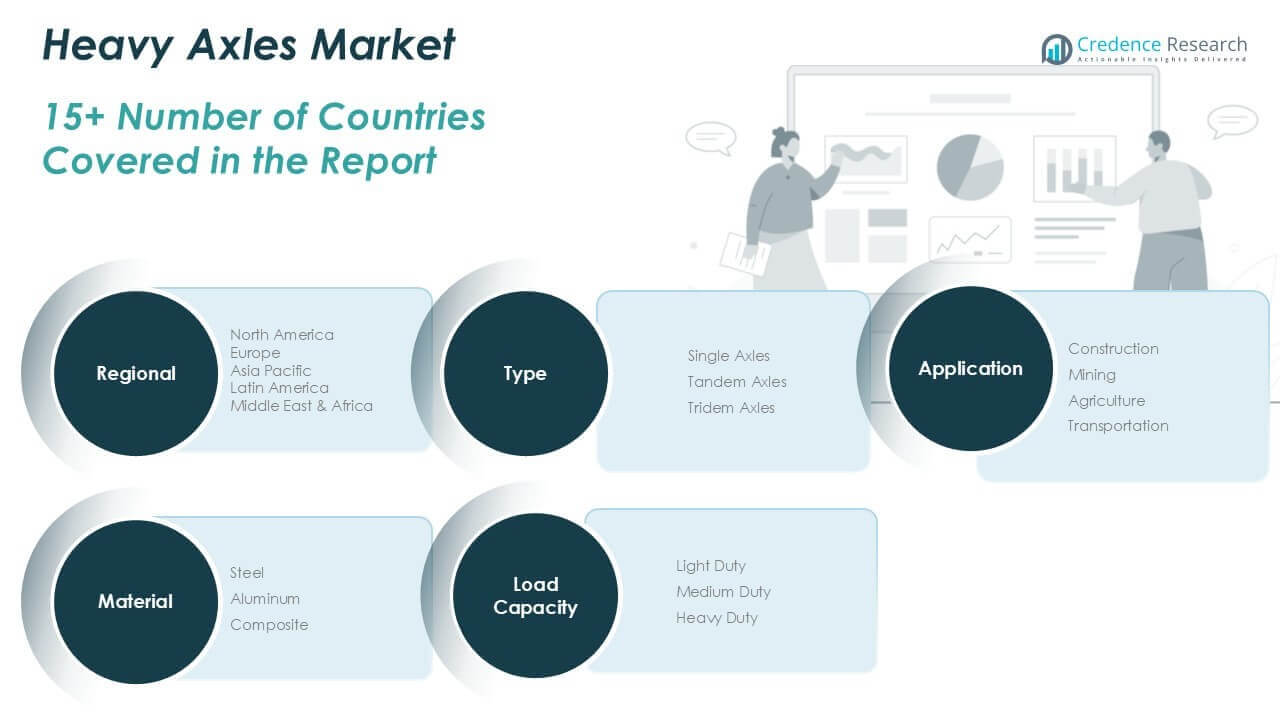
The research report offers an in-depth analysis based on Type, Application, Material, Load Capacity and Region. It details leading market players, providing an overview of their business, product offerings, investments, revenue streams, and key applications. Additionally, the report includes insights into the competitive environment, SWOT analysis, current market trends, as well as the primary drivers and constraints. Furthermore, it discusses various factors that have driven market expansion in recent years. The report also explores market dynamics, regulatory scenarios, and technological advancements that are shaping the industry. It assesses the impact of external factors and global economic changes on market growth. Lastly, it provides strategic recommendations for new entrants and established companies to navigate the complexities of the market.
Future Outlook
- The Heavy Axles Market will experience steady growth driven by increasing demand in logistics, construction, and mining sectors worldwide. Rising infrastructure investments will fuel the need for robust axle solutions.
- Innovations in lightweight materials like aluminum and composites will gain momentum, enabling manufacturers to produce fuel-efficient and durable heavy axles. This shift will support stricter emission standards globally.
- Integration of advanced technologies such as electronic braking systems and smart sensors will enhance axle performance and vehicle safety. These features will become standard in new heavy vehicle models.
- Expansion in emerging markets, particularly in Asia Pacific and Latin America, will present significant growth opportunities due to rapid urbanization and rising commercial vehicle fleets. Localized manufacturing will support cost competitiveness.
- Increasing focus on aftermarket services, including predictive maintenance and remote diagnostics, will strengthen customer loyalty and reduce operational downtime for heavy vehicle operators. Digital platforms will drive service efficiency.
- Regulatory pressure to improve vehicle safety and environmental impact will compel manufacturers to innovate axle designs with enhanced load capacity and reduced weight. Compliance will remain a key market driver.
- The market will witness consolidation through mergers and acquisitions as companies seek to expand technological capabilities and geographical reach. Strategic alliances will help firms address complex customer needs.
- Demand for modular and customizable axle systems will rise, enabling flexibility for various vehicle applications and simplifying maintenance. This trend will cater to diverse industrial requirements.
- Development of sustainable manufacturing processes and eco-friendly materials will become a priority, aligning the Heavy Axles Market with global sustainability goals. Companies investing in green technology will gain a competitive edge.
- Advancements in autonomous and electric heavy vehicles will influence axle design requirements, promoting innovation in durability and integration with electronic systems. The market will evolve to support next-generation vehicle platforms.
Request a Free Sample
Fill in your details and we'll send you a free sample report.
- Sample data tables & charts
- Research methodology
Need a Custom Version of This Report?
Tailor the scope, geography, or segments to your exact requirements.
- Custom geography or segment scope
- Direct access to our analyst team
Frequently Asked Questions
What is the current size and future forecast of the Global Heavy Axles Market?
What factors are driving the growth of the Heavy Axles Market?
How are manufacturers innovating in the Heavy Axles Market?
Who are the key players in the Global Heavy Axles Market?
Table of Content
Chapter 1. Report Introduction
- 1.1 Report Description & Purpose
- 1.1.1 Report Title & Market Definition
- 1.1.2 Unique Selling Propositions (USP) & Key Differentiators
- 1.1.3 Value Proposition for Stakeholders
- 1.2 Research Objectives
- 1.2.1 Market Sizing Objectives (Volume & Revenue)
- 1.2.2 Segmentation Objectives
- 1.2.3 Competitive Intelligence Objectives
- 1.2.4 Forecast & Scenario Objectives
- 1.3 Report Scope
- 1.3.1 Heavy Axles Scope – Types & Subtypes Covered
- 1.3.2 Geographic Scope – Regions & Countries Covered
- 1.3.3 Historical Period, Base Year & Forecast Period (2024; forecast to 2032)
- 1.3.4 Inclusions & Exclusions
- 1.4 HS Code & Classification Framework
- 1.5 Currency, Units & Pricing Basis
- 1.6 Target Stakeholders
- 1.7 Limitations & Assumptions
Chapter 2. Executive Summary
- 2.1 Global Heavy Axles Market Snapshot
- 2.1.1 Market Size – Historical (2024) & Forecast (2024-2032) (2024: USD 5,279.16 million → 2032: USD 7,092.39 million)
- 2.1.2 Volume & Revenue – Global Totals
- 2.1.3 Key Market Highlights – Top Five Facts
- 2.2 Heavy Axles Market Segmentation Snapshot
- 2.2.1 Market Split by Region – 2024 vs. 2032
- 2.3 Competitive Snapshot
- 2.3.1 Top 10 Players by Revenue Share – 2024
- 2.3.2 Top 10 Players by Volume Share – 2024
- 2.3.3 Recent Strategic Developments (18-Month Summary)
- 2.4 Key Investment Highlights & Strategic Conclusions
Chapter 3. Heavy Axles Market Dynamics & Industry Analysis
- 3.1 Market Overview & Context
- 3.1.1 Heavy Axles Market Position in the Broader Automotive Value Chain
- 3.1.2 OEM vs. Replacement Market Dynamics
- 3.1.3 Market Maturity & Development Stage by Region
- 3.2 Heavy Axles Market Drivers
- 3.3 Heavy Axles Market Restraints & Challenges
- 3.4 Heavy Axles Market Opportunities
- 3.5 Porter's Five Forces Analysis
- 3.5.1 Threat of New Entrants
- 3.5.2 Bargaining Power of Suppliers
- 3.5.3 Bargaining Power of Buyers
- 3.5.4 Threat of Substitutes
- 3.5.5 Competitive Rivalry – Intensity Assessment
- 3.6 Heavy Axles Value Chain Analysis
- 3.6.1 Upstream – Raw Material/Input Suppliers
- 3.6.1.1 Raw Material/Input 1
- 3.6.1.2 Raw Material/Input 2
- 3.6.1.3 Raw Material/Input 3
- 3.6.2 Midstream – Production/Manufacturing/Service Delivery
- 3.6.2.1 Production/Process Overview
- 3.6.2.2 Key Facility Locations & Capacity by Manufacturer
- 3.6.3 Downstream – Distribution & End Consumer
- 3.6.3.1 Primary Channel – B2B/OEM
- 3.6.3.2 Secondary Channels – Dealer, Retail, Online, Direct
- 3.6.4 Value Chain Profitability Analysis
- 3.6.1 Upstream – Raw Material/Input Suppliers
- 3.7 PESTEL Analysis
- 3.7.1 Political Factors
- 3.7.2 Economic Factors
- 3.7.3 Social Factors
- 3.7.4 Technological Factors
- 3.7.5 Environmental Factors
- 3.7.6 Legal Factors
- 3.8 Heavy Axles Supply Chain Analysis
- 3.8.1 Raw Material/Input Supply Risk Assessment
- 3.8.2 Manufacturing Concentration Risk (Geographic Exposure)
- 3.8.3 Trade Disruption Impact Analysis
- 3.9 Regulatory & Policy Landscape
Note: The regulatory and policy landscape section covers regulations based on their applicability to the market, Heavy Axles category, geography, and scope of the study. Only regulatory frameworks with a material impact on operations, compliance, trade, sustainability, or market access are analyzed in detail.
Chapter 4. Key Investment Pockets & Opportunity Analysis
- 4.1 Heavy Axles Market Attractiveness Analysis
- 4.1.1 By Region – Investment Attractiveness Matrix (Volume × CAGR)
- 4.2 Absolute Revenue Growth Opportunity
- 4.2.1 By Region – Absolute USD Growth Through 2032
- 4.3 Incremental Volume Opportunity
- 4.3.1 By Region – Incremental Volume Through 2032
- 4.3.2 Segment – Incremental Volume
- 4.4 Emerging Submarket Opportunity Deep Dive (Subject to Applicability)
- 4.5 Emerging Market Opportunity Scorecards
- 4.5.1 United States
- 4.5.2 Europe
- 4.5.3 Asia
- 4.5.4 Middle East & Africa
Note: Emerging Market Opportunity Scorecards will be included based on relevance and strategic importance. Regions listed are indicative and may vary depending on data availability and market dynamics.
Chapter 5. Heavy Axles Import-Export Analysis & Trade Flows
- 5.1 Global Trade Overview
- 5.1.1 Global Export Value by Country (2024)
- 5.1.2 Global Export Volume by Country (2024)
- 5.1.3 Global Import Value by Country (2024)
- 5.1.4 Global Import Volume by Country (2024)
- 5.1.5 Net Trade Balance by Country (2024)
- 5.2 Export Analysis – Segment
- 5.2.1 Type 1 (HS Code)
- 5.2.2 Type 2 (HS Code)
- 5.2.3 Type 3 (HS Code)
- 5.2.4 Type 4 (HS Code)
- 5.2.5 Type 5 (HS Code)
- 5.3 Import Analysis – Segment
- 5.3.1 Type 1 (HS Code)
- 5.3.2 Type 2 (HS Code)
- 5.3.3 Type 3 (HS Code)
- 5.3.4 Type 4 (HS Code)
- 5.3.5 Type 5 (HS Code)
- 5.4 Average Unit Trade Prices
- 5.4.1 Average Export Price – Segment & Country
- 5.4.2 Average Import Price – Segment & Source Country
- 5.4.3 Price Trends (2024)
- 5.5 Key Trade Route Analysis
- 5.5.1 Trade Route 1
- 5.5.2 Trade Route 2
- 5.5.3 Trade Route 3
- 5.5.4 Trade Route 4
- 5.5.5 Trade Route 5
- 5.6 Trade Policy Impact Assessment
- 5.6.1 US Anti-Dumping & Section 301 Tariffs
- 5.6.2 EU Customs Union Impact
- 5.6.3 Major Free Trade Agreements
- 5.6.4 USMCA Rules of Origin
Note: Trade policy analysis will be included only where relevant to the Heavy Axles market.
Chapter 6. Competitive Landscape & Company Benchmarking
- 6.1 Heavy Axles Market Concentration & Structure
- 6.1.1 Herfindahl-Hirschman Index (HHI) – vs. 2024
- 6.1.2 Tier 1, Tier 2 & Tier 3 Market Structure
- 6.1.3 Global, Regional & Local Player Dynamics
- 6.2 Heavy Axles Market Share Analysis – 2024
- 6.2.1 Global Revenue Share by Company
- 6.2.2 Global Volume Share by Company
- 6.2.3 Regional Revenue Share
- 6.2.4 Market Share Evolution ( vs. 2024)
- 6.2.5 OEM Segment Share by Company
- 6.2.6 Replacement Segment Share by Company
- 6.3 Production/Delivery Capacity & Facility Analysis
- 6.3.1 Global Installed Capacity
- 6.3.2 Capacity Utilization Rates
- 6.3.3 Production/Output Volume
- 6.3.4 Facility Locations & Capacity Map
- 6.3.5 Planned Capacity Additions
- 6.4 Heavy Axles Competitive Benchmarking Matrix
- 6.4.1 Revenue, Volume, CAGR & Profitability Comparison
- 6.4.2 Channel Revenue Mix
- 6.4.3 Geographic Revenue Exposure
- 6.4.4 R&D Intensity
- 6.4.5 Sustainability Maturity
- 6.5 Strategic Developments in Heavy Axles (Last 24 Months)
- 6.5.1 Mergers, Acquisitions & Divestments
- 6.5.2 New Heavy Axles Launches
- 6.5.3 Facility Expansions
- 6.5.4 Strategic Alliances, Joint Ventures & Partnerships
- 6.5.5 Distribution Expansion & Market Entry
- 6.5.6 Sustainability & ESG Initiatives
- 6.6 Competitive Strategy Mapping
- 6.6.1 Leader, Challenger, Follower & Niche Classification
- 6.6.2 Pricing Strategy Comparison
- 6.6.3 Channel Strategy Matrix
Note: Strategic developments are included based on their materiality and the availability of reliable information.
Chapter 7. Global Heavy Axles Market – By Distribution Channel
- 7.1 Segment Overview
- 7.1.1 Volume & Revenue Split by Channel (2024 & 2032)
- 7.1.2 Channel Mix Evolution (2024-2032)
Chapter 8. Regional Market Analysis – Global Overview
- 8.1 Global Regional Overview
- 8.1.1 Regional Volume Share
- 8.1.2 Regional Revenue Share
- 8.1.3 Regional Volume by Region
- 8.1.4 Regional Revenue by Region
- 8.1.5 Regional Forecast Through 2032
- 8.2 Cross-Regional Segment Analysis
- 8.2.1 By Distribution Channel
- 8.2.2 By Brand/Price Tier
Chapter 9. North America Heavy Axles Market
- 9.1 United States
- 9.2 Canada
- 9.3 Mexico
Chapter 10. Europe Heavy Axles Market
- 10.1 Germany
- 10.2 France
- 10.3 Italy
- 10.4 United Kingdom
- 10.5 Spain
- 10.6 Poland
- 10.7 Russia
- 10.8 Netherlands
- 10.9 Belgium
- 10.10 Sweden
- 10.11 Denmark
- 10.12 Norway
- 10.13 Rest of Europe
Chapter 11. Asia Pacific Heavy Axles Market
- 11.1 China
- 11.2 India
- 11.3 Japan
- 11.4 South Korea
- 11.5 Thailand
- 11.6 Indonesia
- 11.7 Vietnam
- 11.8 Malaysia
- 11.9 Australia
- 11.10 Rest of Asia Pacific
Chapter 12. Latin America Heavy Axles Market
- 12.1 Brazil
- 12.2 Argentina
- 12.3 Colombia
- 12.4 Chile
- 12.5 Rest of Latin America
Chapter 13. Middle East Heavy Axles Market
- 13.1 Saudi Arabia
- 13.2 United Arab Emirates
- 13.3 Turkey
- 13.4 Israel
- 13.5 Iran
- 13.6 Rest of the Middle East
Chapter 14. Africa Heavy Axles Market
- 14.1 South Africa
- 14.2 Egypt
- 14.3 Nigeria
- 14.4 Morocco
- 14.5 Rest of Africa
Chapter 15. Heavy Axles Company Profiles
- 15.1 [Company 01]
- 15.1.1 Company Overview
- 15.1.2 Key Management Personnel
- 15.1.3 Products & Services Portfolio
- 15.1.4 Financial Performance
- 15.1.5 Key Market Focus & Geographic Presence
- 15.1.6 Recent Developments & Strategic Initiatives
Note: The company profile list is preliminary and may change based on research findings, market developments, data availability, and client requirements.
Chapter 16. Appendices
- Appendix A – List of Abbreviations & Acronyms
- Appendix B – Industry Classification Code Reference – Full Series
- Appendix C – Production & Capacity Data Tables
- Appendix D – End-Use & Demand Base Tables
- Appendix E – Consumption & Replacement Rate Assumptions
- Appendix F – ASP Reference Tables
- Appendix G – Manufacturing & Facility Database
- Appendix H – Import-Export Data Tables
- Appendix I – Regulatory Summary Tables
- Appendix J – Primary Research Participant List (Anonymized)
- Appendix K – Primary Research Questionnaire Framework
- Appendix L – Data Sources & Bibliography
- Appendix M – Market Size Divergence & Source Comparison
Chapter 17. Research Methodology
- 17.1 Research Framework & Philosophy
- 17.2 Secondary Research – Sources, Hierarchy & Data Extraction
- 17.3 Data Modeling – Bottom-Up & Top-Down Market Sizing
- 17.4 Primary Research – Stakeholder Framework, LOI & Sample Sizes
- 17.5 Forecast Methodology – Regression, Scenario & Sensitivity Analysis
- 17.6 Quality Control – Four-Layer Validation Framework
- 17.7 Limitations & Standard Assumptions
- 17.8 Disclaimer
