
| REPORT ATTRIBUTE | DETAILS |
|---|---|
| Historical Period | 2020-2023 |
| Base Year | 2024 |
| Forecast Period | 2025-2032 |
| Imitation Jewellery Market Size 2024 | USD 17000 million |
| Imitation Jewellery Market, CAGR | 7.31% |
| Imitation Jewellery Market Size 2032 | USD 29893.06 million |
Market Overview:
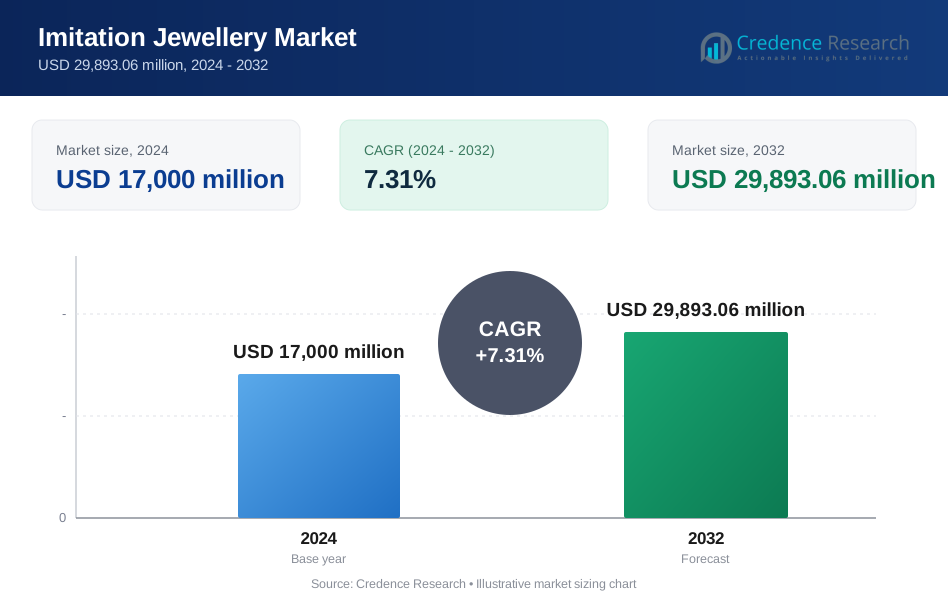
The Global Imitation Jewellery Market size was valued at USD 17000 million in 2024 and is anticipated to reach USD 29893.06 million by 2032, at a CAGR of 7.31% during the forecast period (2024-2032).
Key drivers of the market include evolving fashion trends, rising disposable income, and growing influence of social media and celebrity endorsements. The affordability and versatility of imitation jewellery, compared to fine jewellery, attract a wide consumer base. Additionally, increasing consumer awareness regarding sustainable and ethical sourcing has fueled demand for eco-friendly and non-traditional jewellery materials. E-commerce platforms have played a crucial role in market penetration, offering extensive product choices and discounts. Moreover, manufacturers are investing in advanced production techniques, such as 3D printing and electroforming, to enhance product appeal. The growing popularity of customization and personalized jewellery designs is further boosting market demand. Furthermore, the rise of fast fashion brands incorporating imitation jewellery as part of their offerings has contributed to the market's rapid expansion. Consumer preferences for lightweight, easy-to-maintain jewellery pieces are also fueling industry growth.
Regionally, Asia-Pacific dominates the imitation jewellery market due to high consumer demand from countries such as India and China, where jewellery plays a vital cultural role. North America and Europe are witnessing significant growth due to rising fashion-conscious consumers and the increasing adoption of imitation jewellery among younger demographics. The Middle East and Africa market is expanding due to the growing influence of Western fashion trends and increasing disposable income. Latin America is also emerging as a key market, supported by the popularity of handcrafted and locally inspired designs. The rising presence of local and international brands is strengthening market competition across all regions. Additionally, the expansion of organized retail sectors and specialty jewellery stores is enhancing market accessibility. The integration of innovative marketing strategies, including influencer collaborations and limited-edition collections, is further driving demand across different regions. The overall market is poised for robust growth, driven by changing consumer preferences and continuous innovations in design and materials.
Market Insights:
- The imitation jewellery market was valued at USD 17,000 million in 2024 and is projected to reach USD 29,893.06 million by 2032, growing at a CAGR of 7.31%.
- Evolving fashion trends, rising disposable income, and social media influence are key market drivers, increasing consumer demand for affordable jewellery.
- The adoption of sustainable and ethical materials, including recycled metals and biodegradable alternatives, is gaining traction among environmentally conscious buyers.
- E-commerce platforms, influencer marketing, and digital shopping innovations like AR-based virtual try-ons are expanding market reach and boosting sales.
- Asia-Pacific holds the largest market share at 40%, followed by North America at 25% and Europe at 20%, driven by cultural significance and fashion-conscious consumers.
- The demand for customization and personalized jewellery, including engraved and mix-and-match designs, is increasing, enhancing brand differentiation.
- Market competition remains intense, with price pressures, counterfeit products, and durability concerns challenging manufacturers, driving innovation in quality and branding strategies.
Market Drivers:
Evolving Fashion Trends and Changing Consumer Preferences:
The imitation jewellery market is experiencing significant growth due to rapidly changing fashion trends and evolving consumer preferences. Consumers seek stylish, affordable, and trendy accessories that complement their outfits for various occasions. Unlike fine jewellery, imitation jewellery offers a cost-effective alternative, allowing consumers to update their collections frequently. For instance, Swarovski often collaborates with celebrities to showcase imitation jewellery, enhancing its appeal through social media and celebrity endorsements. The increasing influence of global fashion trends through social media and celebrity endorsements has further propelled the demand for imitation jewellery. Additionally, seasonal collections and limited-edition designs introduced by brands are driving sales and encouraging repeat purchases.
Rising Disposable Income and Urbanization:
Increasing disposable income and urbanization are key factors driving the demand for imitation jewellery. As economies grow and living standards improve, consumers are willing to spend more on fashion accessories, including imitation jewellery. The expanding middle-class population, particularly in emerging economies, has fueled market growth by increasing the affordability and accessibility of stylish jewellery options. For instance, India's growing middle class has significantly contributed to the demand for imitation jewellery, with many consumers opting for affordable yet stylish pieces to match their urban lifestyles. Furthermore, urban lifestyles encourage consumers to invest in multiple jewellery pieces to match different occasions, boosting overall market demand. The accessibility of imitation jewellery in shopping malls, retail stores, and online platforms has further strengthened its presence in the global market.
Growing Influence of E-Commerce and Digital Marketing:
The rise of e-commerce has played a crucial role in the expansion of the imitation jewellery market. Online platforms offer an extensive range of designs, competitive pricing, and convenience, attracting a broad consumer base. Digital marketing strategies, including influencer collaborations, targeted advertisements, and social media campaigns, have significantly enhanced brand visibility and customer engagement. For instance, Amazon and Etsy have successfully leveraged social shopping features to allow customers to browse and purchase imitation jewellery directly from their platforms, enhancing the online shopping experience. Many brands also leverage augmented reality (AR) and virtual try-on features to improve the online shopping experience, making it easier for consumers to choose jewellery pieces that suit their preferences.
Technological Advancements and Sustainable Materials:
Technological advancements in manufacturing processes, such as 3D printing and electroforming, have enhanced the quality and design capabilities of imitation jewellery. These innovations enable manufacturers to create intricate and durable designs that closely resemble fine jewellery. Additionally, the growing consumer preference for sustainable and ethically sourced products has led to the adoption of eco-friendly materials, including recycled metals and biodegradable alternatives. For instance, Evol Jewels has successfully integrated sustainable practices into their production, using recycled materials and lab-grown diamonds to appeal to environmentally conscious consumers. This shift towards sustainability not only appeals to environmentally conscious consumers but also strengthens brand reputation and market competitiveness.
Market Trends:
Growing Popularity of Customization and Personalization:
The rising demand for customized and personalized jewellery is a key trend shaping the imitation jewellery market. Consumers seek unique designs that reflect their personal style, leading brands to offer engraving, nameplate pendants, and mix-and-match options. For instance, Pandora offers customizable charm bracelets that allow customers to create unique pieces that reflect their personal stories. Advanced manufacturing technologies, such as 3D printing and laser engraving, have enabled brands to create intricate, tailor-made designs efficiently. This trend is particularly strong among younger demographics who prefer exclusive and meaningful jewellery pieces.
Increased Adoption of Sustainable and Ethical Materials:
Sustainability has become a significant focus in the imitation jewellery industry, with brands incorporating eco-friendly materials such as recycled metals, biodegradable components, and lab-created stones. For instance, Tiffany & Co. has committed to using 100% ethically sourced gold in their jewellery production. Consumers are increasingly conscious of ethical sourcing, prompting manufacturers to use non-toxic and sustainable alternatives. Many brands are also promoting transparency in their supply chains to attract environmentally aware buyers. The shift toward sustainable jewellery aligns with the broader trend of ethical fashion, further driving demand in the market.
Expansion of Online Retail and Digital Engagement:
E-commerce has become a dominant sales channel for imitation jewellery, offering consumers convenience, variety, and competitive pricing. Brands leverage digital marketing strategies, including influencer collaborations, social media campaigns, and virtual try-on technology, to enhance customer engagement. For instance, Blue Nile uses augmented reality (AR) tools to allow consumers to visualize jewellery before purchase, improving the online shopping experience. Augmented reality (AR) tools allow consumers to visualize jewellery before purchase, improving the online shopping experience. This digital transformation is expanding market reach and strengthening brand presence globally.
Fusion of Traditional and Contemporary Designs:
Modern imitation jewellery blends traditional craftsmanship with contemporary aesthetics to appeal to a diverse consumer base. Ethnic and cultural motifs integrated with modern designs attract buyers looking for versatile pieces suitable for both everyday wear and special occasions. For instance, Jashn India successfully combines traditional Indian motifs with modern sensibilities, creating unique pieces that honor heritage while embracing contemporary style. The trend is particularly evident in emerging markets where cultural heritage influences jewellery choices. This fusion of classic and modern styles continues to drive product innovation and market expansion.
Market Challenges Analysis:
Intense Market Competition and Pricing Pressures:
The imitation jewellery market faces intense competition due to the presence of numerous local and international players. With low entry barriers, new brands and unorganized market participants frequently emerge, leading to price wars and reduced profit margins for established businesses. Additionally, counterfeit products and low-quality imitations affect consumer trust and brand reputation. Manufacturers must continuously innovate in design, quality, and marketing strategies to differentiate themselves and maintain a competitive edge. The rising cost of raw materials, coupled with fluctuations in supply chains, further adds to pricing pressures, making it challenging for brands to balance affordability with profitability. The increasing adoption of automated manufacturing processes is helping some businesses reduce production costs while maintaining product quality. Strategic collaborations with influencers and fashion brands are also being used to enhance brand visibility and consumer loyalty.
Changing Consumer Preferences and Durability Concerns:
Rapidly shifting fashion trends pose a challenge for manufacturers who must quickly adapt to evolving consumer preferences. Unlike fine jewellery, imitation jewellery has a shorter lifecycle due to its association with fast fashion, requiring brands to introduce new collections frequently to stay relevant. Additionally, concerns regarding the durability and longevity of imitation jewellery impact consumer purchasing decisions. Many imitation jewellery pieces are prone to tarnishing, discoloration, or breakage over time, leading to hesitation among buyers. To address these challenges, manufacturers must focus on improving product quality, incorporating anti-tarnish coatings, and enhancing durability while maintaining affordability. Furthermore, effective customer education on jewellery care and maintenance can help build consumer confidence and drive repeat purchases. Investments in advanced materials, such as tarnish-resistant alloys and hypoallergenic coatings, are becoming a priority for leading brands. Additionally, warranty programs and after-sales services are being introduced to reassure consumers and enhance brand credibility.
Market Opportunities:
The imitation jewellery market presents significant growth opportunities driven by increasing consumer demand for affordable, stylish, and diverse accessory options. The growing influence of social media, celebrity endorsements, and fashion trends has expanded the potential customer base, particularly among younger consumers. The rise of e-commerce platforms has further fueled market expansion by providing a convenient and accessible shopping experience. Online retail allows brands to reach global audiences, offering customized and exclusive collections that cater to diverse tastes. Additionally, the increasing acceptance of imitation jewellery for everyday wear, special occasions, and professional settings creates a steady demand, encouraging brands to invest in innovative designs and high-quality materials. Expanding product lines with sustainable and hypoallergenic materials also presents an opportunity to attract environmentally conscious consumers and individuals with sensitive skin.
Advancements in technology, including 3D printing and AI-driven design solutions, are enabling manufacturers to create intricate and high-quality jewellery at competitive prices. The growing preference for personalized and bespoke jewellery further enhances opportunities for brands that offer customization options. Strategic collaborations with fashion retailers, influencers, and designers can strengthen brand positioning and increase consumer engagement. Additionally, emerging markets in Asia-Pacific, Latin America, and the Middle East present vast potential due to increasing disposable incomes and evolving fashion preferences. Strengthening distribution networks through both online and offline channels can enhance market penetration, ensuring broader consumer reach. As sustainability and ethical sourcing gain importance, brands investing in transparent and responsible manufacturing practices can establish a strong competitive advantage in the global market.
Market Segmentation Analysis:
By Product Type
The imitation jewellery market is segmented into necklaces, earrings, rings, bracelets, anklets, brooches, and other accessories. Earrings and necklaces hold a significant market share due to their widespread use across different fashion trends and cultural preferences. Rings and bracelets are also witnessing strong demand, particularly among younger consumers who prefer stackable and mix-and-match styles. The increasing popularity of fusion jewellery, combining traditional and modern elements, is further driving demand in this segment.
By Distribution Channel
The market is divided into online and offline distribution channels. Online retail, including e-commerce platforms and brand-owned websites, is expanding rapidly due to its convenience, extensive product variety, and competitive pricing. Social media-driven shopping trends have further boosted online sales, enabling brands to reach a wider audience. Offline retail, comprising jewellery stores, fashion boutiques, and department stores, continues to attract consumers who prefer physical inspection before purchase. The adoption of omnichannel strategies by leading brands is improving accessibility and customer engagement.
By End-User
The market caters to both men and women, with women dominating the consumer base due to their higher inclination toward fashion accessories. However, the men’s segment is witnessing steady growth, driven by the rising popularity of bracelets, rings, and cufflinks. The increasing use of imitation jewellery for professional and formal wear is further expanding its market reach, attracting a diverse range of consumers across different demographics.
Segmentations:
By Product Type
- Necklaces
- Bracelets
- Anklets
- Earrings
- Brooches
- Rings
- Other Accessories
By Distribution Channel
- Offline Retail (Jewellery Stores, Fashion Boutiques, Department Stores)
- Online Retail (E-commerce Platforms, Brand Websites, Social Media Stores)
By End-User
- Men
- Women
By Region
- North America
- U.S.
- Canada
- Mexico
- Europe
- Germany
- France
- U.K.
- Italy
- Spain
- Rest of Europe
- Asia Pacific
- China
- Japan
- India
- South Korea
- South-east Asia
- Rest of Asia Pacific
- Latin America
- Brazil
- Argentina
- Rest of Latin America
- Middle East & Africa
- GCC Countries
- South Africa
- Rest of the Middle East and Africa
Regional Analysis:
Asia-Pacific
Asia-Pacific holds the largest share in the imitation jewellery market, accounting for 40% of the global market. The region's strong dominance is driven by high consumer demand from countries such as India, China, and Japan, where jewellery holds cultural significance. The growing middle-class population, rising disposable income, and increasing preference for affordable jewellery options contribute to market expansion. India, in particular, is a key market due to its deep-rooted tradition of jewellery in weddings and festive occasions, boosting demand for both traditional and contemporary designs. The expansion of online retail platforms and social media influence further strengthen market growth in this region, allowing brands to reach a wider audience and cater to evolving fashion trends.
North America
North America accounts for 25% of the imitation jewellery market, driven by a strong fashion-conscious consumer base and increasing demand for trendy, affordable accessories. The region witnesses significant adoption of imitation jewellery among millennials and Gen Z consumers, who prefer fast fashion and cost-effective alternatives to fine jewellery. The rise of e-commerce and digital marketing strategies has played a crucial role in market penetration, with brands leveraging influencer collaborations and social media campaigns to drive sales. The increasing popularity of customization, sustainable jewellery, and hypoallergenic materials further fuels market growth. The United States leads the regional market, supported by a well-established retail infrastructure and high consumer spending on fashion accessories.
Europe
Europe holds a 20% share in the global imitation jewellery market, supported by the region’s strong fashion industry and increasing consumer inclination toward affordable luxury. Countries such as France, Italy, Germany, and the United Kingdom exhibit high demand for imitation jewellery, driven by evolving fashion trends and the influence of designer brands. The market benefits from a rising preference for sustainable and ethically sourced jewellery, encouraging manufacturers to use eco-friendly materials. The presence of established fashion retailers, both online and offline, enhances market accessibility. Additionally, the growing demand for gender-neutral jewellery and minimalist designs is reshaping the European market, attracting a diverse range of consumers across different demographics.
Key Player Analysis:
- LOUIS VUITTON (France)
- Stuller, Inc. (US)
- Yurman Design, Inc. (US)
- Billig Jewelers, Inc. (US)
- DCK Concessions (UK)
- Avon Product Inc. (US)
- BaubleBar Inc. (US)
- Buckley Jewellery Limited (UK)
- Gianni Versace Sp.A. (Italy)
Competitive Analysis:
The imitation jewellery market is highly competitive, with established brands and emerging players striving for market share. Leading companies differentiate themselves through innovative designs, premium-quality materials, and strong brand positioning. For instance, Voylla is renowned for offering a wide variety of jewellery that appeals to both traditional and modern tastes, providing everything from ethnic to Western influences. Luxury brands such as Swarovski, Cartier, and Tiffany & Co. maintain a competitive edge through exclusive collections and high-end craftsmanship. Fast fashion retailers like H&M and ZARA leverage affordability and trend-driven designs to attract a broad consumer base. E-commerce has intensified competition, enabling smaller brands and independent designers to reach global consumers. Digital marketing strategies, influencer collaborations, and social media engagement play a crucial role in brand visibility. Companies are also focusing on sustainability and customization to meet evolving consumer preferences. Strong distribution networks, omnichannel strategies, and product diversification further enhance competitiveness. As consumer demand for affordability and quality grows, market players continue to innovate to strengthen their market position.
Recent Developments:
- In September 2023, David Yurman took legal action against Royal Chain and Samuel B., alleging that these companies copied several of its most recognizable designs. This action underscores Yurman's commitment to protecting its brand and intellectual property, which can indirectly influence the imitation jewellery market by setting standards for originality and authenticity.
- In August 2024, Avon Products filed for Chapter 11 bankruptcy protection to address talc-related lawsuits. This development primarily affects Avon's broader business rather than its specific involvement in the imitation jewellery market.
- In Late 2023/Early 2024, DCK Group partnered with Next to launch the AELA brand, offering a range of fashion-forward jewellery pieces across Next's UK stores and website.
Market Concentration & Characteristics:
The imitation jewellery market is moderately fragmented, with a mix of global brands, regional players, and unorganized local manufacturers competing for market share. Established brands such as Swarovski, Cartier, and Tiffany & Co. dominate the premium segment, while fast fashion retailers and independent designers cater to cost-conscious consumers. The market is characterized by rapid product innovation, trend-driven demand, and high consumer preference for affordability and variety. E-commerce has played a pivotal role in market expansion, intensifying competition and enabling smaller brands to gain visibility. Sustainability, customization, and digital marketing are key differentiators, influencing consumer purchasing decisions. The presence of counterfeit products and fluctuating raw material costs create challenges, prompting companies to invest in quality assurance and branding strategies. The rising demand for gender-neutral and hypoallergenic jewellery further shapes market dynamics, encouraging continuous innovation and diversification across product categories.
Report Coverage:
The research report offers an in-depth analysis based on Product Type, Distribution Channel, End-User and Region. It details leading market players, providing an overview of their business, product offerings, investments, revenue streams, and key applications. Additionally, the report includes insights into the competitive environment, SWOT analysis, current market trends, as well as the primary drivers and constraints. Furthermore, it discusses various factors that have driven market expansion in recent years. The report also explores market dynamics, regulatory scenarios, and technological advancements that are shaping the industry. It assesses the impact of external factors and global economic changes on market growth. Lastly, it provides strategic recommendations for new entrants and established companies to navigate the complexities of the market.
Future Outlook:
- Consumer demand for affordable, stylish, and customizable jewellery will continue to drive market growth, encouraging brands to invest in innovative designs.
- The increasing influence of social media, celebrity endorsements, and fashion influencers will enhance brand visibility and shape purchasing decisions.
- Sustainability will become a key focus, with brands adopting eco-friendly materials, ethical sourcing, and recyclable packaging to attract environmentally conscious consumers.
- The rise of e-commerce and digital transformation will expand market reach, with augmented reality (AR) and virtual try-on features improving the online shopping experience.
- Customization and personalization will gain traction, with consumers preferring engraved, nameplate, and mix-and-match jewellery options.
- Emerging markets in Asia-Pacific, Latin America, and the Middle East will witness significant growth due to rising disposable income and evolving fashion trends.
- Advanced manufacturing technologies, such as 3D printing and AI-driven design, will enhance product quality, design precision, and production efficiency.
- The growing acceptance of gender-neutral and minimalist jewellery will drive product diversification, appealing to a broader consumer base.
- Omnichannel retail strategies, integrating online and offline sales, will strengthen consumer engagement and improve accessibility.
- Companies will focus on brand differentiation through innovative marketing strategies, loyalty programs, and exclusive collaborations with fashion designers and influencers.
Request a Free Sample
Fill in your details and we'll send you a free sample report.
- Sample data tables & charts
- Research methodology
Market Dynamics
Evolving Fashion Trends and Social Media Influence
Rapidly changing fashion trends and the influence of social media and celebrity endorsements are driving consumers to seek affordable, trendy accessories, boosting demand for imitation jewellery that allows frequent style updates.
Rising Disposable Income and Urbanization
Increasing disposable incomes, especially in emerging economies, and urban lifestyles are enabling consumers to spend more on fashion accessories, making imitation jewellery an attractive, cost-effective option for a growing middle class.
Growth of E-Commerce and Digital Marketing
The expansion of e-commerce platforms and the use of digital marketing, including influencer collaborations and AR-based virtual try-ons, have made imitation jewellery more accessible and appealing to a wider, tech-savvy audience.
Adoption of Sustainable and Ethical Materials
Rising consumer awareness of sustainability and ethical sourcing is encouraging brands to use recycled metals and eco-friendly materials, attracting environmentally conscious buyers and differentiating products in a crowded market.
Technological Advancements in Manufacturing
Innovations such as 3D printing and electroforming are enabling manufacturers to produce intricate, high-quality imitation jewellery at scale, enhancing product appeal and supporting the trend toward customization and personalization.
Need a Custom Version of This Report?
Tailor the scope, geography, or segments to your exact requirements.
- Custom geography or segment scope
- Direct access to our analyst team
Frequently Asked Questions
What is the current and projected market size of the imitation jewellery market?
What are the key drivers of the imitation jewellery market?
Which region dominates the imitation jewellery market?
What are the emerging trends in the imitation jewellery market?
Table of Content
Chapter 1 Market Segmentation
- 1.1 Segmentation Framework
- 1.1.1 Product and Service Classification
- 1.1.2 Application and End-Use Classification
- 1.1.3 Technology and Solution Classification
- 1.1.4 Customer and Distribution Channel Classification
- 1.1.5 Geographic Segmentation
- 1.1.6 Market Segment Definitions and Boundaries
- 1.2 By End-User
- 1.2.1 Men
- 1.2.2 Women
- 1.3 By Product Type
- 1.3.1 Necklaces
- 1.3.2 Bracelets
- 1.3.3 Anklets
- 1.3.4 Earrings
- 1.3.5 Brooches
- 1.3.6 Rings
- 1.3.7 Other Accessories
Chapter 2 Introduction
- 2.1 Report Objectives and Scope
- 2.2 Product Definition and Industry Terminology
- 2.3 Market Inclusions and Exclusions
- 2.4 Research Process
- 2.4.1 Primary Research and Expert Interviews
- 2.4.2 Secondary Research and Source Review
- 2.4.3 Top-Down and Bottom-Up Estimation
- 2.4.4 Data Triangulation and Verification
- 2.5 Market Size Measurement Basis
- 2.5.1 2024: USD 17,000 million → 2032: USD 29,893.06 million
- 2.6 Historical and Forecast Reference Periods
- 2.6.1 Base Year: 2024
- 2.6.2 Forecast Period: 2024-2032
- 2.7 Research Assumptions and Limitations
Chapter 3 Executive Summary
- 3.1 Market Snapshot and Key Findings
- 3.2 Base-Year Market Size, 2024
- 3.3 Forecast Market Size, 2032
- 3.4 Revenue and Volume Growth Outlook
- 3.5 Key Demand and Supply Indicators
- 3.6 Leading Market Segments
- 3.7 Fastest-Growing Market Opportunities
- 3.8 Regional Performance Highlights
- 3.9 Technology and Industry Transformation
- 3.10 Competitive Landscape Summary
- 3.11 Analyst View and Strategic Implications
Chapter 4 Global Imitation Jewellery Market Trends and Developments
- 4.1 Historical Industry Development
- 4.2 Recent Market Trends and Developments
- 4.3 Demand and Customer Behavior Trends
- 4.4 Technology and Product Innovation
- 4.5 Artificial Intelligence, Automation and Digitalization
- 4.6 Local Manufacturing and Supply Chain Realignment
- 4.7 Industry Partnerships, Mergers and Acquisitions
- 4.8 Sustainability and Circular Economy Developments
- 4.9 Government and Private Sector Investment Trends
- 4.10 Emerging Business Models and Commercialization
- 4.11 Industry Developments and Announcements
Chapter 5 Global Imitation Jewellery Market Production, Supply and Demand Analysis
- 5.1 Demand Trend and Consumption Analysis
- 5.2 Demand Forecast, 2024-2032
- 5.3 Production and Output Trend
- 5.4 Production and Output Forecast, 2024-2032
- 5.5 Installed Capacity and Capacity Utilization
- 5.6 Company-Wise Production Plants and Statistics
- 5.6.1 Installed Production Capacity
- 5.6.2 Actual Production
- 5.6.3 Planned Capacity and Expansion Targets
- 5.7 Supply Chain Structure and Procurement Trends
- 5.8 Supply-Demand Gap and Bottlenecks
- 5.9 Import Dependence and Sourcing Structure
- 5.10 Contract Manufacturing and Outsourcing
- 5.11 Regional Supply and Demand Concentration
Chapter 6 Global Imitation Jewellery Market Pricing Analysis
- 6.1 Pricing Structure and Measurement
- 6.2 Historical Pricing Trends
- 6.3 Pricing Outlook, 2024-2032
- 6.4 Average Selling Price and Unit Economics
- 6.5 Pricing by Product and Market Segment
- 6.6 Geographic Pricing Differences
- 6.7 Key Input, Energy, Labor and Logistics Costs
- 6.8 Contract Pricing and Purchasing Models
- 6.9 Pricing Sensitivity and Competitive Positioning
- 6.10 Price, Margin and Profitability Implications
Chapter 7 Global Imitation Jewellery Market Dynamics
- 7.1 Market Growth Drivers
- 7.1.1 Demand-Side Drivers
- 7.1.2 Technology and Innovation Drivers
- 7.1.3 Infrastructure and Investment Drivers
- 7.1.4 Regulatory and Policy Drivers
- 7.2 Market Restraints
- 7.2.1 Cost and Affordability Constraints
- 7.2.2 Technology and Adoption Barriers
- 7.2.3 Supply Chain and Operational Constraints
- 7.3 Market Challenges
- 7.3.1 Competitive Pressure and Margin Erosion
- 7.3.2 Skills, Infrastructure and Implementation Gaps
- 7.4 Emerging Market Opportunities
- 7.5 Market Dynamics Impact and Time-Horizon Assessment
Chapter 8 Global Imitation Jewellery Value Chain Analysis
- 8.1 Industry Value Chain Overview
- 8.2 Upstream Suppliers and Critical Inputs
- 8.3 Technology and Component Providers
- 8.4 Manufacturing or Service Delivery
- 8.5 Distribution, Channel Partners and Integrators
- 8.6 Downstream Applications and End Users
- 8.7 Value Addition and Profit Pools
- 8.8 Vertical Integration and Outsourcing
- 8.9 Supplier Concentration and Risk
- 8.10 Supply Chain Localization and Resilience
Chapter 9 Global Imitation Jewellery Market Regulations and Policies
- 9.1 Relevant Laws, Standards and Compliance Frameworks
- 9.2 Product, Service, Safety and Quality Requirements
- 9.3 Government Policies, Incentives and Subsidies
- 9.4 Imports, Exports and Trade Barriers
- 9.5 Public Procurement and Local Content Requirements
- 9.6 Environmental and Sustainability Compliance
- 9.7 Upcoming Policy Changes and Market Implications
Chapter 10 Global Imitation Jewellery Market Hotspots and Opportunities
- 10.1 Market Opportunity Mapping and Growth Hotspots
- 10.2 High-Growth Applications and Customer Groups
- 10.3 Underserved Markets and White-Space Opportunities
- 10.4 Emerging Technology and Product Opportunities
- 10.5 New Capacity and Investment Hotspots
- 10.6 Market Entry and Expansion Opportunities
- 10.7 Distribution and Partnership Opportunities
- 10.8 Near-Term and Long-Term Commercial Potential
- 10.9 Opportunity Attractiveness and Execution Risks
Chapter 11 Global Imitation Jewellery Market Outlook, 2024-2032
- 11.1 Market Size and Analysis
- 11.1.1 Revenue (Market Measurement: 2024: USD 17,000 million → 2032: USD 29,893.06 million)
- 11.1.2 Market Volume and Quantity Sold
- 11.1.3 Historical Market Size
- 11.1.4 Base-Year Market Size, 2024
- 11.2 Market Forecast, 2024-2032
- 11.2.1 Revenue Forecast to 2032
- 11.2.2 Volume Forecast to 2032
- 11.2.3 CAGR and Year-on-Year Growth
- 11.2.4 Incremental Revenue Opportunity
- 11.3 Forecast Assumptions and Scenario Analysis
- 11.3.1 Base-Case Forecast
- 11.3.2 Optimistic and Conservative Scenarios
- 11.3.3 Technology, Pricing and Policy Sensitivities
- 11.4 Market Attractiveness and Growth Outlook
Chapter 12 Global Imitation Jewellery Market Segmentation and Outlook
- 12.1 Segmentation Summary and Market Shares, 2024
- 12.2 Largest and Fastest-Growing Segments
- 12.3 By End-User - Market Size and Forecast, 2024-2032
- 12.3.1 Segment Definition and Scope
- 12.3.2 Historical Market Size
- 12.3.3 Revenue Forecast, 2024-2032
- 12.3.4 Volume Forecast, 2024-2032
- 12.3.5 Base-Year Market Share, 2024
- 12.3.6 Segment CAGR and Growth Drivers
- 12.3.7 Subsegment Market Size and Forecast
- 12.3.7.1 Men
- 12.3.7.2 Women
- 12.3.8 Subsegment Pricing and Adoption Trends
- 12.3.9 Leading Suppliers and Competition
- 12.3.10 Regional Demand and Opportunities
- 12.4 By Product Type - Market Size and Forecast, 2024-2032
- 12.4.1 Segment Definition and Scope
- 12.4.2 Historical Market Size
- 12.4.3 Revenue Forecast, 2024-2032
- 12.4.4 Volume Forecast, 2024-2032
- 12.4.5 Base-Year Market Share, 2024
- 12.4.6 Segment CAGR and Growth Drivers
- 12.4.7 Subsegment Market Size and Forecast
- 12.4.7.1 Necklaces
- 12.4.7.2 Bracelets
- 12.4.7.3 Anklets
- 12.4.7.4 Earrings
- 12.4.7.5 Brooches
- 12.4.7.6 Rings
- 12.4.7.7 Other Accessories
- 12.4.8 Subsegment Pricing and Adoption Trends
- 12.4.9 Leading Suppliers and Competition
- 12.4.10 Regional Demand and Opportunities
- 12.5 Segment Growth Comparison
- 12.6 Segment Attractiveness and Priority Matrix
Chapter 13 Global Imitation Jewellery End-Use and Application Market Outlook
- 13.1 End-Use Industry and Customer Demand Structure
- 13.2 Leading Applications and Customer Groups
- 13.3 End-Use Market Size, Share and Forecast
- 13.4 Major End-Use Industry Deep Dives
- 13.4.1 Customer Requirements and Use Cases
- 13.4.2 Demand and Replacement Cycles
- 13.4.3 Technical and Regulatory Considerations
- 13.4.4 Purchasing and Procurement Models
- 13.4.5 Leading Vendors and Distribution Channels
- 13.4.6 Forecast and Commercial Opportunities
- 13.5 Emerging Applications and Cross-Segment Demand
- 13.6 End-Use Industry Investment Priorities
Chapter 14 Global Imitation Jewellery Geographic Market Outlook, 2024-2032
- 14.1 Regional Market Size and Share, 2024
- 14.2 Regional Market Forecast, 2024-2032
- 14.3 Regional Pricing, Production and Demand Differences
- 14.4 North America
- 14.4.1 United States
- 14.4.2 Canada
- 14.4.3 Mexico
- 14.5 Europe
- 14.5.1 Germany
- 14.5.2 France
- 14.5.3 Italy
- 14.5.4 United Kingdom
- 14.5.5 Spain
- 14.5.6 Poland
- 14.5.7 Russia
- 14.5.8 Netherlands
- 14.5.9 Belgium
- 14.5.10 Sweden
- 14.5.11 Denmark
- 14.5.12 Norway
- 14.5.13 Rest of Europe
- 14.6 Asia Pacific
- 14.6.1 China
- 14.6.2 India
- 14.6.3 Japan
- 14.6.4 South Korea
- 14.6.5 Thailand
- 14.6.6 Indonesia
- 14.6.7 Vietnam
- 14.6.8 Malaysia
- 14.6.9 Australia
- 14.6.10 Rest of Asia Pacific
- 14.7 Latin America
- 14.7.1 Brazil
- 14.7.2 Argentina
- 14.7.3 Colombia
- 14.7.4 Chile
- 14.7.5 Rest of Latin America
- 14.8 Middle East
- 14.8.1 Saudi Arabia
- 14.8.2 United Arab Emirates
- 14.8.3 Turkey
- 14.8.4 Israel
- 14.8.5 Iran
- 14.8.6 Rest of the Middle East
- 14.9 Africa
- 14.9.1 South Africa
- 14.9.2 Egypt
- 14.9.3 Nigeria
- 14.9.4 Morocco
- 14.9.5 Rest of Africa
- 14.10 Regional Investment, Policy and Supply Chain Differences
- 14.11 Regional Competitive Landscape
- 14.12 Geographic Growth Hotspots
Chapter 15 Global Imitation Jewellery Technology, Innovation and Sustainability Outlook
- 15.1 Technology Landscape and Maturity
- 15.2 Product, Process and Service Innovation
- 15.3 AI, Automation and Digital Tools in the Industry
- 15.4 Technology Adoption and Performance Benchmarking
- 15.5 Innovation Pipeline and R&D Investment
- 15.6 Patent and Intellectual Property Trends
- 15.7 Energy Efficiency and Resource Management
- 15.8 Sustainability, Recycling and Circularity
- 15.9 Technology Roadmap, 2024-2032
- 15.10 Risks of Obsolescence and Technology Substitution
Chapter 16 Global Imitation Jewellery Market Key Strategic Imperatives
- 16.1 Growth and Market Entry Priorities
- 16.2 High-Return Products and Segments
- 16.3 Pricing, Profitability and Cost Optimization
- 16.4 Technology Investment and Product Differentiation
- 16.5 Supply Chain Localization and Resilience
- 16.6 Distribution and Customer Acquisition
- 16.7 Partnership, Acquisition and Capacity Strategy
- 16.8 Regional Expansion Priorities
- 16.9 Short-, Medium- and Long-Term Actions
Chapter 17 Competition Outlook
- 17.1 Industry Competition Characteristics
- 17.2 Market Structure and Concentration
- 17.3 Market Share and Competitive Positioning, 2024
- 17.4 Company-Wise Revenue and Product Benchmarking
- 17.5 Production and Service Capacity Benchmarking
- 17.6 Technology, Pricing and Differentiation
- 17.7 Regional Footprint and Distribution Strength
- 17.8 Mergers, Acquisitions and Strategic Alliances
- 17.9 New Entrants and Competitive Threats
- 17.10 Porter's Five Forces and Industry Attractiveness
- 17.11 Competitive Outlook, 2024-2032
Chapter 18 Company Profiles
- 18.1 Company Coverage and Selection Criteria
- 18.2 LOUIS VUITTON
- 18.2.1 Business Description
- 18.2.2 Company Ownership and Geographic Presence
- 18.2.3 Product and Service Portfolio
- 18.2.4 Manufacturing and Operating Footprint
- 18.2.5 Production Capacity and Expansion Plans
- 18.2.6 Financial Performance and Investment
- 18.2.7 Market Share and Competitive Position
- 18.2.8 Technology and Innovation Capabilities
- 18.2.9 Strategic Alliances or Partnerships
- 18.2.10 Recent Developments
- 18.2.11 Growth Strategy and Outlook
- 18.3 Stuller, Inc.
- 18.4 Yurman Design, Inc.
- 18.5 Billig Jewelers, Inc.
- 18.6 DCK Concessions
- 18.7 Avon Product Inc.
- 18.8 BaubleBar Inc.
- 18.9 Buckley Jewellery Limited
- 18.10 Gianni Versace Sp.A.
- 18.11 Swarovski
- 18.12 Other Relevant Market Participants
Note: Every listed company is profiled on the structure shown under the first company. The company list is preliminary and may change based on research findings, market developments, data availability and client requirements.
Chapter 19 Disclaimer
- 19.1 Research and Forecast Disclaimer
- 19.2 Data Source and Estimation Limitations
Note: The depth of individual sections depends on data availability for this market. Volume, capacity, trade and other unit-based metrics are included where applicable.

