
| REPORT ATTRIBUTE | DETAILS |
|---|---|
| Historical Period | 2019-2022 |
| Base Year | 2023 |
| Forecast Period | 2024-2032 |
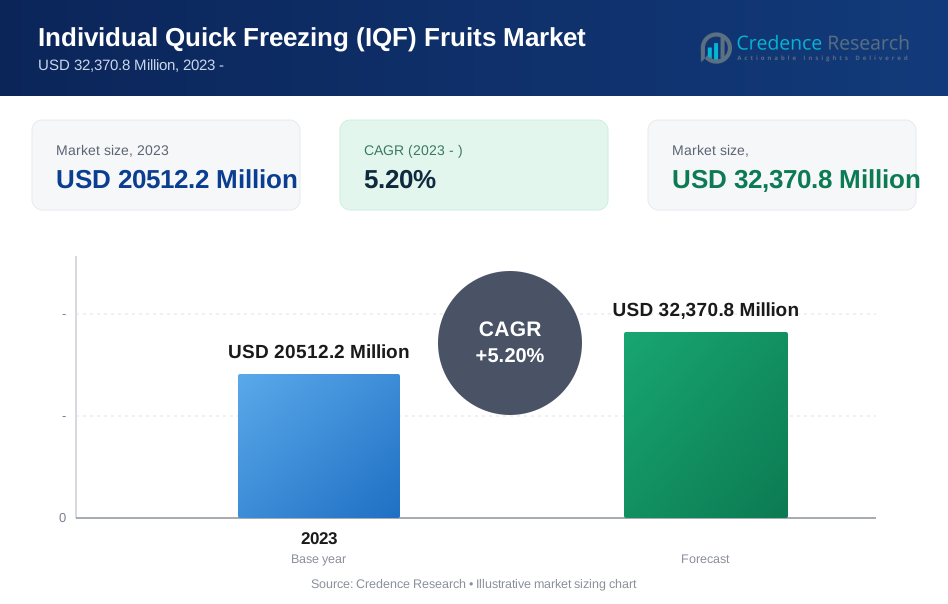
| Individual Quick Freezing (IQF) Fruits Market Size 2023 | USD 20512.2 Million |
| Individual Quick Freezing (IQF) Fruits Market, CAGR | 5.20% |
| Individual Quick Freezing (IQF) Fruits Market Size 2032 | USD 20512.2 Million |
Market Insights
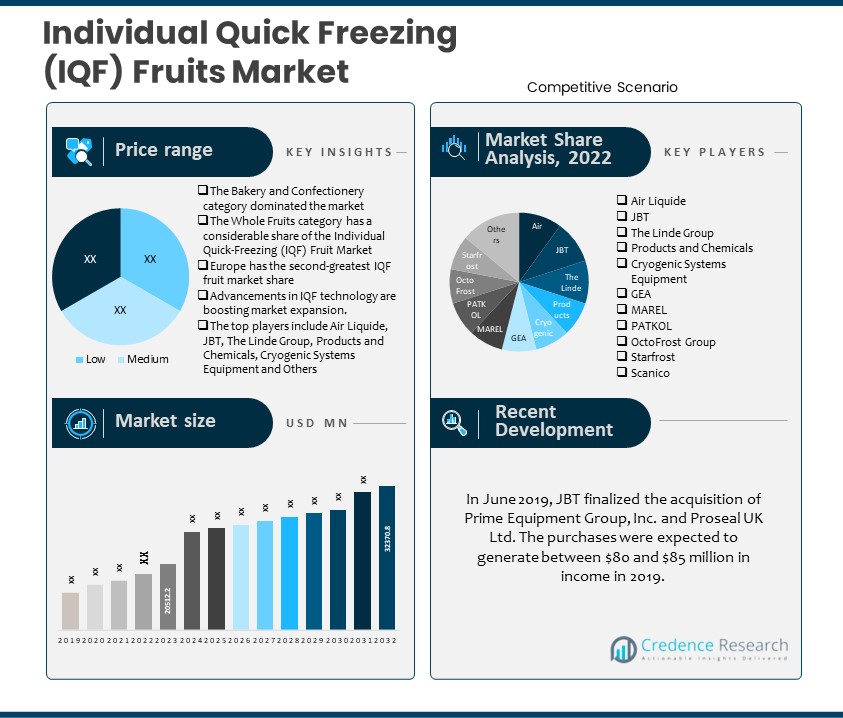
- The global demand for Individual Quick Freezing (IQF) Fruits was valued at USD 20512.2 Million in 2023 and is expected to reach USD 32370.8 Million in 2032, growing at a CAGR of 5.20% between 2024 and 2032.
- The Whole Fruits category has a substantial share of the Individual Quick-Freezing (IQF) Fruit Market. Another big market segment is Sliced/Chopped Fruits.
- The retail industry is projected to increase at a 7.8% CAGR over the forecast period, while the Food Service segment is also likely to grow significantly.
- The Bakery and Confectionery category dominated the market in 2023 and is expected to continue doing so throughout the forecast period. Additionally, the Desserts and Frozen Treats category is predicted to experience the strongest sales growth during the forecast period.
- In 2023, North America's IQF Fruits market accounted for 45% of total sales, while Europe had the second-largest IQF fruit market share.
- Increased demand for frozen food items fuels industry expansion.
- Inadequate infrastructure impedes market growth.
Executive Summary
Market Definition
Individual Quick Freezing (IQF) enables the quick freezing of food products while preventing crystal formation, which helps to keep food items dry when defrosted. IQF is beneficial for the long-term preservation of food goods, particularly perishable products like meat, fruits, and vegetables because it extends the shelf life while maintaining freshness. In fact, frozen food products contain more nutrients than fresh foods. Global food waste has risen considerably in recent years. According to a BCG estimate, 1.6 billion tonnes of food are wasted each year, accounting for over one-third of total world food output.
The majority of food products are affected across the whole food value chain, from manufacturing to consumption. The damage could occur during shipping or as a result of a food product expiring due to non-use. All of these factors have altered the food industry's demand pattern, which has switched from fresh to frozen food items. Producers are likewise shifting away from direct sales of farm-fresh vegetables and toward rapid freezing of food products. Furthermore, rapid advancements in supply chain infrastructure, particularly cold chain infrastructure in both developed and emerging countries, as well as digital supply chain technologies, have considerably aided the growth of the global IQF industry.
Market Overview
The global Individual Quick-Freezing (IQF) Fruit Market has witnessed steady growth in recent years and is expected to grow at a CAGR of 5.20% between 2024 and 2032. The market was valued at USD 20512.2 million in 2023 and is expected to reach USD 32370.8 million in 2032.
Rising demand for processed and frozen foods propels market expansion. The IQF industry is predicted to grow because of increased demand for processed and frozen foods, particularly in developed countries. This is because IQF technology helps to maintain food quality by retaining flavor, nutritional value, and freshness. Furthermore, technological advancements drive market expansion. The IQF market is projected to benefit from the processing equipment industry's constant technical advances. This is because modern technology helps processors increase operational efficiency while reducing waste.
Increased consumer awareness of the health benefits of frozen foods drives industry expansion. Consumers worldwide are becoming more aware of the health benefits of eating frozen foods. Frozen fruits and vegetables are a healthier option since they retain most of their nutrients even after being stored at low temperatures for an extended period.
However, the high energy consumption of Individual Quick Freezers, which results in high energy costs for manufacturers, stringent government regulations governing the entire quick freezing process, and large capital investments required for IQF infrastructure are critical market growth impediments. Furthermore, concerns about greenhouse gas emissions are projected to limit the industry's expansion.
Segmentation By Product Type
- The Whole Fruits category has a considerable share of the Individual Quick-Freezing (IQF) Fruit Market. This is because whole fruits are commonly employed in a variety of applications, including smoothies, sweets, and baking, making them a popular choice among customers.
- Another significant market area is Sliced/Chopped Fruits. Sliced or chopped fruits are easier to consume and cook, making them desirable to consumers searching for ready-to-use fruit options.
Segmentation by Distribution Channel
- The retail segment is predicted to grow at a 7.8% CAGR over the projection period. Customers want to inspect and assess products before purchase, which boosts retail sales of IQF fruits. Specialty stores provide exceptional customer service, complete product specifications, and professional counsel to consumers, increasing the selling of these products.
- Over the projection period, the Food Service segment is also expected to grow significantly.
Segmentation by End-Use/Application
- The Bakery and Confectionery category dominated the market in 2023 and is likely to continue to do so throughout the forecast period. Every day, the need for bakery and confectionery products grows due to changing lifestyles, an expanding population, and economic improvements. Rising urbanization and desire for ready-to-eat or quick meals are predicted to enhance bread and cereal sales. The incorporation of IQF fruits into baking and confectionery products is strengthening the IQF fruit market.
- The Desserts and Frozen Treats category is expected to see the fastest revenue growth throughout the forecast period.
Segmentation by Region
- In 2023, North America's IQF Fruits market accounted for 45% of total sales.
- Europe has the second greatest IQF fruit market share.
- The rest of the world, including Latin America, the Middle East, and Africa, supplies the remaining demand for Individual Quick Freezing (IQF) Fruits.
In North America, the IQF Fruits market had the largest revenue share in 2023. The North American IQF Fruits Market is being driven by fast-paced modern lifestyles that have led buyers to seek out convenient and hygienic fruit products that eliminate the traditional inconveniences of washing and slicing fresh fruits. Other variables include an increasing preference for healthier foods, innovations in packaging technology, and extended shelf life. Furthermore, the growing desire among food manufacturers to preserve food goods for a longer period so that they can be employed as a component in their final product is driving up demand for IQF fruits over the forecast period.
Moreover, Europe had the second-largest IQF fruit market share in 2023 and is likely to maintain its position during the forecast period. Customers' large purchasing power and economic stability are two of the most important reasons driving the expansion of the frozen food industry in Europe. Another factor driving market expansion is customers' hectic lifestyles, which boosts demand for convenience foods. The frozen ready-to-eat healthy breakfast niche has increased in popularity in recent years as health-conscious clients in the region have become more prevalent. Europe has been one of the most profitable markets for frozen food, particularly IQF fruits, due to the presence of several food and bakery enterprises.
Key Highlights of the Report
Product Type, Distribution Channel, End-Use/Application, and Region segment the global Individual Quick Freezing (IQF) Fruits Market. The bakery and confectionery category dominated the market in 2023, and the retail industry is expected to grow at the fastest CAGR throughout the projected period. In addition, the Whole Fruits category has a significant share. The Desserts and Frozen Treats category is predicted to enjoy the fastest sales increase throughout the forecast period and North America leading the market growth.
The market's primary drivers are increasing demand for healthy and convenient food options, a growing desire for natural and additive-free products, and technological developments in IQF technology that improve efficiency and quality. Furthermore, the primary restraints of the market are high initial investment costs for IQF equipment and technology, challenges in maintaining the nutritional content of fruits throughout the freezing process, and a short shelf life compared to alternative preservation methods. In addition, the expanding market for frozen fruits in the food industry and growing consumer awareness about the benefits of IQF fruits are the significant opportunities of the market.
In North America, the IQF Fruits market generated the most revenue in 2023. Fast-paced modern lifestyles are driving the North American IQF Fruits Market, with purchasers seeking for easy and hygienic fruit products that reduce the conventional difficulties of washing and slicing fresh fruits. Other factors include a growing preference for healthier meals, advances in packaging technology, and increased shelf life. Furthermore, Europe held the second-largest IQF fruit market share in 2023 and is expected to keep that position during the forecast period. Customers' high spending power and economic stability are two of the most important factors fueling the rise of the frozen food business in Europe.
What Are The Main Drivers Of The Global Individual Quick Freezing (IQF) Fruits Market?
Growing demand for frozen food products due to busy lifestyles, the rising popularity of convenience meals, and an increase in the number of fast-food restaurants are among the primary drivers of market revenue development.
What Are The Major Challenges Faced By The Global Individual Quick Freezing (IQF) Fruits Market?
The challenges include the high cost of IQF systems and the requirement for qualified operators to operate them are projected to limit market expansion. Furthermore, it is anticipated that the availability of alternative food processing technologies and a lack of uniformity in the IQF process may limit market growth during the projection period.
What Are The Growth Opportunities In The Global Individual Quick Freezing (IQF) Fruits Market?
The key market opportunity is increased R&D investments in IQF system efficiency improvements and carbon footprint reductions, which are likely to drive market revenue growth in the next years. Another factor driving market revenue development is an increase in demand for IQF systems with more capacity and efficiency in the food processing industry.
Market Drivers
Several factors drive the global Individual Quick Freezing (IQF) Fruits Market. The following are the key drivers of the global Individual Quick Freezing (IQF) Fruits Market:
Increasing Demand For Frozen Food Items
The growing demand for frozen food products around the world has increased manufacturers' interest in providing frozen food items due to their prolonged shelf life and quality. The benefits of cooking frozen food include a quick process and the prevention of huge ice crystals forming in the product cells. The increase in demand for frozen food items is expected to impact the operations of food product retailers and manufacturers. The growing preference of customers for nutritious foods with high nutritional content is driving the expansion of the individual quick-freezing industry.
Market Restraints
The global Individual Quick Freezing (IQF) Fruits Market faces some challenges that may hinder its growth. These include the following:
Lack Of Proper Infrastructure
A lack of sufficient infrastructure severely limits the Individual Quick Freezing (IQF) Fruits Market's expansion. Inadequate infrastructure, such as cold storage facilities and transportation systems, might make it difficult to maintain the IQF process's required temperature levels and preserve the quality of frozen fruits. This constraint can lead to logistical challenges, higher prices, and probable delays in delivering IQF fruits to consumers. Addressing this constraint by investing in appropriate infrastructure and logistical solutions is critical to ensuring the efficient production and delivery of IQF fruits, hence improving market competitiveness and efficiently addressing consumer needs.
Opportunities
The global Individual Quick Freezing (IQF) Fruits Market offers significant growth opportunities. These include the following:
Growing Consumer Demands For Storage Of Perishable Food
The growing consumer demand for perishable food storage in the Individual Quick Freezing (IQF) Fruits Market represents a substantial opportunity for the industry. As consumers seek more accessible and long-lasting food options, IQF technology's ability to retain the freshness and nutritional value of fruits becomes increasingly tempting. The simplicity of preserving perishable fruits while retaining quality drives the need for IQF fruits. This tendency is consistent with the current lifestyle, in which customers value convenience without sacrificing the health advantages of fresh fruit. The opportunity comes in meeting this demand by offering a diverse range of IQF fruits that meet customer expectations for quality, flavor, and convenience, hence driving growth in the IQF fruit industry.
Competitive Landscape
Key Players
The global Individual Quick Freezing (IQF) Fruits Market is highly competitive, with several key players. Some of the major players in the market and their market share are as follows:
- Air Liquide
- JBT
- The Linde Group
- Products and Chemicals
- Cryogenic Systems Equipment
- GEA
- Air and Messer Group
- MAREL
- PATKOL
- OctoFrost Group
- Starfrost
- Scanico.
These organizations prioritize product innovation, distribution channel expansion, and mergers and acquisitions to stay competitive.
The global Individual Quick Freezing (IQF) Fruits Market's key players continually seek to stay ahead by offering new products and developments.
In October 2019, MAREL announced the signing of an agreement to acquire a 50% stake in Curio. MAREL completed the first phase of the acquisition in November 2019, obtaining 40% of Curio.
In March 2020, Marel HF has announced the acquisition of Cedar Creek Company, a US-based poultry equipment company. The acquisition aims to broaden Marel's product range and boost its position in the US chicken industry.
In August 2020, Bühler AG has established a strategic relationship with Microsoft to use Microsoft's cloud and artificial intelligence (AI) technology to improve its digital offerings for consumers. The alliance sought to improve Bühler's portfolio and provide clients with creative solutions.
Summary of Key Findings
- Increasing customer demand for perishable food storage.
- Market segmented By Product Type, Distribution Channel, End-Use/Application, and region.
- Food Service segment is also likely to grow significantly.
- Desserts and Frozen Treats category is predicted to experience the strongest sales growth during the forecast period.
- North America is leading in market growth; the market is highly competitive with key players, including Air Liquide, JBT, The Linde Group, Products and Chemicals, Cryogenic Systems Equipment and Others.
Future Outlook
- Increasing desire for convenient and nutritious food options
- The increasing popularity of frozen fruits in the food business.
- Advancements in IQF technology are boosting market expansion.
- Growing consumer knowledge of the benefits of IQF fruits.
How CXOs Can Benefit from the Credence Research Individual Quick Freezing (IQF) Fruits Market Report
The Credence Research Individual Quick Freezing (IQF) Fruits Market Report provides CXOs with a comprehensive overview of the market, including:
- Market size and growth forecast: The report provides detailed estimates of the global Individual Quick Freezing (IQF) Fruits Market size, segmented By Product Type, Distribution Channel, End-Use/Application, and region. It also includes forecasts for the market through 2032 based on key trends and drivers.
- Market segmentation: The report segments the Individual Quick Freezing (IQF) Fruits Market By Type, Distribution Channel, End-Use/Application, and region. This segmentation provides CXOs with a granular understanding of the market and the opportunities in each segment.
- Competitive Landscape: The report profiles the key players in the Individual Quick Freezing (IQF) Fruits Market and provides insights into their strategies, product offerings, and financial performance. This information can help CXOs to identify and assess their competition.
- Key trends and drivers: The report identifies and analyzes the key trends and drivers that are shaping the Individual Quick Freezing (IQF) Fruits Market. This information can help CXOs to make informed decisions about their investments and strategies.
CXOs can use the insights from the Credence Research Individual Quick Freezing (IQF) Fruits Market Report to:
- Identify growth opportunities: The report can help CXOs to identify new growth opportunities in the Individual Quick Freezing (IQF) Fruits Market. For example, it can pinpoint emerging trends in industries like aerospace and automotive, helping executives make informed decisions on expanding their product lines or entering new market segments where Individual Quick Freezing (IQF) Fruits's properties can be leveraged for success.
- Make informed investment decisions: The report can help CXOs make informed investment decisions about Individual Quick Freezing (IQF) Fruits. For example, it can provide crucial insights into market trends, competitive landscape, and potential growth areas, empowering executives to allocate resources strategically and seize opportunities for maximizing returns on investments in the Individual Quick Freezing (IQF) Fruits sector.
- Develop competitive strategies: The report can help CXOs develop competitive strategies for their Individual Quick Freezing (IQF) Fruits businesses. For example, it can offer valuable insights into market trends, competitor analysis, and innovative End-Use/Applications of Individual Quick Freezing (IQF) Fruits, enabling executives to stay ahead of the competition and drive business growth in this dynamic industry.
- Track market developments: The report can help CXOs monitor market developments and stay ahead of the curve. For example, it provides insights into the latest trends and innovations in the Individual Quick Freezing (IQF) Fruits Market.
Overall, the Credence Research Individual Quick Freezing (IQF) Fruits Market Report is a valuable resource for CXOs who are looking to gain a deeper understanding of the market and identify opportunities for growth.
Segmentation
- By Product Type:
- Whole Fruits
- Sliced/Chopped Fruits
- Purees and Pulp
- Mixed Fruits
- By Distribution Channel:
- Retail
- Food Service
- Industrial/B2B
- By End-Use/Application:
- Bakery and Confectionery
- Desserts and Frozen Treats
- Beverages
- Snacks
- Food Preparation
- By Region
- North America
- The U.S.
- Canada
- Mexico
- Europe
- Germany
- France
- The U.K.
- Italy
- Spain
- Rest of Europe
- Asia Pacific
- China
- Japan
- India
- South Korea
- South-east Asia
- Rest of Asia Pacific
- Latin America
- Brazil
- Argentina
- Rest of Latin America
- Middle East & Africa
- GCC Countries
- South Africa
- Rest of the Middle East and Africa
- North America
Request a Free Sample
Fill in your details and we'll send you a free sample report.
- Sample data tables & charts
- Research methodology
Need a Custom Version of This Report?
Tailor the scope, geography, or segments to your exact requirements.
- Custom geography or segment scope
- Direct access to our analyst team
Frequently Asked Questions
What is the current size of the global Individual Quick Freezing (IQF) Fruits Market?
What is the expected growth rate of the Individual Quick Freezing (IQF) Fruits Market between 2024 and 2032?
Which segment is leading the market share in terms of End-Use/Application?
Which Product Type segment governs the demand for Individual Quick Freezing (IQF) Fruits in the world?
Who are the major players in the global Individual Quick Freezing (IQF) Fruits Market?
Table of Content
Chapter 1. Report Introduction
- 1.1 Report Description & Purpose
- 1.1.1 Report Title & Market Definition
- 1.1.2 Unique Selling Propositions (USP) & Key Differentiators
- 1.1.3 Value Proposition for Stakeholders
- 1.2 Research Objectives
- 1.2.1 Market Sizing Objectives (Volume & Revenue)
- 1.2.2 Segmentation Objectives
- 1.2.3 Competitive Intelligence Objectives
- 1.2.4 Forecast & Scenario Objectives
- 1.3 Report Scope
- 1.3.1 Individual Quick Freezing (IQF) Fruits Scope – Types & Subtypes Covered
- 1.3.2 Geographic Scope – Regions & Countries Covered
- 1.3.3 Historical Period, Base Year & Forecast Period (2023; forecast to the forecast period)
- 1.3.4 Inclusions & Exclusions
- 1.4 HS Code & Classification Framework
- 1.5 Currency, Units & Pricing Basis
- 1.6 Target Stakeholders
- 1.7 Limitations & Assumptions
Chapter 2. Executive Summary
- 2.1 Global Individual Quick Freezing (IQF) Fruits Market Snapshot
- 2.1.1 Market Size – Historical (2023) & Forecast (the forecast period) (2023: USD 20512.2 Million → forecast year: USD 32,370.8 Million)
- 2.1.2 Volume & Revenue – Global Totals
- 2.1.3 Key Market Highlights – Top Five Facts
- 2.2 Individual Quick Freezing (IQF) Fruits Market Segmentation Snapshot
- 2.2.1 Market Split by Region – 2023 vs.
- 2.3 Competitive Snapshot
- 2.3.1 Top 10 Players by Revenue Share – 2023
- 2.3.2 Top 10 Players by Volume Share – 2023
- 2.3.3 Recent Strategic Developments (18-Month Summary)
- 2.4 Key Investment Highlights & Strategic Conclusions
Chapter 3. Individual Quick Freezing (IQF) Fruits Market Dynamics & Industry Analysis
- 3.1 Market Overview & Context
- 3.1.1 Individual Quick Freezing (IQF) Fruits Market Position in the Broader Automotive Value Chain
- 3.1.2 OEM vs. Replacement Market Dynamics
- 3.1.3 Market Maturity & Development Stage by Region
- 3.2 Individual Quick Freezing (IQF) Fruits Market Drivers
- 3.3 Individual Quick Freezing (IQF) Fruits Market Restraints & Challenges
- 3.4 Individual Quick Freezing (IQF) Fruits Market Opportunities
- 3.5 Porter's Five Forces Analysis
- 3.5.1 Threat of New Entrants
- 3.5.2 Bargaining Power of Suppliers
- 3.5.3 Bargaining Power of Buyers
- 3.5.4 Threat of Substitutes
- 3.5.5 Competitive Rivalry – Intensity Assessment
- 3.6 Individual Quick Freezing (IQF) Fruits Value Chain Analysis
- 3.6.1 Upstream – Raw Material/Input Suppliers
- 3.6.1.1 Raw Material/Input 1
- 3.6.1.2 Raw Material/Input 2
- 3.6.1.3 Raw Material/Input 3
- 3.6.2 Midstream – Production/Manufacturing/Service Delivery
- 3.6.2.1 Production/Process Overview
- 3.6.2.2 Key Facility Locations & Capacity by Manufacturer
- 3.6.3 Downstream – Distribution & End Consumer
- 3.6.3.1 Primary Channel – B2B/OEM
- 3.6.3.2 Secondary Channels – Dealer, Retail, Online, Direct
- 3.6.4 Value Chain Profitability Analysis
- 3.6.1 Upstream – Raw Material/Input Suppliers
- 3.7 PESTEL Analysis
- 3.7.1 Political Factors
- 3.7.2 Economic Factors
- 3.7.3 Social Factors
- 3.7.4 Technological Factors
- 3.7.5 Environmental Factors
- 3.7.6 Legal Factors
- 3.8 Individual Quick Freezing (IQF) Fruits Supply Chain Analysis
- 3.8.1 Raw Material/Input Supply Risk Assessment
- 3.8.2 Manufacturing Concentration Risk (Geographic Exposure)
- 3.8.3 Trade Disruption Impact Analysis
- 3.9 Regulatory & Policy Landscape
Note: The regulatory and policy landscape section covers regulations based on their applicability to the market, Individual Quick Freezing (IQF) Fruits category, geography, and scope of the study. Only regulatory frameworks with a material impact on operations, compliance, trade, sustainability, or market access are analyzed in detail.
Chapter 4. Key Investment Pockets & Opportunity Analysis
- 4.1 Individual Quick Freezing (IQF) Fruits Market Attractiveness Analysis
- 4.1.1 By Region – Investment Attractiveness Matrix (Volume × CAGR)
- 4.2 Absolute Revenue Growth Opportunity
- 4.2.1 By Region – Absolute USD Growth Through the forecast period
- 4.3 Incremental Volume Opportunity
- 4.3.1 By Region – Incremental Volume Through the forecast period
- 4.3.2 Segment – Incremental Volume
- 4.4 Emerging Submarket Opportunity Deep Dive (Subject to Applicability)
- 4.5 Emerging Market Opportunity Scorecards
- 4.5.1 United States
- 4.5.2 Europe
- 4.5.3 Asia
- 4.5.4 Middle East & Africa
Note: Emerging Market Opportunity Scorecards will be included based on relevance and strategic importance. Regions listed are indicative and may vary depending on data availability and market dynamics.
Chapter 5. Individual Quick Freezing (IQF) Fruits Import-Export Analysis & Trade Flows
- 5.1 Global Trade Overview
- 5.1.1 Global Export Value by Country (2023)
- 5.1.2 Global Export Volume by Country (2023)
- 5.1.3 Global Import Value by Country (2023)
- 5.1.4 Global Import Volume by Country (2023)
- 5.1.5 Net Trade Balance by Country (2023)
- 5.2 Export Analysis – Segment
- 5.2.1 Type 1 (HS Code)
- 5.2.2 Type 2 (HS Code)
- 5.2.3 Type 3 (HS Code)
- 5.2.4 Type 4 (HS Code)
- 5.2.5 Type 5 (HS Code)
- 5.3 Import Analysis – Segment
- 5.3.1 Type 1 (HS Code)
- 5.3.2 Type 2 (HS Code)
- 5.3.3 Type 3 (HS Code)
- 5.3.4 Type 4 (HS Code)
- 5.3.5 Type 5 (HS Code)
- 5.4 Average Unit Trade Prices
- 5.4.1 Average Export Price – Segment & Country
- 5.4.2 Average Import Price – Segment & Source Country
- 5.4.3 Price Trends (2023)
- 5.5 Key Trade Route Analysis
- 5.5.1 Trade Route 1
- 5.5.2 Trade Route 2
- 5.5.3 Trade Route 3
- 5.5.4 Trade Route 4
- 5.5.5 Trade Route 5
- 5.6 Trade Policy Impact Assessment
- 5.6.1 US Anti-Dumping & Section 301 Tariffs
- 5.6.2 EU Customs Union Impact
- 5.6.3 Major Free Trade Agreements
- 5.6.4 USMCA Rules of Origin
Note: Trade policy analysis will be included only where relevant to the Individual Quick Freezing (IQF) Fruits market.
Chapter 6. Competitive Landscape & Company Benchmarking
- 6.1 Individual Quick Freezing (IQF) Fruits Market Concentration & Structure
- 6.1.1 Herfindahl-Hirschman Index (HHI) – vs. 2023
- 6.1.2 Tier 1, Tier 2 & Tier 3 Market Structure
- 6.1.3 Global, Regional & Local Player Dynamics
- 6.2 Individual Quick Freezing (IQF) Fruits Market Share Analysis – 2023
- 6.2.1 Global Revenue Share by Company
- 6.2.2 Global Volume Share by Company
- 6.2.3 Regional Revenue Share
- 6.2.4 Market Share Evolution ( vs. 2023)
- 6.2.5 OEM Segment Share by Company
- 6.2.6 Replacement Segment Share by Company
- 6.3 Production/Delivery Capacity & Facility Analysis
- 6.3.1 Global Installed Capacity
- 6.3.2 Capacity Utilization Rates
- 6.3.3 Production/Output Volume
- 6.3.4 Facility Locations & Capacity Map
- 6.3.5 Planned Capacity Additions
- 6.4 Individual Quick Freezing (IQF) Fruits Competitive Benchmarking Matrix
- 6.4.1 Revenue, Volume, CAGR & Profitability Comparison
- 6.4.2 Channel Revenue Mix
- 6.4.3 Geographic Revenue Exposure
- 6.4.4 R&D Intensity
- 6.4.5 Sustainability Maturity
- 6.5 Strategic Developments in Individual Quick Freezing (IQF) Fruits (Last 24 Months)
- 6.5.1 Mergers, Acquisitions & Divestments
- 6.5.2 New Individual Quick Freezing (IQF) Fruits Launches
- 6.5.3 Facility Expansions
- 6.5.4 Strategic Alliances, Joint Ventures & Partnerships
- 6.5.5 Distribution Expansion & Market Entry
- 6.5.6 Sustainability & ESG Initiatives
- 6.6 Competitive Strategy Mapping
- 6.6.1 Leader, Challenger, Follower & Niche Classification
- 6.6.2 Pricing Strategy Comparison
- 6.6.3 Channel Strategy Matrix
Note: Strategic developments are included based on their materiality and the availability of reliable information.
Chapter 7. Global Individual Quick Freezing (IQF) Fruits Market – By Distribution Channel
- 7.1 Segment Overview
- 7.1.1 Volume & Revenue Split by Channel (2023 & )
- 7.1.2 Channel Mix Evolution (the forecast period)
Chapter 8. Regional Market Analysis – Global Overview
- 8.1 Global Regional Overview
- 8.1.1 Regional Volume Share
- 8.1.2 Regional Revenue Share
- 8.1.3 Regional Volume by Region
- 8.1.4 Regional Revenue by Region
- 8.1.5 Regional Forecast Through the forecast period
- 8.2 Cross-Regional Segment Analysis
- 8.2.1 By Distribution Channel
- 8.2.2 By Brand/Price Tier
Chapter 9. North America Individual Quick Freezing (IQF) Fruits Market
- 9.1 United States
- 9.2 Canada
- 9.3 Mexico
Chapter 10. Europe Individual Quick Freezing (IQF) Fruits Market
- 10.1 Germany
- 10.2 France
- 10.3 Italy
- 10.4 United Kingdom
- 10.5 Spain
- 10.6 Poland
- 10.7 Russia
- 10.8 Netherlands
- 10.9 Belgium
- 10.10 Sweden
- 10.11 Denmark
- 10.12 Norway
- 10.13 Rest of Europe
Chapter 11. Asia Pacific Individual Quick Freezing (IQF) Fruits Market
- 11.1 China
- 11.2 India
- 11.3 Japan
- 11.4 South Korea
- 11.5 Thailand
- 11.6 Indonesia
- 11.7 Vietnam
- 11.8 Malaysia
- 11.9 Australia
- 11.10 Rest of Asia Pacific
Chapter 12. Latin America Individual Quick Freezing (IQF) Fruits Market
- 12.1 Brazil
- 12.2 Argentina
- 12.3 Colombia
- 12.4 Chile
- 12.5 Rest of Latin America
Chapter 13. Middle East Individual Quick Freezing (IQF) Fruits Market
- 13.1 Saudi Arabia
- 13.2 United Arab Emirates
- 13.3 Turkey
- 13.4 Israel
- 13.5 Iran
- 13.6 Rest of the Middle East
Chapter 14. Africa Individual Quick Freezing (IQF) Fruits Market
- 14.1 South Africa
- 14.2 Egypt
- 14.3 Nigeria
- 14.4 Morocco
- 14.5 Rest of Africa
Chapter 15. Individual Quick Freezing (IQF) Fruits Company Profiles
- 15.1 [Company 01]
- 15.1.1 Company Overview
- 15.1.2 Key Management Personnel
- 15.1.3 Products & Services Portfolio
- 15.1.4 Financial Performance
- 15.1.5 Key Market Focus & Geographic Presence
- 15.1.6 Recent Developments & Strategic Initiatives
Note: The company profile list is preliminary and may change based on research findings, market developments, data availability, and client requirements.
Chapter 16. Appendices
- Appendix A – List of Abbreviations & Acronyms
- Appendix B – Industry Classification Code Reference – Full Series
- Appendix C – Production & Capacity Data Tables
- Appendix D – End-Use & Demand Base Tables
- Appendix E – Consumption & Replacement Rate Assumptions
- Appendix F – ASP Reference Tables
- Appendix G – Manufacturing & Facility Database
- Appendix H – Import-Export Data Tables
- Appendix I – Regulatory Summary Tables
- Appendix J – Primary Research Participant List (Anonymized)
- Appendix K – Primary Research Questionnaire Framework
- Appendix L – Data Sources & Bibliography
- Appendix M – Market Size Divergence & Source Comparison
Chapter 17. Research Methodology
- 17.1 Research Framework & Philosophy
- 17.2 Secondary Research – Sources, Hierarchy & Data Extraction
- 17.3 Data Modeling – Bottom-Up & Top-Down Market Sizing
- 17.4 Primary Research – Stakeholder Framework, LOI & Sample Sizes
- 17.5 Forecast Methodology – Regression, Scenario & Sensitivity Analysis
- 17.6 Quality Control – Four-Layer Validation Framework
- 17.7 Limitations & Standard Assumptions
- 17.8 Disclaimer
