
| REPORT ATTRIBUTE | DETAILS |
|---|---|
| Historical Period | 2019-2022 |
| Base Year | 2023 |
| Forecast Period | 2024-2032 |
| Food And Beverages Nano-Enabled Packaging Market Size 2023 | USD 16848.2 Million |
| Food And Beverages Nano-Enabled Packaging Market, CAGR | 13.50% |
| Food And Beverages Nano-Enabled Packaging Market Size 2032 | USD 52664.29 Million |
Market Insights
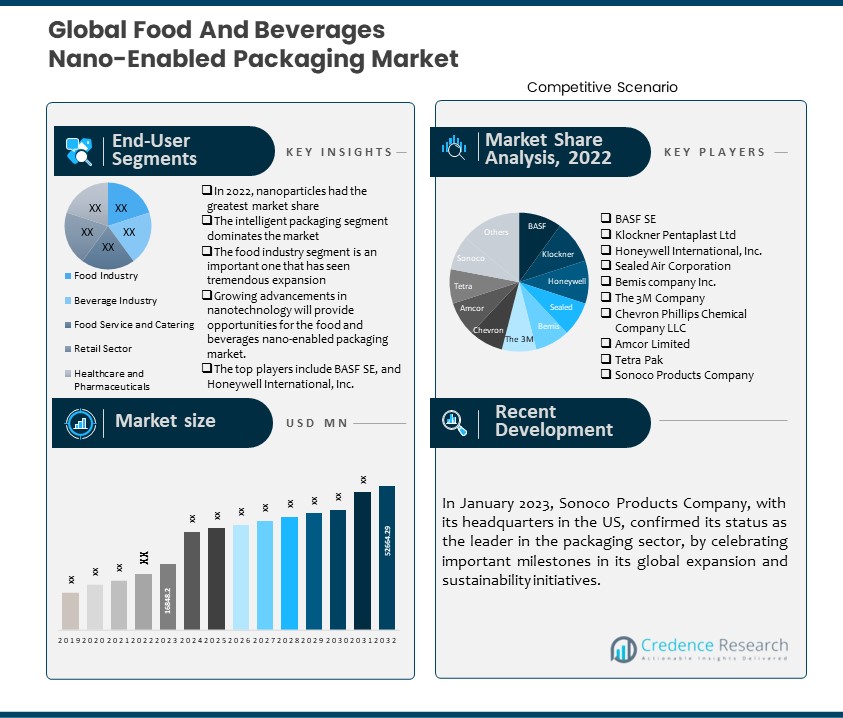
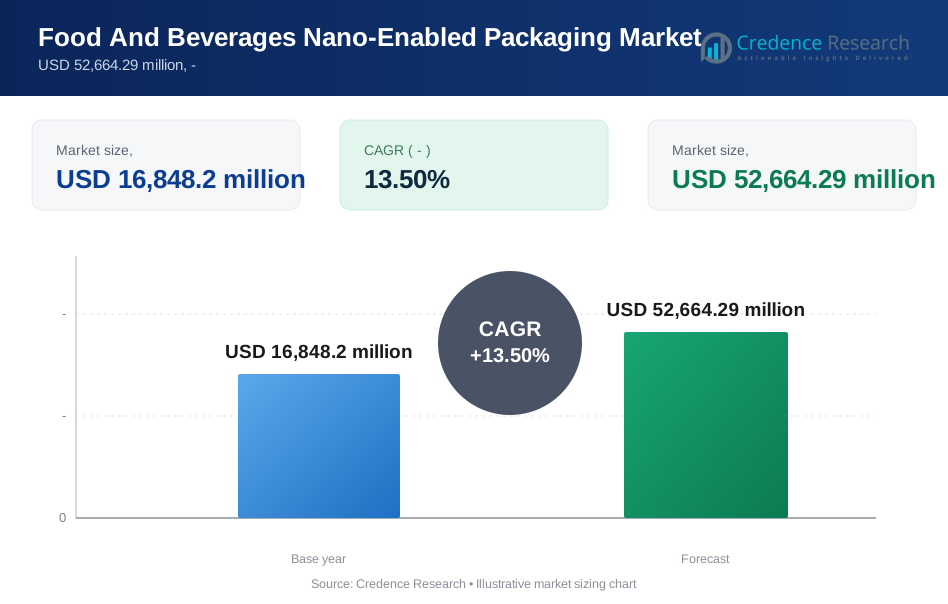
- The global market for food and beverages nano-enabled packaging is expected to develop at a compound annual growth rate (CAGR) of 13.50% between 2024 and 2032, from its estimated USD 16848.2 million in 2023 to USD 52664.29 million in 2032.
- The largest category is nanoparticles. Nanocomposites, on the other hand, are expected to grow at a strong CAGR.
- The intelligent packaging category will expand at a rapid rate of growth.
- The CAGR for the food industry is expected to be the highest during the projection period.
- Asia Pacific dominated the food and beverages nano-enabled packaging market.
- Regarding the market share of food and beverages nano-enabled packaging, Europe is expected to come second.
- In the food and beverages nano-enabled packaging market, North America is anticipated to grow fastest.
- The sector is increasing due to the rising demand for higher funding for R&D and for transparency and traceability.
- The need for sophisticated packaging solutions is rising as emerging countries become more conscious of food safety and sustainability. Companies have the opportunity to take advantage of this trend and increase their market share internationally with nano-enabled packaging.
Executive Summary
Market Definition
The market for food and beverage nano-enabled packaging is the area of the packaging industry that uses nanotechnology to improve food and beverage goods' safety, shelf life, and preservation. This technology manipulates materials at the nanoscale to accomplish desired features, including barrier protection, antibacterial activities, and freshness preservation. By providing cutting-edge solutions for packaging applications in the food and beverage industry, nano-enabled packaging seeks to address issues with food safety, quality maintenance, and sustainability.
Market Overview
The food and beverages nano-enabled packaging sector is estimated to develop at a 13.50% compound annual growth rate (CAGR) between 2024 and 2032, maintaining its current upward trend. The market will continue to develop, rising from its estimated USD 16848.2 million in 2023 to USD 52664.29 million in 2032.
Nanomaterials with a diameter of less than 100 nanometers are used in nano-enabled packaging to create effective packaging solutions. The food and beverage as well as pharmaceutical industries are starting to adopt nano-enabled packaging because it increases the shelf life of the product, gives consumers correct information, and regulates the material's moisture, pH, temperature, and freshness. The increasing demand for packaging, which is possible through nanotechnology, is another result of customers' shifting consumption habits. It successfully creates a barrier against light and UV radiation, preserving food quality and nutrients. The industry is expected to increase as a result of rising demand for processed foods that have a short shelf life and can be packaged using nanotechnology. The government's initiatives and ongoing investments to apply nanotechnologies in various applications will create lucrative growth prospects during the estimated timeframe.
The primary drivers of the market's expansion are the shift in customer preferences toward clean food and the increasing digitization of food records. The consumption of meat, fresh fruits, and vegetables is rising quickly in many nations across the world. In order to preserve the quality of these foods, shield them from outside influences, and extend their shelf life for future use, their manufacturers are compelled to employ packaging that is enabled by nanotechnology. Consumer convenience is increased by the use of nanoparticles, including nano clay, titanium, and silver, as well as intelligent packaging techniques like barcodes and RFID. The need for films and blisters with nano-enabled packaging is increasing due to the pharmaceutical industry's growth and the need to shield its medications from light, moisture, and air. All of these reasons contribute to the global market expansion of food and beverage nano-enabled packaging.
Segmentation by Type of Nanomaterials
- Nanoparticles are the market leader in terms of type of nanomaterials. Antimicrobial nanoparticles, such as zinc oxide and silver nanoparticles, are utilized in packaging materials to prevent the growth of mold, bacteria, and fungi on food surfaces. This contributes to preserving product quality throughout the supply chain and enhancing food safety.
- The nanocomposites category will exhibit a sizable CAGR during the projected period. Barrier films and coatings that can be put to the surface of packaging materials to enhance their barrier qualities are made using nanocomposites. These films and coatings extend the shelf life and improve the quality of packaged food and beverages by adding another layer of defense against moisture, oxygen, and other gases.
- Other types of nanomaterials, including nanocoatings, nanoencapsulation, nanofibers, nanotubes, and nanoporous materials, influence the need for food and beverage nano-enabled packaging.
Segmentation by Functionality and Applications
- Intelligent packaging is considered the best functionality and applications category. It monitors variables, including moisture content, gas concentrations, and microbiological activity, to provide indicators of product integrity and quality. This allows for early identification of quality problems and quick action to stop contamination or product spoiling.
- The active packaging category will likely register a significant CAGR during forecasting. Nanotechnology makes the creation of smart release mechanisms in active packaging materials possible. These systems release active compounds, such as antioxidants or antimicrobials, as necessary to maintain product quality in response to environmental cues like temperature, pH, or microbial activity.
- Other functionalities and applications, such as barrier enhancement, antimicrobial packaging, sustainable packaging, nano-enhanced labels, and tags, packaging for functional foods, beverage packaging innovations, and nanotechnology in food contact materials, also contribute to the demand for food and beverages nano-enabled packaging.
Segmentation by End-User Segments
- The food industry category is projected to grow faster over the projection period. Food producers and manufacturers mostly utilize nanotechnology-enabled packaging solutions to package and safeguard their food and beverage products during distribution, storage, and transit. Nanotechnology-enabled packaging aids in maintaining product freshness, increasing shelf life, and guaranteeing food safety.
- Other end-user segments, including the beverage industry, food service and catering, retail sector, and healthcare and pharmaceuticals, influence the need for food and beverage nano-enabled packaging.
Segmentation by Region
- Asia Pacific leads the food and beverage nano-enabled packaging industry. Due to factors like smartphone adoption and digitalization, nano-enabled packaging solutions that can withstand the demands of online shipping and delivery while retaining product integrity are becoming increasingly popular in Asia Pacific.
- Europe is estimated to rank second in market size for food and beverages nano-enabled packaging.
- The food and beverages nano-enabled packaging industry is predicted to flourish rapidly in North America.
- Regions like Latin America, the Middle East, and Africa meet the remaining need for nano-enabled food and beverage packaging.
The factors supporting the food and beverages nano-enabled packaging market include increasing consumer preference for fresh and minimally processed food, urbanization and changing lifestyles, and growing e-commerce trends.
Based on projections, Asia Pacific is anticipated to control the food and beverages nano-enabled packaging market. Due to the huge and constantly growing population in the Asia Pacific region, there is a growing demand for food and beverages. By offering solutions for food safety, freshness, and convenience, nano-enabled packaging can assist satisfy the needs of this expanding market. Asia Pacific consumers are demanding safer and better food options due to rising health and fitness awareness. To cater to consumer tastes, packaging that is enabled by nanotechnology can improve food safety, prolong its shelf life, and maintain its nutritional value.
Moreover, North America is anticipated to increase at a high rate over the projection period. The intelligent packaging industry is expected to grow more rapidly in North America as a result of various strict rules related to active packaging. Intelligent packaging has seen early adoption and significant market share in North America. The market for intelligent packaging is seeing significant growth, which is anticipated to continue during the forecast period, as an increasing number of Americans are switching from junk food to fresh foods for breakfast. Furthermore, throughout the projection period, there will probably be extremely profitable opportunities due to the expanding need for clever packaging in the global fruit trade.
Key Highlights of the Report
The global food and beverage nano-enabled packaging market is segmented by type of nanomaterials, functionality and applications, end-user segments, and region. As far as the type of nanomaterials is concerned, nanoparticles are the market spearhead. Intelligent packaging is the top functionality and applications category. Throughout the projection period, the food industry category is expected to grow at the greatest CAGR. The food and beverages nano-enabled packaging market is expanding mostly in Asia Pacific.
Innovative package shapes that improve convenience, like stackable containers, films that resist tearing, and easy-open seals, can be developed due to nanotechnology. These qualities make it easier for customers to handle, store, and consume products, increasing their convenience in using and enjoying their favorite meals and beverages. The demand for practical packing solutions that can survive the rigors of online shipping and delivery has increased due to the growth of e-commerce and home delivery services. The convenience of online shopping for food and beverage products is increased by the availability of strong, protective packaging alternatives that preserve product integrity and freshness during transit due to nano-enabled packaging materials.
Asia Pacific is expected to account for the largest food and beverages nano-enabled packaging market globally. Asia-Pacific nations, especially China, Japan, and South Korea, are making significant investments in nanotechnology research and development. The development of cutting-edge packaging materials enabled by nanotechnology and customized to the demands of the food and beverage sector is being driven by this investment. The North American region is also assumed to have the sharpest growth in the market. North America is witnessing a shift toward healthier food and beverage options, much like other regions. Health-conscious consumers might be satisfied by items that have their freshness and nutritional content preserved thanks to packaging that is possible by nanotechnology. As environmental sustainability becomes more important in North America, there is a greater need for eco-friendly packaging options. Recyclable and biodegradable packaging materials with nanotechnology offer ways to overcome these environmental issues.
Which Key Factors Are Driving The Global Food And Beverages Nano-Enabled Packaging Market?
The food and beverages nano-enabled packaging market is expanding due to a number of factors, including increased demand for convenience, extended shelf life of food and beverages, improved food safety, technological advancements, and lightweight packaging.
What Are The Main Challenges Confronting The Global Food And Beverages Nano-Enabled Packaging Market?
The initial investment required for developing and implementing nano-enabled packaging solutions, perception of risk, limited consumer awareness, regulatory hurdles, and supply chain complexity are the main barriers to the sector's expansion.
What Market Opportunities Exist For Food And Beverages Nano-Enabled Packaging Globally?
The factors creating opportunities for the food and beverages nano-enabled packaging market include growing demand for sustainable packaging, increased product differentiation, advancements in nanotechnology, and customization and personalization.
Market Drivers
Multiple factors propel the food and beverages nano-enabled packaging industry across the globe. The primary factors propelling the global food and beverages nano-enabled packaging market are as follows:
Growing Consumer Demand for Packaged Food in Developing Countries Due to Improved Lifestyle
Food packaging with nanotechnology is a relatively new and innovative method that can prolong food shelf life, guarantee food safety, prevent rotting, repair rips in the packaging, lessen food scarcity issues, and ultimately enhance people's health. Food packaging that incorporates nanoparticles may notify consumers about the product's safety. Preservatives can be released to extend the shelf life of food in packaging. At the moment, the food industry's share of nanotechnology research is primarily focused on food packaging and tracking. Since nanotechnology can generate about 25% of all food packaging in the near future, it is anticipated that it will have enormous applications in the food sector. Additionally, nanotechnology technologies are used in the food industry to detect bacteria in packaging or to improve barrier features such as taste, color uniformity, and protection. Numerous nanomaterials are used in food packaging as useful additives, including silver, titanium nitride, nano-titanium dioxide, nano-zinc oxide, and nanoclay.
Market Restraints
There are several obstacles that the global food and beverages nano-enabled packaging market must overcome to continue growing. Among them are the following:
The Initial Investment Required for Developing and Implementing Nano-Enabled Packaging Solutions
Extensive research and development (R&D) is required to improve formulations, test for safety and efficacy, and scale up production processes in order to develop nano-enabled packaging materials. Investing in nano-enabled packaging solutions may be discouraged for businesses, particularly smaller ones, due to the significant research and development expenses. The production of packaging materials with nanotechnology often calls for specialized infrastructure and equipment, like cleanrooms and cutting-edge processing techniques. Establishing these kinds of facilities requires large capital outlays, which can be unaffordable for businesses lacking the required funding. The process of transferring nanotechnology-enabled packaging materials from the laboratory to the commercial sphere can be complex and expensive. Organizations may need help with process optimization, quality control, and production efficiency, resulting in supplementary expenditures on facilities, personnel, and equipment.
Opportunities
There are plenty of potential prospects in the global food and beverages nano-enabled packaging industry. Among these are the following:
Growing Advancements in Nanotechnology
Packaging materials with higher barrier qualities, such as increased resistance to moisture, oxygen, and other gases, can now be developed due to nanotechnology. This contributes to preserving product freshness and quality, decreasing food waste, and increasing the shelf life of food and beverages. It is possible to develop nanomaterials with antimicrobial properties, which prevent the growth of fungi, mold, and bacteria on the surfaces of food packaging. This lowers the possibility of contamination during storage and transit and improves food safety. The creation of active packaging solutions that actively interact with food and drinks to increase shelf life and enhance product quality is made possible by nanotechnology. For instance, food freshness or spoiling changes can be detected and signaled using nanosensors incorporated into packaging materials. The incorporation of intelligent features, such as RFID tags, time-temperature sensors, and temperature indicators, into package materials is made easier by nanotechnology. Through real-time product tracking and monitoring across the supply chain, these smart packaging solutions improve traceability and transparency.
Competitive Landscape
Key Players
Several major competitors exist in the fiercely competitive global food and beverages nano-enabled packaging market. The following are a few of the leading market participants and their market shares:
- BASF SE
- Klockner Pentaplast Ltd
- Honeywell International, Inc.
- Sealed Air Corporation
- Bemis Company Inc.
- The 3M Company
- Chevron Phillips Chemical Company LLC
- Amcor Limited
- Tetra Pak
- Sonoco Products Company
- Others
These companies prioritize product innovation, distribution channel expansion, mergers, and acquisitions to remain competitive.
The most significant suppliers in the global market for food and beverages nano-enabled packaging consistently strive to keep one step ahead of the competition by creating novel ideas and goods.
In March 2023, Amcor, a world leader in producing environmentally friendly packaging solutions, and Nfinite Nanotechnology Inc. announced a collaborative research project agreement. The collaboration is a pilot program designed to test the application of Nfinite's nanocoating technology and enhance Amcor's recyclable and compostable packaging options.
In January 2021, BASF SE announced that it would begin producing packaging coatings in South China. This announcement was made as a calculated move to increase its market share and fortify its position in the area.
In March 2020, The InvisiShield platform technology was launched by Aptar Food + Beverage, a global leader in a comprehensive range of premium active packaging systems & processing equipment. It is a flawlessly integrated anti-pathogenic packaging system that guards fresh-cut produce against dangerous pathogens like bacteria, viruses, and fungi.
Summary of Key Findings
- The food and beverages nano-enabled packaging market continues to grow due to rising consumer preference toward minimally processed, fresh food.
- The market is segmented by type of nanomaterials, functionality, and applications, end-user segments, and region.
- In the market, nanoparticles are the most widely used type of nanomaterials.
- Intelligent packaging is the foremost functionality and applications category.
- The food industry category is expected to grow fastest in terms of CAGR during the forecast period.
- Asia Pacific is leading market development; the market is highly competitive with key players including BASF SE, Klockner Pentaplast Ltd, Honeywell International, Inc., Sealed Air Corporation, Bemis Company Inc., The 3M Company, Chevron Phillips Chemical Company LLC, Amcor Limited, Tetra Pak, Sonoco Products Company, and Others.
Future Outlook
- The food and beverages nano-enabled packaging industry is expected to increase significantly in Asia Pacific, and its outlook is positive worldwide.
- The increased demand for convenience is one of the key reasons for boosting the market for the food and beverages nano-enabled packaging industry.
- The high implementation costs for food and beverage nano-enabled packaging might significantly challenge the market's expansion during the projected period.
- To stay ahead of the competition, key enterprises must develop new products, expand their market reach, and keep their prices competitive.
How CXOs Can Benefit from the Credence Research Food and Beverages Nano-Enabled Packaging Market Report
CXOs may get a detailed picture of the market in the Credence Research Food and Beverages Nano-Enabled Packaging Market Report, which includes:
- Market size and growth forecast: The report provides detailed estimates of the global food and beverages nano-enabled packaging market size, segmented by type of nanomaterials, functionality and applications, end-user segments, and region. It also includes forecasts for the market through 2032 based on key trends and drivers.
- Market segmentation: The research report breaks down the market for food and beverages nano-enabled packaging into segments based on the type of nanomaterials, functionality and applications, end-user segments, and region. This segmentation provides CXOs with a granular understanding of the market and the opportunities in each segment.
- Competitive landscape: The research report offers a detailed analysis of the major companies in the food and beverages nano-enabled packaging industry, including information on their business plans, product lines, and earnings. CXOs can use this information to evaluate and identify their competitors.
- Key trends and drivers: The research report identifies and evaluates the main trends and factors influencing the food and beverages nano-enabled packaging market. CXOs can use this information to make well-informed choices regarding their plans and investments.
CXOs can use the insights from the Credence Research Food and Beverages Nano-Enabled Packaging Market Report to:
- Identify growth opportunities: This analysis may help CXOs identify new growth opportunities in the food and beverages nano-enabled packaging sector. For example, the report identifies the growing demand for nano-enabled packaging from the food and beverage industry as a key opportunity.
- Make informed investment decisions: The report helps CXOs make wise choices regarding food and beverages nano-enabled packaging. For example, the research study provides information on the critical factors to consider when selecting food and beverage nano-enabled packaging solutions and evaluating suppliers.
- Develop competitive strategies: CXOs can use the research report to develop competitive strategies for their food and beverages nano-enabled packaging businesses. For example, the research paper outlines the main strategies that food and beverage nano-enabled packaging suppliers utilize to differentiate themselves from competitors.
- Track market developments: This research report may help CXOs stay ahead of the curve by tracking market developments. For instance, it offers insights into the most recent developments and trends in the food and beverages nano-enabled packaging market.
CXOs seeking to expand their industry knowledge and spot growth prospects will find the Credence Research Food and Beverages Nano-Enabled Packaging Market Report useful.
Segmentation
- By Type of Nanomaterials
- Nanocomposites
- Nanocoatings
- Nanoencapsulation
- Nanofibers
- Nanoparticles
- Nanotubes and Nanoporous Materials
- By Functionality and Applications
- Barrier Enhancement
- Active Packaging
- Intelligent Packaging
- Antimicrobial Packaging
- Sustainable Packaging
- Nano-Enhanced Labels and Tags
- Packaging for Functional Foods
- Beverage Packaging Innovations
- Nanotechnology in Food Contact Materials
- By End-User Segments
- Food Industry
- Beverage Industry
- Food Service and Catering
- Retail Sector
- Healthcare and Pharmaceuticals
- By Region
- North America
- The U.S.
- Canada
- Mexico
- Europe
- Germany
- France
- The U.K.
- Italy
- Spain
- Rest of Europe
- Asia Pacific
- China
- Japan
- India
- South Korea
- South-east Asia
- Rest of Asia Pacific
- Latin America
- Brazil
- Argentina
- Rest of Latin America
- Middle East & Africa
- GCC Countries
- South Africa
- The Rest of the Middle East and Africa
- North America
Request a Free Sample
Fill in your details and we'll send you a free sample report.
- Sample data tables & charts
- Research methodology
Need a Custom Version of This Report?
Tailor the scope, geography, or segments to your exact requirements.
- Custom geography or segment scope
- Direct access to our analyst team
Frequently Asked Questions
How much does the global market currently hold for food and beverages nano-enabled packaging?
What is the food and beverages nano-enabled packaging market's projected growth rate between 2024 and 2032?
In terms of the type of nanomaterials, which market category is leading?
Regarding functionality and applications, which market category is in the lead?
Who are the main players in the global food and beverages nano-enabled packaging industry?
Table of Content
Chapter 1. Report Introduction
- 1.1 Report Description & Purpose
- 1.1.1 Report Title & Market Definition
- 1.1.2 Unique Selling Propositions (USP) & Key Differentiators
- 1.1.3 Value Proposition for Stakeholders
- 1.2 Research Objectives
- 1.2.1 Market Sizing Objectives (Volume & Revenue)
- 1.2.2 Segmentation Objectives
- 1.2.3 Competitive Intelligence Objectives
- 1.2.4 Forecast & Scenario Objectives
- 1.3 Report Scope
- 1.3.1 Food And Beverages Nano-Enabled Packaging Scope – Types & Subtypes Covered
- 1.3.2 Geographic Scope – Regions & Countries Covered
- 1.3.3 Historical Period, Base Year & Forecast Period (the historical period; forecast to the forecast period)
- 1.3.4 Inclusions & Exclusions
- 1.4 HS Code & Classification Framework
- 1.5 Currency, Units & Pricing Basis
- 1.6 Target Stakeholders
- 1.7 Limitations & Assumptions
Chapter 2. Executive Summary
- 2.1 Global Food And Beverages Nano-Enabled Packaging Market Snapshot
- 2.1.1 Market Size – Historical (the historical period) & Forecast (the forecast period) (base year: USD 16,848.2 million → forecast year: USD 52,664.29 million)
- 2.1.2 Volume & Revenue – Global Totals
- 2.1.3 Key Market Highlights – Top Five Facts
- 2.2 Food And Beverages Nano-Enabled Packaging Market Segmentation Snapshot
- 2.2.1 Market Split by Region – vs.
- 2.3 Competitive Snapshot
- 2.3.1 Top 10 Players by Revenue Share –
- 2.3.2 Top 10 Players by Volume Share –
- 2.3.3 Recent Strategic Developments (18-Month Summary)
- 2.4 Key Investment Highlights & Strategic Conclusions
Chapter 3. Food And Beverages Nano-Enabled Packaging Market Dynamics & Industry Analysis
- 3.1 Market Overview & Context
- 3.1.1 Food And Beverages Nano-Enabled Packaging Market Position in the Broader Automotive Value Chain
- 3.1.2 OEM vs. Replacement Market Dynamics
- 3.1.3 Market Maturity & Development Stage by Region
- 3.2 Food And Beverages Nano-Enabled Packaging Market Drivers
- 3.3 Food And Beverages Nano-Enabled Packaging Market Restraints & Challenges
- 3.4 Food And Beverages Nano-Enabled Packaging Market Opportunities
- 3.5 Porter's Five Forces Analysis
- 3.5.1 Threat of New Entrants
- 3.5.2 Bargaining Power of Suppliers
- 3.5.3 Bargaining Power of Buyers
- 3.5.4 Threat of Substitutes
- 3.5.5 Competitive Rivalry – Intensity Assessment
- 3.6 Food And Beverages Nano-Enabled Packaging Value Chain Analysis
- 3.6.1 Upstream – Raw Material/Input Suppliers
- 3.6.1.1 Raw Material/Input 1
- 3.6.1.2 Raw Material/Input 2
- 3.6.1.3 Raw Material/Input 3
- 3.6.2 Midstream – Production/Manufacturing/Service Delivery
- 3.6.2.1 Production/Process Overview
- 3.6.2.2 Key Facility Locations & Capacity by Manufacturer
- 3.6.3 Downstream – Distribution & End Consumer
- 3.6.3.1 Primary Channel – B2B/OEM
- 3.6.3.2 Secondary Channels – Dealer, Retail, Online, Direct
- 3.6.4 Value Chain Profitability Analysis
- 3.6.1 Upstream – Raw Material/Input Suppliers
- 3.7 PESTEL Analysis
- 3.7.1 Political Factors
- 3.7.2 Economic Factors
- 3.7.3 Social Factors
- 3.7.4 Technological Factors
- 3.7.5 Environmental Factors
- 3.7.6 Legal Factors
- 3.8 Food And Beverages Nano-Enabled Packaging Supply Chain Analysis
- 3.8.1 Raw Material/Input Supply Risk Assessment
- 3.8.2 Manufacturing Concentration Risk (Geographic Exposure)
- 3.8.3 Trade Disruption Impact Analysis
- 3.9 Regulatory & Policy Landscape
Note: The regulatory and policy landscape section covers regulations based on their applicability to the market, Food And Beverages Nano-Enabled Packaging category, geography, and scope of the study. Only regulatory frameworks with a material impact on operations, compliance, trade, sustainability, or market access are analyzed in detail.
Chapter 4. Key Investment Pockets & Opportunity Analysis
- 4.1 Food And Beverages Nano-Enabled Packaging Market Attractiveness Analysis
- 4.1.1 By Region – Investment Attractiveness Matrix (Volume × CAGR)
- 4.2 Absolute Revenue Growth Opportunity
- 4.2.1 By Region – Absolute USD Growth Through the forecast period
- 4.3 Incremental Volume Opportunity
- 4.3.1 By Region – Incremental Volume Through the forecast period
- 4.3.2 Segment – Incremental Volume
- 4.4 Emerging Submarket Opportunity Deep Dive (Subject to Applicability)
- 4.5 Emerging Market Opportunity Scorecards
- 4.5.1 United States
- 4.5.2 Europe
- 4.5.3 Asia
- 4.5.4 Middle East & Africa
Note: Emerging Market Opportunity Scorecards will be included based on relevance and strategic importance. Regions listed are indicative and may vary depending on data availability and market dynamics.
Chapter 5. Food And Beverages Nano-Enabled Packaging Import-Export Analysis & Trade Flows
- 5.1 Global Trade Overview
- 5.1.1 Global Export Value by Country (the historical period)
- 5.1.2 Global Export Volume by Country (the historical period)
- 5.1.3 Global Import Value by Country (the historical period)
- 5.1.4 Global Import Volume by Country (the historical period)
- 5.1.5 Net Trade Balance by Country (the historical period)
- 5.2 Export Analysis – Segment
- 5.2.1 Type 1 (HS Code)
- 5.2.2 Type 2 (HS Code)
- 5.2.3 Type 3 (HS Code)
- 5.2.4 Type 4 (HS Code)
- 5.2.5 Type 5 (HS Code)
- 5.3 Import Analysis – Segment
- 5.3.1 Type 1 (HS Code)
- 5.3.2 Type 2 (HS Code)
- 5.3.3 Type 3 (HS Code)
- 5.3.4 Type 4 (HS Code)
- 5.3.5 Type 5 (HS Code)
- 5.4 Average Unit Trade Prices
- 5.4.1 Average Export Price – Segment & Country
- 5.4.2 Average Import Price – Segment & Source Country
- 5.4.3 Price Trends (the historical period)
- 5.5 Key Trade Route Analysis
- 5.5.1 Trade Route 1
- 5.5.2 Trade Route 2
- 5.5.3 Trade Route 3
- 5.5.4 Trade Route 4
- 5.5.5 Trade Route 5
- 5.6 Trade Policy Impact Assessment
- 5.6.1 US Anti-Dumping & Section 301 Tariffs
- 5.6.2 EU Customs Union Impact
- 5.6.3 Major Free Trade Agreements
- 5.6.4 USMCA Rules of Origin
Note: Trade policy analysis will be included only where relevant to the Food And Beverages Nano-Enabled Packaging market.
Chapter 6. Competitive Landscape & Company Benchmarking
- 6.1 Food And Beverages Nano-Enabled Packaging Market Concentration & Structure
- 6.1.1 Herfindahl-Hirschman Index (HHI) – vs.
- 6.1.2 Tier 1, Tier 2 & Tier 3 Market Structure
- 6.1.3 Global, Regional & Local Player Dynamics
- 6.2 Food And Beverages Nano-Enabled Packaging Market Share Analysis –
- 6.2.1 Global Revenue Share by Company
- 6.2.2 Global Volume Share by Company
- 6.2.3 Regional Revenue Share
- 6.2.4 Market Share Evolution ( vs. )
- 6.2.5 OEM Segment Share by Company
- 6.2.6 Replacement Segment Share by Company
- 6.3 Production/Delivery Capacity & Facility Analysis
- 6.3.1 Global Installed Capacity
- 6.3.2 Capacity Utilization Rates
- 6.3.3 Production/Output Volume
- 6.3.4 Facility Locations & Capacity Map
- 6.3.5 Planned Capacity Additions
- 6.4 Food And Beverages Nano-Enabled Packaging Competitive Benchmarking Matrix
- 6.4.1 Revenue, Volume, CAGR & Profitability Comparison
- 6.4.2 Channel Revenue Mix
- 6.4.3 Geographic Revenue Exposure
- 6.4.4 R&D Intensity
- 6.4.5 Sustainability Maturity
- 6.5 Strategic Developments in Food And Beverages Nano-Enabled Packaging (Last 24 Months)
- 6.5.1 Mergers, Acquisitions & Divestments
- 6.5.2 New Food And Beverages Nano-Enabled Packaging Launches
- 6.5.3 Facility Expansions
- 6.5.4 Strategic Alliances, Joint Ventures & Partnerships
- 6.5.5 Distribution Expansion & Market Entry
- 6.5.6 Sustainability & ESG Initiatives
- 6.6 Competitive Strategy Mapping
- 6.6.1 Leader, Challenger, Follower & Niche Classification
- 6.6.2 Pricing Strategy Comparison
- 6.6.3 Channel Strategy Matrix
Note: Strategic developments are included based on their materiality and the availability of reliable information.
Chapter 7. Global Food And Beverages Nano-Enabled Packaging Market – By Distribution Channel
- 7.1 Segment Overview
- 7.1.1 Volume & Revenue Split by Channel ( & )
- 7.1.2 Channel Mix Evolution (the forecast period)
Chapter 8. Regional Market Analysis – Global Overview
- 8.1 Global Regional Overview
- 8.1.1 Regional Volume Share
- 8.1.2 Regional Revenue Share
- 8.1.3 Regional Volume by Region
- 8.1.4 Regional Revenue by Region
- 8.1.5 Regional Forecast Through the forecast period
- 8.2 Cross-Regional Segment Analysis
- 8.2.1 By Distribution Channel
- 8.2.2 By Brand/Price Tier
Chapter 9. North America Food And Beverages Nano-Enabled Packaging Market
- 9.1 United States
- 9.2 Canada
- 9.3 Mexico
Chapter 10. Europe Food And Beverages Nano-Enabled Packaging Market
- 10.1 Germany
- 10.2 France
- 10.3 Italy
- 10.4 United Kingdom
- 10.5 Spain
- 10.6 Poland
- 10.7 Russia
- 10.8 Netherlands
- 10.9 Belgium
- 10.10 Sweden
- 10.11 Denmark
- 10.12 Norway
- 10.13 Rest of Europe
Chapter 11. Asia Pacific Food And Beverages Nano-Enabled Packaging Market
- 11.1 China
- 11.2 India
- 11.3 Japan
- 11.4 South Korea
- 11.5 Thailand
- 11.6 Indonesia
- 11.7 Vietnam
- 11.8 Malaysia
- 11.9 Australia
- 11.10 Rest of Asia Pacific
Chapter 12. Latin America Food And Beverages Nano-Enabled Packaging Market
- 12.1 Brazil
- 12.2 Argentina
- 12.3 Colombia
- 12.4 Chile
- 12.5 Rest of Latin America
Chapter 13. Middle East Food And Beverages Nano-Enabled Packaging Market
- 13.1 Saudi Arabia
- 13.2 United Arab Emirates
- 13.3 Turkey
- 13.4 Israel
- 13.5 Iran
- 13.6 Rest of the Middle East
Chapter 14. Africa Food And Beverages Nano-Enabled Packaging Market
- 14.1 South Africa
- 14.2 Egypt
- 14.3 Nigeria
- 14.4 Morocco
- 14.5 Rest of Africa
Chapter 15. Food And Beverages Nano-Enabled Packaging Company Profiles
- 15.1 [Company 01]
- 15.1.1 Company Overview
- 15.1.2 Key Management Personnel
- 15.1.3 Products & Services Portfolio
- 15.1.4 Financial Performance
- 15.1.5 Key Market Focus & Geographic Presence
- 15.1.6 Recent Developments & Strategic Initiatives
Note: The company profile list is preliminary and may change based on research findings, market developments, data availability, and client requirements.
Chapter 16. Appendices
- Appendix A – List of Abbreviations & Acronyms
- Appendix B – Industry Classification Code Reference – Full Series
- Appendix C – Production & Capacity Data Tables
- Appendix D – End-Use & Demand Base Tables
- Appendix E – Consumption & Replacement Rate Assumptions
- Appendix F – ASP Reference Tables
- Appendix G – Manufacturing & Facility Database
- Appendix H – Import-Export Data Tables
- Appendix I – Regulatory Summary Tables
- Appendix J – Primary Research Participant List (Anonymized)
- Appendix K – Primary Research Questionnaire Framework
- Appendix L – Data Sources & Bibliography
- Appendix M – Market Size Divergence & Source Comparison
Chapter 17. Research Methodology
- 17.1 Research Framework & Philosophy
- 17.2 Secondary Research – Sources, Hierarchy & Data Extraction
- 17.3 Data Modeling – Bottom-Up & Top-Down Market Sizing
- 17.4 Primary Research – Stakeholder Framework, LOI & Sample Sizes
- 17.5 Forecast Methodology – Regression, Scenario & Sensitivity Analysis
- 17.6 Quality Control – Four-Layer Validation Framework
- 17.7 Limitations & Standard Assumptions
- 17.8 Disclaimer
