
| REPORT ATTRIBUTE | DETAILS |
|---|---|
| Historical Period | 2019-2022 |
| Base Year | 2023 |
| Forecast Period | 2024-2032 |
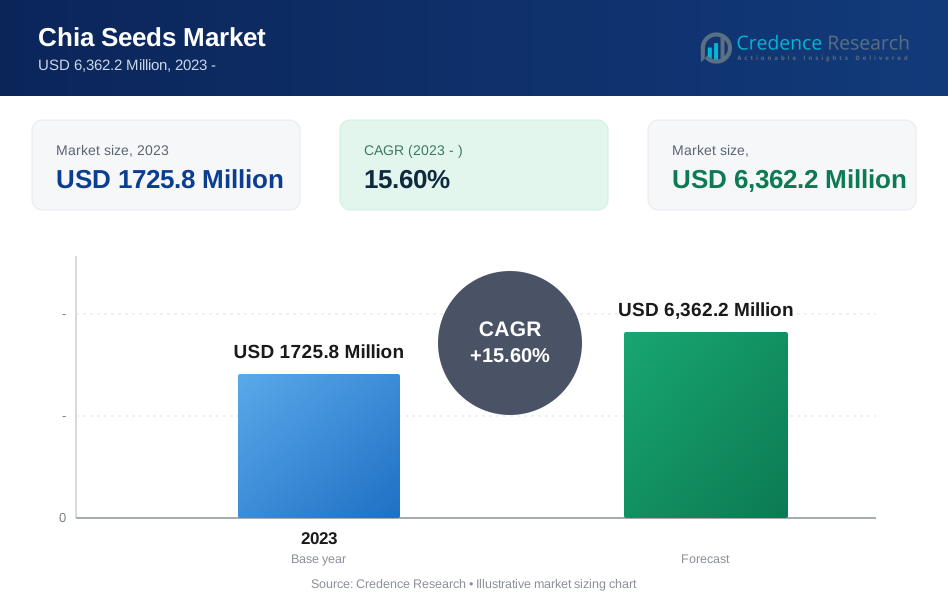
| Chia Seeds Market Size 2023 | USD 1725.8 Million |
| Chia Seeds Market, CAGR | 15.60% |
| Chia Seeds Market Size 2032 | USD 6362.2 Million |
Market Insights
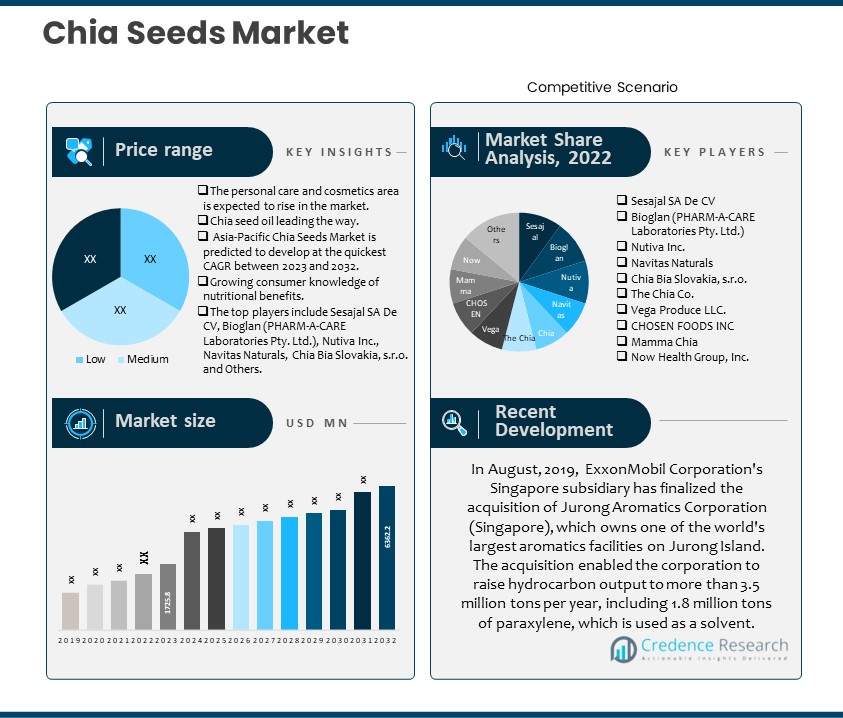
- The global demand for Chia Seeds was valued at USD 1725.8 Million in 2023 and is expected to reach USD 6362.2 Million in 2032, growing at a CAGR of 15.60% between 2024 and 2032.
- The Chia Seeds category dominated the market in 2023 and is predicted to be the fastest-growing sector from 2023 to 2032, with chia seed oil being the fastest-growing category.
- The food and beverage segment led the market in 2023 and is predicted to be the fastest-growing section between 2023 and 2032, while the personal care and cosmetics segment is expected to rise in the market.
- Demand for chia seeds has grown substantially online, and Convenience stores are another popular channel.
- The North American chia seed market accounted for 35.2% in 2023, and it is predicted to increase at a substantial CAGR throughout the study period. Europe has the second-largest market share, while the Asia-Pacific Chia Seeds Market is projected to develop at the quickest CAGR between 2023 and 2032.
- Increased Consumer Awareness of Health Benefits Fuels Market Expansion
- Price changes and market volatility impede growth in the market.
Executive Summary
Market Definition
Chia is an edible seed derived from the flowering plant Salvia hispanica, which grows in Latin America. Latin America is regarded one of the primary providers, accounting for more than 80% of worldwide chia seed supply in 2021. Chia seeds are preferred because they contain a lot of nutrients while also being high in calories. The seeds are mostly composed of fibers, protein, lipids, calcium, manganese, magnesium, and phosphorus, with trace amounts of zinc, vitamin B1, B2, B3, and potassium. The seeds promote metabolic health and minimize the risk of heart disease and type 2 diabetes. The seeds prevent premature skin aging, increase bone and muscle strength, and inhibit free radicals from entering bodily cells. These health benefits are driving up demand for chia seeds in the food, beverage, personal care, and nutraceutical industries.
Market Overview
The global Chia Seeds Market has witnessed steady growth in recent years and is expected to grow at a CAGR of 15.60% between 2024 and 2032. The market was valued at USD 1725.8 million in 2023 and is expected to reach USD 6362.2 million in 2032.
Chia seeds are utilized in a number of food products, including seed mixes, morning cereals, and baked goods. Chia seeds can help you keep your blood sugar stable, enhance your metabolism, and lower your risk of heart disease. Chia seeds are naturally gluten-free and are extremely beneficial to gluten intolerant people. Chia seed contains various nutrients with significant potential as nutraceutical substances that are extremely useful to human health. Chia seed is also recognized as a functional food since it includes omega3 fatty acids, which are beneficial for cardiovascular health. People's growing health consciousness, as well as their need for ancient grains, are driving the expansion of the packaged chia seed industry. Furthermore, rising demand for natural food ingredients in the food and beverage industry, as well as growing preference for organic and gluten-free goods, are expected to boost overall market demand for the Global Packaged Chia Seed Market between 2023 and 2032.
Segmentation By Product Form
- The whole Chia Seeds category dominated the market in 2023 and is expected to be the fastest-growing segment from 2023 to 2032. This is owing to great demand, and it is widely available in the business, where it may be added to a variety of foods and beverages.
- However, due to rising demand, chia seed oil is the fastest-growing category. Furthermore, because it contains fatty acids, dietary fibers, and antioxidants, the oil form has a broad range of applications in various meals, which favorably impacts market growth.
Segmentation by End-Use Application
- The food and beverage category dominated the market in 2023 and is expected to be the fastest-growing segment between 2023 and 2032, owing to the product's excellent nutritional value and increased demand in the industry.
- Beverages is the fastest-growing category due to the increasing demand for superfoods and nutraceuticals.
- However, the personal care and cosmetics segment is expected to grow in the market. Chia seeds are employed in nutraceuticals, personal care items, and culinary applications. The cosmetics industry is lured to its anti-inflammatory and skin-soothing properties, and the omega-3 content of chia seed oil stimulates its usage in dietary supplements.
Segmentation by Application
- The global chia seed market has seen a significant increase in demand due to online retail channels. This development is mostly driven by e-commerce platforms' convenience, accessibility, and increased product diversity. With the growing popularity of online shopping, people can now discover and purchase chia seeds from the comfort of their own homes, giving this market sector a substantial boost.
- Another popular channel in the Chia Seeds Market is Convenience Stores
Segmentation by Region
- The North America chia seed market accounted for 35.2% in 2023 and is expected to grow at a significant CAGR throughout the study period.
- Europe has the second-largest market share and the Asia-Pacific Chia Seeds Market is expected to grow at the fastest CAGR between 2023 and 2032.
- The rest of the world, including Latin America, the Middle East, and Africa, supplies the remaining demand for Chia Seeds.
The North America chia seeds market accounted for majority share in 2023 and is predicted to increase at a substantial CAGR over the study period. This is due to the expanding vegan food demand, community culture, health awareness, and transition from junk food to nutritious snacks in this region. The American Heart Association recommends that omega-3-rich foods and oils be included in regular diets to help avoid heart disease. Plant sources of omega-3 EFAs are becoming increasingly popular due to their ease of incorporation into convenience and functional foods, as well as their neutral flavor.
Due to excessive product use, the Europe chia seed market has the second-largest market share. Chia seed merchants are aggressively developing educational marketing campaigns that include in-store demonstrations across the country, investing extensively in point-of-sale displays, and providing customers with a certificate of analysis for each batch of chia to boost their market share. Furthermore, the German chia seed market had the biggest market share, while the UK chia seed market was the fastest expanding in Europe.
However, The Asia-Pacific Chia Seeds Market is estimated to expand at the quickest CAGR between 2023 and 2032. This is attributed to rising product consumption in nations like India, China, and Japan. Rising rates of lifestyle disorders such as diabetes, high blood pressure, and asthma have led to an increase in demand for healthy snacks, which will help the regional market thrive. Furthermore, the China chia seeds market held the biggest market share, while the India chia seeds market was the fastest-growing market in the Asia-Pacific region.
Key Highlights of the Report
Product Form, End-Use Application, Application, and Region segment the global Chia Seeds Market. The Whole Chia Seeds category led the market in 2023, with chia seed oil and beverages emerging as the fastest-growing category. In addition, demand for chia seeds has significantly grown online retail, and another prominent channel in the Chia Seeds Market is convenience stores and North America leading the market growth.
Growing awareness of chia seeds, particularly among professional athletes, is fueling the preference for an organic and gluten-free vegan diet, which is driving the growth of the global chia seed market. Other factors driving the market's expansion include the rising demand for chia seeds in protein bars, dietary supplements, and natural food ingredients in the food and beverage industry. However, two main obstacles to the growth of the chia seed industry are the strict rules enforced by regional government authorities like the USFDA and EFSA on the use of ingredients in food and personal care products and the lack of knowledge regarding the significance of chia seeds in developing countries.
The North America lead chia seed market in 2023 is expected to grow at a significant CAGR throughout the study period. This is attributed to rising vegan food demand, community culture, health awareness, and a shift from junk food to nutritional snacks in this region. Furthermore, due to excessive product use, the European chia seed market has the second-largest market share. However, the Asia-Pacific Chia Seeds Market is expected to grow at the quickest CAGR between 2023 and 2032.
What Are The Main Drivers Of The Global Chia Seeds Market?
Increasing demand for chia seeds in dietary supplements and protein bars, as well as natural food ingredients in the food and beverage industry, preference for organic and gluten-free vegan diets, and growing awareness about chia seeds, particularly among professional athletes, are some of the factors driving growth in the global chia seed market. Furthermore, the demand for non-Genetically Modified Organisms (GMO) chia seeds for growing presents a significant opportunity for raw material suppliers and distributors to invest in the chia seed market.
What Are The Major Challenges Faced By The Global Chia Seeds Market?
The lack of general directives about the usage of chia seeds is projected to limit market growth over the forecast period. Every country has various guidelines for the use and application of chia seeds. Key businesses find it difficult to comply with such country-specific restrictions, which discourages investment in the chia seeds industry and hence limits market expansion.
What Are The Growth Opportunities In The Global Chia Seeds Market?
Furthermore, the demand for non-Genetically Modified Organisms (GMO) chia seeds for growing presents a significant opportunity for raw material suppliers and distributors to invest in the chia seed market.
Market Drivers
Several factors drive the global Chia Seeds Market. The following are the key drivers of the global Chia Seeds Market:
Raising Consumer Knowledge of Health Advantages
Growing consumer awareness of the health advantages of chia seeds is one of the main factors propelling the global chia seed market. Chia seeds are a great source of fiber, antioxidants, omega-3 fatty acids, and a variety of vitamins and minerals. They are recognized to support heart health, facilitate digestion, and offer long-lasting energy. Chia seeds are becoming more and more popular among customers who value health and wellbeing as a natural and nourishing supplement to their diets. The market has grown as a result of increased demand and greater knowledge of the health advantages of chia seeds.
Market Restraints
The global Chia Seeds Market faces some challenges that may hinder its growth. These include the following:
Price fluctuations and Market Volatility
Price fluctuates and market instability have occurred in the chia seed market, owing to a variety of variables. Supply chain vulnerabilities, as previously indicated, are one significant cause. Currency exchange rates, changes in consumer demand, and global economic conditions all have an impact on the chia seed market. Price volatility can be challenging for both producers and consumers. Unpredictable price swings can have an impact on manufacturing decisions and profit margins. Consumers may be cautious to buy chia seed goods if prices are thought to be volatile. Managing price changes and providing consistent pricing to customers can be a difficult issue for firms in this industry.
Opportunities
The global Chia Seeds Market offers significant growth opportunities. These include the following:
Product Innovation and Market Competition.
The chia seed market's expansion is also due to increasing product innovation and competition. Manufacturers are constantly developing innovative ways to deliver chia seeds in a variety of formats to meet the varying needs of their customers. Chia seeds are available in a variety of forms, including pulverized, milled, and oil, making them appropriate for a wider range of culinary uses. Furthermore, corporations are looking into innovative packaging and marketing tactics to entice customers. As the industry gets more competitive, consumers benefit from a broader selection of chia seed products, and severe rivalry drives market growth.
Competitive Landscape
Key Players
The global Chia Seeds Market is highly competitive, with several key players. Some of the major players in the market and their market share are as follows:
- Sesajal SA De CV
- Bioglan (PHARM-A-CARE Laboratories Pty. Ltd.)
- Nutiva Inc.
- Navitas Naturals
- Chia Bia Slovakia, s.r.o.
- The Chia Co.
- Vega Produce LLC.
- CHOSEN FOODS INC
- Mamma Chia
- Now Health Group, Inc.
- Naturkost Übelhör GmbH & Co. KG
- AgroBolivia (Negocios Europa Ltd.)
These organizations prioritize product innovation, distribution channel expansion, and mergers and acquisitions to stay competitive.
The global Chia Seeds Market's key players continually seek to stay ahead by offering new products and developments.
In October 2021, Benexia introduced encapsulated oil to extract more value from chia seeds. The Chilean company has expanded its product line to include chia-based compounds in addition to the seed itself. Benexia Company, headquartered in Santiago, has long marketed and processed chia cultivated in Bolivia and elsewhere. The most recent product to emerge from this method is Benexia ALA Powder. The encapsulated water-soluble component contains 25% alpha-linolenic acid (ALA) by weight.
In June 2021, The Benexia Company expanded its Consumer packaged goods (CPG) brand, Seeds of Wellness, using its patented chia components; as a result of this expansion, Benexia strengthened its product selection.
Summary of Key Findings
- Innovation in Products and Competition in the Market.
- Market segmented By Product Form, End-Use Application, Application, and region.
- Chia seed oil leading the way.
- The personal care and cosmetics area is expected to rise in the market.
- North America is leading in market growth; the market is highly competitive with key players, including Sesajal SA De CV, Bioglan (PHARM-A-CARE Laboratories Pty. Ltd.), Nutiva Inc., Navitas Naturals, Chia Bia Slovakia, s.r.o. and Others.
Future Outlook
- Rising demand for plant-based superfoods
- Increasing popularity in the health and wellness industry
- Increasing use in numerous food and beverage products.
- Growing consumer knowledge of nutritional benefits.
How CXOs Can Benefit from the Credence Research Chia Seeds Market Report
The Credence Research Chia Seeds Market Report provides CXOs with a comprehensive overview of the market, including:
- Market size and growth forecast: The report provides detailed estimates of the global Chia Seeds Market size, segmented By Product Form, End-Use Application, Application, and region. It also includes forecasts for the market through 2032 based on key trends and drivers.
- Market segmentation: The report segments the Chia Seeds Market By Type, End-Use Application, Application, and region. This segmentation provides CXOs with a granular understanding of the market and the opportunities in each segment.
- Competitive Landscape: The report profiles the key players in the Chia Seeds Market and provides insights into their strategies, product offerings, and financial performance. This information can help CXOs to identify and assess their competition.
- Key trends and drivers: The report identifies and analyzes the key trends and drivers that are shaping the Chia Seeds Market. This information can help CXOs to make informed decisions about their investments and strategies.
CXOs can use the insights from the Credence Research Chia Seeds Market Report to:
- Identify growth opportunities: The report can help CXOs to identify new growth opportunities in the Chia Seeds Market. For example, it can pinpoint emerging trends in industries like aerospace and automotive, helping executives make informed decisions on expanding their product lines or entering new market segments where Chia Seeds's properties can be leveraged for success.
- Make informed investment decisions: The report can help CXOs make informed investment decisions about Chia Seeds. For example, it can provide crucial insights into market trends, competitive landscape, and potential growth areas, empowering executives to allocate resources strategically and seize opportunities for maximizing returns on investments in the Chia Seeds sector.
- Develop competitive strategies: The report can help CXOs develop competitive strategies for their Chia Seeds businesses. For example, it can offer valuable insights into market trends, competitor analysis, and innovative applications of Chia Seeds, enabling executives to stay ahead of the competition and drive business growth in this dynamic industry.
- Track market developments: The report can help CXOs monitor market developments and stay ahead of the curve. For example, it provides insights into the latest trends and innovations in the Chia Seeds Market.
Overall, the Credence Research Chia Seeds Market Report is a valuable resource for CXOs who are looking to gain a deeper understanding of the market and identify opportunities for growth.
Segmentation
- By Product Form:
- Whole Chia Seeds
- Ground Chia Seeds
- Chia Seed Oil
- Chia Seed Powder
- Others
- By End-Use Application:
- Food and Beverages
- Bakery and Confectionery
- Breakfast Cereals
- Beverages (smoothies, juices, etc.)
- Snacks
- Dairy Products
- Dietary Supplements
- Pet Food
- Cosmetics and Personal Care Products
- Others
- By Distribution Channel:
- Supermarkets and Hypermarkets
- Convenience Stores
- Online Retail
- Health Food Stores
- Others
- By Region
- North America
- The U.S.
- Canada
- Mexico
- Europe
- Germany
- France
- The U.K.
- Italy
- Spain
- Rest of Europe
- Asia Pacific
- China
- Japan
- India
- South Korea
- South-east Asia
- Rest of Asia Pacific
- Latin America
- Brazil
- Argentina
- Rest of Latin America
- Middle East & Africa
- GCC Countries
- South Africa
- Rest of the Middle East and Africa
- North America
Request a Free Sample
Fill in your details and we'll send you a free sample report.
- Sample data tables & charts
- Research methodology
Need a Custom Version of This Report?
Tailor the scope, geography, or segments to your exact requirements.
- Custom geography or segment scope
- Direct access to our analyst team
Frequently Asked Questions
What is the current size of the global Chia Seeds Market?
What is the expected growth rate of the Chia Seeds Market between 2024 and 2032?
Which segment is leading the market share in terms of Product Form?
Which Distribution Channel segment governs the demand for Chia Seeds in the world?
Which End-Use Application segment is expected to post the fastest growth rate during the forecast period?
Who are the major players in the global Chia Seeds Market?
Table of Content
Chapter 1. Report Introduction
- 1.1 Report Description & Purpose
- 1.1.1 Report Title & Market Definition
- 1.1.2 Unique Selling Propositions (USP) & Key Differentiators
- 1.1.3 Value Proposition for Stakeholders
- 1.2 Research Objectives
- 1.2.1 Market Sizing Objectives (Volume & Revenue)
- 1.2.2 Segmentation Objectives
- 1.2.3 Competitive Intelligence Objectives
- 1.2.4 Forecast & Scenario Objectives
- 1.3 Report Scope
- 1.3.1 Chia Seeds Scope – Types & Subtypes Covered
- 1.3.2 Geographic Scope – Regions & Countries Covered
- 1.3.3 Historical Period, Base Year & Forecast Period (2023; forecast to the forecast period)
- 1.3.4 Inclusions & Exclusions
- 1.4 HS Code & Classification Framework
- 1.5 Currency, Units & Pricing Basis
- 1.6 Target Stakeholders
- 1.7 Limitations & Assumptions
Chapter 2. Executive Summary
- 2.1 Global Chia Seeds Market Snapshot
- 2.1.1 Market Size – Historical (2023) & Forecast (the forecast period) (2023: USD 1725.8 Million → forecast year: USD 6,362.2 Million)
- 2.1.2 Volume & Revenue – Global Totals
- 2.1.3 Key Market Highlights – Top Five Facts
- 2.2 Chia Seeds Market Segmentation Snapshot
- 2.2.1 Market Split by Region – 2023 vs.
- 2.3 Competitive Snapshot
- 2.3.1 Top 10 Players by Revenue Share – 2023
- 2.3.2 Top 10 Players by Volume Share – 2023
- 2.3.3 Recent Strategic Developments (18-Month Summary)
- 2.4 Key Investment Highlights & Strategic Conclusions
Chapter 3. Chia Seeds Market Dynamics & Industry Analysis
- 3.1 Market Overview & Context
- 3.1.1 Chia Seeds Market Position in the Broader Automotive Value Chain
- 3.1.2 OEM vs. Replacement Market Dynamics
- 3.1.3 Market Maturity & Development Stage by Region
- 3.2 Chia Seeds Market Drivers
- 3.3 Chia Seeds Market Restraints & Challenges
- 3.4 Chia Seeds Market Opportunities
- 3.5 Porter's Five Forces Analysis
- 3.5.1 Threat of New Entrants
- 3.5.2 Bargaining Power of Suppliers
- 3.5.3 Bargaining Power of Buyers
- 3.5.4 Threat of Substitutes
- 3.5.5 Competitive Rivalry – Intensity Assessment
- 3.6 Chia Seeds Value Chain Analysis
- 3.6.1 Upstream – Raw Material/Input Suppliers
- 3.6.1.1 Raw Material/Input 1
- 3.6.1.2 Raw Material/Input 2
- 3.6.1.3 Raw Material/Input 3
- 3.6.2 Midstream – Production/Manufacturing/Service Delivery
- 3.6.2.1 Production/Process Overview
- 3.6.2.2 Key Facility Locations & Capacity by Manufacturer
- 3.6.3 Downstream – Distribution & End Consumer
- 3.6.3.1 Primary Channel – B2B/OEM
- 3.6.3.2 Secondary Channels – Dealer, Retail, Online, Direct
- 3.6.4 Value Chain Profitability Analysis
- 3.6.1 Upstream – Raw Material/Input Suppliers
- 3.7 PESTEL Analysis
- 3.7.1 Political Factors
- 3.7.2 Economic Factors
- 3.7.3 Social Factors
- 3.7.4 Technological Factors
- 3.7.5 Environmental Factors
- 3.7.6 Legal Factors
- 3.8 Chia Seeds Supply Chain Analysis
- 3.8.1 Raw Material/Input Supply Risk Assessment
- 3.8.2 Manufacturing Concentration Risk (Geographic Exposure)
- 3.8.3 Trade Disruption Impact Analysis
- 3.9 Regulatory & Policy Landscape
Note: The regulatory and policy landscape section covers regulations based on their applicability to the market, Chia Seeds category, geography, and scope of the study. Only regulatory frameworks with a material impact on operations, compliance, trade, sustainability, or market access are analyzed in detail.
Chapter 4. Key Investment Pockets & Opportunity Analysis
- 4.1 Chia Seeds Market Attractiveness Analysis
- 4.1.1 By Region – Investment Attractiveness Matrix (Volume × CAGR)
- 4.2 Absolute Revenue Growth Opportunity
- 4.2.1 By Region – Absolute USD Growth Through the forecast period
- 4.3 Incremental Volume Opportunity
- 4.3.1 By Region – Incremental Volume Through the forecast period
- 4.3.2 Segment – Incremental Volume
- 4.4 Emerging Submarket Opportunity Deep Dive (Subject to Applicability)
- 4.5 Emerging Market Opportunity Scorecards
- 4.5.1 United States
- 4.5.2 Europe
- 4.5.3 Asia
- 4.5.4 Middle East & Africa
Note: Emerging Market Opportunity Scorecards will be included based on relevance and strategic importance. Regions listed are indicative and may vary depending on data availability and market dynamics.
Chapter 5. Chia Seeds Import-Export Analysis & Trade Flows
- 5.1 Global Trade Overview
- 5.1.1 Global Export Value by Country (2023)
- 5.1.2 Global Export Volume by Country (2023)
- 5.1.3 Global Import Value by Country (2023)
- 5.1.4 Global Import Volume by Country (2023)
- 5.1.5 Net Trade Balance by Country (2023)
- 5.2 Export Analysis – Segment
- 5.2.1 Type 1 (HS Code)
- 5.2.2 Type 2 (HS Code)
- 5.2.3 Type 3 (HS Code)
- 5.2.4 Type 4 (HS Code)
- 5.2.5 Type 5 (HS Code)
- 5.3 Import Analysis – Segment
- 5.3.1 Type 1 (HS Code)
- 5.3.2 Type 2 (HS Code)
- 5.3.3 Type 3 (HS Code)
- 5.3.4 Type 4 (HS Code)
- 5.3.5 Type 5 (HS Code)
- 5.4 Average Unit Trade Prices
- 5.4.1 Average Export Price – Segment & Country
- 5.4.2 Average Import Price – Segment & Source Country
- 5.4.3 Price Trends (2023)
- 5.5 Key Trade Route Analysis
- 5.5.1 Trade Route 1
- 5.5.2 Trade Route 2
- 5.5.3 Trade Route 3
- 5.5.4 Trade Route 4
- 5.5.5 Trade Route 5
- 5.6 Trade Policy Impact Assessment
- 5.6.1 US Anti-Dumping & Section 301 Tariffs
- 5.6.2 EU Customs Union Impact
- 5.6.3 Major Free Trade Agreements
- 5.6.4 USMCA Rules of Origin
Note: Trade policy analysis will be included only where relevant to the Chia Seeds market.
Chapter 6. Competitive Landscape & Company Benchmarking
- 6.1 Chia Seeds Market Concentration & Structure
- 6.1.1 Herfindahl-Hirschman Index (HHI) – vs. 2023
- 6.1.2 Tier 1, Tier 2 & Tier 3 Market Structure
- 6.1.3 Global, Regional & Local Player Dynamics
- 6.2 Chia Seeds Market Share Analysis – 2023
- 6.2.1 Global Revenue Share by Company
- 6.2.2 Global Volume Share by Company
- 6.2.3 Regional Revenue Share
- 6.2.4 Market Share Evolution ( vs. 2023)
- 6.2.5 OEM Segment Share by Company
- 6.2.6 Replacement Segment Share by Company
- 6.3 Production/Delivery Capacity & Facility Analysis
- 6.3.1 Global Installed Capacity
- 6.3.2 Capacity Utilization Rates
- 6.3.3 Production/Output Volume
- 6.3.4 Facility Locations & Capacity Map
- 6.3.5 Planned Capacity Additions
- 6.4 Chia Seeds Competitive Benchmarking Matrix
- 6.4.1 Revenue, Volume, CAGR & Profitability Comparison
- 6.4.2 Channel Revenue Mix
- 6.4.3 Geographic Revenue Exposure
- 6.4.4 R&D Intensity
- 6.4.5 Sustainability Maturity
- 6.5 Strategic Developments in Chia Seeds (Last 24 Months)
- 6.5.1 Mergers, Acquisitions & Divestments
- 6.5.2 New Chia Seeds Launches
- 6.5.3 Facility Expansions
- 6.5.4 Strategic Alliances, Joint Ventures & Partnerships
- 6.5.5 Distribution Expansion & Market Entry
- 6.5.6 Sustainability & ESG Initiatives
- 6.6 Competitive Strategy Mapping
- 6.6.1 Leader, Challenger, Follower & Niche Classification
- 6.6.2 Pricing Strategy Comparison
- 6.6.3 Channel Strategy Matrix
Note: Strategic developments are included based on their materiality and the availability of reliable information.
Chapter 7. Global Chia Seeds Market – By Distribution Channel
- 7.1 Segment Overview
- 7.1.1 Volume & Revenue Split by Channel (2023 & )
- 7.1.2 Channel Mix Evolution (the forecast period)
Chapter 8. Regional Market Analysis – Global Overview
- 8.1 Global Regional Overview
- 8.1.1 Regional Volume Share
- 8.1.2 Regional Revenue Share
- 8.1.3 Regional Volume by Region
- 8.1.4 Regional Revenue by Region
- 8.1.5 Regional Forecast Through the forecast period
- 8.2 Cross-Regional Segment Analysis
- 8.2.1 By Distribution Channel
- 8.2.2 By Brand/Price Tier
Chapter 9. North America Chia Seeds Market
- 9.1 United States
- 9.2 Canada
- 9.3 Mexico
Chapter 10. Europe Chia Seeds Market
- 10.1 Germany
- 10.2 France
- 10.3 Italy
- 10.4 United Kingdom
- 10.5 Spain
- 10.6 Poland
- 10.7 Russia
- 10.8 Netherlands
- 10.9 Belgium
- 10.10 Sweden
- 10.11 Denmark
- 10.12 Norway
- 10.13 Rest of Europe
Chapter 11. Asia Pacific Chia Seeds Market
- 11.1 China
- 11.2 India
- 11.3 Japan
- 11.4 South Korea
- 11.5 Thailand
- 11.6 Indonesia
- 11.7 Vietnam
- 11.8 Malaysia
- 11.9 Australia
- 11.10 Rest of Asia Pacific
Chapter 12. Latin America Chia Seeds Market
- 12.1 Brazil
- 12.2 Argentina
- 12.3 Colombia
- 12.4 Chile
- 12.5 Rest of Latin America
Chapter 13. Middle East Chia Seeds Market
- 13.1 Saudi Arabia
- 13.2 United Arab Emirates
- 13.3 Turkey
- 13.4 Israel
- 13.5 Iran
- 13.6 Rest of the Middle East
Chapter 14. Africa Chia Seeds Market
- 14.1 South Africa
- 14.2 Egypt
- 14.3 Nigeria
- 14.4 Morocco
- 14.5 Rest of Africa
Chapter 15. Chia Seeds Company Profiles
- 15.1 [Company 01]
- 15.1.1 Company Overview
- 15.1.2 Key Management Personnel
- 15.1.3 Products & Services Portfolio
- 15.1.4 Financial Performance
- 15.1.5 Key Market Focus & Geographic Presence
- 15.1.6 Recent Developments & Strategic Initiatives
Note: The company profile list is preliminary and may change based on research findings, market developments, data availability, and client requirements.
Chapter 16. Appendices
- Appendix A – List of Abbreviations & Acronyms
- Appendix B – Industry Classification Code Reference – Full Series
- Appendix C – Production & Capacity Data Tables
- Appendix D – End-Use & Demand Base Tables
- Appendix E – Consumption & Replacement Rate Assumptions
- Appendix F – ASP Reference Tables
- Appendix G – Manufacturing & Facility Database
- Appendix H – Import-Export Data Tables
- Appendix I – Regulatory Summary Tables
- Appendix J – Primary Research Participant List (Anonymized)
- Appendix K – Primary Research Questionnaire Framework
- Appendix L – Data Sources & Bibliography
- Appendix M – Market Size Divergence & Source Comparison
Chapter 17. Research Methodology
- 17.1 Research Framework & Philosophy
- 17.2 Secondary Research – Sources, Hierarchy & Data Extraction
- 17.3 Data Modeling – Bottom-Up & Top-Down Market Sizing
- 17.4 Primary Research – Stakeholder Framework, LOI & Sample Sizes
- 17.5 Forecast Methodology – Regression, Scenario & Sensitivity Analysis
- 17.6 Quality Control – Four-Layer Validation Framework
- 17.7 Limitations & Standard Assumptions
- 17.8 Disclaimer
