
Market Overview:
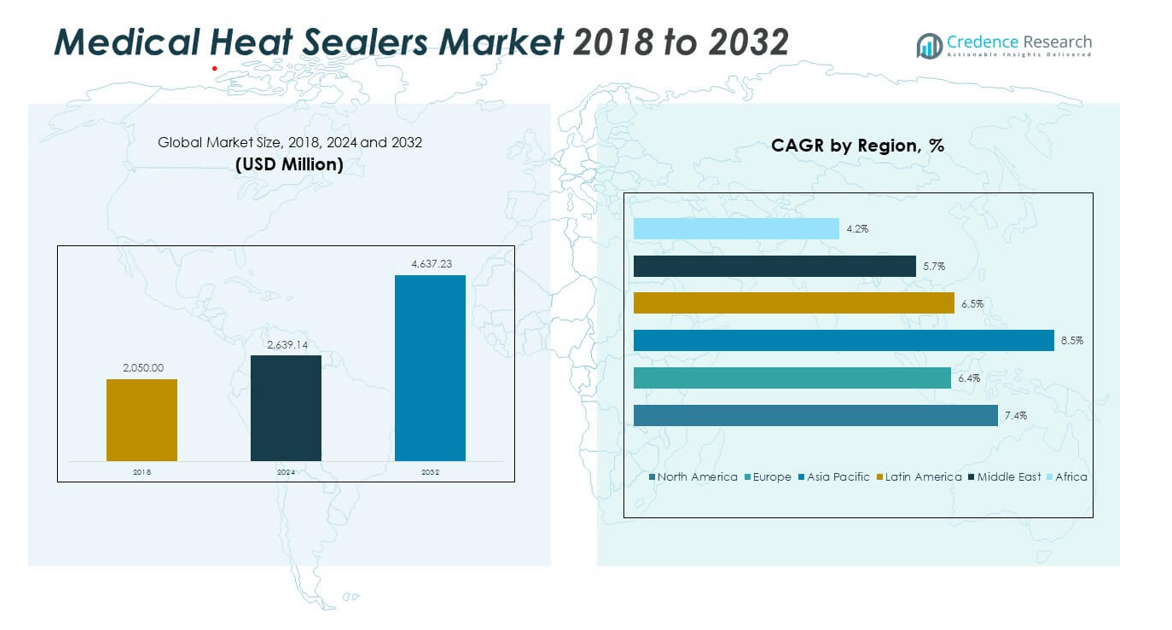
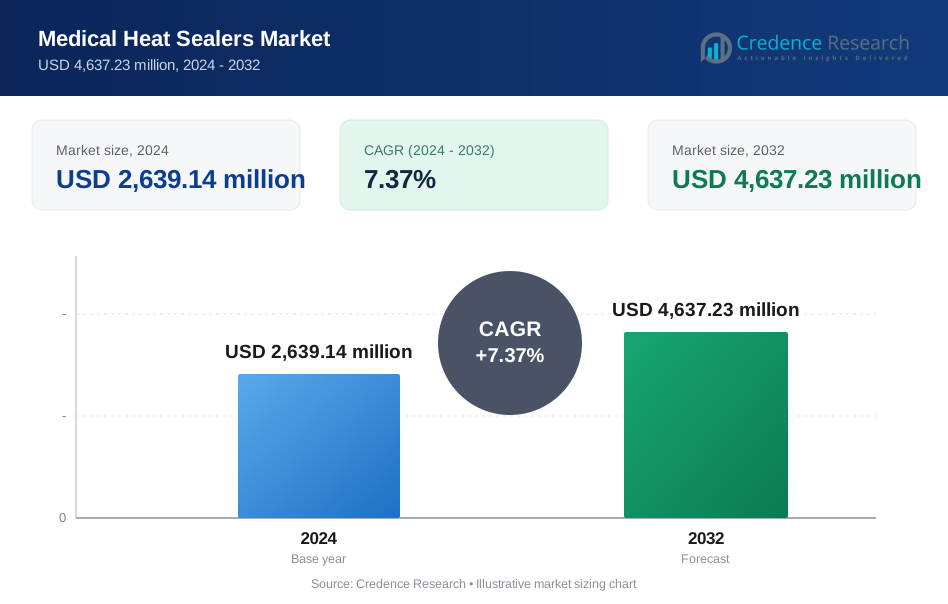
The Medical Heat Sealers Market size was valued at USD 2,050.00 million in 2018, reached USD 2,639.14 million in 2024, and is anticipated to reach USD 4,637.23 million by 2032, at a CAGR of 7.37% during the forecast period.
| REPORT ATTRIBUTE | DETAILS |
|---|---|
| Historical Period | 2020-2023 |
| Base Year | 2024 |
| Forecast Period | 2025-2032 |
| Medical Heat Sealers Market Size 2024 | USD 2,639.14 million |
| Medical Heat Sealers Market, CAGR | 7.37% |
| Medical Heat Sealers Market Size 2032 | USD 4,637.23 million |
Market growth is driven by the rising demand for sterile and tamper-proof medical packaging across hospitals, pharmaceutical manufacturing, and diagnostic centers. Increasing regulatory requirements for packaging integrity encourage manufacturers to develop advanced sealing systems with precise temperature and pressure control. Automation in healthcare facilities enhances production efficiency and reduces contamination risk. Technological advancements such as digital thermocontrol and ultrasonic sealing strengthen product reliability and performance, creating a favorable environment for sustained adoption across clinical and industrial settings.
North America leads the market due to a strong healthcare ecosystem and high adoption of automated packaging equipment. Europe follows, supported by established pharmaceutical manufacturing and strict regulatory frameworks for sterile packaging. The Asia Pacific region is emerging as a high-growth area driven by healthcare infrastructure expansion in China, India, and Japan. Latin America, the Middle East, and Africa show steady adoption through hospital modernization and growing demand for affordable medical packaging solutions.
Market Insights:
- The Medical Heat Sealers Market was valued at USD 2,050.00 million in 2018, reached USD 2,639.14 million in 2024, and is projected to reach USD 4,637.23 million by 2032, growing at a CAGR of 7.37% during the forecast period.
- North America leads the market with a 32.5% share, driven by advanced healthcare infrastructure, high regulatory compliance, and rapid automation in medical packaging systems.
- Europe follows with a 22.2% share, supported by strong pharmaceutical production, while Asia Pacific holds 27.8% and remains the fastest-growing region due to expanding healthcare infrastructure and local manufacturing growth.
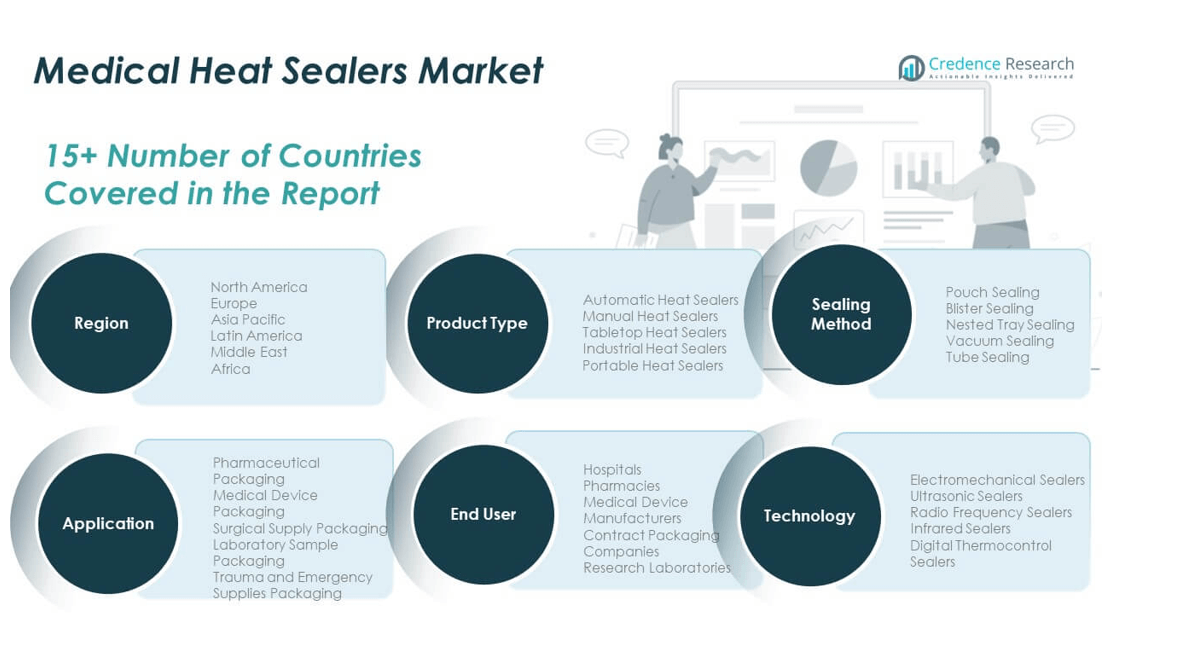
- Among product segments, automatic heat sealers account for nearly 34% of the total market share, reflecting widespread adoption in large healthcare and pharmaceutical facilities.
- Industrial and tabletop heat sealers collectively represent around 30% of the market, driven by their use in medium-scale packaging operations and laboratory applications.
Market Drivers
Rising Demand For Sterile And Tamper-Evident Packaging Solutions
The growing need for sterile packaging in healthcare facilities drives the Medical Heat Sealers Market. Hospitals and clinics require reliable sealing methods to maintain product integrity. It ensures protection against microbial contamination and external tampering. Pharmaceutical manufacturers adopt heat sealers to meet strict regulatory standards. Sterile packaging improves patient safety and reduces infection risks. Companies invest in advanced sealing technologies to support surgical kits and sensitive medical devices. Rising awareness among healthcare professionals further fuels demand. It also facilitates efficient handling and storage of medical supplies, enhancing operational efficiency.
Integration Of Advanced Automation And Smart Sealing Technologies
Automation in healthcare and pharmaceutical sectors boosts the adoption of medical heat sealers. It streamlines packaging processes while reducing manual errors. Smart sealing technologies monitor temperature and pressure for consistent quality. Manufacturers integrate sensors to detect faults and ensure compliance. Automated systems handle high-volume production efficiently. It enhances productivity and reduces labor costs significantly. Advanced machines offer programmable sealing cycles to suit diverse materials. Regulatory bodies favor automated solutions due to precision and traceability. This trend accelerates the replacement of conventional sealing equipment in hospitals and manufacturing units.
- For instance, Audion Elektro’s MEDSEAL® MSIDV series, actively sold into healthcare and pharmaceutical sectors in 2025, provides digital accurate seal temperature control with alarm functions on temperature accuracy (±5°C), as well as programmable cycles and USB data logging for batch traceability, conforming to ISO 11607 standards for medical device packaging.
Increasing Regulatory Requirements For Packaging Sterility And Compliance
Strict regulations from agencies like FDA and ISO impact the Medical Heat Sealers Market. Companies must comply with sterility and safety standards for medical products. It ensures that heat sealers maintain airtight and contamination-free packaging. Non-compliance may result in recalls and financial penalties. Manufacturers invest in robust equipment that meets certification criteria. It also supports adherence to GMP guidelines in production facilities. Regulatory pressures encourage adoption of reliable and tested sealing systems. This drives innovation in sealing materials and technologies. Hospitals and clinics increasingly prefer certified machines for operational assurance.
- For instance, Wipak’s Steriking® series, as of July 2025, is validated to EN ISO 11607-1 & 2 standards, documented by the company and acknowledged by healthcare clients and independent testing laboratories for their sealed sterile barrier systems, which maintain full package integrity and support regulatory audits in hospital and medical device manufacturing environments.
Expansion Of Healthcare Infrastructure In Emerging Economies
Rapid growth of hospitals and clinics in Asia Pacific and Latin America stimulates market demand. It creates a need for efficient packaging solutions to maintain hygiene standards. Rising government spending on healthcare infrastructure further supports adoption. Manufacturers target emerging regions with cost-effective and durable heat sealers. It enables handling of increased patient volumes and medical device throughput. Expansion of pharmaceutical manufacturing in these regions enhances demand for sealing solutions. Training and support services also drive equipment acceptance. It provides an opportunity to penetrate markets with high growth potential.
Market Trends
Adoption Of Energy-Efficient And Environmentally Friendly Heat Sealing Systems
The Medical Heat Sealers Market witnesses rising adoption of energy-efficient solutions. It reduces operational costs while minimizing environmental impact. Manufacturers develop low-power machines using sustainable materials. It aligns with hospitals’ eco-conscious initiatives and corporate responsibility goals. Energy-efficient systems extend equipment lifespan and reduce maintenance needs. It supports integration with renewable energy sources in production units. Customers increasingly prefer green technologies to meet sustainability benchmarks. Hospitals and clinics promote eco-friendly packaging practices. This trend encourages further innovation in heat sealer designs.
Integration Of IoT And Data Analytics For Packaging Performance Optimization
Heat sealers now integrate IoT-enabled sensors to monitor performance metrics. It provides real-time insights into temperature, pressure, and sealing consistency. Data analytics helps identify process inefficiencies and reduce wastage. Manufacturers leverage collected data to enhance predictive maintenance. It also enables remote diagnostics and troubleshooting for continuous operations. Hospitals and pharmaceutical units benefit from improved traceability and compliance reporting. This integration enhances decision-making in packaging workflows. It drives investment in smart, connected sealing solutions. Continuous software upgrades expand functionality and operational insights.
- For instance, Audion Packaging Machines offers advanced medical vacuum sealers with process monitoring software, allowing calibration and real-time control of sealing parameters (including pressure and temperature). The system enables data recording, user access control, and password protection, supporting traceability and remote diagnostics in pharmaceutical packaging workflows.
Focus On Compact And Portable Heat Sealing Solutions For Point-Of-Care Use
Demand grows for compact and portable heat sealers suitable for clinics and mobile units. It provides on-site sterile packaging for emergency care and outpatient procedures. Manufacturers design lightweight machines with easy-to-use interfaces. It ensures rapid sealing without compromising quality or reliability. Hospitals adopt portable units for vaccination campaigns and remote healthcare services. It supports flexible workflows in space-constrained settings. The trend encourages multifunctional devices with battery operation and adjustable sealing parameters. It improves accessibility to reliable sealing technology in varied healthcare environments.
Rising Adoption Of Advanced Materials And Multi-Layer Packaging Films
Medical heat sealers now accommodate innovative packaging materials for enhanced barrier properties. It supports multi-layer films that provide moisture, oxygen, and microbial resistance. Manufacturers optimize sealing mechanisms for complex material combinations. It enables better protection of sensitive pharmaceuticals and surgical instruments. Hospitals increasingly use films offering tamper evidence and sterilization compatibility. It promotes product differentiation and compliance with stringent regulations. Investment in specialized sealing jaws and temperature controls increases operational efficiency. The trend fosters research into materials requiring precise thermal management.
- For instance, Oliver Healthcare Packaging manufactures medical-grade multi-layer films, such as DuPont™ Tyvek® lids, that are tested to meet ISO 13485 and ISO 7 cleanroom standards, offering outstanding microbial penetration resistance for surgical packaging, and supporting large-scale hospital sterilization with validated peelability and tamper-evidence features.
Market Challenges Analysis
High Initial Investment And Maintenance Costs Restrict Market Penetration
The Medical Heat Sealers Market faces barriers due to high acquisition costs. Advanced automated systems require substantial capital expenditure. It can limit adoption among small healthcare providers and clinics. Maintenance and spare part expenses further increase operational burdens. Training staff to operate sophisticated machines adds indirect costs. It impacts decision-making for budget-conscious facilities. The need for regular calibration and quality checks challenges consistent usage. Manufacturers work on cost-optimized solutions, yet affordability remains a concern. Investment hesitancy slows adoption in price-sensitive regions.
Technical Limitations And Compatibility Issues With Diverse Packaging Materials
Heat sealers must handle various films and multi-layer materials for medical products. It may struggle with certain flexible or heat-sensitive substrates. Equipment failure can lead to compromised sterility or leakage. Compatibility challenges require frequent adjustments in sealing parameters. It increases operational complexity for hospital staff. High precision machines demand strict monitoring to maintain performance standards. Training and technical support are critical to avoid errors. Equipment malfunctions can result in product recalls and financial losses. These technical limitations constrain rapid market expansion.
Market Opportunities
Growing Demand For Customized And Automated Sealing Solutions In Healthcare Facilities
The Medical Heat Sealers Market presents opportunities for tailored sealing systems. It enables hospitals and clinics to adopt automation suited to specific workflow requirements. Manufacturers can offer modular units with scalable capabilities. It allows integration with existing packaging lines and production setups. Custom solutions reduce manual errors and improve process efficiency. It supports compliance with regulatory standards and traceability requirements. Healthcare providers increasingly prefer solutions that combine flexibility and reliability. This trend opens avenues for new product launches and service models.
Expansion In Emerging Markets Through Affordable And Durable Equipment Solutions
Emerging regions offer high growth potential for medical heat sealers. It meets the rising demand for efficient packaging in hospitals and pharmaceutical plants. Manufacturers can introduce cost-effective and durable machines suited to local needs. It encourages adoption in regions with expanding healthcare infrastructure. Support services, training, and localized technical assistance enhance market penetration. It provides opportunities for long-term partnerships with healthcare providers. Emerging markets also allow experimentation with portable and energy-efficient solutions. This trend drives strategic investments and business expansion.
Market Segmentation Analysis:
The Medical Heat Sealers Market demonstrates diversified growth across product types and applications.
By product type, automatic heat sealers hold the dominant share due to their precision, efficiency, and integration with automated production lines. It enhances packaging consistency and minimizes contamination risks. Manual and tabletop sealers serve small-scale facilities and laboratories requiring flexibility. Industrial and portable variants find increasing use in large hospitals and emergency response settings. Product innovation focuses on improved sealing control, temperature management, and safety compliance to support a wide range of medical packaging requirements.
- For instance, Van der Stähl’s scientific sealers now feature microprocessor-controlled precision, with temperature regulation tested within ±2°C, ensuring device package safety and regulatory compliance in 2025 installations.
By application, pharmaceutical packaging leads the segment due to the rising demand for sterile and tamper-proof drug packaging. It ensures product safety and regulatory adherence across pharmaceutical manufacturing and distribution. Medical device packaging follows closely, supported by growing production of diagnostic and surgical equipment. Surgical supply and laboratory sample packaging contribute to consistent growth, while trauma and emergency supplies packaging expands through emergency care advancements.
- For instance, Life Science Outsourcing (LSO) documented the validation and adoption of ISO 11607-compliant medical device packaging methods for diagnostic kits manufactured in North America, ensuring resilient sterile barrier integrity through ASTM testing as published in LSO’s April 2025 white paper.
By end user, hospitals represent the largest consumer base owing to constant demand for sterile packaging of medical tools and consumables. Medical device manufacturers and contract packaging companies adopt advanced sealing systems for compliance and productivity. Pharmacies and research laboratories also contribute through in-house packaging of customized or experimental materials.
By technology, electromechanical sealers dominate the market due to reliability and adaptability, while ultrasonic and digital thermocontrol sealers gain traction for precise, clean sealing.
By sealing method, pouch sealing and blister sealing account for major usage, with vacuum and tube sealing increasingly preferred for controlled and sterile environments.
Segmentation:
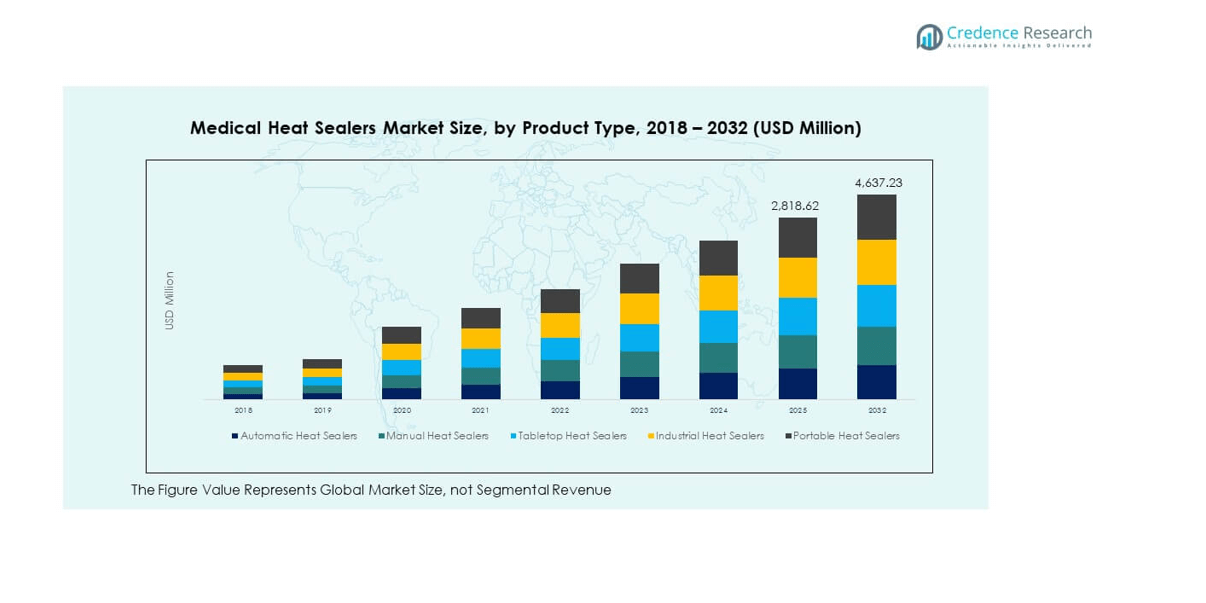
By Product Type
- Automatic Heat Sealers
- Manual Heat Sealers
- Tabletop Heat Sealers
- Industrial Heat Sealers
- Portable Heat Sealers
By Application
- Pharmaceutical Packaging
- Medical Device Packaging
- Surgical Supply Packaging
- Laboratory Sample Packaging
- Trauma and Emergency Supplies Packaging
By End User
- Hospitals
- Pharmacies
- Medical Device Manufacturers
- Contract Packaging Companies
- Research Laboratories
By Technology
- Electromechanical Sealers
- Ultrasonic Sealers
- Radio Frequency Sealers
- Infrared Sealers
- Digital Thermocontrol Sealers
By Sealing Method
- Pouch Sealing
- Blister Sealing
- Nested Tray Sealing
- Vacuum Sealing
- Tube Sealing
By Region
- North America
- U.S.
- Canada
- Mexico
- Europe
- Germany
- France
- U.K.
- Italy
- Spain
- Rest of Europe
- Asia Pacific
- China
- Japan
- India
- South Korea
- South-east Asia
- Rest of Asia Pacific
- Latin America
- Brazil
- Argentina
- Rest of Latin America
- Middle East & Africa
- GCC Countries
- South Africa
- Rest of the Middle East and Africa
Regional Analysis:
North America
The North America Medical Heat Sealers Market size was valued at USD 787.20 million in 2018, reached USD 1,001.80 million in 2024, and is anticipated to reach USD 1,757.98 million by 2032, at a CAGR of 7.4% during the forecast period. North America holds a market share of 32.5%. The region dominates due to strong healthcare infrastructure, advanced manufacturing capabilities, and stringent regulatory standards. The U.S. leads market adoption driven by FDA-approved packaging requirements for medical and pharmaceutical products. It benefits from high investment in automation and digital packaging technologies. Hospitals and device manufacturers across the region focus on maintaining sterility standards, fueling the use of heat sealers. Canada and Mexico contribute through rapid healthcare modernization and growing pharmaceutical production. Regional players emphasize sustainability and precision sealing to align with safety and environmental goals. Continuous R&D enhances product reliability and operational efficiency across healthcare facilities.
Europe
The Europe Medical Heat Sealers Market size was valued at USD 436.65 million in 2018, reached USD 535.14 million in 2024, and is anticipated to reach USD 875.29 million by 2032, at a CAGR of 6.4% during the forecast period. Europe holds a market share of 22.2%. The region experiences steady growth driven by increasing regulatory focus on sterile packaging compliance under MDR guidelines. Germany, France, and the U.K. remain key markets due to established pharmaceutical and medical device industries. It benefits from technological innovation and environmental sustainability initiatives. European manufacturers develop compact, energy-efficient sealers to meet green healthcare goals. Hospitals across the region favor automated sealers for improved process reliability. Expansion of private healthcare services in Eastern Europe supports new equipment deployment. Growing collaborations among European packaging and machinery firms strengthen the regional supply chain and product innovation.
Asia Pacific
The Asia Pacific Medical Heat Sealers Market size was valued at USD 584.25 million in 2018, reached USD 780.78 million in 2024, and is anticipated to reach USD 1,494.58 million by 2032, at a CAGR of 8.5% during the forecast period. Asia Pacific holds a market share of 27.8%. The region leads growth due to expanding pharmaceutical manufacturing and rising healthcare investments. China and India dominate production owing to their large-scale device and drug manufacturing industries. It benefits from rapid hospital expansion and the adoption of automated packaging systems. Japan, South Korea, and Australia contribute through advanced R&D and adoption of digital sealing technologies. Local manufacturers focus on cost-effective yet durable sealing systems to meet regional demand. Favorable government policies encouraging domestic medical equipment production support market expansion. Strong export activity in medical packaging materials further enhances regional competitiveness.
Latin America
The Latin America Medical Heat Sealers Market size was valued at USD 145.55 million in 2018, reached USD 185.77 million in 2024, and is anticipated to reach USD 305.45 million by 2032, at a CAGR of 6.5% during the forecast period. Latin America holds a market share of 7.1%. The market grows due to healthcare modernization and rising pharmaceutical production in Brazil and Mexico. It benefits from increased investment in hospital sterilization units and packaging compliance. Demand for affordable sealing equipment rises across mid-sized healthcare providers. Regional governments encourage domestic manufacturing to reduce equipment import dependence. Pharmaceutical companies expand local packaging capabilities to meet export standards. Hospitals focus on adopting compact and efficient sealers for operational flexibility. Regional distributors partner with global firms to improve technology access and service availability.
Middle East
The Middle East Medical Heat Sealers Market size was valued at USD 65.60 million in 2018, reached USD 78.10 million in 2024, and is anticipated to reach USD 121.06 million by 2032, at a CAGR of 5.7% during the forecast period. The region holds a market share of 5.4%. Growth is driven by expanding hospital infrastructure and increasing imports of medical equipment. GCC countries dominate with investments in healthcare modernization and regulatory compliance. It benefits from new pharmaceutical manufacturing zones and free trade policies. Saudi Arabia and the UAE lead adoption through upgraded sterilization and packaging facilities. Regional players focus on energy-efficient systems to meet sustainability goals. Partnerships with European and Asian manufacturers enhance access to advanced sealing technologies. Training programs and after-sales support further drive product utilization across hospitals and laboratories.
Africa
The Africa Medical Heat Sealers Market size was valued at USD 30.75 million in 2018, reached USD 57.54 million in 2024, and is anticipated to reach USD 82.86 million by 2032, at a CAGR of 4.2% during the forecast period. Africa holds a market share of 5%. The region witnesses gradual adoption supported by improving healthcare infrastructure and international aid programs. South Africa leads usage due to its developed medical manufacturing base. It benefits from increasing imports of low-cost packaging equipment. North African countries invest in modern healthcare packaging to comply with international standards. Public-private partnerships promote technology transfer and workforce training. Rising pharmaceutical production in Egypt and Nigeria supports steady equipment demand. Regional governments emphasize improving medical product quality and packaging safety, driving gradual but consistent growth.
Key Player Analysis:
- Robert Bosch GmbH
- OK International Group Inc.
- Westfield Medical Ltd.
- Urania Engineering Company
- Rennco, LLC.
- Zone Medical Pvt. Ltd.
- PAC Machinery
- FAMOS B.V.
- Hamer-Fischbein Americas
- Accu-Seal Corporation
- Audion Elektro B.V.
Competitive Analysis:
The Medical Heat Sealers Market features strong competition among global and regional players focusing on innovation, automation, and compliance-driven product design. Leading companies such as Robert Bosch GmbH, OK International Group Inc., Westfield Medical Ltd., and PAC Machinery dominate through advanced sealing systems designed for sterile medical packaging. It emphasizes technology upgrades, including digital thermocontrol and energy-efficient sealing. Manufacturers invest in expanding production capacity and establishing partnerships to enhance global reach. FAMOS B.V. and Accu-Seal Corporation focus on customized sealing solutions for hospitals and device manufacturers. Hamer-Fischbein Americas and Audion Elektro B.V. strengthen portfolios with precision sealing technologies. Competitive differentiation relies on durability, user safety, and integration with automated packaging lines. Continuous R&D, regulatory certification, and after-sales support remain key strategies shaping market leadership and sustaining long-term growth across healthcare and pharmaceutical sectors.
Recent Developments:
- In October 2025, DuPont announced the winners of the Tyvek® Sustainable Healthcare Packaging Awards, highlighting Amcor’s ACT2100™. This next-generation Tyvek® heat seal coating delivers 25% stronger seals and 50% greater breathability than previous medical-grade coatings. The launch is set to improve sterile barring and device protection throughout healthcare supply chains, showcasing DuPont and Amcor’s collaborative innovation within the medical heat sealers market.
- In August 2024, Urania Engineering updated its Model 5000P Plus rotary band heat sealer with GS1 Datamatrix printing and Keyence 2D Code Reader integration, meeting CE and CSA standards. This launch responds to new regulatory mandates for medical devices, delivering enhanced traceability and usability features for medical packaging.
Report Coverage:
The research report offers an in-depth analysis based on Product Type, Application, End User, Technology and Sealing Method. It details leading market players, providing an overview of their business, product offerings, investments, revenue streams, and key applications. Additionally, the report includes insights into the competitive environment, SWOT analysis, current market trends, as well as the primary drivers and constraints. Furthermore, it discusses various factors that have driven market expansion in recent years. The report also explores market dynamics, regulatory scenarios, and technological advancements that are shaping the industry. It assesses the impact of external factors and global economic changes on market growth. Lastly, it provides strategic recommendations for new entrants and established companies to navigate the complexities of the market.
Future Outlook:
- The Medical Heat Sealers Market will expand with growing demand for sterile and tamper-proof packaging in hospitals and pharmaceutical manufacturing.
- Automation and smart sealing technologies will enhance operational accuracy and production efficiency across global facilities.
- Eco-friendly and energy-efficient sealing systems will gain preference among manufacturers focusing on sustainable operations.
- Integration of IoT-enabled monitoring systems will improve process traceability and quality assurance.
- Rising healthcare investments in Asia Pacific and Latin America will drive adoption of cost-effective sealing solutions.
- Manufacturers will introduce modular and customizable equipment to support diverse packaging requirements.
- Demand for portable and compact heat sealers will rise in point-of-care and emergency medical settings.
- Regulatory compliance will continue to shape innovation in safety-certified and digitally controlled heat sealers.
- Strategic collaborations among global and regional players will strengthen technological capability and market reach.
- Continuous R&D in precision sealing materials and methods will sustain market competitiveness and reliability.
Request a Free Sample
Fill in your details and we'll send you a free sample report.
- Sample data tables & charts
- Research methodology
Need a Custom Version of This Report?
Tailor the scope, geography, or segments to your exact requirements.
- Custom geography or segment scope
- Direct access to our analyst team
Frequently Asked Questions
What is the current market size for Medical Heat Sealers Market, and what is its projected size in 2032?
At what Compound Annual Growth Rate is the Medical Heat Sealers Market projected to grow between 2024 and 2032?
Which Medical Heat Sealers Market segment held the largest share in 2024?
What is the major growth driving factors for global Medical Heat Sealers market?
Who are the leading companies in the Medical Heat Sealers Market?
What are the primary factors fueling the growth of the Medical Heat Sealers Market?
Table of Content
Chapter 1. Report Introduction
- 1.1 Report Description & Purpose
- 1.1.1 Report Title & Market Definition
- 1.1.2 Unique Selling Propositions (USP) & Key Differentiators
- 1.1.3 Value Proposition for Stakeholders
- 1.2 Research Objectives
- 1.2.1 Market Sizing Objectives (Volume & Revenue) (Volume Where Applicable)
- 1.2.2 Segmentation Objectives
- 1.2.3 Competitive Intelligence Objectives
- 1.2.4 Forecast & Scenario Objectives
- 1.3 Report Scope
- 1.3.1 Medical Heat Sealers Scope – Segments & Subsegments Covered
- 1.3.2 Geographic Scope – Regions & Countries Covered
- 1.3.3 Historical Period, Base Year & Forecast Period (2024; forecast to 2032)
- 1.3.4 Inclusions & Exclusions
- 1.4 Industry Classification & Applicable Codes
- 1.5 Currency, Measurement Units & Valuation Basis
- 1.6 Target Stakeholders
- 1.7 Limitations & Assumptions
Chapter 2. Executive Summary
- 2.1 Global Medical Heat Sealers Market Snapshot
- 2.1.1 Market Size – Historical (2024) & Forecast (2024-2032) (2024: USD 2,639.14 million → 2032: USD 4,637.23 million)
- 2.1.2 Volume & Revenue – Global Totals (Volume Where Applicable)
- 2.1.3 Key Market Highlights – Top Five Facts
- 2.2 Medical Heat Sealers Market Segmentation Snapshot
- 2.2.1 Market Split by Region – 2024 vs. 2032
- 2.3 Competitive Snapshot
- 2.3.1 Top 10 Players by Revenue Share – 2024
- 2.3.2 Top 10 Players by Volume Share – 2024 (Volume Where Applicable)
- 2.3.3 Recent Strategic Developments (18-Month Summary)
- 2.4 Key Investment Highlights & Strategic Conclusions
Chapter 3. Medical Heat Sealers Market Dynamics & Industry Analysis
- 3.1 Market Overview & Context
- 3.1.1 Medical Heat Sealers Market Position in the Broader Industry Value Chain
- 3.1.2 Demand Structure & Purchasing Dynamics
- 3.1.3 Market Maturity & Development Stage by Region
- 3.2 Medical Heat Sealers Market Drivers
- 3.3 Medical Heat Sealers Market Restraints & Challenges
- 3.4 Medical Heat Sealers Market Opportunities
- 3.5 Porter's Five Forces Analysis
- 3.5.1 Threat of New Entrants
- 3.5.2 Bargaining Power of Suppliers
- 3.5.3 Bargaining Power of Buyers
- 3.5.4 Threat of Substitutes
- 3.5.5 Competitive Rivalry – Intensity Assessment
- 3.6 Medical Heat Sealers Value Chain Analysis
- 3.6.1 Upstream – Key Inputs, Resources & Suppliers
- 3.6.1.1 Key Input/Resource 1
- 3.6.1.2 Key Input/Resource 2
- 3.6.1.3 Key Input/Resource 3
- 3.6.2 Midstream – Core Operations & Value Creation
- 3.6.2.1 Operating Model & Process Overview
- 3.6.2.2 Key Operating Locations & Capabilities by Company
- 3.6.3 Downstream – Market Channels & End Users
- 3.6.3.1 Direct Sales & Customer Engagement Channels
- 3.6.3.2 Indirect Sales, Intermediaries & Partner Channels
- 3.6.4 Value Chain Profitability Analysis
- 3.6.1 Upstream – Key Inputs, Resources & Suppliers
- 3.7 PESTEL Analysis
- 3.7.1 Political Factors
- 3.7.2 Economic Factors
- 3.7.3 Social Factors
- 3.7.4 Technological Factors
- 3.7.5 Environmental Factors
- 3.7.6 Legal Factors
- 3.8 Medical Heat Sealers Supply Chain Analysis
- 3.8.1 Critical Input & Resource Availability Risk Assessment
- 3.8.2 Supplier & Operational Concentration Risk (Geographic Exposure)
- 3.8.3 Supply & Service Disruption Impact Analysis
- 3.9 Regulatory & Policy Landscape
Note: The regulatory and policy landscape section covers regulations based on their applicability to the market, Medical Heat Sealers category, geography, and scope of the study. Only regulatory frameworks with a material impact on operations, compliance, trade, sustainability, or market access are analyzed in detail.
Chapter 4. Key Investment Pockets & Opportunity Analysis
- 4.1 Medical Heat Sealers Market Attractiveness Analysis
- 4.1.1 By Region – Investment Attractiveness Matrix (Market Size × CAGR)
- 4.2 Absolute Revenue Growth Opportunity
- 4.2.1 By Region – Absolute Revenue Growth Through 2032
- 4.3 Incremental Demand Opportunity
- 4.3.1 By Region – Incremental Demand Through 2032
- 4.3.2 Segment – Incremental Demand
- 4.4 Emerging Submarket Opportunity Deep Dive (Subject to Applicability)
- 4.5 Priority Market Opportunity Scorecards
- 4.5.1 United States
- 4.5.2 Europe
- 4.5.3 Asia
- 4.5.4 Middle East & Africa
Note: Priority market opportunity scorecards reflect the geographic scope and strategic relevance of the study. Listed markets are indicative and may be adapted to the industry.
Chapter 5. Medical Heat Sealers Cross-Border Trade & Market Access Analysis
- 5.1 International Trade & Cross-Border Activity Overview
- 5.1.1 Global Export Value by Country (2024)
- 5.1.2 Global Export Volume by Country (2024) (Volume Where Applicable)
- 5.1.3 Global Import Value by Country (2024)
- 5.1.4 Global Import Volume by Country (2024) (Volume Where Applicable)
- 5.1.5 Net Trade Balance by Country (2024)
- 5.2 Export Analysis – Segment
- 5.2.1 Category 1 (Applicable Classification Code)
- 5.2.2 Category 2 (Applicable Classification Code)
- 5.2.3 Category 3 (Applicable Classification Code)
- 5.2.4 Category 4 (Applicable Classification Code)
- 5.2.5 Category 5 (Applicable Classification Code)
- 5.3 Import Analysis – Segment
- 5.3.1 Category 1 (Applicable Classification Code)
- 5.3.2 Category 2 (Applicable Classification Code)
- 5.3.3 Category 3 (Applicable Classification Code)
- 5.3.4 Category 4 (Applicable Classification Code)
- 5.3.5 Category 5 (Applicable Classification Code)
- 5.4 Cross-Border Pricing & Transaction Benchmarks
- 5.4.1 Export Pricing – Segment & Country
- 5.4.2 Import Pricing – Segment & Source Country
- 5.4.3 Price Trends (2024)
- 5.5 Key Cross-Border Trade & Delivery Routes
- 5.5.1 Cross-Border Trade/Delivery Route 1
- 5.5.2 Cross-Border Trade/Delivery Route 2
- 5.5.3 Cross-Border Trade/Delivery Route 3
- 5.5.4 Cross-Border Trade/Delivery Route 4
- 5.5.5 Cross-Border Trade/Delivery Route 5
- 5.6 Trade Policy & Market Access Impact Assessment
- 5.6.1 Tariff & Non-Tariff Barriers
- 5.6.2 Regional Trade & Economic Integration Frameworks
- 5.6.3 Bilateral & Multilateral Trade Agreements
- 5.6.4 Cross-Border Operating, Licensing & Localization Requirements
Note: This chapter applies where cross-border trade or delivery is relevant to Medical Heat Sealers. Goods, services, and digital offerings are assessed using applicable classifications and transaction measures. Import-export volumes, trade balances, and route analyses are included only where meaningful to the market.
Chapter 6. Competitive Landscape & Company Benchmarking
- 6.1 Medical Heat Sealers Market Concentration & Structure
- 6.1.1 Herfindahl-Hirschman Index (HHI) – vs. 2024
- 6.1.2 Leading, Mid-Sized & Emerging Player Structure
- 6.1.3 Global, Regional & Local Player Dynamics
- 6.2 Medical Heat Sealers Market Share Analysis – 2024
- 6.2.1 Global Revenue Share by Company
- 6.2.2 Global Volume Share by Company (Volume Where Applicable)
- 6.2.3 Regional Revenue Share
- 6.2.4 Market Share Evolution ( vs. 2024)
- 6.2.5 Company Market Share by Key Segment
- 6.2.6 Company Market Share by Customer Group
- 6.3 Operating Scale, Capacity & Infrastructure Analysis
- 6.3.1 Global Operating Scale & Supply Capacity
- 6.3.2 Resource Utilization & Operating Efficiency
- 6.3.3 Output, Service Delivery & Activity Metrics
- 6.3.4 Operating Footprint & Infrastructure Map
- 6.3.5 Planned Operational & Capacity Expansion
- 6.4 Medical Heat Sealers Competitive Benchmarking Matrix
- 6.4.1 Revenue, Growth, Profitability & Operating Metric Comparison
- 6.4.2 Channel Revenue Mix
- 6.4.3 Geographic Revenue Exposure
- 6.4.4 R&D Intensity
- 6.4.5 Sustainability Maturity
- 6.5 Strategic Developments in Medical Heat Sealers (Last 24 Months)
- 6.5.1 Mergers, Acquisitions & Divestments
- 6.5.2 New Products, Services & Solutions in Medical Heat Sealers
- 6.5.3 Operational & Infrastructure Expansions
- 6.5.4 Strategic Alliances, Joint Ventures & Partnerships
- 6.5.5 Distribution Expansion & Market Entry
- 6.5.6 Sustainability & ESG Initiatives
- 6.6 Competitive Strategy Mapping
- 6.6.1 Leader, Challenger, Follower & Niche Classification
- 6.6.2 Pricing Strategy Comparison
- 6.6.3 Channel Strategy Matrix
Note: Strategic developments are included based on their materiality and the availability of reliable information.
Chapter 7. Global Medical Heat Sealers Market – By Sales & Delivery Channel
- 7.1 Segment Overview
- 7.1.1 Volume & Revenue Split by Channel (2024 & 2032) (Volume Where Applicable)
- 7.1.2 Channel Mix Evolution (2024-2032)
Chapter 8. Regional Market Analysis – Global Overview
- 8.1 Global Regional Overview
- 8.1.1 Regional Volume Share (Volume Where Applicable)
- 8.1.2 Regional Revenue Share
- 8.1.3 Regional Volume by Region (Volume Where Applicable)
- 8.1.4 Regional Revenue by Region
- 8.1.5 Regional Forecast Through 2032
- 8.2 Cross-Regional Segment Analysis
- 8.2.1 By Sales & Delivery Channel
- 8.2.2 By Competitive Positioning & Price Tier
Chapter 9. North America Medical Heat Sealers Market
- 9.1 United States
- 9.2 Canada
- 9.3 Mexico
Chapter 10. Europe Medical Heat Sealers Market
- 10.1 Germany
- 10.2 France
- 10.3 Italy
- 10.4 United Kingdom
- 10.5 Spain
- 10.6 Poland
- 10.7 Russia
- 10.8 Netherlands
- 10.9 Belgium
- 10.10 Sweden
- 10.11 Denmark
- 10.12 Norway
- 10.13 Rest of Europe
Chapter 11. Asia Pacific Medical Heat Sealers Market
- 11.1 China
- 11.2 India
- 11.3 Japan
- 11.4 South Korea
- 11.5 Thailand
- 11.6 Indonesia
- 11.7 Vietnam
- 11.8 Malaysia
- 11.9 Australia
- 11.10 Rest of Asia Pacific
Chapter 12. Latin America Medical Heat Sealers Market
- 12.1 Brazil
- 12.2 Argentina
- 12.3 Colombia
- 12.4 Chile
- 12.5 Rest of Latin America
Chapter 13. Middle East Medical Heat Sealers Market
- 13.1 Saudi Arabia
- 13.2 United Arab Emirates
- 13.3 Turkey
- 13.4 Israel
- 13.5 Iran
- 13.6 Rest of the Middle East
Chapter 14. Africa Medical Heat Sealers Market
- 14.1 South Africa
- 14.2 Egypt
- 14.3 Nigeria
- 14.4 Morocco
- 14.5 Rest of Africa
Chapter 15. Medical Heat Sealers Company Profiles
- 15.1 [Company 01]
- 15.1.1 Company Overview
- 15.1.2 Key Management Personnel
- 15.1.3 Products & Services Portfolio
- 15.1.4 Financial Performance
- 15.1.5 Key Market Focus & Geographic Presence
- 15.1.6 Recent Developments & Strategic Initiatives
Note: The company profile list is preliminary and may change based on research findings, market developments, data availability, and client requirements.
Chapter 16. Appendices
- Appendix A – List of Abbreviations & Acronyms
- Appendix B – Industry Classification Code Reference – Full Series
- Appendix C – Supply, Output & Operating Capacity Data Tables
- Appendix D – End-Use & Demand Base Tables
- Appendix E – Demand, Adoption & Usage Assumptions
- Appendix F – Pricing & Revenue Metric Reference Tables
- Appendix G – Company Operations & Infrastructure Database
- Appendix H – Cross-Border Trade & Activity Data Tables (Where Applicable)
- Appendix I – Regulatory Summary Tables
- Appendix J – Primary Research Participant List (Anonymized)
- Appendix K – Primary Research Questionnaire Framework
- Appendix L – Data Sources & Bibliography
- Appendix M – Market Size Divergence & Source Comparison
Chapter 17. Research Methodology
- 17.1 Research Framework & Philosophy
- 17.2 Secondary Research – Sources, Hierarchy & Data Extraction
- 17.3 Data Modeling – Bottom-Up & Top-Down Market Sizing
- 17.4 Primary Research – Stakeholder Framework, LOI & Sample Sizes
- 17.5 Forecast Methodology – Regression, Scenario & Sensitivity Analysis
- 17.6 Quality Control – Four-Layer Validation Framework
- 17.7 Limitations & Standard Assumptions
- 17.8 Disclaimer
