
| REPORT ATTRIBUTE | DETAILS |
|---|---|
| Historical Period | 2019-2022 |
| Base Year | 2023 |
| Forecast Period | 2024-2032 |
| Middle East and Africa Pet Insurance Market Size 2023 | USD 397.68 million |
| Middle East and Africa Pet Insurance Market, CAGR | 11.99% |
| Middle East and Africa Pet Insurance Market Size 2032 | USD 1015.62 million |
Market Overview
The Middle East and Africa Pet Insurance Market witnessed significant growth, surging from USD 397.68 million in 2023 to a projected USD 1015.62 million by 2032, marking an impressive compound annual growth rate of 11.99%. The pet insurance market in the Middle East and Africa (MEA) region is witnessing remarkable growth, propelled by a multitude of factors that underscore the increasing significance of pet healthcare and well-being. This surge is attributed to a combination of rising pet ownership, heightened awareness about the benefits of pet insurance, and an evolving regulatory landscape aimed at ensuring consumer protection and market stability. The MEA region has seen a notable uptick in pet ownership over the past decade, driven by factors such as urbanization, higher disposable incomes, and changing lifestyles. Pets are increasingly perceived as integral family members, prompting greater investment in their healthcare and well-being.
Concurrently, there has been a significant increase in awareness regarding the importance of pet insurance among MEA pet owners. This heightened awareness stems from a growing recognition of the potential financial burden associated with unexpected veterinary expenses. As a result, there is a growing inclination towards purchasing pet insurance policies to mitigate these unforeseen costs. The proliferation of digital channels and online platforms has further facilitated access to information about pet insurance, contributing to its adoption across the region.
Moreover, the MEA pet insurance market is witnessing a surge in the number of insurance providers offering tailored products and services to meet the diverse needs of pet owners. These insurance companies are diversifying their product portfolios to include a wide range of coverage options, such as accident and illness coverage, wellness plans, and specialized policies for exotic pets. Innovative features like telemedicine services and digital claims processing are being introduced to enhance customer experience and convenience, further driving market growth.
Segmentation Analysis
By Policy Type:
Pet insurance in the Middle East and Africa (MEA) region encompasses various policy types tailored to meet the diverse needs of pet owners. The segmentation by policy type includes both lifetime and non-lifetime cover options. Lifetime cover policies provide comprehensive protection throughout the pet's lifetime, offering coverage for both accidental and illness-related expenses. Within this category, pet owners can opt for accidental cover, which protects against unforeseen accidents, as well as illness cover, which provides financial assistance for veterinary treatment related to illnesses.
By Animal Type:
The MEA pet insurance market caters to a wide range of animal types, including cats, dogs, horses, and exotic pets. Each animal type presents unique healthcare needs and considerations, driving the demand for specialized insurance coverage. Cat and dog insurance are the most prevalent segments within the market, reflecting the popularity of these companion animals among households in the region. Horse insurance caters to the equine community, offering coverage for veterinary expenses, mortality, and liability.
By End User:
The distribution of pet insurance in the MEA region encompasses various channels, catering to different end users' preferences and requirements. The segmentation by end user includes agencies, brokers, bancassurance, and direct writing. Agencies act as intermediaries between insurance providers and pet owners, facilitating policy sales and providing advisory services. Brokers offer personalized guidance and assistance in selecting the most suitable insurance coverage based on the pet owner's needs and preferences. Bancassurance involves the distribution of pet insurance products through banking channels, leveraging existing customer relationships to promote insurance offerings.
Segmentations:
By Policy Type
- Lifetime Cover
-
- Accidental Cover
- Illness Cover
- Non-lifetime Cover
- Accidental Cover
- Illness Cover
By Animal Type
- Cat
- Dog
- Horse
- Exotic Pets
By End User
- Agency
- Broker
- Bancassurance
- Direct Writing
By Region:
- Saudi Arabia
- UAE
- Qatar
- Kuwait
- South Africa
- Nigeria
- Algeria
- Rest of MEA
Market Drivers
Rising Pet Ownership:
A noticeable surge in pet ownership is evident across the Middle East and Africa (MEA) region, fueled by several key drivers. Increasing urbanization and the prevalence of nuclear families have contributed to a growing trend of companion animal adoption. In fact, the Middle East and North Africa (MENA) region is already 64% urbanized, which has likely contributed to this trend. With urban dwellings becoming more commonplace, pets are increasingly viewed as companions and sources of emotional support in households. Moreover, the region’s growing disposable income allows individuals to afford the expenses associated with pet ownership, including healthcare and insurance. The average disposable income in high-income countries across Western Europe, the Americas, Australia, Japan, and the Middle East is more than 80% of the population. As social attitudes towards pets continue to evolve, with them being increasingly considered integral family members, the demand for pet insurance as a means of safeguarding their health and well-being has correspondingly increased.
Growing Awareness of Veterinary Care: There is a palpable increase in awareness regarding the importance of preventative veterinary care and advanced treatment options for pets across the MEA region. For instance, the Middle East & Africa Veterinary Congress, which takes place annually, highlights the growing recognition of the importance of veterinary care. Pet owners are becoming more conscious of the potential costs associated with veterinary treatments and are seeking financial protection to manage these expenses. In fact, the high cost of treatment stands as a formidable challenge in the Middle East & Africa Veterinary Medicine Market. This heightened awareness underscores the need for comprehensive pet insurance coverage that encompasses preventative care, routine checkups, and emergency treatments. Regular check-ups, for example, are crucial for pets’ health, allowing for early detection of potential health issues and preventive care. Emergency care for pets, such as for poisoning, severe pain, severe or uncontrolled bleeding, difficulty breathing, eye injuries, suspected bone fractures, or inability to move a limb, is also essential.
Increased Disposable Income:
The burgeoning economies of the MEA region have led to a notable rise in disposable income levels among households. This increase in purchasing power enables pet owners to allocate more resources towards pet healthcare, including insurance coverage. As disposable income levels continue to rise, there is a corresponding increase in the willingness of pet owners to invest in comprehensive pet insurance plans to ensure the health and well-being of their beloved companions.
Shift Towards Preventive Healthcare:
A significant shift towards preventive healthcare for pets is underway in the MEA region, driven by a growing awareness of the importance of early intervention and wellness maintenance. Pet insurance plans that cover routine wellness checkups, vaccinations, and preventive treatments incentivize pet owners to prioritize preventive care measures. By encouraging regular visits to veterinarians and proactive health management, these insurance plans contribute to reducing the incidence of costly treatments and medical emergencies, ultimately benefiting both pets and their owners.
Marketing and Promotional Efforts:
Insurance companies and pet care providers are actively engaging in targeted marketing campaigns to raise awareness about the benefits of pet insurance among potential customers in the MEA region. These efforts aim to educate pet owners about the financial protection and peace of mind that pet insurance can provide in the event of unexpected accidents or illnesses. Through strategic promotional initiatives, including digital marketing, educational seminars, and partnerships with pet-related organizations, insurers are effectively reaching out to pet owners and highlighting the value proposition of pet insurance.
Market Trends
Focus on Customization:
Pet insurance providers in the Middle East and Africa are increasingly focusing on customization, offering tailored plans that cater to the specific needs and preferences of pet owners. For instance, in the UAE, pet insurance plans are customizable to meet individual needs. Pet owners can choose the level of coverage that is right for them and their pet based on factors like age, breed, and lifestyle. These customizable plans allow pet owners to select coverage levels, deductibles, and add-on benefits such as alternative therapies or grooming services, aligning with their budget constraints and individual requirements. For example, alternative therapies such as acupuncture, physiotherapy, and hydrotherapy are gaining popularity as complementary treatment options in the UAE. Additionally, everything from pet food to services such as grooming, pet daycare, pet gyms, boarding, training, and pet-friendly accommodation is seeing a rise in demand in the Middle East.
Telemedicine Integration:
The integration of telemedicine consultations into pet insurance plans is gaining momentum in the Middle East and Africa. This innovative approach enables pet owners to connect with veterinarians virtually for minor concerns or consultations, reducing the need for unnecessary vet visits and associated claim costs. By leveraging technology to facilitate remote access to veterinary care, insurers enhance convenience for pet owners while promoting cost-effective healthcare solutions in the region’s evolving pet insurance market. For example, in March 2021, a leading integrated healthcare company in India, Practo, announced the launch of a veterinary telemedicine service.
Wearable Tech Integration:
The adoption of wearable technology for pets is on the rise in the Middle East and Africa, presenting opportunities for integration into pet insurance plans. Wearable data from activity trackers can provide valuable insights into a pet's health and activity levels, allowing insurers to personalize premiums based on risk assessment. By incentivizing preventative care and encouraging responsible pet ownership, wearable tech integration in pet insurance promotes healthier lifestyles for pets while potentially lowering healthcare costs for pet owners in the long run.
Focus on Breed-Specific Coverage:
As awareness grows regarding breed-specific health conditions, pet insurance providers in the Middle East and Africa are tailoring their coverage options to cater to the unique needs of different dog and cat breeds. By offering breed-specific coverage, insurers can conduct more accurate risk assessments and provide targeted coverage options that address specific health concerns prevalent in certain breeds. This trend towards breed-specific coverage reflects insurers' commitment to offering comprehensive and personalized insurance solutions that meet the evolving needs of pet owners in the region.
Rise of Micro-Insurance:
Micro-insurance schemes are emerging as a means to make pet insurance more accessible to a wider range of pet owners in the Middle East and Africa, particularly those with limited disposable income. These micro-insurance plans offer basic coverage at affordable premiums, providing essential financial protection for pet owners while ensuring affordability and accessibility. By democratizing access to pet insurance, micro-insurance schemes contribute to broader financial inclusion and promote responsible pet ownership across diverse socio-economic segments in the region.
Strategic Partnerships:
Collaboration between pet insurance providers, veterinary clinics, and pet retail stores is increasingly prevalent in the Middle East and Africa. These strategic partnerships enable wider distribution channels, promotional opportunities, and bundled pet care packages that may include insurance alongside other services. By leveraging synergies between stakeholders in the pet care ecosystem, insurers can expand their reach, enhance customer engagement, and strengthen their market presence in the region's dynamic pet insurance landscape.
Market Restraints and Challenges
Limited Pet Ownership Awareness:
Despite the rising trend of pet ownership in the Middle East and Africa, there remains an overall lack of awareness about responsible pet care, including the importance of pet insurance. Cultural attitudes towards pets and a lack of understanding about their healthcare needs contribute to this limited awareness, hindering market growth. Educating pet owners about the benefits of pet insurance and promoting responsible pet ownership practices are essential steps to overcome this challenge and expand the market.
Affordability Concerns:
Pet insurance premiums can pose a significant expense for pet owners in regions with lower average disposable income levels. Balancing comprehensive coverage with affordability is a challenge for insurers, as they strive to offer adequate protection while ensuring that premiums remain within reach for pet owners. Addressing affordability concerns through innovative pricing strategies and flexible payment options can help make pet insurance more accessible to a wider range of pet owners across the region.
Low Claim Settlement Ratios:
A lack of transparency or delays in claim settlements by some insurers can erode trust and discourage potential pet owners from opting for pet insurance. Low claim settlement ratios contribute to skepticism among consumers about the reliability and effectiveness of pet insurance policies. Enhancing transparency in claims processing, improving communication with policyholders, and expediting claim settlements are critical measures for insurers to build trust and confidence in the market.
Limited Veterinary Infrastructure:
The availability and accessibility of veterinary care, particularly in rural areas of the Middle East and Africa, pose challenges for pet owners and insurers alike. Limited veterinary infrastructure can restrict access to covered services, raising questions about the value proposition of pet insurance for consumers. Investing in the expansion of veterinary services and infrastructure, as well as promoting telemedicine solutions, can help address this challenge and enhance the appeal of pet insurance as a viable healthcare solution for pets across diverse geographic regions.
Lack of Standardized Regulations:
The absence of standardized regulations for pet insurance products across the region creates confusion for consumers and hinders market development. Clearer regulations are needed to ensure transparency, fairness, and consistency in the pet insurance market. Establishing standardized practices and guidelines will help foster consumer trust, promote market stability, and facilitate the growth of the pet insurance industry in the Middle East and Africa. Regulatory bodies play a crucial role in implementing and enforcing these regulations to safeguard the interests of both pet owners and insurers.
Key Players
- Petplan Pet Insurance
- Embrace Pet Insurance Agency
- Royal & Sun Alliance (RSA)
- Pethealth Inc.
- Agria Pet Insurance
- Petfirst Healthcare
- Nationwide Pet Insurance
- PetSure Pty Ltd.
- Petsecure Pet Health Insurance
- Hartville Group
Regional Analysis
Saudi Arabia
Saudi Arabia holds a modest share of the Middle East and Africa Pet Insurance Market, accounting for around 10% of the regional market. Despite being a relatively new concept, pet ownership has been gradually increasing in the country, primarily among urban dwellers and expatriates. This trend, coupled with the growing awareness of pet healthcare needs, has driven the demand for pet insurance solutions. Key players in the Saudi market include companies like Tawuniya and BUPA Arabia, which have introduced specialized pet insurance products to cater to this emerging segment.
United Arab Emirates (UAE)
The UAE dominates the Middle East and Africa Pet Insurance Market, capturing approximately 30% of the regional share. The country's cosmopolitan culture and the presence of a large expatriate population have contributed to the increased pet ownership and the subsequent demand for pet insurance coverage. The UAE's well-developed insurance sector and the presence of international insurers have facilitated the growth of the pet insurance market. Prominent players in the UAE market include insurers like AXA Gulf and Emirates Insurance Company.
Qatar
Qatar holds a modest share of the Middle East and Africa Pet Insurance Market, estimated at around 8%. Despite the cultural traditions, pet ownership has been gradually gaining popularity, particularly among expatriates and affluent locals. The growing awareness of pet healthcare needs and the presence of international insurers like Qatar Insurance Company have driven the demand for pet insurance solutions in the country.
Kuwait
Kuwait accounts for approximately 6% of the Middle East and Africa Pet Insurance Market share. While pet ownership is still a niche concept, the increasing affluence and the influence of Western culture have contributed to the gradual adoption of pet insurance products. Local insurers like Gulf Insurance Group have introduced specialized pet insurance offerings to tap into this emerging market segment.
South Africa
South Africa holds a significant share of the Middle East and Africa Pet Insurance Market, capturing around 20% of the regional market. The country has a well-established pet culture, and the growing awareness of pet healthcare costs has driven the demand for pet insurance solutions. Major insurers like Oneplan and Petplan have established a strong presence in the South African market, offering comprehensive pet insurance products.
Nigeria
Nigeria accounts for a modest share of the Middle East and Africa Pet Insurance Market, estimated at around 5%. While pet ownership is still relatively low, the increasing urbanization and the influence of Western culture have contributed to the gradual adoption of pet insurance products. Local insurers like Leadway Assurance and AIICO Insurance have introduced basic pet insurance offerings to tap into this emerging market segment.
Future Outlook
- Continued Growth: The Middle East and Africa pet insurance market is poised for sustained growth driven by rising pet ownership and increasing awareness about pet healthcare.
- Market Expansion: The market is expected to expand geographically, with untapped regions presenting lucrative opportunities for insurers.
- Product Innovation: Insurers will focus on innovative product offerings tailored to diverse pet owner needs, including customizable plans and specialized coverage options.
- Technological Integration: Integration of technology such as telemedicine and wearable devices will enhance customer experience and streamline insurance processes.
- Regulatory Developments: Evolving regulatory frameworks will promote transparency, consumer protection, and market stability.
- Increased Affordability: Efforts to address affordability concerns through flexible pricing structures and micro-insurance schemes will broaden market accessibility.
- Enhanced Awareness: Ongoing educational initiatives will raise awareness about the benefits of pet insurance, driving market penetration.
- Collaboration and Partnerships: Strategic partnerships between insurers, veterinary clinics, and pet care providers will facilitate wider distribution channels and bundled offerings.
- Demand for Preventive Care: Growing emphasis on preventive healthcare will drive demand for insurance plans covering wellness check-ups and vaccinations.
- Cultural Shift: Changing cultural attitudes towards pets as valued family members will further fuel the demand for comprehensive pet insurance coverage.
Request a Free Sample
Fill in your details and we'll send you a free sample report.
- Sample data tables & charts
- Research methodology
Market Dynamics
Rising Pet Ownership
Urbanization, higher disposable incomes, and changing lifestyles in the Middle East and Africa are leading to increased pet adoption, which in turn drives demand for pet insurance as owners seek to safeguard their pets' health.
Growing Awareness of Veterinary Care
Pet owners in the region are becoming more conscious of the costs and importance of veterinary care, prompting them to seek insurance solutions to manage unexpected medical expenses for their pets.
Increased Disposable Income
Economic growth in the MEA region has raised household purchasing power, enabling more pet owners to afford comprehensive insurance plans for their animals.
Shift Towards Preventive Healthcare
There is a growing emphasis on preventive care, with insurance plans increasingly covering wellness checkups and vaccinations, encouraging regular veterinary visits and reducing the risk of costly emergencies.
Product Innovation and Customization
Insurers are introducing tailored and customizable pet insurance products, including telemedicine and breed-specific coverage, making insurance more attractive and accessible to a wider range of pet owners.
Need a Custom Version of This Report?
Tailor the scope, geography, or segments to your exact requirements.
- Custom geography or segment scope
- Direct access to our analyst team
Frequently Asked Questions
What is the projected growth of the Middle East and Africa Pet Insurance Market between 2023 and 2032?
What factors are driving the growth of the Middle East and Africa Pet Insurance Market?
Who are the major players in the Middle East and Africa Pet Insurance Market?
How is the availability of Middle East and Africa Pet Insurance Market expanding, and through what channels?
Table of Content
Chapter 1 Market Segmentation
- 1.1 Segmentation Framework
- 1.1.1 Product and Service Classification
- 1.1.2 Application and End-Use Classification
- 1.1.3 Technology and Solution Classification
- 1.1.4 Customer and Distribution Channel Classification
- 1.1.5 Geographic Segmentation
- 1.1.6 Market Segment Definitions and Boundaries
- 1.2 By End User
- 1.2.1 Agency
- 1.2.2 Broker
- 1.2.3 Bancassurance
- 1.2.4 Direct Writing
- 1.3 By Animal Type
- 1.3.1 Cat
- 1.3.2 Dog
- 1.3.3 Horse
- 1.3.4 Exotic Pets
- 1.4 By Policy Type
- 1.4.1 Lifetime Cover - Accidental Cover
- 1.4.2 Lifetime Cover - Illness Cover
- 1.4.3 Non-lifetime Cover - Accidental Cover
- 1.4.4 Non-lifetime Cover - Illness Cover
Chapter 2 Introduction
- 2.1 Report Objectives and Scope
- 2.2 Product Definition and Industry Terminology
- 2.3 Market Inclusions and Exclusions
- 2.4 Research Process
- 2.4.1 Primary Research and Expert Interviews
- 2.4.2 Secondary Research and Source Review
- 2.4.3 Top-Down and Bottom-Up Estimation
- 2.4.4 Data Triangulation and Verification
- 2.5 Market Size Measurement Basis
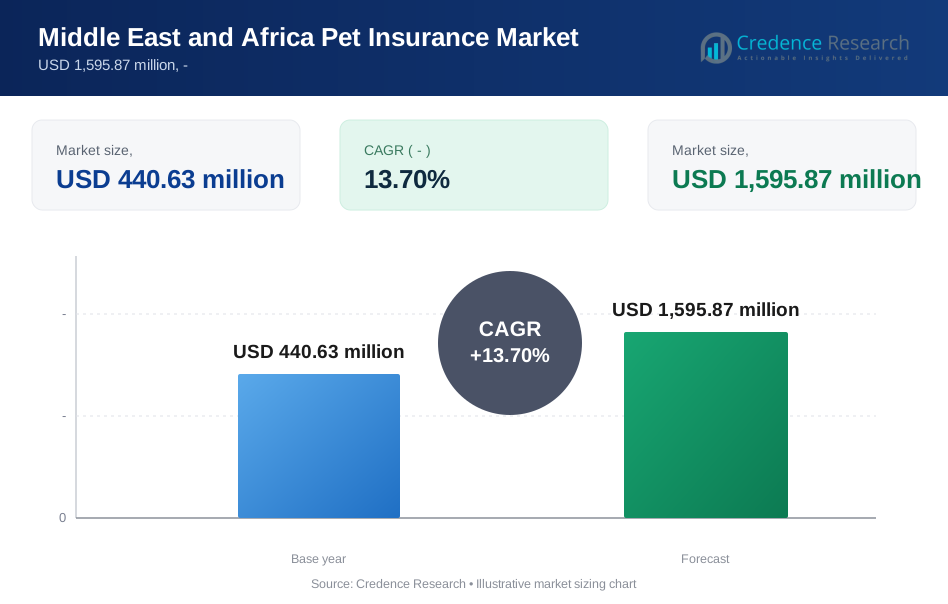
- 2.5.1 2023: USD 440.63 million → 2032: USD 1,595.87 million
- 2.6 Historical and Forecast Reference Periods
- 2.6.1 Base Year: 2023
- 2.6.2 Forecast Period: 2023-2032
- 2.7 Research Assumptions and Limitations
Chapter 3 Executive Summary
- 3.1 Market Snapshot and Key Findings
- 3.2 Base-Year Market Size, 2023
- 3.3 Forecast Market Size, 2032
- 3.4 Revenue and Volume Growth Outlook
- 3.5 Key Demand and Supply Indicators
- 3.6 Leading Market Segments
- 3.7 Fastest-Growing Market Opportunities
- 3.8 Regional Performance Highlights
- 3.9 Technology and Industry Transformation
- 3.10 Competitive Landscape Summary
- 3.11 Analyst View and Strategic Implications
Chapter 4 Middle East and Africa Pet Insurance Market Trends and Developments
- 4.1 Historical Industry Development
- 4.2 Recent Market Trends and Developments
- 4.3 Demand and Customer Behavior Trends
- 4.4 Technology and Product Innovation
- 4.5 Artificial Intelligence, Automation and Digitalization
- 4.6 Local Manufacturing and Supply Chain Realignment
- 4.7 Industry Partnerships, Mergers and Acquisitions
- 4.8 Sustainability and Circular Economy Developments
- 4.9 Government and Private Sector Investment Trends
- 4.10 Emerging Business Models and Commercialization
- 4.11 Industry Developments and Announcements
Chapter 5 Middle East and Africa Pet Insurance Market Supply and Demand Analysis
- 5.1 Demand Trend and Consumption Analysis
- 5.2 Demand Forecast, 2023-2032
- 5.3 Supply Chain Structure and Procurement Trends
- 5.4 Supply-Demand Gap and Bottlenecks
- 5.5 Import Dependence and Sourcing Structure
- 5.6 Regional Supply and Demand Concentration
Chapter 6 Middle East and Africa Pet Insurance Market Pricing Analysis
- 6.1 Pricing Structure and Measurement
- 6.2 Historical Pricing Trends
- 6.3 Pricing Outlook, 2023-2032
- 6.4 Pricing by Product and Market Segment
- 6.5 Geographic Pricing Differences
- 6.6 Key Input, Energy, Labor and Logistics Costs
- 6.7 Contract Pricing and Purchasing Models
- 6.8 Pricing Sensitivity and Competitive Positioning
- 6.9 Price, Margin and Profitability Implications
Chapter 7 Middle East and Africa Pet Insurance Market Dynamics
- 7.1 Market Growth Drivers
- 7.1.1 Demand-Side Drivers
- 7.1.2 Technology and Innovation Drivers
- 7.1.3 Infrastructure and Investment Drivers
- 7.1.4 Regulatory and Policy Drivers
- 7.2 Market Restraints
- 7.2.1 Cost and Affordability Constraints
- 7.2.2 Technology and Adoption Barriers
- 7.2.3 Supply Chain and Operational Constraints
- 7.3 Market Challenges
- 7.3.1 Competitive Pressure and Margin Erosion
- 7.3.2 Skills, Infrastructure and Implementation Gaps
- 7.4 Emerging Market Opportunities
- 7.5 Market Dynamics Impact and Time-Horizon Assessment
Chapter 8 Middle East and Africa Pet Insurance Value Chain Analysis
- 8.1 Industry Value Chain Overview
- 8.2 Upstream Suppliers and Critical Inputs
- 8.3 Technology and Component Providers
- 8.4 Manufacturing or Service Delivery
- 8.5 Distribution, Channel Partners and Integrators
- 8.6 Downstream Applications and End Users
- 8.7 Value Addition and Profit Pools
- 8.8 Vertical Integration and Outsourcing
- 8.9 Supplier Concentration and Risk
- 8.10 Supply Chain Localization and Resilience
Chapter 9 Middle East and Africa Pet Insurance Market Regulations and Policies
- 9.1 Relevant Laws, Standards and Compliance Frameworks
- 9.2 Product, Service, Safety and Quality Requirements
- 9.3 Government Policies, Incentives and Subsidies
- 9.4 Imports, Exports and Trade Barriers
- 9.5 Public Procurement and Local Content Requirements
- 9.6 Data Protection, AI and Cybersecurity Compliance
- 9.7 Upcoming Policy Changes and Market Implications
Chapter 10 Middle East and Africa Pet Insurance Market Hotspots and Opportunities
- 10.1 Market Opportunity Mapping and Growth Hotspots
- 10.2 High-Growth Applications and Customer Groups
- 10.3 Underserved Markets and White-Space Opportunities
- 10.4 Emerging Technology and Product Opportunities
- 10.5 New Capacity and Investment Hotspots
- 10.6 Market Entry and Expansion Opportunities
- 10.7 Distribution and Partnership Opportunities
- 10.8 Near-Term and Long-Term Commercial Potential
- 10.9 Opportunity Attractiveness and Execution Risks
Chapter 11 Middle East and Africa Pet Insurance Market Outlook, 2023-2032
- 11.1 Market Size and Analysis
- 11.1.1 Revenue (Market Measurement: 2023: USD 440.63 million → 2032: USD 1,595.87 million)
- 11.1.2 Historical Market Size
- 11.1.3 Base-Year Market Size, 2023
- 11.2 Market Forecast, 2023-2032
- 11.2.1 Revenue Forecast to 2032
- 11.2.2 CAGR and Year-on-Year Growth
- 11.2.3 Incremental Revenue Opportunity
- 11.3 Forecast Assumptions and Scenario Analysis
- 11.3.1 Base-Case Forecast
- 11.3.2 Optimistic and Conservative Scenarios
- 11.3.3 Technology, Pricing and Policy Sensitivities
- 11.4 Market Attractiveness and Growth Outlook
Chapter 12 Middle East and Africa Pet Insurance Market Segmentation and Outlook
- 12.1 Segmentation Summary and Market Shares, 2023
- 12.2 Largest and Fastest-Growing Segments
- 12.3 By End User - Market Size and Forecast, 2023-2032
- 12.3.1 Segment Definition and Scope
- 12.3.2 Historical Market Size
- 12.3.3 Revenue Forecast, 2023-2032
- 12.3.4 Base-Year Market Share, 2023
- 12.3.5 Segment CAGR and Growth Drivers
- 12.3.6 Subsegment Market Size and Forecast
- 12.3.6.1 Agency
- 12.3.6.2 Broker
- 12.3.6.3 Bancassurance
- 12.3.6.4 Direct Writing
- 12.3.7 Subsegment Pricing and Adoption Trends
- 12.3.8 Leading Suppliers and Competition
- 12.3.9 Regional Demand and Opportunities
- 12.4 By Animal Type - Market Size and Forecast, 2023-2032
- 12.4.1 Segment Definition and Scope
- 12.4.2 Historical Market Size
- 12.4.3 Revenue Forecast, 2023-2032
- 12.4.4 Base-Year Market Share, 2023
- 12.4.5 Segment CAGR and Growth Drivers
- 12.4.6 Subsegment Market Size and Forecast
- 12.4.6.1 Cat
- 12.4.6.2 Dog
- 12.4.6.3 Horse
- 12.4.6.4 Exotic Pets
- 12.4.7 Subsegment Pricing and Adoption Trends
- 12.4.8 Leading Suppliers and Competition
- 12.4.9 Regional Demand and Opportunities
- 12.5 By Policy Type - Market Size and Forecast, 2023-2032
- 12.5.1 Segment Definition and Scope
- 12.5.2 Historical Market Size
- 12.5.3 Revenue Forecast, 2023-2032
- 12.5.4 Base-Year Market Share, 2023
- 12.5.5 Segment CAGR and Growth Drivers
- 12.5.6 Subsegment Market Size and Forecast
- 12.5.6.1 Lifetime Cover - Accidental Cover
- 12.5.6.2 Lifetime Cover - Illness Cover
- 12.5.6.3 Non-lifetime Cover - Accidental Cover
- 12.5.6.4 Non-lifetime Cover - Illness Cover
- 12.5.7 Subsegment Pricing and Adoption Trends
- 12.5.8 Leading Suppliers and Competition
- 12.5.9 Regional Demand and Opportunities
- 12.6 Segment Growth Comparison
- 12.7 Segment Attractiveness and Priority Matrix
Chapter 13 Middle East and Africa Pet Insurance End-Use and Application Market Outlook
- 13.1 End-Use Industry and Customer Demand Structure
- 13.2 Leading Applications and Customer Groups
- 13.3 End-Use Market Size, Share and Forecast
- 13.4 Major End-Use Industry Deep Dives
- 13.4.1 Customer Requirements and Use Cases
- 13.4.2 Demand and Replacement Cycles
- 13.4.3 Technical and Regulatory Considerations
- 13.4.4 Purchasing and Procurement Models
- 13.4.5 Leading Vendors and Distribution Channels
- 13.4.6 Forecast and Commercial Opportunities
- 13.5 Emerging Applications and Cross-Segment Demand
- 13.6 End-Use Industry Investment Priorities
Chapter 14 Middle East and Africa Pet Insurance Geographic Market Outlook, 2023-2032
- 14.1 Regional Market Size and Country-Level Shares, 2023
- 14.2 Country Market Size Comparison, 2023
- 14.3 Country Market Forecasts, 2023-2032
- 14.4 Subregional Industrial and Demand Clusters
- 14.5 Intra-Regional Pricing and Cost Differences
- 14.6 Cross-Border Trade and Supply Networks
- 14.7 Regional Supply and Demand Balances
- 14.8 Country Opportunity Comparison and Prioritization
Note: Every listed country is covered on the structure shown under the first country.
Chapter 15 Middle East and Africa Pet Insurance Technology, Innovation and Sustainability Outlook
- 15.1 Technology Landscape and Maturity
- 15.2 Product, Process and Service Innovation
- 15.3 AI, Automation and Digital Tools in the Industry
- 15.4 Technology Adoption and Performance Benchmarking
- 15.5 Innovation Pipeline and R&D Investment
- 15.6 Energy Efficiency and Resource Management
- 15.7 Sustainability, Recycling and Circularity
- 15.8 Technology Roadmap, 2023-2032
- 15.9 Risks of Obsolescence and Technology Substitution
Chapter 16 Middle East and Africa Pet Insurance Market Key Strategic Imperatives
- 16.1 Growth and Market Entry Priorities
- 16.2 High-Return Products and Segments
- 16.3 Pricing, Profitability and Cost Optimization
- 16.4 Technology Investment and Product Differentiation
- 16.5 Supply Chain Localization and Resilience
- 16.6 Distribution and Customer Acquisition
- 16.7 Partnership, Acquisition and Capacity Strategy
- 16.8 Regional Expansion Priorities
- 16.9 Short-, Medium- and Long-Term Actions
Chapter 17 Competition Outlook
- 17.1 Industry Competition Characteristics
- 17.2 Market Structure and Concentration
- 17.3 Market Share and Competitive Positioning, 2023
- 17.4 Company-Wise Revenue and Product Benchmarking
- 17.5 Production and Service Capacity Benchmarking
- 17.6 Technology, Pricing and Differentiation
- 17.7 Regional Footprint and Distribution Strength
- 17.8 Mergers, Acquisitions and Strategic Alliances
- 17.9 New Entrants and Competitive Threats
- 17.10 Porter's Five Forces and Industry Attractiveness
- 17.11 Competitive Outlook, 2023-2032
Chapter 18 Company Profiles
- 18.1 Company Coverage and Selection Criteria
- 18.2 Petplan Pet Insurance
- 18.2.1 Business Description
- 18.2.2 Company Ownership and Geographic Presence
- 18.2.3 Product and Service Portfolio
- 18.2.4 Manufacturing and Operating Footprint
- 18.2.5 Financial Performance and Investment
- 18.2.6 Market Share and Competitive Position
- 18.2.7 Technology and Innovation Capabilities
- 18.2.8 Strategic Alliances or Partnerships
- 18.2.9 Recent Developments
- 18.2.10 Growth Strategy and Outlook
- 18.3 Embrace Pet Insurance Agency
- 18.4 Royal & Sun Alliance (RSA)
- 18.5 Pethealth Inc.
- 18.6 Agria Pet Insurance
- 18.7 Petfirst Healthcare
- 18.8 Nationwide Pet Insurance
- 18.9 PetSure Pty Ltd.
- 18.10 Petsecure Pet Health Insurance
- 18.11 Hartville Group
- 18.12 Other Relevant Market Participants
Note: Every listed company is profiled on the structure shown under the first company. The company list is preliminary and may change based on research findings, market developments, data availability and client requirements.
Chapter 19 Disclaimer
- 19.1 Research and Forecast Disclaimer
- 19.2 Data Source and Estimation Limitations
Note: The depth of individual sections depends on data availability for this market. Volume, capacity, trade and other unit-based metrics are included where applicable.

