
Nitrous Oxide Market Overview:
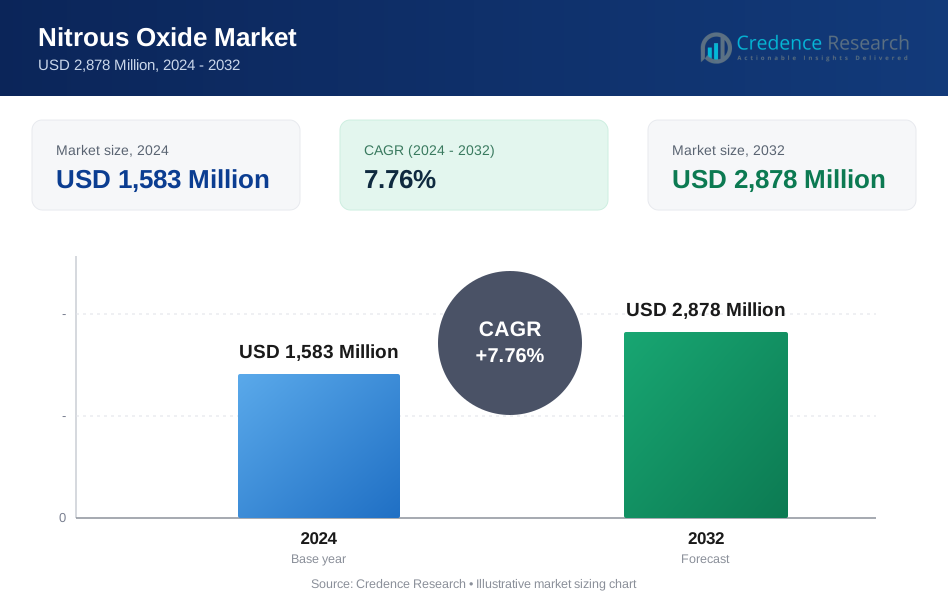
Nitrous Oxide Market size was valued USD 1,583 Million in 2024 and is anticipated to reach USD 2,878 Million by 2032, at a CAGR of 7.76% during the forecast period.
| REPORT ATTRIBUTE | DETAILS |
|---|---|
| Historical Period | 2020-2023 |
| Base Year | 2024 |
| Forecast Period | 2025-2032 |
| Nitrous Oxide Market Size 2024 | USD 1,583 million |
| Nitrous Oxide Market, CAGR | 7.76% |
| Nitrous Oxide Market Size 2032 | USD 2,878 million |
Nitrous Oxide Market Insights
- Market growth is driven by rising adoption in medical and dental anesthesia, increasing surgical volumes, expanding industrial and electronics applications, and growing usage of food-grade nitrous oxide in processing and packaging activities.
- Market trends reflect increasing investments in bulk storage and supply networks, stronger focus on purity and quality standards, and strengthening presence of leading gas manufacturers through capacity expansion and long-term customer partnerships.
- The market faces restraints such as stringent regulatory compliance requirements, safety and handling risks, high production and transportation costs, and supply chain fluctuations affecting availability in emerging and developing regions.
- Regional analysis shows North America leading with 34.8% share in 2024, followed by Europe with 28.6% and Asia-Pacific with 24.9%, while the Medical & Healthcare segment dominated the market with 52.3% share in 2024 due to extensive clinical usage.

Nitrous Oxide Market Segmentation Analysis:
By Application
The Nitrous Oxide Market is primarily driven by its diverse application base, with Medical & Healthcare emerging as the dominant sub-segment holding 52.3% market share in 2024. Its leadership stems from the widespread use of nitrous oxide in anesthesia, sedation, and pain management across surgical and dental procedures. Growing surgical volumes, expansion of ambulatory care services, and strong regulatory acceptance reinforce demand in this segment. Automotive & Electronics, Food & Beverage, and Industrial Applications collectively contribute to the remaining share, supported by usage in engine testing, semiconductor processing, whipping agents, welding, and chemical manufacturing.
- For instance, INOX Air Products commissioned India's first ultra-high purity (6N, 99.9999%) electronic-grade nitrous oxide plant in Chennai with 1700 TPA capacity, supporting semiconductor oxidation processes and oxide film deposition.
By End User
Across end-user categories, Hospitals & Clinics accounted for the largest share at 58.7% in 2024, driven by their high dependency on nitrous oxide for operating rooms, emergency care, and dental treatment settings. Rising hospital infrastructure development, growth in elective surgeries, and greater emphasis on patient-centric pain management strengthen this segment’s leadership. Ambulatory Surgical Centers, Food & Beverage Companies, Industrial Manufacturing Firms, and Research & Academic Institutions collectively contribute to the rest of the market, supported by increasing outpatient care adoption, food propellant demand, industrial processing needs, and laboratory research applications.
- For instance, Stanford University deploys nitrous oxide as a tracer gas in laboratory fume hood testing to validate airflow performance. Linde supports research with ultra-high purity nitrous oxide for applications like environmental monitoring and calibration gas mixtures.
By Sales Channel
In the sales channel structure, Direct Sales remained the dominant sub-segment with 46.2% market share in 2024, as major gas manufacturers prioritize long-term supply contracts with hospitals, industrial users, and large processing facilities. This channel benefits from assured product quality, compliance traceability, and cost-efficient bulk delivery models. Distributors & Dealers, Online Procurement Platforms, and Gas Supply & Specialty Chemical Suppliers serve the remaining share, gaining traction through regional distribution networks, digital purchasing convenience, and specialized supply solutions for SMEs, laboratories, and emerging industrial users.
Key Growth Drivers
Rising Adoption of Nitrous Oxide in Medical and Dental Procedures
The Nitrous Oxide Market experiences strong growth due to its expanding use in anesthesia, sedation, and pain management across hospitals, dental clinics, and ambulatory care centers. Increasing surgical volumes, growth in minimally invasive procedures, and wider integration of conscious sedation in dentistry strengthen demand. Healthcare providers prefer nitrous oxide because it offers rapid onset, controllable effects, and enhanced patient comfort during treatment. Rising investments in healthcare infrastructure, coupled with the growing burden of chronic and lifestyle-related diseases requiring surgical intervention, continue to accelerate utilization. Additionally, training expansion among anesthesiologists and dentists further supports sustained market adoption in clinical environments.
- For instance, Linde's LIVOPAN®, a 50% nitrous oxide/oxygen mixture, provides fast-onset analgesia in obstetrics for labor pain, with low solubility ensuring rapid elimination and preserved spontaneous breathing when combined with other anesthetics.
Expanding Industrial and Electronics Applications
Industrial and electronics applications significantly contribute to market expansion as nitrous oxide is increasingly used in semiconductor manufacturing, engine testing, and specialty chemical processing. Growth in electric vehicles, consumer electronics, and microchip production drives steady consumption across manufacturing environments. The gas plays a critical role as an oxidizing and processing agent, supporting precision performance in advanced fabrication technologies. Rapid industrialization in emerging economies, coupled with capacity expansion by manufacturing facilities, strengthens long-term consumption patterns. Continuous research into alternative industrial gases and performance optimization also encourages technological advancement, enabling broader integration of nitrous oxide in high-value industrial processes.
- For instance, Firehawk Aerospace tested its Armstrong 1K hybrid rocket engine using nitrous oxide as the oxidizer at NASA's Stennis Space Center in 2021. The company completed about 100 cold flow and hot fire tests on a mobile stand, validating 3D-printed hybrid fuel technology for propulsion advantages.
Increasing Demand from Food and Beverage Processing
Growth in the global food and beverage industry fuels rising demand for nitrous oxide as a whipping and foaming agent used in packaged dessert creams, culinary applications, and specialty beverages. Expansion of bakery and confectionery production, together with the growth of café and ready-to-eat food chains, strengthens product uptake. Manufacturers prefer nitrous oxide because it delivers consistent texture, longer shelf stability, and controlled aeration in food processing environments. Increasing urban consumption trends, growth in commercial kitchens, and rising demand for convenience foods further stimulate usage. Regulatory compliance improvements and investments in food-grade gas packaging technologies continue to reinforce market growth in this segment.
Key Trends & Opportunities
Growing Shift Toward Advanced Gas Supply and Distribution Solutions
A major trend shaping the Nitrous Oxide Market is the transition toward advanced distribution infrastructures, including bulk storage systems, centralized gas piping, and automated cylinder tracking technologies. Healthcare facilities and industrial plants increasingly invest in integrated delivery networks that enhance safety, quality assurance, and supply reliability. This shift creates opportunities for gas manufacturers to expand service-based offerings such as onsite gas management, long-term supply contracts, and customized delivery programs. Digital procurement platforms and remote monitoring capabilities further support operational efficiency, enabling end users to optimize consumption and reduce logistical risks while strengthening supplier-customer partnerships across regions.
- For instance, Air Liquide Healthcare supplies medical-grade nitrous oxide through bulk liquid storage in vacuum-insulated vessels with capacities from 1,000 to 65,000 liters, supporting integrated reticulated gas distribution systems in healthcare facilities.
Expansion Opportunities Across Emerging Economies and Research Environments
Rapid industrial growth, healthcare modernization, and government investment in research infrastructure across emerging economies present strong opportunities for market expansion. Hospitals, laboratories, and manufacturing units in developing regions continue to adopt nitrous oxide for clinical care, industrial processing, and experimental applications. Academic institutions and R&D facilities increasingly incorporate specialty gases into biotechnology, materials science, and pharmaceutical research, helping broaden application scope. Favorable policy reforms, increasing foreign direct investment, and establishment of new manufacturing clusters create additional demand potential. Market players benefit from local production partnerships, capacity expansion strategies, and regional distribution networks that enhance accessibility and strengthen competitive positioning.
- For instance, INOX Air Products commissioned India's first ultra-high purity electronic grade nitrous oxide plant in Manali, Chennai, with 1,700 tons per annum capacity at 6N (99.9999%) purity.
Key Challenges
Regulatory Compliance, Safety Risks, and Environmental Concerns
Stringent regulatory frameworks surrounding medical gas handling, storage safety, and emissions control pose significant challenges for industry participants. Healthcare and industrial facilities must adhere to rigorous quality standards, certification requirements, and occupational safety protocols, increasing operational complexity and compliance costs. Environmental concerns related to nitrous oxide emissions, particularly within industrial and agricultural sectors, have intensified scrutiny from regulatory authorities and sustainability organizations. Market participants face pressure to adopt monitoring technologies, emission-reduction practices, and environmentally responsible production processes. Balancing demand growth with regulatory accountability remains a critical challenge influencing operational strategies and product lifecycle management.
Supply Chain Volatility and High Production and Transportation Costs
The Nitrous Oxide Market faces challenges arising from supply chain fluctuations, high production expenses, and logistics-intensive distribution networks. Dependence on specialized manufacturing facilities, purity-controlled processing systems, and cylinder handling infrastructure increases capital and operational costs for suppliers. Fuel price fluctuations, transportation constraints, and limited availability of skilled handling personnel further affect market stability. Regional imbalances in production capacity can lead to inconsistent supply availability, especially in emerging markets. Manufacturers seek to address these challenges through localized production expansion, strategic sourcing partnerships, and efficient logistics planning; however, cost pressures continue to influence pricing strategies and market accessibility for end users.
Regional Analysis
North America
North America holds a leading position in the Nitrous Oxide Market, supported by strong adoption across hospitals, dental facilities, and advanced manufacturing sectors. The region accounted for 34.8% market share in 2024, driven by extensive use of nitrous oxide in anesthesia, outpatient surgical care, semiconductor fabrication, and food processing. The United States remains the primary revenue contributor due to a mature healthcare ecosystem, high surgical volume, and strong presence of industrial gas suppliers. Growth is further reinforced by rising investments in healthcare infrastructure modernization, expansion of medical gas pipeline systems, and increasing penetration of ambulatory surgical centers across urban and suburban regions.
Europe
Europe represents a significant share of the Nitrous Oxide Market, with strong demand arising from medical, pharmaceutical, food and beverage, and automotive testing applications. The region captured 28.6% market share in 2024, supported by stringent healthcare quality standards and well-established industrial gas distribution networks. Countries such as Germany, France, and the United Kingdom contribute significantly due to high adoption of hospital-based anesthesia solutions and expanding electronics manufacturing activities. Ongoing emphasis on regulatory compliance, sustainability initiatives, and technological upgrades in industrial production environments strengthens long-term consumption patterns, while continued investments in research laboratories and dental care facilities further enhance regional market growth.
Asia-Pacific
Asia-Pacific emerges as the fastest-growing regional market, supported by rapid industrialization, rising healthcare expenditure, and expansion of semiconductor and electronics manufacturing ecosystems. The region accounted for 24.9% market share in 2024, with China, India, Japan, and South Korea playing key roles in driving demand across medical, industrial, and food processing industries. Growing hospital infrastructure development, increasing surgical treatment rates, and scaling manufacturing capabilities reinforce market expansion. Additionally, strong government focus on healthcare capacity building, rising investments in specialty gas production facilities, and the growing presence of multinational industrial gas suppliers enhance accessibility, strengthening both domestic consumption and export-driven application segments.
Latin America
Latin America continues to develop as a steadily expanding market for nitrous oxide, supported by improving healthcare delivery systems, rising awareness of pain-management practices, and gradual industrial modernization. The region recorded 6.9% market share in 2024, with Brazil, Mexico, and Argentina contributing significantly through hospital upgrades, dental care expansion, and increasing integration of specialty gases in food processing and manufacturing. Public and private sector investments in surgical infrastructure and clinical facilities are strengthening demand, while industrial applications benefit from the growth of automotive and packaging sectors. However, supply chain constraints and limited localized production capacity continue to shape procurement dynamics across the region.
Middle East & Africa
The Middle East & Africa region shows progressive growth momentum in the Nitrous Oxide Market, supported by expanding healthcare networks, rising medical tourism hubs, and increasing industrial development initiatives. The region accounted for 4.8% market share in 2024, with the Gulf countries leading adoption through investment in hospital infrastructure, specialty clinics, and modern surgical facilities. Industrial and research-based applications are gaining traction as manufacturing diversification strategies advance across key economies. Growing participation of international gas suppliers, capacity expansion in regional distribution networks, and gradual enhancement of regulatory frameworks collectively support broader market penetration and strengthen long-term demand potential across medical and industrial environments.
Nitrous Oxide Market Segmentations:
By Application
- Medical & Healthcare
- Automotive & Electronics
- Food & Beverage
- Industrial Applications
By End User
- Hospitals & Clinics
- Ambulatory Surgical Centers
- Food & Beverage Companies
- Industrial Manufacturing Firms
- Research & Academic Institutions
By Sales Channel
- Direct Sales
- Distributors & Dealers
- Online Procurement Platforms
- Gas Supply & Specialty Chemical Suppliers
By Geography
- North America
- U.S.
- Canada
- Mexico
- Europe
- Germany
- France
- U.K.
- Italy
- Spain
- Rest of Europe
- Asia Pacific
- China
- Japan
- India
- South Korea
- South-east Asia
- Rest of Asia Pacific
- Latin America
- Brazil
- Argentina
- Rest of Latin America
- Middle East & Africa
- GCC Countries
- South Africa
- Rest of the Middle East and Africa
Competitive Landscape
Competitive landscape in the Nitrous Oxide Market features leading players such as Linde plc, Air Liquide S.A., Air Products and Chemicals Inc., Praxair Technology Inc., MATHESON TRI-GAS Inc., SOL Group, Merck KGaA, Nippon Sanso Holdings Co. Ltd., Ellenbarrie Industrial Gases Ltd., and Airgas Inc. The market operates in a moderately consolidated structure, where global industrial gas companies leverage large-scale production capabilities, long-term supply contracts, and strong distribution networks to maintain market presence. Players focus on expanding medical-grade and food-grade gas portfolios, enhancing purity standards, and strengthening compliance with safety and environmental regulations. Strategic initiatives such as capacity expansion, regional manufacturing partnerships, and investment in automated cylinder management and bulk delivery systems support operational efficiency and service reliability. Increasing emphasis on healthcare infrastructure development, semiconductor manufacturing, and industrial processing encourages companies to innovate supply models and deepen customer engagement, while mergers, acquisitions, and technology-driven logistics solutions continue to shape competitive positioning across global and emerging markets.
Key Player Analysis
- Linde plc
- Air Liquide S.A.
- Air Products and Chemicals, Inc.
- Praxair Technology, Inc.
- MATHESON TRI-GAS, INC.
- SOL Group (SOL Spa)
- Merck KGaA
- Nippon Sanso Holdings Co., Ltd.
- Ellenbarrie Industrial Gases Ltd.
- Airgas, Inc.
Recent Developments
- In November 2025, INOX Air Products signed a long-term partnership with ReNew to supply ultra-high purity nitrogen via a new air separation unit for solar cell manufacturing, building on their existing nitrous oxide supplies.
- In February 2025, Linde Gas & Equipment Inc. filed a 510(k) premarket notification with the U.S. FDA for NOXBOX I PLUS, an enhanced nitric oxide delivery system compatible with NOXIVENT gas.
- In January 2025, INOX Air Products commissioned India’s first Ultra High Purity (UHP) Electronic Grade Nitrous Oxide plant with 99.9999% purity capacity, enhancing supply for advanced electronics and semiconductor applications.
Report Coverage
The research report offers an in-depth analysis based on Application, End User, Sales Channel and Geography. It details leading market players, providing an overview of their business, product offerings, investments, revenue streams, and key applications. Additionally, the report includes insights into the competitive environment, SWOT analysis, current market trends, as well as the primary drivers and constraints. Furthermore, it discusses various factors that have driven market expansion in recent years. The report also explores market dynamics, regulatory scenarios, and technological advancements that are shaping the industry. It assesses the impact of external factors and global economic changes on market growth. Lastly, it provides strategic recommendations for new entrants and established companies to navigate the complexities of the market.
Future Outlook
- The market will witness sustained demand growth driven by increasing use of nitrous oxide in medical and dental anesthesia and sedation services.
- Healthcare infrastructure expansion and higher surgical procedure volumes will strengthen consumption across hospitals and ambulatory care centers.
- Industrial and electronics manufacturing applications will continue to expand, supported by growth in semiconductors and precision engineering.
- Food and beverage processing will remain a stable demand source due to rising usage in whipping agents and packaged dessert applications.
- Market participants will invest in advanced distribution networks, bulk storage systems, and automated cylinder management solutions.
- Emerging economies will offer strong growth opportunities through healthcare modernization and manufacturing capacity expansion.
- Regulatory compliance, quality assurance, and safety standards will increasingly influence product development and operational strategies.
- Strategic partnerships, capacity expansions, and regional production facilities will help companies reduce supply chain risks.
- Sustainability initiatives and emission control efforts will encourage technological improvements in production and handling processes.
- Digital procurement platforms and service-based supply models will enhance customer accessibility and long-term supplier relationships.
Request a Free Sample
Fill in your details and we'll send you a free sample report.
- Sample data tables & charts
- Research methodology
Need a Custom Version of This Report?
Tailor the scope, geography, or segments to your exact requirements.
- Custom geography or segment scope
- Direct access to our analyst team
Frequently Asked Questions
What is the current market size for Nitrous Oxide Market, and what is its projected size in 2032?
At what Compound Annual Growth Rate is the Nitrous Oxide Market projected to grow between 2024 and 2032?
Which Nitrous Oxide Market segment held the largest share in 2024?
What are the primary factors fueling the growth of the Nitrous Oxide Market?
Who are the leading companies in the Nitrous Oxide Market?
Which region commanded the largest share of the Nitrous Oxide Market in 2024?
Table of Content
Chapter 1 Market Segmentation
- 1.1 Segmentation Framework
- 1.1.1 Product and Service Classification
- 1.1.2 Application and End-Use Classification
- 1.1.3 Technology and Solution Classification
- 1.1.4 Customer and Distribution Channel Classification
- 1.1.5 Geographic Segmentation
- 1.1.6 Market Segment Definitions and Boundaries
Chapter 2 Introduction
- 2.1 Report Objectives and Scope
- 2.2 Product Definition and Industry Terminology
- 2.3 Market Inclusions and Exclusions
- 2.4 Research Process
- 2.4.1 Primary Research and Expert Interviews
- 2.4.2 Secondary Research and Source Review
- 2.4.3 Top-Down and Bottom-Up Estimation
- 2.4.4 Data Triangulation and Verification
- 2.5 Market Size Measurement Basis
- 2.5.1 2024: USD 1,583 Million → 2032: USD 2,878 Million
- 2.6 Historical and Forecast Reference Periods
- 2.6.1 Base Year: 2024
- 2.6.2 Forecast Period: 2024-2032
- 2.7 Research Assumptions and Limitations
Chapter 3 Executive Summary
- 3.1 Market Snapshot and Key Findings
- 3.2 Base-Year Market Size, 2024
- 3.3 Forecast Market Size, 2032
- 3.4 Revenue and Volume Growth Outlook
- 3.5 Key Demand and Supply Indicators
- 3.6 Leading Market Segments
- 3.7 Fastest-Growing Market Opportunities
- 3.8 Regional Performance Highlights
- 3.9 Technology and Industry Transformation
- 3.10 Competitive Landscape Summary
- 3.11 Analyst View and Strategic Implications
Chapter 4 Global Nitrous Oxide Market Trends and Developments
- 4.1 Historical Industry Development
- 4.2 Recent Market Trends and Developments
- 4.3 Demand and Customer Behavior Trends
- 4.4 Technology and Product Innovation
- 4.5 Artificial Intelligence, Automation and Digitalization
- 4.6 Local Manufacturing and Supply Chain Realignment
- 4.7 Industry Partnerships, Mergers and Acquisitions
- 4.8 Sustainability and Circular Economy Developments
- 4.9 Government and Private Sector Investment Trends
- 4.10 Emerging Business Models and Commercialization
- 4.11 Industry Developments and Announcements
Chapter 5 Global Nitrous Oxide Market Production, Supply and Demand Analysis
- 5.1 Demand Trend and Consumption Analysis
- 5.2 Demand Forecast, 2024-2032
- 5.3 Production and Output Trend
- 5.4 Production and Output Forecast, 2024-2032
- 5.5 Installed Capacity and Capacity Utilization
- 5.6 Company-Wise Production Plants and Statistics
- 5.6.1 Installed Production Capacity
- 5.6.2 Actual Production
- 5.6.3 Planned Capacity and Expansion Targets
- 5.7 Supply Chain Structure and Procurement Trends
- 5.8 Supply-Demand Gap and Bottlenecks
- 5.9 Import Dependence and Sourcing Structure
- 5.10 Contract Manufacturing and Outsourcing
- 5.11 Regional Supply and Demand Concentration
Chapter 6 Global Nitrous Oxide Market Pricing Analysis
- 6.1 Pricing Structure and Measurement
- 6.2 Historical Pricing Trends
- 6.3 Pricing Outlook, 2024-2032
- 6.4 Average Selling Price and Unit Economics
- 6.5 Pricing by Product and Market Segment
- 6.6 Geographic Pricing Differences
- 6.7 Key Input, Energy, Labor and Logistics Costs
- 6.8 Contract Pricing and Purchasing Models
- 6.9 Pricing Sensitivity and Competitive Positioning
- 6.10 Price, Margin and Profitability Implications
Chapter 7 Global Nitrous Oxide Market Dynamics
- 7.1 Market Growth Drivers
- 7.1.1 Demand-Side Drivers
- 7.1.2 Technology and Innovation Drivers
- 7.1.3 Infrastructure and Investment Drivers
- 7.1.4 Regulatory and Policy Drivers
- 7.2 Market Restraints
- 7.2.1 Cost and Affordability Constraints
- 7.2.2 Technology and Adoption Barriers
- 7.2.3 Supply Chain and Operational Constraints
- 7.3 Market Challenges
- 7.3.1 Competitive Pressure and Margin Erosion
- 7.3.2 Skills, Infrastructure and Implementation Gaps
- 7.4 Emerging Market Opportunities
- 7.5 Market Dynamics Impact and Time-Horizon Assessment
Chapter 8 Global Nitrous Oxide Value Chain Analysis
- 8.1 Industry Value Chain Overview
- 8.2 Upstream Suppliers and Critical Inputs
- 8.3 Technology and Component Providers
- 8.4 Manufacturing or Service Delivery
- 8.5 Distribution, Channel Partners and Integrators
- 8.6 Downstream Applications and End Users
- 8.7 Value Addition and Profit Pools
- 8.8 Vertical Integration and Outsourcing
- 8.9 Supplier Concentration and Risk
- 8.10 Supply Chain Localization and Resilience
Chapter 9 Global Nitrous Oxide Market Regulations and Policies
- 9.1 Relevant Laws, Standards and Compliance Frameworks
- 9.2 Product, Service, Safety and Quality Requirements
- 9.3 Government Policies, Incentives and Subsidies
- 9.4 Imports, Exports and Trade Barriers
- 9.5 Public Procurement and Local Content Requirements
- 9.6 Environmental and Sustainability Compliance
- 9.7 Upcoming Policy Changes and Market Implications
Chapter 10 Global Nitrous Oxide Market Hotspots and Opportunities
- 10.1 Market Opportunity Mapping and Growth Hotspots
- 10.2 High-Growth Applications and Customer Groups
- 10.3 Underserved Markets and White-Space Opportunities
- 10.4 Emerging Technology and Product Opportunities
- 10.5 New Capacity and Investment Hotspots
- 10.6 Market Entry and Expansion Opportunities
- 10.7 Distribution and Partnership Opportunities
- 10.8 Near-Term and Long-Term Commercial Potential
- 10.9 Opportunity Attractiveness and Execution Risks
Chapter 11 Global Nitrous Oxide Market Outlook, 2024-2032
- 11.1 Market Size and Analysis
- 11.1.1 Revenue (Market Measurement: 2024: USD 1,583 Million → 2032: USD 2,878 Million)
- 11.1.2 Market Volume and Quantity Sold
- 11.1.3 Historical Market Size
- 11.1.4 Base-Year Market Size, 2024
- 11.2 Market Forecast, 2024-2032
- 11.2.1 Revenue Forecast to 2032
- 11.2.2 Volume Forecast to 2032
- 11.2.3 CAGR and Year-on-Year Growth
- 11.2.4 Incremental Revenue Opportunity
- 11.3 Forecast Assumptions and Scenario Analysis
- 11.3.1 Base-Case Forecast
- 11.3.2 Optimistic and Conservative Scenarios
- 11.3.3 Technology, Pricing and Policy Sensitivities
- 11.4 Market Attractiveness and Growth Outlook
Chapter 12 Global Nitrous Oxide Market Segmentation and Outlook
- 12.1 Segmentation Summary and Market Shares, 2024
- 12.2 Largest and Fastest-Growing Segments
- 12.3 Segment Growth Comparison
- 12.4 Segment Attractiveness and Priority Matrix
Chapter 13 Global Nitrous Oxide Geographic Market Outlook, 2024-2032
- 13.1 Regional Market Size and Share, 2024
- 13.2 Regional Market Forecast, 2024-2032
- 13.3 Regional Pricing, Production and Demand Differences
- 13.4 North America
- 13.4.1 United States
- 13.4.2 Canada
- 13.4.3 Mexico
- 13.5 Europe
- 13.5.1 Germany
- 13.5.2 France
- 13.5.3 Italy
- 13.5.4 United Kingdom
- 13.5.5 Spain
- 13.5.6 Poland
- 13.5.7 Russia
- 13.5.8 Netherlands
- 13.5.9 Belgium
- 13.5.10 Sweden
- 13.5.11 Denmark
- 13.5.12 Norway
- 13.5.13 Rest of Europe
- 13.6 Asia Pacific
- 13.6.1 China
- 13.6.2 India
- 13.6.3 Japan
- 13.6.4 South Korea
- 13.6.5 Thailand
- 13.6.6 Indonesia
- 13.6.7 Vietnam
- 13.6.8 Malaysia
- 13.6.9 Australia
- 13.6.10 Rest of Asia Pacific
- 13.7 Latin America
- 13.7.1 Brazil
- 13.7.2 Argentina
- 13.7.3 Colombia
- 13.7.4 Chile
- 13.7.5 Rest of Latin America
- 13.8 Middle East
- 13.8.1 Saudi Arabia
- 13.8.2 United Arab Emirates
- 13.8.3 Turkey
- 13.8.4 Israel
- 13.8.5 Iran
- 13.8.6 Rest of the Middle East
- 13.9 Africa
- 13.9.1 South Africa
- 13.9.2 Egypt
- 13.9.3 Nigeria
- 13.9.4 Morocco
- 13.9.5 Rest of Africa
- 13.10 Regional Investment, Policy and Supply Chain Differences
- 13.11 Regional Competitive Landscape
- 13.12 Geographic Growth Hotspots
Chapter 14 Global Nitrous Oxide Technology, Innovation and Sustainability Outlook
- 14.1 Technology Landscape and Maturity
- 14.2 Product, Process and Service Innovation
- 14.3 AI, Automation and Digital Tools in the Industry
- 14.4 Technology Adoption and Performance Benchmarking
- 14.5 Innovation Pipeline and R&D Investment
- 14.6 Patent and Intellectual Property Trends
- 14.7 Energy Efficiency and Resource Management
- 14.8 Sustainability, Recycling and Circularity
- 14.9 Technology Roadmap, 2024-2032
- 14.10 Risks of Obsolescence and Technology Substitution
Chapter 15 Global Nitrous Oxide Market Key Strategic Imperatives
- 15.1 Growth and Market Entry Priorities
- 15.2 High-Return Products and Segments
- 15.3 Pricing, Profitability and Cost Optimization
- 15.4 Technology Investment and Product Differentiation
- 15.5 Supply Chain Localization and Resilience
- 15.6 Distribution and Customer Acquisition
- 15.7 Partnership, Acquisition and Capacity Strategy
- 15.8 Regional Expansion Priorities
- 15.9 Short-, Medium- and Long-Term Actions
Chapter 16 Competition Outlook
- 16.1 Industry Competition Characteristics
- 16.2 Market Structure and Concentration
- 16.3 Market Share and Competitive Positioning, 2024
- 16.4 Company-Wise Revenue and Product Benchmarking
- 16.5 Production and Service Capacity Benchmarking
- 16.6 Technology, Pricing and Differentiation
- 16.7 Regional Footprint and Distribution Strength
- 16.8 Mergers, Acquisitions and Strategic Alliances
- 16.9 New Entrants and Competitive Threats
- 16.10 Porter's Five Forces and Industry Attractiveness
- 16.11 Competitive Outlook, 2024-2032
Chapter 17 Company Profiles
- 17.1 Company Coverage and Selection Criteria
- 17.2 Leading Market Participants – Standard Profile Structure
- 17.2.1 Business Description
- 17.2.2 Company Ownership and Geographic Presence
- 17.2.3 Product and Service Portfolio
- 17.2.4 Manufacturing and Operating Footprint
- 17.2.5 Production Capacity and Expansion Plans
- 17.2.6 Financial Performance and Investment
- 17.2.7 Market Share and Competitive Position
- 17.2.8 Technology and Innovation Capabilities
- 17.2.9 Strategic Alliances or Partnerships
- 17.2.10 Recent Developments
- 17.2.11 Growth Strategy and Outlook
- 17.3 Other Relevant Market Participants
Note: Every listed company is profiled on the structure shown under the first company. The company list is preliminary and may change based on research findings, market developments, data availability and client requirements.
Chapter 18 Disclaimer
- 18.1 Research and Forecast Disclaimer
- 18.2 Data Source and Estimation Limitations
Note: The depth of individual sections depends on data availability for this market. Volume, capacity, trade and other unit-based metrics are included where applicable.

