
Petroleum Coke (Pet coke) Market Overview:
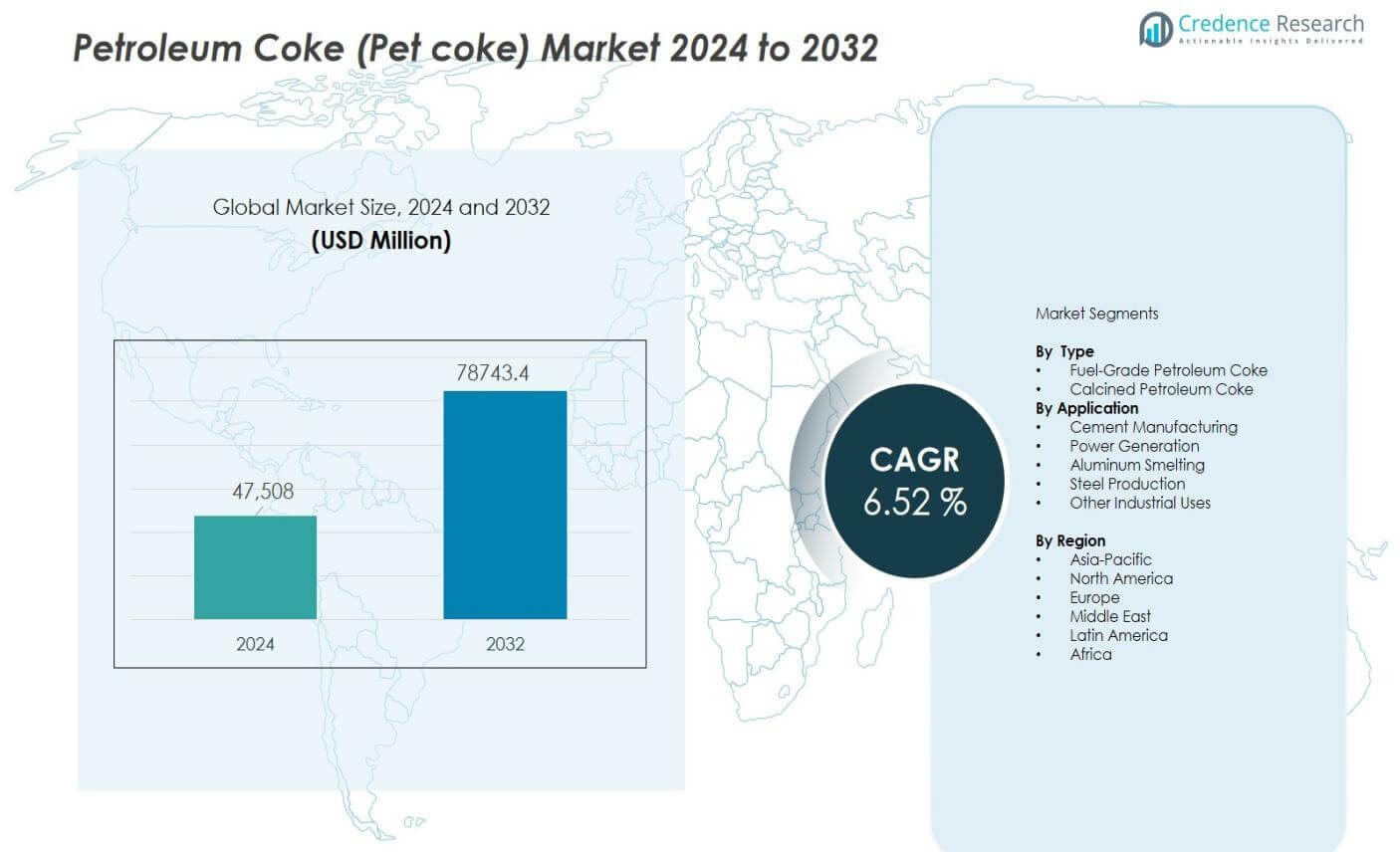
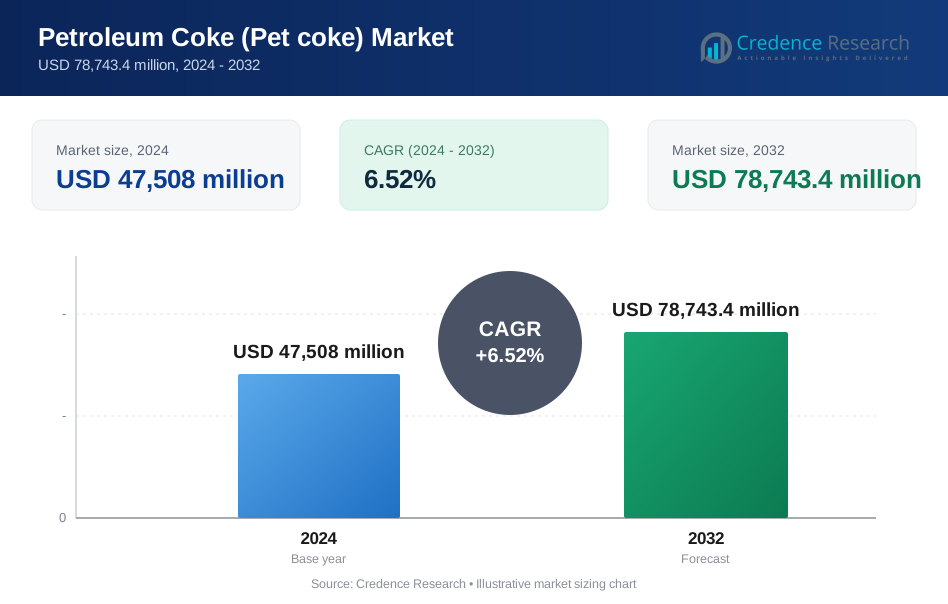
The Petroleum Coke (Pet coke) Market size was valued at USD 47,508 million in 2024 and is anticipated to reach USD 78743.4 million by 2032, at a CAGR of 6.52 % during the forecast period.
| REPORT ATTRIBUTE | DETAILS |
|---|---|
| Historical Period | 2020-2024 |
| Base Year | 2025 |
| Forecast Period | 2026-2032 |
| Petroleum Coke (Pet coke) Market Size 2024 | USD 47,508 million |
| Petroleum Coke (Pet coke) Market, CAGR | 6.52% |
| Petroleum Coke (Pet coke) Market Size 2032 | USD 78743.4 million |
Petroleum Coke (Pet coke) Market Insights:
- High calorific value, cost efficiency, and reliable availability position petroleum coke as a preferred solid fuel across energy-intensive industries.
- Cement manufacturing, power generation, aluminum smelting, and steel production drive sustained demand due to the need for stable thermal performance and operational efficiency.
- Expanding infrastructure projects, rapid urban development, and rising construction activity strengthen long-term consumption across developing and industrializing economies.
- Growth in refining capacity and increased processing of heavy crude support steady pet coke output and supply continuity for industrial users.
- Environmental regulations related to sulfur emissions, carbon intensity, and air quality create compliance challenges and increase operating costs for end users.
- Regional dynamics show Asia-Pacific as the leading consumer with a 47% share, followed by North America at 25% supported by strong refining infrastructure, while the Middle East holds 16% driven by export-oriented production and Europe maintains controlled demand under strict regulations.
Petroleum Coke (Pet coke) Market Drivers:
Cost-Efficient Energy Source for Heavy Industries
The Petroleum Coke (Pet coke) Market benefits from strong demand for cost-efficient, high-energy fuels across heavy industries. Pet coke offers a high calorific value that supports consistent thermal output in cement kilns and power plants. Industries favor it due to stable supply from refinery operations and predictable pricing structures. It supports large-scale production environments that prioritize fuel efficiency and cost control.
- For instance, Petroleum Coke Industries Company (PCIC) operates the leading single-kiln coke calciner, achieving 350,000 tons of calcined petroleum coke capacity annually.
Rising Infrastructure and Construction Activity
The Petroleum Coke (Pet coke) Market gains momentum from expanding infrastructure and construction activity worldwide. Cement production relies on pet coke to maintain high kiln efficiency and reduce fuel expenditure. Rapid urban development and public infrastructure projects increase clinker and cement output. It sustains demand from producers that require reliable, high-heat fuels for continuous operations.
- For instance, Indian Oil Corporation (IOC) upgraded its Barauni refinery's capacity from 6 to 9 million tonnes per year by December 2025, enhancing petroleum coke processing amid infrastructure-driven energy needs.
Growth in Refining Capacity and Heavy Crude Processing
The Petroleum Coke (Pet coke) Market advances alongside growth in global refining capacity. Refineries process heavier crude slates to maximize output and margins, which increases pet coke availability. Upgrades in delayed coking units strengthen production volumes and quality consistency. It supports long-term supply security for industrial consumers across multiple regions.
Expanding Use in Metals and Power Generation
The Petroleum Coke (Pet coke) Market experiences sustained demand from aluminum smelting and power generation sectors. Smelters rely on pet coke for anodes due to its carbon content and structural stability. Power producers in cost-sensitive markets prefer it to manage fuel expenses. It reinforces adoption where operational efficiency and fuel affordability remain priorities.
Petroleum Coke (Pet coke) Market Trends:
Shift Toward Higher-Value Applications and Quality Segmentation
The Petroleum Coke (Pet coke) Market shows a clear trend toward higher-value applications and refined quality segmentation. Producers focus on differentiating fuel-grade and calcined variants to meet specific industrial requirements. Aluminum smelters increase preference for low-sulfur, high-purity calcined pet coke for anode production. Refineries invest in process control and quality monitoring to meet tighter customer specifications. It supports consistent performance in energy-intensive operations that demand predictable carbon content. Industrial buyers emphasize long-term supply contracts to secure stable quality and pricing. This trend strengthens supplier–consumer alignment across metals and manufacturing sectors.
- For Instance, Rio Tinto manages a high-volume supply chain for its aluminum smelting hubs, typically requiring 500,000 to 1,000,000 metric tons of high-purity calcined petroleum coke (CPC) annually to support its carbon anode production.
Regional Production Shifts and Trade Optimization
The Petroleum Coke (Pet coke) Market reflects evolving regional production and trade dynamics driven by refinery economics. North America and the Middle East expand export capacity due to high refinery throughput and delayed coking investments. Asia-Pacific increases imports to support cement and power demand in rapidly industrializing economies. It encourages logistics optimization and port infrastructure development to manage bulk handling volumes. Market participants focus on supply chain efficiency to reduce transportation costs and delivery risk. Environmental compliance influences trade routes and sourcing strategies in regulated regions. These dynamics reshape global pet coke flows and regional market competitiveness.
- For instance, Phillips 66 expanded its delayed coker unit at the Sweeny refinery, boosting pet coke production capacity to 650,000 tons per year.
Petroleum Coke (Pet coke) Market Challenges Analysis:
Environmental Regulations and Emission Compliance Pressure
The Petroleum Coke (Pet coke) Market faces increasing challenges from strict environmental regulations across major economies. Governments enforce tighter limits on sulfur emissions, particulate matter, and carbon intensity from industrial fuels. Compliance raises operating costs for cement plants and power producers that rely on high-sulfur pet coke. It forces users to invest in emission control systems and fuel blending strategies. Regulatory uncertainty creates planning complexity for long-term fuel procurement. Public scrutiny of carbon-intensive fuels intensifies policy pressure. These factors constrain adoption in environmentally sensitive regions.
Price Volatility and Supply Dependence on Refinery Operations
The Petroleum Coke (Pet coke) Market encounters challenges linked to price volatility and supply dependence on refinery throughput. Pet coke output fluctuates with crude slate selection and refinery utilization rates. Global oil price swings influence refinery margins and delayed coking activity. It affects availability and contract stability for industrial buyers. Import-dependent regions face exposure to logistics disruptions and freight cost changes. Trade restrictions and quality specifications complicate cross-border sourcing. These conditions limit supply predictability and cost planning for end users.
Petroleum Coke (Pet coke) Market Opportunities:
Expansion of Infrastructure and Industrial Capacity in Emerging Economies
The Petroleum Coke (Pet coke) Market presents strong opportunities through infrastructure expansion and industrial capacity growth in emerging economies. Rapid urban development increases cement production and fuel demand across Asia-Pacific, Africa, and Latin America. Industrial operators seek cost-efficient fuels to maintain competitiveness in large-scale projects. It supports sustained consumption where energy affordability remains a priority. Government-led infrastructure programs create long-term demand visibility for suppliers. Growing power generation needs in developing regions further reinforce market potential. These factors encourage investment in supply agreements and distribution networks.
Advancement in Processing Technologies and Value-Added Applications
The Petroleum Coke (Pet coke) Market benefits from opportunities linked to processing technology advancement and value-added applications. Refineries invest in upgraded coking units to improve product quality and consistency. Calcined pet coke demand rises from aluminum and specialty carbon applications. It supports margin enhancement through premium-grade output and customized specifications. Industrial users favor reliable suppliers that meet strict quality requirements. Technology-driven efficiency improvements strengthen environmental compliance performance. These developments expand commercial opportunities across high-value end-use segments.
Petroleum Coke (Pet coke) Market Segmentation Analysis:
By Type: Fuel-Grade and Calcined Petroleum Coke
The Petroleum Coke (Pet coke) Market shows clear segmentation by type, with fuel-grade and calcined variants serving distinct industrial needs. Fuel-grade petroleum coke dominates volume consumption due to widespread use in cement kilns and power generation. It offers high calorific value and cost efficiency that support large-scale thermal applications. Calcined petroleum coke addresses demand from aluminum smelting and specialty carbon products that require low impurity levels. Producers focus on quality control and sulfur management to meet application-specific standards. This segmentation supports differentiated pricing and margin structures across end-use sectors.
- For instance, Reliance Industries achieved a calorific value of 8,200 kcal/kg in their fuel-grade pet coke at the Jamnagar refinery, enabling efficient power generation.
By Application: Cement, Power, and Metal Industries
The Petroleum Coke (Pet coke) Market demonstrates strong application-based segmentation across cement manufacturing, power generation, aluminum smelting, and steel production. Cement remains the largest application due to continuous kiln operations and high fuel intensity. It supports thermal stability and reduced fuel costs in clinker production. Power generation uses petroleum coke in cost-sensitive markets where affordability remains critical. Aluminum smelters rely on calcined petroleum coke for anode production due to carbon purity and structural consistency. This application diversity sustains demand stability across industrial cycles.
- For Instance, NTPC’s thermal power stations successfully utilize fuel-grade petroleum coke (petcoke) as a blending agent, leveraging its high gross calorific value of approximately 8,000–8,500 kcal/kg to augment fuel quality.
Segmentations:
By Type
- Fuel-Grade Petroleum Coke
- Calcined Petroleum Coke
By Application
- Cement Manufacturing
- Power Generation
- Aluminum Smelting
- Steel Production
- Other Industrial Uses
By Region
- North America
- U.S.
- Canada
- Mexico
- Europe
- Germany
- France
- U.K.
- Italy
- Spain
- Rest of Europe
- Asia Pacific
- China
- Japan
- India
- South Korea
- South-east Asia
- Rest of Asia Pacific
- Latin America
- Brazil
- Argentina
- Rest of Latin America
- Middle East & Africa
- GCC Countries
- South Africa
- Rest of the Middle East and Africa
Regional Analysis:
Asia-Pacific: Dominant Consumption Driven by Industrial Expansion
Asia-Pacific holds 47% of the global Petroleum Coke (Pet coke) Market share, positioning it as the largest consuming region. Rapid industrial expansion in China and India supports sustained demand from cement manufacturing and power generation sectors. Large-scale infrastructure projects increase clinker production that depends on high-calorific fuels. It benefits from cost-sensitive industrial operations that prioritize fuel efficiency. Expanding aluminum smelting capacity strengthens regional consumption. Import dependency encourages long-term supply contracts and port infrastructure development. Regulatory frameworks remain relatively flexible, supporting continued usage growth.
North America: Strong Production Base and Export Orientation
North America accounts for 25% of the global Petroleum Coke (Pet coke) Market share, supported by extensive refining capacity. Advanced refinery infrastructure enables consistent pet coke output through delayed coking units. Strong export orientation supports regional producers through access to international markets. It maintains stable domestic demand from cement and metal processing industries. Logistics efficiency and established port facilities enhance supply reliability. Environmental regulations shape usage patterns without eliminating industrial demand. The region remains a critical supply hub in global trade flows.
Middle East and Europe: Supply Strength and Regulatory Balance
The Middle East represents 16% of the global Petroleum Coke (Pet coke) Market share, driven by high refinery throughput and export-focused strategies. Energy-intensive industries leverage competitive fuel availability across regional markets. It supports steady export flows to Asia and Africa. Europe maintains controlled demand influenced by strict environmental standards. Industrial users apply selective adoption and fuel blending strategies. Refinery operations sustain production aligned with compliance requirements. These regions contribute distinct supply and demand dynamics to the global market.
Key Player Analysis:
- Oxbow Corporation (U.S.)
- Suncor Energy Inc. (Canada)
- Phillips 66 Company (U.S.)
- Aminco Resources LLC. (U.S.)
- Nippon Coke & Engineering. Co., Ltd. (Japan)
- Petroleum Coke Industries Company (Kuwait)
- Renelux Cyprus Ltd. (Greece)
- Graphite India Limited (India)
- British Petroleum (U.K.)
- Indian Oil Corporation Ltd (India)
- Chevron Corporation (U.S.)
- Marathon Petroleum Corporation (U.S.)
Competitive Analysis:
The Petroleum Coke (Pet coke) Market features a competitive landscape shaped by large integrated oil refiners and specialized coke producers with strong supply capabilities. Major participants compete on refinery scale, crude slate flexibility, and delayed coking capacity to ensure consistent product availability. It favors players with access to heavy crude feedstock and advanced refining infrastructure that supports stable output quality. Companies strengthen their positions through long-term supply agreements with cement, power, and aluminum producers. Strategic focus on logistics, port access, and export networks enhances global reach and cost efficiency. Environmental compliance capabilities influence competitive strength in regulated regions. Product differentiation between fuel-grade and calcined pet coke supports margin optimization across end-use industries. Market participants also emphasize operational efficiency and reliability to maintain customer retention and protect market share.
Recent Developments:
- In September 2025, Phillips 66 announced an agreement to purchase the remaining 50% interest in WRB Refining LP from Cenovus Energy for $1.4 billion, gaining full control of the Wood River and Borger refineries.
- In May 2025, the Uniper partnership at Humber Refinery advanced with ITM Power selected to supply 120MW electrolyzers for green hydrogen production.
Report Coverage:
The research report offers an in-depth analysis based on Type, Application and Region. It details leading Market players, providing an overview of their business, product offerings, investments, revenue streams, and key applications. Additionally, the report includes insights into the competitive environment, SWOT analysis, current Market trends, as well as the primary drivers and constraints. Furthermore, it discusses various factors that have driven Market expansion in recent years. The report also explores Market dynamics, regulatory scenarios, and technological advancements that are shaping the industry. It assesses the impact of external factors and global economic changes on Market growth. Lastly, it provides strategic recommendations for new entrants and established companies to navigate the complexities of the Market.
Future Outlook:
- The Petroleum Coke (Pet coke) Market will continue to benefit from steady demand across cement manufacturing, power generation, and metal processing industries.
- Infrastructure development in emerging economies will support sustained consumption of high-calorific industrial fuels.
- Refinery modernization and delayed coking capacity expansion will strengthen supply stability and product quality consistency.
- Heavy crude processing trends will support long-term availability of petroleum coke across key producing regions.
- Cost sensitivity among industrial users will reinforce preference for petroleum coke over higher-priced alternative fuels.
- Environmental compliance requirements will influence fuel selection and encourage adoption of emission control technologies.
- Trade flows will expand from refinery-intensive regions toward high-demand industrial markets.
- Aluminum smelting and specialty carbon applications will increase demand for calcined petroleum coke grades.
- Logistics optimization and port infrastructure development will enhance distribution efficiency and supply reliability.
- Policy balance between industrial growth and environmental regulation will shape adoption patterns across regions.
Request a Free Sample
Fill in your details and we'll send you a free sample report.
- Sample data tables & charts
- Research methodology
Need a Custom Version of This Report?
Tailor the scope, geography, or segments to your exact requirements.
- Custom geography or segment scope
- Direct access to our analyst team
Frequently Asked Questions
What is the current market size of the Petroleum Coke (Pet coke) Market, and what is its projected value by 2032?
At what Compound Annual Growth Rate is the Petroleum Coke (Pet coke) Market expected to grow during the forecast period?
Which segment held the largest share in the Petroleum Coke (Pet coke) Market in 2024?
What are the primary factors driving growth in the Petroleum Coke (Pet coke) Market?
Who are the leading companies operating in the Petroleum Coke (Pet coke) Market?
Which region dominated the Petroleum Coke (Pet coke) Market in 2024?
Table of Content
Chapter 1. Report Introduction
- 1.1 Report Description & Purpose
- 1.1.1 Report Title & Market Definition
- 1.1.2 Unique Selling Propositions (USP) & Key Differentiators
- 1.1.3 Value Proposition for Stakeholders
- 1.2 Research Objectives
- 1.2.1 Market Sizing Objectives (Volume & Revenue)
- 1.2.2 Segmentation Objectives
- 1.2.3 Competitive Intelligence Objectives
- 1.2.4 Forecast & Scenario Objectives
- 1.3 Report Scope
- 1.3.1 Petroleum Coke (Pet coke) Scope – Types & Subtypes Covered
- 1.3.2 Geographic Scope – Regions & Countries Covered
- 1.3.3 Historical Period, Base Year & Forecast Period (2024; forecast to 2032)
- 1.3.4 Inclusions & Exclusions
- 1.4 HS Code & Classification Framework
- 1.5 Currency, Units & Pricing Basis
- 1.6 Target Stakeholders
- 1.7 Limitations & Assumptions
Chapter 2. Executive Summary
- 2.1 Global Petroleum Coke (Pet coke) Market Snapshot
- 2.1.1 Market Size – Historical (2024) & Forecast (2024-2032) (2024: USD 47,508 million → 2032: USD 78,743.4 million)
- 2.1.2 Volume & Revenue – Global Totals
- 2.1.3 Key Market Highlights – Top Five Facts
- 2.2 Petroleum Coke (Pet coke) Market Segmentation Snapshot
- 2.2.1 Market Split by Region – 2024 vs. 2032
- 2.3 Competitive Snapshot
- 2.3.1 Top 10 Players by Revenue Share – 2024
- 2.3.2 Top 10 Players by Volume Share – 2024
- 2.3.3 Recent Strategic Developments (18-Month Summary)
- 2.4 Key Investment Highlights & Strategic Conclusions
Chapter 3. Petroleum Coke (Pet coke) Market Dynamics & Industry Analysis
- 3.1 Market Overview & Context
- 3.1.1 Petroleum Coke (Pet coke) Market Position in the Broader Automotive Value Chain
- 3.1.2 OEM vs. Replacement Market Dynamics
- 3.1.3 Market Maturity & Development Stage by Region
- 3.2 Petroleum Coke (Pet coke) Market Drivers
- 3.3 Petroleum Coke (Pet coke) Market Restraints & Challenges
- 3.4 Petroleum Coke (Pet coke) Market Opportunities
- 3.5 Porter's Five Forces Analysis
- 3.5.1 Threat of New Entrants
- 3.5.2 Bargaining Power of Suppliers
- 3.5.3 Bargaining Power of Buyers
- 3.5.4 Threat of Substitutes
- 3.5.5 Competitive Rivalry – Intensity Assessment
- 3.6 Petroleum Coke (Pet coke) Value Chain Analysis
- 3.6.1 Upstream – Raw Material/Input Suppliers
- 3.6.1.1 Raw Material/Input 1
- 3.6.1.2 Raw Material/Input 2
- 3.6.1.3 Raw Material/Input 3
- 3.6.2 Midstream – Production/Manufacturing/Service Delivery
- 3.6.2.1 Production/Process Overview
- 3.6.2.2 Key Facility Locations & Capacity by Manufacturer
- 3.6.3 Downstream – Distribution & End Consumer
- 3.6.3.1 Primary Channel – B2B/OEM
- 3.6.3.2 Secondary Channels – Dealer, Retail, Online, Direct
- 3.6.4 Value Chain Profitability Analysis
- 3.6.1 Upstream – Raw Material/Input Suppliers
- 3.7 PESTEL Analysis
- 3.7.1 Political Factors
- 3.7.2 Economic Factors
- 3.7.3 Social Factors
- 3.7.4 Technological Factors
- 3.7.5 Environmental Factors
- 3.7.6 Legal Factors
- 3.8 Petroleum Coke (Pet coke) Supply Chain Analysis
- 3.8.1 Raw Material/Input Supply Risk Assessment
- 3.8.2 Manufacturing Concentration Risk (Geographic Exposure)
- 3.8.3 Trade Disruption Impact Analysis
- 3.9 Regulatory & Policy Landscape
Note: The regulatory and policy landscape section covers regulations based on their applicability to the market, Petroleum Coke (Pet coke) category, geography, and scope of the study. Only regulatory frameworks with a material impact on operations, compliance, trade, sustainability, or market access are analyzed in detail.
Chapter 4. Key Investment Pockets & Opportunity Analysis
- 4.1 Petroleum Coke (Pet coke) Market Attractiveness Analysis
- 4.1.1 By Region – Investment Attractiveness Matrix (Volume × CAGR)
- 4.2 Absolute Revenue Growth Opportunity
- 4.2.1 By Region – Absolute USD Growth Through 2032
- 4.3 Incremental Volume Opportunity
- 4.3.1 By Region – Incremental Volume Through 2032
- 4.3.2 Segment – Incremental Volume
- 4.4 Emerging Submarket Opportunity Deep Dive (Subject to Applicability)
- 4.5 Emerging Market Opportunity Scorecards
- 4.5.1 United States
- 4.5.2 Europe
- 4.5.3 Asia
- 4.5.4 Middle East & Africa
Note: Emerging Market Opportunity Scorecards will be included based on relevance and strategic importance. Regions listed are indicative and may vary depending on data availability and market dynamics.
Chapter 5. Petroleum Coke (Pet coke) Import-Export Analysis & Trade Flows
- 5.1 Global Trade Overview
- 5.1.1 Global Export Value by Country (2024)
- 5.1.2 Global Export Volume by Country (2024)
- 5.1.3 Global Import Value by Country (2024)
- 5.1.4 Global Import Volume by Country (2024)
- 5.1.5 Net Trade Balance by Country (2024)
- 5.2 Export Analysis – Segment
- 5.2.1 Type 1 (HS Code)
- 5.2.2 Type 2 (HS Code)
- 5.2.3 Type 3 (HS Code)
- 5.2.4 Type 4 (HS Code)
- 5.2.5 Type 5 (HS Code)
- 5.3 Import Analysis – Segment
- 5.3.1 Type 1 (HS Code)
- 5.3.2 Type 2 (HS Code)
- 5.3.3 Type 3 (HS Code)
- 5.3.4 Type 4 (HS Code)
- 5.3.5 Type 5 (HS Code)
- 5.4 Average Unit Trade Prices
- 5.4.1 Average Export Price – Segment & Country
- 5.4.2 Average Import Price – Segment & Source Country
- 5.4.3 Price Trends (2024)
- 5.5 Key Trade Route Analysis
- 5.5.1 Trade Route 1
- 5.5.2 Trade Route 2
- 5.5.3 Trade Route 3
- 5.5.4 Trade Route 4
- 5.5.5 Trade Route 5
- 5.6 Trade Policy Impact Assessment
- 5.6.1 US Anti-Dumping & Section 301 Tariffs
- 5.6.2 EU Customs Union Impact
- 5.6.3 Major Free Trade Agreements
- 5.6.4 USMCA Rules of Origin
Note: Trade policy analysis will be included only where relevant to the Petroleum Coke (Pet coke) market.
Chapter 6. Competitive Landscape & Company Benchmarking
- 6.1 Petroleum Coke (Pet coke) Market Concentration & Structure
- 6.1.1 Herfindahl-Hirschman Index (HHI) – vs. 2024
- 6.1.2 Tier 1, Tier 2 & Tier 3 Market Structure
- 6.1.3 Global, Regional & Local Player Dynamics
- 6.2 Petroleum Coke (Pet coke) Market Share Analysis – 2024
- 6.2.1 Global Revenue Share by Company
- 6.2.2 Global Volume Share by Company
- 6.2.3 Regional Revenue Share
- 6.2.4 Market Share Evolution ( vs. 2024)
- 6.2.5 OEM Segment Share by Company
- 6.2.6 Replacement Segment Share by Company
- 6.3 Production/Delivery Capacity & Facility Analysis
- 6.3.1 Global Installed Capacity
- 6.3.2 Capacity Utilization Rates
- 6.3.3 Production/Output Volume
- 6.3.4 Facility Locations & Capacity Map
- 6.3.5 Planned Capacity Additions
- 6.4 Petroleum Coke (Pet coke) Competitive Benchmarking Matrix
- 6.4.1 Revenue, Volume, CAGR & Profitability Comparison
- 6.4.2 Channel Revenue Mix
- 6.4.3 Geographic Revenue Exposure
- 6.4.4 R&D Intensity
- 6.4.5 Sustainability Maturity
- 6.5 Strategic Developments in Petroleum Coke (Pet coke) (Last 24 Months)
- 6.5.1 Mergers, Acquisitions & Divestments
- 6.5.2 New Petroleum Coke (Pet coke) Launches
- 6.5.3 Facility Expansions
- 6.5.4 Strategic Alliances, Joint Ventures & Partnerships
- 6.5.5 Distribution Expansion & Market Entry
- 6.5.6 Sustainability & ESG Initiatives
- 6.6 Competitive Strategy Mapping
- 6.6.1 Leader, Challenger, Follower & Niche Classification
- 6.6.2 Pricing Strategy Comparison
- 6.6.3 Channel Strategy Matrix
Note: Strategic developments are included based on their materiality and the availability of reliable information.
Chapter 7. Global Petroleum Coke (Pet coke) Market – By Distribution Channel
- 7.1 Segment Overview
- 7.1.1 Volume & Revenue Split by Channel (2024 & 2032)
- 7.1.2 Channel Mix Evolution (2024-2032)
Chapter 8. Regional Market Analysis – Global Overview
- 8.1 Global Regional Overview
- 8.1.1 Regional Volume Share
- 8.1.2 Regional Revenue Share
- 8.1.3 Regional Volume by Region
- 8.1.4 Regional Revenue by Region
- 8.1.5 Regional Forecast Through 2032
- 8.2 Cross-Regional Segment Analysis
- 8.2.1 By Distribution Channel
- 8.2.2 By Brand/Price Tier
Chapter 9. North America Petroleum Coke (Pet coke) Market
- 9.1 United States
- 9.2 Canada
- 9.3 Mexico
Chapter 10. Europe Petroleum Coke (Pet coke) Market
- 10.1 Germany
- 10.2 France
- 10.3 Italy
- 10.4 United Kingdom
- 10.5 Spain
- 10.6 Poland
- 10.7 Russia
- 10.8 Netherlands
- 10.9 Belgium
- 10.10 Sweden
- 10.11 Denmark
- 10.12 Norway
- 10.13 Rest of Europe
Chapter 11. Asia Pacific Petroleum Coke (Pet coke) Market
- 11.1 China
- 11.2 India
- 11.3 Japan
- 11.4 South Korea
- 11.5 Thailand
- 11.6 Indonesia
- 11.7 Vietnam
- 11.8 Malaysia
- 11.9 Australia
- 11.10 Rest of Asia Pacific
Chapter 12. Latin America Petroleum Coke (Pet coke) Market
- 12.1 Brazil
- 12.2 Argentina
- 12.3 Colombia
- 12.4 Chile
- 12.5 Rest of Latin America
Chapter 13. Middle East Petroleum Coke (Pet coke) Market
- 13.1 Saudi Arabia
- 13.2 United Arab Emirates
- 13.3 Turkey
- 13.4 Israel
- 13.5 Iran
- 13.6 Rest of the Middle East
Chapter 14. Africa Petroleum Coke (Pet coke) Market
- 14.1 South Africa
- 14.2 Egypt
- 14.3 Nigeria
- 14.4 Morocco
- 14.5 Rest of Africa
Chapter 15. Petroleum Coke (Pet coke) Company Profiles
- 15.1 [Company 01]
- 15.1.1 Company Overview
- 15.1.2 Key Management Personnel
- 15.1.3 Products & Services Portfolio
- 15.1.4 Financial Performance
- 15.1.5 Key Market Focus & Geographic Presence
- 15.1.6 Recent Developments & Strategic Initiatives
Note: The company profile list is preliminary and may change based on research findings, market developments, data availability, and client requirements.
Chapter 16. Appendices
- Appendix A – List of Abbreviations & Acronyms
- Appendix B – Industry Classification Code Reference – Full Series
- Appendix C – Production & Capacity Data Tables
- Appendix D – End-Use & Demand Base Tables
- Appendix E – Consumption & Replacement Rate Assumptions
- Appendix F – ASP Reference Tables
- Appendix G – Manufacturing & Facility Database
- Appendix H – Import-Export Data Tables
- Appendix I – Regulatory Summary Tables
- Appendix J – Primary Research Participant List (Anonymized)
- Appendix K – Primary Research Questionnaire Framework
- Appendix L – Data Sources & Bibliography
- Appendix M – Market Size Divergence & Source Comparison
Chapter 17. Research Methodology
- 17.1 Research Framework & Philosophy
- 17.2 Secondary Research – Sources, Hierarchy & Data Extraction
- 17.3 Data Modeling – Bottom-Up & Top-Down Market Sizing
- 17.4 Primary Research – Stakeholder Framework, LOI & Sample Sizes
- 17.5 Forecast Methodology – Regression, Scenario & Sensitivity Analysis
- 17.6 Quality Control – Four-Layer Validation Framework
- 17.7 Limitations & Standard Assumptions
- 17.8 Disclaimer
