
Market Overview
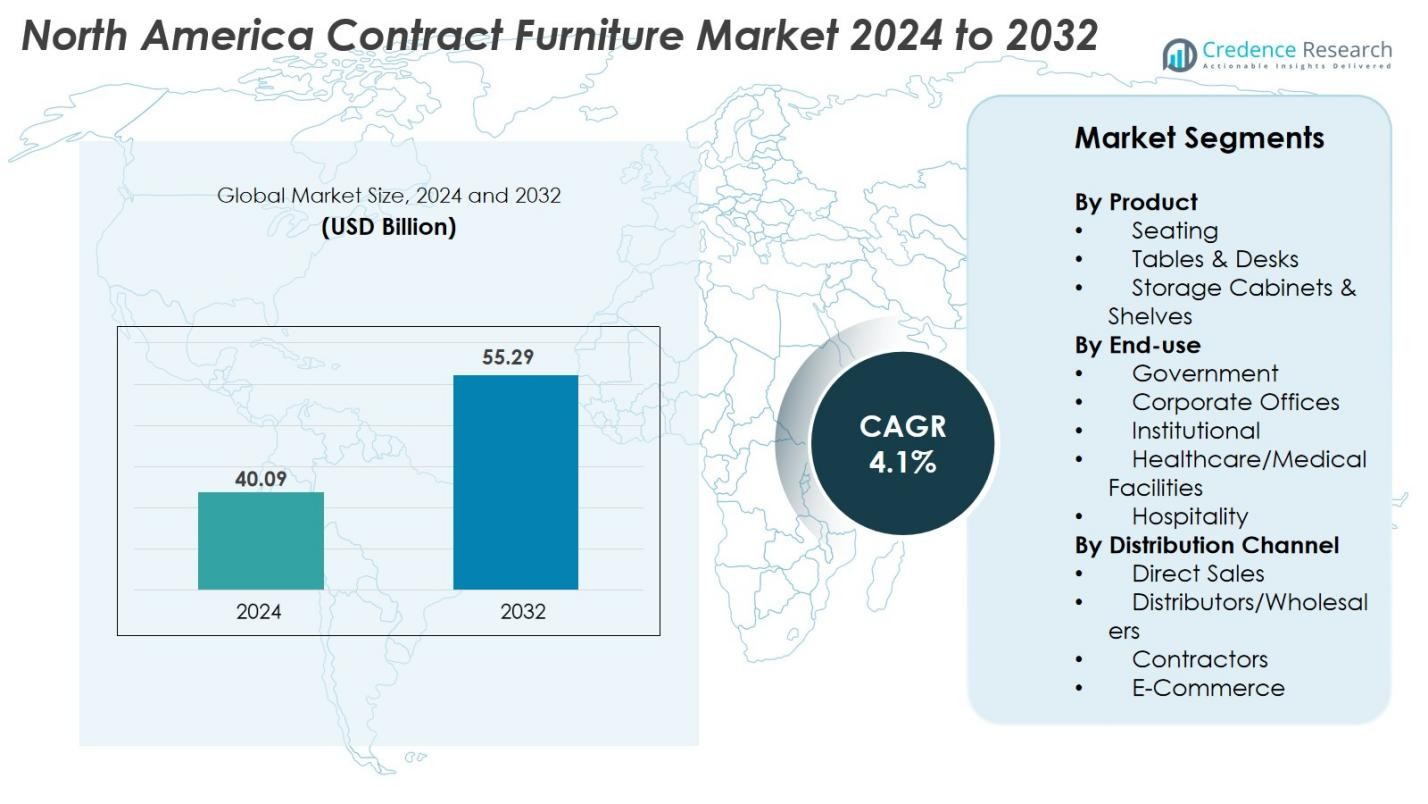
The North America Contract Furniture Market size was valued at USD 40.09 billion in 2024 and is anticipated to reach USD 55.29 billion by 2032, at a CAGR of 4.1% during the forecast period.
| REPORT ATTRIBUTE | DETAILS |
|---|---|
| Historical Period | 2020-2023 |
| Base Year | 2024 |
| Forecast Period | 2025-2032 |
| North America Contract Furniture Market Size 2024 | USD 40.09 Billion |
| North America Contract Furniture Market, CAGR | 4.1% |
| North America Contract Furniture Market Size 2032 | USD 55.29 Billion |
The North America Contract Furniture Market is led by prominent companies such as Haworth Inc., Herman Miller Inc., Steelcase Inc., Teknion Corp., Kimball International, and Humanscale International Holdings Ltd. These companies dominate through innovative product offerings, a focus on ergonomic designs, and sustainability. The U.S. is the largest market, holding a significant share of 75.3% in 2024, driven by the growth of flexible workspaces and corporate office renovations. Canada follows with a share of 14.7%, spurred by demand for sustainable office environments and ergonomic solutions. Mexico, contributing 9.9%, is emerging as a growing market, particularly with increasing investments in healthcare, corporate infrastructure, and government facilities. The region is characterized by increasing adoption of smart and sustainable furniture solutions.
Market Insights
- The North America Contract Furniture Market size stood at USD 40.09 billion in 2024 and is projected to reach USD 55.29 billion by 2032, growing at a CAGR of 4.1%.
- The rising demand for ergonomic seating solutions, which capture 42.5% of the product‑segment share, is driving market expansion across corporate offices and healthcare environments.
- Key trends include a growing emphasis on sustainable furniture with eco‑friendly materials and the integration of smart technologies in desks and seating systems.
- The market landscape features major players such as Haworth Inc., Herman Miller Inc., Steelcase Inc., Teknion Corp., and Kimball International, Inc., leveraging design innovation and strong distribution networks.
- The United States dominates regional share with 75.3%, while Canada holds 14.7% and Mexico 9.9%, although supply‑chain disruptions and fluctuating raw‑material prices pose significant restraints.
Market Segmentation Analysis:
By Product
Seating is the dominant product segment in the North America Contract Furniture Market, capturing a market share of 42.5% in 2024. The demand for ergonomic and comfortable seating solutions is rising, especially in corporate offices, healthcare, and hospitality sectors. The trend towards modern and adaptable office spaces that prioritize comfort and flexibility, along with the growing importance of employee well-being, is driving growth in this segment. Additionally, innovations in design and sustainability are further boosting the market's expansion.
- For instance, Herman Miller’s Aeron Chair incorporates advanced PostureFit SL technology, which uses adjustable, individual pads to stabilize the sacrum and support the lumbar region, helping to maintain a healthy spinal shape. The chair is available in three sizes and supports users weighing up to 350 pounds.
By End-Use
Corporate offices represent a major end-use segment in the North America Contract Furniture Market, holding a substantial market share of 38.9% in 2024. The shift towards flexible workspaces, driven by remote and hybrid work trends, is increasing the demand for functional and customizable office furniture. Companies are prioritizing designs that foster collaboration, innovation, and employee well-being, fueling the growth of seating, desks, and storage solutions within corporate environments. The corporate office segment is expected to continue driving market growth as businesses adapt to evolving workplace needs.
- For instance, Herman Miller states that more than 9 million units of its Aeron ergonomic chair have been sold globally.
By Distribution Channel
Direct sales is the leading distribution channel in the North America Contract Furniture Market, accounting for 41.2% of the market share in 2024. This channel's growth is attributed to the ability of manufacturers and suppliers to directly engage with clients, offering tailored solutions for contract furniture needs. Direct sales allow for better customization, customer service, and quicker delivery, making it the preferred method for large-scale commercial projects, especially in the corporate and institutional sectors. As businesses demand more specialized furniture, direct sales will remain a key driver in the market.
Key Growth Drivers
Rising Demand for Flexible Workspaces
The increasing shift toward flexible workspaces, driven by the adoption of hybrid and remote work models, is a significant growth driver in the North America Contract Furniture Market. Companies are redesigning office spaces to accommodate both collaborative and private working areas, fueling the demand for versatile and adaptable furniture solutions. Adjustable desks, modular seating, and multi-functional workstations are in high demand, with businesses seeking solutions that enhance productivity and employee satisfaction. This growing need for flexible office environments is expected to continue to drive market expansion.
- For instance, Steelcase’s Flex Collection offers desks with an Extended Range option that adjusts from 22.6 inches to 48.7 inches in height, meeting the BIFMA G1 ergonomic guidelines to accommodate a wider range of users.
Focus on Employee Wellness and Comfort
As companies prioritize employee wellness, the demand for ergonomic and comfort-focused furniture is growing rapidly. Workplaces are increasingly seen as environments that need to promote physical and mental well-being, leading to greater investments in high-quality seating, adjustable desks, and other comfort-oriented furniture. This focus on wellness is driving companies to choose furniture that supports good posture, reduces physical strain, and promotes overall employee health. This trend is expected to further accelerate as more organizations recognize the impact of ergonomics on productivity and employee satisfaction.
- For instance, Herman Miller’s Aeron chair-engineered for spinal support-has surpassed 8 million units sold globally, reflecting enterprise adoption of ergonomically advanced seating.
Technological Advancements in Furniture Design
Technological innovations in furniture design, including the integration of smart features and sustainability-focused materials, are significantly driving the growth of the North America Contract Furniture Market. Smart furniture solutions such as desks with wireless charging, built-in sensors for posture monitoring, and eco-friendly materials are becoming increasingly popular. These advancements meet the needs of modern offices looking to improve functionality, efficiency, and sustainability. As technological developments continue to reshape the market, the demand for high-tech, sustainable, and customizable furniture solutions will grow.
Key Trends & Opportunities
Emphasis on Sustainable and Eco-friendly Furniture
Sustainability is becoming a key trend in the North America Contract Furniture Market, with businesses increasingly seeking environmentally friendly and energy-efficient furniture solutions. The demand for furniture made from recycled, biodegradable, and low-emission materials is rising, reflecting the broader shift toward sustainable business practices. Companies are looking to reduce their environmental impact, which presents an opportunity for manufacturers to innovate and offer eco-friendly furniture options. This trend is likely to intensify as government regulations and corporate social responsibility initiatives push for greener, more sustainable office environments.
- For instance, Herman Miller integrates ocean-bound plastic into its Aeron chair, with each unit incorporating between 0.5 and 2.5 pounds (0.226 kg and 1.13 kg) of mismanaged plastic waste sourced from marine environments, depending on the configuration and colorway. The new Onyx Ultra Matte colorway contains the highest amount, at almost 2.5 pounds (1.13 kg) per chair.
Growth of Healthcare and Medical Facility Furniture
The healthcare sector is experiencing a surge in demand for specialized furniture, providing a significant opportunity in the North America Contract Furniture Market. With the expansion of healthcare facilities and the growing focus on patient comfort and safety, furniture designed for hospitals, clinics, and medical centers is in high demand. Furniture solutions such as adjustable hospital beds, patient chairs, and medical office furniture are seeing increased adoption. This sector's growth is driven by the need for functional, hygienic, and comfortable furniture solutions, presenting opportunities for manufacturers to cater to this rapidly expanding market.
- For instance, Hillrom (now part of Baxter International) classifies its business segments including “Patient Support Systems – Smart Beds and Surfaces” among others.
Key Challenges
Supply Chain Disruptions
The North America Contract Furniture Market faces challenges related to supply chain disruptions, which have impacted the timely delivery and availability of raw materials and finished products. Issues such as global shipping delays, increased material costs, and labor shortages have hindered production timelines and increased operational costs for manufacturers. These disruptions are creating uncertainty in the market, making it difficult for companies to meet demand while maintaining profitability. Addressing these supply chain challenges will be critical for sustaining growth in the market.
Fluctuating Raw Material Prices
Fluctuations in raw material prices, particularly for metals, plastics, and wood, are a significant challenge in the North America Contract Furniture Market. Price volatility in these key materials directly affects the overall cost of manufacturing contract furniture, leading to unpredictable pricing for consumers. Rising costs for sustainable materials and transportation have further exacerbated this issue. As a result, manufacturers are under pressure to balance quality, cost-efficiency, and sustainability, which could affect their competitiveness in the market.
Regional Analysis
United States The United States is the dominant player in the North America Contract Furniture Market, holding a substantial market share of 75.3% in 2024. The growth in demand for contract furniture in the U.S. is driven by the expansion of corporate offices, healthcare facilities, and educational institutions. Additionally, the growing trend of flexible workspaces, remote working, and employee wellness initiatives has increased the demand for ergonomic and adaptable furniture solutions. The U.S. is also witnessing significant technological advancements in furniture design, further bolstering market growth in the region.
Canada
Canada accounts for a notable share of 14.7% of the North America Contract Furniture Market in 2024. The Canadian market is experiencing growth due to the increasing focus on sustainable office environments, as well as the rising demand for ergonomic furniture in corporate offices and government facilities. The trend toward hybrid and remote work is also driving demand for flexible and multifunctional office furniture. Furthermore, Canada’s growing healthcare sector and institutional expansions offer additional growth opportunities, with a rise in the need for medical and educational furniture solutions contributing to the market's overall expansion.
Mexico
Mexico holds a smaller but emerging share of 9.9% in the North America Contract Furniture Market in 2024. The country is witnessing growth driven by a rise in commercial and industrial infrastructure projects, including corporate offices, hospitality, and healthcare facilities. Additionally, the demand for contract furniture is growing due to the increasing focus on employee comfort and well-being in workplace designs. The expansion of multinational companies in Mexico, coupled with government investments in institutional furniture for schools and hospitals, presents significant growth opportunities for furniture manufacturers in the region.
Market Segmentations
By Product
- Seating
- Tables & Desks
- Storage Cabinets & Shelves
By End-use
- Government
- Corporate Offices
- Institutional
- Healthcare/Medical Facilities
- Hospitality
By Distribution Channel
- Direct Sales
- Distributors/Wholesalers
- Contractors
- E-Commerce
By Region
- U.S.
- Canada
- Mexico
Competitive Landscape
Competitive analysis of the North America Contract Furniture Market reveals a dynamic and rapidly evolving landscape with major players such as Steelcase Inc., Haworth Inc., Herman Miller Inc., Kimball International, and Teknion Corp. These companies lead the market through their innovative product offerings, strong distribution networks, and strategic acquisitions. Steelcase Inc. and Herman Miller Inc. continue to dominate with their extensive portfolios of ergonomic, sustainable, and customizable office furniture solutions. Haworth Inc. has strengthened its position through partnerships and expansion into international markets. Companies in this sector are focusing heavily on sustainability, offering furniture made from eco-friendly materials to meet increasing demand from businesses and consumers for greener solutions. Additionally, advancements in smart furniture technology, such as desks with built-in charging stations and ergonomic adjustments, are reshaping product offerings. The market is also seeing consolidation with key players acquiring smaller, innovative companies to enhance their product range and customer reach.
Key Player Analysis
- Kimball International, Inc.
- Teknion Corp.
- Steelcase Inc.
- Haworth Inc.
- Global Furniture Group
- Herman Miller Inc.
- Virco
- Humanscale International Holdings Ltd.
- Knoll Inc.
- Nienkamper International, Inc.
Recent Developments
- In August 2025, HNI Corporation announced a definitive agreement to acquire Steelcase Inc. in a cash-and-stock transaction valued at approximately USD 2.2 billion.
- In 2025, MillerKnoll Inc. committed that all its North American products would be free from added per- and poly-fluoroalkyl substances (PFAS), becoming the first major office-furniture manufacturer to make this pledge.
- In March 2025, Haworth Inc. announced a closed-loop manufacturing process for the plastic used in its “Fern” ergonomic chairs, developed in partnership with Royal Technologies and PADNOS, with production set to begin in Q2 2025.
Report Coverage
The research report offers an in-depth analysis based on Product, End Use, Distribution Channel and Region. It details leading market players, providing an overview of their business, product offerings, investments, revenue streams, and key applications. Additionally, the report includes insights into the competitive environment, SWOT analysis, current market trends, as well as the primary drivers and constraints. Furthermore, it discusses various factors that have driven market expansion in recent years. The report also explores market dynamics, regulatory scenarios, and technological advancements that are shaping the industry. It assesses the impact of external factors and global economic changes on market growth. Lastly, it provides strategic recommendations for new entrants and established companies to navigate the complexities of the market.
Future Outlook
- The North America Contract Furniture Market is expected to witness steady growth driven by the increasing demand for ergonomic and flexible furniture solutions across various industries.
- The rise of hybrid and remote work models will continue to boost the demand for adaptable office furniture, particularly in corporate offices and shared workspaces.
- The growing focus on employee wellness and comfort in the workplace will lead to higher adoption of ergonomic seating, adjustable desks, and other health-conscious furniture options.
- Sustainability trends will shape product innovation, with manufacturers increasingly offering eco-friendly, recyclable, and energy-efficient furniture.
- Technological advancements, such as the integration of smart furniture with built-in charging capabilities and sensors, will contribute to the market's future growth.
- The healthcare sector will remain a significant growth driver, with increasing investments in medical facility furniture designed for comfort, safety, and hygiene
- The educational sector will see continued demand for durable and functional furniture, particularly in schools, colleges, and universities.
- Increased government investments in infrastructure projects will boost the need for institutional furniture across public sector buildings and government offices.
- The hospitality industry’s growth, including hotels and resorts, will generate demand for stylish, durable, and customizable furniture solutions.
- E-commerce platforms will play a crucial role in expanding the reach of contract furniture, making it easier for customers to access a wide range of products for commercial spaces.

Request a Free Sample
Fill in your details and we'll send you a free sample report.
- Sample data tables & charts
- Research methodology
Market Dynamics
Growth of Flexible Workspaces
The shift toward hybrid and remote work models is prompting companies to redesign offices for flexibility, driving demand for adaptable and modular contract furniture that supports both collaborative and private work environments.
Emphasis on Employee Wellness and Ergonomics
Organizations are increasingly prioritizing employee health and comfort, leading to higher adoption of ergonomic seating, adjustable desks, and wellness-focused furniture solutions that enhance productivity and reduce workplace injuries.
Sustainability and Eco-friendly Materials
Corporate social responsibility and regulatory pressures are pushing businesses to invest in contract furniture made from recycled, low-emission, and biodegradable materials, fueling innovation and market growth in sustainable product lines.
Technological Advancements in Furniture Design
The integration of smart features such as wireless charging, posture monitoring sensors, and connectivity options in contract furniture is meeting the evolving needs of modern workplaces, making technologically advanced products a key growth area.
Expansion of Healthcare and Institutional Sectors
Rising investments in healthcare, education, and government infrastructure are increasing the demand for specialized, durable, and hygienic contract furniture, particularly in medical and institutional settings.
Need a Custom Version of This Report?
Tailor the scope, geography, or segments to your exact requirements.
- Custom geography or segment scope
- Direct access to our analyst team
Frequently Asked Questions
What is the current market size for North America Contract Furniture Market, and what is its projected size in 2032?
At what Compound Annual Growth Rate is the North America Contract Furniture Market projected to grow between 2025 and 2032?
Which North America Contract Furniture Market segment held the largest share in 2024?
What are the primary factors fueling the growth of the North America Contract Furniture Market?
Who are the leading companies in the North America Contract Furniture Market?
Which region commanded the largest share of the North America Contract Furniture Market in 2024?
Table of Content
Chapter 1 Market Segmentation
- 1.1 Segmentation Framework
- 1.1.1 Product and Service Classification
- 1.1.2 Application and End-Use Classification
- 1.1.3 Technology and Solution Classification
- 1.1.4 Customer and Distribution Channel Classification
- 1.1.5 Geographic Segmentation
- 1.1.6 Market Segment Definitions and Boundaries
- 1.2 By End-use
- 1.2.1 Corporate Offices
- 1.2.2 Healthcare/Medical Facilities
- 1.2.3 Government
- 1.2.4 Institutional
- 1.2.5 Hospitality
- 1.3 By Product
- 1.3.1 Seating
- 1.3.2 Tables & Desks
- 1.3.3 Storage Cabinets & Shelves
Chapter 2 Introduction
- 2.1 Report Objectives and Scope
- 2.2 Product Definition and Industry Terminology
- 2.3 Market Inclusions and Exclusions
- 2.4 Research Process
- 2.4.1 Primary Research and Expert Interviews
- 2.4.2 Secondary Research and Source Review
- 2.4.3 Top-Down and Bottom-Up Estimation
- 2.4.4 Data Triangulation and Verification
- 2.5 Market Size Measurement Basis
- 2.5.1 2024: USD 40.09 billion → 2032: USD 55.29 billion
- 2.6 Historical and Forecast Reference Periods
- 2.6.1 Base Year: 2024
- 2.6.2 Forecast Period: 2024-2032
- 2.7 Research Assumptions and Limitations
Chapter 3 Executive Summary
- 3.1 Market Snapshot and Key Findings
- 3.2 Base-Year Market Size, 2024
- 3.3 Forecast Market Size, 2032
- 3.4 Revenue and Volume Growth Outlook
- 3.5 Key Demand and Supply Indicators
- 3.6 Leading Market Segments
- 3.7 Fastest-Growing Market Opportunities
- 3.8 Regional Performance Highlights
- 3.9 Technology and Industry Transformation
- 3.10 Competitive Landscape Summary
- 3.11 Analyst View and Strategic Implications
Chapter 4 North America Contract Furniture Market Trends and Developments
- 4.1 Historical Industry Development
- 4.2 Recent Market Trends and Developments
- 4.3 Demand and Customer Behavior Trends
- 4.4 Technology and Product Innovation
- 4.5 Artificial Intelligence, Automation and Digitalization
- 4.6 Local Manufacturing and Supply Chain Realignment
- 4.7 Industry Partnerships, Mergers and Acquisitions
- 4.8 Sustainability and Circular Economy Developments
- 4.9 Government and Private Sector Investment Trends
- 4.10 Emerging Business Models and Commercialization
- 4.11 Industry Developments and Announcements
Chapter 5 North America Contract Furniture Market Production, Supply and Demand Analysis
- 5.1 Demand Trend and Consumption Analysis
- 5.2 Demand Forecast, 2024-2032
- 5.3 Production and Output Trend
- 5.4 Production and Output Forecast, 2024-2032
- 5.5 Installed Capacity and Capacity Utilization
- 5.6 Company-Wise Production Plants and Statistics
- 5.6.1 Installed Production Capacity
- 5.6.2 Actual Production
- 5.6.3 Planned Capacity and Expansion Targets
- 5.7 Supply Chain Structure and Procurement Trends
- 5.8 Supply-Demand Gap and Bottlenecks
- 5.9 Import Dependence and Sourcing Structure
- 5.10 Contract Manufacturing and Outsourcing
- 5.11 Regional Supply and Demand Concentration
Chapter 6 North America Contract Furniture Market Pricing Analysis
- 6.1 Pricing Structure and Measurement
- 6.2 Historical Pricing Trends
- 6.3 Pricing Outlook, 2024-2032
- 6.4 Average Selling Price and Unit Economics
- 6.5 Pricing by Product and Market Segment
- 6.6 Geographic Pricing Differences
- 6.7 Key Input, Energy, Labor and Logistics Costs
- 6.8 Contract Pricing and Purchasing Models
- 6.9 Pricing Sensitivity and Competitive Positioning
- 6.10 Price, Margin and Profitability Implications
Chapter 7 North America Contract Furniture Market Dynamics
- 7.1 Market Growth Drivers
- 7.1.1 Demand-Side Drivers
- 7.1.2 Technology and Innovation Drivers
- 7.1.3 Infrastructure and Investment Drivers
- 7.1.4 Regulatory and Policy Drivers
- 7.2 Market Restraints
- 7.2.1 Cost and Affordability Constraints
- 7.2.2 Technology and Adoption Barriers
- 7.2.3 Supply Chain and Operational Constraints
- 7.3 Market Challenges
- 7.3.1 Competitive Pressure and Margin Erosion
- 7.3.2 Skills, Infrastructure and Implementation Gaps
- 7.4 Emerging Market Opportunities
- 7.5 Market Dynamics Impact and Time-Horizon Assessment
Chapter 8 North America Contract Furniture Value Chain Analysis
- 8.1 Industry Value Chain Overview
- 8.2 Upstream Suppliers and Critical Inputs
- 8.3 Technology and Component Providers
- 8.4 Manufacturing or Service Delivery
- 8.5 Distribution, Channel Partners and Integrators
- 8.6 Downstream Applications and End Users
- 8.7 Value Addition and Profit Pools
- 8.8 Vertical Integration and Outsourcing
- 8.9 Supplier Concentration and Risk
- 8.10 Supply Chain Localization and Resilience
Chapter 9 North America Contract Furniture Market Regulations and Policies
- 9.1 Relevant Laws, Standards and Compliance Frameworks
- 9.2 Product, Service, Safety and Quality Requirements
- 9.3 Government Policies, Incentives and Subsidies
- 9.4 Imports, Exports and Trade Barriers
- 9.5 Public Procurement and Local Content Requirements
- 9.6 Environmental and Sustainability Compliance
- 9.7 Upcoming Policy Changes and Market Implications
Chapter 10 North America Contract Furniture Market Hotspots and Opportunities
- 10.1 Market Opportunity Mapping and Growth Hotspots
- 10.2 High-Growth Applications and Customer Groups
- 10.3 Underserved Markets and White-Space Opportunities
- 10.4 Emerging Technology and Product Opportunities
- 10.5 New Capacity and Investment Hotspots
- 10.6 Market Entry and Expansion Opportunities
- 10.7 Distribution and Partnership Opportunities
- 10.8 Near-Term and Long-Term Commercial Potential
- 10.9 Opportunity Attractiveness and Execution Risks
Chapter 11 North America Contract Furniture Market Outlook, 2024-2032
- 11.1 Market Size and Analysis
- 11.1.1 Revenue (Market Measurement: 2024: USD 40.09 billion → 2032: USD 55.29 billion)
- 11.1.2 Market Volume and Quantity Sold
- 11.1.3 Historical Market Size
- 11.1.4 Base-Year Market Size, 2024
- 11.2 Market Forecast, 2024-2032
- 11.2.1 Revenue Forecast to 2032
- 11.2.2 Volume Forecast to 2032
- 11.2.3 CAGR and Year-on-Year Growth
- 11.2.4 Incremental Revenue Opportunity
- 11.3 Forecast Assumptions and Scenario Analysis
- 11.3.1 Base-Case Forecast
- 11.3.2 Optimistic and Conservative Scenarios
- 11.3.3 Technology, Pricing and Policy Sensitivities
- 11.4 Market Attractiveness and Growth Outlook
Chapter 12 North America Contract Furniture Market Segmentation and Outlook
- 12.1 Segmentation Summary and Market Shares, 2024
- 12.2 Largest and Fastest-Growing Segments
- 12.3 By End-use - Market Size and Forecast, 2024-2032
- 12.3.1 Segment Definition and Scope
- 12.3.2 Historical Market Size
- 12.3.3 Revenue Forecast, 2024-2032
- 12.3.4 Volume Forecast, 2024-2032
- 12.3.5 Base-Year Market Share, 2024
- 12.3.6 Segment CAGR and Growth Drivers
- 12.3.7 Subsegment Market Size and Forecast
- 12.3.7.1 Corporate Offices
- 12.3.7.2 Healthcare/Medical Facilities
- 12.3.7.3 Government
- 12.3.7.4 Institutional
- 12.3.7.5 Hospitality
- 12.3.8 Subsegment Pricing and Adoption Trends
- 12.3.9 Leading Suppliers and Competition
- 12.3.10 Regional Demand and Opportunities
- 12.4 By Product - Market Size and Forecast, 2024-2032
- 12.4.1 Segment Definition and Scope
- 12.4.2 Historical Market Size
- 12.4.3 Revenue Forecast, 2024-2032
- 12.4.4 Volume Forecast, 2024-2032
- 12.4.5 Base-Year Market Share, 2024
- 12.4.6 Segment CAGR and Growth Drivers
- 12.4.7 Subsegment Market Size and Forecast
- 12.4.7.1 Seating
- 12.4.7.2 Tables & Desks
- 12.4.7.3 Storage Cabinets & Shelves
- 12.4.8 Subsegment Pricing and Adoption Trends
- 12.4.9 Leading Suppliers and Competition
- 12.4.10 Regional Demand and Opportunities
- 12.5 Segment Growth Comparison
- 12.6 Segment Attractiveness and Priority Matrix
Chapter 13 North America Contract Furniture End-Use and Application Market Outlook
- 13.1 End-Use Industry and Customer Demand Structure
- 13.2 Leading Applications and Customer Groups
- 13.3 End-Use Market Size, Share and Forecast
- 13.4 Major End-Use Industry Deep Dives
- 13.4.1 Customer Requirements and Use Cases
- 13.4.2 Demand and Replacement Cycles
- 13.4.3 Technical and Regulatory Considerations
- 13.4.4 Purchasing and Procurement Models
- 13.4.5 Leading Vendors and Distribution Channels
- 13.4.6 Forecast and Commercial Opportunities
- 13.5 Emerging Applications and Cross-Segment Demand
- 13.6 End-Use Industry Investment Priorities
Chapter 14 North America Contract Furniture Geographic Market Outlook, 2024-2032
- 14.1 Regional Market Size and Country-Level Shares, 2024
- 14.2 Country Market Size Comparison, 2024
- 14.3 Country Market Forecasts, 2024-2032
- 14.4 Subregional Industrial and Demand Clusters
- 14.5 Intra-Regional Pricing and Cost Differences
- 14.6 Cross-Border Trade and Supply Networks
- 14.7 Regional Supply and Demand Balances
- 14.8 Country Opportunity Comparison and Prioritization
Note: Every listed country is covered on the structure shown under the first country.
Chapter 15 North America Contract Furniture Technology, Innovation and Sustainability Outlook
- 15.1 Technology Landscape and Maturity
- 15.2 Product, Process and Service Innovation
- 15.3 AI, Automation and Digital Tools in the Industry
- 15.4 Technology Adoption and Performance Benchmarking
- 15.5 Innovation Pipeline and R&D Investment
- 15.6 Patent and Intellectual Property Trends
- 15.7 Energy Efficiency and Resource Management
- 15.8 Sustainability, Recycling and Circularity
- 15.9 Technology Roadmap, 2024-2032
- 15.10 Risks of Obsolescence and Technology Substitution
Chapter 16 North America Contract Furniture Market Key Strategic Imperatives
- 16.1 Growth and Market Entry Priorities
- 16.2 High-Return Products and Segments
- 16.3 Pricing, Profitability and Cost Optimization
- 16.4 Technology Investment and Product Differentiation
- 16.5 Supply Chain Localization and Resilience
- 16.6 Distribution and Customer Acquisition
- 16.7 Partnership, Acquisition and Capacity Strategy
- 16.8 Regional Expansion Priorities
- 16.9 Short-, Medium- and Long-Term Actions
Chapter 17 Competition Outlook
- 17.1 Industry Competition Characteristics
- 17.2 Market Structure and Concentration
- 17.3 Market Share and Competitive Positioning, 2024
- 17.4 Company-Wise Revenue and Product Benchmarking
- 17.5 Production and Service Capacity Benchmarking
- 17.6 Technology, Pricing and Differentiation
- 17.7 Regional Footprint and Distribution Strength
- 17.8 Mergers, Acquisitions and Strategic Alliances
- 17.9 New Entrants and Competitive Threats
- 17.10 Porter's Five Forces and Industry Attractiveness
- 17.11 Competitive Outlook, 2024-2032
Chapter 18 Company Profiles
- 18.1 Company Coverage and Selection Criteria
- 18.2 Steelcase Inc.
- 18.2.1 Business Description
- 18.2.2 Company Ownership and Geographic Presence
- 18.2.3 Product and Service Portfolio
- 18.2.4 Manufacturing and Operating Footprint
- 18.2.5 Production Capacity and Expansion Plans
- 18.2.6 Financial Performance and Investment
- 18.2.7 Market Share and Competitive Position
- 18.2.8 Technology and Innovation Capabilities
- 18.2.9 Strategic Alliances or Partnerships
- 18.2.10 Recent Developments
- 18.2.11 Growth Strategy and Outlook
- 18.3 Haworth Inc.
- 18.4 Herman Miller Inc.
- 18.5 Kimball International, Inc.
- 18.6 Teknion Corp.
- 18.7 Global Furniture Group
- 18.8 Virco
- 18.9 Humanscale International Holdings Ltd.
- 18.10 Knoll Inc.
- 18.11 Nienkamper International, Inc.
- 18.12 Other Relevant Market Participants
Note: Every listed company is profiled on the structure shown under the first company. The company list is preliminary and may change based on research findings, market developments, data availability and client requirements.
Chapter 19 Disclaimer
- 19.1 Research and Forecast Disclaimer
- 19.2 Data Source and Estimation Limitations
Note: The depth of individual sections depends on data availability for this market. Volume, capacity, trade and other unit-based metrics are included where applicable.

