
Market Overview:
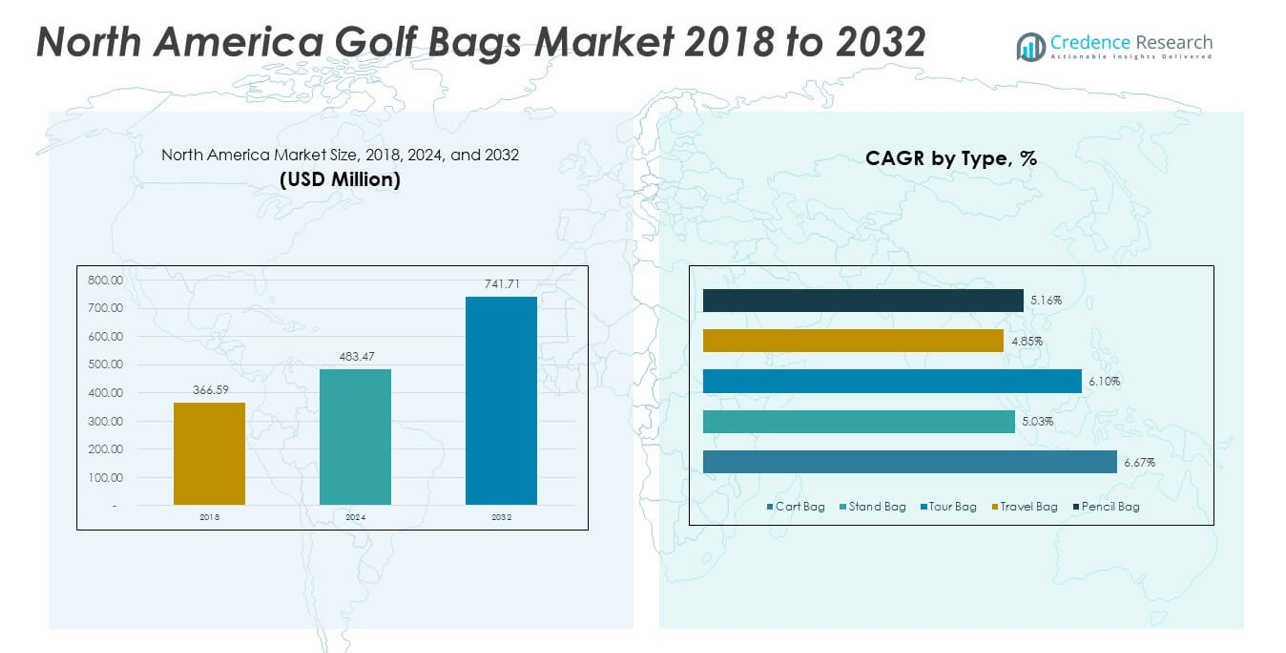
The North America Golf Bags Market size was valued at USD 366.59 million in 2018 to USD 483.47 million in 2024 and is anticipated to reach USD 741.71 million by 2032, at a CAGR of 5.60% during the forecast period.
| REPORT ATTRIBUTE | DETAILS |
|---|---|
| Historical Period | 2020-2023 |
| Base Year | 2024 |
| Forecast Period | 2025-2032 |
| North America Golf Bags Market Size 2024 | USD 483.47 million |
| North America Golf Bags Market, CAGR | 5.60% |
| North America Golf Bags Market Size 2032 | USD 741.71 million |
The market growth is driven by rising golf participation rates, fueled by both recreational and professional players. Increasing investments in golf course infrastructure and the growing popularity of golf tourism have enhanced the demand for high-quality, durable, and feature-rich golf bags. Innovations such as lightweight materials, ergonomic designs, and integrated storage solutions are appealing to consumers seeking convenience and performance. Additionally, premium product offerings targeting luxury and sustainability trends are attracting a broader consumer base.
Geographically, the United States holds the dominant position in the North America Golf Bags Market due to its extensive golfing culture, large number of courses, and a strong base of professional and amateur players. Canada is witnessing steady growth, supported by seasonal golf tourism and increasing retail penetration of premium golf equipment. Emerging demand from regions with developing golfing communities, combined with targeted marketing and promotional events, is further expanding the market’s regional footprint and creating new opportunities for manufacturers and retailers.
Market Insights:
- The North America Golf Bags Market was valued at USD 483.47 million in 2024 and is projected to reach USD 741.71 million by 2032, growing at a CAGR of 5.60%.
- The Global Golf Bags Market size was valued at USD 1,141.7 million in 2018 to USD 1,510.1 million in 2024 and is anticipated to reach USD 2,325.8 million by 2032, at a CAGR of 5.61% during the forecast period.
- Rising golf participation among recreational and professional players is driving consistent demand for high-quality, feature-rich golf bags.
- Product innovation, including lightweight materials, ergonomic designs, and integrated technology, is enhancing consumer appeal and brand differentiation.
- Seasonal demand fluctuations influence sales patterns, requiring effective inventory and production planning for sustained profitability.
- The United States dominates the regional market, supported by an extensive golfing culture, robust infrastructure, and a strong base of premium buyers.
- Canada records steady growth due to seasonal golf tourism, increasing participation, and demand for weather-resistant designs.
- Mexico is emerging as a growth market, driven by expanding golf tourism, resort developments, and rising domestic interest in premium golf equipment.
Market Drivers:
Expanding Golf Participation and Evolving Consumer Preferences
The North America Golf Bags Market benefits from increasing participation in golf, supported by both recreational players and professionals. Growth in golf tourism, fueled by international tournaments and domestic leisure travel, has amplified demand for quality equipment. Product innovation focusing on lightweight construction, ergonomic designs, and multifunctional storage attracts diverse customer segments. Rising disposable incomes and lifestyle-driven purchasing habits push demand for premium, branded products. Sustainability initiatives, including eco-friendly materials, resonate with environmentally conscious buyers. Retailers and e-commerce platforms enhance product accessibility across urban and suburban markets. Influencer marketing and sponsorships by professional golfers boost brand visibility. Expanding youth engagement programs and inclusive golf initiatives are introducing the sport to wider demographics. The combination of these factors sustains steady sales growth.
- For instance, TaylorMade’s FlexTech Stand Bag weighs 4.5 lbs and features a crush‑resistant 4‑way top paired with its proprietary FlexTech stand system for seamless functionality. It delivers lightweight performance and reliable organization that appeals to both recreational and professional golfers.
Impact of Technological Advancements on Product Design
Technological advancements reshape the North America Golf Bags Market by integrating functionality and style. Lightweight composites improve durability without sacrificing portability. Ergonomic carrying systems enhance comfort for walking golfers, while cart-specific models cater to ease of transportation. Integration of weather-resistant materials extends product longevity in varied conditions. Smart features such as GPS holders, USB charging ports, and solar panels create added value for tech-savvy consumers. Manufacturers focus on modular designs to allow customizable storage layouts. Product differentiation through innovation enables brands to maintain competitive advantage. Enhanced quality control ensures consistent performance and builds consumer trust. This alignment of technology with consumer demands reinforces sustained market expansion.
- For instance, Callaway’s Chase 14 Cart Bag incorporates a front-facing GPS pocket, dual-sided apparel storage, and easily accessible grab handles features tailored for golfers who value both on-course connectivity and convenient access to essentials
Influence of Sports Infrastructure and Tourism Development
The North America Golf Bags Market thrives on the strong presence of golf infrastructure across the region. The U.S. leads with an extensive network of courses, country clubs, and resorts catering to golfers of all skill levels. Canada’s seasonal golfing culture, supported by picturesque courses, attracts domestic and international players. Golf tourism packages combining leisure travel with tournament attendance contribute to equipment sales. Strategic hosting of international championships elevates the sport’s profile and drives consumer purchases. Resort developments with integrated golf amenities attract high-spending tourists. Public and private investments in course maintenance and expansion strengthen the sport’s accessibility. This well-developed infrastructure fosters consistent demand for advanced and stylish golf bags.
Shifting Consumer Lifestyles and Brand Engagement Strategies
Lifestyle changes influence purchasing behavior in the North America Golf Bags Market, with consumers seeking products reflecting their identity and performance needs. Premium brands leverage storytelling and heritage to appeal to loyal buyers. Limited-edition releases and exclusive collaborations create urgency and exclusivity. Retailers adopt personalized shopping experiences, offering customization of colors, logos, and accessories. Increased participation of women in golf expands product variety in style, weight, and color schemes. Brand engagement through social media campaigns and athlete endorsements fosters stronger customer relationships. Online reviews and peer recommendations drive buying confidence. Seasonal promotions align with peak golfing months, optimizing sales cycles. This blend of lifestyle marketing and targeted offerings sustains market momentum.
Market Trends:
Sustainability Driving Material Innovation
In the North America Golf Bags Market, sustainability trends influence design and production choices. Manufacturers are adopting recycled polyester, organic fabrics, and biodegradable packaging to reduce environmental impact. Consumer awareness of eco-friendly practices fuels demand for these products. Partnerships with environmental organizations strengthen brand credibility. Minimalist designs using fewer components enhance recyclability. Brands position their sustainability efforts as core to their value proposition, influencing purchase decisions. Marketing campaigns highlight the lifecycle benefits of durable and repairable golf bags. Transparency in sourcing and ethical manufacturing practices appeal to conscious consumers. This growing alignment with environmental priorities is reshaping industry standards.
- For instance, Sun Mountain’s Eco‑Lite Stand Bag uses Repreve® fabric, which incorporates approximately 25 recycled 20‑oz plastic bottles into each bag’s construction. It supports environmental sustainability by repurposing waste into durable, lightweight materials and reducing greenhouse gas emissions.
Growth of E-Commerce and Direct-to-Consumer Models
The North America Golf Bags Market experiences notable growth through online sales channels. E-commerce platforms offer an extensive selection, enabling consumers to compare designs, features, and prices efficiently. Direct-to-consumer models allow brands to maintain control over pricing and branding while improving profit margins. Online-exclusive product lines create differentiation and attract niche audiences. Virtual try-on tools and 360-degree product visuals enhance the buying experience. Subscription-based equipment upgrades appeal to frequent players seeking the latest innovations. Mobile-friendly platforms make golf bag purchases more accessible across demographics. Enhanced logistics ensure faster delivery times, boosting customer satisfaction. The integration of online and offline retail strategies strengthens overall market reach.
Rise of Customization and Personalization in Product Offerings
Customization emerges as a defining trend in the North America Golf Bags Market. Consumers increasingly value products tailored to their playing style and aesthetic preferences. Brands provide design tools that allow customization of colors, embroidery, and compartment layouts. Limited-edition collaborations with designers or athletes attract collectors and enthusiasts. Customization also extends to functional elements, such as adjustable strap systems and interchangeable pockets. Retailers highlight these offerings to differentiate from mass-produced alternatives. The trend aligns with the growing premium segment, where uniqueness justifies higher prices. Personalization strengthens emotional connections between consumers and brands. This trend is expected to expand as technology simplifies customization processes.
Integration of Advanced Features and Smart Technologies
The North America Golf Bags Market sees increased integration of advanced features that enhance convenience and performance. Built-in power banks and solar panels address charging needs for devices on the course. Waterproof zippers and weatherproof coatings improve protection against varying conditions. Anti-theft compartments safeguard valuables, appealing to traveling golfers. Lightweight yet durable frames ensure longevity without compromising comfort. Ventilated sections maintain airflow for stored apparel. Modular attachments enable easy upgrades or replacements. These technological enhancements appeal to golfers seeking performance and innovation in their gear. Continuous R&D investment ensures competitive differentiation in this segment.
- For instance, the MNML MR2 Stand Bag includes a solar-powered phone charger, eight magnetic-closure pockets, and a thermal compartment for up to six cans. It also features a built-in filming pocket for swing recording and is made from 100% recycled ripstop material for lightweight durability.
Market Challenges Analysis
Competitive Pressure and Brand Differentiation
The North America Golf Bags Market faces intense competition among established brands and emerging players. A crowded marketplace makes it challenging to maintain brand visibility and customer loyalty. Price wars can erode profit margins, especially in the mid-range segment. Consumers have access to a wide array of options through online platforms, intensifying competition. Product imitation and counterfeiting threaten brand equity. Maintaining consistent quality standards across product lines is essential for differentiation. Rapid product cycles demand frequent innovation, which can strain resources. Marketing strategies must balance tradition with innovation to retain diverse consumer groups. This competitive environment requires constant vigilance and adaptability.
Supply Chain Disruptions and Cost Management
The North America Golf Bags Market contends with vulnerabilities in its supply chain. Dependence on imported raw materials exposes manufacturers to fluctuations in currency and tariffs. Logistics delays can affect seasonal inventory availability, impacting sales peaks. Rising material and labor costs pressure profit margins. Balancing premium product quality with competitive pricing requires efficient cost management. Weather-related disruptions can hinder distribution in key golfing regions. Compliance with environmental and labor regulations in multiple jurisdictions adds complexity. Brands must invest in supply chain resilience to safeguard production timelines. Effective supplier relationships and diversified sourcing reduce risk exposure.
Market Opportunities:
Expansion into Emerging Demographics and Lifestyle Segments
The North America Golf Bags Market has opportunities to target emerging golfer demographics. Growing female participation creates demand for stylish, lighter, and ergonomically designed bags. Youth programs and school golf teams provide a channel to introduce branded products early. Lifestyle integration, where golf gear is used for casual or travel purposes, opens new product categories. Marketing strategies emphasizing inclusivity can capture diverse customer bases. Cross-industry collaborations with fashion and travel brands can expand appeal beyond core players. Offering accessories tailored to non-traditional golfers strengthens brand presence. Targeting these segments builds a broader and more resilient market footprint.
Leveraging Technology and Sustainability for Brand Leadership
Technology integration presents significant growth avenues in the North America Golf Bags Market. Developing smart bags with tracking devices, charging capabilities, and performance monitoring features appeals to tech-focused players. Expanding eco-friendly product lines meets growing sustainability demands. Leveraging recycled materials without compromising durability strengthens brand image. Partnerships with technology firms can accelerate innovation. Marketing campaigns highlighting both performance and environmental responsibility attract premium buyers. Offering modular upgrade options extends product lifecycle and fosters repeat purchases. These innovations, combined with sustainability initiatives, can position brands as market leaders in a competitive landscape.
Market Segmentation Analysis:
The North America Golf Bags Market is segmented
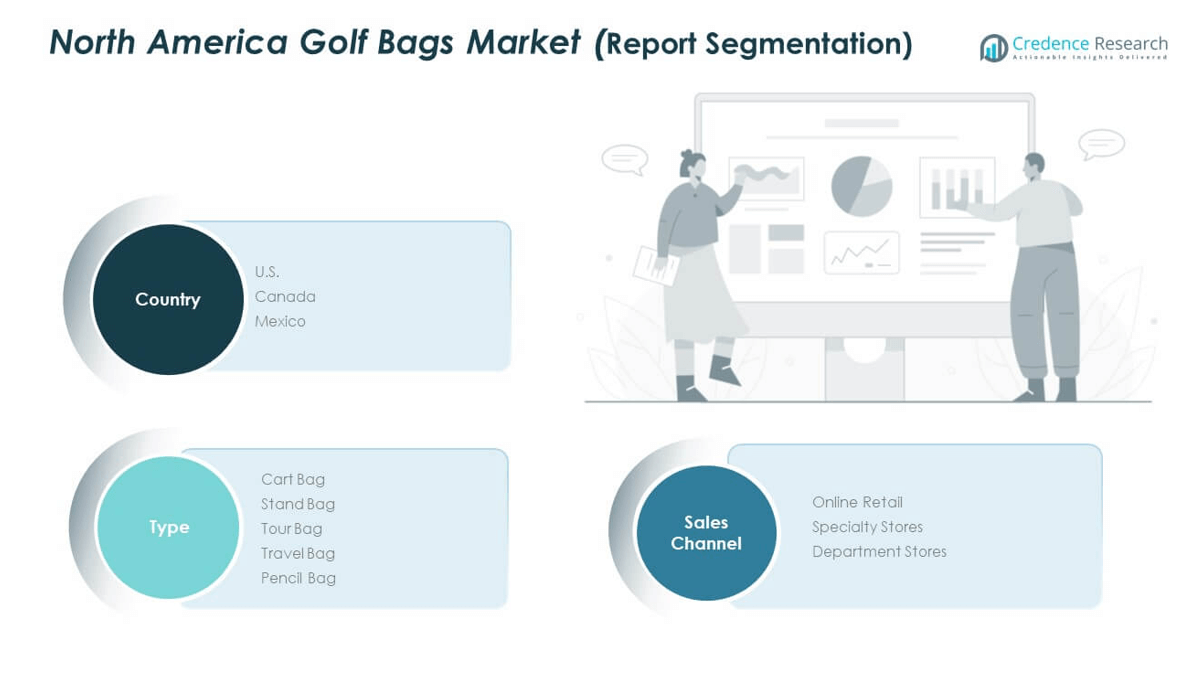
By type into cart bags, stand bags, tour bags, travel bags, and pencil bags. Cart bags dominate due to their compatibility with golf carts and enhanced storage capacity, appealing to both casual and professional players. Stand bags attract walking golfers with lightweight designs and convenient dual-strap systems. Tour bags maintain demand in the premium segment, favored by professionals and brand-conscious consumers for their durability and capacity. Travel bags register steady growth, supported by golf tourism and protective features for air travel. Pencil bags serve a niche audience seeking minimal weight and compactness for short rounds or practice sessions.
- For instance, Titleist’s Players 4 Carbon Stand Bag clocks in at just under 3 lbs (approximately 1.4 kg), offering a feather-light experience for walking golfers. It features carbon fiber legs for strength without weight, a premium double strap for comfort, and durable rip‑stop material to support long-lasting use on the course.
By sales channel, the market is categorized into online retail, specialty stores, and department stores. Online retail shows rapid growth, driven by product variety, competitive pricing, and convenience of home delivery. Specialty stores remain significant, offering personalized services, expert recommendations, and physical product inspection that appeal to dedicated golfers. Department stores contribute to sales by catering to mainstream consumers and promoting seasonal offers. It benefits from diversified distribution, ensuring wide accessibility and meeting the preferences of both value-driven and premium-seeking buyers. Each channel plays a distinct role in shaping consumer access and brand positioning, enabling manufacturers to optimize market coverage and strengthen competitive presence.
- For instance, PGA TOUR Superstore offers expert guidance, personalized fittings, and hands-on product demonstrations that online platforms cannot easily match. Its in-store STUDIO™ spaces feature certified fitters and advanced technology, enhancing the shopping experience for premium golf bags and equipment.
Segmentation:
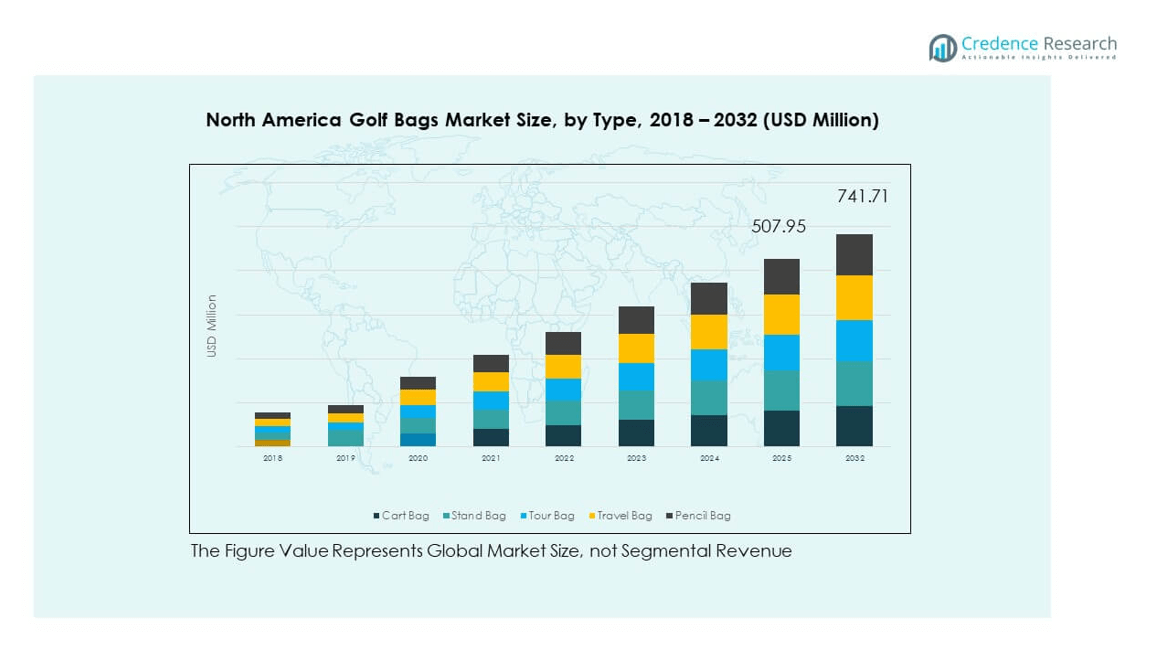
By Type
- Cart Bag
- Stand Bag
- Tour Bag
- Travel Bag
- Pencil Bag
By Sales Channel
- Online Retail
- Specialty Stores
- Department Stores
By Region
- North America
- S.
- Canada
- Mexico
Regional Analysis:
The United States holds the largest share of the North America Golf Bags Market, accounting for 68% of the regional revenue. It benefits from a well-established golfing culture, a dense network of courses, and a high base of both recreational and professional players. The presence of leading golf tournaments, coupled with extensive retail availability, supports consistent product demand. Strong consumer preference for premium and technologically advanced golf bags drives innovation and competition among manufacturers. Golf tourism in states such as Florida, Arizona, and California further boosts sales. The U.S. market also sees high adoption of customized and branded products, reinforcing brand loyalty and premium positioning.
Canada represents 20% of the North America Golf Bags Market share, driven by a seasonal but passionate golfing community. Demand peaks during warmer months, with golf tourism contributing to equipment purchases. The country’s scenic courses and growing participation in organized tournaments create steady product turnover. Specialty retailers and pro shops maintain strong influence over sales, offering targeted product recommendations and exclusive models. Canadian consumers value lightweight, weather-resistant designs suited for varied climates. Support for youth golf programs encourages early brand engagement, fostering long-term demand. The market is also influenced by cross-border product trends and collaborations.
Mexico accounts for 12% of the regional market share, with growth driven by expanding golf tourism and the development of resort-based courses. International visitors, particularly from the U.S. and Canada, contribute significantly to sales in luxury golf resorts. Rising disposable incomes among domestic players increase interest in mid- to premium-segment products. Distribution is concentrated in resort towns, urban specialty stores, and select department stores. Partnerships between golf resorts and equipment brands create direct sales opportunities. The market benefits from gradual infrastructure expansion and growing visibility of the sport through tournaments and promotional events. It is emerging as a promising destination for future investments in golf retail and branded experiences.
Key Player Analysis:
- Acushnet Company
- Ping
- Mizuno Corporation
- Sun Mountain Sports
- Motocaddy
- TaylorMade Golf
- Wilson Sporting Goods
- Taser International Inc.
- Chicco Golf
- Other Key Players
Competitive Analysis:
The North America Golf Bags Market features a competitive landscape dominated by global and regional brands such as Acushnet Company, Ping, Mizuno Corporation, Sun Mountain Sports, Motocaddy, TaylorMade Golf, and Wilson Sporting Goods. These companies compete through product innovation, brand reputation, and diversified distribution networks. Premium offerings with advanced materials, ergonomic designs, and integrated technology help brands capture high-value segments. Mid-tier players focus on affordability and durability to target broader consumer bases. E-commerce growth has intensified competition, with direct-to-consumer models improving margins and market reach. Strategic partnerships, sponsorships, and targeted marketing campaigns strengthen brand loyalty. It maintains high entry barriers due to brand-driven consumer preferences and the importance of consistent quality.
Recent Developments:
- In January 2025, Sun Mountain Sports debuted prominent new products at the PGA Show, including the Eclipse E-Series golf bags and the luxury Matchplay Collection, alongside a premium AW25 apparel line. The company is emphasizing innovation, enhanced functional design, and luxury while maintaining its tradition of pioneering stand bag technology.
- In May 2024, Motocaddy extended its partnership with the Clutch Pro Tour through a new multi-year agreement, positioning itself as the “Official Trolley & Laser” brand for the tour and underscoring its support for emerging professional golfers. The arrangement also expands Motocaddy’s involvement as a presenting sponsor of key regional PGA events and junior golf initiatives, deepening its engagement in North America’s golf landscape.
Market Concentration & Characteristics
The North America Golf Bags Market is moderately concentrated, with leading brands holding significant market share through strong retail presence and brand recognition. It is characterized by a mix of premium and mid-range products catering to varied consumer segments. Innovation in materials, lightweight construction, and functionality shapes competitive differentiation. Seasonal demand patterns influence production and inventory strategies. Consumer loyalty remains high for established brands, while niche players succeed through unique designs and customization. Distribution spans specialty stores, online platforms, and department stores, ensuring broad market coverage.
Report Coverage:
The research report offers an in-depth analysis based on type and sales Channel. It details leading market players, providing an overview of their business, product offerings, investments, revenue streams, and key applications. Additionally, the report includes insights into the competitive environment, SWOT analysis, current market trends, as well as the primary drivers and constraints. Furthermore, it discusses various factors that have driven market expansion in recent years. The report also explores market dynamics, regulatory scenarios, and technological advancements that are shaping the industry. It assesses the impact of external factors and global economic changes on market growth. Lastly, it provides strategic recommendations for new entrants and established companies to navigate the complexities of the market.
Future Outlook:
- The market is expected to witness steady growth driven by sustained golf participation across both recreational and professional segments.
- Product innovation will focus on lightweight materials, ergonomic designs, and enhanced storage functionality.
- Sustainability initiatives will gain momentum, with manufacturers adopting recycled and eco-friendly materials.
- The integration of smart features such as GPS holders and charging ports will appeal to tech-oriented consumers.
- Expansion of golf tourism in the region will create demand for travel-friendly and durable golf bags.
- Customization options in design, color, and branding will strengthen consumer engagement and brand loyalty.
- E-commerce growth will accelerate product accessibility and boost direct-to-consumer sales strategies.
- Partnerships between golf resorts, tournaments, and equipment brands will support promotional sales channels.
- Seasonal marketing strategies will optimize sales peaks aligned with prime golfing months.
- Investment in youth and women’s golf programs will broaden the customer base and sustain long-term demand.

Request a Free Sample
Fill in your details and we'll send you a free sample report.
- Sample data tables & charts
- Research methodology
Market Dynamics
Expanding Golf Participation and Tourism
Rising participation among recreational and professional golfers, along with the growth of golf tourism and international tournaments, is fueling demand for high-quality golf bags across North America.
Product Innovation and Technological Advancements
Manufacturers are introducing lightweight materials, ergonomic designs, and integrated smart features such as GPS holders and charging ports, which enhance convenience and appeal to tech-savvy consumers.
Sustainability and Eco-Friendly Materials
Growing consumer awareness and preference for sustainable products are driving brands to adopt recycled and eco-friendly materials, strengthening brand loyalty and attracting environmentally conscious buyers.
Growth of E-Commerce and Direct-to-Consumer Sales
The expansion of online retail platforms and direct-to-consumer models is increasing product accessibility, enabling consumers to compare features and prices easily, and boosting overall market growth.
Customization and Personalization Trends
Demand for personalized golf bags with customizable colors, logos, and features is rising, allowing brands to differentiate their offerings and foster stronger consumer engagement.
Need a Custom Version of This Report?
Tailor the scope, geography, or segments to your exact requirements.
- Custom geography or segment scope
- Direct access to our analyst team
Frequently Asked Questions
What is the current market size for North America Golf Bags Market, and what is its projected size in 2032?
At what Compound Annual Growth Rate is the North America Golf Bags Market projected to grow between 2024 and 2032?
What are the primary factors fueling the growth of the North America Golf Bags Market?
Who are the leading companies in the North America Golf Bags Market?
Table of Content
Chapter 1 Market Segmentation
- 1.1 Segmentation Framework
- 1.1.1 Product and Service Classification
- 1.1.2 Application and End-Use Classification
- 1.1.3 Technology and Solution Classification
- 1.1.4 Customer and Distribution Channel Classification
- 1.1.5 Geographic Segmentation
- 1.1.6 Market Segment Definitions and Boundaries
- 1.2 By Type
- 1.2.1 Cart Bag
- 1.2.2 Stand Bag
- 1.2.3 Tour Bag
- 1.2.4 Travel Bag
- 1.2.5 Pencil Bag
- 1.3 By Country
- 1.3.1 United States
- 1.3.2 Canada
- 1.3.3 Mexico
- 1.4 By Sales Channel
- 1.4.1 Online Retail
- 1.4.2 Specialty Stores
- 1.4.3 Department Stores
Chapter 2 Introduction
- 2.1 Report Objectives and Scope
- 2.2 Product Definition and Industry Terminology
- 2.3 Market Inclusions and Exclusions
- 2.4 Research Process
- 2.4.1 Primary Research and Expert Interviews
- 2.4.2 Secondary Research and Source Review
- 2.4.3 Top-Down and Bottom-Up Estimation
- 2.4.4 Data Triangulation and Verification
- 2.5 Market Size Measurement Basis
- 2.5.1 2024: USD 483.47 million → 2032: USD 741.71 million
- 2.6 Historical and Forecast Reference Periods
- 2.6.1 Base Year: 2024
- 2.6.2 Forecast Period: 2024-2032
- 2.7 Research Assumptions and Limitations
Chapter 3 Executive Summary
- 3.1 Market Snapshot and Key Findings
- 3.2 Base-Year Market Size, 2024
- 3.3 Forecast Market Size, 2032
- 3.4 Revenue and Volume Growth Outlook
- 3.5 Key Demand and Supply Indicators
- 3.6 Leading Market Segments
- 3.7 Fastest-Growing Market Opportunities
- 3.8 Regional Performance Highlights
- 3.9 Technology and Industry Transformation
- 3.10 Competitive Landscape Summary
- 3.11 Analyst View and Strategic Implications
Chapter 4 North America Golf Bags Market Trends and Developments
- 4.1 Historical Industry Development
- 4.2 Recent Market Trends and Developments
- 4.3 Demand and Customer Behavior Trends
- 4.4 Technology and Product Innovation
- 4.5 Artificial Intelligence, Automation and Digitalization
- 4.6 Local Manufacturing and Supply Chain Realignment
- 4.7 Industry Partnerships, Mergers and Acquisitions
- 4.8 Sustainability and Circular Economy Developments
- 4.9 Government and Private Sector Investment Trends
- 4.10 Emerging Business Models and Commercialization
- 4.11 Industry Developments and Announcements
Chapter 5 North America Golf Bags Market Production, Supply and Demand Analysis
- 5.1 Demand Trend and Consumption Analysis
- 5.2 Demand Forecast, 2024-2032
- 5.3 Production and Output Trend
- 5.4 Production and Output Forecast, 2024-2032
- 5.5 Installed Capacity and Capacity Utilization
- 5.6 Company-Wise Production Plants and Statistics
- 5.6.1 Installed Production Capacity
- 5.6.2 Actual Production
- 5.6.3 Planned Capacity and Expansion Targets
- 5.7 Supply Chain Structure and Procurement Trends
- 5.8 Supply-Demand Gap and Bottlenecks
- 5.9 Import Dependence and Sourcing Structure
- 5.10 Contract Manufacturing and Outsourcing
- 5.11 Regional Supply and Demand Concentration
Chapter 6 North America Golf Bags Market Pricing Analysis
- 6.1 Pricing Structure and Measurement
- 6.2 Historical Pricing Trends
- 6.3 Pricing Outlook, 2024-2032
- 6.4 Average Selling Price and Unit Economics
- 6.5 Pricing by Product and Market Segment
- 6.6 Geographic Pricing Differences
- 6.7 Key Input, Energy, Labor and Logistics Costs
- 6.8 Contract Pricing and Purchasing Models
- 6.9 Pricing Sensitivity and Competitive Positioning
- 6.10 Price, Margin and Profitability Implications
Chapter 7 North America Golf Bags Market Dynamics
- 7.1 Market Growth Drivers
- 7.1.1 Demand-Side Drivers
- 7.1.2 Technology and Innovation Drivers
- 7.1.3 Infrastructure and Investment Drivers
- 7.1.4 Regulatory and Policy Drivers
- 7.2 Market Restraints
- 7.2.1 Cost and Affordability Constraints
- 7.2.2 Technology and Adoption Barriers
- 7.2.3 Supply Chain and Operational Constraints
- 7.3 Market Challenges
- 7.3.1 Competitive Pressure and Margin Erosion
- 7.3.2 Skills, Infrastructure and Implementation Gaps
- 7.4 Emerging Market Opportunities
- 7.5 Market Dynamics Impact and Time-Horizon Assessment
Chapter 8 North America Golf Bags Value Chain Analysis
- 8.1 Industry Value Chain Overview
- 8.2 Upstream Suppliers and Critical Inputs
- 8.3 Technology and Component Providers
- 8.4 Manufacturing or Service Delivery
- 8.5 Distribution, Channel Partners and Integrators
- 8.6 Downstream Applications and End Users
- 8.7 Value Addition and Profit Pools
- 8.8 Vertical Integration and Outsourcing
- 8.9 Supplier Concentration and Risk
- 8.10 Supply Chain Localization and Resilience
Chapter 9 North America Golf Bags Market Regulations and Policies
- 9.1 Relevant Laws, Standards and Compliance Frameworks
- 9.2 Product, Service, Safety and Quality Requirements
- 9.3 Government Policies, Incentives and Subsidies
- 9.4 Imports, Exports and Trade Barriers
- 9.5 Public Procurement and Local Content Requirements
- 9.6 Environmental and Sustainability Compliance
- 9.7 Upcoming Policy Changes and Market Implications
Chapter 10 North America Golf Bags Market Hotspots and Opportunities
- 10.1 Market Opportunity Mapping and Growth Hotspots
- 10.2 High-Growth Applications and Customer Groups
- 10.3 Underserved Markets and White-Space Opportunities
- 10.4 Emerging Technology and Product Opportunities
- 10.5 New Capacity and Investment Hotspots
- 10.6 Market Entry and Expansion Opportunities
- 10.7 Distribution and Partnership Opportunities
- 10.8 Near-Term and Long-Term Commercial Potential
- 10.9 Opportunity Attractiveness and Execution Risks
Chapter 11 North America Golf Bags Market Outlook, 2024-2032
- 11.1 Market Size and Analysis
- 11.1.1 Revenue (Market Measurement: 2024: USD 483.47 million → 2032: USD 741.71 million)
- 11.1.2 Market Volume and Quantity Sold
- 11.1.3 Historical Market Size
- 11.1.4 Base-Year Market Size, 2024
- 11.2 Market Forecast, 2024-2032
- 11.2.1 Revenue Forecast to 2032
- 11.2.2 Volume Forecast to 2032
- 11.2.3 CAGR and Year-on-Year Growth
- 11.2.4 Incremental Revenue Opportunity
- 11.3 Forecast Assumptions and Scenario Analysis
- 11.3.1 Base-Case Forecast
- 11.3.2 Optimistic and Conservative Scenarios
- 11.3.3 Technology, Pricing and Policy Sensitivities
- 11.4 Market Attractiveness and Growth Outlook
Chapter 12 North America Golf Bags Market Segmentation and Outlook
- 12.1 Segmentation Summary and Market Shares, 2024
- 12.2 Largest and Fastest-Growing Segments
- 12.3 By Type - Market Size and Forecast, 2024-2032
- 12.3.1 Segment Definition and Scope
- 12.3.2 Historical Market Size
- 12.3.3 Revenue Forecast, 2024-2032
- 12.3.4 Volume Forecast, 2024-2032
- 12.3.5 Base-Year Market Share, 2024
- 12.3.6 Segment CAGR and Growth Drivers
- 12.3.7 Subsegment Market Size and Forecast
- 12.3.7.1 Cart Bag
- 12.3.7.2 Stand Bag
- 12.3.7.3 Tour Bag
- 12.3.7.4 Travel Bag
- 12.3.7.5 Pencil Bag
- 12.3.8 Subsegment Pricing and Adoption Trends
- 12.3.9 Leading Suppliers and Competition
- 12.3.10 Regional Demand and Opportunities
- 12.4 By Country - Market Size and Forecast, 2024-2032
- 12.4.1 Segment Definition and Scope
- 12.4.2 Historical Market Size
- 12.4.3 Revenue Forecast, 2024-2032
- 12.4.4 Volume Forecast, 2024-2032
- 12.4.5 Base-Year Market Share, 2024
- 12.4.6 Segment CAGR and Growth Drivers
- 12.4.7 Subsegment Market Size and Forecast
- 12.4.7.1 United States
- 12.4.7.2 Canada
- 12.4.7.3 Mexico
- 12.4.8 Subsegment Pricing and Adoption Trends
- 12.4.9 Leading Suppliers and Competition
- 12.4.10 Regional Demand and Opportunities
- 12.5 By Sales Channel - Market Size and Forecast, 2024-2032
- 12.5.1 Segment Definition and Scope
- 12.5.2 Historical Market Size
- 12.5.3 Revenue Forecast, 2024-2032
- 12.5.4 Volume Forecast, 2024-2032
- 12.5.5 Base-Year Market Share, 2024
- 12.5.6 Segment CAGR and Growth Drivers
- 12.5.7 Subsegment Market Size and Forecast
- 12.5.7.1 Online Retail
- 12.5.7.2 Specialty Stores
- 12.5.7.3 Department Stores
- 12.5.8 Subsegment Pricing and Adoption Trends
- 12.5.9 Leading Suppliers and Competition
- 12.5.10 Regional Demand and Opportunities
- 12.6 Segment Growth Comparison
- 12.7 Segment Attractiveness and Priority Matrix
Chapter 13 North America Golf Bags Geographic Market Outlook, 2024-2032
- 13.1 Regional Market Size and Country-Level Shares, 2024
- 13.2 Country Market Size Comparison, 2024
- 13.3 Country Market Forecasts, 2024-2032
- 13.4 Subregional Industrial and Demand Clusters
- 13.5 Intra-Regional Pricing and Cost Differences
- 13.6 Cross-Border Trade and Supply Networks
- 13.7 Regional Supply and Demand Balances
- 13.8 Country Opportunity Comparison and Prioritization
Note: Every listed country is covered on the structure shown under the first country.
Chapter 14 North America Golf Bags Technology, Innovation and Sustainability Outlook
- 14.1 Technology Landscape and Maturity
- 14.2 Product, Process and Service Innovation
- 14.3 AI, Automation and Digital Tools in the Industry
- 14.4 Technology Adoption and Performance Benchmarking
- 14.5 Innovation Pipeline and R&D Investment
- 14.6 Patent and Intellectual Property Trends
- 14.7 Energy Efficiency and Resource Management
- 14.8 Sustainability, Recycling and Circularity
- 14.9 Technology Roadmap, 2024-2032
- 14.10 Risks of Obsolescence and Technology Substitution
Chapter 15 North America Golf Bags Market Key Strategic Imperatives
- 15.1 Growth and Market Entry Priorities
- 15.2 High-Return Products and Segments
- 15.3 Pricing, Profitability and Cost Optimization
- 15.4 Technology Investment and Product Differentiation
- 15.5 Supply Chain Localization and Resilience
- 15.6 Distribution and Customer Acquisition
- 15.7 Partnership, Acquisition and Capacity Strategy
- 15.8 Regional Expansion Priorities
- 15.9 Short-, Medium- and Long-Term Actions
Chapter 16 Competition Outlook
- 16.1 Industry Competition Characteristics
- 16.2 Market Structure and Concentration
- 16.3 Market Share and Competitive Positioning, 2024
- 16.4 Company-Wise Revenue and Product Benchmarking
- 16.5 Production and Service Capacity Benchmarking
- 16.6 Technology, Pricing and Differentiation
- 16.7 Regional Footprint and Distribution Strength
- 16.8 Mergers, Acquisitions and Strategic Alliances
- 16.9 New Entrants and Competitive Threats
- 16.10 Porter's Five Forces and Industry Attractiveness
- 16.11 Competitive Outlook, 2024-2032
Chapter 17 Company Profiles
- 17.1 Company Coverage and Selection Criteria
- 17.2 Acushnet Company
- 17.2.1 Business Description
- 17.2.2 Company Ownership and Geographic Presence
- 17.2.3 Product and Service Portfolio
- 17.2.4 Manufacturing and Operating Footprint
- 17.2.5 Production Capacity and Expansion Plans
- 17.2.6 Financial Performance and Investment
- 17.2.7 Market Share and Competitive Position
- 17.2.8 Technology and Innovation Capabilities
- 17.2.9 Strategic Alliances or Partnerships
- 17.2.10 Recent Developments
- 17.2.11 Growth Strategy and Outlook
- 17.3 Ping
- 17.4 Mizuno Corporation
- 17.5 Sun Mountain Sports
- 17.6 Motocaddy
- 17.7 TaylorMade Golf
- 17.8 Wilson Sporting Goods
- 17.9 Taser International Inc.
- 17.10 Chicco Golf
- 17.11 Other Relevant Market Participants
Note: Every listed company is profiled on the structure shown under the first company. The company list is preliminary and may change based on research findings, market developments, data availability and client requirements.
Chapter 18 Disclaimer
- 18.1 Research and Forecast Disclaimer
- 18.2 Data Source and Estimation Limitations
Note: The depth of individual sections depends on data availability for this market. Volume, capacity, trade and other unit-based metrics are included where applicable.

