
| REPORT ATTRIBUTE | DETAILS |
|---|---|
| Historical Period | 2020-2023 |
| Base Year | 2024 |
| Forecast Period | 2025-2032 |
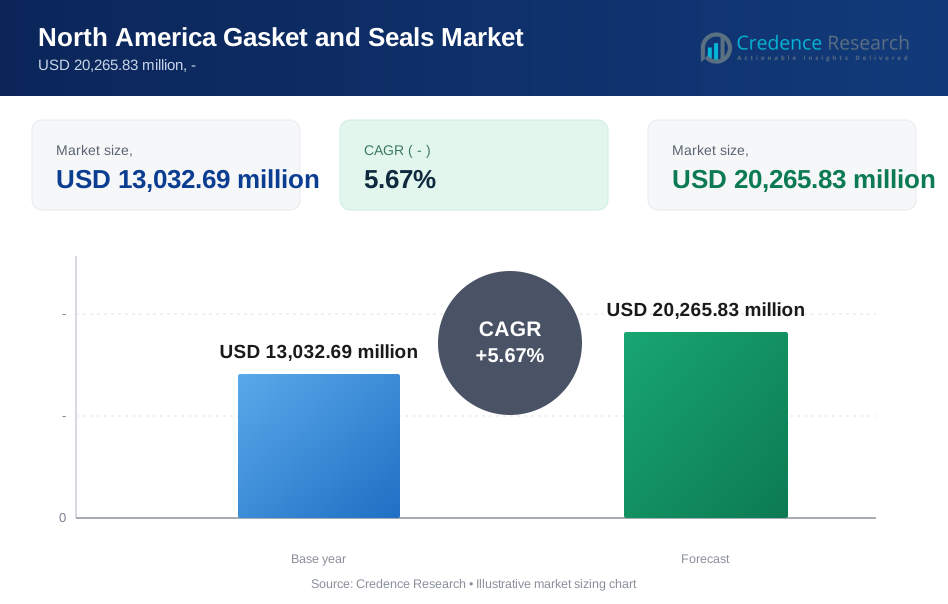
| North America Gasket and Seals Market Size 2024 | USD 13,032.69 million |
| North America Gasket and Seals Market, CAGR | 5.67% |
| North America Gasket and Seals Market Size 2032 | USD 20,265.83 million |
Market Overview
The North America Gasket and Seals Market is projected to grow from USD 13,032.69 million in 2024 to an estimated USD 20,265.83 million by 2032, with a compound annual growth rate (CAGR) of 5.67% from 2025 to 2032. This growth is driven by the increasing demand for high-performance sealing solutions across industries such as automotive, aerospace, oil and gas, and industrial machinery.
The market is primarily driven by factors such as the increasing demand for reliable sealing solutions to prevent fluid and gas leaks, as well as advancements in materials and technologies. Additionally, the growing focus on reducing maintenance costs, along with stringent environmental regulations, is fueling the adoption of high-performance gaskets and seals. Furthermore, the trend towards electric vehicles (EVs) and renewable energy sources is also creating significant opportunities for market players to develop specialized sealing solutions.
Geographically, North America dominates the market, with the United States leading in terms of both production and consumption. The region’s strong industrial base, including automotive, aerospace, and energy sectors, contributes significantly to the demand for gaskets and seals. Key players in the market include companies such as Parker Hannifin Corporation, Freudenberg Group, SKF Group, and Trelleborg AB, which continue to innovate and expand their product portfolios to cater to diverse industry requirements.
Market Insights
- The North American gasket and seals market is projected to grow from USD 13,032.69 million in 2024 to USD 20,265.83 million by 2032, driven by the demand for high-performance sealing solutions.
- Increasing industrial activities in sectors like automotive, aerospace, and oil and gas are fueling the demand for reliable and durable sealing solutions to prevent leaks.
- Innovations in gasket and seal materials, such as fluoropolymers and elastomers, are enhancing product performance and expanding market applications.
- The growing demand for eco-friendly materials and products is pushing manufacturers to develop biodegradable and recyclable sealing solutions.
- The rising costs of raw materials and global supply chain disruptions pose challenges to manufacturers in maintaining production efficiency and cost-effectiveness.
- The United States leads the North American market, driven by its large industrial base, including automotive, aerospace, and energy sectors.
- The shift towards electric vehicles and renewable energy sources presents new opportunities for specialized gasket and seal solutions.
Market Drivers
Rising Demand for High-Performance Sealing Solutions in Diverse Industries
The North American gasket and seals market is witnessing robust growth, driven by the increasing demand for high-performance sealing solutions across various industries. These products are critical for preventing fluid and gas leaks, ensuring operational efficiency, and safeguarding machinery from damage. Industries such as automotive, aerospace, oil and gas, industrial machinery, and power generation rely heavily on these solutions to maintain system integrity.In the automotive sector, for instance, gaskets and seals are indispensable in engines, transmissions, and exhaust systems to enhance durability, curb emissions, and improve performance. The industry's shift toward energy efficiency and sustainability is further fueling demand for advanced sealing technologies. Similarly, the aerospace sector depends on high-performance seals capable of withstanding extreme temperatures and pressures to ensure aircraft safety and longevity. The growing focus on reducing maintenance costs has led industries to adopt innovative materials like elastomers and PTFE, which offer superior resistance to harsh environments. These advancements are enabling manufacturers to meet the rising expectations of diverse applications while improving overall reliability.
Technological Advancements and Innovations in Materials
Technological progress and material innovations are transforming the North American gasket and seals market. Manufacturers are leveraging advanced materials such as thermoplastic elastomers (TPE) and fluoropolymers to develop products with enhanced durability and performance. These innovations address the need for sealing solutions that can withstand extreme conditions in demanding environments.For instance, the rise of electric vehicles (EVs) has created a demand for seals that can endure high chemical exposure and temperature fluctuations within EV battery packs. This has spurred research into novel materials that meet these stringent requirements. Similarly, renewable energy applications require advanced sealing technologies capable of performing under challenging conditions. As industries demand more specialized solutions, manufacturers are intensifying their focus on research and development to create cutting-edge products. These efforts not only cater to evolving industry needs but also position companies to capitalize on emerging opportunities in this dynamic market.
Stringent Environmental and Safety Regulations
The North American market for gaskets and seals is also being driven by the increasing implementation of stringent environmental and safety regulations. Governments in the region have set high standards for emissions control, energy efficiency, and safety, all of which contribute to the growing need for reliable sealing solutions. Seals and gaskets play a critical role in ensuring that machinery and systems comply with these regulations by preventing leaks that could lead to hazardous environmental conditions, such as fuel spills, chemical leaks, and gas emissions.For instance, the automotive industry is subject to stringent emissions standards, pushing manufacturers to develop sealing solutions that prevent exhaust gas leakage and improve fuel efficiency. Similarly, the oil and gas sector faces regulatory pressures related to preventing leaks that can contribute to environmental degradation. In such applications, high-performance gaskets and seals are essential to ensure that pipelines, valves, and pumps operate in compliance with environmental safety standards. The growing importance of adhering to environmental and safety regulations continues to fuel the demand for high-quality gaskets and seals that can meet these standards.
Growth of Electric Vehicles (EVs) and Renewable Energy Sectors
The growth of the electric vehicle (EV) and renewable energy sectors is another key driver of the North American gasket and seals market. As the automotive industry transitions toward cleaner and more energy-efficient vehicles, the need for specialized gaskets and seals in electric vehicles has surged. Gaskets are used in critical components such as EV batteries, powertrains, and charging systems. These components require sealing solutions that can handle high temperatures, moisture, and vibration, all of which are common in electric vehicle operations. Furthermore, the renewable energy sector, which includes wind, solar, and geothermal power generation, is also contributing to the demand for advanced gasket and seal products. For example, wind turbines rely on seals to protect critical components such as bearings and shafts from external elements. Similarly, seals are essential in the solar industry, where they are used in photovoltaic systems to protect against moisture and environmental wear. The transition to renewable energy sources is expected to continue growing in the coming years, further driving the demand for gaskets and seals in this sector.
Market Trends
Integration of Smart Technologies and IoT in Sealing Solutions
Another emerging trend in the North American gasket and seals market is the integration of smart technologies and the Internet of Things (IoT) into sealing solutions. As industries continue to embrace digitalization, there is a growing demand for sealing products that can communicate data and monitor performance in real-time. This integration of smart technology allows for more efficient maintenance, reduced downtime, and enhanced system reliability.For example, in critical sectors such as oil and gas, smart gaskets and seals equipped with sensors can detect early signs of wear or leaks, providing real-time data that helps maintenance teams take proactive action. These smart sealing solutions can also integrate with predictive maintenance systems, enabling operators to monitor the condition of sealing components remotely and schedule maintenance before failures occur. Similarly, in the automotive industry, smart seals could potentially monitor the integrity of seals in electric vehicle batteries or engine components, alerting manufacturers or service centers when repairs or replacements are needed. As IoT and smart technologies continue to gain traction across industries, manufacturers in the gasket and seals market are incorporating these innovations to offer products that are not only durable but also capable of providing valuable operational insights.
Growing Demand for Customization and Tailored Solutions
The increasing complexity of industrial applications and the diverse requirements across sectors are driving the demand for customized and tailored gasket and seal solutions. Manufacturers are focusing on offering bespoke sealing products that meet the specific needs of their clients, whether it’s for highly specialized equipment, unique operating environments, or custom-fit designs. This trend is particularly strong in industries such as aerospace, automotive, and energy, where off-the-shelf solutions may not provide the necessary performance or durability for critical systems.In the aerospace industry, for example, sealing solutions must be designed to withstand extreme conditions, including high pressure and temperature variations, while maintaining airtight and leak-proof seals. Custom gaskets and seals are essential to meet these rigorous requirements. Similarly, in the automotive sector, as vehicle designs become more intricate, the need for sealing products that fit precisely within complex engine compartments, transmission systems, and battery packs is growing. To meet this demand, manufacturers are investing in advanced production techniques, such as 3D printing and CNC machining, to produce seals that are tailored to specific dimensions and performance specifications.
Adoption of Advanced Materials for Specialized Applications
One of the most prominent trends in the North American gasket and seals market is the growing adoption of advanced materials that offer superior performance in specialized applications. Manufacturers are increasingly turning to high-performance materials such as fluoropolymers, thermoplastic elastomers (TPE), and composite materials to meet the evolving needs of industries like automotive, aerospace, oil and gas, and renewable energy. These advanced materials are being developed to withstand extreme temperatures, pressures, and chemical exposures, which are common in critical applications. For instance, companies like Freudenberg Sealing Technologies are developing advanced materials that provide superior resistance to extreme conditions, enhancing the reliability and efficiency of industrial applications. The growing emphasis on performance, efficiency, and sustainability has accelerated the adoption of these specialized materials, making them a key trend in the market.
Increased Focus on Sustainability and Eco-friendly Products
Sustainability has become a major consideration in the design and production of gaskets and seals, driven by both regulatory requirements and growing consumer demand for eco-friendly products. The North American market is seeing a shift towards more environmentally friendly materials, with manufacturers exploring alternatives to traditional materials that may have a greater environmental impact. For instance, companies like ElringKlinger are developing innovative cylinder-head gaskets that significantly reduce emissions, contributing to a cleaner environment. This shift is particularly important in industries such as automotive and energy, where environmental regulations are becoming more stringent. As the renewable energy sector continues to expand, the demand for sustainable sealing products is also increasing. Gaskets and seals used in solar panels, wind turbines, and other renewable energy technologies are expected to be made from materials that not only enhance performance but also minimize environmental impact. This trend towards sustainability is expected to continue driving innovation in the gasket and seals market, as companies strive to meet regulatory requirements and align with global sustainability goals.
Market Challenges
Intense Market Competition and Price Pressure
The North American gasket and seals market is highly competitive, with numerous domestic and international players vying for market share. This competition, coupled with price sensitivity among customers, has created significant pricing pressure on manufacturers. Companies must balance offering high-quality products with the need to remain competitive on price, which can be a difficult proposition when raw material costs are rising. Additionally, many customers, particularly in industries such as automotive and industrial manufacturing, are focused on cost-effective sealing solutions, making it challenging for manufacturers to justify premium pricing for high-performance or custom-engineered gaskets and seals. This intense competition forces companies to continuously innovate, streamline production processes, and adopt cost-saving technologies to stay competitive. However, these efforts often require significant upfront investment and can impact the profitability of manufacturers, especially smaller players who may lack the resources to invest in such initiatives. The ability to differentiate through product quality, innovation, and customer service becomes essential to maintain a competitive edge in this crowded market.
Rising raw material costs and supply chain disruptions
Rising raw material costs and supply chain disruptions have emerged as significant challenges for the North American gasket and seals market. The industry heavily relies on specialized materials such as elastomers, metals, and polymers, which are subject to price volatility due to factors like geopolitical tensions, trade restrictions, and global demand fluctuations. For instance, disruptions caused by the COVID-19 pandemic exposed vulnerabilities in supply chains, leading to delays and shortages of key materials required for production. These issues have increased manufacturing costs, impacting the pricing and availability of finished products in the market. Manufacturers are now prioritizing strategies to manage these challenges, including optimizing supply chain operations and exploring alternative sourcing methods such as nearshoring or vertical integration. However, these measures require substantial investments and long-term planning, adding complexity to the market landscape. Additionally, reliance on global suppliers for critical raw materials continues to pose risks related to geopolitical uncertainties and fluctuating material prices. As industries like automotive and aerospace demand high-performance gaskets and seals, manufacturers must balance cost management with delivering quality products. Addressing these challenges is crucial for maintaining profitability and meeting customer expectations in a competitive market environment.
Market Opportunities
Expansion in the Electric Vehicle (EV) and Renewable Energy Sectors
The growing adoption of electric vehicles (EVs) and the increasing emphasis on renewable energy sources present significant opportunities for the North American gasket and seals market. As the automotive industry shifts towards electric vehicles, there is a rising demand for specialized sealing solutions for EV batteries, powertrains, and charging systems. Gaskets and seals in these applications must be able to withstand high temperatures, moisture, and aggressive chemicals, creating a niche for high-performance sealing products. Additionally, the expansion of the renewable energy sector, including wind and solar power generation, is driving demand for durable and efficient sealing solutions in components like turbines, solar panels, and energy storage systems. This trend offers manufacturers an opportunity to innovate and cater to the growing need for specialized, eco-friendly sealing solutions.
Advancements in Material Technologies and Customization
Another key market opportunity lies in the development of advanced materials and customization capabilities for gaskets and seals. With increasing demand for sealing solutions that can operate under extreme conditions—such as high pressure, temperature fluctuations, and aggressive chemicals—there is a growing opportunity to develop new materials that offer enhanced performance and durability. Innovations in materials like fluoropolymers, thermoplastic elastomers, and composite materials provide a competitive edge in industries like aerospace, oil and gas, and automotive. Additionally, the increasing need for customized sealing solutions in complex industrial applications opens up avenues for manufacturers to offer tailored products that meet specific client requirements. This growing focus on material innovation and customization provides companies with significant opportunities for market differentiation and growth.
Market Segmentation Analysis
By Product
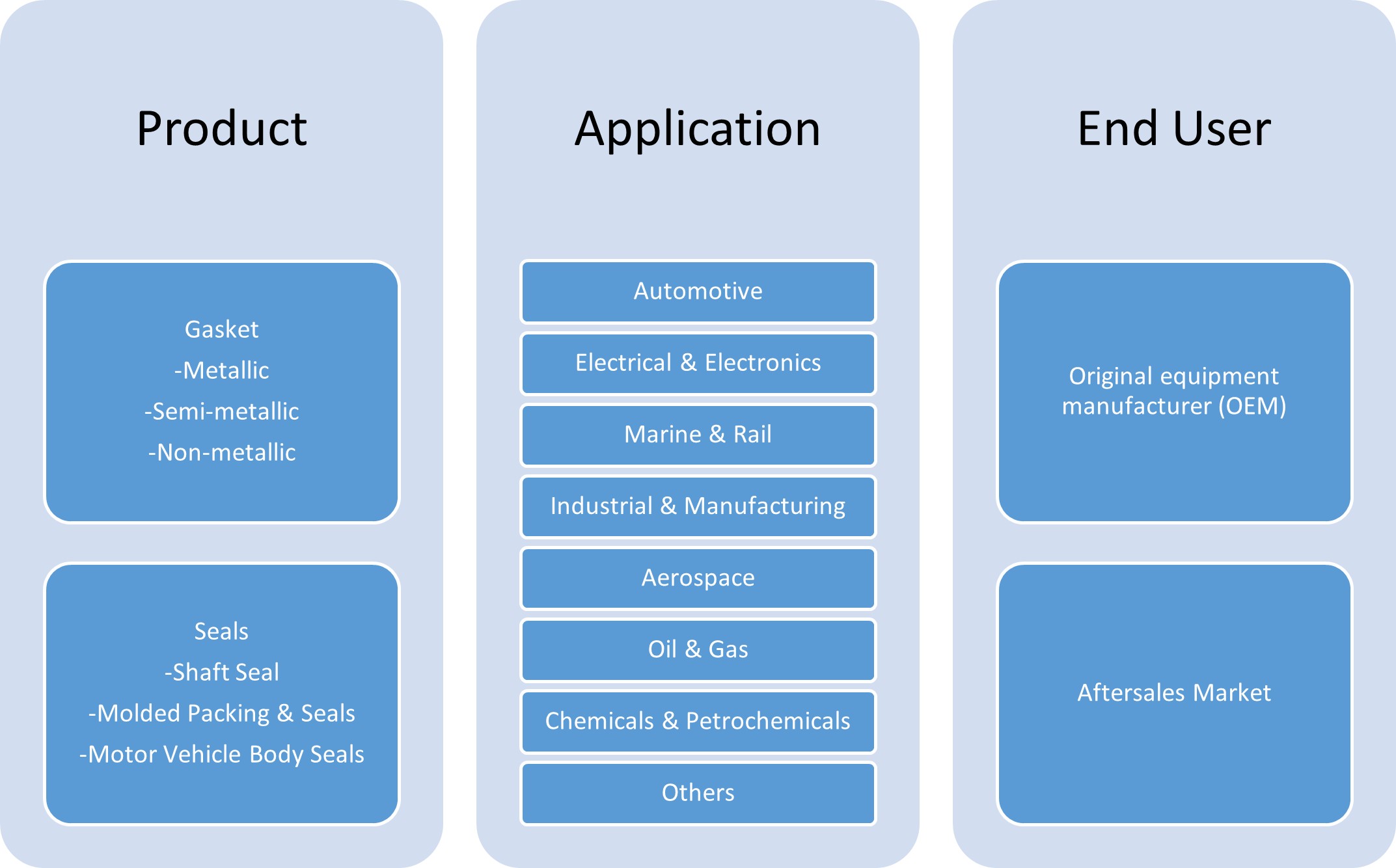
The gasket segment holds a significant share in the North American market, with three key subcategories: metallic, semi-metallic, and non-metallic gaskets. Metallic gaskets are commonly used in high-strength applications requiring resistance to extreme temperatures and pressures, such as in aerospace, automotive, and industrial sectors. These gaskets offer durability and are well-suited for harsh environments. Semi-metallic gaskets, which combine metallic and non-metallic materials, offer enhanced flexibility and sealing performance. They are widely used in automotive engines and power generation systems due to their resilience in demanding conditions. Non-metallic gaskets, made from materials like rubber, PTFE, and elastomers, are preferred in applications requiring chemical resistance and lower temperature performance, making them common in the automotive and chemical industries. In the seals segment, shaft seals are crucial for sealing rotating parts, preventing leakage of fluids and contaminants in automotive, industrial machinery, and aerospace applications. Molded packing and seals provide reliable solutions for applications that demand precise fits and resistance to wear, heat, and chemicals, commonly used in industrial machinery and automotive industries. Motor vehicle body seals protect vehicle parts from external elements such as moisture, dust, and noise, playing an important role in enhancing vehicle safety, comfort, and durability.
By Application
The demand for gaskets and seals is prominent across various industries, with automotive being one of the largest consumers. These components are critical for engine systems, exhaust systems, transmission systems, and vehicle body parts, with the growing demand for fuel efficiency and emissions control driving the need for high-performance sealing solutions. The electrical and electronics sector also contributes to the demand, as gaskets and seals protect sensitive components from dust, moisture, and contamination, particularly in electric vehicles (EVs) and renewable energy systems. In the marine and rail industries, gaskets and seals are essential for preventing leaks in engines, pumps, and other equipment exposed to harsh conditions, requiring materials that can withstand moisture, vibration, and corrosion. The industrial and manufacturing sectors increasingly rely on gaskets and seals to maintain operational integrity in equipment like pumps, compressors, and turbines. As industries focus on reducing downtime and improving efficiency, the demand for sealing solutions is on the rise. Aerospace applications require seals that can withstand extreme temperatures, high pressures, and environmental stress, ensuring performance and safety in engines, airframes, and avionics systems. The oil and gas industry also plays a significant role, as gaskets and seals are critical in pipeline systems, drilling rigs, and processing equipment, where they must endure high pressures, extreme temperatures, and aggressive chemicals. In the chemicals and petrochemicals sector, seals are necessary to resist corrosive chemicals and high temperatures, ensuring safe and efficient operations in chemical processing plants. Additionally, other industries, such as food and beverage, pharmaceuticals, and construction, also contribute to the demand for gaskets and seals, particularly in specialized applications requiring high-performance sealing materials.
Segments
Based on Product
- Gasket
- Metallic
- Semi-metallic
- Non-metallic
- Seals
- Shaft Seal
- Molded Packing & Seals
- Motor Vehicle Body Seals
Based on Application
- Automotive
- Electrical & Electronics
- Marine & Rail
- Industrial & Manufacturing
- Aerospace
- Oil & Gas
- Chemicals & Petrochemicals
- Others
Based on End User
- Original equipment manufacturer (OEM)
- Aftersales Market
Based on Region
- United States
- Canada
- Mexico
Regional Analysis
United States (75%)
The United States holds the largest market share in the North American gasket and seals market, accounting for approximately 75% of the total market share. The country’s advanced industrial infrastructure, coupled with its robust automotive, aerospace, oil and gas, and chemical industries, contributes significantly to the demand for gaskets and seals. The U.S. automotive sector, which is undergoing a transition towards electric vehicles (EVs), is a major consumer of high-performance sealing solutions. Additionally, the aerospace and oil and gas industries in the U.S. rely heavily on gaskets and seals to maintain operational efficiency and safety in extreme conditions. The demand for advanced sealing solutions is further bolstered by the presence of leading manufacturers and a focus on innovations in materials and smart technologies.
Canada (15%)
Canada holds a market share of approximately 15% in the North American gasket and seals market. The country’s manufacturing sector, particularly in industries like automotive, mining, and oil and gas, is a key driver for gasket and seal demand. With its rich natural resources and a strong focus on the energy sector, particularly in oil sands and pipeline systems, the demand for durable sealing solutions remains high. Furthermore, Canada’s growing investment in renewable energy technologies, including wind and solar power, is expected to contribute to the growth of gaskets and seals used in these systems. The need for high-performance sealing solutions in extreme environmental conditions presents opportunities for market expansion in Canada.
Key players
- Garlock Sealing Technologies
- Parker Hannifin
- John Crane
- Flexitallic
- Donaldson Company
Competitive Analysis
The North American gasket and seals market is highly competitive, with several well-established players vying for market share. Garlock Sealing Technologies, a leading player, offers a broad range of sealing solutions, including high-performance gaskets and seals, and focuses on continuous innovation to maintain a competitive edge. Parker Hannifin is another strong contender, recognized for its advanced sealing technologies and strong presence in diverse sectors, including automotive, aerospace, and industrial. John Crane, with its extensive product portfolio, is a dominant player in the oil and gas industry, focusing on custom-engineered sealing solutions. Flexitallic is known for its expertise in gasket manufacturing and its commitment to sustainability, which resonates well with the growing demand for eco-friendly sealing products. Donaldson Company, primarily recognized for its filtration technologies, also offers sealing solutions, capitalizing on its innovation and reliability. These companies differentiate themselves through product quality, technological advancements, and tailored solutions to meet the unique needs of various industries.
Recent Developments
- On February 12, 2025, SKF India Limited's Board of Directors approved the appointment of Ms. Surbhi Srivastava, Head of People Experience, to the Senior Management Team. Ms. Srivastava holds a Bachelor of Science from Fergusson College and an MBA from Symbiosis Institute of Business Management, Pune, with over 20 years of experience across various industries.
- In May 2024, Trelleborg announced plans to invest in a new production facility in Casablanca, Morocco, dedicated to aerospace sealing solutions. Construction commenced prior to January 2025, with operations expected to begin by the end of 2025.
- In November 2023, Freudenberg Sealing Technologies reported that sales of its Simriz perfluoroelastomeric (FFKM) compounds had more than doubled in North America over the preceding 24 months. This surge was attributed to the compounds' quality, performance, and availability during supply chain disruptions.
- On May 2, 2023, The Yokohama Rubber Co., Ltd. completed the acquisition of all outstanding shares of Trelleborg Wheel Systems Holding AB, expanding its presence in the off-highway tire sector.
Market Concentration and Characteristics
The North American gasket and seals market exhibits a moderate level of concentration, with a mix of large multinational players and smaller regional companies competing for market share. The market is characterized by intense competition, driven by the demand for high-performance, customizable sealing solutions across various industries, including automotive, aerospace, oil and gas, and manufacturing. Key players, such as Garlock Sealing Technologies, Parker Hannifin, John Crane, Flexitallic, and Donaldson Company, leverage their extensive product portfolios, technological advancements, and strong distribution networks to maintain their competitive edge. The market is also witnessing increased emphasis on sustainability, with manufacturers developing eco-friendly materials and solutions to meet growing environmental concerns. As industries demand more advanced, durable, and cost-effective sealing products, market players focus on innovation, custom solutions, and maintaining a strong foothold in both the OEM and aftersales sectors.
Report Coverage
The research report offers an in-depth analysis based on Product, Application, End User and Region. It details leading market players, providing an overview of their business, product offerings, investments, revenue streams, and key applications. Additionally, the report includes insights into the competitive environment, SWOT analysis, current market trends, as well as the primary drivers and constraints. Furthermore, it discusses various factors that have driven market expansion in recent years. The report also explores market dynamics, regulatory scenarios, and technological advancements that are shaping the industry. It assesses the impact of external factors and global economic changes on market growth. Lastly, it provides strategic recommendations for new entrants and established companies to navigate the complexities of the market.
Future Outlook
- The North American gasket and seals market is expected to continue growing, supported by the increasing demand for sealing solutions in the automotive, aerospace, and energy sectors.
- With the rise of electric vehicles, there will be greater demand for specialized sealing solutions for battery packs, powertrains, and thermal management systems.
- Manufacturers will intensify efforts to develop biodegradable and recyclable sealing materials to meet the growing consumer and regulatory demand for eco-friendly solutions.
- Innovation in materials such as high-performance elastomers and fluoropolymers will drive market growth by offering enhanced durability and resistance to harsh operating conditions.
- The adoption of smart sealing technologies, incorporating IoT and sensor capabilities, will improve predictive maintenance and operational efficiency in industries such as oil and gas and automotive.
- As the renewable energy sector expands, there will be an increased demand for seals and gaskets used in wind turbines, solar power systems, and energy storage applications.
- The growing complexity of industrial applications will lead to higher demand for tailored sealing solutions designed to meet specific operational requirements in various sectors.
- As the aerospace industry continues to recover and grow, particularly with the rise of commercial space travel, demand for high-performance seals will surge in aircraft engines and avionics.
- With the expansion of the chemical and petrochemical industries, there will be a growing need for seals that can withstand aggressive chemicals, high temperatures, and high pressures.
- The continued expansion of manufacturing in Mexico and Canada, particularly in the automotive sector, presents new opportunities for gasket and seal manufacturers looking to tap into emerging regional markets.
Request a Free Sample
Fill in your details and we'll send you a free sample report.
- Sample data tables & charts
- Research methodology
Need a Custom Version of This Report?
Tailor the scope, geography, or segments to your exact requirements.
- Custom geography or segment scope
- Direct access to our analyst team
Frequently Asked Questions
What is the market size of the North America Gasket and Seals Market in 2023 and 2032, and what is its CAGR?
What are the key drivers of growth in the North America Gasket and Seals Market?
Which industries are contributing the most to the demand for gaskets and seals?
Who are the major players in the North America Gasket and Seals Market?
Table of Content
Chapter 1. Report Introduction
- 1.1 Report Description & Purpose
- 1.1.1 Report Title & Market Definition
- 1.1.2 Unique Selling Propositions (USP) & Key Differentiators
- 1.1.3 Value Proposition for Stakeholders
- 1.2 Research Objectives
- 1.2.1 Market Sizing Objectives (Volume & Revenue)
- 1.2.2 Segmentation Objectives
- 1.2.3 Competitive Intelligence Objectives
- 1.2.4 Forecast & Scenario Objectives
- 1.3 Report Scope
- 1.3.1 North America Gasket and Seals Scope – Types & Subtypes Covered
- 1.3.2 Geographic Scope – Regions & Countries Covered
- 1.3.3 Historical Period, Base Year & Forecast Period (the historical period; forecast to the forecast period)
- 1.3.4 Inclusions & Exclusions
- 1.4 HS Code & Classification Framework
- 1.5 Currency, Units & Pricing Basis
- 1.6 Target Stakeholders
- 1.7 Limitations & Assumptions
Chapter 2. Executive Summary
- 2.1 Global North America Gasket and Seals Market Snapshot
- 2.1.1 Market Size – Historical (the historical period) & Forecast (the forecast period) (base year: USD 13,032.69 million → forecast year: USD 20,265.83 million)
- 2.1.2 Volume & Revenue – Global Totals
- 2.1.3 Key Market Highlights – Top Five Facts
- 2.2 North America Gasket and Seals Market Segmentation Snapshot
- 2.2.1 Market Split by Region – vs.
- 2.3 Competitive Snapshot
- 2.3.1 Top 10 Players by Revenue Share –
- 2.3.2 Top 10 Players by Volume Share –
- 2.3.3 Recent Strategic Developments (18-Month Summary)
- 2.4 Key Investment Highlights & Strategic Conclusions
Chapter 3. North America Gasket and Seals Market Dynamics & Industry Analysis
- 3.1 Market Overview & Context
- 3.1.1 North America Gasket and Seals Market Position in the Broader Automotive Value Chain
- 3.1.2 OEM vs. Replacement Market Dynamics
- 3.1.3 Market Maturity & Development Stage by Region
- 3.2 North America Gasket and Seals Market Drivers
- 3.3 North America Gasket and Seals Market Restraints & Challenges
- 3.4 North America Gasket and Seals Market Opportunities
- 3.5 Porter's Five Forces Analysis
- 3.5.1 Threat of New Entrants
- 3.5.2 Bargaining Power of Suppliers
- 3.5.3 Bargaining Power of Buyers
- 3.5.4 Threat of Substitutes
- 3.5.5 Competitive Rivalry – Intensity Assessment
- 3.6 North America Gasket and Seals Value Chain Analysis
- 3.6.1 Upstream – Raw Material/Input Suppliers
- 3.6.1.1 Raw Material/Input 1
- 3.6.1.2 Raw Material/Input 2
- 3.6.1.3 Raw Material/Input 3
- 3.6.2 Midstream – Production/Manufacturing/Service Delivery
- 3.6.2.1 Production/Process Overview
- 3.6.2.2 Key Facility Locations & Capacity by Manufacturer
- 3.6.3 Downstream – Distribution & End Consumer
- 3.6.3.1 Primary Channel – B2B/OEM
- 3.6.3.2 Secondary Channels – Dealer, Retail, Online, Direct
- 3.6.4 Value Chain Profitability Analysis
- 3.6.1 Upstream – Raw Material/Input Suppliers
- 3.7 PESTEL Analysis
- 3.7.1 Political Factors
- 3.7.2 Economic Factors
- 3.7.3 Social Factors
- 3.7.4 Technological Factors
- 3.7.5 Environmental Factors
- 3.7.6 Legal Factors
- 3.8 North America Gasket and Seals Supply Chain Analysis
- 3.8.1 Raw Material/Input Supply Risk Assessment
- 3.8.2 Manufacturing Concentration Risk (Geographic Exposure)
- 3.8.3 Trade Disruption Impact Analysis
- 3.9 Regulatory & Policy Landscape
Note: The regulatory and policy landscape section covers regulations based on their applicability to the market, North America Gasket and Seals category, geography, and scope of the study. Only regulatory frameworks with a material impact on operations, compliance, trade, sustainability, or market access are analyzed in detail.
Chapter 4. Key Investment Pockets & Opportunity Analysis
- 4.1 North America Gasket and Seals Market Attractiveness Analysis
- 4.1.1 By Region – Investment Attractiveness Matrix (Volume × CAGR)
- 4.2 Absolute Revenue Growth Opportunity
- 4.2.1 By Region – Absolute USD Growth Through the forecast period
- 4.3 Incremental Volume Opportunity
- 4.3.1 By Region – Incremental Volume Through the forecast period
- 4.3.2 Segment – Incremental Volume
- 4.4 Emerging Submarket Opportunity Deep Dive (Subject to Applicability)
- 4.5 Emerging Market Opportunity Scorecards
- 4.5.1 United States
- 4.5.2 Europe
- 4.5.3 Asia
- 4.5.4 Middle East & Africa
Note: Emerging Market Opportunity Scorecards will be included based on relevance and strategic importance. Regions listed are indicative and may vary depending on data availability and market dynamics.
Chapter 5. North America Gasket and Seals Import-Export Analysis & Trade Flows
- 5.1 Global Trade Overview
- 5.1.1 Global Export Value by Country (the historical period)
- 5.1.2 Global Export Volume by Country (the historical period)
- 5.1.3 Global Import Value by Country (the historical period)
- 5.1.4 Global Import Volume by Country (the historical period)
- 5.1.5 Net Trade Balance by Country (the historical period)
- 5.2 Export Analysis – Segment
- 5.2.1 Type 1 (HS Code)
- 5.2.2 Type 2 (HS Code)
- 5.2.3 Type 3 (HS Code)
- 5.2.4 Type 4 (HS Code)
- 5.2.5 Type 5 (HS Code)
- 5.3 Import Analysis – Segment
- 5.3.1 Type 1 (HS Code)
- 5.3.2 Type 2 (HS Code)
- 5.3.3 Type 3 (HS Code)
- 5.3.4 Type 4 (HS Code)
- 5.3.5 Type 5 (HS Code)
- 5.4 Average Unit Trade Prices
- 5.4.1 Average Export Price – Segment & Country
- 5.4.2 Average Import Price – Segment & Source Country
- 5.4.3 Price Trends (the historical period)
- 5.5 Key Trade Route Analysis
- 5.5.1 Trade Route 1
- 5.5.2 Trade Route 2
- 5.5.3 Trade Route 3
- 5.5.4 Trade Route 4
- 5.5.5 Trade Route 5
- 5.6 Trade Policy Impact Assessment
- 5.6.1 US Anti-Dumping & Section 301 Tariffs
- 5.6.2 EU Customs Union Impact
- 5.6.3 Major Free Trade Agreements
- 5.6.4 USMCA Rules of Origin
Note: Trade policy analysis will be included only where relevant to the North America Gasket and Seals market.
Chapter 6. Competitive Landscape & Company Benchmarking
- 6.1 North America Gasket and Seals Market Concentration & Structure
- 6.1.1 Herfindahl-Hirschman Index (HHI) – vs.
- 6.1.2 Tier 1, Tier 2 & Tier 3 Market Structure
- 6.1.3 Global, Regional & Local Player Dynamics
- 6.2 North America Gasket and Seals Market Share Analysis –
- 6.2.1 Global Revenue Share by Company
- 6.2.2 Global Volume Share by Company
- 6.2.3 Regional Revenue Share
- 6.2.4 Market Share Evolution ( vs. )
- 6.2.5 OEM Segment Share by Company
- 6.2.6 Replacement Segment Share by Company
- 6.3 Production/Delivery Capacity & Facility Analysis
- 6.3.1 Global Installed Capacity
- 6.3.2 Capacity Utilization Rates
- 6.3.3 Production/Output Volume
- 6.3.4 Facility Locations & Capacity Map
- 6.3.5 Planned Capacity Additions
- 6.4 North America Gasket and Seals Competitive Benchmarking Matrix
- 6.4.1 Revenue, Volume, CAGR & Profitability Comparison
- 6.4.2 Channel Revenue Mix
- 6.4.3 Geographic Revenue Exposure
- 6.4.4 R&D Intensity
- 6.4.5 Sustainability Maturity
- 6.5 Strategic Developments in North America Gasket and Seals (Last 24 Months)
- 6.5.1 Mergers, Acquisitions & Divestments
- 6.5.2 New North America Gasket and Seals Launches
- 6.5.3 Facility Expansions
- 6.5.4 Strategic Alliances, Joint Ventures & Partnerships
- 6.5.5 Distribution Expansion & Market Entry
- 6.5.6 Sustainability & ESG Initiatives
- 6.6 Competitive Strategy Mapping
- 6.6.1 Leader, Challenger, Follower & Niche Classification
- 6.6.2 Pricing Strategy Comparison
- 6.6.3 Channel Strategy Matrix
Note: Strategic developments are included based on their materiality and the availability of reliable information.
Chapter 7. Global North America Gasket and Seals Market – By Distribution Channel
- 7.1 Segment Overview
- 7.1.1 Volume & Revenue Split by Channel ( & )
- 7.1.2 Channel Mix Evolution (the forecast period)
Chapter 8. Regional Market Analysis – Global Overview
- 8.1 Global Regional Overview
- 8.1.1 Regional Volume Share
- 8.1.2 Regional Revenue Share
- 8.1.3 Regional Volume by Region
- 8.1.4 Regional Revenue by Region
- 8.1.5 Regional Forecast Through the forecast period
- 8.2 Cross-Regional Segment Analysis
- 8.2.1 By Distribution Channel
- 8.2.2 By Brand/Price Tier
Chapter 9. North America North America Gasket and Seals Market
- 9.1 United States
- 9.2 Canada
- 9.3 Mexico
Chapter 10. Europe North America Gasket and Seals Market
- 10.1 Germany
- 10.2 France
- 10.3 Italy
- 10.4 United Kingdom
- 10.5 Spain
- 10.6 Poland
- 10.7 Russia
- 10.8 Netherlands
- 10.9 Belgium
- 10.10 Sweden
- 10.11 Denmark
- 10.12 Norway
- 10.13 Rest of Europe
Chapter 11. Asia Pacific North America Gasket and Seals Market
- 11.1 China
- 11.2 India
- 11.3 Japan
- 11.4 South Korea
- 11.5 Thailand
- 11.6 Indonesia
- 11.7 Vietnam
- 11.8 Malaysia
- 11.9 Australia
- 11.10 Rest of Asia Pacific
Chapter 12. Latin America North America Gasket and Seals Market
- 12.1 Brazil
- 12.2 Argentina
- 12.3 Colombia
- 12.4 Chile
- 12.5 Rest of Latin America
Chapter 13. Middle East North America Gasket and Seals Market
- 13.1 Saudi Arabia
- 13.2 United Arab Emirates
- 13.3 Turkey
- 13.4 Israel
- 13.5 Iran
- 13.6 Rest of the Middle East
Chapter 14. Africa North America Gasket and Seals Market
- 14.1 South Africa
- 14.2 Egypt
- 14.3 Nigeria
- 14.4 Morocco
- 14.5 Rest of Africa
Chapter 15. North America Gasket and Seals Company Profiles
- 15.1 [Company 01]
- 15.1.1 Company Overview
- 15.1.2 Key Management Personnel
- 15.1.3 Products & Services Portfolio
- 15.1.4 Financial Performance
- 15.1.5 Key Market Focus & Geographic Presence
- 15.1.6 Recent Developments & Strategic Initiatives
Note: The company profile list is preliminary and may change based on research findings, market developments, data availability, and client requirements.
Chapter 16. Appendices
- Appendix A – List of Abbreviations & Acronyms
- Appendix B – Industry Classification Code Reference – Full Series
- Appendix C – Production & Capacity Data Tables
- Appendix D – End-Use & Demand Base Tables
- Appendix E – Consumption & Replacement Rate Assumptions
- Appendix F – ASP Reference Tables
- Appendix G – Manufacturing & Facility Database
- Appendix H – Import-Export Data Tables
- Appendix I – Regulatory Summary Tables
- Appendix J – Primary Research Participant List (Anonymized)
- Appendix K – Primary Research Questionnaire Framework
- Appendix L – Data Sources & Bibliography
- Appendix M – Market Size Divergence & Source Comparison
Chapter 17. Research Methodology
- 17.1 Research Framework & Philosophy
- 17.2 Secondary Research – Sources, Hierarchy & Data Extraction
- 17.3 Data Modeling – Bottom-Up & Top-Down Market Sizing
- 17.4 Primary Research – Stakeholder Framework, LOI & Sample Sizes
- 17.5 Forecast Methodology – Regression, Scenario & Sensitivity Analysis
- 17.6 Quality Control – Four-Layer Validation Framework
- 17.7 Limitations & Standard Assumptions
- 17.8 Disclaimer
