
| REPORT ATTRIBUTE | DETAILS |
|---|---|
| Historical Period | 2020-2023 |
| Base Year | 2024 |
| Forecast Period | 2025-2032 |
| Plastic Welding Equipment Market Size 2024 | USD 11,340.00 Million |
| Plastic Welding Equipment Market, CAGR | 7.24% |
| Plastic Welding Equipment Market Size 2032 | USD 19,842.36 Million |
Market Overview
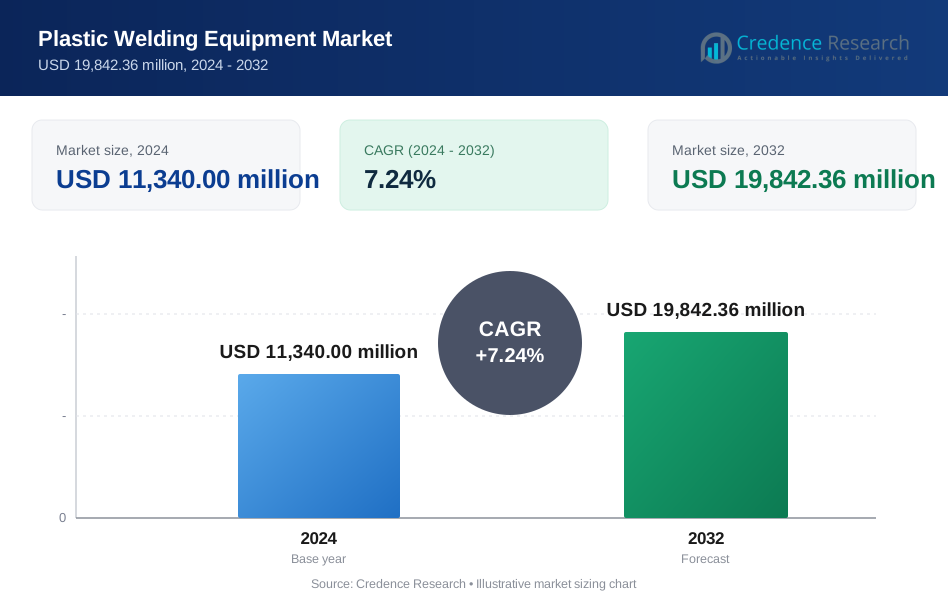
Global Plastic Welding Equipment Market size was valued at USD 11,340.00 million in 2024 and is anticipated to reach USD 19,842.36 million by 2032, at a CAGR of 7.24% during the forecast period (2024-2032).
The global plastic welding equipment market is driven by the growing demand for durable, lightweight, and cost-effective plastic products across various industries, including automotive, electronics, and packaging. The shift toward electric vehicles and the increasing use of thermoplastics in vehicle manufacturing support the market's growth. Additionally, advancements in automation and the integration of robotics in welding processes enhance productivity and precision, further fueling demand. Stringent regulations promoting eco-friendly manufacturing and recycling practices also encourage the adoption of plastic welding techniques. Market trends highlight a rising preference for ultrasonic and laser welding technologies due to their energy efficiency and high-speed operation. Moreover, the growing focus on customized welding solutions and the emergence of Industry 4.0 technologies are reshaping the market landscape, enabling real-time monitoring and improved quality control. Collectively, these drivers and trends indicate a robust growth trajectory for the plastic welding equipment market in the coming years.
The global plastic welding equipment market is characterized by significant demand across key regions, with North America, Europe, and Asia-Pacific leading the way. North America benefits from a strong manufacturing base, particularly in automotive and medical devices, driving demand for high-precision welding systems. Europe is known for its advanced automotive and packaging industries, where stringent quality standards fuel the adoption of plastic welding technologies. Meanwhile, Asia-Pacific is witnessing rapid growth, driven by the expansion of manufacturing capabilities in countries like China, India, and Japan. Leading players in the market include Branson Ultrasonics Corporation, Leister Technologies AG, and Dukane Corporation, who offer innovative solutions such as ultrasonic and laser welding systems. Other key players, such as Emerson Electric Co. and Herrmann Ultraschalltechnik GmbH, continue to contribute to advancements in automation and process efficiency, strengthening the market's competitive landscape globally.
Market Insights
- The global plastic welding equipment market was valued at USD 11,340.00 million in 2024 and is projected to reach USD 19,842.36 million by 2032, growing at a CAGR of 7.24% from 2024 to 2032.
- Increasing demand for lightweight materials in automotive, medical, and packaging industries is driving market growth.
- The trend towards automation and the integration of Industry 4.0 technologies is enhancing the efficiency and precision of plastic welding processes.
- Rising environmental concerns and demand for sustainable manufacturing solutions are pushing the adoption of advanced welding systems.
- Market restraints include high initial investment and maintenance costs of advanced plastic welding equipment.
- Competitive analysis reveals key players like Branson Ultrasonics, Leister Technologies, and Dukane Corporation leading innovation and market share.
- The Asia-Pacific region is expected to experience the fastest growth due to rapid industrialization, particularly in automotive and electronics.
Report Scope
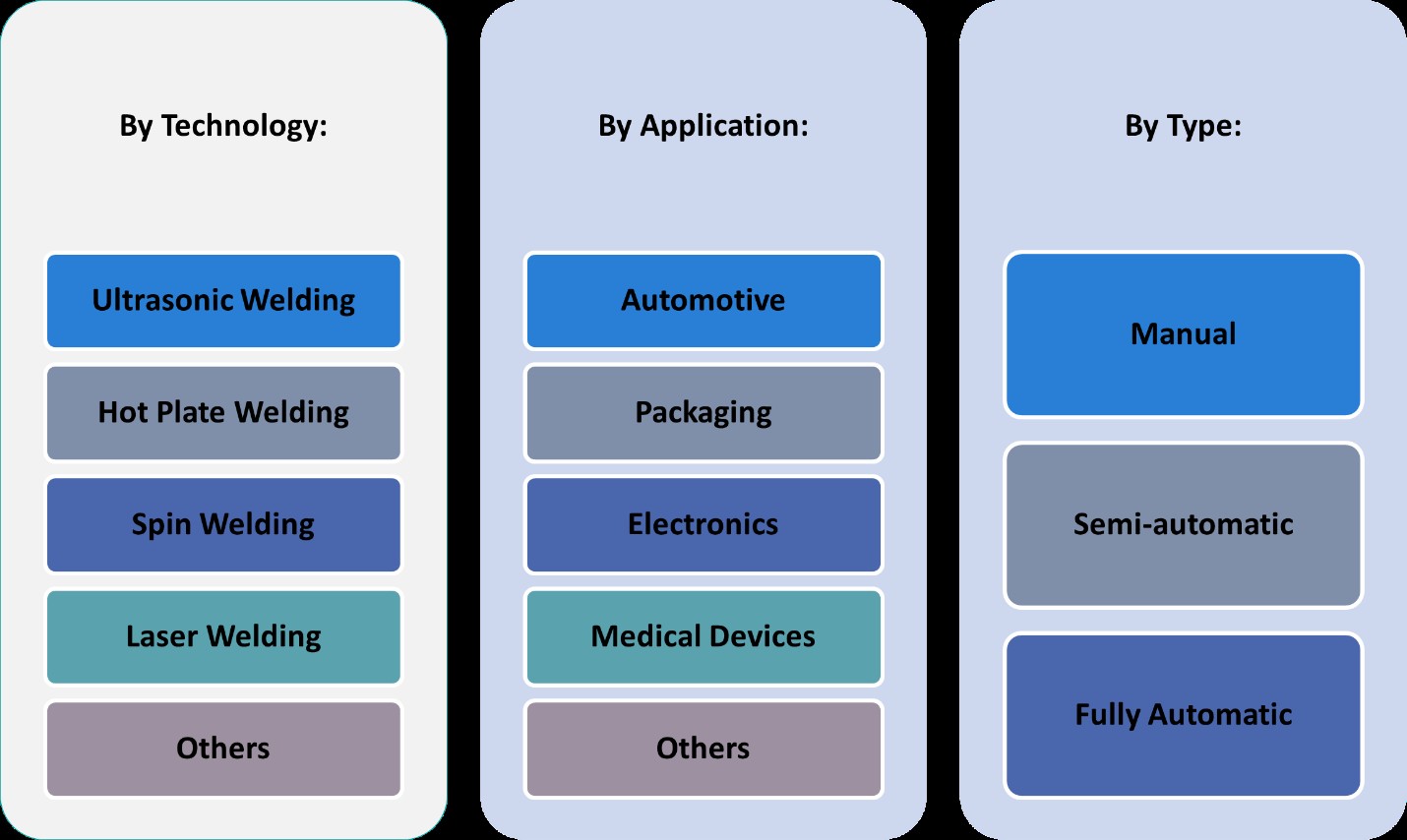
This report segments the Global Plastic Welding Equipment Market as follows:
Market Drivers
Growing Demand from Automotive and Transportation Industries
The expanding automotive and transportation sectors play a critical role in driving the global plastic welding equipment market. The increasing shift toward lightweight vehicles to improve fuel efficiency and meet stringent emission regulations has prompted automakers to adopt high-performance plastics. These materials are extensively used in manufacturing fuel tanks, bumpers, dashboards, and fluid reservoirs, which require reliable and seamless welding solutions. Plastic welding equipment ensures strong, leak-proof joints and enhances the durability of automotive components. Moreover, the growing production and sales of electric vehicles (EVs), which use plastics for battery enclosures and electronic housings, further boost demand for advanced welding technologies. As manufacturers seek cost-effective and high-precision joining techniques, the automotive industry’s reliance on plastic welding equipment is expected to grow steadily.
Environmental Regulations and Focus on Sustainable Manufacturing
Stringent environmental regulations and the global push toward sustainable manufacturing practices are accelerating the adoption of plastic welding equipment. For instance, reports from environmental agencies highlight the advantages of plastic welding over adhesives or mechanical fasteners, as it produces minimal waste and avoids harmful chemicals. Furthermore, the ability to repair and recycle plastic components through welding aligns with circular economy goals and waste reduction initiatives. Industries are increasingly seeking sustainable alternatives that comply with environmental standards while maintaining product quality and performance. As a result, companies are investing in energy-efficient and low-emission plastic welding technologies to reduce their environmental footprint and enhance regulatory compliance. This shift toward greener manufacturing further reinforces the market’s long-term growth potential.
Rising Adoption of Automation and Industry 4.0 Technologies
Automation has become a significant driver in enhancing productivity and consistency across manufacturing operations, including plastic welding. For instance, studies conducted by manufacturing technology organizations highlight the integration of robotic arms, programmable logic controllers (PLCs), and computer numerical control (CNC) systems into welding processes to achieve high precision and reduced cycle times. Additionally, Industry 4.0 technologies such as artificial intelligence (AI), the Internet of Things (IoT), and real-time monitoring are transforming the plastic welding landscape. These innovations enable predictive maintenance, process optimization, and remote quality control, leading to reduced operational costs and improved product quality. As manufacturers prioritize smart manufacturing and digital transformation, the demand for technologically advanced plastic welding equipment continues to surge, particularly in high-volume production environments.
Expanding Applications in Packaging and Consumer Goods
The packaging industry is another significant contributor to the growth of the plastic welding equipment market. With the rising consumption of packaged food, beverages, pharmaceuticals, and personal care products, manufacturers are increasingly turning to plastic materials for their durability, cost-effectiveness, and flexibility. Plastic welding technologies, such as ultrasonic and hot plate welding, are widely used to seal plastic packaging components securely and efficiently. In the consumer goods segment, plastic welding equipment is essential for assembling products like toys, appliances, and electronic devices, where aesthetic appeal and structural integrity are crucial. As consumer preferences evolve and demand for high-quality, precision-assembled plastic products increases, the application scope for plastic welding equipment continues to widen.
Market Trends
Shift Toward Advanced Welding Technologies
One of the most prominent trends shaping the global plastic welding equipment market is the increasing adoption of advanced welding technologies such as laser welding, ultrasonic welding, and vibration welding. For instance, reports from manufacturing technology organizations highlight the growing use of laser welding in industries like medical devices and electronics, where complex geometries and micro-welding applications are prevalent. These techniques offer high precision, cleaner seams, minimal material distortion, and faster processing times compared to traditional methods. Ultrasonic welding continues to dominate applications involving thin thermoplastics, especially in packaging and automotive interior components. As industries prioritize quality and efficiency, manufacturers are investing in cutting-edge welding solutions that offer greater control and repeatability.
Integration of Smart Manufacturing and IoT Capabilities
The growing influence of Industry 4.0 is driving the integration of smart manufacturing technologies within plastic welding operations. For instance, studies conducted by Industry 4.0 initiatives highlight the incorporation of sensors, real-time monitoring systems, and data analytics in welding equipment to enable predictive maintenance and process optimization. These IoT-enabled solutions help identify anomalies early in the process, minimize downtime, and improve product consistency. Additionally, connectivity features support centralized control systems that enhance traceability and compliance with regulatory standards. This trend is particularly significant in high-precision industries such as automotive, aerospace, and medical devices, where process validation and documentation are critical.
Rising Focus on Customization and Modular Equipment
As end-use industries demand more versatile and application-specific welding solutions, there is a noticeable shift toward modular and customizable plastic welding equipment. Manufacturers are offering equipment that can be easily configured for different welding methods, materials, and production volumes. This flexibility allows businesses to adapt quickly to changing product designs and production requirements. Moreover, modular systems are increasingly preferred in sectors where rapid tooling changes and scalability are essential, such as consumer electronics and packaging. The trend toward customization not only enhances operational efficiency but also improves return on investment by extending the usability of equipment across multiple applications.
Growth in Emerging Economies and Localized Production
The expansion of manufacturing capabilities in emerging economies such as India, China, Brazil, and Southeast Asian countries is contributing to increased demand for plastic welding equipment. These regions are witnessing rapid industrialization, supported by government initiatives to boost domestic manufacturing and reduce reliance on imports. As global companies establish production facilities in these countries to tap into cost advantages and local market potential, the need for reliable and efficient plastic welding solutions grows. Additionally, localized production is driving demand for compact, energy-efficient, and easy-to-maintain equipment suitable for small- and medium-sized enterprises. This geographical shift is expected to influence product development strategies and distribution networks across the plastic welding industry.
Market Challenges Analysis
High Initial Investment and Maintenance Costs
One of the primary challenges in the global plastic welding equipment market is the high initial cost associated with purchasing advanced welding systems. Sophisticated equipment such as laser and ultrasonic welding machines often require significant capital investment, which can be a barrier for small- and medium-sized enterprises (SMEs). Additionally, the integration of automation, robotics, and IoT-enabled components increases the complexity and cost of these systems. Beyond the upfront expenditure, ongoing maintenance, operator training, and the need for skilled technicians further add to the operational burden. In price-sensitive markets, this challenge can hinder adoption, especially where low-cost alternatives or traditional joining methods are still widely used. As a result, many manufacturers may delay technology upgrades or limit implementation to specific high-precision applications, slowing down overall market penetration.
Material Compatibility and Technical Limitations
Another key challenge impacting the plastic welding equipment market is the variability in material compatibility and technical limitations of certain welding techniques. Not all plastic types can be effectively joined using the same welding method, and the presence of additives, reinforcements, or layered structures can complicate the welding process. For instance, welding dissimilar plastics or composites often leads to weak joints or requires additional processing steps, limiting efficiency. Furthermore, achieving uniform weld strength across complex or irregular geometries remains a technical hurdle for many equipment types. These limitations not only impact product quality but also constrain the range of applications where plastic welding can be reliably deployed. Manufacturers must often invest in extensive testing and process optimization to ensure welding compatibility, which can increase production time and cost. Overcoming these challenges will require continued innovation in welding technologies and material science to broaden the applicability and reliability of plastic welding equipment.
Market Opportunities
The global plastic welding equipment market presents significant opportunities driven by the rapid expansion of key end-use industries and technological innovation. The rising demand for electric vehicles (EVs), medical devices, and consumer electronics is creating a strong need for precise, high-performance plastic joining techniques. As EV manufacturers increasingly use lightweight thermoplastics to improve vehicle efficiency and battery protection, the demand for advanced welding technologies is expected to grow substantially. Similarly, the healthcare sector is adopting plastic welding for assembling components in diagnostic devices, fluid containers, and surgical tools, where sterile, airtight seals are critical. These applications offer manufacturers opportunities to develop specialized, application-specific equipment tailored to stringent industry standards. Additionally, increasing government support for domestic manufacturing across emerging economies is encouraging localized production, opening up new markets for cost-effective and compact plastic welding solutions.
Moreover, the growing emphasis on sustainability and recyclability presents another avenue for market expansion. As industries shift toward eco-friendly manufacturing practices, plastic welding stands out as a cleaner and more efficient alternative to traditional bonding methods, offering minimal waste and energy consumption. Manufacturers can capitalize on this trend by developing energy-efficient, modular welding systems that support green manufacturing initiatives and align with global regulatory frameworks. Furthermore, the integration of smart technologies such as AI, machine learning, and remote diagnostics in welding systems allows vendors to offer enhanced value propositions through predictive maintenance and real-time quality control. These advancements not only improve operational efficiency but also make the equipment more attractive to industries focused on precision and compliance. As the need for automation, customization, and sustainability continues to rise, companies that invest in innovation and strategic expansion into underserved regions will be well-positioned to capture emerging growth opportunities in the global plastic welding equipment market.
Market Segmentation Analysis:
By Type:
The global plastic welding equipment market, based on type, is segmented into manual, semi-automatic, and fully automatic systems. Manual welding equipment continues to serve industries requiring low-cost, labor-intensive solutions, particularly in small-scale applications and maintenance operations. However, with growing demand for efficiency and consistency, semi-automatic machines are gaining significant traction. These systems offer a balance between automation and control, making them ideal for mid-volume production environments. On the other hand, fully automatic plastic welding equipment is witnessing the fastest growth, driven by advancements in robotics, artificial intelligence, and Industry 4.0 integration. These systems enable high-speed, precise, and repeatable welding processes with minimal human intervention, thereby reducing error rates and improving production throughput. Industries such as automotive, electronics, and medical devices are leading adopters of fully automated systems to meet stringent quality and regulatory standards. As the need for cost optimization and operational excellence increases, the adoption of semi- and fully automatic systems is expected to surge across various end-use sectors.
By Application:
By application, the market is categorized into electronics, packaging, automotive, medical devices, and others. The automotive industry holds a substantial share due to the rising use of thermoplastics for lightweighting and enhanced fuel efficiency. Plastic welding is extensively used in assembling fuel tanks, bumpers, and interior components. In the electronics sector, precise welding is critical for compact components and delicate circuitry, where ultrasonic and laser welding techniques are preferred. The packaging industry also represents a significant market, driven by the need for durable, leak-proof seals in consumer and industrial packaging solutions. Meanwhile, the medical devices segment is growing steadily, supported by the rising demand for sterile, reliable joints in items like IV bags, filters, and diagnostic instruments. Regulatory compliance and the demand for high-quality, contamination-free welds are accelerating innovation in this space. Other applications, including textiles and consumer goods, are also contributing to market growth, benefiting from customized welding solutions tailored to specific material and design needs.
Segments:
Based on Type:
- Manual
- Semi-automatic
- Fully Automatic
Based on Application:
- Electronics
- Packaging
- Automotive
- Medical Devices
- Others
Based on Technology:
- Ultrasonic Welding
- Hot Plate Welding
- Spin Welding
- Laser Welding
- Others
Based on the Geography:
- North America
- U.S.
- Canada
- Mexico
- Europe
- UK
- France
- Germany
- Italy
- Spain
- Russia
- Belgium
- Netherlands
- Austria
- Sweden
- Poland
- Denmark
- Switzerland
- Rest of Europe
- Asia Pacific
- China
- Japan
- South Korea
- India
- Australia
- Thailand
- Indonesia
- Vietnam
- Malaysia
- Philippines
- Taiwan
- Rest of Asia Pacific
- Latin America
- Brazil
- Argentina
- Peru
- Chile
- Colombia
- Rest of Latin America
- Middle East
- UAE
- KSA
- Israel
- Turkey
- Iran
- Rest of Middle East
- Africa
- Egypt
- Nigeria
- Algeria
- Morocco
- Rest of Africa
Regional Analysis
North America
The North American market for plastic welding equipment holds a significant share, accounting for approximately 30% of the global market in 2024. This is driven by the region's strong manufacturing base, particularly in the automotive, aerospace, and electronics industries. The high adoption of advanced welding technologies, such as laser and ultrasonic welding, further bolsters growth. The U.S. leads this region, supported by robust demand for high-quality and precision welding in the automotive and medical sectors. With increasing investments in electric vehicles and sustainable manufacturing, North America is expected to maintain its dominant position, further expanding its market share throughout the forecast period.
Europe
In Europe, the market share for plastic welding equipment is projected to be around 25% in 2024. The region's well-established automotive and packaging industries, along with stringent environmental regulations, are key factors driving the adoption of advanced plastic welding technologies. Germany, France, and the UK are the primary markets within Europe, with manufacturers focusing on high-precision welding systems for automotive interiors, medical devices, and consumer electronics. The growing trend toward automation and Industry 4.0 is anticipated to propel further growth in Europe, especially with the rising demand for fully automatic plastic welding systems in manufacturing plants.
Asia-Pacific (APAC)
The Asia-Pacific (APAC) region is expected to experience the highest growth rate, with a projected market share of 35% by 2032. The rapid industrialization and expansion of manufacturing capabilities in countries such as China, India, Japan, and South Korea are fueling demand for plastic welding equipment. The automotive and packaging industries in this region are particularly prominent, with significant investments in lightweighting and energy-efficient solutions. Additionally, the increasing focus on sustainable practices and local production in emerging economies offers vast opportunities for plastic welding equipment manufacturers. APAC’s market growth is supported by both the demand for low-cost solutions and the adoption of advanced welding technologies for high-end applications.
Rest of the World (RoW)
In the Rest of the World (RoW), which includes regions such as Latin America, the Middle East, and Africa, the plastic welding equipment market holds a smaller share, estimated at 10% in 2024. However, this region is showing steady growth, particularly in industries such as packaging, automotive, and electronics, which are seeing increased investments and infrastructure development. The Middle East and Africa, with their growing manufacturing sectors, offer opportunities for plastic welding solutions in industries like oil and gas, consumer goods, and medical devices. As these regions continue to industrialize and modernize, the market for plastic welding equipment is expected to expand, driven by demand for more efficient and automated solutions.
Key Player Analysis
- Branson Ultrasonics Corporation
- Leister Technologies AG
- Dukane Corporation
- Emerson Electric Co.
- Herrmann Ultraschalltechnik GmbH & Co. KG
- Bielomatik Leuze GmbH + Co. KG
- Frimo Group GmbH
- Seelye Acquisitions, Inc.
- Munsch Plastic Welding Technology
- Ritmo S.p.A
Competitive Analysis
The global plastic welding equipment market is highly competitive, with several leading players driving innovation and market growth. Branson Ultrasonics Corporation, Leister Technologies AG, Dukane Corporation, Emerson Electric Co., Herrmann Ultraschalltechnik GmbH & Co. KG, Bielomatik Leuze GmbH + Co. KG, Frimo Group GmbH, Seelye Acquisitions, Inc., Munsch Plastic Welding Technology, and Ritmo S.p.A are prominent contributors to the market’s development. These companies focus on delivering advanced welding technologies, including ultrasonic, laser, and hot plate welding systems, catering to a wide range of industries such as automotive, electronics, packaging, and medical devices. Companies are increasingly adopting Industry 4.0 technologies to integrate automation, robotics, and artificial intelligence into welding systems, enhancing production efficiency and reducing human error. Furthermore, the market is witnessing the introduction of eco-friendly solutions that meet growing environmental concerns. Manufacturers are focusing on reducing energy consumption, improving sustainability, and complying with stringent environmental regulations. Strategic partnerships, mergers, and acquisitions are also key strategies adopted by companies to expand their product offerings and strengthen their global presence. To maintain market share, companies are targeting regional expansions, with a strong emphasis on emerging markets in Asia-Pacific and other developing regions. This enables them to tap into new growth opportunities driven by rapid industrialization and increasing manufacturing demand in these areas.
Recent Developments
- In March 2025, Leister transferred its laser plastic welding business to Hymson Novolas AG, a subsidiary of Hymson Laser Technology Group Co. Ltd. The transition ensures continuity and further development of existing product lines, with a new Laser Technology Center established in Switzerland. Leister will now focus more on its core competencies: plastic welding (hot air, infrared) and industrial process heat.
- In February 2025, Herrmann continues to set industry standards with its ultrasonic welding solutions, particularly for medical devices and sensitive components. The company emphasizes individualized process development, intelligent process control, and digital quality monitoring for reproducible, high-strength welds. Herrmann will showcase new applications and integration options at K 2025, focusing on automation and sustainability in medical and packaging industries.
- In January 2025, Dukane highlighted its patented Q-Factor, Melt-Match®, Low Amplitude Preheat, and Ultra-High Frequency (260–400 Hz) vibration welding technologies, emphasizing their leadership in process control and diagnostics.
- In May 2024, Emerson launched the Branson™ GLX-1 Laser Welder, designed for the automated assembly of small, intricate plastic parts. The GLX-1 features a compact, modular design suitable for cleanroom environments, advanced servo-based actuation, and the ability to “un-weld” plastics for closed-loop recycling. It uses Simultaneous Through-Transmission Infrared® (STTlr) laser-welding technology for high efficiency, weld strength, and aesthetics. Enhanced connectivity, security, and data collection features support Industry 4.0 integration.
Market Concentration & Characteristics
The global plastic welding equipment market exhibits moderate to high concentration, with a few dominant players holding a significant market share. These companies are key innovators, driving advancements in welding technologies such as ultrasonic, laser, and hot plate welding. The market is characterized by the continuous introduction of high-performance, automated, and energy-efficient solutions aimed at meeting the evolving demands of various industries, including automotive, packaging, electronics, and medical devices. Additionally, manufacturers are increasingly focusing on providing eco-friendly solutions to address growing environmental concerns and regulatory pressures. The market is also witnessing a trend toward customization, as companies develop tailored plastic welding equipment for specific applications. Another notable characteristic is the shift toward automation and integration with Industry 4.0 technologies, which enhances productivity, reduces human error, and lowers operational costs. Overall, the competitive environment is shaped by innovation, strategic partnerships, and regional expansion.
Report Coverage
The research report offers an in-depth analysis based on Type, Application, Technology and Geography. It details leading market players, providing an overview of their business, product offerings, investments, revenue streams, and key applications. Additionally, the report includes insights into the competitive environment, SWOT analysis, current market trends, as well as the primary drivers and constraints. Furthermore, it discusses various factors that have driven market expansion in recent years. The report also explores market dynamics, regulatory scenarios, and technological advancements that are shaping the industry. It assesses the impact of external factors and global economic changes on market growth. Lastly, it provides strategic recommendations for new entrants and established companies to navigate the complexities of the market.
Future Outlook
- The demand for plastic welding equipment is expected to grow significantly due to increased industrial applications in sectors like automotive, construction, and packaging.
- Advancements in technology will lead to more efficient and cost-effective plastic welding systems, offering improved precision and faster production times.
- The growing emphasis on sustainable and eco-friendly manufacturing processes will boost the adoption of plastic welding equipment, as it allows for the recycling and reuse of plastics.
- The rising trend of automation in manufacturing will drive the demand for robotic and automated plastic welding systems.
- Increased investments in research and development will result in the creation of innovative plastic welding solutions tailored to meet specific industry needs.
- The expanding use of plastics in medical and electronics industries will further fuel the need for high-quality, reliable plastic welding equipment.
- As industries adopt Industry 4.0 technologies, smart plastic welding systems equipped with sensors and data analytics will become more common.
- Rising labor costs and the need for more efficient production methods will accelerate the shift towards automated plastic welding solutions.
- Regulatory pressures on plastic waste management and recycling will encourage the adoption of plastic welding technology in the repair and refurbishment of plastic products.
- The growing global manufacturing base, particularly in emerging markets, will create significant opportunities for the expansion of plastic welding equipment in these regions.
Request a Free Sample
Fill in your details and we'll send you a free sample report.
- Sample data tables & charts
- Research methodology
Need a Custom Version of This Report?
Tailor the scope, geography, or segments to your exact requirements.
- Custom geography or segment scope
- Direct access to our analyst team
Frequently Asked Questions
What is the current size of the Global Plastic Welding Equipment?
What factors are driving the growth of the Global Plastic Welding Equipment?
What are the key segments within the Global Plastic Welding Equipment?
What are some challenges faced by the Global Plastic Welding Equipment?
Who are the major players in the Global Plastic Welding Equipment?
Table of Content
Chapter 1. Report Introduction
- 1.1 Report Description & Purpose
- 1.1.1 Report Title & Market Definition
- 1.1.2 Unique Selling Propositions (USP) & Key Differentiators
- 1.1.3 Value Proposition for Stakeholders
- 1.2 Research Objectives
- 1.2.1 Market Sizing Objectives (Volume & Revenue)
- 1.2.2 Segmentation Objectives
- 1.2.3 Competitive Intelligence Objectives
- 1.2.4 Forecast & Scenario Objectives
- 1.3 Report Scope
- 1.3.1 Plastic Welding Equipment Scope – Types & Subtypes Covered
- 1.3.2 Geographic Scope – Regions & Countries Covered
- 1.3.3 Historical Period, Base Year & Forecast Period (2024; forecast to 2032)
- 1.3.4 Inclusions & Exclusions
- 1.4 HS Code & Classification Framework
- 1.5 Currency, Units & Pricing Basis
- 1.6 Target Stakeholders
- 1.7 Limitations & Assumptions
Chapter 2. Executive Summary
- 2.1 Global Plastic Welding Equipment Market Snapshot
- 2.1.1 Market Size – Historical (2024) & Forecast (2024-2032) (2024: USD 11,340.00 million → 2032: USD 19,842.36 million)
- 2.1.2 Volume & Revenue – Global Totals
- 2.1.3 Key Market Highlights – Top Five Facts
- 2.2 Plastic Welding Equipment Market Segmentation Snapshot
- 2.2.1 Market Split by Region – 2024 vs. 2032
- 2.3 Competitive Snapshot
- 2.3.1 Top 10 Players by Revenue Share – 2024
- 2.3.2 Top 10 Players by Volume Share – 2024
- 2.3.3 Recent Strategic Developments (18-Month Summary)
- 2.4 Key Investment Highlights & Strategic Conclusions
Chapter 3. Plastic Welding Equipment Market Dynamics & Industry Analysis
- 3.1 Market Overview & Context
- 3.1.1 Plastic Welding Equipment Market Position in the Broader Automotive Value Chain
- 3.1.2 OEM vs. Replacement Market Dynamics
- 3.1.3 Market Maturity & Development Stage by Region
- 3.2 Plastic Welding Equipment Market Drivers
- 3.3 Plastic Welding Equipment Market Restraints & Challenges
- 3.4 Plastic Welding Equipment Market Opportunities
- 3.5 Porter's Five Forces Analysis
- 3.5.1 Threat of New Entrants
- 3.5.2 Bargaining Power of Suppliers
- 3.5.3 Bargaining Power of Buyers
- 3.5.4 Threat of Substitutes
- 3.5.5 Competitive Rivalry – Intensity Assessment
- 3.6 Plastic Welding Equipment Value Chain Analysis
- 3.6.1 Upstream – Raw Material/Input Suppliers
- 3.6.1.1 Raw Material/Input 1
- 3.6.1.2 Raw Material/Input 2
- 3.6.1.3 Raw Material/Input 3
- 3.6.2 Midstream – Production/Manufacturing/Service Delivery
- 3.6.2.1 Production/Process Overview
- 3.6.2.2 Key Facility Locations & Capacity by Manufacturer
- 3.6.3 Downstream – Distribution & End Consumer
- 3.6.3.1 Primary Channel – B2B/OEM
- 3.6.3.2 Secondary Channels – Dealer, Retail, Online, Direct
- 3.6.4 Value Chain Profitability Analysis
- 3.6.1 Upstream – Raw Material/Input Suppliers
- 3.7 PESTEL Analysis
- 3.7.1 Political Factors
- 3.7.2 Economic Factors
- 3.7.3 Social Factors
- 3.7.4 Technological Factors
- 3.7.5 Environmental Factors
- 3.7.6 Legal Factors
- 3.8 Plastic Welding Equipment Supply Chain Analysis
- 3.8.1 Raw Material/Input Supply Risk Assessment
- 3.8.2 Manufacturing Concentration Risk (Geographic Exposure)
- 3.8.3 Trade Disruption Impact Analysis
- 3.9 Regulatory & Policy Landscape
Note: The regulatory and policy landscape section covers regulations based on their applicability to the market, Plastic Welding Equipment category, geography, and scope of the study. Only regulatory frameworks with a material impact on operations, compliance, trade, sustainability, or market access are analyzed in detail.
Chapter 4. Key Investment Pockets & Opportunity Analysis
- 4.1 Plastic Welding Equipment Market Attractiveness Analysis
- 4.1.1 By Region – Investment Attractiveness Matrix (Volume × CAGR)
- 4.2 Absolute Revenue Growth Opportunity
- 4.2.1 By Region – Absolute USD Growth Through 2032
- 4.3 Incremental Volume Opportunity
- 4.3.1 By Region – Incremental Volume Through 2032
- 4.3.2 Segment – Incremental Volume
- 4.4 Emerging Submarket Opportunity Deep Dive (Subject to Applicability)
- 4.5 Emerging Market Opportunity Scorecards
- 4.5.1 United States
- 4.5.2 Europe
- 4.5.3 Asia
- 4.5.4 Middle East & Africa
Note: Emerging Market Opportunity Scorecards will be included based on relevance and strategic importance. Regions listed are indicative and may vary depending on data availability and market dynamics.
Chapter 5. Plastic Welding Equipment Import-Export Analysis & Trade Flows
- 5.1 Global Trade Overview
- 5.1.1 Global Export Value by Country (2024)
- 5.1.2 Global Export Volume by Country (2024)
- 5.1.3 Global Import Value by Country (2024)
- 5.1.4 Global Import Volume by Country (2024)
- 5.1.5 Net Trade Balance by Country (2024)
- 5.2 Export Analysis – Segment
- 5.2.1 Type 1 (HS Code)
- 5.2.2 Type 2 (HS Code)
- 5.2.3 Type 3 (HS Code)
- 5.2.4 Type 4 (HS Code)
- 5.2.5 Type 5 (HS Code)
- 5.3 Import Analysis – Segment
- 5.3.1 Type 1 (HS Code)
- 5.3.2 Type 2 (HS Code)
- 5.3.3 Type 3 (HS Code)
- 5.3.4 Type 4 (HS Code)
- 5.3.5 Type 5 (HS Code)
- 5.4 Average Unit Trade Prices
- 5.4.1 Average Export Price – Segment & Country
- 5.4.2 Average Import Price – Segment & Source Country
- 5.4.3 Price Trends (2024)
- 5.5 Key Trade Route Analysis
- 5.5.1 Trade Route 1
- 5.5.2 Trade Route 2
- 5.5.3 Trade Route 3
- 5.5.4 Trade Route 4
- 5.5.5 Trade Route 5
- 5.6 Trade Policy Impact Assessment
- 5.6.1 US Anti-Dumping & Section 301 Tariffs
- 5.6.2 EU Customs Union Impact
- 5.6.3 Major Free Trade Agreements
- 5.6.4 USMCA Rules of Origin
Note: Trade policy analysis will be included only where relevant to the Plastic Welding Equipment market.
Chapter 6. Competitive Landscape & Company Benchmarking
- 6.1 Plastic Welding Equipment Market Concentration & Structure
- 6.1.1 Herfindahl-Hirschman Index (HHI) – vs. 2024
- 6.1.2 Tier 1, Tier 2 & Tier 3 Market Structure
- 6.1.3 Global, Regional & Local Player Dynamics
- 6.2 Plastic Welding Equipment Market Share Analysis – 2024
- 6.2.1 Global Revenue Share by Company
- 6.2.2 Global Volume Share by Company
- 6.2.3 Regional Revenue Share
- 6.2.4 Market Share Evolution ( vs. 2024)
- 6.2.5 OEM Segment Share by Company
- 6.2.6 Replacement Segment Share by Company
- 6.3 Production/Delivery Capacity & Facility Analysis
- 6.3.1 Global Installed Capacity
- 6.3.2 Capacity Utilization Rates
- 6.3.3 Production/Output Volume
- 6.3.4 Facility Locations & Capacity Map
- 6.3.5 Planned Capacity Additions
- 6.4 Plastic Welding Equipment Competitive Benchmarking Matrix
- 6.4.1 Revenue, Volume, CAGR & Profitability Comparison
- 6.4.2 Channel Revenue Mix
- 6.4.3 Geographic Revenue Exposure
- 6.4.4 R&D Intensity
- 6.4.5 Sustainability Maturity
- 6.5 Strategic Developments in Plastic Welding Equipment (Last 24 Months)
- 6.5.1 Mergers, Acquisitions & Divestments
- 6.5.2 New Plastic Welding Equipment Launches
- 6.5.3 Facility Expansions
- 6.5.4 Strategic Alliances, Joint Ventures & Partnerships
- 6.5.5 Distribution Expansion & Market Entry
- 6.5.6 Sustainability & ESG Initiatives
- 6.6 Competitive Strategy Mapping
- 6.6.1 Leader, Challenger, Follower & Niche Classification
- 6.6.2 Pricing Strategy Comparison
- 6.6.3 Channel Strategy Matrix
Note: Strategic developments are included based on their materiality and the availability of reliable information.
Chapter 7. Global Plastic Welding Equipment Market – By Distribution Channel
- 7.1 Segment Overview
- 7.1.1 Volume & Revenue Split by Channel (2024 & 2032)
- 7.1.2 Channel Mix Evolution (2024-2032)
Chapter 8. Regional Market Analysis – Global Overview
- 8.1 Global Regional Overview
- 8.1.1 Regional Volume Share
- 8.1.2 Regional Revenue Share
- 8.1.3 Regional Volume by Region
- 8.1.4 Regional Revenue by Region
- 8.1.5 Regional Forecast Through 2032
- 8.2 Cross-Regional Segment Analysis
- 8.2.1 By Distribution Channel
- 8.2.2 By Brand/Price Tier
Chapter 9. North America Plastic Welding Equipment Market
- 9.1 United States
- 9.2 Canada
- 9.3 Mexico
Chapter 10. Europe Plastic Welding Equipment Market
- 10.1 Germany
- 10.2 France
- 10.3 Italy
- 10.4 United Kingdom
- 10.5 Spain
- 10.6 Poland
- 10.7 Russia
- 10.8 Netherlands
- 10.9 Belgium
- 10.10 Sweden
- 10.11 Denmark
- 10.12 Norway
- 10.13 Rest of Europe
Chapter 11. Asia Pacific Plastic Welding Equipment Market
- 11.1 China
- 11.2 India
- 11.3 Japan
- 11.4 South Korea
- 11.5 Thailand
- 11.6 Indonesia
- 11.7 Vietnam
- 11.8 Malaysia
- 11.9 Australia
- 11.10 Rest of Asia Pacific
Chapter 12. Latin America Plastic Welding Equipment Market
- 12.1 Brazil
- 12.2 Argentina
- 12.3 Colombia
- 12.4 Chile
- 12.5 Rest of Latin America
Chapter 13. Middle East Plastic Welding Equipment Market
- 13.1 Saudi Arabia
- 13.2 United Arab Emirates
- 13.3 Turkey
- 13.4 Israel
- 13.5 Iran
- 13.6 Rest of the Middle East
Chapter 14. Africa Plastic Welding Equipment Market
- 14.1 South Africa
- 14.2 Egypt
- 14.3 Nigeria
- 14.4 Morocco
- 14.5 Rest of Africa
Chapter 15. Plastic Welding Equipment Company Profiles
- 15.1 [Company 01]
- 15.1.1 Company Overview
- 15.1.2 Key Management Personnel
- 15.1.3 Products & Services Portfolio
- 15.1.4 Financial Performance
- 15.1.5 Key Market Focus & Geographic Presence
- 15.1.6 Recent Developments & Strategic Initiatives
Note: The company profile list is preliminary and may change based on research findings, market developments, data availability, and client requirements.
Chapter 16. Appendices
- Appendix A – List of Abbreviations & Acronyms
- Appendix B – Industry Classification Code Reference – Full Series
- Appendix C – Production & Capacity Data Tables
- Appendix D – End-Use & Demand Base Tables
- Appendix E – Consumption & Replacement Rate Assumptions
- Appendix F – ASP Reference Tables
- Appendix G – Manufacturing & Facility Database
- Appendix H – Import-Export Data Tables
- Appendix I – Regulatory Summary Tables
- Appendix J – Primary Research Participant List (Anonymized)
- Appendix K – Primary Research Questionnaire Framework
- Appendix L – Data Sources & Bibliography
- Appendix M – Market Size Divergence & Source Comparison
Chapter 17. Research Methodology
- 17.1 Research Framework & Philosophy
- 17.2 Secondary Research – Sources, Hierarchy & Data Extraction
- 17.3 Data Modeling – Bottom-Up & Top-Down Market Sizing
- 17.4 Primary Research – Stakeholder Framework, LOI & Sample Sizes
- 17.5 Forecast Methodology – Regression, Scenario & Sensitivity Analysis
- 17.6 Quality Control – Four-Layer Validation Framework
- 17.7 Limitations & Standard Assumptions
- 17.8 Disclaimer
