
| REPORT ATTRIBUTE | DETAILS |
|---|---|
| Historical Period | 2020-2023 |
| Base Year | 2024 |
| Forecast Period | 2025-2032 |
| Ru/C Catalyst Market Size 2024 | USD 892.3 million |
| Ru/C Catalyst Market, CAGR | 6.70% |
| Ru/C Catalyst Market Size 2032 | USD 1,499.1 million |
Market Overview
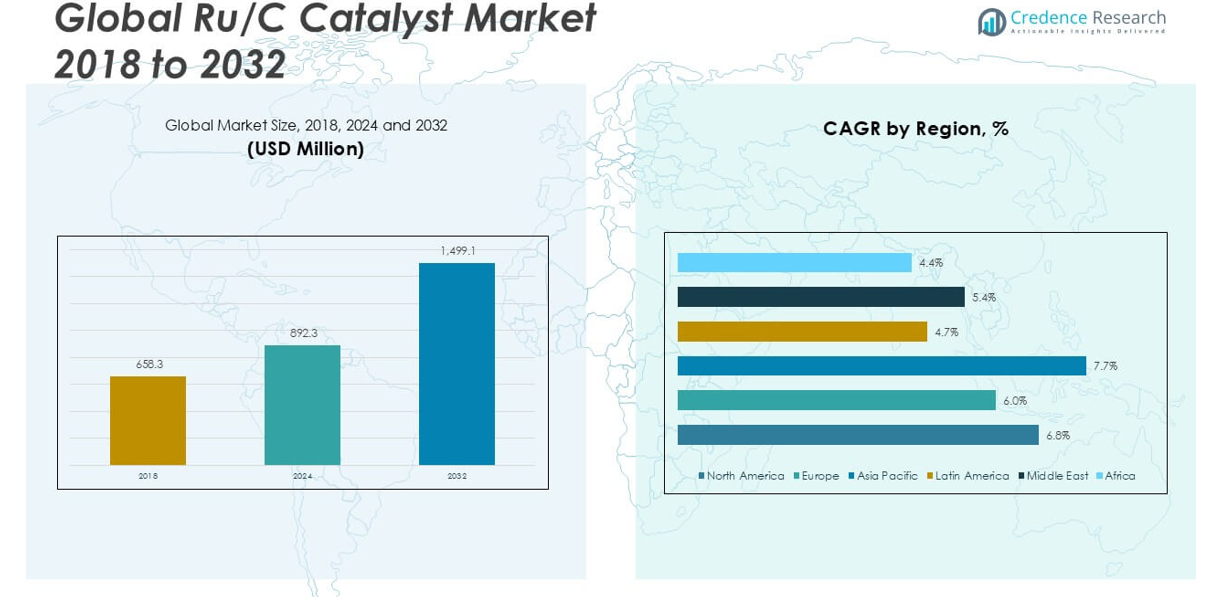
The Ru/C Catalyst market size was valued at USD 658.3 million in 2018, reached USD 892.3 million in 2024, and is anticipated to reach USD 1,499.1 million by 2032, at a CAGR of 6.70% during the forecast period.
The Ru/C Catalyst market is led by prominent companies such as BASF SE, Johnson Matthey, Clariant AG, Evonik Industries AG, Albemarle Corporation, Haldor Topsoe A/S, and Umicore, all recognized for their technological expertise and comprehensive product portfolios. These players consistently invest in research and development to deliver high-performance and sustainable catalytic solutions across key industries. Asia Pacific stands as the leading region, commanding approximately 34% of the global market share in 2024, driven by rapid industrialization and growing demand from chemical and automotive sectors. North America and Europe also hold significant shares, supported by advanced manufacturing capabilities and strong regulatory frameworks.
Market Insights
- The Ru/C Catalyst market reached USD 892.3 million in 2024 and is projected to grow to USD 1,499.1 million by 2032, registering a CAGR of 6.70%.
- Rising demand for advanced catalysts in chemical synthesis and emission control across automotive and aerospace sectors is a primary growth driver.
- Increasing adoption of sustainable catalytic processes and technological advancements, especially in Asia Pacific, are shaping key market trends.
- The market is competitive, with leading players such as BASF SE, Johnson Matthey, and Clariant AG focusing on innovation, while supply constraints and high raw material costs act as restraints.
- Asia Pacific holds the largest regional share at 34% in 2024, followed by North America at 28% and Europe at 25%; the non-homogeneous segment dominates the market by type with a 67% share.
Market Segmentation Analysis:
By Type
In the Ru/C Catalyst market, the Non-Homogeneous segment holds the dominant share, accounting for approximately 67% of the total market. This dominance is driven by the widespread adoption of non-homogeneous catalysts in large-scale industrial processes, particularly in hydrogenation and chemical synthesis applications. These catalysts offer superior stability, ease of separation, and cost-effective regeneration, which appeals to end-users seeking operational efficiency. The growing demand for high-performance catalysts in industrial chemistry continues to propel the adoption of non-homogeneous Ru/C catalysts across various sectors.
- For instance, Johnson Matthey developed a non-homogeneous Ru/C catalyst used in the commercial hydrogenation of 1,000 metric tons of specialty chemicals annually, streamlining production for several major pharmaceutical manufacturers.
By Application
The Automotive segment leads the Ru/C Catalyst market by application, capturing around 45% of the overall market share. This segment benefits from stringent emission standards and the increasing use of advanced catalytic converters in vehicle exhaust systems. Ru/C catalysts are highly effective in promoting cleaner emissions and enhancing fuel efficiency, which has accelerated their integration in automotive manufacturing. The growing focus on sustainable mobility and regulatory compliance continues to support the strong demand for Ru/C catalysts within the automotive sector.
- For instance, BASF SE supplies Ru/C-based emission control catalysts to over 500,000 hybrid vehicles produced by a leading European automaker each year.
Market Overview
Rising Demand for Advanced Catalysts in Chemical Synthesis
The Ru/C Catalyst market is experiencing robust growth due to increased demand for advanced catalysts in chemical synthesis, particularly in hydrogenation and carbon coupling reactions. Industries rely on Ru/C catalysts for their high selectivity, efficiency, and operational stability, which enable cost-effective large-scale production of fine chemicals and pharmaceuticals. As companies aim to improve productivity and reduce process costs, the preference for reliable and high-performance catalysts continues to accelerate market expansion.
- For instance, Evonik Industries AG reported that its Ru/C catalysts have reduced batch processing time by up to 30 hours in the synthesis of certain pharmaceutical intermediates.
Increasing Focus on Green and Sustainable Chemistry
The shift towards sustainable and environmentally friendly chemical processes is a significant driver for the Ru/C Catalyst market. Ru/C catalysts enable cleaner production routes and help minimize hazardous by-products, aligning with global sustainability goals. Government policies and corporate initiatives focused on reducing environmental impact are encouraging adoption, making Ru/C catalysts an essential component in next-generation green chemistry applications.
- For instance, Haldor Topsoe A/S successfully implemented Ru/C catalysts in a biorefinery that converts 50,000 tons of waste biomass annually into biofuels and specialty chemicals.
Expansion of Automotive and Aerospace Industries
Rapid growth in the automotive and aerospace industries is propelling the Ru/C Catalyst market forward. These sectors require efficient emission control and fuel processing technologies, where Ru/C catalysts are widely utilized for their effectiveness in reducing harmful exhaust gases and enhancing energy efficiency. Stricter emission regulations worldwide are driving manufacturers to invest in advanced catalyst solutions, ensuring compliance and supporting sustained market growth.
Key Trend & Opportunity
Technological Innovations in Catalyst Design
Continuous advancements in catalyst design and nanotechnology are opening new avenues in the Ru/C Catalyst market. Innovative approaches to improve catalytic activity, stability, and recyclability are making Ru/C catalysts more attractive for diverse industrial applications. Companies investing in research and development are poised to capture emerging opportunities, especially in fields requiring highly specific and efficient catalytic processes.
- For instance, Albemarle Corporation’s research division patented a new Ru/C catalyst formulation with a particle size under 10 nanometers, doubling the catalyst’s lifecycle in industrial hydrogenation processes.
Growing Adoption in Renewable Energy Applications
The integration of Ru/C catalysts in renewable energy technologies, such as hydrogen fuel production and storage, represents a major trend and opportunity. As clean energy adoption rises, demand for effective catalysts in water splitting and hydrogenation reactions grows. Ru/C catalysts’ ability to facilitate these processes positions them as critical components in the transition towards sustainable energy systems.
- For instance, Sinopec Catalyst Company supplied Ru/C catalysts to a pilot project that achieved the daily production of 2,000 kilograms of hydrogen through water electrolysis.
Key Challenge
High Cost and Limited Raw Material Availability
One of the primary challenges facing the Ru/C Catalyst market is the high cost and limited availability of ruthenium, the essential raw material. Fluctuating prices and supply constraints can impact production costs, making it difficult for manufacturers to maintain competitive pricing. This challenge prompts ongoing research into catalyst efficiency and alternative materials to reduce dependence on scarce resources.
Stringent Environmental and Safety Regulations
Compliance with stringent environmental and safety regulations presents another challenge for Ru/C Catalyst manufacturers. Handling, transportation, and disposal of catalysts require adherence to strict protocols to mitigate environmental risks. The need for compliance increases operational complexity and may result in higher regulatory costs for producers.
Technical Barriers to Widespread Adoption
Technical limitations, such as catalyst deactivation, sensitivity to reaction conditions, and difficulties in large-scale application, can restrict the broader adoption of Ru/C catalysts. Overcoming these barriers requires significant investment in research and development to enhance catalyst performance and durability, which remains a critical challenge for the industry.
Regional Analysis
North America
North America accounted for USD 197.5 million in 2018 and reached USD 249.8 million in 2024, with projections of USD 374.8 million by 2032. Holding an estimated 28% market share in 2024, the region continues to show steady growth with a CAGR of 6.8%. Strong demand from the automotive and chemical industries, coupled with ongoing investments in emission control technologies, fuels market expansion. The presence of major manufacturers and innovation in catalyst technology further support North America’s leading position in the global Ru/C Catalyst market.
Europe
Europe captured USD 174.4 million in 2018 and rose to USD 222.2 million in 2024, projected to reach USD 329.8 million by 2032. Representing about 25% market share in 2024, the region is growing at a CAGR of 6.0%. Stringent environmental regulations and increasing adoption of sustainable catalytic processes are driving market growth across key industries, especially automotive and aerospace. Europe’s established industrial base and focus on green chemistry position it as a key contributor to the Ru/C Catalyst market’s global development.
Asia Pacific
Asia Pacific emerged as the fastest-growing region, with market size rising from USD 184.3 million in 2018 to USD 305.2 million in 2024, and is anticipated to reach USD 599.6 million by 2032. The region commands the largest market share at approximately 34% in 2024 and posts a robust CAGR of 7.7%. Surging industrialization, growing investments in chemical production, and increasing automotive manufacturing underpin market expansion. Rapid economic development and strong demand for advanced catalytic solutions further solidify Asia Pacific’s leadership in the Ru/C Catalyst market.
Latin America
Latin America reported a market size of USD 32.9 million in 2018, increasing to USD 41.9 million in 2024 and projected at USD 82.4 million by 2032. Holding about 5% market share in 2024, the region is advancing at a CAGR of 4.7%. Expansion of local chemical manufacturing and gradual improvements in industrial infrastructure are key factors supporting growth. While the market remains comparatively smaller, increasing investment in cleaner technologies and automotive applications presents emerging opportunities for the Ru/C Catalyst market in Latin America.
Middle East
The Middle East held USD 46.1 million in 2018, reached USD 53.5 million in 2024, and is expected to attain USD 97.4 million by 2032. With a market share of nearly 6% in 2024 and a CAGR of 5.4%, the region benefits from rising demand in petrochemical and industrial sectors. Investments in upgrading production technologies and the push toward more efficient catalytic processes drive growth. The region’s focus on diversifying its industrial base further supports the adoption of Ru/C catalysts.
Africa
Africa’s Ru/C Catalyst market declined from USD 23.0 million in 2018 to USD 19.6 million in 2024 and is projected to decrease further to USD 15.0 million by 2032. Representing less than 3% market share in 2024 and a negative growth outlook with a declining trend, the region faces challenges such as limited industrialization and slower adoption of advanced catalytic solutions. Economic and infrastructural constraints, coupled with low investment in relevant sectors, contribute to the subdued market performance for Ru/C catalysts in Africa.
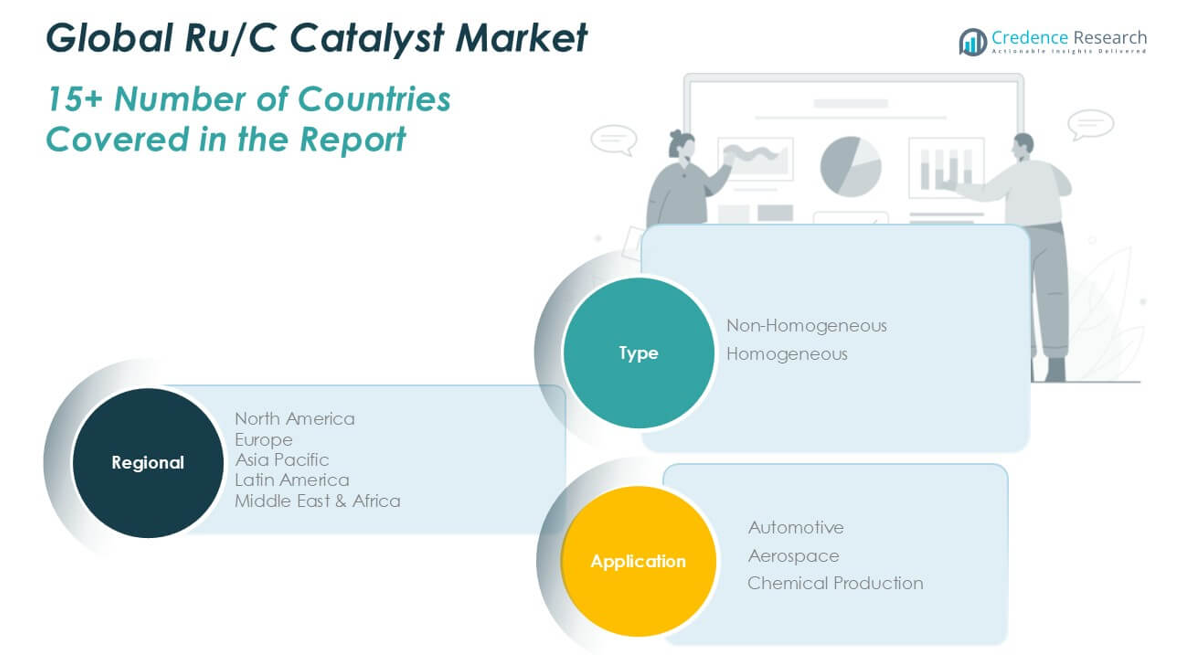
Market Segmentations:
By Type
- Non-Homogeneous
- Homogeneous
By Application
- Automotive
- Aerospace
- Chemical Production
By Geography:
- North America
- U.S.
- Canada
- Mexico
- Europe
- Germany
- France
- U.K.
- Italy
- Spain
- Rest of Europe
- Asia Pacific
- China
- Japan
- India
- South Korea
- South-east Asia
- Rest of Asia Pacific
- Latin America
- Brazil
- Argentina
- Rest of Latin America
- Middle East & Africa
- GCC Countries
- South Africa
- Rest of the Middle East and Africa
Competitive Landscape
The competitive landscape of the Ru/C Catalyst market features a mix of global chemical giants and specialized catalyst manufacturers, each leveraging distinct strengths to capture market share. Key players such as BASF SE, Johnson Matthey, Clariant AG, and Evonik Industries AG maintain strong market positions through extensive product portfolios, advanced R&D capabilities, and robust global distribution networks. Companies like Albemarle Corporation, Haldor Topsoe A/S, and Umicore focus on innovation and process optimization to meet rising industry demands for high-performance and sustainable catalysts. Emerging firms and regional players, including Sinopec Catalyst Company and Catalysts & Chemicals Pvt Ltd, are expanding their presence through cost-effective solutions and tailored product offerings. Strategic initiatives such as mergers, acquisitions, and collaborations are common, enabling firms to strengthen their technological expertise and expand their customer base. Intense competition centers on technological innovation, quality assurance, and the ability to offer customized solutions for evolving application requirements.
Key Player Analysis
- BASF SE
- Johnson Matthey
- Clariant AG
- Evonik Industries AG
- Albemarle Corporation
- Haldor Topsoe A/S
- Umicore
- Sud-Chemie AG
- Sinopec Catalyst Company
- R. Grace & Co.
- Arkema Group
- Tosoh Corporation
- Ingevity Corporation
- Catalysts & Chemicals Pvt Ltd
Recent Developments
- In December 2024, BASF inaugurated a new Catalyst Development and Solids Processing Center in Ludwigshafen, Germany. This facility is designed to accelerate the development and scale-up of innovative catalyst technologies, including those involving ruthenium on carbon (Ru/C) systems. The center enables faster pilot-scale synthesis and transition from laboratory to production, strengthening BASF’s ability to deliver advanced catalyst solutions for industrial applications.
- In 2024, Sinopec Catalyst Company (SCC) made strides in developing sustainable and efficient catalyst technologies for refining and chemical processes, particularly focusing on the advancement of catalysts that produce light aromatics through hydrocracking and aromatic extraction, alongside the initiation of large-scale production for new chemical units, all while prioritizing green development and technological innovation.
Market Concentration & Characteristics
The Ru/C Catalyst Market demonstrates moderate to high market concentration, with a select group of global players such as BASF SE, Johnson Matthey, Clariant AG, and Evonik Industries AG commanding significant shares. It is characterized by high barriers to entry, driven by the technical expertise, capital investment, and advanced research capabilities required to compete effectively. Product differentiation centers on catalytic efficiency, stability, and environmental performance, prompting leading firms to focus on continuous innovation and process optimization. The market favors suppliers with robust global distribution networks and comprehensive product portfolios, enabling them to address complex and evolving customer requirements across industries. It serves specialized segments, with non-homogeneous catalysts capturing the majority share due to their operational efficiency and ease of use in large-scale industrial applications. The market is sensitive to raw material availability and pricing, particularly for ruthenium, which influences strategic sourcing and long-term supply agreements. It also displays regional diversity, with Asia Pacific leading in demand and innovation.
Report Coverage
The research report offers an in-depth analysis based on Type, Application, and Geography. It details leading market players, providing an overview of their business, product offerings, investments, revenue streams, and key applications. Additionally, the report includes insights into the competitive environment, SWOT analysis, current market trends, as well as the primary drivers and constraints. Furthermore, it discusses various factors that have driven market expansion in recent years. The report also explores market dynamics, regulatory scenarios, and technological advancements that are shaping the industry. It assesses the impact of external factors and global economic changes on market growth. Lastly, it provides strategic recommendations for new entrants and established companies to navigate the complexities of the market.
Future Outlook
- Market adoption will expand in renewable energy applications, particularly in hydrogen production and fuel cell technologies.
- Firms will increase investments in R&D to develop catalysts with enhanced durability and higher selectivity.
- Advanced nanostructured Ru/C catalysts will gain traction in specialized chemical synthesis processes.
- Collaborative partnerships between catalyst manufacturers and end‑users will accelerate innovation pipelines.
- Environmental regulations will push industries toward cleaner catalysts, boosting Ru/C demand.
- New processing techniques will reduce ruthenium loading while maintaining performance.
- Increased automation in catalyst manufacturing will lower production costs and improve consistency.
- Emerging markets in Asia and Latin America will drive regional market expansion.
- Circular economy strategies will lead to development of Ru/C catalyst regeneration and recycling initiatives.
- Digitalization and process control integration will enhance catalyst performance monitoring and lifecycle management.

Request a Free Sample
Fill in your details and we'll send you a free sample report.
- Sample data tables & charts
- Research methodology
Market Dynamics
Stringent Emission Regulations in Automotive and Aerospace
Increasingly strict global emission standards are compelling automotive and aerospace manufacturers to adopt advanced Ru/C catalysts for emission control, driving demand for high-performance catalytic converters and cleaner exhaust systems.
Expansion of Chemical Synthesis and Hydrogenation Processes
The need for efficient, selective, and stable catalysts in large-scale chemical synthesis and hydrogenation reactions is fueling the adoption of Ru/C catalysts, particularly in the production of fine chemicals and pharmaceuticals.
Shift Toward Green and Sustainable Chemistry
Growing emphasis on environmentally friendly processes and government policies promoting sustainability are accelerating the use of Ru/C catalysts, which enable cleaner production routes and minimize hazardous by-products.
Technological Advancements in Catalyst Design
Continuous innovation in catalyst nanostructuring and formulation is enhancing the activity, durability, and recyclability of Ru/C catalysts, making them more attractive for diverse industrial applications and supporting market growth.
Rising Adoption in Renewable Energy Applications
The integration of Ru/C catalysts in hydrogen production, storage, and fuel cell technologies is expanding as the renewable energy sector grows, positioning these catalysts as critical components in the transition to sustainable energy systems.
Need a Custom Version of This Report?
Tailor the scope, geography, or segments to your exact requirements.
- Custom geography or segment scope
- Direct access to our analyst team
Frequently Asked Questions
What is the current size of the Ru/C Catalyst Market?
What factors are driving the growth of the Ru/C Catalyst Market?
What are some challenges faced by the Ru/C Catalyst Market?
Who are the major players in the Ru/C Catalyst Market?
Table of Content
Chapter 1 Market Segmentation
- 1.1 Segmentation Framework
- 1.1.1 Product and Service Classification
- 1.1.2 Application and End-Use Classification
- 1.1.3 Technology and Solution Classification
- 1.1.4 Customer and Distribution Channel Classification
- 1.1.5 Geographic Segmentation
- 1.1.6 Market Segment Definitions and Boundaries
- 1.2 By Type
- 1.2.1 Non-Homogeneous
- 1.2.2 Homogeneous
- 1.3 By Application
- 1.3.1 Automotive
- 1.3.2 Aerospace
- 1.3.3 Chemical Production
Chapter 2 Introduction
- 2.1 Report Objectives and Scope
- 2.2 Product Definition and Industry Terminology
- 2.3 Market Inclusions and Exclusions
- 2.4 Research Process
- 2.4.1 Primary Research and Expert Interviews
- 2.4.2 Secondary Research and Source Review
- 2.4.3 Top-Down and Bottom-Up Estimation
- 2.4.4 Data Triangulation and Verification
- 2.5 Market Size Measurement Basis
- 2.5.1 2024: USD 892.3 million → 2032: USD 1,499.1 million
- 2.6 Historical and Forecast Reference Periods
- 2.6.1 Base Year: 2024
- 2.6.2 Forecast Period: 2024-2032
- 2.7 Research Assumptions and Limitations
Chapter 3 Executive Summary
- 3.1 Market Snapshot and Key Findings
- 3.2 Base-Year Market Size, 2024
- 3.3 Forecast Market Size, 2032
- 3.4 Revenue and Volume Growth Outlook
- 3.5 Key Demand and Supply Indicators
- 3.6 Leading Market Segments
- 3.7 Fastest-Growing Market Opportunities
- 3.8 Regional Performance Highlights
- 3.9 Technology and Industry Transformation
- 3.10 Competitive Landscape Summary
- 3.11 Analyst View and Strategic Implications
Chapter 4 Global Ru/C Catalyst Market Trends and Developments
- 4.1 Historical Industry Development
- 4.2 Recent Market Trends and Developments
- 4.3 Demand and Customer Behavior Trends
- 4.4 Technology and Product Innovation
- 4.5 Artificial Intelligence, Automation and Digitalization
- 4.6 Local Manufacturing and Supply Chain Realignment
- 4.7 Industry Partnerships, Mergers and Acquisitions
- 4.8 Sustainability and Circular Economy Developments
- 4.9 Government and Private Sector Investment Trends
- 4.10 Emerging Business Models and Commercialization
- 4.11 Industry Developments and Announcements
Chapter 5 Global Ru/C Catalyst Market Production, Supply and Demand Analysis
- 5.1 Demand Trend and Consumption Analysis
- 5.2 Demand Forecast, 2024-2032
- 5.3 Production and Output Trend
- 5.4 Production and Output Forecast, 2024-2032
- 5.5 Installed Capacity and Capacity Utilization
- 5.6 Company-Wise Production Plants and Statistics
- 5.6.1 Installed Production Capacity
- 5.6.2 Actual Production
- 5.6.3 Planned Capacity and Expansion Targets
- 5.7 Supply Chain Structure and Procurement Trends
- 5.8 Supply-Demand Gap and Bottlenecks
- 5.9 Import Dependence and Sourcing Structure
- 5.10 Contract Manufacturing and Outsourcing
- 5.11 Regional Supply and Demand Concentration
Chapter 6 Global Ru/C Catalyst Market Pricing Analysis
- 6.1 Pricing Structure and Measurement
- 6.2 Historical Pricing Trends
- 6.3 Pricing Outlook, 2024-2032
- 6.4 Average Selling Price and Unit Economics
- 6.5 Pricing by Product and Market Segment
- 6.6 Geographic Pricing Differences
- 6.7 Key Input, Energy, Labor and Logistics Costs
- 6.8 Contract Pricing and Purchasing Models
- 6.9 Pricing Sensitivity and Competitive Positioning
- 6.10 Price, Margin and Profitability Implications
Chapter 7 Global Ru/C Catalyst Market Dynamics
- 7.1 Market Growth Drivers
- 7.1.1 Demand-Side Drivers
- 7.1.2 Technology and Innovation Drivers
- 7.1.3 Infrastructure and Investment Drivers
- 7.1.4 Regulatory and Policy Drivers
- 7.2 Market Restraints
- 7.2.1 Cost and Affordability Constraints
- 7.2.2 Technology and Adoption Barriers
- 7.2.3 Supply Chain and Operational Constraints
- 7.3 Market Challenges
- 7.3.1 Competitive Pressure and Margin Erosion
- 7.3.2 Skills, Infrastructure and Implementation Gaps
- 7.4 Emerging Market Opportunities
- 7.5 Market Dynamics Impact and Time-Horizon Assessment
Chapter 8 Global Ru/C Catalyst Value Chain Analysis
- 8.1 Industry Value Chain Overview
- 8.2 Upstream Suppliers and Critical Inputs
- 8.3 Technology and Component Providers
- 8.4 Manufacturing or Service Delivery
- 8.5 Distribution, Channel Partners and Integrators
- 8.6 Downstream Applications and End Users
- 8.7 Value Addition and Profit Pools
- 8.8 Vertical Integration and Outsourcing
- 8.9 Supplier Concentration and Risk
- 8.10 Supply Chain Localization and Resilience
Chapter 9 Global Ru/C Catalyst Market Regulations and Policies
- 9.1 Relevant Laws, Standards and Compliance Frameworks
- 9.2 Product, Service, Safety and Quality Requirements
- 9.3 Government Policies, Incentives and Subsidies
- 9.4 Imports, Exports and Trade Barriers
- 9.5 Public Procurement and Local Content Requirements
- 9.6 Environmental and Sustainability Compliance
- 9.7 Upcoming Policy Changes and Market Implications
Chapter 10 Global Ru/C Catalyst Market Hotspots and Opportunities
- 10.1 Market Opportunity Mapping and Growth Hotspots
- 10.2 High-Growth Applications and Customer Groups
- 10.3 Underserved Markets and White-Space Opportunities
- 10.4 Emerging Technology and Product Opportunities
- 10.5 New Capacity and Investment Hotspots
- 10.6 Market Entry and Expansion Opportunities
- 10.7 Distribution and Partnership Opportunities
- 10.8 Near-Term and Long-Term Commercial Potential
- 10.9 Opportunity Attractiveness and Execution Risks
Chapter 11 Global Ru/C Catalyst Market Outlook, 2024-2032
- 11.1 Market Size and Analysis
- 11.1.1 Revenue (Market Measurement: 2024: USD 892.3 million → 2032: USD 1,499.1 million)
- 11.1.2 Market Volume and Quantity Sold
- 11.1.3 Historical Market Size
- 11.1.4 Base-Year Market Size, 2024
- 11.2 Market Forecast, 2024-2032
- 11.2.1 Revenue Forecast to 2032
- 11.2.2 Volume Forecast to 2032
- 11.2.3 CAGR and Year-on-Year Growth
- 11.2.4 Incremental Revenue Opportunity
- 11.3 Forecast Assumptions and Scenario Analysis
- 11.3.1 Base-Case Forecast
- 11.3.2 Optimistic and Conservative Scenarios
- 11.3.3 Technology, Pricing and Policy Sensitivities
- 11.4 Market Attractiveness and Growth Outlook
Chapter 12 Global Ru/C Catalyst Market Segmentation and Outlook
- 12.1 Segmentation Summary and Market Shares, 2024
- 12.2 Largest and Fastest-Growing Segments
- 12.3 By Type - Market Size and Forecast, 2024-2032
- 12.3.1 Segment Definition and Scope
- 12.3.2 Historical Market Size
- 12.3.3 Revenue Forecast, 2024-2032
- 12.3.4 Volume Forecast, 2024-2032
- 12.3.5 Base-Year Market Share, 2024
- 12.3.6 Segment CAGR and Growth Drivers
- 12.3.7 Subsegment Market Size and Forecast
- 12.3.7.1 Non-Homogeneous
- 12.3.7.2 Homogeneous
- 12.3.8 Subsegment Pricing and Adoption Trends
- 12.3.9 Leading Suppliers and Competition
- 12.3.10 Regional Demand and Opportunities
- 12.4 By Application - Market Size and Forecast, 2024-2032
- 12.4.1 Segment Definition and Scope
- 12.4.2 Historical Market Size
- 12.4.3 Revenue Forecast, 2024-2032
- 12.4.4 Volume Forecast, 2024-2032
- 12.4.5 Base-Year Market Share, 2024
- 12.4.6 Segment CAGR and Growth Drivers
- 12.4.7 Subsegment Market Size and Forecast
- 12.4.7.1 Automotive
- 12.4.7.2 Aerospace
- 12.4.7.3 Chemical Production
- 12.4.8 Subsegment Pricing and Adoption Trends
- 12.4.9 Leading Suppliers and Competition
- 12.4.10 Regional Demand and Opportunities
- 12.5 Segment Growth Comparison
- 12.6 Segment Attractiveness and Priority Matrix
Chapter 13 Global Ru/C Catalyst End-Use and Application Market Outlook
- 13.1 End-Use Industry and Customer Demand Structure
- 13.2 Leading Applications and Customer Groups
- 13.3 End-Use Market Size, Share and Forecast
- 13.4 Major End-Use Industry Deep Dives
- 13.4.1 Customer Requirements and Use Cases
- 13.4.2 Demand and Replacement Cycles
- 13.4.3 Technical and Regulatory Considerations
- 13.4.4 Purchasing and Procurement Models
- 13.4.5 Leading Vendors and Distribution Channels
- 13.4.6 Forecast and Commercial Opportunities
- 13.5 Emerging Applications and Cross-Segment Demand
- 13.6 End-Use Industry Investment Priorities
Chapter 14 Global Ru/C Catalyst Geographic Market Outlook, 2024-2032
- 14.1 Regional Market Size and Share, 2024
- 14.2 Regional Market Forecast, 2024-2032
- 14.3 Regional Pricing, Production and Demand Differences
- 14.4 North America
- 14.4.1 United States
- 14.4.2 Canada
- 14.4.3 Mexico
- 14.5 Europe
- 14.5.1 Germany
- 14.5.2 France
- 14.5.3 Italy
- 14.5.4 United Kingdom
- 14.5.5 Spain
- 14.5.6 Poland
- 14.5.7 Russia
- 14.5.8 Netherlands
- 14.5.9 Belgium
- 14.5.10 Sweden
- 14.5.11 Denmark
- 14.5.12 Norway
- 14.5.13 Rest of Europe
- 14.6 Asia Pacific
- 14.6.1 China
- 14.6.2 India
- 14.6.3 Japan
- 14.6.4 South Korea
- 14.6.5 Thailand
- 14.6.6 Indonesia
- 14.6.7 Vietnam
- 14.6.8 Malaysia
- 14.6.9 Australia
- 14.6.10 Rest of Asia Pacific
- 14.7 Latin America
- 14.7.1 Brazil
- 14.7.2 Argentina
- 14.7.3 Colombia
- 14.7.4 Chile
- 14.7.5 Rest of Latin America
- 14.8 Middle East
- 14.8.1 Saudi Arabia
- 14.8.2 United Arab Emirates
- 14.8.3 Turkey
- 14.8.4 Israel
- 14.8.5 Iran
- 14.8.6 Rest of the Middle East
- 14.9 Africa
- 14.9.1 South Africa
- 14.9.2 Egypt
- 14.9.3 Nigeria
- 14.9.4 Morocco
- 14.9.5 Rest of Africa
- 14.10 Regional Investment, Policy and Supply Chain Differences
- 14.11 Regional Competitive Landscape
- 14.12 Geographic Growth Hotspots
Chapter 15 Global Ru/C Catalyst Technology, Innovation and Sustainability Outlook
- 15.1 Technology Landscape and Maturity
- 15.2 Product, Process and Service Innovation
- 15.3 AI, Automation and Digital Tools in the Industry
- 15.4 Technology Adoption and Performance Benchmarking
- 15.5 Innovation Pipeline and R&D Investment
- 15.6 Patent and Intellectual Property Trends
- 15.7 Energy Efficiency and Resource Management
- 15.8 Sustainability, Recycling and Circularity
- 15.9 Technology Roadmap, 2024-2032
- 15.10 Risks of Obsolescence and Technology Substitution
Chapter 16 Global Ru/C Catalyst Market Key Strategic Imperatives
- 16.1 Growth and Market Entry Priorities
- 16.2 High-Return Products and Segments
- 16.3 Pricing, Profitability and Cost Optimization
- 16.4 Technology Investment and Product Differentiation
- 16.5 Supply Chain Localization and Resilience
- 16.6 Distribution and Customer Acquisition
- 16.7 Partnership, Acquisition and Capacity Strategy
- 16.8 Regional Expansion Priorities
- 16.9 Short-, Medium- and Long-Term Actions
Chapter 17 Competition Outlook
- 17.1 Industry Competition Characteristics
- 17.2 Market Structure and Concentration
- 17.3 Market Share and Competitive Positioning, 2024
- 17.4 Company-Wise Revenue and Product Benchmarking
- 17.5 Production and Service Capacity Benchmarking
- 17.6 Technology, Pricing and Differentiation
- 17.7 Regional Footprint and Distribution Strength
- 17.8 Mergers, Acquisitions and Strategic Alliances
- 17.9 New Entrants and Competitive Threats
- 17.10 Porter's Five Forces and Industry Attractiveness
- 17.11 Competitive Outlook, 2024-2032
Chapter 18 Company Profiles
- 18.1 Company Coverage and Selection Criteria
- 18.2 BASF SE
- 18.2.1 Business Description
- 18.2.2 Company Ownership and Geographic Presence
- 18.2.3 Product and Service Portfolio
- 18.2.4 Manufacturing and Operating Footprint
- 18.2.5 Production Capacity and Expansion Plans
- 18.2.6 Financial Performance and Investment
- 18.2.7 Market Share and Competitive Position
- 18.2.8 Technology and Innovation Capabilities
- 18.2.9 Strategic Alliances or Partnerships
- 18.2.10 Recent Developments
- 18.2.11 Growth Strategy and Outlook
- 18.3 Johnson Matthey
- 18.4 Clariant AG
- 18.5 Evonik Industries AG
- 18.6 Albemarle Corporation
- 18.7 Haldor Topsoe A/S
- 18.8 Umicore
- 18.9 Sinopec Catalyst Company
- 18.10 Sud-Chemie AG
- 18.11 Tosoh Corporation
- 18.12 Other Relevant Market Participants
Note: Every listed company is profiled on the structure shown under the first company. The company list is preliminary and may change based on research findings, market developments, data availability and client requirements.
Chapter 19 Disclaimer
- 19.1 Research and Forecast Disclaimer
- 19.2 Data Source and Estimation Limitations
Note: The depth of individual sections depends on data availability for this market. Volume, capacity, trade and other unit-based metrics are included where applicable.

