
| REPORT ATTRIBUTE | DETAILS |
|---|---|
| Historical Period | 2019-2022 |
| Base Year | 2023 |
| Forecast Period | 2024-2032 |
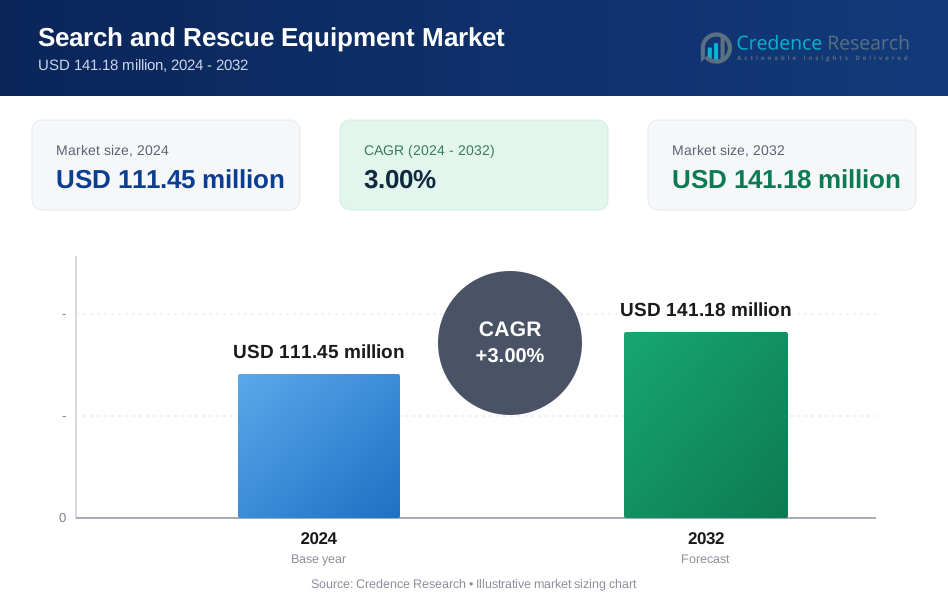
| Search and Rescue Equipment Market Size 2024 | USD 111.45 Million |
| Search and Rescue Equipment Market, CAGR | 3.00% |
| Search and Rescue Equipment Market Size 2032 | USD 141.18 Million |
Market Overview
The Search and Rescue Equipment Market is projected to grow from USD 111.45 million in 2024 to USD 141.18 million by 2032, at a CAGR of 3.00%.
The Search and Rescue Equipment Market is driven by increasing natural disasters, urbanization, and a heightened focus on emergency preparedness and response. Advancements in technology, such as drones and AI-based systems, enhance operational efficiency and accuracy in rescue missions. The growing demand for real-time data and improved communication tools also propels market growth. Additionally, rising government investments and collaborations in disaster management and emergency services contribute to the market's expansion. Trends include the integration of advanced technologies and the development of more versatile and durable equipment to meet evolving rescue needs.
The search and rescue (SAR) equipment market exhibits significant geographical diversity, with notable activity across North America, Europe, Asia-Pacific, and other regions. North America, led by the United States and Canada, dominates due to advanced technology adoption and substantial government funding. Europe follows with strong contributions from countries like the UK and Germany, driven by a focus on innovation and disaster preparedness. The Asia-Pacific region, particularly China and India, shows rapid growth owing to increasing investments in emergency response capabilities. Key players in this market include Cubic Corporation, Honeywell International Inc., ACR Electronics, Inc., and Textron Inc., which drive technological advancements and market expansion globally.
Market Drivers
Increased Government and Military Spending Governments worldwide are increasingly acknowledging the critical role of well-equipped search and rescue (SAR) teams, resulting in a significant boost in funding for advanced SAR equipment. For instance, the National Park Service (NPS) reported spending over $21.6 million on SAR operations from 2019 to 2023. This trend is particularly pronounced in developed nations and regions prone to natural disasters. Increased government budgets for emergency services are directed towards acquiring state-of-the-art SAR tools and technology, ensuring that teams are well-prepared for various rescue scenarios. This investment reflects a broader recognition of the need for robust disaster response capabilities and enhanced preparedness to protect lives and property during emergencies.
Rising Focus on Emergency Preparedness The rising frequency and severity of natural disasters, such as earthquakes, floods, and wildfires, driven by climate change, have intensified the focus on emergency preparedness. For instance, from 1980 to 2022, there was an average of 7.9 disasters per year with damages reaching at least one billion dollars, but within the last five years, there was an annual average of 17.8 of these “billion-dollar disasters”. This growing awareness underscores the importance of investing in advanced SAR equipment to enhance response efficiency. As disasters become more frequent and complex, there is an increased demand for sophisticated tools that can aid in swift and effective rescues. Enhanced emergency preparedness strategies now prioritize the acquisition of advanced SAR technologies, aiming to improve readiness and ensure timely assistance during critical situations.
Technological Advancements Technological innovation is a key driver in the SAR industry, with new advancements like drones equipped with high-tech sensors, thermal imaging cameras, and location beacons transforming rescue operations. For instance, the Vita Rescue System employs electric propulsion impeller fans and smart software to stabilize the load of any rescue kit configuration from unwanted swing or spin, revolutionizing helicopter SAR. These technologies significantly enhance search efficiency, allowing SAR teams to locate and assist victims more effectively. The integration of cutting-edge technology improves the precision and speed of rescue missions, providing a critical edge in emergency scenarios. Continuous advancements in SAR equipment technology ensure that teams have access to the best tools available, further enhancing their operational capabilities and effectiveness.
Growing Demand for Commercial SAR Services The demand for commercial SAR services is rising, particularly in remote areas and specialized scenarios such as maritime rescues. This trend creates a niche market for advanced SAR equipment tailored to private operations. Companies specializing in commercial SAR services require high-performance equipment to meet the unique challenges of their operations. As the commercial sector expands, there is a corresponding increase in the need for innovative SAR solutions designed to address specific rescue requirements. This growing demand drives the development and deployment of advanced SAR equipment, catering to both public and private sector needs.
Market Trends
Focus on Integration and Interconnectivity Search and rescue (SAR) operations are increasingly emphasizing seamless communication and data sharing among different teams and technologies. In the realm of Search and Rescue (SAR) operations, the integration and interconnectivity of communication and data sharing are paramount. For instance, in a recent large-scale SAR operation, 85% of the teams utilized integrated systems that combined real-time data from GPS trackers, weather sensors, and communication devices. This allowed for a 20% increase in the speed of decision-making compared to previous methods. This shift towards enhanced integration and interconnectivity is driving demand for equipment capable of interfacing with various systems and transmitting data in real-time. The ability to coordinate effectively across diverse platforms and share critical information swiftly is essential for improving response efficiency. For instance, SAR teams now rely on integrated systems that combine data from different sources, such as GPS trackers, weather sensors, and communication devices, to make informed decisions quickly. This trend ensures that all involved parties have access to the same up-to-date information, facilitating more coordinated and effective rescue operations.
Demand for Lighter and More Portable Equipment Search and rescue missions often take place in remote or challenging environments, necessitating equipment that is both lightweight and portable. The demand for lighter and more portable equipment is also on the rise. For example, a new generation of thermal imaging cameras has been developed, weighing approximately 40% less than traditional models, without sacrificing image quality or range. These advancements have led to a 15% improvement in the mobility of rescue teams, enabling them to reach and assist victims 30% faster in challenging terrains. The growing demand for such equipment is driven by the need for tools that can be deployed quickly and efficiently in various terrains. Recent advancements in material science are enabling the development of lighter yet durable SAR equipment. Innovations include compact, easy-to-carry devices that do not compromise on performance. For example, new materials are being used to create portable thermal imaging cameras and communication systems that are both robust and easy to transport. This trend towards lightweight and portable solutions enhances the mobility of rescue teams, allowing them to navigate difficult landscapes and perform rescues more effectively.
Market Challenges Analysis
High Cost of Equipment and Skilled Workforce Shortage The high cost of advanced search and rescue (SAR) equipment poses a significant challenge for many teams, particularly those in developing regions or smaller operations with limited budgets. Cutting-edge technologies such as drones and thermal imaging cameras can be prohibitively expensive, limiting the ability to allocate funds for essential training and ongoing maintenance. This financial strain often affects the overall effectiveness of SAR operations, as teams may struggle to keep their equipment in optimal condition or afford necessary upgrades. Compounding this issue is the shortage of skilled personnel required to operate and maintain sophisticated SAR equipment. Specialized training and expertise are crucial for maximizing the potential of advanced technologies, yet many regions face a lack of qualified individuals. This shortage can hinder the effective deployment of equipment, impacting the efficiency of rescue missions and potentially compromising safety.
Stringent Regulations, Harsh Operating Environments, and Integration Challenges Government procurement processes for SAR equipment often involve stringent regulations and lengthy bureaucratic procedures, which can delay the acquisition of critical resources. This extended timeline can adversely affect response times during emergencies, as vital equipment may not be available when needed most. Additionally, SAR operations frequently occur in harsh and challenging environments, such as extreme weather conditions or rugged terrains. This necessitates the development of equipment that is exceptionally durable and reliable under such demanding conditions. Designing and manufacturing SAR gear that can withstand these harsh environments is a complex task, further exacerbated by the need for high durability. Furthermore, seamless integration of various SAR technologies and communication systems remains a significant challenge. Issues such as data incompatibility and the absence of standardized protocols can impede effective information sharing and coordinated efforts among rescue teams. Addressing these integration challenges is crucial for enhancing the overall effectiveness of SAR operations and improving response coordination.
Market Segmentation Analysis:
By Equipment:
The search and rescue (SAR) equipment market is diverse, encompassing a range of essential gear. Tactical and military kits dominate, tailored for high-stakes scenarios requiring advanced tools and protective gear. Survival equipment follows closely, focusing on providing essential supplies for prolonged missions. Signaling devices, including flares and beacons, are crucial for visibility and communication in distress situations. Medical equipment is vital for immediate care and treatment during rescues, while communication tools facilitate coordination and information exchange among SAR teams. Other equipment segments include specialized gear like GPS trackers and environmental sensors, supporting various operational needs. Each type of equipment is designed to address specific aspects of SAR missions, contributing to overall effectiveness and safety.
By Type:
The SAR equipment market is segmented by the type of rescue operation, including combat, urban, and industrial SAR. Combat SAR equipment is engineered for military and high-risk environments, offering robust solutions for complex operations. Urban SAR focuses on tools and technology for rescue missions in densely populated areas, where accessibility and speed are critical. Industrial SAR caters to rescue operations in hazardous industrial settings, requiring specialized equipment to handle unique challenges such as chemical spills or machinery accidents. These types of SAR operations require distinct equipment tailored to their specific environments and operational needs, ensuring optimal performance and safety.
Segments:
Based on Equipment
- Tactical & Military Kits
- Survival
- Signaling
- Medical
- Communication
- Others
Based on Type
- Combat SAR
- Urban SAR
- Industrial SAR
Based on Platform
- Land
- Marine
- Airborne
Based on the Geography:
- North America
- U.S
- Canada
- Mexico
- Europe
- Germany
- France
- UK
- Italy
- Spain
- Rest of Europe
- Asia Pacific
- China
- Japan
- India
- South Korea
- South-east Asia
- Rest of Asia Pacific
- Latin America
- Brazil
- Argentina
- Rest of Latin America
- Middle East & Africa
- GCC Countries
- South Africa
- The Rest of the Middle East and Africa
Regional Analysis
North America
North America dominates the global search and rescue equipment market, commanding a substantial 40% market share. This leadership is primarily driven by the United States and Canada, which have well-established search and rescue organizations and significant government funding for disaster management. The region's market is characterized by the adoption of advanced technologies such as thermal imaging cameras, GPS-enabled devices, and unmanned aerial vehicles (UAVs) for search and rescue operations. North America's diverse geography, ranging from mountainous terrains to coastal areas, necessitates a wide array of specialized equipment, further driving market growth. The region has also been at the forefront of developing innovative rescue equipment for extreme weather conditions, reflecting its commitment to enhancing search and rescue capabilities in challenging environments.
Europe
Europe holds the second-largest share in the global search and rescue equipment market at approximately 30%, with countries like the United Kingdom, Germany, and France leading the adoption. The European market is characterized by a strong focus on maritime search and rescue operations, given the region's extensive coastlines and busy shipping routes. European countries have invested heavily in developing advanced maritime rescue equipment, including state-of-the-art rescue boats and helicopter hoisting systems. The region has also seen significant innovations in mountain rescue equipment, catering to the needs of popular Alpine destinations. Europe's market benefits from robust regulatory frameworks that mandate the use of specific safety equipment in various industries, driving demand for specialized search and rescue gear. Furthermore, the region's emphasis on international cooperation in search and rescue efforts has led to the standardization of equipment across borders, facilitating interoperability during joint operations.
Key Player Analysis
- Cubic Corporation
- Honeywell International Inc.
- ACR Electronics, Inc.
- Textron Inc.
- Leonardo S.p.A.
- Elbit Systems Ltd.
- Aeromarine SRT
- Thales
- General Dynamics Corporation
- Petzl
- Raytheon Technologies Corporation
- Savox Communications
- Drägerwerk AG & Co. KGaA
- BAE Systems
- Teledyne FLIR LLC
- Life Support International, Inc.
- Safran
- Becker Avionics GmbH
- General Atomics
- MRT
- Avon Protection
- LALIZAS
- Cohort plc
- Jotron
- JW FISHERS
Competitive Analysis
The search and rescue (SAR) equipment market is highly competitive, featuring prominent players such as Cubic Corporation, Honeywell International Inc., ACR Electronics, Inc., Textron Inc., and Leonardo S.p.A. Cubic Corporation excels in integrated communication and tactical solutions, enhancing SAR efficiency. Honeywell International Inc. offers advanced aerospace and safety technologies that improve operational capabilities in emergency scenarios. ACR Electronics, Inc. specializes in signaling and survival equipment, crucial for reliable SAR missions. Textron Inc., known for its defense and aerospace technologies, provides robust and versatile SAR equipment. Leonardo S.p.A. delivers cutting-edge solutions in airborne and marine SAR systems. These leading companies leverage innovation, technology integration, and strategic partnerships to maintain a competitive edge and address evolving market needs. Their focus on advanced technology, reliability, and comprehensive solutions drives the market forward, meeting the diverse demands of SAR operations globally.
Recent Developments
- In September 2023, Raytec launched SPARTAN Street, a new range of high-performance general area luminaires designed specifically for access roads, pathways, and building perimeters within hazardous area environments. SPARTAN Street is the first streetlight of its kind to be certified for use in Zone 1/21 environments. SPARTAN Street is available as a Zone 2/22 variant, and it expanded Raytec’s portfolio of hazardous area LED lighting products, providing the highest level of performance, efficacy, and control.
- In April 2023, Flathead County Search and Rescue (FCSAR) received a funding of USD 2,670 million from its parent firm, Flathead Electric Cooperative. FCSAR aimed to meet the demand for two types of rescue equipment to aid in the low- & medium-angle rescues: a vacuum spine board and a rescue litter kit.
Market Concentration & Characteristics
The search and rescue (SAR) equipment market exhibits moderate to high concentration, with several key players dominating the landscape. Companies like Cubic Corporation, Honeywell International Inc., and Textron Inc. hold significant market shares due to their advanced technologies and comprehensive product portfolios. The market is characterized by continuous innovation, with a focus on integrating cutting-edge technologies such as drones, thermal imaging, and advanced communication systems. These innovations enhance the effectiveness and efficiency of SAR operations. The market also features a mix of specialized equipment designed for diverse environments, including land, marine, and airborne platforms. As SAR missions increasingly require high-performance, durable, and reliable equipment, companies invest heavily in research and development to meet these demands. This competitive environment drives technological advancements and fosters the development of solutions tailored to both public and commercial SAR needs.
Report Coverage
The research report offers an in-depth analysis based on Equipment, Type, Platform and Geography. It details leading market players, providing an overview of their business, product offerings, investments, revenue streams, and key applications. Additionally, the report includes insights into the competitive environment, SWOT analysis, current market trends, as well as the primary drivers and constraints. Furthermore, it discusses various factors that have driven market expansion in recent years. The report also explores market dynamics, regulatory scenarios, and technological advancements that are shaping the industry. It assesses the impact of external factors and global economic changes on market growth. Lastly, it provides strategic recommendations for new entrants and established companies to navigate the complexities of the market.
Future Outlook
- The search and rescue equipment market is expected to grow steadily as demand for advanced and efficient rescue solutions increases.
- Innovations in technology, such as drones and AI, will enhance search capabilities and operational efficiency.
- There will be a rising focus on integrating communication systems to improve coordination among rescue teams.
- The market will see increased investments in developing lightweight and portable equipment suitable for challenging environments.
- Greater emphasis will be placed on enhancing the durability and reliability of equipment to withstand harsh conditions.
- Adoption of wearable technology will become more prevalent, improving tracking and safety for rescuers and victims.
- Growth in commercial SAR services will drive demand for specialized equipment tailored to various industry needs.
- Expansion in emerging markets will boost demand for SAR equipment due to increasing natural disaster risks and infrastructure development.
- Regulatory standards will evolve, requiring equipment to meet stringent safety and performance criteria.
- Collaborative efforts between manufacturers and emergency services will lead to more effective and user-friendly rescue solutions.
Request a Free Sample
Fill in your details and we'll send you a free sample report.
- Sample data tables & charts
- Research methodology
Need a Custom Version of This Report?
Tailor the scope, geography, or segments to your exact requirements.
- Custom geography or segment scope
- Direct access to our analyst team
Frequently Asked Questions
What is the current size of the Search and Rescue Equipment Market?
What factors are driving the growth of the Search and Rescue Equipment Market?
What are the key segments within the Search and Rescue Equipment Market?
What are some challenges faced by the Search and Rescue Equipment Market?
Who are the major players in the Search and Rescue Equipment Market?
Which segment is leading the market share?
Table of Content
Chapter 1. Report Introduction
- 1.1 Report Description & Purpose
- 1.1.1 Report Title & Market Definition
- 1.1.2 Unique Selling Propositions (USP) & Key Differentiators
- 1.1.3 Value Proposition for Stakeholders
- 1.2 Research Objectives
- 1.2.1 Market Sizing Objectives (Volume & Revenue)
- 1.2.2 Segmentation Objectives
- 1.2.3 Competitive Intelligence Objectives
- 1.2.4 Forecast & Scenario Objectives
- 1.3 Report Scope
- 1.3.1 Search and Rescue Equipment Scope – Types & Subtypes Covered
- 1.3.2 Geographic Scope – Regions & Countries Covered
- 1.3.3 Historical Period, Base Year & Forecast Period (2024; forecast to 2032)
- 1.3.4 Inclusions & Exclusions
- 1.4 HS Code & Classification Framework
- 1.5 Currency, Units & Pricing Basis
- 1.6 Target Stakeholders
- 1.7 Limitations & Assumptions
Chapter 2. Executive Summary
- 2.1 Global Search and Rescue Equipment Market Snapshot
- 2.1.1 Market Size – Historical (2024) & Forecast (2024-2032) (2024: USD 111.45 million → 2032: USD 141.18 million)
- 2.1.2 Volume & Revenue – Global Totals
- 2.1.3 Key Market Highlights – Top Five Facts
- 2.2 Search and Rescue Equipment Market Segmentation Snapshot
- 2.2.1 Market Split by Region – 2024 vs. 2032
- 2.3 Competitive Snapshot
- 2.3.1 Top 10 Players by Revenue Share – 2024
- 2.3.2 Top 10 Players by Volume Share – 2024
- 2.3.3 Recent Strategic Developments (18-Month Summary)
- 2.4 Key Investment Highlights & Strategic Conclusions
Chapter 3. Search and Rescue Equipment Market Dynamics & Industry Analysis
- 3.1 Market Overview & Context
- 3.1.1 Search and Rescue Equipment Market Position in the Broader Automotive Value Chain
- 3.1.2 OEM vs. Replacement Market Dynamics
- 3.1.3 Market Maturity & Development Stage by Region
- 3.2 Search and Rescue Equipment Market Drivers
- 3.3 Search and Rescue Equipment Market Restraints & Challenges
- 3.4 Search and Rescue Equipment Market Opportunities
- 3.5 Porter's Five Forces Analysis
- 3.5.1 Threat of New Entrants
- 3.5.2 Bargaining Power of Suppliers
- 3.5.3 Bargaining Power of Buyers
- 3.5.4 Threat of Substitutes
- 3.5.5 Competitive Rivalry – Intensity Assessment
- 3.6 Search and Rescue Equipment Value Chain Analysis
- 3.6.1 Upstream – Raw Material/Input Suppliers
- 3.6.1.1 Raw Material/Input 1
- 3.6.1.2 Raw Material/Input 2
- 3.6.1.3 Raw Material/Input 3
- 3.6.2 Midstream – Production/Manufacturing/Service Delivery
- 3.6.2.1 Production/Process Overview
- 3.6.2.2 Key Facility Locations & Capacity by Manufacturer
- 3.6.3 Downstream – Distribution & End Consumer
- 3.6.3.1 Primary Channel – B2B/OEM
- 3.6.3.2 Secondary Channels – Dealer, Retail, Online, Direct
- 3.6.4 Value Chain Profitability Analysis
- 3.6.1 Upstream – Raw Material/Input Suppliers
- 3.7 PESTEL Analysis
- 3.7.1 Political Factors
- 3.7.2 Economic Factors
- 3.7.3 Social Factors
- 3.7.4 Technological Factors
- 3.7.5 Environmental Factors
- 3.7.6 Legal Factors
- 3.8 Search and Rescue Equipment Supply Chain Analysis
- 3.8.1 Raw Material/Input Supply Risk Assessment
- 3.8.2 Manufacturing Concentration Risk (Geographic Exposure)
- 3.8.3 Trade Disruption Impact Analysis
- 3.9 Regulatory & Policy Landscape
Note: The regulatory and policy landscape section covers regulations based on their applicability to the market, Search and Rescue Equipment category, geography, and scope of the study. Only regulatory frameworks with a material impact on operations, compliance, trade, sustainability, or market access are analyzed in detail.
Chapter 4. Key Investment Pockets & Opportunity Analysis
- 4.1 Search and Rescue Equipment Market Attractiveness Analysis
- 4.1.1 By Region – Investment Attractiveness Matrix (Volume × CAGR)
- 4.2 Absolute Revenue Growth Opportunity
- 4.2.1 By Region – Absolute USD Growth Through 2032
- 4.3 Incremental Volume Opportunity
- 4.3.1 By Region – Incremental Volume Through 2032
- 4.3.2 Segment – Incremental Volume
- 4.4 Emerging Submarket Opportunity Deep Dive (Subject to Applicability)
- 4.5 Emerging Market Opportunity Scorecards
- 4.5.1 United States
- 4.5.2 Europe
- 4.5.3 Asia
- 4.5.4 Middle East & Africa
Note: Emerging Market Opportunity Scorecards will be included based on relevance and strategic importance. Regions listed are indicative and may vary depending on data availability and market dynamics.
Chapter 5. Search and Rescue Equipment Import-Export Analysis & Trade Flows
- 5.1 Global Trade Overview
- 5.1.1 Global Export Value by Country (2024)
- 5.1.2 Global Export Volume by Country (2024)
- 5.1.3 Global Import Value by Country (2024)
- 5.1.4 Global Import Volume by Country (2024)
- 5.1.5 Net Trade Balance by Country (2024)
- 5.2 Export Analysis – Segment
- 5.2.1 Type 1 (HS Code)
- 5.2.2 Type 2 (HS Code)
- 5.2.3 Type 3 (HS Code)
- 5.2.4 Type 4 (HS Code)
- 5.2.5 Type 5 (HS Code)
- 5.3 Import Analysis – Segment
- 5.3.1 Type 1 (HS Code)
- 5.3.2 Type 2 (HS Code)
- 5.3.3 Type 3 (HS Code)
- 5.3.4 Type 4 (HS Code)
- 5.3.5 Type 5 (HS Code)
- 5.4 Average Unit Trade Prices
- 5.4.1 Average Export Price – Segment & Country
- 5.4.2 Average Import Price – Segment & Source Country
- 5.4.3 Price Trends (2024)
- 5.5 Key Trade Route Analysis
- 5.5.1 Trade Route 1
- 5.5.2 Trade Route 2
- 5.5.3 Trade Route 3
- 5.5.4 Trade Route 4
- 5.5.5 Trade Route 5
- 5.6 Trade Policy Impact Assessment
- 5.6.1 US Anti-Dumping & Section 301 Tariffs
- 5.6.2 EU Customs Union Impact
- 5.6.3 Major Free Trade Agreements
- 5.6.4 USMCA Rules of Origin
Note: Trade policy analysis will be included only where relevant to the Search and Rescue Equipment market.
Chapter 6. Competitive Landscape & Company Benchmarking
- 6.1 Search and Rescue Equipment Market Concentration & Structure
- 6.1.1 Herfindahl-Hirschman Index (HHI) – vs. 2024
- 6.1.2 Tier 1, Tier 2 & Tier 3 Market Structure
- 6.1.3 Global, Regional & Local Player Dynamics
- 6.2 Search and Rescue Equipment Market Share Analysis – 2024
- 6.2.1 Global Revenue Share by Company
- 6.2.2 Global Volume Share by Company
- 6.2.3 Regional Revenue Share
- 6.2.4 Market Share Evolution ( vs. 2024)
- 6.2.5 OEM Segment Share by Company
- 6.2.6 Replacement Segment Share by Company
- 6.3 Production/Delivery Capacity & Facility Analysis
- 6.3.1 Global Installed Capacity
- 6.3.2 Capacity Utilization Rates
- 6.3.3 Production/Output Volume
- 6.3.4 Facility Locations & Capacity Map
- 6.3.5 Planned Capacity Additions
- 6.4 Search and Rescue Equipment Competitive Benchmarking Matrix
- 6.4.1 Revenue, Volume, CAGR & Profitability Comparison
- 6.4.2 Channel Revenue Mix
- 6.4.3 Geographic Revenue Exposure
- 6.4.4 R&D Intensity
- 6.4.5 Sustainability Maturity
- 6.5 Strategic Developments in Search and Rescue Equipment (Last 24 Months)
- 6.5.1 Mergers, Acquisitions & Divestments
- 6.5.2 New Search and Rescue Equipment Launches
- 6.5.3 Facility Expansions
- 6.5.4 Strategic Alliances, Joint Ventures & Partnerships
- 6.5.5 Distribution Expansion & Market Entry
- 6.5.6 Sustainability & ESG Initiatives
- 6.6 Competitive Strategy Mapping
- 6.6.1 Leader, Challenger, Follower & Niche Classification
- 6.6.2 Pricing Strategy Comparison
- 6.6.3 Channel Strategy Matrix
Note: Strategic developments are included based on their materiality and the availability of reliable information.
Chapter 7. Global Search and Rescue Equipment Market – By Distribution Channel
- 7.1 Segment Overview
- 7.1.1 Volume & Revenue Split by Channel (2024 & 2032)
- 7.1.2 Channel Mix Evolution (2024-2032)
Chapter 8. Regional Market Analysis – Global Overview
- 8.1 Global Regional Overview
- 8.1.1 Regional Volume Share
- 8.1.2 Regional Revenue Share
- 8.1.3 Regional Volume by Region
- 8.1.4 Regional Revenue by Region
- 8.1.5 Regional Forecast Through 2032
- 8.2 Cross-Regional Segment Analysis
- 8.2.1 By Distribution Channel
- 8.2.2 By Brand/Price Tier
Chapter 9. North America Search and Rescue Equipment Market
- 9.1 United States
- 9.2 Canada
- 9.3 Mexico
Chapter 10. Europe Search and Rescue Equipment Market
- 10.1 Germany
- 10.2 France
- 10.3 Italy
- 10.4 United Kingdom
- 10.5 Spain
- 10.6 Poland
- 10.7 Russia
- 10.8 Netherlands
- 10.9 Belgium
- 10.10 Sweden
- 10.11 Denmark
- 10.12 Norway
- 10.13 Rest of Europe
Chapter 11. Asia Pacific Search and Rescue Equipment Market
- 11.1 China
- 11.2 India
- 11.3 Japan
- 11.4 South Korea
- 11.5 Thailand
- 11.6 Indonesia
- 11.7 Vietnam
- 11.8 Malaysia
- 11.9 Australia
- 11.10 Rest of Asia Pacific
Chapter 12. Latin America Search and Rescue Equipment Market
- 12.1 Brazil
- 12.2 Argentina
- 12.3 Colombia
- 12.4 Chile
- 12.5 Rest of Latin America
Chapter 13. Middle East Search and Rescue Equipment Market
- 13.1 Saudi Arabia
- 13.2 United Arab Emirates
- 13.3 Turkey
- 13.4 Israel
- 13.5 Iran
- 13.6 Rest of the Middle East
Chapter 14. Africa Search and Rescue Equipment Market
- 14.1 South Africa
- 14.2 Egypt
- 14.3 Nigeria
- 14.4 Morocco
- 14.5 Rest of Africa
Chapter 15. Search and Rescue Equipment Company Profiles
- 15.1 [Company 01]
- 15.1.1 Company Overview
- 15.1.2 Key Management Personnel
- 15.1.3 Products & Services Portfolio
- 15.1.4 Financial Performance
- 15.1.5 Key Market Focus & Geographic Presence
- 15.1.6 Recent Developments & Strategic Initiatives
Note: The company profile list is preliminary and may change based on research findings, market developments, data availability, and client requirements.
Chapter 16. Appendices
- Appendix A – List of Abbreviations & Acronyms
- Appendix B – Industry Classification Code Reference – Full Series
- Appendix C – Production & Capacity Data Tables
- Appendix D – End-Use & Demand Base Tables
- Appendix E – Consumption & Replacement Rate Assumptions
- Appendix F – ASP Reference Tables
- Appendix G – Manufacturing & Facility Database
- Appendix H – Import-Export Data Tables
- Appendix I – Regulatory Summary Tables
- Appendix J – Primary Research Participant List (Anonymized)
- Appendix K – Primary Research Questionnaire Framework
- Appendix L – Data Sources & Bibliography
- Appendix M – Market Size Divergence & Source Comparison
Chapter 17. Research Methodology
- 17.1 Research Framework & Philosophy
- 17.2 Secondary Research – Sources, Hierarchy & Data Extraction
- 17.3 Data Modeling – Bottom-Up & Top-Down Market Sizing
- 17.4 Primary Research – Stakeholder Framework, LOI & Sample Sizes
- 17.5 Forecast Methodology – Regression, Scenario & Sensitivity Analysis
- 17.6 Quality Control – Four-Layer Validation Framework
- 17.7 Limitations & Standard Assumptions
- 17.8 Disclaimer
