
| REPORT ATTRIBUTE | DETAILS |
|---|---|
| Historical Period | 2019-2022 |
| Base Year | 2023 |
| Forecast Period | 2024-2032 |
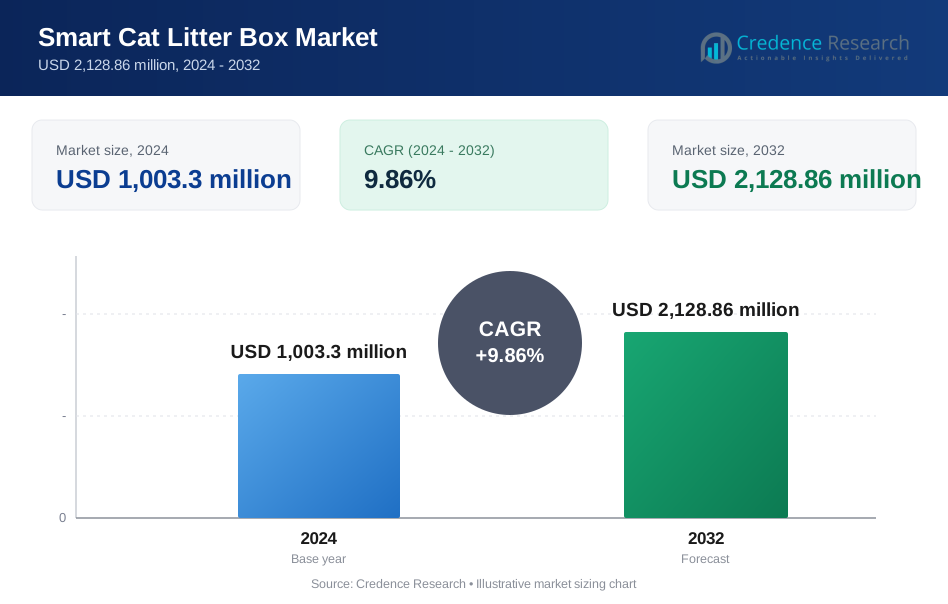
| Smart Cat Litter Box Market Size 2024 | USD 1,003.3 million |
| Smart Cat Litter Box Market, CAGR | 9.86% |
| Smart Cat Litter Box Market Size 2032 | USD 2,128.86 million |
Market Overview:
The global smart cat litter box market is projected to grow significantly from USD 1,003.3 million in 2024 to USD 2,128.86 million by 2032, reflecting a compound annual growth rate (CAGR) of 9.86%.
This robust growth trajectory underscores the increasing demand for smart cat litter boxes, driven by their essential role in enhancing pet care and hygiene. The market’s expansion is indicative of the rising need for convenient and efficient solutions for pet owners, particularly in urban areas where space and time constraints are prevalent.
Several key drivers are propelling the growth of the smart cat litter box market. The escalating need for convenience and better pet care solutions is a primary factor. Smart cat litter boxes offer automated cleaning, odour control, and health monitoring features, which significantly reduce the manual effort required by pet owners. Additionally, advancements in technology, such as the integration of sensors, app control, and self-flushing capabilities, are attracting tech-savvy consumers. The increasing pet ownership rates and growing awareness about pet hygiene further contribute to the market’s growth. For instance, the American Pet Products Association reported a significant rise in pet adoption during the COVID-19 pandemic, which has sustained the demand for smart pet care products.
Regionally, the smart cat litter box market exhibits varied growth patterns. North America and Europe are expected to maintain significant market shares due to the established pet care industries and high adoption rates of smart home technologies. The Asia-Pacific region, however, is anticipated to witness the highest growth rate, driven by the expanding middle-class population, increasing disposable incomes, and rising pet ownership in countries like China and Japan. The Middle East and Africa are also projected to experience moderate growth, supported by the improving economic conditions and growing awareness about pet care. Latin America is expected to show steady growth, with increasing investments in the pet care sector and rising urbanization.
Market Drivers:
Increasing Pet Ownership:
The smart cat litter box market is significantly driven by the rising pet ownership rates globally. As more households adopt pets, the demand for convenient and efficient pet care solutions has surged. For instance, the American Pet Products Association reported a substantial increase in pet adoption during the COVID-19 pandemic, with 11.38 million households in the United States acquiring pets. This trend has led to a growing need for automated and smart pet care products, including smart cat litter boxes, which offer enhanced convenience and hygiene for pet owners.
Technological Advancements:
Technological advancements play a crucial role in driving the smart cat litter box market. Innovations such as sensors, app control, and self-flushing capabilities have transformed traditional litter boxes into smart devices that offer automated cleaning and health monitoring features. For example, companies like PETKIT Ltd. have introduced smart litter boxes equipped with advanced sensors that detect the number of times a cat uses the litter box, reducing the frequency of cleaning cycles. These technological innovations attract tech-savvy consumers and enhance the overall pet care experience.
Growing Awareness of Pet Hygiene:
The increasing awareness of pet hygiene and health is another key driver for the smart cat litter box market. Pet owners are becoming more conscious of the importance of maintaining a clean and sanitary environment for their pets. Government surveys indicate that a significant percentage of pet owners prioritize hygiene when selecting pet care products. For instance, a survey conducted by the American Veterinary Medical Association revealed that 29% of households owned at least one cat in 2022, emphasizing the need for effective litter management solutions. Smart cat litter boxes, with their automated cleaning and odour control features, address these hygiene concerns effectively.
Convenience and Time-Saving Solutions:
The demand for convenience and time-saving solutions is a major factor driving the smart cat litter box market. Busy lifestyles and the increasing number of working pet owners have created a need for automated pet care products that reduce manual effort. For instance, the integration of app control and programmable settings in smart cat litter boxes allows pet owners to monitor and manage their pets’ litter boxes remotely. This convenience factor is highly appealing to pet owners, contributing to the growing adoption of smart cat litter boxes.
Market Trends:
Integration of Advanced Technologies:
The smart cat litter box market is witnessing a significant trend towards the integration of advanced technologies. Companies are incorporating features such as sensors, app control, and self-flushing capabilities to enhance the functionality and convenience of these products. For instance, PETKIT Ltd. has introduced smart litter boxes equipped with sensors that detect the number of times a cat uses the litter box, reducing the frequency of cleaning cycles. These technological advancements not only improve the user experience but also attract tech-savvy consumers looking for innovative pet care solutions.
Growing Demand for Eco-Friendly Products:
There is a rising demand for eco-friendly products in the smart cat litter box market. Consumers are becoming increasingly conscious of the environmental impact of their purchases and are seeking sustainable options. For example, a government survey indicated that consumers prefer eco-friendly pet care products. Companies like PETKIT Ltd. have responded to this trend by launching biodegradable and recyclable smart cat litter boxes, contributing to their market growth and appealing to environmentally conscious pet owners.
Increasing Pet Ownership:
The market is also driven by the increasing rates of pet ownership globally. As more households adopt pets, the demand for convenient and efficient pet care solutions has surged. The American Pet Products Association reported a substantial increase in pet adoption during the COVID-19 pandemic, with approximately 11.38 million households in the United States acquiring pets3. This trend has led to a growing need for automated and smart pet care products, including smart cat litter boxes, which offer enhanced convenience and hygiene for pet owners.
Focus on Health Monitoring:
Another notable trend in the smart cat litter box market is the focus on health monitoring features. Companies are developing smart litter boxes that can track and monitor a cat’s health by analyzing waste patterns and alerting owners to potential health issues. For example, some smart litter boxes are equipped with sensors that detect changes in a cat’s urination and defecation habits, providing valuable insights into their health. This focus on health monitoring not only enhances the well-being of pets but also provides peace of mind to pet owners, driving the adoption of smart cat litter boxes.
Market Challenges Analysis:
High Purchase and Maintenance Costs:
One of the primary challenges facing the smart cat litter box market is the high purchase and maintenance costs associated with these products. Smart cat litter boxes often come with advanced features such as sensors, app control, and self-cleaning mechanisms, which contribute to their higher price points. Additionally, consumers incur ongoing expenses such as replacement filters, installation fees, and technological support costs. These high costs can deter potential buyers, particularly in developing and underdeveloped regions where disposable incomes are lower.
Supply Chain Disruptions:
Supply chain disruptions present another significant restraint on the smart cat litter box market. Factors such as raw material shortages, transportation delays, and geopolitical tensions can impact the production and distribution of smart cat litter boxes. For example, the COVID-19 pandemic caused significant disruptions in global supply chains, affecting the availability of essential materials and components for manufacturing. These disruptions can lead to increased production costs and delays in product delivery, hindering market growth.
Noise and Disturbance Issues:
Noise and disturbance issues associated with smart cat litter boxes can also pose challenges for market growth. Some smart litter boxes produce noise during the cleaning process, which can be disruptive for both cats and their owners. This issue is particularly problematic for noise-sensitive cats and households with multiple pets. Manufacturers need to address these concerns by developing quieter and more efficient models to enhance user satisfaction and adoption rates.
Limited Adoption in Developing Regions:
The adoption of smart cat litter boxes is limited in developing and underdeveloped regions due to economic constraints and lower awareness levels. In these regions, traditional litter boxes are more commonly used due to their affordability and simplicity. To overcome this challenge, companies need to focus on increasing awareness about the benefits of smart cat litter boxes and offering cost-effective solutions that cater to the needs of price-sensitive consumers.
Market Segmentation Analysis:
By Type
The smart cat litter box market is segmented by type into automatic flush and semi-automatic flush. Automatic flush litter boxes are highly preferred due to their convenience and efficiency in maintaining cleanliness. These products are equipped with advanced features such as self-cleaning mechanisms and odour control, making them popular among pet owners. Semi-automatic flush litter boxes, while less advanced, still offer significant benefits in terms of ease of use and maintenance.
By Technology
Technological advancements have significantly influenced the smart cat litter box market. The integration of sensors, app control, and self-flushing capabilities has transformed traditional litter boxes into smart devices. For instance, some smart litter boxes are equipped with sensors that detect the number of times a cat uses the litter box, reducing the frequency of cleaning cycles. Additionally, the use of programmable settings and mobile control features has enhanced the convenience and customization options for pet owners, driving the adoption of smart cat litter boxes.
By End User
The smart cat litter box market is also segmented by end user into residential and commercial. The residential segment dominates the market, driven by the high demand for convenient and efficient pet care solutions among individual pet owners. Smart cat litter boxes are particularly popular in households with multiple cats, as they help maintain hygiene and reduce manual cleaning efforts. The commercial segment, which includes pet stores, veterinary clinics, and pet boarding facilities, is also witnessing growth. These establishments are increasingly adopting smart cat litter boxes to provide better care and hygiene for the cats in their care.
Segmentation:
By Product Type:
- Open Top Cat Litter Box
- Enclosed Cat Litter Box
- High Sided Cat Litter Box
- Modern Cat Litter Box
- Others
By Filler Type:
- Scoopable Cat Litter Box
- Clay Cat Litter Box
- Clumping
- Non-Clumping
By Buyer Type:
- Residential Buyers
- Commercial Buyers
- Institutional Buyers
By Sales Channel:
- Modern Trade
- Convenience Stores
- Pet Stores
- Multi-Brand Stores
- Online Retailers
- Other Sales Channel
By Geography:
- North America
- U.S.
- Canada
- Mexico
- Europe
- Germany
- France
- U.K.
- Italy
- Spain
- Rest of Europe
- Asia Pacific
- China
- Japan
- India
- South Korea
- South-east Asia
- Rest of Asia Pacific
- Latin America
- Brazil
- Argentina
- Rest of Latin America
- Middle East & Africa
- GCC Countries
- South Africa
- Rest of the Middle East and Africa
Regional Analysis:
North America
North America holds a significant share of the smart cat litter box market, driven by the high adoption rates of smart home technologies and the well-established pet care industry. The region accounts for approximately 35% of the global market share. The United States and Canada are the major contributors, with a growing number of pet owners seeking convenient and efficient pet care solutions. The increasing awareness of pet hygiene and the rising disposable incomes further bolster the market growth in this region.
Europe
Europe is another prominent market for smart cat litter boxes, with a market share of around 25%. The demand in this region is fueled by the extensive use of smart home devices and the high pet ownership rates in countries like Germany, the United Kingdom, and France. The European market is also witnessing a shift towards eco-friendly and sustainable products, driven by stringent environmental regulations and growing consumer awareness. Companies in this region are focusing on introducing innovative and environmentally friendly smart cat litter boxes to cater to the evolving demands of pet owners.
Asia-Pacific
The Asia-Pacific region is expected to witness the highest growth rate in the smart cat litter box market, with a market share of approximately 30%. The rapid urbanization and industrialization in countries like China, Japan, and India are driving the demand for smart home technologies, including smart cat litter boxes. The expanding middle-class population, increasing disposable incomes, and rising pet ownership rates further contribute to the market growth. Additionally, the growing awareness of pet hygiene and the adoption of advanced manufacturing technologies are propelling the market in this region.
Middle East and Africa
The Middle East and Africa region holds a smaller share of the smart cat litter box market, accounting for about 5%. The market growth in this region is driven by the increasing demand for smart home devices and the rising pet ownership rates in countries like the United Arab Emirates, Saudi Arabia, and South Africa. The region’s improving economic conditions and growing awareness of pet care are contributing to the steady demand for smart cat litter boxes. However, the market faces challenges such as supply chain disruptions and economic instability, which may hinder its growth.
Latin America
Latin America accounts for approximately 5% of the global smart cat litter box market. The region’s demand is primarily driven by the corporate sector and educational institutions in countries like Brazil, Mexico, and Argentina. The market is witnessing a gradual shift towards eco-friendly products, driven by increasing environmental awareness among consumers. Companies in this region are focusing on introducing innovative and sustainable smart cat litter box solutions to cater to the evolving demands of the market.
Key Player Analysis:
- Automated Pet Care Products
- OmegaPaw
- PetNovations Ltd.
- Spectrum Brands, Inc.
- Moderna Products
- NOBA ANIMAL CO.
- MessyMutts
- Cosmic Pet LLC
- Taizhou Comeon Pet Products Co., Ltd.
- Nature’s Miracle
Competitive Analysis:
The smart cat litter box market is highly competitive, with key players continuously innovating to maintain their market positions. Companies like Automated Pet Care Products and PETKIT Ltd. lead the market with their advanced self-cleaning and health-monitoring features. These market leaders focus on integrating cutting-edge technologies such as sensors, app control, and self-flushing capabilities to enhance user experience and attract tech-savvy consumers.
Smaller players, such as OmegaPaw and NOBA ANIMAL CO., are also making significant strides by offering eco-friendly and cost-effective solutions. The competitive landscape is further intensified by the entry of new players introducing innovative products to cater to the evolving demands of pet owners. Overall, the smart cat litter box market remains dynamic, with companies continuously seeking to enhance their product offerings and gain a competitive edge.
Recent Developments:
- In February 2023, PetSnowy announced the release of an innovative self-cleaning litter box designed to eliminate the need for messy cleanup. This product aims to provide a more convenient and hygienic solution for pet owners.
- In January 2023, Furbuild introduced the Catbula, an autonomous toilet box featuring novel technology and advanced features. This product is designed to enhance the convenience and efficiency of cat litter management.
- In 2022, PETKIT Ltd. launched a smart litter box equipped with advanced sensors that detect the number of times a cat uses the litter box. This innovation reduces the frequency of cleaning cycles and improves overall user experience.
Market Concentration & Characteristics:
The smart cat litter box market is moderately concentrated, with several key players such as Automated Pet Care Products, PETKIT Ltd., and OmegaPaw leading the landscape. These companies leverage technological advancements and innovative product designs to maintain a competitive edge. The market is characterized by a growing demand for convenience and better pet care solutions, driven by increasing pet ownership rates and advancements in technology. Additionally, the market is witnessing a shift towards eco-friendly and sustainable products, as consumers become more environmentally conscious. The integration of advanced features such as sensors, app control, and self-flushing capabilities further enhances the appeal of smart cat litter boxes, attracting tech-savvy consumers. Despite challenges such as high costs and supply chain disruptions, the market continues to evolve, with companies focusing on innovation and sustainability to meet the changing needs of pet owners.
Report Coverage:
The research report offers an in-depth analysis based on Product Type, Filler Type, Sales Channel, and Region. It details leading market players, providing an overview of their business, product offerings, investments, revenue streams, and key applications. Additionally, the report includes insights into the competitive environment, SWOT analysis, current market trends, as well as the primary drivers and constraints. Furthermore, it discusses various factors that have driven market expansion in recent years. The report also explores market dynamics, regulatory scenarios, and technological advancements that are shaping the industry. It assesses the impact of external factors and global economic changes on market growth. Lastly, it provides strategic recommendations for new entrants and established companies to navigate the complexities of the market.
Future Outlook:
- The smart cat litter box market is projected to grow significantly.
- Continuous advancements in sensor technology, automation, and robotics will enhance the functionality and convenience of smart cat litter boxes.
- The market will see a rise in eco-friendly and sustainable smart cat litter boxes, driven by growing consumer awareness and environmental regulations.
- The Asia-Pacific region is expected to witness the highest growth rate, driven by rapid urbanization, increasing disposable incomes, and rising pet ownership.
- Smart cat litter boxes with health monitoring capabilities will gain popularity, providing valuable insights into pets’ health and well-being.
- The demand for convenient and time-saving pet care solutions will continue to drive the adoption of smart cat litter boxes.
- The increasing popularity of e-commerce platforms will boost the sales of smart cat litter boxes, providing consumers with easy access to a wide range of products.
- Manufacturers will focus on developing quieter smart cat litter boxes to cater to noise-sensitive cats and their owners.
- Key players will form strategic partnerships with e-commerce platforms and other stakeholders to enhance their market presence and reach.
- Companies will continue to innovate and introduce new designs and features to meet the evolving needs of pet owners and maintain a competitive edge.
Request a Free Sample
Fill in your details and we'll send you a free sample report.
- Sample data tables & charts
- Research methodology
Need a Custom Version of This Report?
Tailor the scope, geography, or segments to your exact requirements.
- Custom geography or segment scope
- Direct access to our analyst team
Frequently Asked Questions
What is the current size of the Smart Cat Litter Box Market?
What factors are driving the growth of the Smart Cat Litter Box Market?
What are some challenges faced by the Smart Cat Litter Box Market?
Who are the major players in the Smart Cat Litter Box Market?
Table of Content
Chapter 1. Report Introduction
- 1.1 Report Description & Purpose
- 1.1.1 Report Title & Market Definition
- 1.1.2 Unique Selling Propositions (USP) & Key Differentiators
- 1.1.3 Value Proposition for Stakeholders
- 1.2 Research Objectives
- 1.2.1 Market Sizing Objectives (Volume & Revenue)
- 1.2.2 Segmentation Objectives
- 1.2.3 Competitive Intelligence Objectives
- 1.2.4 Forecast & Scenario Objectives
- 1.3 Report Scope
- 1.3.1 Smart Cat Litter Box Scope – Types & Subtypes Covered
- 1.3.2 Geographic Scope – Regions & Countries Covered
- 1.3.3 Historical Period, Base Year & Forecast Period (2024; forecast to 2032)
- 1.3.4 Inclusions & Exclusions
- 1.4 HS Code & Classification Framework
- 1.5 Currency, Units & Pricing Basis
- 1.6 Target Stakeholders
- 1.7 Limitations & Assumptions
Chapter 2. Executive Summary
- 2.1 Global Smart Cat Litter Box Market Snapshot
- 2.1.1 Market Size – Historical (2024) & Forecast (2024-2032) (2024: USD 1,003.3 million → 2032: USD 2,128.86 million)
- 2.1.2 Volume & Revenue – Global Totals
- 2.1.3 Key Market Highlights – Top Five Facts
- 2.2 Smart Cat Litter Box Market Segmentation Snapshot
- 2.2.1 Market Split by Region – 2024 vs. 2032
- 2.3 Competitive Snapshot
- 2.3.1 Top 10 Players by Revenue Share – 2024
- 2.3.2 Top 10 Players by Volume Share – 2024
- 2.3.3 Recent Strategic Developments (18-Month Summary)
- 2.4 Key Investment Highlights & Strategic Conclusions
Chapter 3. Smart Cat Litter Box Market Dynamics & Industry Analysis
- 3.1 Market Overview & Context
- 3.1.1 Smart Cat Litter Box Market Position in the Broader Automotive Value Chain
- 3.1.2 OEM vs. Replacement Market Dynamics
- 3.1.3 Market Maturity & Development Stage by Region
- 3.2 Smart Cat Litter Box Market Drivers
- 3.3 Smart Cat Litter Box Market Restraints & Challenges
- 3.4 Smart Cat Litter Box Market Opportunities
- 3.5 Porter's Five Forces Analysis
- 3.5.1 Threat of New Entrants
- 3.5.2 Bargaining Power of Suppliers
- 3.5.3 Bargaining Power of Buyers
- 3.5.4 Threat of Substitutes
- 3.5.5 Competitive Rivalry – Intensity Assessment
- 3.6 Smart Cat Litter Box Value Chain Analysis
- 3.6.1 Upstream – Raw Material/Input Suppliers
- 3.6.1.1 Raw Material/Input 1
- 3.6.1.2 Raw Material/Input 2
- 3.6.1.3 Raw Material/Input 3
- 3.6.2 Midstream – Production/Manufacturing/Service Delivery
- 3.6.2.1 Production/Process Overview
- 3.6.2.2 Key Facility Locations & Capacity by Manufacturer
- 3.6.3 Downstream – Distribution & End Consumer
- 3.6.3.1 Primary Channel – B2B/OEM
- 3.6.3.2 Secondary Channels – Dealer, Retail, Online, Direct
- 3.6.4 Value Chain Profitability Analysis
- 3.6.1 Upstream – Raw Material/Input Suppliers
- 3.7 PESTEL Analysis
- 3.7.1 Political Factors
- 3.7.2 Economic Factors
- 3.7.3 Social Factors
- 3.7.4 Technological Factors
- 3.7.5 Environmental Factors
- 3.7.6 Legal Factors
- 3.8 Smart Cat Litter Box Supply Chain Analysis
- 3.8.1 Raw Material/Input Supply Risk Assessment
- 3.8.2 Manufacturing Concentration Risk (Geographic Exposure)
- 3.8.3 Trade Disruption Impact Analysis
- 3.9 Regulatory & Policy Landscape
Note: The regulatory and policy landscape section covers regulations based on their applicability to the market, Smart Cat Litter Box category, geography, and scope of the study. Only regulatory frameworks with a material impact on operations, compliance, trade, sustainability, or market access are analyzed in detail.
Chapter 4. Key Investment Pockets & Opportunity Analysis
- 4.1 Smart Cat Litter Box Market Attractiveness Analysis
- 4.1.1 By Region – Investment Attractiveness Matrix (Volume × CAGR)
- 4.2 Absolute Revenue Growth Opportunity
- 4.2.1 By Region – Absolute USD Growth Through 2032
- 4.3 Incremental Volume Opportunity
- 4.3.1 By Region – Incremental Volume Through 2032
- 4.3.2 Segment – Incremental Volume
- 4.4 Emerging Submarket Opportunity Deep Dive (Subject to Applicability)
- 4.5 Emerging Market Opportunity Scorecards
- 4.5.1 United States
- 4.5.2 Europe
- 4.5.3 Asia
- 4.5.4 Middle East & Africa
Note: Emerging Market Opportunity Scorecards will be included based on relevance and strategic importance. Regions listed are indicative and may vary depending on data availability and market dynamics.
Chapter 5. Smart Cat Litter Box Import-Export Analysis & Trade Flows
- 5.1 Global Trade Overview
- 5.1.1 Global Export Value by Country (2024)
- 5.1.2 Global Export Volume by Country (2024)
- 5.1.3 Global Import Value by Country (2024)
- 5.1.4 Global Import Volume by Country (2024)
- 5.1.5 Net Trade Balance by Country (2024)
- 5.2 Export Analysis – Segment
- 5.2.1 Type 1 (HS Code)
- 5.2.2 Type 2 (HS Code)
- 5.2.3 Type 3 (HS Code)
- 5.2.4 Type 4 (HS Code)
- 5.2.5 Type 5 (HS Code)
- 5.3 Import Analysis – Segment
- 5.3.1 Type 1 (HS Code)
- 5.3.2 Type 2 (HS Code)
- 5.3.3 Type 3 (HS Code)
- 5.3.4 Type 4 (HS Code)
- 5.3.5 Type 5 (HS Code)
- 5.4 Average Unit Trade Prices
- 5.4.1 Average Export Price – Segment & Country
- 5.4.2 Average Import Price – Segment & Source Country
- 5.4.3 Price Trends (2024)
- 5.5 Key Trade Route Analysis
- 5.5.1 Trade Route 1
- 5.5.2 Trade Route 2
- 5.5.3 Trade Route 3
- 5.5.4 Trade Route 4
- 5.5.5 Trade Route 5
- 5.6 Trade Policy Impact Assessment
- 5.6.1 US Anti-Dumping & Section 301 Tariffs
- 5.6.2 EU Customs Union Impact
- 5.6.3 Major Free Trade Agreements
- 5.6.4 USMCA Rules of Origin
Note: Trade policy analysis will be included only where relevant to the Smart Cat Litter Box market.
Chapter 6. Competitive Landscape & Company Benchmarking
- 6.1 Smart Cat Litter Box Market Concentration & Structure
- 6.1.1 Herfindahl-Hirschman Index (HHI) – vs. 2024
- 6.1.2 Tier 1, Tier 2 & Tier 3 Market Structure
- 6.1.3 Global, Regional & Local Player Dynamics
- 6.2 Smart Cat Litter Box Market Share Analysis – 2024
- 6.2.1 Global Revenue Share by Company
- 6.2.2 Global Volume Share by Company
- 6.2.3 Regional Revenue Share
- 6.2.4 Market Share Evolution ( vs. 2024)
- 6.2.5 OEM Segment Share by Company
- 6.2.6 Replacement Segment Share by Company
- 6.3 Production/Delivery Capacity & Facility Analysis
- 6.3.1 Global Installed Capacity
- 6.3.2 Capacity Utilization Rates
- 6.3.3 Production/Output Volume
- 6.3.4 Facility Locations & Capacity Map
- 6.3.5 Planned Capacity Additions
- 6.4 Smart Cat Litter Box Competitive Benchmarking Matrix
- 6.4.1 Revenue, Volume, CAGR & Profitability Comparison
- 6.4.2 Channel Revenue Mix
- 6.4.3 Geographic Revenue Exposure
- 6.4.4 R&D Intensity
- 6.4.5 Sustainability Maturity
- 6.5 Strategic Developments in Smart Cat Litter Box (Last 24 Months)
- 6.5.1 Mergers, Acquisitions & Divestments
- 6.5.2 New Smart Cat Litter Box Launches
- 6.5.3 Facility Expansions
- 6.5.4 Strategic Alliances, Joint Ventures & Partnerships
- 6.5.5 Distribution Expansion & Market Entry
- 6.5.6 Sustainability & ESG Initiatives
- 6.6 Competitive Strategy Mapping
- 6.6.1 Leader, Challenger, Follower & Niche Classification
- 6.6.2 Pricing Strategy Comparison
- 6.6.3 Channel Strategy Matrix
Note: Strategic developments are included based on their materiality and the availability of reliable information.
Chapter 7. Global Smart Cat Litter Box Market – By Distribution Channel
- 7.1 Segment Overview
- 7.1.1 Volume & Revenue Split by Channel (2024 & 2032)
- 7.1.2 Channel Mix Evolution (2024-2032)
Chapter 8. Regional Market Analysis – Global Overview
- 8.1 Global Regional Overview
- 8.1.1 Regional Volume Share
- 8.1.2 Regional Revenue Share
- 8.1.3 Regional Volume by Region
- 8.1.4 Regional Revenue by Region
- 8.1.5 Regional Forecast Through 2032
- 8.2 Cross-Regional Segment Analysis
- 8.2.1 By Distribution Channel
- 8.2.2 By Brand/Price Tier
Chapter 9. North America Smart Cat Litter Box Market
- 9.1 United States
- 9.2 Canada
- 9.3 Mexico
Chapter 10. Europe Smart Cat Litter Box Market
- 10.1 Germany
- 10.2 France
- 10.3 Italy
- 10.4 United Kingdom
- 10.5 Spain
- 10.6 Poland
- 10.7 Russia
- 10.8 Netherlands
- 10.9 Belgium
- 10.10 Sweden
- 10.11 Denmark
- 10.12 Norway
- 10.13 Rest of Europe
Chapter 11. Asia Pacific Smart Cat Litter Box Market
- 11.1 China
- 11.2 India
- 11.3 Japan
- 11.4 South Korea
- 11.5 Thailand
- 11.6 Indonesia
- 11.7 Vietnam
- 11.8 Malaysia
- 11.9 Australia
- 11.10 Rest of Asia Pacific
Chapter 12. Latin America Smart Cat Litter Box Market
- 12.1 Brazil
- 12.2 Argentina
- 12.3 Colombia
- 12.4 Chile
- 12.5 Rest of Latin America
Chapter 13. Middle East Smart Cat Litter Box Market
- 13.1 Saudi Arabia
- 13.2 United Arab Emirates
- 13.3 Turkey
- 13.4 Israel
- 13.5 Iran
- 13.6 Rest of the Middle East
Chapter 14. Africa Smart Cat Litter Box Market
- 14.1 South Africa
- 14.2 Egypt
- 14.3 Nigeria
- 14.4 Morocco
- 14.5 Rest of Africa
Chapter 15. Smart Cat Litter Box Company Profiles
- 15.1 [Company 01]
- 15.1.1 Company Overview
- 15.1.2 Key Management Personnel
- 15.1.3 Products & Services Portfolio
- 15.1.4 Financial Performance
- 15.1.5 Key Market Focus & Geographic Presence
- 15.1.6 Recent Developments & Strategic Initiatives
Note: The company profile list is preliminary and may change based on research findings, market developments, data availability, and client requirements.
Chapter 16. Appendices
- Appendix A – List of Abbreviations & Acronyms
- Appendix B – Industry Classification Code Reference – Full Series
- Appendix C – Production & Capacity Data Tables
- Appendix D – End-Use & Demand Base Tables
- Appendix E – Consumption & Replacement Rate Assumptions
- Appendix F – ASP Reference Tables
- Appendix G – Manufacturing & Facility Database
- Appendix H – Import-Export Data Tables
- Appendix I – Regulatory Summary Tables
- Appendix J – Primary Research Participant List (Anonymized)
- Appendix K – Primary Research Questionnaire Framework
- Appendix L – Data Sources & Bibliography
- Appendix M – Market Size Divergence & Source Comparison
Chapter 17. Research Methodology
- 17.1 Research Framework & Philosophy
- 17.2 Secondary Research – Sources, Hierarchy & Data Extraction
- 17.3 Data Modeling – Bottom-Up & Top-Down Market Sizing
- 17.4 Primary Research – Stakeholder Framework, LOI & Sample Sizes
- 17.5 Forecast Methodology – Regression, Scenario & Sensitivity Analysis
- 17.6 Quality Control – Four-Layer Validation Framework
- 17.7 Limitations & Standard Assumptions
- 17.8 Disclaimer
