
| REPORT ATTRIBUTE | DETAILS |
|---|---|
| Historical Period | 2019-2022 |
| Base Year | 2023 |
| Forecast Period | 2024-2032 |
| Smart Set-Top Box and Dongle Market Size 2024 | USD 25,385 million |
| Smart Set-Top Box and Dongle Market, CAGR | 6.4% |
| Smart Set-Top Box and Dongle Market Size 2032 | USD 41,697.51 million |
Market Overview
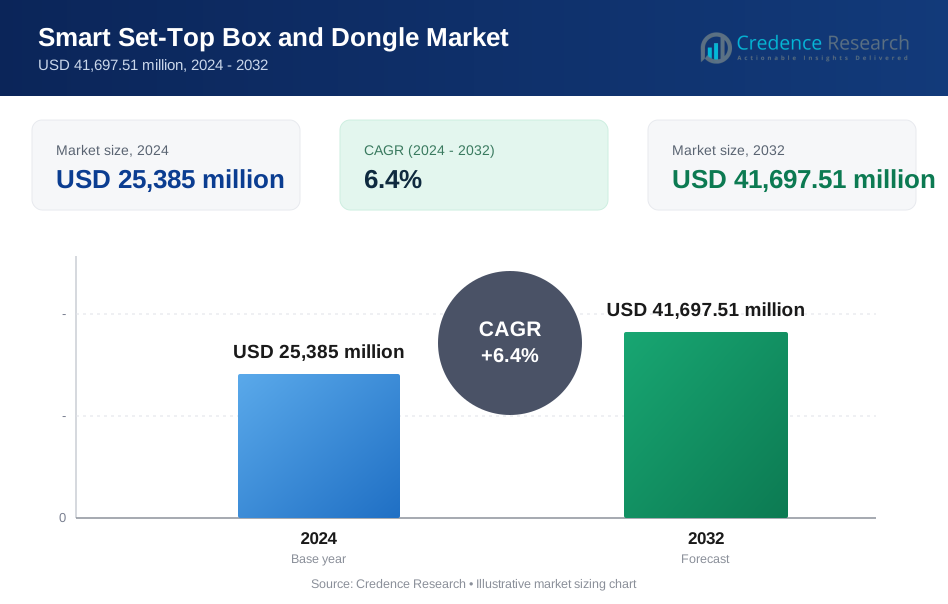
The smart set-top box and dongle market is projected to grow from USD 25,385 million in 2024 to USD 41,697.51 million by 2032, registering a compound annual growth rate (CAGR) of 6.4% during the forecast period.
The smart set-top box and dongle market is driven by the increasing adoption of streaming services, advancements in internet connectivity, and the growing demand for personalized entertainment experiences. Consumers are shifting from traditional cable to over-the-top (OTT) platforms, which offer flexibility and diverse content. Technological advancements, including integration with AI and IoT, enhance user experience through features like voice control, content recommendations, and smart home connectivity. Rising disposable income and the proliferation of smart TVs further fuel market growth. Additionally, trends such as 4K and 8K video support, compact device designs, and affordability attract a broader consumer base. Key market players are focusing on innovative product launches and strategic partnerships to gain a competitive edge. However, challenges like data privacy concerns and compatibility issues with legacy systems may limit adoption. Nonetheless, the market is poised for robust growth, supported by ongoing digital transformation and increasing consumer preference for seamless entertainment solutions.
The smart set-top box and dongle market exhibits significant geographical variation, with North America leading in market share due to advanced infrastructure, widespread OTT adoption, and the presence of major players like Roku and Amazon. Asia-Pacific is the fastest-growing region, driven by increasing internet penetration, rising disposable incomes, and a growing middle class in countries like China and India. Key players in the market include Google, Samsung, Amazon, Roku, Xiaomi, and NVIDIA, which drive innovation with features such as 4K/8K support, AI integration, and voice control. Companies like ZTE, Skyworth, and Netgem focus on cost-effective solutions tailored to regional demands. The competitive landscape reflects a mix of global giants and regional players striving to capture the evolving consumer preferences in both mature and emerging markets.
Market Drivers
Increasing Adoption of Over-the-Top (OTT) Platforms
The growing preference for over-the-top (OTT) platforms is a significant driver of the smart set-top box and dongle market. Consumers increasingly seek flexible, on-demand entertainment options over traditional cable and satellite services. For instance, the Federal Communications Commission (FCC) report highlights that OTT platforms provide diverse content libraries, live streaming capabilities, and the convenience of access across multiple devices. This shift in viewing behavior is compelling households to adopt smart set-top boxes and dongles that enable seamless streaming of high-quality content. The demand is further amplified by the rise of exclusive original content offered by major OTT providers, making these devices indispensable for modern entertainment.
Advancements in Internet Connectivity
The proliferation of high-speed internet connectivity, including the expansion of 5G networks, is fueling the growth of the smart set-top box and dongle market. Faster internet speeds enable uninterrupted streaming of high-definition (HD), 4K, and even 8K video content. Improved broadband penetration, especially in emerging markets, ensures a wider audience can access these devices. For instance, a report by the International Telecommunication Union (ITU), the advancements in internet connectivity are significantly contributing to the smart set-top box and dongle market's growth. Furthermore, the integration of Wi-Fi 6 technology in smart devices enhances connectivity and supports multiple users in a household, making these devices more appealing to consumers.
Integration of Smart Technologies
The integration of artificial intelligence (AI) and Internet of Things (IoT) technologies is revolutionizing the functionality of smart set-top boxes and dongles. Features like voice-controlled interfaces, personalized content recommendations, and smart home connectivity are enhancing the user experience. For example, Samsung Electronics has integrated AI and IoT technologies in their smart set-top boxes to offer intuitive controls and seamless interaction with devices and smart home accessories, enhancing performance and user experience. These advancements not only add convenience but also make these devices central to the growing smart home ecosystem.
Rising Disposable Income and Consumer Preferences
Growing disposable incomes and changing consumer preferences are driving demand for smart entertainment devices. Consumers are willing to invest in premium devices that offer superior features and enhanced user experiences. For instance, a report by the United Nations Conference on Trade and Development (UNCTAD), these economic and consumer trends are significantly influencing the growth of the smart set-top box and dongle market. Additionally, the trend of upgrading to smart TVs and home theater systems complements the adoption of smart set-top boxes and dongles, making them a crucial component of modern entertainment setups.
Market Trends
Growth in 4K and 8K Streaming Capabilities
One of the prevailing trends in the smart set-top box and dongle market is the increasing adoption of devices that support 4K and 8K streaming capabilities. For instance, Amazon's Fire TV Stick 4K Max, an offering from the multinational conglomerate Amazon Inc., supports 4K UHD, Dolby Vision, HDR, and HDR10+ streaming, allowing users to experience cinematic visuals at home. As consumers demand higher video quality, manufacturers are equipping devices with advanced hardware and software to deliver ultra-high-definition content. This trend is further bolstered by the availability of 4K and 8K content on leading streaming platforms like Netflix, YouTube, and Disney+, and the growing penetration of 4K-enabled televisions. Enhanced visual experiences are becoming a key selling point, encouraging more consumers to upgrade their existing devices.
Compact and Portable Designs
The demand for compact and portable devices is shaping the design strategies in the market. For instance, Google’s Chromecast with Google TV, from the tech giant Alphabet Inc., is a compact, dongle-like device that plugs directly into the TV's HDMI port and offers a sleek, minimalist design. Smart dongles like this have gained significant traction due to their lightweight and easy-to-use nature. These devices offer plug-and-play functionality, making them ideal for consumers seeking convenient streaming solutions. The trend toward minimalist designs ensures seamless integration with modern home entertainment systems without adding clutter, aligning with the aesthetic preferences of tech-savvy users.
Integration of Voice and AI Technologies
Voice-controlled functionalities and AI-driven features are rapidly becoming standard in smart set-top boxes and dongles. For instance, the Apple TV 4K (2nd generation) from Apple Inc., exemplifies this trend by featuring Siri voice control, enabling users to search for content, control smart home devices, and more through voice commands. AI technology further enhances user experience through personalized content recommendations and predictive analysis of viewing preferences. This integration not only improves functionality but also increases the appeal of these devices among tech enthusiasts and smart home adopters.
Focus on Energy Efficiency
Energy efficiency is an emerging trend as manufacturers strive to meet environmental standards and consumer preferences for sustainable solutions. For instance, the Roku Express 4K+, developed by Roku Inc., is a perfect example of a device designed with energy efficiency in mind. It incorporates low-power components and energy-saving modes, reducing the device's overall energy consumption. This focus not only reduces operational costs for consumers but also aligns with global initiatives toward reducing carbon footprints, making these devices environmentally friendly.
Market Challenges Analysis
Competition from Smart TVs
One of the significant challenges in the smart set-top box and dongle market is the increasing competition from smart TVs. Modern smart TVs are equipped with advanced operating systems and integrated streaming capabilities, effectively reducing the need for additional devices like set-top boxes and dongles. As smart TV adoption continues to grow, particularly in developed and emerging markets, the standalone demand for these devices faces considerable pressure. Consumers often prefer an all-in-one solution that simplifies their entertainment setup and offers seamless functionality. This trend poses a challenge for manufacturers to differentiate their products by integrating unique features, enhancing user experience, and justifying their value proposition in an increasingly competitive and technologically advanced landscape. Many consumers rely on high-speed internet for a seamless streaming experience, and inadequate infrastructure can severely restrict access to online content. This disparity in connectivity can prevent potential customers from fully utilizing smart set-top boxes and dongles, thereby limiting market growth in these regions.
Data Privacy and Compatibility Concerns
Data privacy and compatibility issues remain critical challenges in the smart set-top box and dongle market. Consumers are increasingly cautious about data collection practices, potential security vulnerabilities, and unauthorized access associated with connected devices. Addressing these concerns necessitates significant investment by manufacturers in robust encryption, secure software updates, and transparent data management practices, which can drive up production costs. Moreover, ensuring compatibility with a wide range of devices and platforms remains a persistent hurdle. Older televisions, regional content restrictions, and differing hardware standards can limit the functionality and appeal of these devices. To overcome these barriers, companies must prioritize seamless integration, enhance security features, and focus on user-centric designs that cater to diverse consumer needs while addressing evolving regulatory and market expectations. As users engage with various streaming platforms, concerns regarding data privacy and cyber threats become paramount. The risk of unauthorized access to personal information and content piracy can deter consumers from adopting these devices.
Market Segmentation Analysis:
By Feature
The market is witnessing increased segmentation by advanced features, such as 4K/8K resolution support, voice-enabled controls, and integrated artificial intelligence (AI). Devices supporting ultra-high-definition streaming are gaining traction due to the growing availability of high-quality content on platforms like Netflix, Amazon Prime, and Disney+. Voice control functionality, often integrated with virtual assistants such as Alexa, Google Assistant, and Siri, has become a key differentiator, offering consumers enhanced convenience. Additionally, AI-driven content recommendations and predictive analytics cater to the demand for personalized viewing experiences, making such devices more appealing to tech-savvy consumers.
By Product
The product segmentation includes standalone set-top boxes and compact dongles. Set-top boxes remain popular in regions where cable and satellite services coexist with streaming platforms, offering hybrid solutions that cater to diverse viewing habits. Conversely, smart dongles have emerged as a dominant segment, driven by their portability, affordability, and plug-and-play functionality. Dongles such as Amazon Fire Stick, Google Chromecast, and Roku Streaming Stick are particularly favored by younger, mobile users who value flexibility and ease of use. The competition between these products underscores the industry's focus on catering to varied consumer needs while maintaining innovation and affordability.
Segments:
Based on Feature
- Android Operating System
- Linux Operating System
- Memory
- Others
Based on Product
- Dongle
- Smart Set-top Box
Based on Video Quality
- UHD 4K
- Full HD
Based on the Geography:
- North America
- U.S.
- Canada
- Mexico
- Europe
- Germany
- France
- U.K.
- Italy
- Spain
- Rest of Europe
- Asia Pacific
- China
- Japan
- India
- South Korea
- South-east Asia
- Rest of Asia Pacific
- Latin America
- Brazil
- Argentina
- Rest of Latin America
- Middle East & Africa
- GCC Countries
- South Africa
- Rest of the Middle East and Africa
Regional Analysis
North America
North America holds a substantial share of the smart set-top box and dongle market, driven by the region's high adoption of streaming services and advanced consumer technology. The United States dominates this market, supported by the presence of leading players such as Roku, Amazon, and Apple. The proliferation of OTT platforms like Netflix, Hulu, and Disney+ has significantly influenced consumer preferences, encouraging the widespread use of these devices. Furthermore, the region benefits from robust internet infrastructure, including high broadband penetration and the rollout of 5G, which facilitates seamless streaming of 4K and 8K content. North America accounted for 35% of the global market share in 2024, reflecting its advanced technological ecosystem and high consumer spending on smart home and entertainment devices. Additionally, government initiatives promoting digital transformation and the rapid adoption of smart homes further drive the market. The widespread availability of content streaming in multiple languages and genres appeals to diverse consumer demographics. Increasing competition among major brands also pushes innovation, offering devices with enhanced features such as voice control, AI integration, and compact designs, ensuring sustained market dominance. Future growth in the region is expected to be fueled by continued advancements in smart device ecosystems and increasing demand for integrated home automation solutions.
Asia-Pacific
Asia-Pacific represents the fastest-growing market for smart set-top boxes and dongles, driven by rapid digitalization and increasing internet penetration in emerging economies such as China, India, and Southeast Asia. The region's expanding middle-class population, coupled with rising disposable incomes, has fueled the demand for affordable and portable streaming solutions. Local and global players are leveraging this growth by offering cost-effective devices tailored to regional content preferences. China, with its strong manufacturing base and widespread adoption of smart TVs, leads the market, while India shows impressive growth potential due to the rapid rise of OTT platforms and improving broadband accessibility. Asia-Pacific accounted for 28% of the global market share in 2024 and is expected to grow significantly, propelled by the region's young, tech-savvy population and ongoing technological advancements. Furthermore, government investments in digital infrastructure and incentives for foreign manufacturers encourage innovation and market entry. The popularity of regional content and partnerships between OTT platforms and local device manufacturers add momentum, establishing Asia-Pacific as a key contributor to the market’s future growth trajectory. Additionally, increased focus on affordability and locally relevant features ensures widespread adoption across urban and rural segments, driving long-term expansion.
Key Player Analysis
- Skyworth
- Roku
- ZTE
- Amazon
- Xiaomi
- Microsoft
- NVIDIA
- Samsung
- Netgem
Competitive Analysis
The smart set-top box and dongle market is highly competitive, with leading players such as Google, Amazon, Roku, Xiaomi, Samsung, NVIDIA, and Microsoft driving innovation to maintain their market positions. These companies focus on developing feature-rich devices that support advanced functionalities like 4K/8K streaming, AI-driven recommendations, and voice control to enhance user experience. Players like Roku and Amazon emphasize affordability and ease of use, appealing to a broad consumer base, while NVIDIA and Microsoft leverage their technological expertise to offer premium, high-performance devices targeting tech-savvy users. Regional players such as ZTE and Skyworth cater to specific market needs in Asia, offering cost-effective solutions with localized features. For instance, NVIDIA's Shield TV Pro targets tech-savvy users with its high-performance features, including support for 4K HDR streaming, AI upscaling, and the ability to function as a gaming console. The competition is further intensified by ongoing technological advancements, aggressive pricing strategies, and strategic partnerships with content providers to capture consumer loyalty and expand market reach.
Recent Developments
- In August 2024, Reliance ,unveiled JioTV+ and JioTV OS, with the latter serving as the software platform that powers the JioTV Set-Top Box, featuring 4K HDR support.
- In October 2024, SEI Robotics, a prominent provider of end-to-end solutions for smart home IoT and Android TV, announced a strategic partnership with DishTV India Limited, a major player in the Indian content distribution sector.
- In April 2024, Vantiva, a leading company in the technology and network services sector, revealed that it had sold nearly 22 million units of set-top boxes featuring Android TV technology to date. The company has continuously upgraded the Android TV technology and secured multiple OTT certifications since its inception.
- In March 2024, ZTE Corporation, a key player in the information technology and communication industry, announced a strategic partnership with Telecab TV + Internet. The collaboration aims to introduce its latest set-top box model, the B866V2FA, to the Brazilian market.
Market Concentration & Characteristics
The smart set-top box and dongle market exhibits a moderately fragmented structure, characterized by the presence of several global leaders alongside regional players. Major companies such as Google, Amazon, and Roku dominate the market, leveraging advanced technology and strong brand recognition to maintain their competitive edge. However, regional players like ZTE and Skyworth contribute to market diversity by catering to localized needs with cost-effective solutions. The market is highly dynamic, driven by rapid technological advancements, including AI integration, 4K/8K streaming support, and voice-enabled functionality. While competition remains intense, market concentration is higher in developed regions like North America and Europe, where established players hold significant shares. Emerging markets in Asia-Pacific, however, reflect a more dispersed landscape with opportunities for new entrants. Overall, the market is characterized by constant innovation, aggressive pricing strategies, and strategic collaborations aimed at expanding consumer reach and capturing evolving entertainment trends.
Report Coverage
The research report offers an in-depth analysis based on Feature, Product, Video Quality and Geography. It details leading market players, providing an overview of their business, product offerings, investments, revenue streams, and key applications. Additionally, the report includes insights into the competitive environment, SWOT analysis, current market trends, as well as the primary drivers and constraints. Furthermore, it discusses various factors that have driven market expansion in recent years. The report also explores market dynamics, regulatory scenarios, and technological advancements that are shaping the industry. It assesses the impact of external factors and global economic changes on market growth. Lastly, it provides strategic recommendations for new entrants and established companies to navigate the complexities of the market.
Future Outlook
- The market is expected to witness robust growth due to increasing adoption of OTT platforms and streaming services globally.
- Technological advancements, including 4K/8K support and AI-driven features, will continue to shape the market's future.
- Growing internet penetration and the rollout of 5G will enhance device functionality and boost demand.
- The Asia-Pacific region is anticipated to emerge as a key growth area due to rising disposable incomes and expanding digital infrastructure.
- Voice control and smart home integration will become standard features, enhancing user convenience and experience.
- Manufacturers will focus on compact, energy-efficient designs to meet evolving consumer preferences and sustainability goals.
- Partnerships between device manufacturers and OTT service providers will strengthen, driving innovation and exclusive offerings.
- Increasing competition from smart TVs will push market players to diversify their product portfolios.
- Affordability and localized content features will drive adoption in emerging markets.
- Data privacy and cybersecurity will remain critical priorities to ensure consumer trust and regulatory compliance.
Request a Free Sample
Fill in your details and we'll send you a free sample report.
- Sample data tables & charts
- Research methodology
Market Dynamics
Increasing Adoption of Over-the-Top (OTT) Platforms
Consumers are shifting from traditional cable and satellite TV to OTT streaming services, driving demand for smart set-top boxes and dongles that enable flexible, on-demand access to diverse content libraries and exclusive original programming.
Advancements in Internet Connectivity
The expansion of high-speed broadband and 5G networks allows for seamless streaming of HD, 4K, and 8K content, making smart set-top boxes and dongles more attractive and accessible, especially in emerging markets with improving infrastructure.
Integration of Smart Technologies
The incorporation of AI and IoT features, such as voice control, personalized recommendations, and smart home connectivity, enhances user experience and positions these devices as central hubs in connected home ecosystems.
Rising Disposable Income and Consumer Preferences
Growing disposable incomes and evolving entertainment preferences are encouraging consumers to invest in premium, feature-rich devices, further supported by the trend toward upgrading to smart TVs and home theater systems.
Growth in 4K and 8K Streaming Capabilities
The increasing availability of ultra-high-definition content and consumer demand for superior visual experiences are pushing manufacturers to launch devices with advanced hardware and software that support 4K and 8K streaming.
Need a Custom Version of This Report?
Tailor the scope, geography, or segments to your exact requirements.
- Custom geography or segment scope
- Direct access to our analyst team
Frequently Asked Questions
What is the current size of the Smart Set-Top Box and Dongle Market?
What factors are driving the growth of the Smart Set-Top Box and Dongle Market?
What are some challenges faced by the Smart Set-Top Box and Dongle Market?
Who are the major players in the Smart Set-Top Box and Dongle Market?
Table of Content
Chapter 1 Market Segmentation
- 1.1 Segmentation Framework
- 1.1.1 Product and Service Classification
- 1.1.2 Application and End-Use Classification
- 1.1.3 Technology and Solution Classification
- 1.1.4 Customer and Distribution Channel Classification
- 1.1.5 Geographic Segmentation
- 1.1.6 Market Segment Definitions and Boundaries
- 1.2 By Feature
- 1.2.1 Android Operating System
- 1.2.2 Linux Operating System
- 1.2.3 Memory
- 1.2.4 Others
- 1.3 By Product
- 1.3.1 Dongle
- 1.3.2 Smart Set-top Box
- 1.4 By Video Quality
- 1.4.1 UHD 4K
- 1.4.2 Full HD
Chapter 2 Introduction
- 2.1 Report Objectives and Scope
- 2.2 Product Definition and Industry Terminology
- 2.3 Market Inclusions and Exclusions
- 2.4 Research Process
- 2.4.1 Primary Research and Expert Interviews
- 2.4.2 Secondary Research and Source Review
- 2.4.3 Top-Down and Bottom-Up Estimation
- 2.4.4 Data Triangulation and Verification
- 2.5 Market Size Measurement Basis
- 2.5.1 2024: USD 25,385 million → 2032: USD 41,697.51 million
- 2.6 Historical and Forecast Reference Periods
- 2.6.1 Base Year: 2024
- 2.6.2 Forecast Period: 2024-2032
- 2.7 Research Assumptions and Limitations
Chapter 3 Executive Summary
- 3.1 Market Snapshot and Key Findings
- 3.2 Base-Year Market Size, 2024
- 3.3 Forecast Market Size, 2032
- 3.4 Revenue and Volume Growth Outlook
- 3.5 Key Demand and Supply Indicators
- 3.6 Leading Market Segments
- 3.7 Fastest-Growing Market Opportunities
- 3.8 Regional Performance Highlights
- 3.9 Technology and Industry Transformation
- 3.10 Competitive Landscape Summary
- 3.11 Analyst View and Strategic Implications
Chapter 4 Global Smart Set-Top Box and Dongle Market Trends and Developments
- 4.1 Historical Industry Development
- 4.2 Recent Market Trends and Developments
- 4.3 Demand and Customer Behavior Trends
- 4.4 Technology and Product Innovation
- 4.5 Artificial Intelligence, Automation and Digitalization
- 4.6 Local Manufacturing and Supply Chain Realignment
- 4.7 Industry Partnerships, Mergers and Acquisitions
- 4.8 Sustainability and Circular Economy Developments
- 4.9 Government and Private Sector Investment Trends
- 4.10 Emerging Business Models and Commercialization
- 4.11 Industry Developments and Announcements
Chapter 5 Global Smart Set-Top Box and Dongle Market Production, Supply and Demand Analysis
- 5.1 Demand Trend and Consumption Analysis
- 5.2 Demand Forecast, 2024-2032
- 5.3 Production and Output Trend
- 5.4 Production and Output Forecast, 2024-2032
- 5.5 Installed Capacity and Capacity Utilization
- 5.6 Company-Wise Production Plants and Statistics
- 5.6.1 Installed Production Capacity
- 5.6.2 Actual Production
- 5.6.3 Planned Capacity and Expansion Targets
- 5.7 Supply Chain Structure and Procurement Trends
- 5.8 Supply-Demand Gap and Bottlenecks
- 5.9 Import Dependence and Sourcing Structure
- 5.10 Contract Manufacturing and Outsourcing
- 5.11 Regional Supply and Demand Concentration
Chapter 6 Global Smart Set-Top Box and Dongle Market Pricing Analysis
- 6.1 Pricing Structure and Measurement
- 6.2 Historical Pricing Trends
- 6.3 Pricing Outlook, 2024-2032
- 6.4 Average Selling Price and Unit Economics
- 6.5 Pricing by Product and Market Segment
- 6.6 Geographic Pricing Differences
- 6.7 Key Input, Energy, Labor and Logistics Costs
- 6.8 Contract Pricing and Purchasing Models
- 6.9 Pricing Sensitivity and Competitive Positioning
- 6.10 Price, Margin and Profitability Implications
Chapter 7 Global Smart Set-Top Box and Dongle Market Dynamics
- 7.1 Market Growth Drivers
- 7.1.1 Demand-Side Drivers
- 7.1.2 Technology and Innovation Drivers
- 7.1.3 Infrastructure and Investment Drivers
- 7.1.4 Regulatory and Policy Drivers
- 7.2 Market Restraints
- 7.2.1 Cost and Affordability Constraints
- 7.2.2 Technology and Adoption Barriers
- 7.2.3 Supply Chain and Operational Constraints
- 7.3 Market Challenges
- 7.3.1 Competitive Pressure and Margin Erosion
- 7.3.2 Skills, Infrastructure and Implementation Gaps
- 7.4 Emerging Market Opportunities
- 7.5 Market Dynamics Impact and Time-Horizon Assessment
Chapter 8 Global Smart Set-Top Box and Dongle Value Chain Analysis
- 8.1 Industry Value Chain Overview
- 8.2 Upstream Suppliers and Critical Inputs
- 8.3 Technology and Component Providers
- 8.4 Manufacturing or Service Delivery
- 8.5 Distribution, Channel Partners and Integrators
- 8.6 Downstream Applications and End Users
- 8.7 Value Addition and Profit Pools
- 8.8 Vertical Integration and Outsourcing
- 8.9 Supplier Concentration and Risk
- 8.10 Supply Chain Localization and Resilience
Chapter 9 Global Smart Set-Top Box and Dongle Market Regulations and Policies
- 9.1 Relevant Laws, Standards and Compliance Frameworks
- 9.2 Product, Service, Safety and Quality Requirements
- 9.3 Government Policies, Incentives and Subsidies
- 9.4 Imports, Exports and Trade Barriers
- 9.5 Public Procurement and Local Content Requirements
- 9.6 Environmental and Sustainability Compliance
- 9.7 Upcoming Policy Changes and Market Implications
Chapter 10 Global Smart Set-Top Box and Dongle Market Hotspots and Opportunities
- 10.1 Market Opportunity Mapping and Growth Hotspots
- 10.2 High-Growth Applications and Customer Groups
- 10.3 Underserved Markets and White-Space Opportunities
- 10.4 Emerging Technology and Product Opportunities
- 10.5 New Capacity and Investment Hotspots
- 10.6 Market Entry and Expansion Opportunities
- 10.7 Distribution and Partnership Opportunities
- 10.8 Near-Term and Long-Term Commercial Potential
- 10.9 Opportunity Attractiveness and Execution Risks
Chapter 11 Global Smart Set-Top Box and Dongle Market Outlook, 2024-2032
- 11.1 Market Size and Analysis
- 11.1.1 Revenue (Market Measurement: 2024: USD 25,385 million → 2032: USD 41,697.51 million)
- 11.1.2 Market Volume and Quantity Sold
- 11.1.3 Historical Market Size
- 11.1.4 Base-Year Market Size, 2024
- 11.2 Market Forecast, 2024-2032
- 11.2.1 Revenue Forecast to 2032
- 11.2.2 Volume Forecast to 2032
- 11.2.3 CAGR and Year-on-Year Growth
- 11.2.4 Incremental Revenue Opportunity
- 11.3 Forecast Assumptions and Scenario Analysis
- 11.3.1 Base-Case Forecast
- 11.3.2 Optimistic and Conservative Scenarios
- 11.3.3 Technology, Pricing and Policy Sensitivities
- 11.4 Market Attractiveness and Growth Outlook
Chapter 12 Global Smart Set-Top Box and Dongle Market Segmentation and Outlook
- 12.1 Segmentation Summary and Market Shares, 2024
- 12.2 Largest and Fastest-Growing Segments
- 12.3 By Feature - Market Size and Forecast, 2024-2032
- 12.3.1 Segment Definition and Scope
- 12.3.2 Historical Market Size
- 12.3.3 Revenue Forecast, 2024-2032
- 12.3.4 Volume Forecast, 2024-2032
- 12.3.5 Base-Year Market Share, 2024
- 12.3.6 Segment CAGR and Growth Drivers
- 12.3.7 Subsegment Market Size and Forecast
- 12.3.7.1 Android Operating System
- 12.3.7.2 Linux Operating System
- 12.3.7.3 Memory
- 12.3.7.4 Others
- 12.3.8 Subsegment Pricing and Adoption Trends
- 12.3.9 Leading Suppliers and Competition
- 12.3.10 Regional Demand and Opportunities
- 12.4 By Product - Market Size and Forecast, 2024-2032
- 12.4.1 Segment Definition and Scope
- 12.4.2 Historical Market Size
- 12.4.3 Revenue Forecast, 2024-2032
- 12.4.4 Volume Forecast, 2024-2032
- 12.4.5 Base-Year Market Share, 2024
- 12.4.6 Segment CAGR and Growth Drivers
- 12.4.7 Subsegment Market Size and Forecast
- 12.4.7.1 Dongle
- 12.4.7.2 Smart Set-top Box
- 12.4.8 Subsegment Pricing and Adoption Trends
- 12.4.9 Leading Suppliers and Competition
- 12.4.10 Regional Demand and Opportunities
- 12.5 By Video Quality - Market Size and Forecast, 2024-2032
- 12.5.1 Segment Definition and Scope
- 12.5.2 Historical Market Size
- 12.5.3 Revenue Forecast, 2024-2032
- 12.5.4 Volume Forecast, 2024-2032
- 12.5.5 Base-Year Market Share, 2024
- 12.5.6 Segment CAGR and Growth Drivers
- 12.5.7 Subsegment Market Size and Forecast
- 12.5.7.1 UHD 4K
- 12.5.7.2 Full HD
- 12.5.8 Subsegment Pricing and Adoption Trends
- 12.5.9 Leading Suppliers and Competition
- 12.5.10 Regional Demand and Opportunities
- 12.6 Segment Growth Comparison
- 12.7 Segment Attractiveness and Priority Matrix
Chapter 13 Global Smart Set-Top Box and Dongle Geographic Market Outlook, 2024-2032
- 13.1 Regional Market Size and Share, 2024
- 13.2 Regional Market Forecast, 2024-2032
- 13.3 Regional Pricing, Production and Demand Differences
- 13.4 North America
- 13.4.1 United States
- 13.4.2 Canada
- 13.4.3 Mexico
- 13.5 Europe
- 13.5.1 Germany
- 13.5.2 France
- 13.5.3 Italy
- 13.5.4 United Kingdom
- 13.5.5 Spain
- 13.5.6 Poland
- 13.5.7 Russia
- 13.5.8 Netherlands
- 13.5.9 Belgium
- 13.5.10 Sweden
- 13.5.11 Denmark
- 13.5.12 Norway
- 13.5.13 Rest of Europe
- 13.6 Asia Pacific
- 13.6.1 China
- 13.6.2 India
- 13.6.3 Japan
- 13.6.4 South Korea
- 13.6.5 Thailand
- 13.6.6 Indonesia
- 13.6.7 Vietnam
- 13.6.8 Malaysia
- 13.6.9 Australia
- 13.6.10 Rest of Asia Pacific
- 13.7 Latin America
- 13.7.1 Brazil
- 13.7.2 Argentina
- 13.7.3 Colombia
- 13.7.4 Chile
- 13.7.5 Rest of Latin America
- 13.8 Middle East
- 13.8.1 Saudi Arabia
- 13.8.2 United Arab Emirates
- 13.8.3 Turkey
- 13.8.4 Israel
- 13.8.5 Iran
- 13.8.6 Rest of the Middle East
- 13.9 Africa
- 13.9.1 South Africa
- 13.9.2 Egypt
- 13.9.3 Nigeria
- 13.9.4 Morocco
- 13.9.5 Rest of Africa
- 13.10 Regional Investment, Policy and Supply Chain Differences
- 13.11 Regional Competitive Landscape
- 13.12 Geographic Growth Hotspots
Chapter 14 Global Smart Set-Top Box and Dongle Technology, Innovation and Sustainability Outlook
- 14.1 Technology Landscape and Maturity
- 14.2 Product, Process and Service Innovation
- 14.3 AI, Automation and Digital Tools in the Industry
- 14.4 Technology Adoption and Performance Benchmarking
- 14.5 Innovation Pipeline and R&D Investment
- 14.6 Patent and Intellectual Property Trends
- 14.7 Energy Efficiency and Resource Management
- 14.8 Sustainability, Recycling and Circularity
- 14.9 Technology Roadmap, 2024-2032
- 14.10 Risks of Obsolescence and Technology Substitution
Chapter 15 Global Smart Set-Top Box and Dongle Market Key Strategic Imperatives
- 15.1 Growth and Market Entry Priorities
- 15.2 High-Return Products and Segments
- 15.3 Pricing, Profitability and Cost Optimization
- 15.4 Technology Investment and Product Differentiation
- 15.5 Supply Chain Localization and Resilience
- 15.6 Distribution and Customer Acquisition
- 15.7 Partnership, Acquisition and Capacity Strategy
- 15.8 Regional Expansion Priorities
- 15.9 Short-, Medium- and Long-Term Actions
Chapter 16 Competition Outlook
- 16.1 Industry Competition Characteristics
- 16.2 Market Structure and Concentration
- 16.3 Market Share and Competitive Positioning, 2024
- 16.4 Company-Wise Revenue and Product Benchmarking
- 16.5 Production and Service Capacity Benchmarking
- 16.6 Technology, Pricing and Differentiation
- 16.7 Regional Footprint and Distribution Strength
- 16.8 Mergers, Acquisitions and Strategic Alliances
- 16.9 New Entrants and Competitive Threats
- 16.10 Porter's Five Forces and Industry Attractiveness
- 16.11 Competitive Outlook, 2024-2032
Chapter 17 Company Profiles
- 17.1 Company Coverage and Selection Criteria
- 17.2 Google
- 17.2.1 Business Description
- 17.2.2 Company Ownership and Geographic Presence
- 17.2.3 Product and Service Portfolio
- 17.2.4 Manufacturing and Operating Footprint
- 17.2.5 Production Capacity and Expansion Plans
- 17.2.6 Financial Performance and Investment
- 17.2.7 Market Share and Competitive Position
- 17.2.8 Technology and Innovation Capabilities
- 17.2.9 Strategic Alliances or Partnerships
- 17.2.10 Recent Developments
- 17.2.11 Growth Strategy and Outlook
- 17.3 Amazon
- 17.4 Roku
- 17.5 Samsung
- 17.6 Xiaomi
- 17.7 NVIDIA
- 17.8 Microsoft
- 17.9 ZTE
- 17.10 Skyworth
- 17.11 Netgem
- 17.12 Other Relevant Market Participants
Note: Every listed company is profiled on the structure shown under the first company. The company list is preliminary and may change based on research findings, market developments, data availability and client requirements.
Chapter 18 Disclaimer
- 18.1 Research and Forecast Disclaimer
- 18.2 Data Source and Estimation Limitations
Note: The depth of individual sections depends on data availability for this market. Volume, capacity, trade and other unit-based metrics are included where applicable.

