
Market Overview
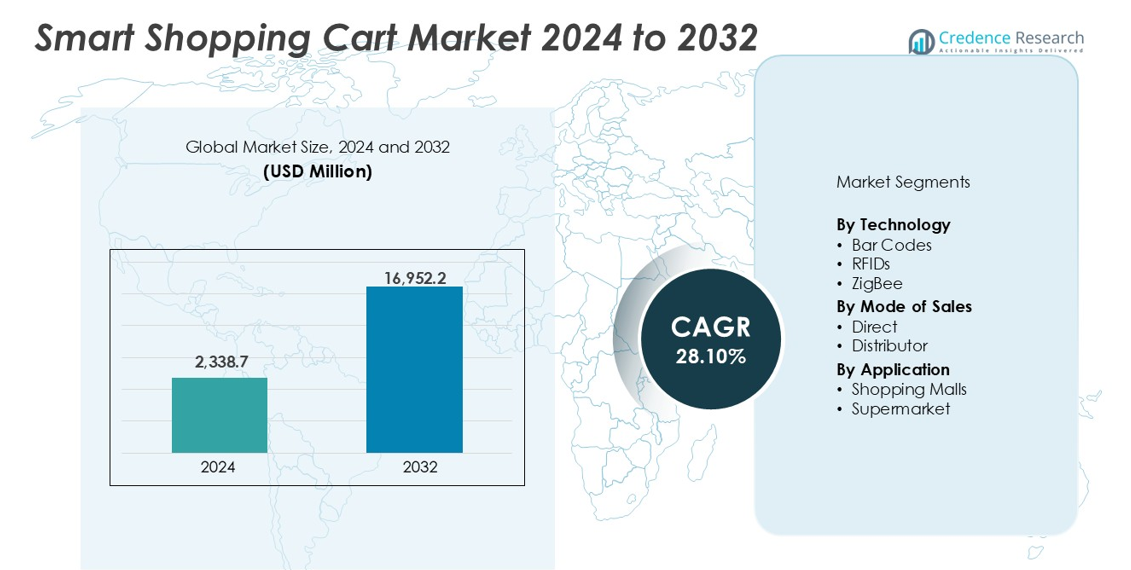
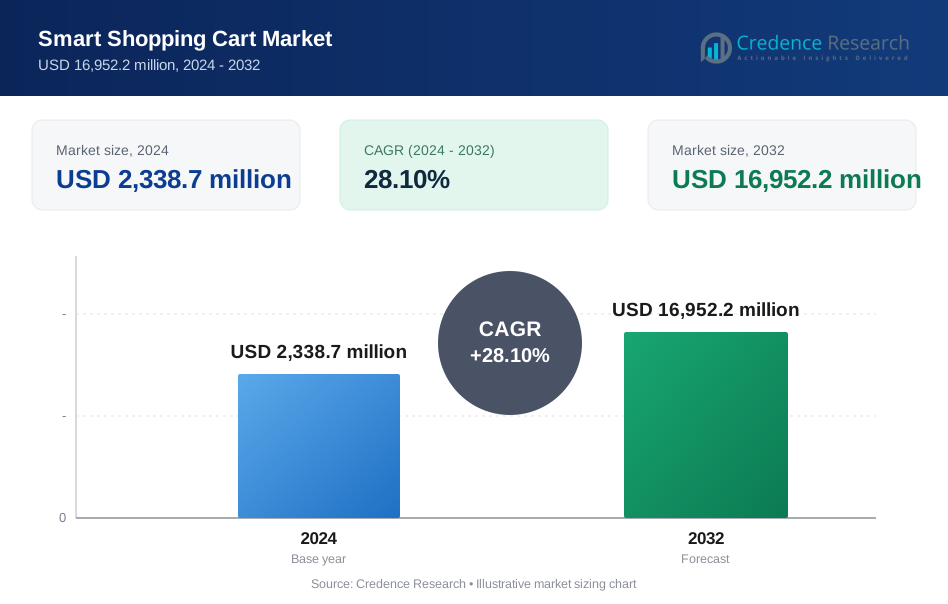
The Smart Shopping Cart Market was valued at USD 2,338.7 million in 2024 and is projected to reach USD 16,952.2 million by 2032, growing at a CAGR of 28.10% during the forecast period (2024–2032).
| REPORT ATTRIBUTE | DETAILS |
|---|---|
| Historical Period | 2020-2023 |
| Base Year | 2024 |
| Forecast Period | 2025-2032 |
| Smart Shopping Cart Market Size 2024 | USD 2,338.7 million |
| Smart Shopping Cart Market, CAGR | 28.10% |
| Smart Shopping Cart Market Size 2032 | USD 16,952.2 million |
The Smart Shopping Cart market is led by major players such as AiFi Inc., Caper Inc., Fujitsu Limited, IBM Corporation, Microsoft Corporation, SAP SE, Cust2mate Ltd., Grabango Co., and Walmart Inc. These companies dominate through advanced AI, IoT, and computer vision technologies that enhance automated checkout and data-driven retail management. North America remains the leading region, accounting for 34% of the global market share in 2024, driven by strong technology adoption and large retail networks. Europe and Asia-Pacific follow, supported by expanding smart retail infrastructure and increasing investments in digital transformation across supermarkets and hypermarkets.
Market Insights
- The Smart Shopping Cart market was valued at USD 2,338.7 million in 2024 and is projected to reach USD 16,952.2 million by 2032, growing at a CAGR of 28.10% during the forecast period.
- Key market drivers include rising adoption of AI, IoT, and RFID technologies that enhance operational efficiency, automate checkout, and improve customer convenience.
- Market trends show increasing demand for contactless shopping, predictive analytics integration, and smart retail expansion in supermarkets and hypermarkets, with the supermarket segment holding 67% share in 2024.
- The competitive landscape features companies such as AiFi Inc., Caper Inc., Fujitsu Limited, IBM, Microsoft, and Cust2mate Ltd., focusing on partnerships and real-time data platforms to enhance customer experience.
- North America leads with 34% market share, followed by Europe at 27% and Asia-Pacific at 28%, driven by strong retail digitalization and expanding smart shopping infrastructure.
Market Segmentation Analysis:
By Technology
The RFID segment dominated the Smart Shopping Cart market in 2024, accounting for over 52% of the market share. RFID technology enables real-time item tracking, faster billing, and reduced checkout time, improving operational efficiency for retailers. Its seamless integration with IoT and AI platforms enhances inventory visibility and reduces human error. Bar code technology remains cost-effective for smaller retailers, while ZigBee offers reliable wireless communication for advanced, interconnected retail environments. Growing investment in smart retail infrastructure continues to strengthen RFID adoption globally.
- For instance, in April 2024, Amazon announced it was removing its "Just Walk Out" technology from all Amazon Fresh grocery stores in the U.S. and replacing it with the Dash Cart, a "smart shopping cart".
By Mode of Sales:
The direct sales segment led the market with a share exceeding 60% in 2024, driven by large-scale retailers and technology partners seeking customized smart cart solutions. Direct sales allow vendors to offer integrated hardware–software packages tailored to client needs, ensuring better data security and performance monitoring. Distributors play a key role in expanding reach across small and medium retail chains, particularly in emerging markets. Increasing retailer preference for vendor-managed services and end-to-end implementation boosts the direct sales channel’s dominance.
- For instance, Fujitsu did collaborate with AEON Retail, deploying AI-based video analysis and other retail technology solutions across a number of stores, including a 2021 deployment of an AI-powered operations system in 76 stores.
By Application:
Supermarkets emerged as the leading application segment, capturing around 67% of the global market share in 2024. The strong growth stems from higher foot traffic, large product assortments, and the need to reduce checkout congestion. Smart carts equipped with digital payment systems and product recommendation displays enhance customer engagement and basket value. Shopping malls are gradually adopting the technology to improve shopper convenience and streamline retail operations. Rising demand for contactless shopping and automation further accelerates smart cart adoption in supermarkets worldwide.
Key Growth Drivers
Rising Adoption of Automated Retail Technologies
The growing integration of automation, artificial intelligence, and Internet of Things (IoT) in retail environments is a major driver of the Smart Shopping Cart market. Retailers are adopting smart carts equipped with sensors, RFID scanners, and image recognition systems to automate billing and enhance operational efficiency. These technologies enable real-time inventory tracking, reduce checkout time, and improve customer convenience. Large retailers are deploying AI-driven analytics to understand shopping behavior and personalize promotions. The demand for automation to minimize labor dependency and optimize in-store management continues to accelerate market adoption globally.
- For instance, Walmart announced the expansion of an AI-powered logistics platform for its supply chain. Walmart tested digital shelf labels in some stores, which use a mobile app to instantly update prices and give associates more time to assist customers.
Expanding Supermarket and Hypermarket Networks
The global expansion of supermarkets and hypermarkets significantly supports smart shopping cart demand. These large retail formats require efficient systems to handle high customer volumes and diverse product ranges. Smart carts simplify product scanning, reduce queue times, and provide instant digital payment options, enhancing overall customer satisfaction. Retail chains are prioritizing digital transformation to attract tech-savvy consumers and streamline inventory management. The increasing establishment of organized retail infrastructure, particularly in Asia-Pacific and the Middle East, is creating substantial opportunities for smart cart integration across modern retail stores.
- For instance, Carrefour, operated by Majid Al Futtaim in the UAE, has launched various AI-powered initiatives to enhance the in-store experience, including pilot programs for AI-powered, checkout-free stores.
Growing Consumer Preference for Contactless Shopping
Consumer inclination toward contactless shopping experiences has surged since the pandemic, driving smart cart adoption. Shoppers increasingly favor solutions that minimize human contact, reduce waiting times, and ensure secure payments. Smart shopping carts equipped with touchless payment modules and self-checkout interfaces meet these expectations. Retailers benefit from enhanced customer retention and reduced operational bottlenecks. The integration of digital wallets, QR-based billing, and loyalty programs into smart carts further promotes seamless shopping. Rising awareness of hygiene, combined with the convenience of automated transactions, continues to fuel the adoption of these intelligent systems.
Key Trends & Opportunities
Integration of Artificial Intelligence and Predictive Analytics
AI-driven smart carts represent a major trend in the retail sector, providing data-driven insights and personalized recommendations. Retailers are leveraging predictive analytics to optimize inventory planning and understand purchasing patterns. Smart carts can analyze customer journeys, suggest complementary products, and deliver targeted promotions in real time. These features not only improve sales but also strengthen customer engagement. With increasing data availability and advanced analytics tools, retailers are adopting AI-powered smart carts to enhance the overall in-store experience and support strategic decision-making in pricing and marketing.
- For instance, Amazonintegrated AI-based predictive systems into its Dash Cart technology, which uses computer vision and sensor fusion to identify items and offer product recommendations based on a customer's shopping list, past purchases, and store-specific promotions.
Expansion of Smart Retail Ecosystems in Emerging Markets
Emerging economies are presenting vast opportunities for smart shopping cart manufacturers due to rapid urbanization and rising disposable incomes. Governments and private investors are supporting smart city projects and digital retail transformation. Retailers in countries such as India, Brazil, and Indonesia are modernizing stores to integrate IoT-enabled systems and enhance shopping convenience. The shift from traditional retail to organized formats is boosting technology adoption. Local partnerships and affordable product innovations are helping vendors tap into these high-growth markets, creating long-term opportunities for smart cart penetration.
Key Challenges
High Initial Investment and Integration Costs
The high upfront cost of smart shopping cart systems remains a critical challenge for widespread adoption. Implementing RFID technology, AI-driven software, and wireless communication systems demands significant capital expenditure. Small and medium retailers often struggle to justify these investments due to tight profit margins and uncertain ROI. Additionally, integrating smart carts with existing point-of-sale systems and store networks can be complex and time-consuming. The lack of standardized communication protocols between hardware and software further increases deployment challenges, especially across diverse retail environments.
Data Privacy and Security Concerns
Smart shopping carts rely heavily on customer data collection and wireless communication, raising concerns about data privacy and cybersecurity. Retailers must ensure compliance with regulations such as GDPR and CCPA to protect sensitive user information. Unauthorized data access, tracking misuse, or payment breaches can damage consumer trust and lead to financial losses. Maintaining secure data transmission between smart carts, store servers, and cloud platforms remains a technical challenge. Addressing these security vulnerabilities through robust encryption, authentication protocols, and transparent data policies is essential for long-term market sustainability.
Regional Analysis
North America:
North America dominated the Smart Shopping Cart market in 2024, holding about 34% of the global market share. The region’s growth is driven by high adoption of advanced retail technologies and strong investments by supermarket chains such as Walmart and Kroger. Widespread use of RFID, AI, and IoT-enabled systems enhances checkout efficiency and customer analytics. The U.S. remains the key contributor, supported by well-developed retail infrastructure and consumer preference for contactless shopping. Continuous innovation and early technology integration maintain North America’s leadership in the global market.
Europe:
Europe accounted for around 27% of the market share in 2024, supported by growing retail digitalization and sustainability-focused smart store initiatives. Countries such as Germany, the U.K., and France are rapidly adopting smart carts to improve store efficiency and customer convenience. Retailers prioritize eco-friendly materials and energy-efficient smart carts to align with EU sustainability goals. Increasing investments in AI-based retail systems and enhanced payment integration strengthen market penetration. European supermarkets are focusing on smart shopping solutions to attract tech-savvy customers and optimize in-store operations.
Asia-Pacific:
Asia-Pacific held about 28% of the global market share in 2024, emerging as the fastest-growing regional market. Expansion of organized retail, rising disposable income, and rapid urbanization fuel adoption. Countries such as China, Japan, South Korea, and India are investing heavily in smart retail and IoT-based automation. Local and international retailers are integrating digital carts to enhance operational efficiency and customer experience. The region’s growing smartphone penetration and preference for cashless transactions further drive market growth. Government support for smart infrastructure accelerates technology implementation across urban shopping centers.
Latin America:
Latin America represented around 7% of the Smart Shopping Cart market in 2024, supported by gradual modernization of retail networks. Brazil, Mexico, and Chile lead regional adoption, driven by expanding supermarket chains and rising demand for seamless shopping experiences. Retailers are adopting cost-effective RFID and barcode-based carts to enhance checkout convenience. Growing middle-class populations and improving digital infrastructure are creating favorable conditions for technology integration. However, high deployment costs and limited awareness still restrain widespread adoption, though market growth remains steady with ongoing retail transformation.
Middle East & Africa:
The Middle East & Africa accounted for about 4% of the global market share in 2024, showing gradual progress in smart retail adoption. The United Arab Emirates and Saudi Arabia lead with heavy investments in smart store technologies under national digital transformation agendas. Modern shopping malls and hypermarkets are integrating intelligent cart systems to enhance shopper experience. Africa’s growth is emerging, supported by expanding urban retail spaces and improving internet access. Although market penetration remains low, increasing government and private retail investments are expected to boost regional adoption through 2032.
Market Segmentations:
By Technology
- Bar Codes
- RFIDs
- ZigBee
By Mode of Sales
- Direct
- Distributor
By Application
- Shopping Malls
- Supermarket
By Geography
- North America
- U.S.
- Canada
- Europe
- Germany
- France
- U.K.
- Italy
- Spain
- Rest of Europe
- Asia Pacific
- China
- Japan
- India
- South Korea
- South-east Asia
- Rest of Asia Pacific
- Latin America
- Brazil
- Mexico
- Rest of Latin America
- Middle East & Africa
- GCC Countries
- South Africa
- Rest of Middle East and Africa
Competitive Landscape
The Smart Shopping Cart market is moderately consolidated, with a mix of global technology firms and specialized retail automation providers. Leading players such as AiFi Inc., Caper Inc., Fujitsu Limited, IBM Corporation, Microsoft Corporation, and Walmart Inc. dominate through strong R&D capabilities and established retail partnerships. Companies like Cust2mate Ltd., Veeve Inc., Grabango Co., and Focal Systems Inc. focus on AI-powered solutions that integrate machine vision and real-time analytics to enhance checkout automation. Strategic collaborations, mergers, and product innovations remain central to maintaining competitive advantage. Major players are expanding partnerships with supermarket chains and deploying pilot projects across North America, Europe, and Asia-Pacific to strengthen market presence. Continuous development of IoT-based systems, self-checkout technologies, and data-driven retail platforms is shaping the competition. Price differentiation, user experience, and integration flexibility are key factors influencing vendor positioning in this rapidly evolving market.
Key Player Analysis
- AiFi Inc.
- Caper Inc.
- Cart Technologies, LLC
- Cust2mate Ltd.
- Focal Systems Inc.
- Fujitsu Limited
- Grabango Co.
- IMAGR Limited
- International Business Machines Corporation (IBM)
- Microsoft Corporation
- Retail AI, Inc.
- SAP SE
- SK Telecom Co., Ltd.
- Standard Cognition Corp.
- Tracxpoint, Inc.
- V-Mark Enterprise Limited
- Veeve Inc.
- Walmart Inc.
- Wanzl India Pvt. Ltd.
- ZooZ by PayU Company
Recent Developments
- In December 2024, Walmart Chile and Shopic implemented AI-Powered Smart Carts to transform Retail industry in Chile.
- In April 2024, Amazon announced plans to offer Dash carts to third-party grocers, expanding the checkout technology beyond Amazon grocery banners and Whole Foods Market stores.
- In January 2024, Microsoft announced new generative AI and data solutions across the shopper journey, offering copilot experiences through Microsoft Cloud for Retail.
- In May 2023, Grocery smart cart provider Shopic announced a partnership with the Microsoft Experience Center EMEA in Munich to showcase its innovative smart cart technology.
- In September 2022, Seattle startup Veeve announced the expansion of its checkout-free, smart shopping-cart technology from grocery stores to big-box retailers with a new attachment that effectively turns regular shopping carts into smart carts
Report Coverage
The research report offers an in-depth analysis based on Technology, Mode of Sales, End-User and Geography. It details leading market players, providing an overview of their business, product offerings, investments, revenue streams, and key applications. Additionally, the report includes insights into the competitive environment, SWOT analysis, current market trends, as well as the primary drivers and constraints. Furthermore, it discusses various factors that have driven market expansion in recent years. The report also explores market dynamics, regulatory scenarios, and technological advancements that are shaping the industry. It assesses the impact of external factors and global economic changes on market growth. Lastly, it provides strategic recommendations for new entrants and established companies to navigate the complexities of the market.
Future Outlook
- The market will continue to grow rapidly, supported by expanding smart retail and automation demand.
- Retailers will adopt AI, IoT, and RFID-enabled carts to enhance operational efficiency and customer engagement.
- Increasing preference for contactless and cashless shopping will strengthen smart cart integration in supermarkets.
- Software-driven analytics will provide personalized shopping experiences and real-time inventory management.
- Partnerships between technology providers and retail chains will accelerate large-scale smart cart deployment.
- High initial costs will encourage manufacturers to develop cost-efficient and modular smart cart systems.
- Data security advancements will improve consumer trust in automated shopping solutions.
- Asia-Pacific will emerge as the fastest-growing region, while North America will retain market leadership.
- Supermarkets will remain the dominant end-user segment, supported by high foot traffic and automation needs.
- Continuous R&D and digital transformation in retail will drive innovation and long-term market sustainability.
Request a Free Sample
Fill in your details and we'll send you a free sample report.
- Sample data tables & charts
- Research methodology
Need a Custom Version of This Report?
Tailor the scope, geography, or segments to your exact requirements.
- Custom geography or segment scope
- Direct access to our analyst team
Frequently Asked Questions
What is the current market size for the Smart Shopping Cart market, and what is its projected size in 2032?
At what Compound Annual Growth Rate is the Smart Shopping Cart market projected to grow between 2025 and 2032?
Which is the leading region of the market for a smart shopping cart?
What are the key drivers for the growth of the smart shopping cart market?
Which is the major segment in the smart shopping cart market by technology?
Which is the major segment in the smart shopping cart market by application?
Table of Content
Chapter 1. Report Introduction
- 1.1 Report Description & Purpose
- 1.1.1 Report Title & Market Definition
- 1.1.2 Unique Selling Propositions (USP) & Key Differentiators
- 1.1.3 Value Proposition for Stakeholders
- 1.2 Research Objectives
- 1.2.1 Market Sizing Objectives (Volume & Revenue) (Volume Where Applicable)
- 1.2.2 Segmentation Objectives
- 1.2.3 Competitive Intelligence Objectives
- 1.2.4 Forecast & Scenario Objectives
- 1.3 Report Scope
- 1.3.1 Smart Shopping Cart Scope – Segments & Subsegments Covered
- 1.3.2 Geographic Scope – Regions & Countries Covered
- 1.3.3 Historical Period, Base Year & Forecast Period (2024; forecast to 2032)
- 1.3.4 Inclusions & Exclusions
- 1.4 Industry Classification & Applicable Codes
- 1.5 Currency, Measurement Units & Valuation Basis
- 1.6 Target Stakeholders
- 1.7 Limitations & Assumptions
Chapter 2. Executive Summary
- 2.1 Global Smart Shopping Cart Market Snapshot
- 2.1.1 Market Size – Historical (2024) & Forecast (2024-2032) (2024: USD 2,338.7 million → 2032: USD 16,952.2 million)
- 2.1.2 Volume & Revenue – Global Totals (Volume Where Applicable)
- 2.1.3 Key Market Highlights – Top Five Facts
- 2.2 Smart Shopping Cart Market Segmentation Snapshot
- 2.2.1 Market Split by Region – 2024 vs. 2032
- 2.3 Competitive Snapshot
- 2.3.1 Top 10 Players by Revenue Share – 2024
- 2.3.2 Top 10 Players by Volume Share – 2024 (Volume Where Applicable)
- 2.3.3 Recent Strategic Developments (18-Month Summary)
- 2.4 Key Investment Highlights & Strategic Conclusions
Chapter 3. Smart Shopping Cart Market Dynamics & Industry Analysis
- 3.1 Market Overview & Context
- 3.1.1 Smart Shopping Cart Market Position in the Broader Industry Value Chain
- 3.1.2 Demand Structure & Purchasing Dynamics
- 3.1.3 Market Maturity & Development Stage by Region
- 3.2 Smart Shopping Cart Market Drivers
- 3.3 Smart Shopping Cart Market Restraints & Challenges
- 3.4 Smart Shopping Cart Market Opportunities
- 3.5 Porter's Five Forces Analysis
- 3.5.1 Threat of New Entrants
- 3.5.2 Bargaining Power of Suppliers
- 3.5.3 Bargaining Power of Buyers
- 3.5.4 Threat of Substitutes
- 3.5.5 Competitive Rivalry – Intensity Assessment
- 3.6 Smart Shopping Cart Value Chain Analysis
- 3.6.1 Upstream – Key Inputs, Resources & Suppliers
- 3.6.1.1 Key Input/Resource 1
- 3.6.1.2 Key Input/Resource 2
- 3.6.1.3 Key Input/Resource 3
- 3.6.2 Midstream – Core Operations & Value Creation
- 3.6.2.1 Operating Model & Process Overview
- 3.6.2.2 Key Operating Locations & Capabilities by Company
- 3.6.3 Downstream – Market Channels & End Users
- 3.6.3.1 Direct Sales & Customer Engagement Channels
- 3.6.3.2 Indirect Sales, Intermediaries & Partner Channels
- 3.6.4 Value Chain Profitability Analysis
- 3.6.1 Upstream – Key Inputs, Resources & Suppliers
- 3.7 PESTEL Analysis
- 3.7.1 Political Factors
- 3.7.2 Economic Factors
- 3.7.3 Social Factors
- 3.7.4 Technological Factors
- 3.7.5 Environmental Factors
- 3.7.6 Legal Factors
- 3.8 Smart Shopping Cart Supply Chain Analysis
- 3.8.1 Critical Input & Resource Availability Risk Assessment
- 3.8.2 Supplier & Operational Concentration Risk (Geographic Exposure)
- 3.8.3 Supply & Service Disruption Impact Analysis
- 3.9 Regulatory & Policy Landscape
Note: The regulatory and policy landscape section covers regulations based on their applicability to the market, Smart Shopping Cart category, geography, and scope of the study. Only regulatory frameworks with a material impact on operations, compliance, trade, sustainability, or market access are analyzed in detail.
Chapter 4. Key Investment Pockets & Opportunity Analysis
- 4.1 Smart Shopping Cart Market Attractiveness Analysis
- 4.1.1 By Region – Investment Attractiveness Matrix (Market Size × CAGR)
- 4.2 Absolute Revenue Growth Opportunity
- 4.2.1 By Region – Absolute Revenue Growth Through 2032
- 4.3 Incremental Demand Opportunity
- 4.3.1 By Region – Incremental Demand Through 2032
- 4.3.2 Segment – Incremental Demand
- 4.4 Emerging Submarket Opportunity Deep Dive (Subject to Applicability)
- 4.5 Priority Market Opportunity Scorecards
- 4.5.1 United States
- 4.5.2 Europe
- 4.5.3 Asia
- 4.5.4 Middle East & Africa
Note: Priority market opportunity scorecards reflect the geographic scope and strategic relevance of the study. Listed markets are indicative and may be adapted to the industry.
Chapter 5. Smart Shopping Cart Cross-Border Trade & Market Access Analysis
- 5.1 International Trade & Cross-Border Activity Overview
- 5.1.1 Global Export Value by Country (2024)
- 5.1.2 Global Export Volume by Country (2024) (Volume Where Applicable)
- 5.1.3 Global Import Value by Country (2024)
- 5.1.4 Global Import Volume by Country (2024) (Volume Where Applicable)
- 5.1.5 Net Trade Balance by Country (2024)
- 5.2 Export Analysis – Segment
- 5.2.1 Category 1 (Applicable Classification Code)
- 5.2.2 Category 2 (Applicable Classification Code)
- 5.2.3 Category 3 (Applicable Classification Code)
- 5.2.4 Category 4 (Applicable Classification Code)
- 5.2.5 Category 5 (Applicable Classification Code)
- 5.3 Import Analysis – Segment
- 5.3.1 Category 1 (Applicable Classification Code)
- 5.3.2 Category 2 (Applicable Classification Code)
- 5.3.3 Category 3 (Applicable Classification Code)
- 5.3.4 Category 4 (Applicable Classification Code)
- 5.3.5 Category 5 (Applicable Classification Code)
- 5.4 Cross-Border Pricing & Transaction Benchmarks
- 5.4.1 Export Pricing – Segment & Country
- 5.4.2 Import Pricing – Segment & Source Country
- 5.4.3 Price Trends (2024)
- 5.5 Key Cross-Border Trade & Delivery Routes
- 5.5.1 Cross-Border Trade/Delivery Route 1
- 5.5.2 Cross-Border Trade/Delivery Route 2
- 5.5.3 Cross-Border Trade/Delivery Route 3
- 5.5.4 Cross-Border Trade/Delivery Route 4
- 5.5.5 Cross-Border Trade/Delivery Route 5
- 5.6 Trade Policy & Market Access Impact Assessment
- 5.6.1 Tariff & Non-Tariff Barriers
- 5.6.2 Regional Trade & Economic Integration Frameworks
- 5.6.3 Bilateral & Multilateral Trade Agreements
- 5.6.4 Cross-Border Operating, Licensing & Localization Requirements
Note: This chapter applies where cross-border trade or delivery is relevant to Smart Shopping Cart. Goods, services, and digital offerings are assessed using applicable classifications and transaction measures. Import-export volumes, trade balances, and route analyses are included only where meaningful to the market.
Chapter 6. Competitive Landscape & Company Benchmarking
- 6.1 Smart Shopping Cart Market Concentration & Structure
- 6.1.1 Herfindahl-Hirschman Index (HHI) – vs. 2024
- 6.1.2 Leading, Mid-Sized & Emerging Player Structure
- 6.1.3 Global, Regional & Local Player Dynamics
- 6.2 Smart Shopping Cart Market Share Analysis – 2024
- 6.2.1 Global Revenue Share by Company
- 6.2.2 Global Volume Share by Company (Volume Where Applicable)
- 6.2.3 Regional Revenue Share
- 6.2.4 Market Share Evolution ( vs. 2024)
- 6.2.5 Company Market Share by Key Segment
- 6.2.6 Company Market Share by Customer Group
- 6.3 Operating Scale, Capacity & Infrastructure Analysis
- 6.3.1 Global Operating Scale & Supply Capacity
- 6.3.2 Resource Utilization & Operating Efficiency
- 6.3.3 Output, Service Delivery & Activity Metrics
- 6.3.4 Operating Footprint & Infrastructure Map
- 6.3.5 Planned Operational & Capacity Expansion
- 6.4 Smart Shopping Cart Competitive Benchmarking Matrix
- 6.4.1 Revenue, Growth, Profitability & Operating Metric Comparison
- 6.4.2 Channel Revenue Mix
- 6.4.3 Geographic Revenue Exposure
- 6.4.4 R&D Intensity
- 6.4.5 Sustainability Maturity
- 6.5 Strategic Developments in Smart Shopping Cart (Last 24 Months)
- 6.5.1 Mergers, Acquisitions & Divestments
- 6.5.2 New Products, Services & Solutions in Smart Shopping Cart
- 6.5.3 Operational & Infrastructure Expansions
- 6.5.4 Strategic Alliances, Joint Ventures & Partnerships
- 6.5.5 Distribution Expansion & Market Entry
- 6.5.6 Sustainability & ESG Initiatives
- 6.6 Competitive Strategy Mapping
- 6.6.1 Leader, Challenger, Follower & Niche Classification
- 6.6.2 Pricing Strategy Comparison
- 6.6.3 Channel Strategy Matrix
Note: Strategic developments are included based on their materiality and the availability of reliable information.
Chapter 7. Global Smart Shopping Cart Market – By Sales & Delivery Channel
- 7.1 Segment Overview
- 7.1.1 Volume & Revenue Split by Channel (2024 & 2032) (Volume Where Applicable)
- 7.1.2 Channel Mix Evolution (2024-2032)
Chapter 8. Regional Market Analysis – Global Overview
- 8.1 Global Regional Overview
- 8.1.1 Regional Volume Share (Volume Where Applicable)
- 8.1.2 Regional Revenue Share
- 8.1.3 Regional Volume by Region (Volume Where Applicable)
- 8.1.4 Regional Revenue by Region
- 8.1.5 Regional Forecast Through 2032
- 8.2 Cross-Regional Segment Analysis
- 8.2.1 By Sales & Delivery Channel
- 8.2.2 By Competitive Positioning & Price Tier
Chapter 9. North America Smart Shopping Cart Market
- 9.1 United States
- 9.2 Canada
- 9.3 Mexico
Chapter 10. Europe Smart Shopping Cart Market
- 10.1 Germany
- 10.2 France
- 10.3 Italy
- 10.4 United Kingdom
- 10.5 Spain
- 10.6 Poland
- 10.7 Russia
- 10.8 Netherlands
- 10.9 Belgium
- 10.10 Sweden
- 10.11 Denmark
- 10.12 Norway
- 10.13 Rest of Europe
Chapter 11. Asia Pacific Smart Shopping Cart Market
- 11.1 China
- 11.2 India
- 11.3 Japan
- 11.4 South Korea
- 11.5 Thailand
- 11.6 Indonesia
- 11.7 Vietnam
- 11.8 Malaysia
- 11.9 Australia
- 11.10 Rest of Asia Pacific
Chapter 12. Latin America Smart Shopping Cart Market
- 12.1 Brazil
- 12.2 Argentina
- 12.3 Colombia
- 12.4 Chile
- 12.5 Rest of Latin America
Chapter 13. Middle East Smart Shopping Cart Market
- 13.1 Saudi Arabia
- 13.2 United Arab Emirates
- 13.3 Turkey
- 13.4 Israel
- 13.5 Iran
- 13.6 Rest of the Middle East
Chapter 14. Africa Smart Shopping Cart Market
- 14.1 South Africa
- 14.2 Egypt
- 14.3 Nigeria
- 14.4 Morocco
- 14.5 Rest of Africa
Chapter 15. Smart Shopping Cart Company Profiles
- 15.1 [Company 01]
- 15.1.1 Company Overview
- 15.1.2 Key Management Personnel
- 15.1.3 Products & Services Portfolio
- 15.1.4 Financial Performance
- 15.1.5 Key Market Focus & Geographic Presence
- 15.1.6 Recent Developments & Strategic Initiatives
Note: The company profile list is preliminary and may change based on research findings, market developments, data availability, and client requirements.
Chapter 16. Appendices
- Appendix A – List of Abbreviations & Acronyms
- Appendix B – Industry Classification Code Reference – Full Series
- Appendix C – Supply, Output & Operating Capacity Data Tables
- Appendix D – End-Use & Demand Base Tables
- Appendix E – Demand, Adoption & Usage Assumptions
- Appendix F – Pricing & Revenue Metric Reference Tables
- Appendix G – Company Operations & Infrastructure Database
- Appendix H – Cross-Border Trade & Activity Data Tables (Where Applicable)
- Appendix I – Regulatory Summary Tables
- Appendix J – Primary Research Participant List (Anonymized)
- Appendix K – Primary Research Questionnaire Framework
- Appendix L – Data Sources & Bibliography
- Appendix M – Market Size Divergence & Source Comparison
Chapter 17. Research Methodology
- 17.1 Research Framework & Philosophy
- 17.2 Secondary Research – Sources, Hierarchy & Data Extraction
- 17.3 Data Modeling – Bottom-Up & Top-Down Market Sizing
- 17.4 Primary Research – Stakeholder Framework, LOI & Sample Sizes
- 17.5 Forecast Methodology – Regression, Scenario & Sensitivity Analysis
- 17.6 Quality Control – Four-Layer Validation Framework
- 17.7 Limitations & Standard Assumptions
- 17.8 Disclaimer
