Home » Chemicals » Staple Fibers Market

Staple Fibers Market By Type (Cellulosic, Cotton, Polyester, Others); By Application (Automotive, Apparel, Construction, Home Furnishing, Personal Care and Hygiene, Others) – Growth, Share, Opportunities & Competitive Analysis, 2024 – 2032

Report ID: 9716 | Report Format : Excel, PDF

Market Overview

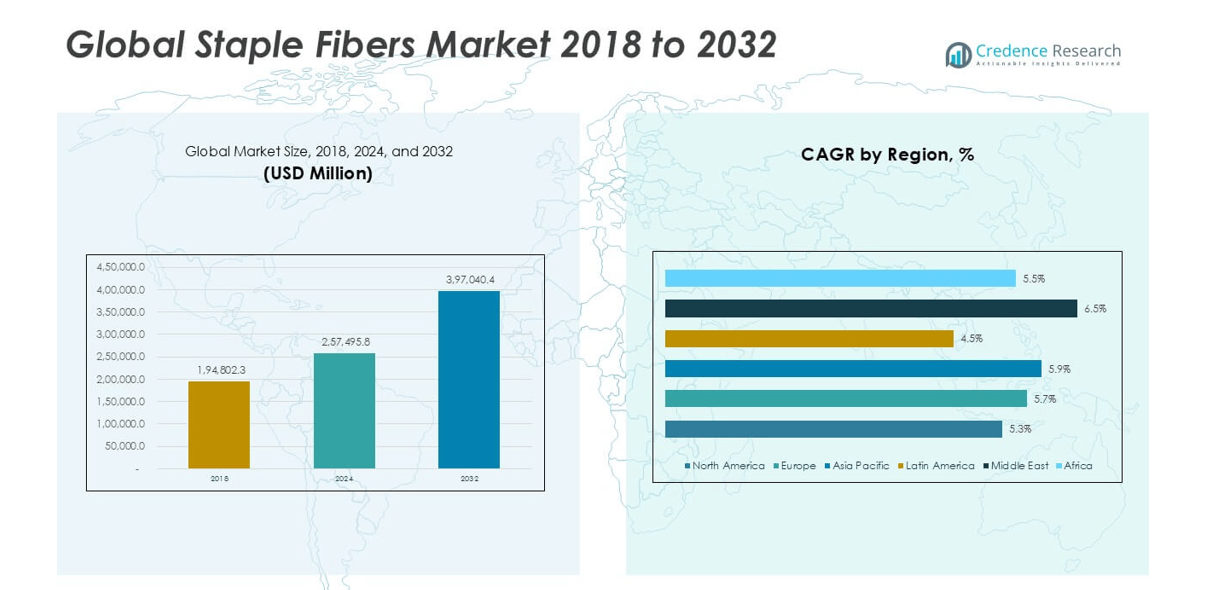
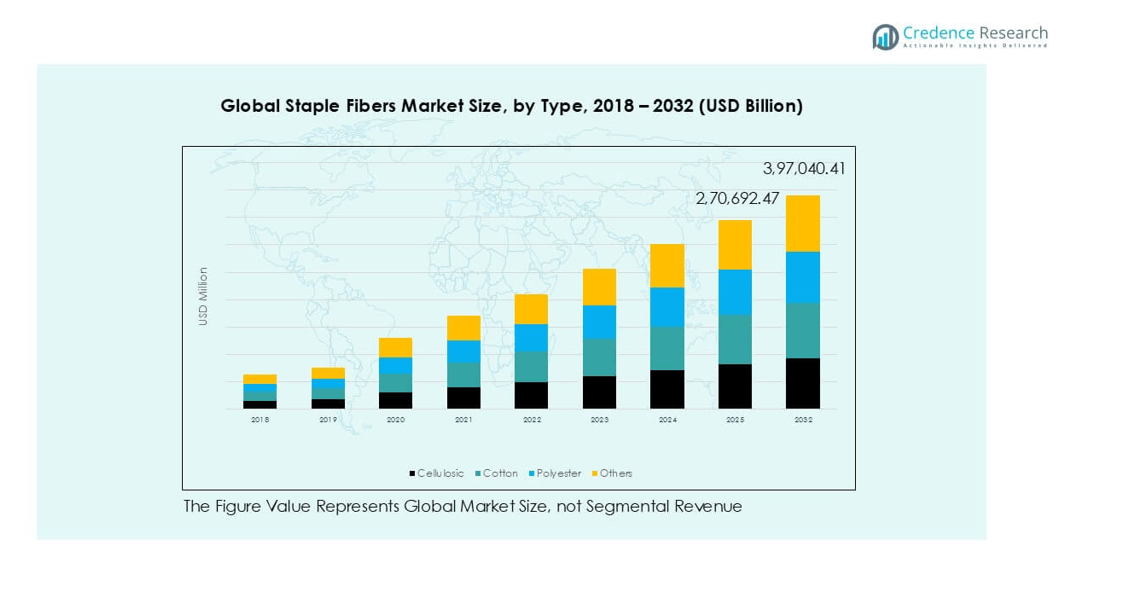
Global Staple Fibers market size was valued at USD 1,94,802.3 million in 2018 to USD 2,57,495.8 million in 2024 and is anticipated to reach USD 3,97,040.4 million by 2032, at a CAGR of 5.62% during the forecast period.

REPORT ATTRIBUTE DETAILS
Historical Period 2020-2023
Base Year 2024
Forecast Period 2025-2032
Staple Fibers Market Size 2024 USD 2,57,495.8 million
Staple Fibers Market, CAGR 5.62%
Staple Fibers Market Size 2032 USD 3,97,040.4 million


The Global Staple Fibers market features strong participation from Tongkun Group, Indorama Ventures, Zhejiang Hengsheng Chemical Fiber, Toray Industries, Alpek, Reliance Industries, China Petroleum and Chemical Corporation, and Hubei Botao Synthetic Fiber. These players compete through scale, vertical integration, and cost leadership, mainly in polyester staple fibers. Asia Pacific leads the market with an exact 34.2% share, driven by large textile manufacturing bases in China and India. Europe follows with a 26.7% share, supported by sustainable textile demand and automotive nonwovens. North America holds a 21.9% share, backed by apparel, hygiene, and industrial textiles. Leading companies expand capacity and invest in recycled fibers to strengthen regional dominance.

Staple Fibers Market size

Market Insights

  • The Global Staple Fibers market reached USD 257,495.8 million in 2024 and is projected to grow at a CAGR of 5.62% through 2032, driven by steady textile and nonwoven demand.
  • Rising apparel production and home furnishing consumption drive fiber usage, with polyester holding the largest segment share due to durability, cost efficiency, and large-scale availability.
  • Sustainability trends support growth in recycled polyester and cellulosic fibers, while nonwoven applications expand across hygiene, automotive interiors, and construction textiles.
  • The competitive landscape remains moderately consolidated, led by large integrated producers in Asia, focusing on capacity expansion, cost leadership, and recycled fiber portfolios.
  • Asia Pacific leads with a 34.2% regional share, followed by Europe at 26.7% and North America at 21.9%, while Latin America, the Middle East, and Africa show steady growth from apparel, infrastructure, and hygiene segments.

Access crucial information at unmatched prices!

Request your sample report today & start making informed decisions powered by Credence Research Inc.!

Download Sample

Market Segmentation Analysis:

By Type

The Type segment shows polyester as the dominant sub-segment, holding the largest market share. Polyester benefits from high durability, cost efficiency, and large-scale global production. Apparel, home textiles, and industrial uses drive steady polyester demand. Cellulosic fibers gain traction due to sustainability focus and biodegradability advantages. Cotton maintains stable demand from apparel and home furnishing sectors. Others, including acrylic and nylon, serve niche industrial and blended applications. Rising textile output, recycling initiatives, and performance fabric demand continue to support segment growth.

  • For instance, Indorama Ventures operates more than 140 manufacturing sites worldwide and produces over 14 million tons of polyester and fiber products annually, supporting large-scale staple fiber supply.

By Application

The Application segment is led by apparel, accounting for the highest market share. Apparel demand rises due to fast fashion growth and expanding middle-class populations. Staple fibers support yarn spinning, fabric blending, and mass garment production. Home furnishing follows, supported by housing growth and interior upgrades. Automotive use expands through nonwoven interiors and insulation materials. Construction demand grows for insulation and reinforcement products. Personal care and hygiene benefits from nonwoven wipes and absorbent products. Lifestyle changes and urbanization remain key growth drivers.

  • For instance, Toray Industries supplies staple fibers to global apparel brands and operates textile production facilities capable of processing hundreds of thousands of tons of fibers per year across Asia.

Key Growth Drivers

Growth of Global Apparel and Textile Production

Rising apparel demand strongly drives the Global Staple Fibers market. Expanding urban populations increase daily clothing consumption worldwide. Fast fashion cycles shorten product lifetimes and raise fiber usage volumes. Manufacturers prefer staple fibers for yarn spinning flexibility. Polyester staple fibers dominate due to durability and cost control. Cotton fibers maintain relevance in comfort-focused garments. Blended yarns increase fabric performance and price efficiency. Asia-Pacific leads textile production with large-scale mills. Export-oriented economies invest in capacity upgrades and automation. Government incentives support textile parks and fiber processing zones. E-commerce apparel sales further accelerate production volumes. Seasonal fashion refreshes increase raw fiber procurement frequency. Brand focus on consistent quality supports standardized fiber demand. Textile recycling initiatives also increase staple fiber reuse. These combined factors sustain long-term consumption growth across global markets.

  • For instance, the China National Textile and Apparel Council (CNTAC) reports China operates approximately 40,000 textile and apparel manufacturing enterprises (above a designated size), processing over 45 million tons of staple fibers annually for domestic and export apparel production.

Rising Demand from Home Furnishing and Interior Textiles

Home furnishing growth acts as a major demand driver. Residential construction boosts bedding and upholstery consumption. Urban housing projects raise demand for curtains and carpets. Staple fibers support bulk fabric production at controlled costs. Polyester fibers lead due to stain resistance and strength. Cotton fibers support premium bed linen and comfort products. Blended fabrics improve durability for frequent household use. Hospitality sector expansion supports large-volume textile purchases. Hotels prefer easy-care and long-life fiber materials. Replacement cycles for home textiles remain short. Lifestyle upgrades increase spending on interior aesthetics. E-commerce platforms improve access to home textile products. Manufacturers increase capacity for nonwoven furnishing fabrics. These drivers strengthen stable, recurring demand across furnishing applications globally.

  • For instance, Welspun India operates integrated home textile facilities with an annual bath linen capacity of 90,000 metric tons and a bed linen capacity of 108 million meters, relying heavily on polyester and cotton staple fibers.

Expansion of Nonwoven Applications Across Industries

Nonwoven growth strongly supports staple fiber demand. Personal care products require absorbent fiber structures. Hygiene products use staple fibers for softness and strength. Automotive interiors use nonwovens for insulation and acoustics. Construction applications rely on fiber mats for reinforcement. Infrastructure projects increase use of geotextiles. Polyester staple fibers dominate nonwoven manufacturing lines. High-volume production supports cost efficiency and scalability. Lightweight materials improve fuel efficiency in vehicles. Medical disposables increase healthcare-driven fiber consumption. Aging populations raise hygiene product usage rates. Emerging markets invest in local nonwoven production plants. Technology improvements enhance fiber bonding and performance. These factors expand industrial adoption across diverse end-use sectors.

Staple Fibers Market share

Key Trends & Opportunities

Shift Toward Sustainable and Recycled Staple Fibers

Sustainability trends create strong market opportunities. Brands commit to lower environmental impact targets. Recycled polyester fibers gain wider commercial acceptance. Circular textile programs encourage fiber reuse. Manufacturers invest in chemical and mechanical recycling. Cellulosic fibers benefit from renewable feedstock usage. Eco-label certifications influence buyer preferences. Governments tighten regulations on textile waste management. Consumer awareness supports demand for greener products. Apparel brands promote recycled fiber collections. Automotive firms adopt recycled materials for interiors. Supply chains prioritize traceable and compliant fibers. Technology advances improve recycled fiber quality. Sustainability positioning enhances brand value and long-term competitiveness.

  • For instance, Indorama Ventures produces recycled polyester staple fibers using post-consumer PET bottles, recycling more than 100 billion bottles cumulatively into textile-grade fibers for apparel and automotive applications.

Growth Opportunities in Emerging Economies

Emerging markets present strong expansion opportunities. Rising incomes increase apparel and home textile spending. Population growth supports long-term consumption volumes. Local textile manufacturing capacity continues to expand. Governments support domestic fiber production investments. Infrastructure development boosts construction textile demand. Automotive production growth increases nonwoven fiber usage. Cost-competitive labor attracts global textile sourcing. Retail expansion improves product availability in rural areas. Private investments modernize spinning and processing units. Regional trade agreements support export competitiveness. Fiber producers benefit from proximity to textile hubs. Demand diversification reduces reliance on mature markets. These dynamics create attractive growth pathways for industry players.

Key Challenges

Volatility In Raw Material Prices

Raw material price fluctuation remains a key challenge. Polyester fiber prices depend on crude oil trends. Cotton prices fluctuate due to weather conditions. Supply disruptions affect production planning stability. Cost volatility pressures manufacturer profit margins. Small producers face limited hedging capabilities. Price swings complicate long-term supply contracts. Buyers resist frequent price adjustments. Inventory management becomes more complex for mills. Input cost uncertainty affects capital investment decisions. Blended fiber strategies partially reduce exposure risks. Recycling inputs also face collection cost variability. Managing price volatility requires strong procurement planning. This challenge continues to impact operational predictability across markets.

Environmental Regulations And Waste Management Pressures

Environmental compliance poses another major challenge. Governments impose stricter emission and waste norms. Fiber manufacturing requires high energy and water usage. Wastewater treatment raises operating costs for producers. Synthetic fiber disposal attracts regulatory scrutiny. Microfiber pollution concerns affect polyester acceptance. Compliance investments increase capital expenditure needs. Smaller firms struggle with regulatory adaptation costs. Certification requirements lengthen product approval timelines. Export markets demand strict environmental documentation. Recycling infrastructure remains uneven across regions. Technology upgrades require skilled workforce availability. Balancing compliance and profitability remain difficult. These pressures influence strategic planning across the staple fibers industry.

Regional Analysis

North America

North America held about 21.9% market share in 2018, with a value of USD 42,642.22 million. The region shows steady expansion at a CAGR of 5.3%. Demand comes from apparel, home furnishing, and automotive nonwovens. Polyester staple fibers dominate due to cost control and performance stability. The United States leads regional consumption through large textile and hygiene markets. Recycling initiatives support fiber reuse adoption. Technological upgrades improve yarn efficiency. By 2024, the market reached USD 55,383.67 million. Growth remains stable through 2032, supported by industrial textiles and consumer spending recovery.

Europe

Europe accounted for nearly 26.7% market share in 2018, valued at USD 52,070.64 million. The region grows at a CAGR of 5.7%. Apparel and home textiles drive consistent fiber demand. Sustainability regulations accelerate recycled and cellulosic fiber usage. Western Europe leads consumption, while Eastern Europe supports manufacturing growth. Automotive interiors increase nonwoven fiber demand. High-quality textile standards favor blended staple fibers. The market reached USD 69,126.59 million in 2024. Strong policy support for circular textiles sustains long-term growth. Europe is projected to reach USD 107,200.91 million by 2032.

Asia Pacific

Asia Pacific dominated the market with about 34.2% share in 2018, reaching USD 66,680.81 million. The region records a CAGR of 5.9%. China and India lead global textile production volumes. Large spinning capacity supports high staple fiber consumption. Polyester fibers remain the primary choice due to scale efficiency. Apparel exports drive continuous demand growth. Rising middle-class income boosts domestic textile sales. The market reached USD 89,729.93 million in 2024. Infrastructure and automotive production further expand nonwoven usage. Asia Pacific is projected to reach USD 141,624.31 million by 2032.

Latin America

Latin America captured about 10.3% market share in 2018, valued at USD 20,142.55 million. The region grows at a CAGR of 4.5%. Brazil and Mexico lead textile and apparel production. Staple fibers support cost-effective domestic manufacturing. Apparel demand drives the largest application share. Polyester fibers dominate due to durability and availability. Import substitution policies encourage local fiber processing. The market reached USD 25,146.30 million in 2024. Gradual industrial expansion supports steady growth. By 2032, the region is expected to reach USD 35,733.64 million.

Middle East

The Middle East held around 4.3% market share in 2018, valued at USD 8,454.42 million. The region shows the fastest CAGR at 6.5%. Construction and home furnishing textiles drive demand. Infrastructure development supports nonwoven fiber usage. Polyester staple fibers lead due to heat resistance and strength. Gulf countries invest in downstream textile capacity. Import reliance remains high but declining gradually. The market reached USD 11,782.27 million in 2024. Industrial diversification strategies support textile sector growth. By 2032, the market is projected to reach USD 19,415.28 million.

Africa

Africa accounted for about 2.5% market share in 2018, with USD 4,811.62 million value. The region grows at a CAGR of 5.5%. Apparel manufacturing expansion supports staple fiber demand. Local textile hubs emerge in North and East Africa. Polyester fibers dominate due to affordability and supply access. Government programs promote domestic textile production. Rising population supports long-term consumption growth. The market reached USD 6,327.04 million in 2024. Infrastructure and hygiene product demand increase gradually. Africa is projected to reach USD 9,687.79 million by 2032.

Staple Fibers Market segmentation

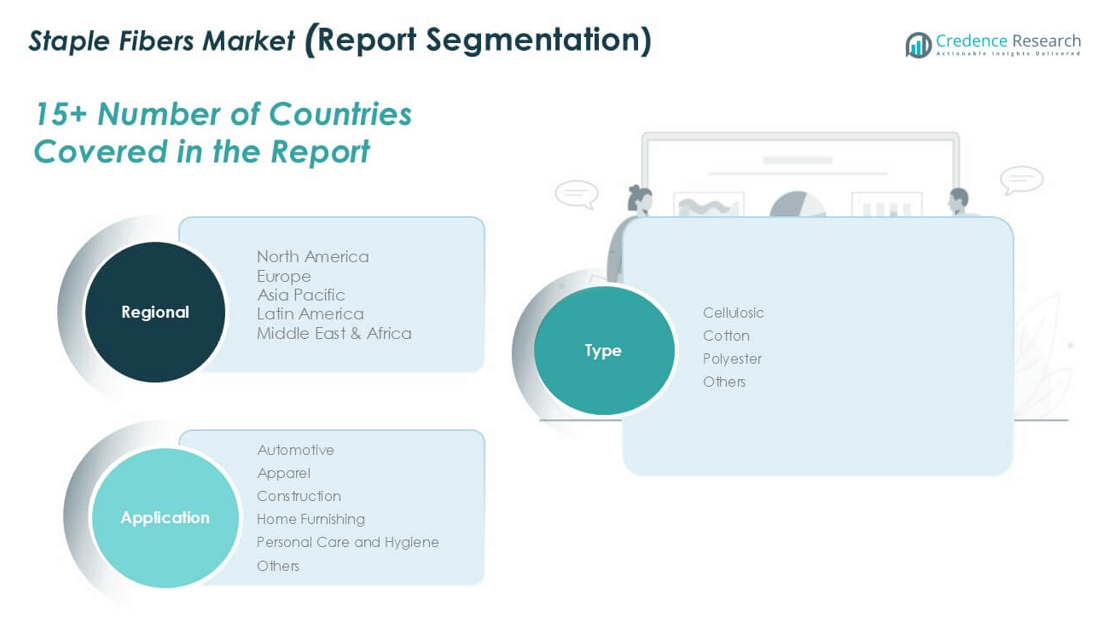
Market Segmentations:

By Type

  • Cellulosic
  • Cotton
  • Polyester
  • Others

By Application

  • Automotive
  • Apparel
  • Construction
  • Home Furnishing
  • Personal Care and Hygiene
  • Others

By Geography

  • North America
    • U.S.
    • Canada
    • Mexico
  • Europe
    • Germany
    • France
    • U.K.
    • Italy
    • Spain
    • Rest of Europe
  • Asia Pacific
    • China
    • Japan
    • India
    • South Korea
    • South-east Asia
    • Rest of Asia Pacific
  • Latin America
    • Brazil
    • Argentina
    • Rest of Latin America
  • Middle East & Africa
    • GCC Countries
    • South Africa
    • Rest of the Middle East and Africa

Competitive Landscape

The competitive landscape of the Global Staple Fibers market remains moderately consolidated, with large integrated producers holding strong positions. Key players compete on scale, cost efficiency, and vertical integration across petrochemicals and textiles. Polyester staple fiber producers dominate through high-capacity plants and global distribution networks. Asian manufacturers benefit from proximity to textile hubs and lower production costs. Companies invest in recycled and sustainable fiber portfolios to meet brand requirements. Capacity expansions focus on high-demand regions in Asia Pacific and the Middle East. Strategic partnerships support downstream integration and stable offtake agreements. Product consistency and supply reliability influence long-term contracts with spinners. Technology upgrades improve fiber quality and energy efficiency. Price competition remains intense in commoditized segments. Leading players strengthen market presence through diversification, sustainability alignment, and regional manufacturing expansion.

Shape Your Report to Specific Countries or Regions & Enjoy 30% Off!

Key Player Analysis

Recent Developments

  • In October 2022, The Teijin Groups fibers converting company, Teijin Frontier Co., Ltd., announced that its core base for polyester fiber manufacturing, Teijin Polyester (Thailand) Limited (TPL), had launched an advanced automated facility for highly efficient production of polyester filaments.

Report Coverage

The research report offers an in-depth analysis based on Type, Application and Geography. It details leading market players, providing an overview of their business, product offerings, investments, revenue streams, and key applications. Additionally, the report includes insights into the competitive environment, SWOT analysis, current market trends, as well as the primary drivers and constraints. Furthermore, it discusses various factors that have driven market expansion in recent years. The report also explores market dynamics, regulatory scenarios, and technological advancements that are shaping the industry. It assesses the impact of external factors and global economic changes on market growth. Lastly, it provides strategic recommendations for new entrants and established companies to navigate the complexities of the market.

Future Outlook

  1. Demand will rise from expanding global apparel and textile production.
  2. Polyester staple fibers will maintain dominance due to cost and performance balance.
  3. Recycled and sustainable fibers will gain wider adoption across applications.
  4. Nonwoven applications will expand in hygiene, automotive, and construction uses.
  5. Asia Pacific will remain the leading production and consumption region.
  6. Capacity expansions will focus on high-growth emerging economies.
  7. Manufacturers will invest in energy-efficient and automated production lines.
  8. Blended fiber products will increase to improve fabric functionality.
  9. Regulatory pressure will accelerate circular textile initiatives.
  10. Strategic partnerships will strengthen supply chain stability and market reach.

CHAPTER NO. 1 : GENESIS OF THE MARKET    

1.1 Market Prelude – Introduction & Scope

1.2 The Big Picture – Objectives & Vision

1.3 Strategic Edge – Unique Value Proposition

1.4 Stakeholder Compass – Key Beneficiaries

CHAPTER NO. 2 : EXECUTIVE LENS

2.1 Pulse of the Industry – Market Snapshot

2.2 Growth Arc – Revenue Projections (USD Million)

2.3. Premium Insights – Based on Primary Interviews

CHAPTER NO. 3 : STAPLE FIBERS MARKET FORCES & INDUSTRY PULSE  

3.1 Foundations of Change – Market Overview
3.2 Catalysts of Expansion – Key Market Drivers
3.2.1 Momentum Boosters – Growth Triggers
3.2.2 Innovation Fuel – Disruptive Technologies
3.3 Headwinds & Crosswinds – Market Restraints
3.3.1 Regulatory Tides – Compliance Challenges
3.3.2 Economic Frictions – Inflationary Pressures
3.4 Untapped Horizons – Growth Potential & Opportunities
3.5 Strategic Navigation – Industry Frameworks
3.5.1 Market Equilibrium – Porter’s Five Forces
3.5.2 Ecosystem Dynamics – Value Chain Analysis
3.5.3 Macro Forces – PESTEL Breakdown

CHAPTER NO. 4 :      KEY INVESTMENT EPICENTER    

4.1 Regional Goldmines – High-Growth Geographies

4.2 Product Frontiers – Lucrative Type Categories

4.3 Application Sweet Spots – Emerging Demand Segments

CHAPTER NO. 5: REVENUE TRAJECTORY & WEALTH MAPPING

5.1 Momentum Metrics – Forecast & Growth Curves

5.2 Regional Revenue Footprint – Market Share Insights

5.3 Segmental Wealth Flow – Type & Application Revenue

CHAPTER NO. 6 : TRADE & COMMERCE ANALYSIS    

6.1.      Import Analysis By Region

6.1.1.    Global Staple Fibers Market Import Revenue By Region

6.2.      Export Analysis By Region

6.2.1.    Global Staple Fibers Market Export Revenue By Region

CHAPTER NO. 7 : COMPETITION ANALYSIS      

7.1.      Company Market Share Analysis

7.1.1.    Global Staple Fibers Market: Company Market Share

7.2.      Global Staple Fibers Market Company Revenue Market Share

7.3.      Strategic Developments

7.3.1.    Acquisitions & Mergers

7.3.2.    New Product Launch

7.3.3.    Regional Expansion

7.4.      Competitive Dashboard

7.5.      Company Assessment Metrics, 2024

CHAPTER NO. 8 : STAPLE FIBERS MARKET – BY TYPE SEGMENT ANALYSIS

8.1.      Staple Fibers Market Overview By Type Segment

8.1.1.    Staple Fibers Market Revenue Share By Type

8.2.      Cellulosic

8.3.      Cotton

8.4.      Polyester

8.5.      Others

CHAPTER NO. 9 : STAPLE FIBERS MARKET – BY APPLICATION SEGMENT ANALYSIS

9.1.      Staple Fibers Market Overview By Application Segment

9.1.1.    Staple Fibers Market Revenue Share By Application

9.2.      Automotive

9.3.      Apparel

9.4.      Construction

9.5.      Home Furnishing

9.6.     Personal Care and Hygiene

9.7.     Others

CHAPTER NO. 10 : STAPLE FIBERS MARKET – REGIONAL ANALYSIS         

10.1.     Staple Fibers Market Overview By Region Segment

10.1.1.  Global Staple Fibers Market Revenue Share By Region

10.1.2.  Regions

10.1.3.  Global Staple Fibers Market Revenue By Region

10.1.4.  Type

10.1.5.  Global Staple Fibers Market Revenue By Type

10.1.6.  Application

10.1.7. Global Staple Fibers Market Revenue By Application

CHAPTER NO. 11 : NORTH AMERICA STAPLE FIBERS MARKET – COUNTRY ANALYSIS

11.1.     North America Staple Fibers Market Overview By Country Segment

11.1.1.  North America Staple Fibers Market Revenue Share By Region

11.2.     North America

11.2.1.  North America Staple Fibers Market Revenue By Country

11.2.2.  Type

11.2.3.  North America Staple Fibers Market Revenue By Type

11.2.4.  Application

11.2.5.  North America Staple Fibers Market Revenue By Application

11.3.     U.S.

11.4.     Canada

11.5.     Mexico

CHAPTER NO. 12 : EUROPE STAPLE FIBERS MARKET – COUNTRY ANALYSIS

12.1.     Europe Staple Fibers Market Overview By Country Segment

12.1.1.  Europe Staple Fibers Market Revenue Share By Region

12.2.     Europe

12.2.1.  Europe Staple Fibers Market Revenue By Country

12.2.2.  Type

12.2.3.  Europe Staple Fibers Market Revenue By Type

12.2.4.  Application

12.2.5.  Europe Staple Fibers Market Revenue By Application

12.3.     UK

12.4.     France

12.5.     Germany

12.6.     Italy

12.7.     Spain

12.8.     Russia

12.9.   Rest of Europe

CHAPTER NO. 13 : ASIA PACIFIC STAPLE FIBERS MARKET – COUNTRY ANALYSIS

13.1.     Asia Pacific Staple Fibers Market Overview By Country Segment

13.1.1.  Asia Pacific Staple Fibers Market Revenue Share By Region

13.2.     Asia Pacific

13.2.1.  Asia Pacific Staple Fibers Market Revenue By Country

13.2.2.  Type

13.2.3.  Asia Pacific Staple Fibers Market Revenue By Type

13.2.4.  Application

13.2.5.  Asia Pacific Staple Fibers Market Revenue By Application

13.3.     China

13.4.     Japan

13.5.     South Korea

13.6.     India

13.7.     Australia

13.8.     Southeast Asia

13.9.     Rest of Asia Pacific

CHAPTER NO. 14 : LATIN AMERICA STAPLE FIBERS MARKET – COUNTRY ANALYSIS

14.1.     Latin America Staple Fibers Market Overview By Country Segment

14.1.1.  Latin America Staple Fibers Market Revenue Share By Region

14.2.     Latin America

14.2.1.  Latin America Staple Fibers Market Revenue By Country

14.2.2.  Type

14.2.3.  Latin America Staple Fibers Market Revenue By Type

14.2.4.  Application

14.2.5.  Latin America Staple Fibers Market Revenue By Application

14.3.     Brazil

14.4.     Argentina

14.5.     Rest of Latin America

CHAPTER NO. 15 : MIDDLE EAST STAPLE FIBERS MARKET – COUNTRY ANALYSIS

15.1.     Middle East Staple Fibers Market Overview By Country Segment

15.1.1.  Middle East Staple Fibers Market Revenue Share By Region

15.2.     Middle East

15.2.1.  Middle East Staple Fibers Market Revenue By Country

15.2.2.  Type

15.2.3.  Middle East Staple Fibers Market Revenue By Type

15.2.4.  Application

15.2.5.  Middle East Staple Fibers Market Revenue By Application

15.3.     GCC Countries

15.4.     Israel

15.5.     Turkey

15.6.     Rest of Middle East

CHAPTER NO. 16 : AFRICA STAPLE FIBERS MARKET – COUNTRY ANALYSIS

16.1.     Africa Staple Fibers Market Overview By Country Segment

16.1.1.  Africa Staple Fibers Market Revenue Share By Region

16.2.     Africa

16.2.1.  Africa Staple Fibers Market Revenue By Country

16.2.2.  Type

16.2.3.  Africa Staple Fibers Market Revenue By Type

16.2.4.  Application

16.2.5.  Africa Staple Fibers Market Revenue By Application

16.3.     South Africa

16.4.     Egypt

16.5.     Rest of Africa

CHAPTER NO. 17 : COMPANY PROFILES

17.1.     Tongkun Group

17.1.2.  Product Portfolio

17.1.3.  Financial Overview

17.1.4.  Recent Developments

17.1.5.  Growth Strategy

17.1.6.  SWOT Analysis

17.2.    Indorama Ventures Public Company Limited

17.3.    Zhejiang Hengsheng Chemical Fiber Co., Ltd.

17.4.    Toray Industries, Inc.

17.5.    Alpek S.A.B. de C.V.

17.6.    Reliance Industries Limited

17.6.    China Petroleum and Chemical Corporation

17.7.    Hubei Botao Synthetic Fiber Co., ltd

17.8.  Other Key Players

Request Free Sample

We prioritize the confidentiality and security of your data. Our promise: your information remains private.

Ready to Transform Data into Decisions?

Request Your Sample Report and Start Your Journey of Informed Choices


Providing the strategic compass for industry titans.

cr-clients-logos

Frequently Asked Question:

What is the current market size for Staple Fibers Market, and what is its projected size in 2032?

The market was valued at USD 257,495.8 million in 2024 and is projected to reach USD 397,040.4 million by 2032.

At what Compound Annual Growth Rate is the Staple Fibers Market projected to grow between 2025 and 2032?

The market is expected to grow at a CAGR of 5.62% during the forecast period.

Who are the major players in this market?

Indorama Ventures Public Company Limited,Zhejiang Hengsheng Chemical Fiber Co., Ltd.,Toray Industries, Inc.,Alpek S.A.B. de C.V., Reliance Industries Limited. are some of the major players in the global market.

What are the primary factors fueling the growth of the Staple Fibers Market?

Growth is driven by rising apparel demand, expanding home furnishing use, and increasing adoption of recycled and sustainable fibers.

Who are the leading companies in the Staple Fibers Market?

Key players include TEIJIN FRONTIER Co. Ltd, Reliance Industries Limited, Toray Industries Inc, Sateri International Co. Ltd, and Indorama Ventures Public Company Limited.

Which region commanded the largest share of the Global Staple Fibers market in 2024?

Asia Pacific led the market with a dominant share, driven by large-scale textile manufacturing in China and India.

About Author

Shweta Bisht

Shweta Bisht

Healthcare & Biotech Analyst

Shweta is a healthcare and biotech researcher with strong analytical skills in chemical and agri domains.

View Profile


Related Reports

Organic Peroxide Market

The Organic peroxide market is projected to grow from USD 1,953 million in 2024 to an estimated USD 2,863.3 million by 2032. The market is expected to register a CAGR of 4.9% from 2024 to 2032.

Organo-Modified Bentonite Market

The Organo modified bentonite market is projected to grow from USD 282.8 million in 2024 to an estimated USD 454.1 million by 2032, registering a compound annual growth rate of 6.1% from 2024 to 2032.

Open Gear Lubricants Market

The Open gear lubricants market is projected to grow from USD 732.9 million in 2024 to USD 987.7 million by 2032. The market is expected to expand at a CAGR of 3.8% from 2024 to 2032.

Non Clinical Polymerase Chain Reaction Market

The Non clinical polymerase chain reaction market was valued at USD 12,100 million in 2024 and is projected to reach USD 16,056.7 million by 2032, registering a CAGR of 3.6% from 2024 to 2032.

Nylon 6 Market

The Nylon 6 market is projected to grow from USD 16,553 million in 2024 to USD 25,154 million by 2032. The market is expected to record a compound annual growth rate of 5.37% from 2024 to 2032.

Magnesium Photoengraving Plate Market

The Global Magnesium Photoengraving Plate Market size was valued at USD 192.15 million in 2018 to USD 268.58 million in 2024 and is anticipated to reach USD 414.40 million by 2032, at a CAGR of 5.19% during the forecast period.

HDPE Blow Molding and Injection Molding Container Market

The HDPE Blow Molding and Injection Molding Container Market is projected to grow from USD 10,490 million in 2024 to USD 14,803.31 million by 2032. The market is expected to expand at a CAGR of 4.4% during the forecast period.

Automotive Adhesive Market

The Global Automotive Adhesive Market size was valued at USD 4,472.30 million in 2018 to USD 6,458.40 million in 2024 and is anticipated to reach USD 9,766.80 million by 2032, at a CAGR of 5.26% during the forecast period.

Pool Water Treatment Chemicals Market

The Pool water treatment chemicals market is projected to grow from USD 1,333 million in 2024 to an estimated USD 1,954.2 million by 2032, at a CAGR of 4.9% during the forecast period.

Polyisobutylene Market

The Polyisobutylene market is projected to grow from USD 2,193 million in 2024 to USD 2,863 million by 2032. The market is expected to expand at a CAGR of 3.39% from 2024 to 2032.

Polyvinylpyrrolidone Market

The Polyvinylpyrrolidone market is projected to grow from USD 2,803 million in 2024 to USD 5,692.2 million by 2032, registering a CAGR of 9.26% during the forecast period.

Polyurea Coatings Market

The Polyurea coating market is projected to grow from USD 1,501 million in 2024 to USD 3,245.5 million by 2032, at a CAGR of 10.12% during the forecast period.

Licence Option

The report comes as a view-only PDF document, optimized for individual clients. This version is recommended for personal digital use and does not allow printing. Use restricted to one purchaser only.
$4999

To meet the needs of modern corporate teams, our report comes in two formats: a printable PDF and a data-rich Excel sheet. This package is optimized for internal analysis. Unlimited users allowed within one corporate location (e.g., regional office).
$6999

The report will be delivered in printable PDF format along with the report’s data Excel sheet. This license offers 100 Free Analyst hours where the client can utilize Credence Research Inc. research team. Permitted for unlimited global use by all users within the purchasing corporation, such as all employees of a single company.
$12999

Report delivery within 24 to 48 hours

Europe

North America

Email

Smallform of Sample request
User Review

Thank you for the data! The numbers are exactly what we asked for and what we need to build our business case.

Materials Scientist
(privacy requested)

User Review

The report was an excellent overview of the Industrial Burners market. This report does a great job of breaking everything down into manageable chunks.

Imre Hof
Management Assistant, Bekaert

cr-clients-logos

Request Sample